
Performance Media
How to Use LinkedIn Matched Audiences
How to Use LinkedIn Matched Audiences
08 min read
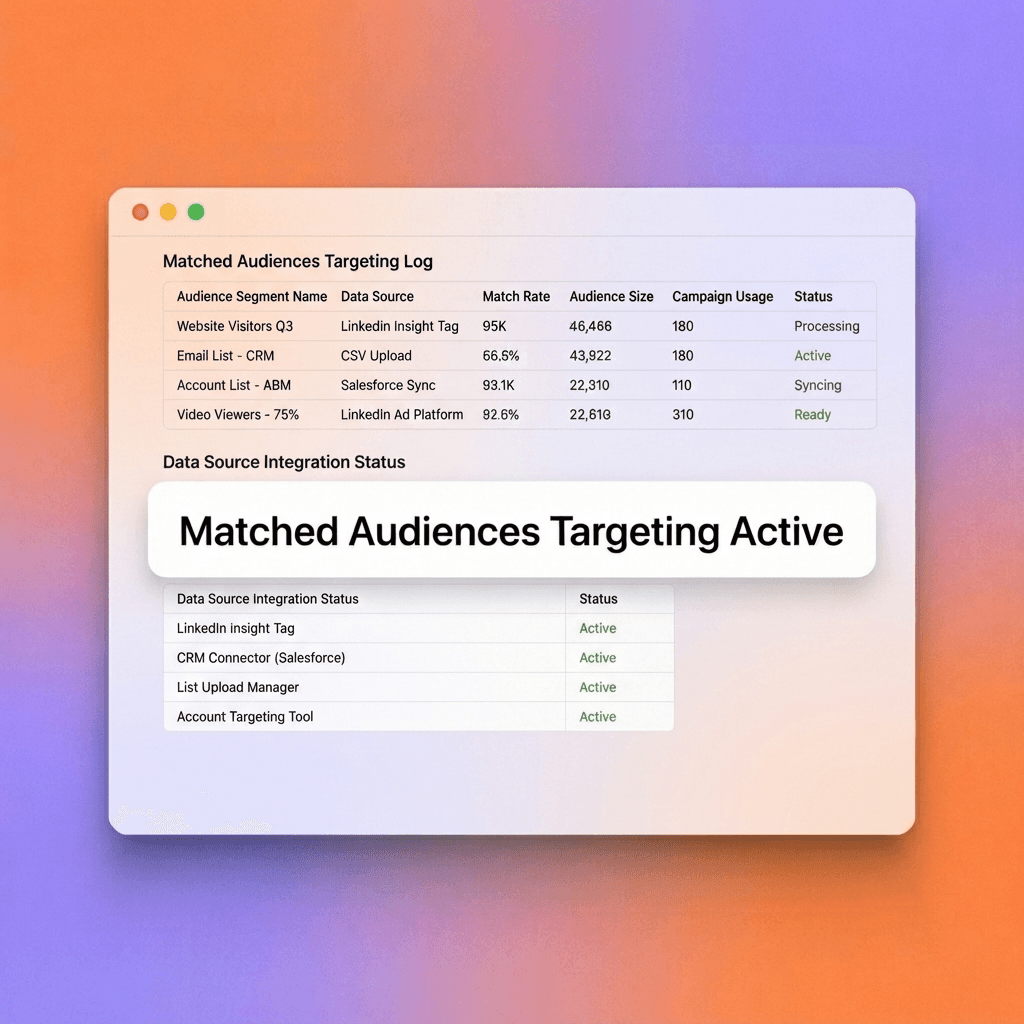
What LinkedIn Matched Audiences Actually Changes in Campaign Strategy
LinkedIn Matched Audiences is one of the most commercially valuable targeting tools on the platform because it allows advertisers to move beyond broad, cold professional targeting and instead leverage first-party audience intelligence to reach individuals who have a pre-existing relationship with your organization.
Instead of relying solely on demographic filters like job title, seniority, industry, or company size which often cast a net too wide to be truly efficient Matched Audiences enables a business to curate specific segments of people who already exhibit a trust signal or intent marker.
By utilizing this capability, you can significantly reduce the "noise" of cold advertising, ensuring that your budget is concentrated on prospects who are either already familiar with your value proposition or are actively investigating your solutions.
For B2B advertisers navigating increasingly complex buying cycles, this tool effectively becomes the critical bridge between simple platform visibility and measurable pipeline acceleration, transforming your LinkedIn presence into a surgical instrument for conversion rather than a blunt tool for reach.
The Three Core Types of LinkedIn Matched Audiences
Website Retargeting
Website retargeting is the process of placing a pixel on your domain to capture visitor behavior, allowing you to target individuals who have previously engaged with specific segments of your site architecture.
Typical examples of high-intent retargeting include focusing on pricing page visitors, service page visitors, case study readers, and demo page visitors. This is often the fastest route to improving conversion efficiency because the visitor has already demonstrated a baseline of interest and intent that a cold audience simply cannot match.
By mapping your ad creative to the specific pages visited—such as showing a technical whitepaper to someone who read your service details—you maintain relevance and keep your brand top-of-mind during their research phase, ultimately shortening the time it takes for a casual visitor to transition into a sales-qualified prospect.
Contact List Uploads
Advertisers can upload first-party lists directly into LinkedIn, including CRM contacts, legacy prospect databases, existing lead pools, and event registrants, which the platform then hashes and matches to specific user profiles.
This approach is highly effective for re-engaging known prospects who may have gone dark or need a specific nudge to move to the next stage of your funnel. Because you are matching against verified professional identities, you can deliver personalized messaging that acknowledges their history with your brand, such as offering a product update to a current lead or inviting a former webinar participant to a new, advanced session.
The efficacy of this method is entirely dependent on the cleanliness of your internal database; therefore, maintaining high-fidelity CRM hygiene is a prerequisite for ensuring that your match rates are high and that your ad spend is not being wasted on outdated or inaccurate contact records.
Company List Targeting
Company list targeting allows for precise account-based targeting by uploading specific target company names, which is especially valuable in enterprise sales environments where capturing the "right" accounts is significantly more important than achieving broad lead volume.
Targeting companies changes your entire campaign intent, shifting the focus from individual persona metrics to organizational penetration and account-level progress. When you focus your spend on a finite list of high-value accounts, you can ensure that your creative is tailored to the specific industry challenges they face, drastically increasing the likelihood of engagement from the decision-makers within those target firms.
This strategy works best when layered with additional filters, such as seniority and job function, ensuring that you aren't just hitting every employee at a target firm, but are instead specifically reaching the stakeholders who possess the influence to authorize a procurement decision.
Optimization and Operational Best Practices
Why Website Retargeting Usually Delivers the Fastest Performance Gains
Among all Matched Audience options, website retargeting often creates the quickest visible efficiency because website visitors have already demonstrated a clear intent by navigating your digital property.
A person who has intentionally navigated to your pricing, service details, product comparison, or contact page is commercially much warmer than a random professional browsing their feed. However, page segmentation matters significantly more than total traffic volume; treating all site visitors as a single block will inevitably weaken performance by diluting your message.
Better segmentation strategies involve creating distinct buckets for high-intent pages, educational resource pages, and career pages, the latter of which should be systematically excluded to prevent budget waste on non-prospects. By tailoring the intensity and tone of your ads to the specific page intent, you ensure that your retargeting efforts remain highly relevant and persuasive.
Contact Uploads Work Best When CRM Quality Is High
A contact upload only performs as well as the underlying data quality, and the most robust uploads come from qualified CRM leads, webinar participants, active sales conversations, and newsletter subscribers who have demonstrated business relevance. Weak uploads, such as old, low-quality, or broad lists that have not been scrubbed for accuracy, will almost always underperform, resulting in low match rates and poor engagement.
To avoid this, it is essential to implement a data maintenance protocol that regularly purges inactive contacts and normalizes the format of your email addresses before uploading them to LinkedIn. When your source list is high-quality, the resulting match is highly reliable, allowing you to build hyper-personalized campaigns that feel like a direct extension of your sales team's outreach, thereby increasing the trust and credibility of your digital touchpoints.
Company Targeting Powers Account-Based LinkedIn Strategy
For B2B brands selling into specific, high-value companies, this is the most strategic use of Matched Audiences, as it allows you to dominate the digital landscape for the accounts that truly move your bottom line. Targeting companies changes your campaign intent from "broad market reach" to "target account focus," which forces your creative team to produce content that resonates with the specific firmographic needs of those companies.
Company targeting works best with layered filters—adding seniority, job function, and geography to avoid wasting spend on junior employees who don't impact purchasing. For example, if you target 200 high-value accounts but only show ads to Directors and above within the operations and finance departments, you ensure that your budget is laser-focused on the stakeholders most likely to sign off on your enterprise-level solution.
Matched Audiences Should Not Replace Core Targeting — It Should Strengthen It
A common mistake is assuming that Matched Audiences can or should work in isolation; in reality, it is most effective when layered correctly to provide both reach and precision. An example of strong layering is combining a CRM upload with seniority and geography filters to ensure you are only reaching the correct stakeholders at your target firms.
Conversely, using a CRM upload without any layering is a weak approach that may lead to wasted impressions on stakeholders who are no longer relevant to your current campaign. Layering protects your relevance, ensuring that the warm audience you have curated is further qualified by your ideal customer profile attributes, which guarantees that your advertising spend is working as efficiently as possible to hit the high-value decision-makers.
Retargeting Windows Matter More Than Many Advertisers Expect
Audience freshness affects performance heavily, and your retargeting window should be calibrated to the speed of your sales cycle to ensure your messaging remains resonant. Short windows of 30 to 60 days usually convert better because these audiences retain a stronger memory of their initial interaction with your brand, making them more likely to click on a follow-up ad.
Longer windows, ranging from 90 to 180 days, may be necessary for enterprise sales environments with slow-moving procurement, but these segments should be managed with caution to avoid "creative fatigue." By testing and setting your retargeting duration to match the typical decision-making timeline of your target prospect, you ensure that you are staying present throughout their evaluation without becoming an intrusive nuisance that damages your brand's prestige.
Creative Strategy and Operational Execution
Different Matched Audiences Need Different Creative
The same ad should not be shown to every matched segment, as the context of their relationship with your brand varies wildly.
Website visitors need progression; if they previously saw a service page, your next ad should deepen that trust by providing a case study or a technical benchmark. CRM leads, who already know the brand, need specificity, and their creative should move toward decision support or direct consultation offers.
Target accounts require strategic credibility, with messaging that feels commercially mature and addresses the long-term ROI of your partnership. By segmenting your creative assets to reflect the specific "warmth" and intent level of each audience, you ensure that every ad touchpoint advances the prospect toward a conversion.
Exclusions Are Essential Inside Matched Audiences
One of the strongest, yet most overlooked, uses of Matched Audiences is the strategic application of exclusions to protect your budget from being leaked.
You should proactively exclude current customers to avoid wasting spend on an audience that has already converted, and you must exclude internal employees to prevent their organic impressions from distorting your delivery and performance metrics.
Additionally, you should exclude converted leads from your lead-gen campaigns, because otherwise, your budget will repeat unnecessarily on people who have already completed the form.
By maintaining a clean exclusion list, you ensure your LinkedIn budget is strictly focused on acquiring net-new prospects, which maximizes your total campaign efficiency and ensures that your reach is always directed toward growth opportunities rather than recycled traffic.
Common Mistakes With LinkedIn Matched Audiences
The most pervasive mistakes often involve a lack of strategic oversight regarding data inputs and audience hygiene. Uploading poor-quality contact lists is a primary offender, as bad input inevitably weakens your output and wastes your ad budget on inactive or irrelevant profiles.
Another frequent failure is using one generic creative asset across all segments, which ignores the reality that audience intent differs significantly between a cold CRM contact and a frequent website visitor. Ignoring necessary exclusions is a direct route to budget leakage, as your ads end up targeting the wrong people for the wrong reasons.
Retargeting too broadly also causes your message to lose its sense of "warmth" and relevance, and finally, expecting immediate, massive scale from a Matched Audience campaign is misguided, as these audiences are, by design, smaller and more qualified than your broad reach segments, requiring a shift in KPI expectations from volume to quality.
Bottom Line: What Metrics Should Drive Your LinkedIn Decision?
The ultimate goal of using Matched Audiences is to achieve superior efficiency that pays dividends in your overall customer acquisition strategy. Your CTR should naturally improve versus cold audiences, as warm visitors are far more likely to engage with familiar brand touchpoints.
CPL must be compared by segment, as CRM audiences often vastly outperform cold targeting and should be judged by their own unique efficiency benchmarks. Opportunity Rate is a far more important signal than simple Form Volume, as warm leads should be converting deeper into the funnel and exhibiting more serious purchase intent.
Your CAC will almost always improve when your segmentation is strong, especially when you employ a clean retargeting logic that stops unnecessary spend. However, audience saturation must be monitored constantly, as small, high-quality segments fatigue very quickly if you over-expose them.
Frequency must be kept under strict control, as too much repetition can damage the professional trust you have built. Ultimately, revenue influence often appears much faster with Matched Audiences because warm prospects are closer to a buying decision, and tracking that velocity is the best way to prove the value of your first-party data efforts.
What LinkedIn Matched Audiences Actually Changes in Campaign Strategy
LinkedIn Matched Audiences is one of the most commercially valuable targeting tools on the platform because it allows advertisers to move beyond broad, cold professional targeting and instead leverage first-party audience intelligence to reach individuals who have a pre-existing relationship with your organization.
Instead of relying solely on demographic filters like job title, seniority, industry, or company size which often cast a net too wide to be truly efficient Matched Audiences enables a business to curate specific segments of people who already exhibit a trust signal or intent marker.
By utilizing this capability, you can significantly reduce the "noise" of cold advertising, ensuring that your budget is concentrated on prospects who are either already familiar with your value proposition or are actively investigating your solutions.
For B2B advertisers navigating increasingly complex buying cycles, this tool effectively becomes the critical bridge between simple platform visibility and measurable pipeline acceleration, transforming your LinkedIn presence into a surgical instrument for conversion rather than a blunt tool for reach.
The Three Core Types of LinkedIn Matched Audiences
Website Retargeting
Website retargeting is the process of placing a pixel on your domain to capture visitor behavior, allowing you to target individuals who have previously engaged with specific segments of your site architecture.
Typical examples of high-intent retargeting include focusing on pricing page visitors, service page visitors, case study readers, and demo page visitors. This is often the fastest route to improving conversion efficiency because the visitor has already demonstrated a baseline of interest and intent that a cold audience simply cannot match.
By mapping your ad creative to the specific pages visited—such as showing a technical whitepaper to someone who read your service details—you maintain relevance and keep your brand top-of-mind during their research phase, ultimately shortening the time it takes for a casual visitor to transition into a sales-qualified prospect.
Contact List Uploads
Advertisers can upload first-party lists directly into LinkedIn, including CRM contacts, legacy prospect databases, existing lead pools, and event registrants, which the platform then hashes and matches to specific user profiles.
This approach is highly effective for re-engaging known prospects who may have gone dark or need a specific nudge to move to the next stage of your funnel. Because you are matching against verified professional identities, you can deliver personalized messaging that acknowledges their history with your brand, such as offering a product update to a current lead or inviting a former webinar participant to a new, advanced session.
The efficacy of this method is entirely dependent on the cleanliness of your internal database; therefore, maintaining high-fidelity CRM hygiene is a prerequisite for ensuring that your match rates are high and that your ad spend is not being wasted on outdated or inaccurate contact records.
Company List Targeting
Company list targeting allows for precise account-based targeting by uploading specific target company names, which is especially valuable in enterprise sales environments where capturing the "right" accounts is significantly more important than achieving broad lead volume.
Targeting companies changes your entire campaign intent, shifting the focus from individual persona metrics to organizational penetration and account-level progress. When you focus your spend on a finite list of high-value accounts, you can ensure that your creative is tailored to the specific industry challenges they face, drastically increasing the likelihood of engagement from the decision-makers within those target firms.
This strategy works best when layered with additional filters, such as seniority and job function, ensuring that you aren't just hitting every employee at a target firm, but are instead specifically reaching the stakeholders who possess the influence to authorize a procurement decision.
Optimization and Operational Best Practices
Why Website Retargeting Usually Delivers the Fastest Performance Gains
Among all Matched Audience options, website retargeting often creates the quickest visible efficiency because website visitors have already demonstrated a clear intent by navigating your digital property.
A person who has intentionally navigated to your pricing, service details, product comparison, or contact page is commercially much warmer than a random professional browsing their feed. However, page segmentation matters significantly more than total traffic volume; treating all site visitors as a single block will inevitably weaken performance by diluting your message.
Better segmentation strategies involve creating distinct buckets for high-intent pages, educational resource pages, and career pages, the latter of which should be systematically excluded to prevent budget waste on non-prospects. By tailoring the intensity and tone of your ads to the specific page intent, you ensure that your retargeting efforts remain highly relevant and persuasive.
Contact Uploads Work Best When CRM Quality Is High
A contact upload only performs as well as the underlying data quality, and the most robust uploads come from qualified CRM leads, webinar participants, active sales conversations, and newsletter subscribers who have demonstrated business relevance. Weak uploads, such as old, low-quality, or broad lists that have not been scrubbed for accuracy, will almost always underperform, resulting in low match rates and poor engagement.
To avoid this, it is essential to implement a data maintenance protocol that regularly purges inactive contacts and normalizes the format of your email addresses before uploading them to LinkedIn. When your source list is high-quality, the resulting match is highly reliable, allowing you to build hyper-personalized campaigns that feel like a direct extension of your sales team's outreach, thereby increasing the trust and credibility of your digital touchpoints.
Company Targeting Powers Account-Based LinkedIn Strategy
For B2B brands selling into specific, high-value companies, this is the most strategic use of Matched Audiences, as it allows you to dominate the digital landscape for the accounts that truly move your bottom line. Targeting companies changes your campaign intent from "broad market reach" to "target account focus," which forces your creative team to produce content that resonates with the specific firmographic needs of those companies.
Company targeting works best with layered filters—adding seniority, job function, and geography to avoid wasting spend on junior employees who don't impact purchasing. For example, if you target 200 high-value accounts but only show ads to Directors and above within the operations and finance departments, you ensure that your budget is laser-focused on the stakeholders most likely to sign off on your enterprise-level solution.
Matched Audiences Should Not Replace Core Targeting — It Should Strengthen It
A common mistake is assuming that Matched Audiences can or should work in isolation; in reality, it is most effective when layered correctly to provide both reach and precision. An example of strong layering is combining a CRM upload with seniority and geography filters to ensure you are only reaching the correct stakeholders at your target firms.
Conversely, using a CRM upload without any layering is a weak approach that may lead to wasted impressions on stakeholders who are no longer relevant to your current campaign. Layering protects your relevance, ensuring that the warm audience you have curated is further qualified by your ideal customer profile attributes, which guarantees that your advertising spend is working as efficiently as possible to hit the high-value decision-makers.
Retargeting Windows Matter More Than Many Advertisers Expect
Audience freshness affects performance heavily, and your retargeting window should be calibrated to the speed of your sales cycle to ensure your messaging remains resonant. Short windows of 30 to 60 days usually convert better because these audiences retain a stronger memory of their initial interaction with your brand, making them more likely to click on a follow-up ad.
Longer windows, ranging from 90 to 180 days, may be necessary for enterprise sales environments with slow-moving procurement, but these segments should be managed with caution to avoid "creative fatigue." By testing and setting your retargeting duration to match the typical decision-making timeline of your target prospect, you ensure that you are staying present throughout their evaluation without becoming an intrusive nuisance that damages your brand's prestige.
Creative Strategy and Operational Execution
Different Matched Audiences Need Different Creative
The same ad should not be shown to every matched segment, as the context of their relationship with your brand varies wildly.
Website visitors need progression; if they previously saw a service page, your next ad should deepen that trust by providing a case study or a technical benchmark. CRM leads, who already know the brand, need specificity, and their creative should move toward decision support or direct consultation offers.
Target accounts require strategic credibility, with messaging that feels commercially mature and addresses the long-term ROI of your partnership. By segmenting your creative assets to reflect the specific "warmth" and intent level of each audience, you ensure that every ad touchpoint advances the prospect toward a conversion.
Exclusions Are Essential Inside Matched Audiences
One of the strongest, yet most overlooked, uses of Matched Audiences is the strategic application of exclusions to protect your budget from being leaked.
You should proactively exclude current customers to avoid wasting spend on an audience that has already converted, and you must exclude internal employees to prevent their organic impressions from distorting your delivery and performance metrics.
Additionally, you should exclude converted leads from your lead-gen campaigns, because otherwise, your budget will repeat unnecessarily on people who have already completed the form.
By maintaining a clean exclusion list, you ensure your LinkedIn budget is strictly focused on acquiring net-new prospects, which maximizes your total campaign efficiency and ensures that your reach is always directed toward growth opportunities rather than recycled traffic.
Common Mistakes With LinkedIn Matched Audiences
The most pervasive mistakes often involve a lack of strategic oversight regarding data inputs and audience hygiene. Uploading poor-quality contact lists is a primary offender, as bad input inevitably weakens your output and wastes your ad budget on inactive or irrelevant profiles.
Another frequent failure is using one generic creative asset across all segments, which ignores the reality that audience intent differs significantly between a cold CRM contact and a frequent website visitor. Ignoring necessary exclusions is a direct route to budget leakage, as your ads end up targeting the wrong people for the wrong reasons.
Retargeting too broadly also causes your message to lose its sense of "warmth" and relevance, and finally, expecting immediate, massive scale from a Matched Audience campaign is misguided, as these audiences are, by design, smaller and more qualified than your broad reach segments, requiring a shift in KPI expectations from volume to quality.
Bottom Line: What Metrics Should Drive Your LinkedIn Decision?
The ultimate goal of using Matched Audiences is to achieve superior efficiency that pays dividends in your overall customer acquisition strategy. Your CTR should naturally improve versus cold audiences, as warm visitors are far more likely to engage with familiar brand touchpoints.
CPL must be compared by segment, as CRM audiences often vastly outperform cold targeting and should be judged by their own unique efficiency benchmarks. Opportunity Rate is a far more important signal than simple Form Volume, as warm leads should be converting deeper into the funnel and exhibiting more serious purchase intent.
Your CAC will almost always improve when your segmentation is strong, especially when you employ a clean retargeting logic that stops unnecessary spend. However, audience saturation must be monitored constantly, as small, high-quality segments fatigue very quickly if you over-expose them.
Frequency must be kept under strict control, as too much repetition can damage the professional trust you have built. Ultimately, revenue influence often appears much faster with Matched Audiences because warm prospects are closer to a buying decision, and tracking that velocity is the best way to prove the value of your first-party data efforts.
FAQs
How large should a Matched Audience be?
Framer is a design tool that allows you to design websites on a freeform canvas, and then publish them as websites with a single click.
Web Personalisation
Framer is a design tool that allows you to design websites on a freeform canvas, and then publish them as websites with a single click.
UI and UX Design
Framer is a design tool that allows you to design websites on a freeform canvas, and then publish them as websites with a single click.
Search Engine Optimisation
Framer is a design tool that allows you to design websites on a freeform canvas, and then publish them as websites with a single click.
CRM and ERP Solutions
Framer is a design tool that allows you to design websites on a freeform canvas, and then publish them as websites with a single click.
Ecommerce
Framer is a design tool that allows you to design websites on a freeform canvas, and then publish them as websites with a single click.
Email Marketing
Framer is a design tool that allows you to design websites on a freeform canvas, and then publish them as websites with a single click.
Marketing Automation
Framer is a design tool that allows you to design websites on a freeform canvas, and then publish them as websites with a single click.
Chatbots and Conversational AI
Framer is a design tool that allows you to design websites on a freeform canvas, and then publish them as websites with a single click.
Chatbots and Conversational AI
Framer is a design tool that allows you to design websites on a freeform canvas, and then publish them as websites with a single click.
Related Blogs
We know your space
Explore our latest UI/UX Case Studies that showcase how our process-driven creativity transforms complex ideas into real, measurable business results, step by step.

AI and Data Analytics
•
Aug 19, 2026
Context Engineering for Enterprise AI Agents: Memory, Retrieval, Tools and State Management

AI and Data Analytics
•
Aug 19, 2026
Enterprise RAG vs Agentic RAG vs AI Search: Which Architecture Should You Build?

AI and Data Analytics
•
Aug 19, 2026
Enterprise Semantic Layer for AI Agents: How to Produce Trusted Business Answers
Let's work together
Have a project in mind?
Let's make it real.
Tell us what you're building. We'll bring the design, technology, and thinking to make it happen.
Fill up the following form to start a conversation
with our team
Let's work together
Have a project in mind?
Let's make it real.
Tell us what you're building. We'll bring the design, technology, and thinking to make it happen.
Fill up the following form to start a conversation with our team
Let's work together
Have a project in mind?
Let's make it real.
Tell us what you're building. We'll bring the design, technology, and thinking to make it happen.
Fill up the following form to start a conversation
with our team
Services
Services
© 2026 projectsupply
Part of Tangle
Services
© 2026 projectsupply
Part of Tangle