
Ecommerce Development
Shopify Agency vs Freelancer in India: How to Choose for Your Project
Shopify Agency vs Freelancer in India: How to Choose for Your Project
08 min read
SEO Title: Shopify Agency vs Freelancer in India: How to Choose for Your Project
Meta Description: Comparing a Shopify agency vs freelancer in India? Use this guide to match your project size, budget, and growth stage to the right vendor — without wasting time or money.
URL Slug: /shopify-agency-vs-freelancer-india
FULL BLOG:
Shopify Agency vs Freelancer in India: How to Choose Based on Your Project Size and Budget
If you're building or scaling a Shopify store in India, the vendor decision comes early — and gets expensive when you get it wrong. The Shopify agency vs freelancer question isn't really about quality. It's about fit. The right answer depends on what you're building, how fast you need it, and what you can realistically manage on your end. This guide gives you a clear framework for making that call. Strategic vendor selection is a cornerstone of D2C operational excellence, as it dictates not just the immediate output of your e-commerce storefront but also the long-term maintainability and scalability of your digital architecture. Making the wrong choice at the outset often leads to significant technical debt, fragmented codebases, and lost revenue during critical growth phases, which makes understanding the nuance between individual expertise and institutional delivery absolutely essential for every founder.
Why the Shopify Agency vs Freelancer Decision Actually Matters
Most founders default to a freelancer because it feels lower-risk. Most enterprises default to an agency because it feels safer. Neither instinct is wrong — but neither is a strategy. The actual risk isn't the vendor type. It's misalignment between your project complexity and your vendor's operational structure. A freelancer handling a multi-currency, multi-warehouse D2C build is under-resourced. An agency handling a three-page MVP is over-priced and under-motivated. Get the match right and both options work well. Get it wrong and you're rebuilding in six months. Misalignment typically results in missed deadlines, budget overruns, and the heartbreaking realization that your store cannot support the scale you intended to achieve, emphasizing why upfront evaluation of your project's specific requirements is the most cost-effective defensive measure you can take in the procurement process.
What a Shopify Freelancer in India Actually Looks Like
A Shopify freelancer is typically one person — sometimes two — operating independently. In India, the freelancer market for Shopify is large, mature, and genuinely skilled at the execution layer. What you're buying from a freelancer:
Direct access: You engage in one-on-one communication with the person actually writing the code, which eliminates the administrative bloat often found in larger organizations and ensures that your technical requirements are understood exactly as you intended them.
Cost efficiency: With lower hourly or project rates (typically ₹800–₹2,500/hour depending on experience), you can maximize your immediate budget for high-impact technical tasks without the added overhead costs associated with corporate project management or physical office maintenance.
Speed of execution: Freelancers provide exceptionally fast turnaround on contained, well-defined tasks, making them the ideal choice for tactical needs where quick implementation is required to keep your store updated and bug-free.
Specialization: They often possess deep knowledge of specific theme customizations, app integrations, and minor bug fixes, delivering strong value for brands that need targeted technical interventions rather than holistic system overhauls.
Operational flexibility: The inherent ability to engage on short-term or milestone-based contracts provides founders with the agility to pivot their technical support needs as the market shifts, without the necessity of long-term lock-in commitments.
What you're not buying: A team that can run parallel workstreams, built-in project management, QA, or strategy, continuity when the freelancer is unavailable, and a vendor who can grow with you across multiple functions. Freelancers work best when you know exactly what you need, can brief it clearly, and have internal capacity to manage the engagement. By offloading the technical execution to a solo expert, you effectively accept the role of project lead yourself, necessitating a higher level of internal oversight to ensure the deliverables align with your broader business roadmap and quality standards.
What a Shopify Agency in India Actually Looks Like
A Shopify agency brings a structured team — developers, designers, strategists, project managers — operating under a defined delivery process. Indian Shopify agencies range from small boutique shops (5–15 people) to larger full-service digital operations. What you're buying from an agency:
Multidisciplinary teams: You gain access to a cohesive group of professionals with complementary skills, including UX designers, back-end developers, and conversion rate optimization specialists, all working synchronously on your project to ensure a polished end product.
Defined processes: Agencies utilize battle-tested workflows for scoping, delivery, quality assurance, and project handover, which significantly reduces the administrative burden on your internal team and minimizes the likelihood of major technical oversights.
Strategic advisory: Beyond mere execution, agencies provide high-level strategic input regarding your tech stack decisions, user journey optimization, and conversion strategies, effectively acting as an extension of your own growth team rather than just a pair of hands.
Accountability frameworks: They provide institutional accountability structures, offering clear escalation paths and professional project management oversight that ensure your goals are prioritized even if individual staff members rotate or unforeseen challenges emerge.
Scalable capacity: Agencies offer the necessary bandwidth for larger, longer, or multi-phase engagements, positioning them as an ideal partner for ambitious D2C brands that require ongoing support for international expansion or complex platform migrations.
What you're not buying cheaply: Agencies in India typically charge ₹3,000–₹8,000/hour or scope projects at ₹3–₹15 lakh+ depending on complexity; your project competes with others on their roster, and you may not always work directly with senior talent. Agencies work best when your project has moving parts, your team lacks bandwidth to manage execution, or you're building something you intend to scale. Investing in an agency is essentially a purchase of risk mitigation and long-term sustainability, as the agency's institutional knowledge ensures that your Shopify environment remains compliant, secure, and optimized for high-volume transactions as you grow.
The Project Supply Shopify Vendor Fit Matrix
Use this matrix to map your situation to the right vendor type before you start outreach.
How to Read the Matrix
Match your project against four criteria: scope complexity, internal capacity, timeline pressure, and budget. The vendor fit recommendation appears in the final column.
Theme customization or minor UI changes: High Freelancer Fit, Low Agency Fit, Recommendation: Freelancer.
Single app integration or bug fix: High Freelancer Fit, Low Agency Fit, Recommendation: Freelancer.
New Shopify store build (standard): Medium Freelancer Fit, Medium Agency Fit, Recommendation: Freelancer with strong brief, or boutique agency.
New Shopify store build (custom, D2C): Low Freelancer Fit, High Agency Fit, Recommendation: Agency.
Shopify Plus migration or replatforming: Low Freelancer Fit, High Agency Fit, Recommendation: Agency.
Ongoing CRO, SEO, or paid media: Low Freelancer Fit, High Agency Fit, Recommendation: Agency retainer.
One-time landing page or campaign: High Freelancer Fit, Low Agency Fit, Recommendation: Freelancer.
Multi-market or multi-currency setup: Low Freelancer Fit, High Agency Fit, Recommendation: Agency.
Performance audit or tech review: Medium Freelancer Fit, Medium Agency Fit, Recommendation: Either — scope it first.
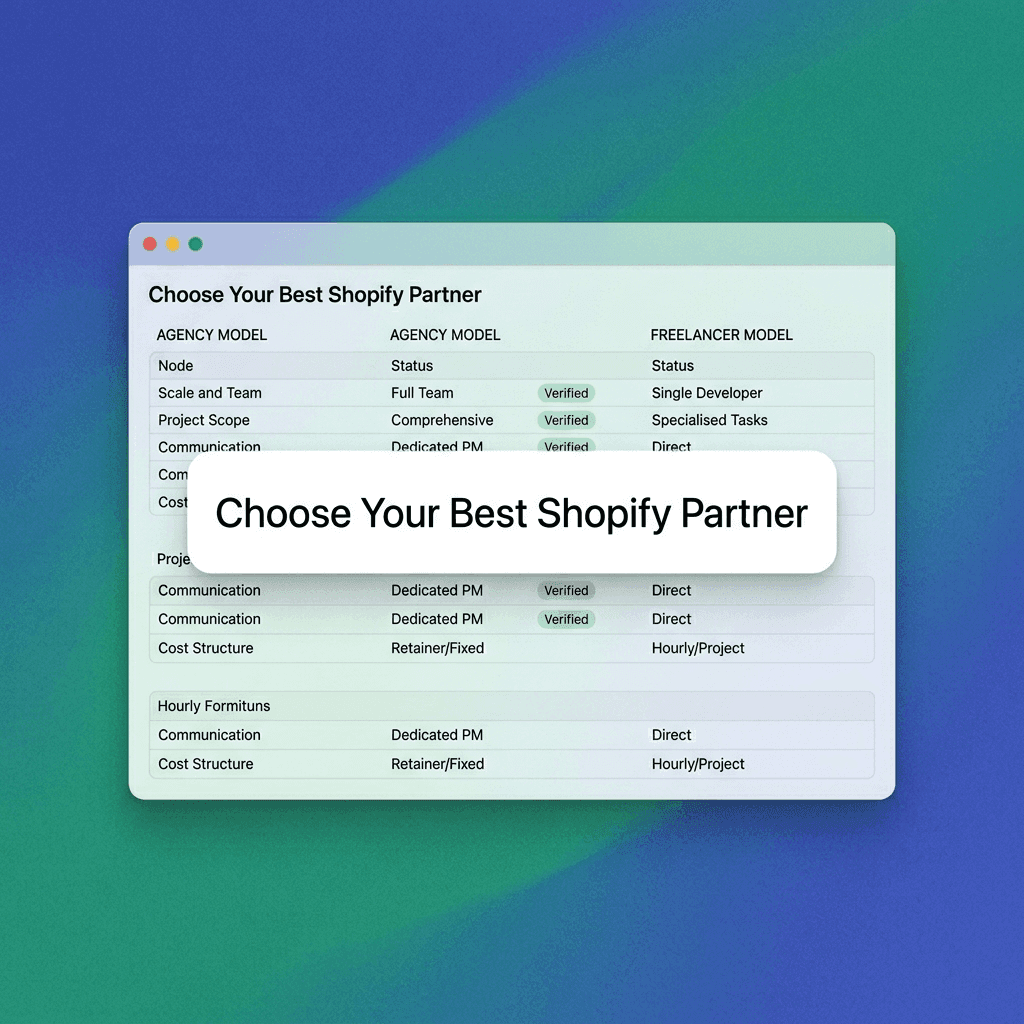
Key Differences: Shopify Agency vs Freelancer India at a Glance
Accountability
Freelancers are accountable to you directly. That's efficient when things go well and fragile when they don't. If a freelancer goes silent, falls ill, or takes on too many clients, you have no fallback. Agencies have internal escalation paths. If one developer is off, the project doesn't stop. This matters more on long-timeline builds than short sprints, as the loss of a single critical resource in a freelance environment can lead to total project stoppage, whereas an agency's bench strength provides a layer of operational redundancy that protects your launch timeline.
Communication
Freelancers often communicate faster and more personally. You're talking to the person building. Agencies route through a project manager, which adds a layer but also adds structure. Neither is better universally. For complex multi-stakeholder projects, structured communication reduces chaos. For contained tasks, direct communication is faster. The trade-off between speed and structure is defined by your internal requirements; if your organization lacks a dedicated product owner, an agency’s project management layer is an essential bridge to keep technical output aligned with business requirements.
Cost Structure
Freelancers typically charge per hour or per milestone. Agencies usually scope fixed-price projects or work on retainer. Fixed-price agency scopes can protect your budget — but only if the scope is locked. Scope creep is the biggest cost risk with either model. The mitigation is the same: brief clearly, agree in writing, define change request terms upfront. While freelancers may seem more affordable, the lack of defined change management processes can quickly turn a budget-friendly project into an expensive, open-ended endeavor, necessitating rigid adherence to written project scopes.
Scalability
If your needs grow, an agency can grow with you. A freelancer can't easily add capacity mid-project without bringing in subcontractors — who you may not have visibility into. If you're planning a phased build or ongoing growth work, factor this into the decision from day one. Engaging an agency early in your growth trajectory allows for the seamless transition from initial development to long-term growth marketing or feature optimization, whereas relying on a fragmented freelance team often forces you to restart your search for specialized help at each stage of your brand's evolution.
Common Mistakes When Hiring for Shopify in India
These are patterns that consistently lead to project failure or budget overrun, regardless of vendor type.
Briefing vaguely to save time: The less specific your brief, the more you rely on the vendor's interpretation. You'll end up negotiating scope mid-build, which costs more in both time and money than writing a detailed brief upfront, often resulting in features that do not meet your actual business needs.
Choosing on price alone: The cheapest Shopify freelancer and the most expensive agency are both the wrong choice if they're not matched to your project. Price is a signal, not a selection criterion, and prioritizing it often leads to a failure in technical delivery that costs far more in the long run.
Skipping reference checks: Portfolio work shows visual taste. Reference checks tell you about communication, deadline reliability, and how the vendor handles problems. One is easy to fake. The other isn't, and failing to verify these qualitative metrics is a primary cause of hiring someone whose working style is incompatible with your internal team's culture.
Treating a freelancer like an agency: A freelancer you're asking to manage strategy, coordinate with your logistics team, and handle design, development, and QA simultaneously is being set up to fail. Define the lane clearly and accept that asking a sole operator to be a full-service agency is an unreasonable expectation.
Starting without a scope document: Whether you're hiring a ₹50,000 freelancer or a ₹10 lakh agency, document the scope before work begins. This protects both parties by establishing a source of truth for all deliverables, timelines, and payment milestones, which is vital for preventing the misunderstandings that plague technical projects.
Ignoring post-launch support: Most D2C store issues surface in the first 30–60 days after launch. Confirm upfront what post-launch support looks like, whether it's included, and at what rate, because failing to plan for maintenance ensures that your store is vulnerable to initial bugs or configuration errors that can significantly impact conversion rates post-launch.
How Budget Should Actually Inform Your Decision
Budget thresholds in the Indian Shopify market tend to cluster around capability levels. Here's a practical breakdown.
Under ₹50,000 — Freelancer territory: Contained tasks, single integrations, theme work. Agencies won't be interested at this budget and shouldn't be, as this tier is designed for rapid, surgical interventions rather than comprehensive platform development or complex technical architectural design.
₹50,000–₹2,00,000 — Freelancer or boutique agency: Standard store builds, moderate customization. A strong freelancer or a small agency can deliver here. Evaluate on portfolio match and communication quality, as your goal is to balance professional delivery standards with the personal accountability that comes from smaller, more nimble teams.
₹2,00,000–₹8,00,000 — Agency range: Custom D2C builds, Shopify Plus setups, multi-function projects. This budget warrants an agency structure. Freelancers operating in this range are usually running subcontractor networks — ask about who's actually doing the work, as the primary value here is the agency's ability to coordinate multiple expert roles effectively.
₹8,00,000+ — Strategic agency engagement: Replatforming, growth retainers, international expansion. At this level, vendor selection should be treated like a business decision, not a procurement exercise. Evaluate culture fit, not just capability, because you are entering a long-term partnership that will fundamentally influence your brand’s capability to compete effectively in the global marketplace.
Questions to Ask Before You Hire Either
Before signing with any Shopify vendor — agency or freelancer — get clear answers to the following. Who specifically will be working on my project, and what is their experience with Shopify at my project scale? How do you handle scope changes mid-project? What does your QA process look like before handover? Can you share two or three examples of projects similar to mine in size and industry? What does post-launch support look like and what does it cost? What's your availability and how many other projects are you running in parallel? How do you communicate progress — tools, frequency, format? The answers will tell you more than the portfolio. By digging into these operational details, you peel back the marketing layer to understand the actual reality of the delivery process, ensuring you don't fall for slick sales pitches that lack the underlying infrastructure to support your specific project requirements.
SEO Title: Shopify Agency vs Freelancer in India: How to Choose for Your Project
Meta Description: Comparing a Shopify agency vs freelancer in India? Use this guide to match your project size, budget, and growth stage to the right vendor — without wasting time or money.
URL Slug: /shopify-agency-vs-freelancer-india
FULL BLOG:
Shopify Agency vs Freelancer in India: How to Choose Based on Your Project Size and Budget
If you're building or scaling a Shopify store in India, the vendor decision comes early — and gets expensive when you get it wrong. The Shopify agency vs freelancer question isn't really about quality. It's about fit. The right answer depends on what you're building, how fast you need it, and what you can realistically manage on your end. This guide gives you a clear framework for making that call. Strategic vendor selection is a cornerstone of D2C operational excellence, as it dictates not just the immediate output of your e-commerce storefront but also the long-term maintainability and scalability of your digital architecture. Making the wrong choice at the outset often leads to significant technical debt, fragmented codebases, and lost revenue during critical growth phases, which makes understanding the nuance between individual expertise and institutional delivery absolutely essential for every founder.
Why the Shopify Agency vs Freelancer Decision Actually Matters
Most founders default to a freelancer because it feels lower-risk. Most enterprises default to an agency because it feels safer. Neither instinct is wrong — but neither is a strategy. The actual risk isn't the vendor type. It's misalignment between your project complexity and your vendor's operational structure. A freelancer handling a multi-currency, multi-warehouse D2C build is under-resourced. An agency handling a three-page MVP is over-priced and under-motivated. Get the match right and both options work well. Get it wrong and you're rebuilding in six months. Misalignment typically results in missed deadlines, budget overruns, and the heartbreaking realization that your store cannot support the scale you intended to achieve, emphasizing why upfront evaluation of your project's specific requirements is the most cost-effective defensive measure you can take in the procurement process.
What a Shopify Freelancer in India Actually Looks Like
A Shopify freelancer is typically one person — sometimes two — operating independently. In India, the freelancer market for Shopify is large, mature, and genuinely skilled at the execution layer. What you're buying from a freelancer:
Direct access: You engage in one-on-one communication with the person actually writing the code, which eliminates the administrative bloat often found in larger organizations and ensures that your technical requirements are understood exactly as you intended them.
Cost efficiency: With lower hourly or project rates (typically ₹800–₹2,500/hour depending on experience), you can maximize your immediate budget for high-impact technical tasks without the added overhead costs associated with corporate project management or physical office maintenance.
Speed of execution: Freelancers provide exceptionally fast turnaround on contained, well-defined tasks, making them the ideal choice for tactical needs where quick implementation is required to keep your store updated and bug-free.
Specialization: They often possess deep knowledge of specific theme customizations, app integrations, and minor bug fixes, delivering strong value for brands that need targeted technical interventions rather than holistic system overhauls.
Operational flexibility: The inherent ability to engage on short-term or milestone-based contracts provides founders with the agility to pivot their technical support needs as the market shifts, without the necessity of long-term lock-in commitments.
What you're not buying: A team that can run parallel workstreams, built-in project management, QA, or strategy, continuity when the freelancer is unavailable, and a vendor who can grow with you across multiple functions. Freelancers work best when you know exactly what you need, can brief it clearly, and have internal capacity to manage the engagement. By offloading the technical execution to a solo expert, you effectively accept the role of project lead yourself, necessitating a higher level of internal oversight to ensure the deliverables align with your broader business roadmap and quality standards.
What a Shopify Agency in India Actually Looks Like
A Shopify agency brings a structured team — developers, designers, strategists, project managers — operating under a defined delivery process. Indian Shopify agencies range from small boutique shops (5–15 people) to larger full-service digital operations. What you're buying from an agency:
Multidisciplinary teams: You gain access to a cohesive group of professionals with complementary skills, including UX designers, back-end developers, and conversion rate optimization specialists, all working synchronously on your project to ensure a polished end product.
Defined processes: Agencies utilize battle-tested workflows for scoping, delivery, quality assurance, and project handover, which significantly reduces the administrative burden on your internal team and minimizes the likelihood of major technical oversights.
Strategic advisory: Beyond mere execution, agencies provide high-level strategic input regarding your tech stack decisions, user journey optimization, and conversion strategies, effectively acting as an extension of your own growth team rather than just a pair of hands.
Accountability frameworks: They provide institutional accountability structures, offering clear escalation paths and professional project management oversight that ensure your goals are prioritized even if individual staff members rotate or unforeseen challenges emerge.
Scalable capacity: Agencies offer the necessary bandwidth for larger, longer, or multi-phase engagements, positioning them as an ideal partner for ambitious D2C brands that require ongoing support for international expansion or complex platform migrations.
What you're not buying cheaply: Agencies in India typically charge ₹3,000–₹8,000/hour or scope projects at ₹3–₹15 lakh+ depending on complexity; your project competes with others on their roster, and you may not always work directly with senior talent. Agencies work best when your project has moving parts, your team lacks bandwidth to manage execution, or you're building something you intend to scale. Investing in an agency is essentially a purchase of risk mitigation and long-term sustainability, as the agency's institutional knowledge ensures that your Shopify environment remains compliant, secure, and optimized for high-volume transactions as you grow.
The Project Supply Shopify Vendor Fit Matrix
Use this matrix to map your situation to the right vendor type before you start outreach.
How to Read the Matrix
Match your project against four criteria: scope complexity, internal capacity, timeline pressure, and budget. The vendor fit recommendation appears in the final column.
Theme customization or minor UI changes: High Freelancer Fit, Low Agency Fit, Recommendation: Freelancer.
Single app integration or bug fix: High Freelancer Fit, Low Agency Fit, Recommendation: Freelancer.
New Shopify store build (standard): Medium Freelancer Fit, Medium Agency Fit, Recommendation: Freelancer with strong brief, or boutique agency.
New Shopify store build (custom, D2C): Low Freelancer Fit, High Agency Fit, Recommendation: Agency.
Shopify Plus migration or replatforming: Low Freelancer Fit, High Agency Fit, Recommendation: Agency.
Ongoing CRO, SEO, or paid media: Low Freelancer Fit, High Agency Fit, Recommendation: Agency retainer.
One-time landing page or campaign: High Freelancer Fit, Low Agency Fit, Recommendation: Freelancer.
Multi-market or multi-currency setup: Low Freelancer Fit, High Agency Fit, Recommendation: Agency.
Performance audit or tech review: Medium Freelancer Fit, Medium Agency Fit, Recommendation: Either — scope it first.
Key Differences: Shopify Agency vs Freelancer India at a Glance
Accountability
Freelancers are accountable to you directly. That's efficient when things go well and fragile when they don't. If a freelancer goes silent, falls ill, or takes on too many clients, you have no fallback. Agencies have internal escalation paths. If one developer is off, the project doesn't stop. This matters more on long-timeline builds than short sprints, as the loss of a single critical resource in a freelance environment can lead to total project stoppage, whereas an agency's bench strength provides a layer of operational redundancy that protects your launch timeline.
Communication
Freelancers often communicate faster and more personally. You're talking to the person building. Agencies route through a project manager, which adds a layer but also adds structure. Neither is better universally. For complex multi-stakeholder projects, structured communication reduces chaos. For contained tasks, direct communication is faster. The trade-off between speed and structure is defined by your internal requirements; if your organization lacks a dedicated product owner, an agency’s project management layer is an essential bridge to keep technical output aligned with business requirements.
Cost Structure
Freelancers typically charge per hour or per milestone. Agencies usually scope fixed-price projects or work on retainer. Fixed-price agency scopes can protect your budget — but only if the scope is locked. Scope creep is the biggest cost risk with either model. The mitigation is the same: brief clearly, agree in writing, define change request terms upfront. While freelancers may seem more affordable, the lack of defined change management processes can quickly turn a budget-friendly project into an expensive, open-ended endeavor, necessitating rigid adherence to written project scopes.
Scalability
If your needs grow, an agency can grow with you. A freelancer can't easily add capacity mid-project without bringing in subcontractors — who you may not have visibility into. If you're planning a phased build or ongoing growth work, factor this into the decision from day one. Engaging an agency early in your growth trajectory allows for the seamless transition from initial development to long-term growth marketing or feature optimization, whereas relying on a fragmented freelance team often forces you to restart your search for specialized help at each stage of your brand's evolution.
Common Mistakes When Hiring for Shopify in India
These are patterns that consistently lead to project failure or budget overrun, regardless of vendor type.
Briefing vaguely to save time: The less specific your brief, the more you rely on the vendor's interpretation. You'll end up negotiating scope mid-build, which costs more in both time and money than writing a detailed brief upfront, often resulting in features that do not meet your actual business needs.
Choosing on price alone: The cheapest Shopify freelancer and the most expensive agency are both the wrong choice if they're not matched to your project. Price is a signal, not a selection criterion, and prioritizing it often leads to a failure in technical delivery that costs far more in the long run.
Skipping reference checks: Portfolio work shows visual taste. Reference checks tell you about communication, deadline reliability, and how the vendor handles problems. One is easy to fake. The other isn't, and failing to verify these qualitative metrics is a primary cause of hiring someone whose working style is incompatible with your internal team's culture.
Treating a freelancer like an agency: A freelancer you're asking to manage strategy, coordinate with your logistics team, and handle design, development, and QA simultaneously is being set up to fail. Define the lane clearly and accept that asking a sole operator to be a full-service agency is an unreasonable expectation.
Starting without a scope document: Whether you're hiring a ₹50,000 freelancer or a ₹10 lakh agency, document the scope before work begins. This protects both parties by establishing a source of truth for all deliverables, timelines, and payment milestones, which is vital for preventing the misunderstandings that plague technical projects.
Ignoring post-launch support: Most D2C store issues surface in the first 30–60 days after launch. Confirm upfront what post-launch support looks like, whether it's included, and at what rate, because failing to plan for maintenance ensures that your store is vulnerable to initial bugs or configuration errors that can significantly impact conversion rates post-launch.
How Budget Should Actually Inform Your Decision
Budget thresholds in the Indian Shopify market tend to cluster around capability levels. Here's a practical breakdown.
Under ₹50,000 — Freelancer territory: Contained tasks, single integrations, theme work. Agencies won't be interested at this budget and shouldn't be, as this tier is designed for rapid, surgical interventions rather than comprehensive platform development or complex technical architectural design.
₹50,000–₹2,00,000 — Freelancer or boutique agency: Standard store builds, moderate customization. A strong freelancer or a small agency can deliver here. Evaluate on portfolio match and communication quality, as your goal is to balance professional delivery standards with the personal accountability that comes from smaller, more nimble teams.
₹2,00,000–₹8,00,000 — Agency range: Custom D2C builds, Shopify Plus setups, multi-function projects. This budget warrants an agency structure. Freelancers operating in this range are usually running subcontractor networks — ask about who's actually doing the work, as the primary value here is the agency's ability to coordinate multiple expert roles effectively.
₹8,00,000+ — Strategic agency engagement: Replatforming, growth retainers, international expansion. At this level, vendor selection should be treated like a business decision, not a procurement exercise. Evaluate culture fit, not just capability, because you are entering a long-term partnership that will fundamentally influence your brand’s capability to compete effectively in the global marketplace.
Questions to Ask Before You Hire Either
Before signing with any Shopify vendor — agency or freelancer — get clear answers to the following. Who specifically will be working on my project, and what is their experience with Shopify at my project scale? How do you handle scope changes mid-project? What does your QA process look like before handover? Can you share two or three examples of projects similar to mine in size and industry? What does post-launch support look like and what does it cost? What's your availability and how many other projects are you running in parallel? How do you communicate progress — tools, frequency, format? The answers will tell you more than the portfolio. By digging into these operational details, you peel back the marketing layer to understand the actual reality of the delivery process, ensuring you don't fall for slick sales pitches that lack the underlying infrastructure to support your specific project requirements.
FAQs
Web Personalisation
Framer is a design tool that allows you to design websites on a freeform canvas, and then publish them as websites with a single click.
UI and UX Design
Framer is a design tool that allows you to design websites on a freeform canvas, and then publish them as websites with a single click.
Search Engine Optimisation
Framer is a design tool that allows you to design websites on a freeform canvas, and then publish them as websites with a single click.
CRM and ERP Solutions
Framer is a design tool that allows you to design websites on a freeform canvas, and then publish them as websites with a single click.
Ecommerce
Framer is a design tool that allows you to design websites on a freeform canvas, and then publish them as websites with a single click.
Email Marketing
Framer is a design tool that allows you to design websites on a freeform canvas, and then publish them as websites with a single click.
Marketing Automation
Framer is a design tool that allows you to design websites on a freeform canvas, and then publish them as websites with a single click.
Chatbots and Conversational AI
Framer is a design tool that allows you to design websites on a freeform canvas, and then publish them as websites with a single click.
Chatbots and Conversational AI
Framer is a design tool that allows you to design websites on a freeform canvas, and then publish them as websites with a single click.
Related Blogs
We know your space
Explore our latest UI/UX Case Studies that showcase how our process-driven creativity transforms complex ideas into real, measurable business results, step by step.

AI and Data Analytics
•
Aug 19, 2026
Context Engineering for Enterprise AI Agents: Memory, Retrieval, Tools and State Management

AI and Data Analytics
•
Aug 19, 2026
Enterprise RAG vs Agentic RAG vs AI Search: Which Architecture Should You Build?

AI and Data Analytics
•
Aug 19, 2026
Enterprise Semantic Layer for AI Agents: How to Produce Trusted Business Answers
Let's work together
Have a project in mind?
Let's make it real.
Tell us what you're building. We'll bring the design, technology, and thinking to make it happen.
Fill up the following form to start a conversation
with our team
Let's work together
Have a project in mind?
Let's make it real.
Tell us what you're building. We'll bring the design, technology, and thinking to make it happen.
Fill up the following form to start a conversation with our team
Let's work together
Have a project in mind?
Let's make it real.
Tell us what you're building. We'll bring the design, technology, and thinking to make it happen.
Fill up the following form to start a conversation
with our team
Services
Services
© 2026 projectsupply
Part of Tangle
Services
© 2026 projectsupply
Part of Tangle