
AI and Data Analytics
08 min read
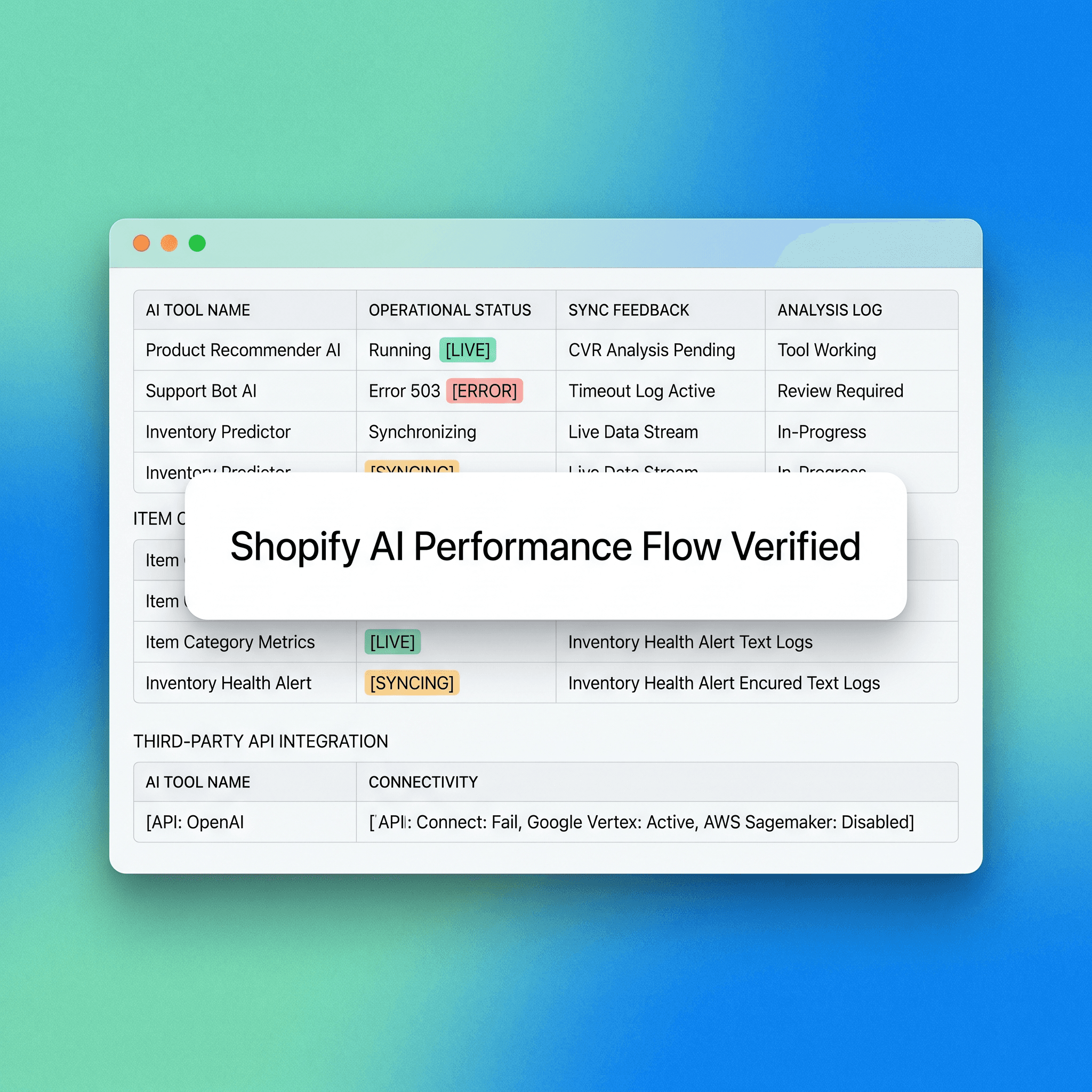
The best Shopify AI tool for an Indian D2C brand is the one that improves a specific workflow with measurable quality and controlled risk. Start with Shopify-native capabilities such as Shopify Magic and Sidekick where they fit, then add specialist tools only for a defined gap in merchandising, customer service, analytics, retention or operations. Do not buy an “AI stack” before mapping the decision, data and owner.
Indian brands should test multilingual output, catalogue accuracy, cash-on-delivery and return-to-origin workflows, WhatsApp handoffs, tax and pricing context, marketplace or quick-commerce coordination, and the effect on contribution margin. A tool that produces more content but creates product errors, support escalations or discount dependence is not delivering value.
What the decision really involves
For Indian D2C founders, ecommerce leaders and operations teams, the visible product or market comparison is only the front of the decision. The underlying system includes people, process, data, integrations, approvals, reporting and support. A choice can look attractive in a demonstration yet add reconciliation work, duplicate data, weaken accountability or move cost into another team. Map who creates the input, who approves the output, which system is authoritative and who resolves exceptions before committing.
Define the business outcome
Write the target as a measurable change rather than an activity. Examples include shorter cycle time, fewer manual corrections, higher qualified conversion, lower failure rate, faster settlement or more reliable management reporting. Record the current baseline, desired range, accountable owner and review date. If the team cannot observe the outcome using existing or deliberately designed instrumentation, the programme is not ready to scale.
Decision criteria
Weight criteria before reviewing vendors or approaches. A practical scorecard covers capability fit, data and integration, governance, user experience, implementation effort, operating cost, scalability, support and reversibility. Weighting prevents an impressive but secondary feature from dominating the decision. Score evidence from a controlled pilot, not sales language. Document assumptions and confidence separately so uncertain estimates are visible.
Capability and workflow fit
Trace one important case from trigger to verified outcome. Identify inputs, transformations, approvals, outputs, exceptions and handoffs. Test the difficult edge cases as well as the happy path. For Shopify AI tools India, the decisive constraint is often not whether a capability exists, but whether it works reliably inside the current workflow without excessive manual intervention or specialist rescue.
Data, integration and architecture
List every source, destination, identifier and synchronisation rule. Decide which system owns each field and how late, missing or duplicated records are handled. Review authentication, permissions, rate limits, webhooks, exports, observability and recovery. Avoid point-to-point connections that cannot be monitored. A lightweight architecture diagram and data contract will expose hidden dependencies before they become production incidents.
Governance, security and risk
Use least-privilege access, named owners, approval rules and an auditable change process. Classify personal, financial, confidential and regulated information before it moves between systems. Review retention, deletion, incident response, vendor access, subcontractors and portability with the relevant legal and security specialists. Do not treat a vendor badge or generic compliance statement as a substitute for reviewing the exact deployment and data flow.
Commercial model and total ownership
Compare total ownership over a realistic planning horizon. Include licences, implementation, migration, integration, internal staff time, training, support, monitoring, add-ons, change requests and exit work. Show ranges instead of false precision. Separate one-time investment from recurring expense and quantify the cost of delay or failure. The cheapest subscription can be the most expensive option when it creates continuing rework or limits a revenue-critical workflow.
Implementation playbook
Run a staged programme with explicit gates. Discovery confirms scope, baseline and constraints. Design establishes architecture, roles, measurement and acceptance criteria. A controlled pilot tests representative work with real users and safe data. Production hardening covers security, monitoring, documentation, support and rollback. Scale only after evidence meets the pre-agreed threshold; do not change the threshold after seeing which option performs best.
Phase 1: baseline and requirements
Interview operators and decision owners, observe the current workflow and collect a small set of representative cases. Record cycle time, exception rate, manual effort, conversion or quality outcomes as appropriate. Translate complaints into testable requirements. Distinguish mandatory constraints from preferences and future ideas. Produce a one-page problem statement, current-state map, data inventory and decision scorecard.
Phase 2: controlled pilot
Use the same input set, user roles and acceptance rules for every shortlisted route. Capture setup time, completion time, human correction, failures, support needs and user confidence. Preserve failed attempts because they reveal ownership cost. Keep the pilot narrow enough to repeat when configuration changes, but difficult enough to expose the deciding constraint.
Phase 3: production readiness
Before launch, complete access reviews, data-quality checks, monitoring, alerting, runbooks, training, support ownership and rollback tests. Confirm reporting matches operational reality. Define service expectations and escalation paths. Remove temporary pilot workarounds. A production approval should be evidence that the organisation can operate and recover the system, not merely that the core demonstration succeeded.
Phase 4: rollout and optimisation
Expand by cohort, market, workflow or business unit. Compare each cohort with the baseline and watch exception rates, not only aggregate activity. Hold a review after the first complete operating cycle. Retire redundant tools and manual steps when safe. Maintain a change log linking decisions, releases, observed results and follow-up actions so optimisation is cumulative rather than anecdotal.
Measurement model
Use three layers of measurement. Business outcomes show whether the investment creates value. Operational metrics explain how the workflow performs. Guardrail metrics detect quality, security or customer harm. Assign each metric an owner, source, definition, cadence and decision threshold. Avoid reporting volume as value: more generated assets, messages, deployments or reports are useful only when they improve the intended outcome.
90-day roadmap
Days 1–15: confirm the problem, baseline, owners and constraints. Days 16–30: design the target workflow, scorecard and pilot. Days 31–60: configure, integrate and test representative cases. Days 61–75: harden security, data quality, monitoring and support. Days 76–90: roll out to a controlled cohort, measure against baseline and issue a written continue, change or stop decision.
A workflow-first AI stack for Indian D2C
Merchandising and product content
Use generative assistance to draft product descriptions, attribute summaries, FAQs and campaign variants, but ground every output in approved catalogue data. Product title, size, material, ingredient, compatibility, care, price and policy facts should come from structured sources rather than model memory.
Test the workflow on difficult products and regional-language variants. Measure correction time, factual-error rate, search visibility and conversion quality. A faster first draft is useful only when the editorial and compliance burden does not erase the gain.
Customer service and agent assistance
AI can classify intent, retrieve approved answers, summarise conversations and recommend actions. It should not invent delivery promises, refund decisions or product claims. Connect the assistant to order, fulfilment, policy and product systems through controlled tools with permissions and audit logs.
Design a clear handoff for payment failures, damaged orders, health or safety questions, angry customers and exceptions. Track containment together with repeat contact, escalation quality, resolution time, refund rate and customer satisfaction.
Analytics and decision support
Use AI to help analysts query data, explain metric movement and generate investigation plans. Keep a governed semantic layer for revenue, orders, customers, returns, marketing cost and contribution. Without consistent definitions, a conversational interface makes conflicting numbers easier to produce.
Require every important answer to expose the time period, population, filters, data freshness and source. Validate generated analysis against known cases before allowing leaders to use it for inventory or media decisions.
Retention and personalisation
AI can help select products, messages, timing and offers, but it should operate within commercial rules. Define eligible audiences, excluded products, margin floors, frequency limits and consent. Avoid training the system to maximise short-term response through perpetual discounting.
Evaluate incremental profit, repeat purchase, return rate and unsubscribe or complaint behaviour. Separate model lift from the value of additional message volume.
Operations, COD and RTO
Indian D2C economics can be materially affected by cash-on-delivery confirmation, address quality, failed delivery and return-to-origin. AI may support risk scoring or outreach prioritisation, but it must not become an unexplained rejection mechanism. Use interpretable inputs, manual review for consequential cases and monitoring for segment-level errors.
Connect predictions to a measured intervention such as confirmation, alternate payment, address correction or service contact. Measure avoided loss after outreach cost and false positives, not only model accuracy.
How to evaluate a tool
Run a controlled pilot with representative products, languages, users and exceptions. Score output accuracy, workflow completion, specialist correction, latency, integration effort, permission controls, logging, data retention, exportability and ongoing administration.
Review the vendor’s current documentation, data-processing terms and commercial conditions for the exact plan and feature. Do not assume that an enterprise label, marketplace listing or native integration resolves privacy, intellectual-property or regulatory questions.
Build, buy or combine
Prefer native capability when it closes the workflow gap with lower integration and governance effort. Choose a specialist product when the use case requires deeper domain functionality and the measurable benefit exceeds added ownership. Build only when the workflow differentiates the business, required controls are unavailable, or integration logic is strategically important.
Many brands will use a combination: Shopify-native assistance for admin work, a governed service agent, an analytics layer and selected automation around retention or operations. The architecture should minimise duplicate customer data and define which system owns every action.
Commercial decision
Approve the tool only with a baseline, target outcome, accountable owner, approved data scope, failure threshold and exit plan. Include subscription, usage, integration, monitoring, review and retraining or prompt-maintenance effort in total ownership cost.
Project Supply can help map the D2C workflow, establish data and governance controls, and run a measured pilot before a wider rollout.
Lead-generation opportunity
If your team is evaluating Shopify AI tools India, Project Supply can facilitate the discovery, architecture, pilot and production-readiness work. The engagement should begin with a short decision workshop that converts commercial goals into measurable requirements and a risk-controlled roadmap.
Explore AI and Data Analytics: Project Supply AI and Data Analytics
Discuss your project: Contact Project Supply
Common failure modes
Teams often begin with a preferred tool, automate an unclear process, skip baseline measurement or assume integrations will reconcile themselves. Other failures include broad permissions, no named data owner, training without workflow redesign, launch without rollback and renewal without outcome review. Prevent these by making decision evidence, ownership and exit criteria part of the initial scope.
How Project Supply would approach it
Project Supply would start with the commercial outcome and the operating constraint, then align product, data and engineering decisions around them. The deliverables are intentionally practical: decision memo, prioritised requirements, workflow and data design, pilot plan, measurement model, implementation roadmap and ownership map. This reduces debate, makes trade-offs explicit and gives leaders a traceable basis for investment.
Procurement and vendor due diligence
Procurement should validate the exact product, plan, deployment, support model and contractual terms under consideration. Ask vendors to demonstrate the representative workflow using realistic inputs, not a polished generic demo. Request documentation for data handling, availability, support escalation, export, deletion, change notification and service dependencies. Separate statements that are contractually committed from roadmap intentions. Reference checks should involve customers with a similar operating model and scale. Record every material assumption in the decision memo and attach an owner and expiry date so the organisation knows when evidence must be refreshed.
Operating ownership model
Name a business owner, product or process owner, technical owner, data owner, security reviewer and operational support owner. Clarify who can approve configuration changes, who monitors performance, who resolves failed transactions or outputs and who communicates incidents. Use a simple RACI only where it removes ambiguity; ownership should remain readable without a complex governance chart. Budget capacity for continuous improvement, because the first release will expose new edge cases. Include vendor-management and renewal responsibility so commercial terms, usage and realised value are reviewed together rather than in separate departments.
Scenario-based acceptance testing
Build an acceptance pack containing normal cases, boundary cases, failure cases and recovery cases. For Shopify AI tools India, include the scenario most likely to expose the deciding constraint described in the discovery phase. Define the expected result, acceptable tolerance, maximum manual intervention and evidence to retain. Run the pack before launch and after material changes. A pass should require reproducible evidence, not stakeholder confidence alone. Where outputs involve judgement, use two independent reviewers and a documented rubric; where systems integrate, reconcile source and destination records.
Change management and adoption
Adoption depends on removing friction from the real workflow, not delivering a generic training session. Design role-specific guidance around the moments when users make decisions, approve work or handle exceptions. Provide examples, checklists, office hours and a clear support channel during rollout. Track usage alongside outcome and quality metrics so low adoption is not misdiagnosed as poor technology. Interview both active and inactive users after the first operating cycle. If people preserve an old workaround, investigate the unmet need before mandating compliance.
Exit planning and review cadence
Define portability, handover and decommissioning before approval. Identify the data, configuration, code, prompts, templates, reports and decision history the organisation must retain. Test export and restoration where practical. Record contract notice periods, dependency owners and the conditions that trigger re-evaluation. Schedule a formal review after the pilot, after the first scaled cycle and before renewal. The review should choose continue, optimise, expand, narrow, replace or stop, with evidence attached. This protects the organisation from accidental lock-in and from keeping a weak system simply because switching feels difficult.
FAQs
Web Personalisation
Framer is a design tool that allows you to design websites on a freeform canvas, and then publish them as websites with a single click.
UI and UX Design
Framer is a design tool that allows you to design websites on a freeform canvas, and then publish them as websites with a single click.
Search Engine Optimisation
Framer is a design tool that allows you to design websites on a freeform canvas, and then publish them as websites with a single click.
CRM and ERP Solutions
Framer is a design tool that allows you to design websites on a freeform canvas, and then publish them as websites with a single click.
Ecommerce
Framer is a design tool that allows you to design websites on a freeform canvas, and then publish them as websites with a single click.
Email Marketing
Framer is a design tool that allows you to design websites on a freeform canvas, and then publish them as websites with a single click.
Marketing Automation
Framer is a design tool that allows you to design websites on a freeform canvas, and then publish them as websites with a single click.
Chatbots and Conversational AI
Framer is a design tool that allows you to design websites on a freeform canvas, and then publish them as websites with a single click.
Chatbots and Conversational AI
Framer is a design tool that allows you to design websites on a freeform canvas, and then publish them as websites with a single click.
Related Blogs
We know your space
Explore our latest UI/UX Case Studies that showcase how our process-driven creativity transforms complex ideas into real, measurable business results, step by step.


