
Ecommerce Development
Shopify India GEO 2026: How Indian D2C Brands Get Cited by AI in Hindi and English
Shopify India GEO 2026: How Indian D2C Brands Get Cited by AI in Hindi and English
08 min read
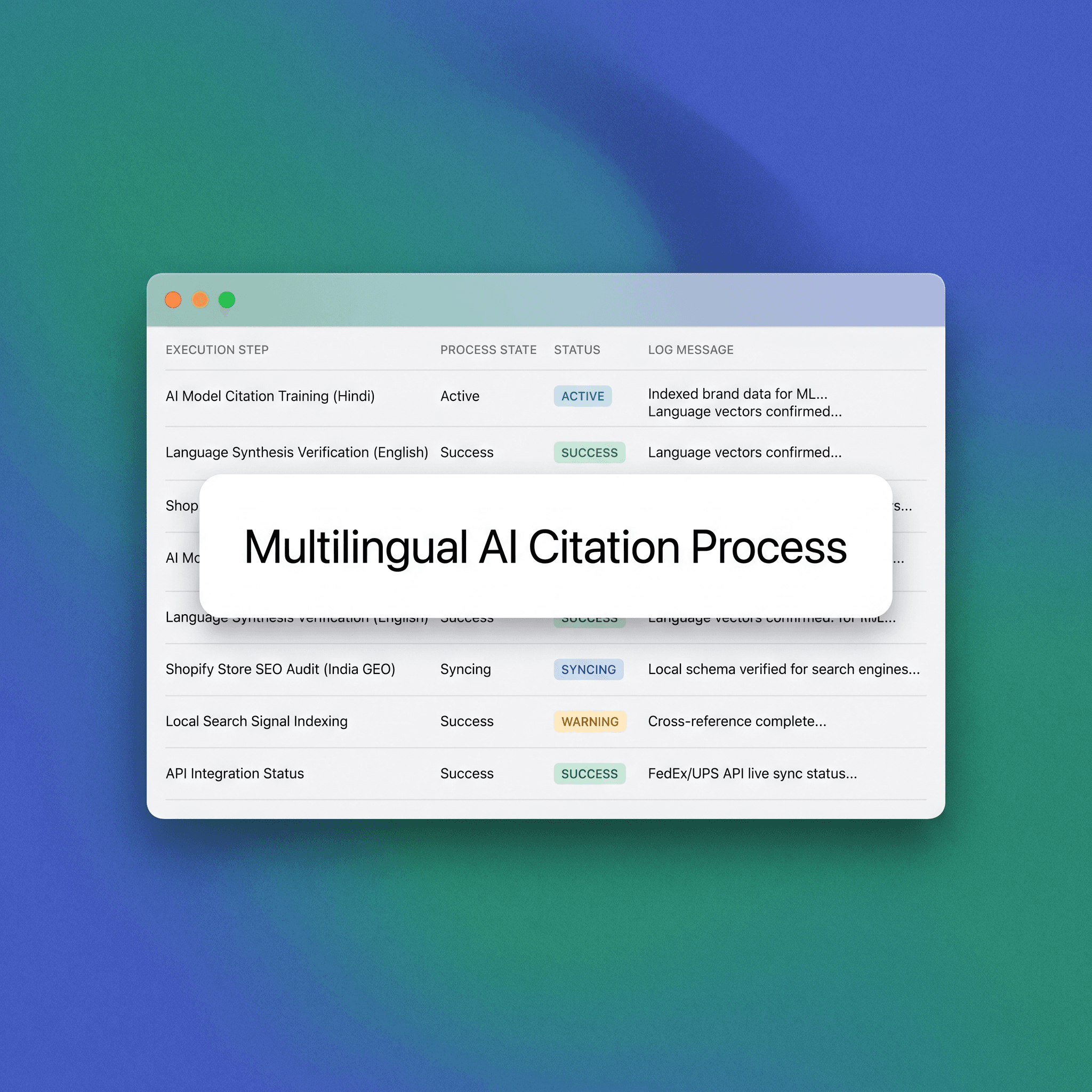
Indian shoppers are changing how they search. A growing percentage of product discovery, comparison, and purchase intent queries in India are now resolved not by clicking a list of ten blue links but by reading an AI-generated summary at the top of the results page. Google AI Overviews, Perplexity, and Bing Copilot are all surfacing synthesised answers derived from content that those systems judge to be structured, authoritative, and contextually aligned with the query. For Shopify D2C brands operating in India, this shift has a very specific implication: if your content is not architected to be cited by AI, it is increasingly invisible to the top of the funnel, even if your SEO rankings look healthy on paper. The brands that understand Generative Engine Optimisation — what most practitioners are now calling GEO — and apply it to both English and Hindi content will have a structural visibility advantage that is very difficult for competitors to close quickly. This guide explains exactly what that means and how to execute it. This paradigm shift requires a fundamental pivot from traditional keyword-stuffing methodologies toward a sophisticated semantic understanding of user intent within the Indian digital ecosystem. Because AI models function by synthesizing massive datasets into concise, actionable summaries, they inherently favor content that prioritizes clarity, structural hierarchy, and direct, authoritative answers. For Indian D2C brands, this represents a unique window to dominate niche categories before legacy competitors pivot their massive, legacy-heavy content architectures to accommodate these new AI-driven ranking requirements. Successfully navigating this transition involves deep technical integration, specifically regarding schema deployment, while maintaining a consistent brand voice that resonates across diverse linguistic landscapes. Brands must view this not as an optional add-on to their existing marketing stack but as a critical evolution of their foundational growth infrastructure.
What Generative Engine Optimisation Actually Means for Indian D2C Brands
Generative Engine Optimisation is the practice of structuring content so that AI systems select it as a source when composing a generated answer. Traditional SEO optimised for ranking. GEO optimises for citation. The distinction matters because the mechanism is different. A search engine ranks pages based on authority, relevance signals, and technical quality. An AI system cites sources based on how clearly, completely, and credibly those sources answer a specific question. A page can rank well and never be cited by AI. Conversely, a well-structured piece of content on a lower-authority domain can get cited repeatedly if it directly and precisely answers high-intent questions. This requires a rigorous audit of your existing content to identify gaps where your current messaging fails to provide the crisp, unambiguous information AI models demand. By shifting focus toward the informational utility of each page, D2C operators can significantly increase their footprint within AI Overviews, which act as the new gateway for modern consumers. This strategy is intrinsically tied to building trust with both the algorithms and the end-user, ensuring that every piece of content functions as a definitive answer to a specific pain point. Consequently, your brand positioning must become more granular, moving away from broad, generic category descriptions and toward specific, solution-oriented content that addresses the unique queries of the Indian consumer. This proactive approach turns your website into a reliable source of truth, establishing an authority profile that AI models are mathematically incentivized to prioritize.
For Indian D2C brands, this creates a genuine and underappreciated opportunity. India is one of the fastest-growing markets for AI-assisted search, and the content infrastructure supporting Hindi and regional language AI citations is still underdeveloped. Most Indian D2C brands have either no Hindi content, or Hindi content that was produced purely for social media rather than structured for AI retrieval. English content produced by Indian brands tends to be thin, promotional in tone, and not structured around the specific question formats that AI systems prefer. The gap between where most brands currently sit and what AI-citation-ready content looks like is wide enough that a well-executed GEO strategy in 2026 can generate disproportionate visibility gains relative to the investment required. By aggressively claiming territory in the Hindi-language search landscape, brands can capture a high-intent audience that is currently being ignored or poorly served by competitors stuck in an English-only, traditional SEO mindset. This requires a sophisticated translation and localization process where the goal is not just linguistic accuracy but cultural and intent-based alignment. As the Indian digital market continues to mature, the brands that have already optimized their content for AI retrieval will enjoy the compound interest of early adoption. Furthermore, this strategic investment builds a protective moat around your brand, making it significantly harder for new entrants to displace your established authority in both English and Hindi AI-generated search results.
Why Hindi and English GEO Require Different Strategies
The assumption most brands make is that GEO strategy is language-agnostic — write good content, structure it well, and it works in any language. That assumption breaks down in the Indian market for several reasons that are specific to how Indian consumers search and how AI systems process multilingual queries. This divergence occurs because language is not merely a vehicle for communication but a marker of cultural context, search history, and intent-driven behavior. AI models trained on multilingual datasets in the Indian context demonstrate a clear preference for content that reflects the nuances of regional linguistic patterns rather than sanitized, direct translations. By neglecting these differences, brands risk being penalized by AI systems that perceive translated content as lacking the natural, conversational depth required for authoritative citation. A sophisticated GEO approach recognizes that Hindi speakers often employ more descriptive, problem-centric language, while English-speaking Indian users may favor more technical, transactional terminology. Effectively addressing this requires the development of distinct, parallel content tracks that acknowledge these variations in user behavior and intent. This granular focus ensures that your brand remains relevant across the full spectrum of the Indian customer journey, from initial discovery in a native language to deep comparison in English.
Hindi search queries in India carry different intent patterns than English queries on the same topic. A consumer searching in Hindi is more likely to be in a discovery or comparison phase, using conversational phrasing, voice-driven syntax, and localised framing. A consumer searching in English is more likely to be in a higher-consideration phase, looking for specific product information, brand comparisons, or operational details. AI systems trained on Indian language data recognise these distinctions, and the content that gets cited for a Hindi query is typically structured differently from content that gets cited for an English query on the same subject. This fundamental behavioral disparity mandates that brands rethink their keyword research methodologies to incorporate linguistic-specific intent modeling. For instance, while an English user might search for "best skincare for dry skin," a Hindi user might ask a more holistic, wellness-oriented question that requires a nuanced, expert-led response rather than a standard product pitch. By aligning your content structure with these specific cultural expectations, you provide AI systems with the high-quality, contextual training data they require to confidently recommend your brand. This level of precision is the cornerstone of effective GEO in India, distinguishing top-tier brands from those who rely on outdated, monolithic content strategies.
English GEO for Indian D2C brands needs to prioritise structured authority — clear definitions, comparative information, process explanations, and first-person operational expertise. Hindi GEO needs to prioritise conversational directness and question-answer alignment. Both require avoiding the dense, promotional writing that characterises most D2C brand blog and category content today. The practical implication is that you cannot simply translate your English GEO content into Hindi and expect equivalent citation performance. The two language strategies need to be developed in parallel with separate intent mapping, separate structural choices, and separate quality benchmarks. This bifurcation of strategy is essential because, while the core brand identity remains consistent, the delivery mechanisms for information must evolve to meet the distinct needs of each language segment. Brands that invest in native-speaker, expert-led content creation for both languages will find themselves far ahead of the curve, as they effectively communicate their brand values while solving real-world consumer problems. Ultimately, this approach creates a robust content ecosystem where each piece of information is purpose-built to satisfy the specific algorithmic criteria of AI search engines in the Indian market. Such operational rigor prevents the dilution of your content’s impact and ensures that you are providing a cohesive, high-quality experience that fosters trust and drives long-term brand loyalty.
The D2C Language Visibility Matrix
The D2C Language Visibility Matrix is a decision framework for mapping your content investment to language, intent type, and AI citation readiness. It gives Shopify operators a structured way to audit what content they currently have, what is missing, and where to invest next to maximise GEO coverage across both Hindi and English search surfaces. This tool serves as the tactical map for your entire content operation, preventing resource leakage by identifying high-impact areas that correlate with the highest likelihood of AI citation. By visualizing your content library through this matrix, you can shift from a reactive content creation model to a strategic, data-driven approach that anticipates consumer needs. The framework simplifies complex decision-making processes by categorizing every asset according to its functional utility, ensuring that your team maintains a balanced, high-performing content portfolio. As the AI landscape evolves, this matrix can be adjusted to account for new citation signals or changes in search engine algorithms, maintaining its relevance as your primary optimization guide. Implementing this system requires a disciplined approach, but it pays dividends in the form of increased visibility and, ultimately, higher conversion rates through improved AI-assisted discovery.
The matrix operates across three dimensions. The first dimension is query language — English or Hindi. The second dimension is intent type — discovery, comparison, or decision. The third dimension is content format — explanatory article, structured FAQ, product narrative, or process guide. Each cell in the matrix represents a content type that either exists, is partially developed, or is absent from your current content library. The cells that are absent in high-intent categories represent your most valuable GEO gaps. By systematically populating these cells, you ensure comprehensive coverage of the entire purchase funnel, leaving no opportunity for AI-driven discovery to fall to competitors. This methodology transforms your website from a passive digital storefront into an active participant in the AI-generated search ecosystem. It also allows for clear, quantifiable reporting on your progress, as you can track the growth of your visibility matrix alongside the uptick in AI-referral traffic. This level of clarity is vital for D2C leadership, as it justifies the necessary investment in high-quality content production and technical infrastructure needed to stay competitive in 2026.
Discovery Intent
Discovery intent queries are the top-of-funnel searches where consumers are not yet product-aware. In English, these look like broad category searches or problem-statement searches. In Hindi, they tend to be phrased as open questions, sometimes voice-driven. Discovery content that performs well for GEO is structured around clear problem definitions, category explanations, and beginner-level guides that answer the question completely in the first 200–300 words before elaborating further. D2C brands that produce this kind of content in Hindi are currently operating in very low competition, which means AI citation rates are disproportionately high relative to content effort. To excel here, your content must act as an educational bridge, transforming a vague user query into a coherent, brand-aligned understanding of the solution space. By prioritizing the "what" and "why" of the problem, you establish your brand as an expert resource before the consumer has even decided on a specific product category. This proactive positioning is critical for long-term brand equity, as it places your brand at the very beginning of the consumer’s decision-making process. The goal is to provide enough value within the initial AI summary that the user is naturally incentivized to click through to your domain for deeper, more specialized insights.
Comparison Intent
Comparison intent is the highest-value GEO territory for D2C brands. When a shopper is comparing options and an AI system generates a synthesised answer to their comparison query, the sources cited in that answer get attributed. Brands whose content is structured to directly address comparison queries get cited. Brands whose content is written in a promotional or vague way do not. In English, this means building structured comparison pages and articles that name alternatives directly and explain trade-offs clearly. In Hindi, this means creating comparison content that matches the specific phrasing patterns Hindi speakers use when evaluating products in your category. Success in this area requires a radical commitment to objectivity; if your content only highlights your brand's virtues while ignoring competitors, AI models will recognize the inherent bias and likely avoid citing you as a neutral source. Instead, provide a balanced, data-driven analysis that helps the user make an informed decision, even if that means acknowledging the strengths of alternatives. By becoming the go-to resource for objective comparison, you naturally embed your brand into the most critical stage of the buyer’s journey, significantly increasing your conversion potential. This strategy effectively turns your website into a helpful consultant, which is exactly the kind of role AI systems are designed to favor for user recommendations.
Decision Intent
Decision intent is the closest to purchase — queries like "which brand to buy for X" or "best option for Y situation." This content needs to be authoritative, specific, and structured around a clear recommendation with supporting reasoning. In English, this often means detailed product guides, expert recommendations, and use-case-specific articles. In Hindi, this means content that speaks directly to the specific decision context of your target buyer, using language and references that are locally relevant rather than translated from an English original. This stage requires a high degree of confidence and clarity, as you are providing the final nudge that turns a researcher into a buyer. By utilizing authoritative, evidence-backed language, your content gains the credibility necessary to be prioritized by AI systems when they need to provide a definitive answer to a purchase query. This involves ensuring your product pages, buying guides, and expert recommendations are fully optimized with relevant, high-fidelity schema data that makes it easy for AI to parse your claims. Effectively capturing this intent ensures that you are present exactly when the consumer is ready to transact, maximizing the ROI of your entire content operation. Furthermore, establishing this level of authority creates a powerful psychological effect, reinforcing consumer trust in your brand as the expert in your specific niche.
How to Structure Shopify Content for AI Citation in India
Structuring content for AI citation is not the same as structuring content for traditional on-page SEO. The core principles are different, the format requirements are different, and the common pitfalls are different. The following implementation process reflects what works specifically for Indian D2C brands operating on Shopify who are building GEO-optimised content for both Hindi and English. This systematic approach ensures that every element of your site—from technical schema to copy structure—is optimized to communicate clearly with AI crawlers. By following these steps, you build a foundation of technical and structural excellence that allows your site to stand out in the crowded Indian ecommerce space. Each step is designed to address a specific technical or strategic requirement, ensuring that your brand’s content is not just visible, but inherently citation-worthy. This is a deliberate, multi-dimensional effort that requires coordination between your design, development, and content teams to ensure seamless implementation across your entire Shopify environment. As you refine this process, you will find that the improvements made for AI search often lead to better overall user experience and performance for humans, creating a win-win scenario for your brand's long-term growth.
Step 1: Build a Query Intent Inventory
Before writing a single piece of content, build a complete inventory of the queries your target buyers are asking in both Hindi and English. This is not a keyword list. It is a question inventory. For each product category you operate in, identify the top 10 discovery questions, top 10 comparison questions, and top 5 decision questions in English. Then repeat the exercise in Hindi, using native-speaker input rather than translation tools, because the phrasing will be structurally different. Use Google Search Console, Google Autocomplete, People Also Ask boxes, and Perplexity query suggestions to populate this list. The inventory becomes your GEO content brief library. This exhaustive inventory provides the raw material for all your future content, ensuring that your output is always aligned with actual consumer demand rather than internal assumptions. By treating this as a live, evolving document, you ensure your strategy stays ahead of shifting market trends and changing consumer behavior in the Indian context. This meticulous preparation prevents "guess-and-check" content creation and ensures that every dollar spent on production delivers maximum value in terms of potential AI citation.
Step 2: Write to Answer, Not to Rank
AI systems cite content that answers a question directly. The single biggest structural change most D2C brands need to make is reversing the order in which they present information. Most brand content buries the answer inside the article after paragraphs of context. GEO-optimised content states the answer in the first 2–3 sentences, then builds the supporting explanation. This is called answer-first structure and it is the most reliable format for triggering AI citations. Apply this to every blog post, category description, FAQ page, and product guide on your Shopify store. In Hindi content, this structure aligns naturally with conversational search phrasing, making citation performance even stronger. This stylistic shift forces your content teams to prioritize clarity and conciseness, which is essential for competing in an attention-constrained digital environment. By leading with the answer, you satisfy the primary goal of the user (and the AI), creating a positive feedback loop that encourages the algorithm to reward your content with higher visibility. This disciplined approach ensures your brand is perceived as helpful and expert, which is the ultimate currency for building long-term authority in the eyes of both users and machines.
Step 3: Add Schema Markup to All Structured Content
Schema markup is the technical layer that tells AI systems what type of content is on your page and how to interpret it. For D2C Shopify brands, the most important schema types for GEO are FAQPage schema, Article schema, Product schema, and HowTo schema. Shopify's native schema support covers Product schema well but requires custom implementation for FAQ and Article schema. Use a Shopify app or custom JSON-LD injection to add FAQPage schema to every page that contains a question-and-answer block. This dramatically increases the likelihood that your FAQ content surfaces inside AI-generated answers. Implement in both English and Hindi content libraries. This technical rigor is non-negotiable in the age of AI search, as it provides the explicit signals that crawlers need to categorize your content accurately. Without this layer, your content is essentially invisible to the automated systems that structure the modern internet. By investing in this technical setup, you provide your brand with a permanent competitive advantage, as many of your rivals will struggle with or ignore the complexities of proper schema implementation.
Step 4: Build Language-Specific Content Hubs
A content hub is a cluster of interlinked articles around a central topic. For GEO purposes, a hub tells AI systems that your domain has depth and authority on a specific subject. For Indian D2C brands, the most effective GEO structure is a separate hub for Hindi content and a separate hub for English content, each built around the top 3–5 categories that matter most to your buyer. The hub should include a central pillar page — a comprehensive guide — and 6–10 supporting articles that address specific questions within that topic. Link the supporting articles to the pillar and link the pillar back to each supporting article. This internal architecture improves AI citation rates because it signals both breadth and specificity. By creating these dedicated silos, you help AI systems easily map the topical authority of your domain, ensuring that they associate your brand with the relevant subject matter in both language streams. This is especially vital in the Indian market, where building a sense of "expert authority" can often be the deciding factor in a consumer's choice of brand.
Step 5: Monitor for Citation Appearance and Iterate
GEO measurement is still developing as a discipline, but there are practical signals you can track today. Monitor your branded queries in Perplexity and Google AI Overviews monthly and note which of your pages are being cited. Use Google Search Console to track impressions and click data from AI Overview referrals, which Google is now separating in the interface. Set up a regular audit of your top 20 target queries in both Hindi and English and document whether your content is surfacing in the generated answer, surfacing as a linked source below the answer, or not surfacing at all. Each outcome requires a different optimisation response. This analytical feedback loop allows you to refine your approach continually, identifying what works and discarding what doesn't. As you gain more data, you can optimize your content for even more specific, higher-intent queries, further cementing your authority. Treating GEO as a process of continuous improvement is the only way to stay ahead of the rapidly changing AI search environment, where algorithms are constantly being refined.
Common GEO Mistakes Indian D2C Brands Make
Most Indian D2C brands approaching GEO for the first time make a predictable set of errors that reduce citation performance significantly. Recognising these before investing content budget is worth more than any single tactical fix. By systematically avoiding these pitfalls, your team saves valuable time and resources while ensuring your content remains optimized for the highest possible performance. Many of these mistakes stem from applying outdated, traditional SEO logic to a fundamentally different technological paradigm. Understanding these common failure points allows you to build a more resilient strategy, one that accounts for the unique challenges and opportunities of the 2026 search landscape. Ultimately, it is the absence of these errors—rather than the presence of any single "trick"—that will allow your brand to consistently appear in AI-generated search results.
Translating English GEO content: Translating English GEO content into Hindi without adapting the structure or phrasing, which produces content that does not match the query patterns Hindi speakers actually use.
Building Generic FAQ sections: Building FAQ sections that answer generic questions rather than the specific high-intent questions real buyers are asking in your category.
Inconsistent answer-first structures: Writing answer-first only on FAQ pages and continuing to use a traditional long-preamble structure on blog posts and category pages, leaving most of your content GEO-ineffective.
Thin product descriptions: Using thin product descriptions that repeat specification data but never address the use-case or comparison questions buyers bring to a search.
Ignoring schema markup: Ignoring schema markup because it feels technical, missing the primary structural signal that AI systems use to classify and retrieve content.
Undervaluing Hindi quality: Producing Hindi content at a lower quality threshold than English content, treating it as a secondary market when Hindi-language GEO competition is currently lower and citation rates are proportionally higher.
Measuring via wrong metrics: Measuring GEO success only through organic search traffic rather than tracking citation appearances directly, which leads to misreading early GEO investment as underperforming.
Comparing Traditional SEO and GEO for Shopify India
The following comparison reflects where traditional SEO and GEO diverge in terms of what they optimise for and what execution looks like for an Indian D2C brand operating on Shopify. Traditional SEO is primarily concerned with the "crawling and indexing" phase of search, whereas GEO is focused on the "synthesizing and answering" phase. Understanding these differences allows your team to maintain two distinct, yet complementary, workflows that cover both traditional organic search and the emerging AI-driven landscape. This dual approach ensures your brand captures traffic from both legacy search users and the growing audience of AI-assisted shoppers.
Dimension | Traditional SEO | GEO |
Primary goal | Rank on page one | Get cited inside AI-generated answers |
Content structure | Keyword density and header hierarchy | Answer-first with complete question resolution |
Success metric | Organic impressions and click-through rate | Citation appearances and attributed traffic |
Language approach | Single-language primary content | Parallel Hindi and English content with separate intent mapping |
Schema priority | Meta tags, title tags, alt text | FAQPage, Article, HowTo, and Product schema |
Competition level for Hindi | Moderate and growing | Currently low and highly accessible |
Time to impact | 3–6 months for new content | 4–8 weeks for well-structured answer-first content |
Building GEO Into Your Shopify Content Operations in 2026
GEO is not a campaign. It is an operational shift in how your content team thinks about the purpose and structure of every piece of content it produces. The brands that will have meaningful AI citation visibility in India by the end of 2026 are the ones that start building the query intent inventory, implementing schema infrastructure, and producing answer-first content in both Hindi and English now rather than treating it as a future consideration. The window of low competition in Hindi GEO is real and it will close as more brands recognise the opportunity. The English GEO landscape is more competitive but still structurally accessible for brands willing to invest in comparative and decision-intent content built around real buyer questions rather than keyword density. For Shopify operators specifically, the technical lift required to support GEO is modest — schema implementation, internal hub architecture, and content reformatting are all achievable within standard development and content operations budgets. The strategic lift is more significant: it requires a different brief format, a different quality bar for Hindi content, and a different success metric than your current SEO programme. The brands that align their content operations to these new requirements in 2026 are building a compounding asset that will generate discovery and attribution well beyond the organic channels they currently depend on.
If schema implementation is a blocker on your Shopify store, that is typically a one-session technical fix — not a project. Reach out to the Project Supply team to assess what is already in place and what needs adding.
Indian shoppers are changing how they search. A growing percentage of product discovery, comparison, and purchase intent queries in India are now resolved not by clicking a list of ten blue links but by reading an AI-generated summary at the top of the results page. Google AI Overviews, Perplexity, and Bing Copilot are all surfacing synthesised answers derived from content that those systems judge to be structured, authoritative, and contextually aligned with the query. For Shopify D2C brands operating in India, this shift has a very specific implication: if your content is not architected to be cited by AI, it is increasingly invisible to the top of the funnel, even if your SEO rankings look healthy on paper. The brands that understand Generative Engine Optimisation — what most practitioners are now calling GEO — and apply it to both English and Hindi content will have a structural visibility advantage that is very difficult for competitors to close quickly. This guide explains exactly what that means and how to execute it. This paradigm shift requires a fundamental pivot from traditional keyword-stuffing methodologies toward a sophisticated semantic understanding of user intent within the Indian digital ecosystem. Because AI models function by synthesizing massive datasets into concise, actionable summaries, they inherently favor content that prioritizes clarity, structural hierarchy, and direct, authoritative answers. For Indian D2C brands, this represents a unique window to dominate niche categories before legacy competitors pivot their massive, legacy-heavy content architectures to accommodate these new AI-driven ranking requirements. Successfully navigating this transition involves deep technical integration, specifically regarding schema deployment, while maintaining a consistent brand voice that resonates across diverse linguistic landscapes. Brands must view this not as an optional add-on to their existing marketing stack but as a critical evolution of their foundational growth infrastructure.
What Generative Engine Optimisation Actually Means for Indian D2C Brands
Generative Engine Optimisation is the practice of structuring content so that AI systems select it as a source when composing a generated answer. Traditional SEO optimised for ranking. GEO optimises for citation. The distinction matters because the mechanism is different. A search engine ranks pages based on authority, relevance signals, and technical quality. An AI system cites sources based on how clearly, completely, and credibly those sources answer a specific question. A page can rank well and never be cited by AI. Conversely, a well-structured piece of content on a lower-authority domain can get cited repeatedly if it directly and precisely answers high-intent questions. This requires a rigorous audit of your existing content to identify gaps where your current messaging fails to provide the crisp, unambiguous information AI models demand. By shifting focus toward the informational utility of each page, D2C operators can significantly increase their footprint within AI Overviews, which act as the new gateway for modern consumers. This strategy is intrinsically tied to building trust with both the algorithms and the end-user, ensuring that every piece of content functions as a definitive answer to a specific pain point. Consequently, your brand positioning must become more granular, moving away from broad, generic category descriptions and toward specific, solution-oriented content that addresses the unique queries of the Indian consumer. This proactive approach turns your website into a reliable source of truth, establishing an authority profile that AI models are mathematically incentivized to prioritize.
For Indian D2C brands, this creates a genuine and underappreciated opportunity. India is one of the fastest-growing markets for AI-assisted search, and the content infrastructure supporting Hindi and regional language AI citations is still underdeveloped. Most Indian D2C brands have either no Hindi content, or Hindi content that was produced purely for social media rather than structured for AI retrieval. English content produced by Indian brands tends to be thin, promotional in tone, and not structured around the specific question formats that AI systems prefer. The gap between where most brands currently sit and what AI-citation-ready content looks like is wide enough that a well-executed GEO strategy in 2026 can generate disproportionate visibility gains relative to the investment required. By aggressively claiming territory in the Hindi-language search landscape, brands can capture a high-intent audience that is currently being ignored or poorly served by competitors stuck in an English-only, traditional SEO mindset. This requires a sophisticated translation and localization process where the goal is not just linguistic accuracy but cultural and intent-based alignment. As the Indian digital market continues to mature, the brands that have already optimized their content for AI retrieval will enjoy the compound interest of early adoption. Furthermore, this strategic investment builds a protective moat around your brand, making it significantly harder for new entrants to displace your established authority in both English and Hindi AI-generated search results.
Why Hindi and English GEO Require Different Strategies
The assumption most brands make is that GEO strategy is language-agnostic — write good content, structure it well, and it works in any language. That assumption breaks down in the Indian market for several reasons that are specific to how Indian consumers search and how AI systems process multilingual queries. This divergence occurs because language is not merely a vehicle for communication but a marker of cultural context, search history, and intent-driven behavior. AI models trained on multilingual datasets in the Indian context demonstrate a clear preference for content that reflects the nuances of regional linguistic patterns rather than sanitized, direct translations. By neglecting these differences, brands risk being penalized by AI systems that perceive translated content as lacking the natural, conversational depth required for authoritative citation. A sophisticated GEO approach recognizes that Hindi speakers often employ more descriptive, problem-centric language, while English-speaking Indian users may favor more technical, transactional terminology. Effectively addressing this requires the development of distinct, parallel content tracks that acknowledge these variations in user behavior and intent. This granular focus ensures that your brand remains relevant across the full spectrum of the Indian customer journey, from initial discovery in a native language to deep comparison in English.
Hindi search queries in India carry different intent patterns than English queries on the same topic. A consumer searching in Hindi is more likely to be in a discovery or comparison phase, using conversational phrasing, voice-driven syntax, and localised framing. A consumer searching in English is more likely to be in a higher-consideration phase, looking for specific product information, brand comparisons, or operational details. AI systems trained on Indian language data recognise these distinctions, and the content that gets cited for a Hindi query is typically structured differently from content that gets cited for an English query on the same subject. This fundamental behavioral disparity mandates that brands rethink their keyword research methodologies to incorporate linguistic-specific intent modeling. For instance, while an English user might search for "best skincare for dry skin," a Hindi user might ask a more holistic, wellness-oriented question that requires a nuanced, expert-led response rather than a standard product pitch. By aligning your content structure with these specific cultural expectations, you provide AI systems with the high-quality, contextual training data they require to confidently recommend your brand. This level of precision is the cornerstone of effective GEO in India, distinguishing top-tier brands from those who rely on outdated, monolithic content strategies.
English GEO for Indian D2C brands needs to prioritise structured authority — clear definitions, comparative information, process explanations, and first-person operational expertise. Hindi GEO needs to prioritise conversational directness and question-answer alignment. Both require avoiding the dense, promotional writing that characterises most D2C brand blog and category content today. The practical implication is that you cannot simply translate your English GEO content into Hindi and expect equivalent citation performance. The two language strategies need to be developed in parallel with separate intent mapping, separate structural choices, and separate quality benchmarks. This bifurcation of strategy is essential because, while the core brand identity remains consistent, the delivery mechanisms for information must evolve to meet the distinct needs of each language segment. Brands that invest in native-speaker, expert-led content creation for both languages will find themselves far ahead of the curve, as they effectively communicate their brand values while solving real-world consumer problems. Ultimately, this approach creates a robust content ecosystem where each piece of information is purpose-built to satisfy the specific algorithmic criteria of AI search engines in the Indian market. Such operational rigor prevents the dilution of your content’s impact and ensures that you are providing a cohesive, high-quality experience that fosters trust and drives long-term brand loyalty.
The D2C Language Visibility Matrix
The D2C Language Visibility Matrix is a decision framework for mapping your content investment to language, intent type, and AI citation readiness. It gives Shopify operators a structured way to audit what content they currently have, what is missing, and where to invest next to maximise GEO coverage across both Hindi and English search surfaces. This tool serves as the tactical map for your entire content operation, preventing resource leakage by identifying high-impact areas that correlate with the highest likelihood of AI citation. By visualizing your content library through this matrix, you can shift from a reactive content creation model to a strategic, data-driven approach that anticipates consumer needs. The framework simplifies complex decision-making processes by categorizing every asset according to its functional utility, ensuring that your team maintains a balanced, high-performing content portfolio. As the AI landscape evolves, this matrix can be adjusted to account for new citation signals or changes in search engine algorithms, maintaining its relevance as your primary optimization guide. Implementing this system requires a disciplined approach, but it pays dividends in the form of increased visibility and, ultimately, higher conversion rates through improved AI-assisted discovery.
The matrix operates across three dimensions. The first dimension is query language — English or Hindi. The second dimension is intent type — discovery, comparison, or decision. The third dimension is content format — explanatory article, structured FAQ, product narrative, or process guide. Each cell in the matrix represents a content type that either exists, is partially developed, or is absent from your current content library. The cells that are absent in high-intent categories represent your most valuable GEO gaps. By systematically populating these cells, you ensure comprehensive coverage of the entire purchase funnel, leaving no opportunity for AI-driven discovery to fall to competitors. This methodology transforms your website from a passive digital storefront into an active participant in the AI-generated search ecosystem. It also allows for clear, quantifiable reporting on your progress, as you can track the growth of your visibility matrix alongside the uptick in AI-referral traffic. This level of clarity is vital for D2C leadership, as it justifies the necessary investment in high-quality content production and technical infrastructure needed to stay competitive in 2026.
Discovery Intent
Discovery intent queries are the top-of-funnel searches where consumers are not yet product-aware. In English, these look like broad category searches or problem-statement searches. In Hindi, they tend to be phrased as open questions, sometimes voice-driven. Discovery content that performs well for GEO is structured around clear problem definitions, category explanations, and beginner-level guides that answer the question completely in the first 200–300 words before elaborating further. D2C brands that produce this kind of content in Hindi are currently operating in very low competition, which means AI citation rates are disproportionately high relative to content effort. To excel here, your content must act as an educational bridge, transforming a vague user query into a coherent, brand-aligned understanding of the solution space. By prioritizing the "what" and "why" of the problem, you establish your brand as an expert resource before the consumer has even decided on a specific product category. This proactive positioning is critical for long-term brand equity, as it places your brand at the very beginning of the consumer’s decision-making process. The goal is to provide enough value within the initial AI summary that the user is naturally incentivized to click through to your domain for deeper, more specialized insights.
Comparison Intent
Comparison intent is the highest-value GEO territory for D2C brands. When a shopper is comparing options and an AI system generates a synthesised answer to their comparison query, the sources cited in that answer get attributed. Brands whose content is structured to directly address comparison queries get cited. Brands whose content is written in a promotional or vague way do not. In English, this means building structured comparison pages and articles that name alternatives directly and explain trade-offs clearly. In Hindi, this means creating comparison content that matches the specific phrasing patterns Hindi speakers use when evaluating products in your category. Success in this area requires a radical commitment to objectivity; if your content only highlights your brand's virtues while ignoring competitors, AI models will recognize the inherent bias and likely avoid citing you as a neutral source. Instead, provide a balanced, data-driven analysis that helps the user make an informed decision, even if that means acknowledging the strengths of alternatives. By becoming the go-to resource for objective comparison, you naturally embed your brand into the most critical stage of the buyer’s journey, significantly increasing your conversion potential. This strategy effectively turns your website into a helpful consultant, which is exactly the kind of role AI systems are designed to favor for user recommendations.
Decision Intent
Decision intent is the closest to purchase — queries like "which brand to buy for X" or "best option for Y situation." This content needs to be authoritative, specific, and structured around a clear recommendation with supporting reasoning. In English, this often means detailed product guides, expert recommendations, and use-case-specific articles. In Hindi, this means content that speaks directly to the specific decision context of your target buyer, using language and references that are locally relevant rather than translated from an English original. This stage requires a high degree of confidence and clarity, as you are providing the final nudge that turns a researcher into a buyer. By utilizing authoritative, evidence-backed language, your content gains the credibility necessary to be prioritized by AI systems when they need to provide a definitive answer to a purchase query. This involves ensuring your product pages, buying guides, and expert recommendations are fully optimized with relevant, high-fidelity schema data that makes it easy for AI to parse your claims. Effectively capturing this intent ensures that you are present exactly when the consumer is ready to transact, maximizing the ROI of your entire content operation. Furthermore, establishing this level of authority creates a powerful psychological effect, reinforcing consumer trust in your brand as the expert in your specific niche.
How to Structure Shopify Content for AI Citation in India
Structuring content for AI citation is not the same as structuring content for traditional on-page SEO. The core principles are different, the format requirements are different, and the common pitfalls are different. The following implementation process reflects what works specifically for Indian D2C brands operating on Shopify who are building GEO-optimised content for both Hindi and English. This systematic approach ensures that every element of your site—from technical schema to copy structure—is optimized to communicate clearly with AI crawlers. By following these steps, you build a foundation of technical and structural excellence that allows your site to stand out in the crowded Indian ecommerce space. Each step is designed to address a specific technical or strategic requirement, ensuring that your brand’s content is not just visible, but inherently citation-worthy. This is a deliberate, multi-dimensional effort that requires coordination between your design, development, and content teams to ensure seamless implementation across your entire Shopify environment. As you refine this process, you will find that the improvements made for AI search often lead to better overall user experience and performance for humans, creating a win-win scenario for your brand's long-term growth.
Step 1: Build a Query Intent Inventory
Before writing a single piece of content, build a complete inventory of the queries your target buyers are asking in both Hindi and English. This is not a keyword list. It is a question inventory. For each product category you operate in, identify the top 10 discovery questions, top 10 comparison questions, and top 5 decision questions in English. Then repeat the exercise in Hindi, using native-speaker input rather than translation tools, because the phrasing will be structurally different. Use Google Search Console, Google Autocomplete, People Also Ask boxes, and Perplexity query suggestions to populate this list. The inventory becomes your GEO content brief library. This exhaustive inventory provides the raw material for all your future content, ensuring that your output is always aligned with actual consumer demand rather than internal assumptions. By treating this as a live, evolving document, you ensure your strategy stays ahead of shifting market trends and changing consumer behavior in the Indian context. This meticulous preparation prevents "guess-and-check" content creation and ensures that every dollar spent on production delivers maximum value in terms of potential AI citation.
Step 2: Write to Answer, Not to Rank
AI systems cite content that answers a question directly. The single biggest structural change most D2C brands need to make is reversing the order in which they present information. Most brand content buries the answer inside the article after paragraphs of context. GEO-optimised content states the answer in the first 2–3 sentences, then builds the supporting explanation. This is called answer-first structure and it is the most reliable format for triggering AI citations. Apply this to every blog post, category description, FAQ page, and product guide on your Shopify store. In Hindi content, this structure aligns naturally with conversational search phrasing, making citation performance even stronger. This stylistic shift forces your content teams to prioritize clarity and conciseness, which is essential for competing in an attention-constrained digital environment. By leading with the answer, you satisfy the primary goal of the user (and the AI), creating a positive feedback loop that encourages the algorithm to reward your content with higher visibility. This disciplined approach ensures your brand is perceived as helpful and expert, which is the ultimate currency for building long-term authority in the eyes of both users and machines.
Step 3: Add Schema Markup to All Structured Content
Schema markup is the technical layer that tells AI systems what type of content is on your page and how to interpret it. For D2C Shopify brands, the most important schema types for GEO are FAQPage schema, Article schema, Product schema, and HowTo schema. Shopify's native schema support covers Product schema well but requires custom implementation for FAQ and Article schema. Use a Shopify app or custom JSON-LD injection to add FAQPage schema to every page that contains a question-and-answer block. This dramatically increases the likelihood that your FAQ content surfaces inside AI-generated answers. Implement in both English and Hindi content libraries. This technical rigor is non-negotiable in the age of AI search, as it provides the explicit signals that crawlers need to categorize your content accurately. Without this layer, your content is essentially invisible to the automated systems that structure the modern internet. By investing in this technical setup, you provide your brand with a permanent competitive advantage, as many of your rivals will struggle with or ignore the complexities of proper schema implementation.
Step 4: Build Language-Specific Content Hubs
A content hub is a cluster of interlinked articles around a central topic. For GEO purposes, a hub tells AI systems that your domain has depth and authority on a specific subject. For Indian D2C brands, the most effective GEO structure is a separate hub for Hindi content and a separate hub for English content, each built around the top 3–5 categories that matter most to your buyer. The hub should include a central pillar page — a comprehensive guide — and 6–10 supporting articles that address specific questions within that topic. Link the supporting articles to the pillar and link the pillar back to each supporting article. This internal architecture improves AI citation rates because it signals both breadth and specificity. By creating these dedicated silos, you help AI systems easily map the topical authority of your domain, ensuring that they associate your brand with the relevant subject matter in both language streams. This is especially vital in the Indian market, where building a sense of "expert authority" can often be the deciding factor in a consumer's choice of brand.
Step 5: Monitor for Citation Appearance and Iterate
GEO measurement is still developing as a discipline, but there are practical signals you can track today. Monitor your branded queries in Perplexity and Google AI Overviews monthly and note which of your pages are being cited. Use Google Search Console to track impressions and click data from AI Overview referrals, which Google is now separating in the interface. Set up a regular audit of your top 20 target queries in both Hindi and English and document whether your content is surfacing in the generated answer, surfacing as a linked source below the answer, or not surfacing at all. Each outcome requires a different optimisation response. This analytical feedback loop allows you to refine your approach continually, identifying what works and discarding what doesn't. As you gain more data, you can optimize your content for even more specific, higher-intent queries, further cementing your authority. Treating GEO as a process of continuous improvement is the only way to stay ahead of the rapidly changing AI search environment, where algorithms are constantly being refined.
Common GEO Mistakes Indian D2C Brands Make
Most Indian D2C brands approaching GEO for the first time make a predictable set of errors that reduce citation performance significantly. Recognising these before investing content budget is worth more than any single tactical fix. By systematically avoiding these pitfalls, your team saves valuable time and resources while ensuring your content remains optimized for the highest possible performance. Many of these mistakes stem from applying outdated, traditional SEO logic to a fundamentally different technological paradigm. Understanding these common failure points allows you to build a more resilient strategy, one that accounts for the unique challenges and opportunities of the 2026 search landscape. Ultimately, it is the absence of these errors—rather than the presence of any single "trick"—that will allow your brand to consistently appear in AI-generated search results.
Translating English GEO content: Translating English GEO content into Hindi without adapting the structure or phrasing, which produces content that does not match the query patterns Hindi speakers actually use.
Building Generic FAQ sections: Building FAQ sections that answer generic questions rather than the specific high-intent questions real buyers are asking in your category.
Inconsistent answer-first structures: Writing answer-first only on FAQ pages and continuing to use a traditional long-preamble structure on blog posts and category pages, leaving most of your content GEO-ineffective.
Thin product descriptions: Using thin product descriptions that repeat specification data but never address the use-case or comparison questions buyers bring to a search.
Ignoring schema markup: Ignoring schema markup because it feels technical, missing the primary structural signal that AI systems use to classify and retrieve content.
Undervaluing Hindi quality: Producing Hindi content at a lower quality threshold than English content, treating it as a secondary market when Hindi-language GEO competition is currently lower and citation rates are proportionally higher.
Measuring via wrong metrics: Measuring GEO success only through organic search traffic rather than tracking citation appearances directly, which leads to misreading early GEO investment as underperforming.
Comparing Traditional SEO and GEO for Shopify India
The following comparison reflects where traditional SEO and GEO diverge in terms of what they optimise for and what execution looks like for an Indian D2C brand operating on Shopify. Traditional SEO is primarily concerned with the "crawling and indexing" phase of search, whereas GEO is focused on the "synthesizing and answering" phase. Understanding these differences allows your team to maintain two distinct, yet complementary, workflows that cover both traditional organic search and the emerging AI-driven landscape. This dual approach ensures your brand captures traffic from both legacy search users and the growing audience of AI-assisted shoppers.
Dimension | Traditional SEO | GEO |
Primary goal | Rank on page one | Get cited inside AI-generated answers |
Content structure | Keyword density and header hierarchy | Answer-first with complete question resolution |
Success metric | Organic impressions and click-through rate | Citation appearances and attributed traffic |
Language approach | Single-language primary content | Parallel Hindi and English content with separate intent mapping |
Schema priority | Meta tags, title tags, alt text | FAQPage, Article, HowTo, and Product schema |
Competition level for Hindi | Moderate and growing | Currently low and highly accessible |
Time to impact | 3–6 months for new content | 4–8 weeks for well-structured answer-first content |
Building GEO Into Your Shopify Content Operations in 2026
GEO is not a campaign. It is an operational shift in how your content team thinks about the purpose and structure of every piece of content it produces. The brands that will have meaningful AI citation visibility in India by the end of 2026 are the ones that start building the query intent inventory, implementing schema infrastructure, and producing answer-first content in both Hindi and English now rather than treating it as a future consideration. The window of low competition in Hindi GEO is real and it will close as more brands recognise the opportunity. The English GEO landscape is more competitive but still structurally accessible for brands willing to invest in comparative and decision-intent content built around real buyer questions rather than keyword density. For Shopify operators specifically, the technical lift required to support GEO is modest — schema implementation, internal hub architecture, and content reformatting are all achievable within standard development and content operations budgets. The strategic lift is more significant: it requires a different brief format, a different quality bar for Hindi content, and a different success metric than your current SEO programme. The brands that align their content operations to these new requirements in 2026 are building a compounding asset that will generate discovery and attribution well beyond the organic channels they currently depend on.
If schema implementation is a blocker on your Shopify store, that is typically a one-session technical fix — not a project. Reach out to the Project Supply team to assess what is already in place and what needs adding.
FAQs
Web Personalisation
Framer is a design tool that allows you to design websites on a freeform canvas, and then publish them as websites with a single click.
UI and UX Design
Framer is a design tool that allows you to design websites on a freeform canvas, and then publish them as websites with a single click.
Search Engine Optimisation
Framer is a design tool that allows you to design websites on a freeform canvas, and then publish them as websites with a single click.
CRM and ERP Solutions
Framer is a design tool that allows you to design websites on a freeform canvas, and then publish them as websites with a single click.
Ecommerce
Framer is a design tool that allows you to design websites on a freeform canvas, and then publish them as websites with a single click.
Email Marketing
Framer is a design tool that allows you to design websites on a freeform canvas, and then publish them as websites with a single click.
Marketing Automation
Framer is a design tool that allows you to design websites on a freeform canvas, and then publish them as websites with a single click.
Chatbots and Conversational AI
Framer is a design tool that allows you to design websites on a freeform canvas, and then publish them as websites with a single click.
Chatbots and Conversational AI
Framer is a design tool that allows you to design websites on a freeform canvas, and then publish them as websites with a single click.
Related Blogs
We know your space
Explore our latest UI/UX Case Studies that showcase how our process-driven creativity transforms complex ideas into real, measurable business results, step by step.

AI and Data Analytics
•
Aug 19, 2026
Context Engineering for Enterprise AI Agents: Memory, Retrieval, Tools and State Management

AI and Data Analytics
•
Aug 19, 2026
Enterprise RAG vs Agentic RAG vs AI Search: Which Architecture Should You Build?

AI and Data Analytics
•
Aug 19, 2026
Enterprise Semantic Layer for AI Agents: How to Produce Trusted Business Answers
Let's work together
Have a project in mind?
Let's make it real.
Tell us what you're building. We'll bring the design, technology, and thinking to make it happen.
Fill up the following form to start a conversation
with our team
Let's work together
Have a project in mind?
Let's make it real.
Tell us what you're building. We'll bring the design, technology, and thinking to make it happen.
Fill up the following form to start a conversation with our team
Let's work together
Have a project in mind?
Let's make it real.
Tell us what you're building. We'll bring the design, technology, and thinking to make it happen.
Fill up the following form to start a conversation
with our team
Services
Services
© 2026 projectsupply
Part of Tangle
Services
© 2026 projectsupply
Part of Tangle