

Shopify
Shopify Plus for Indian D2C Brands: When Does the Upgrade Actually Make Sense?
Shopify Plus for Indian D2C Brands: When Does the Upgrade Actually Make Sense?
Considering Shopify Plus for your Indian D2C brand? This guide breaks down when the upgrade is worth it, what you actually get, and the signals that say you're ready — or not.
Considering Shopify Plus for your Indian D2C brand? This guide breaks down when the upgrade is worth it, what you actually get, and the signals that say you're ready — or not.
08 min read
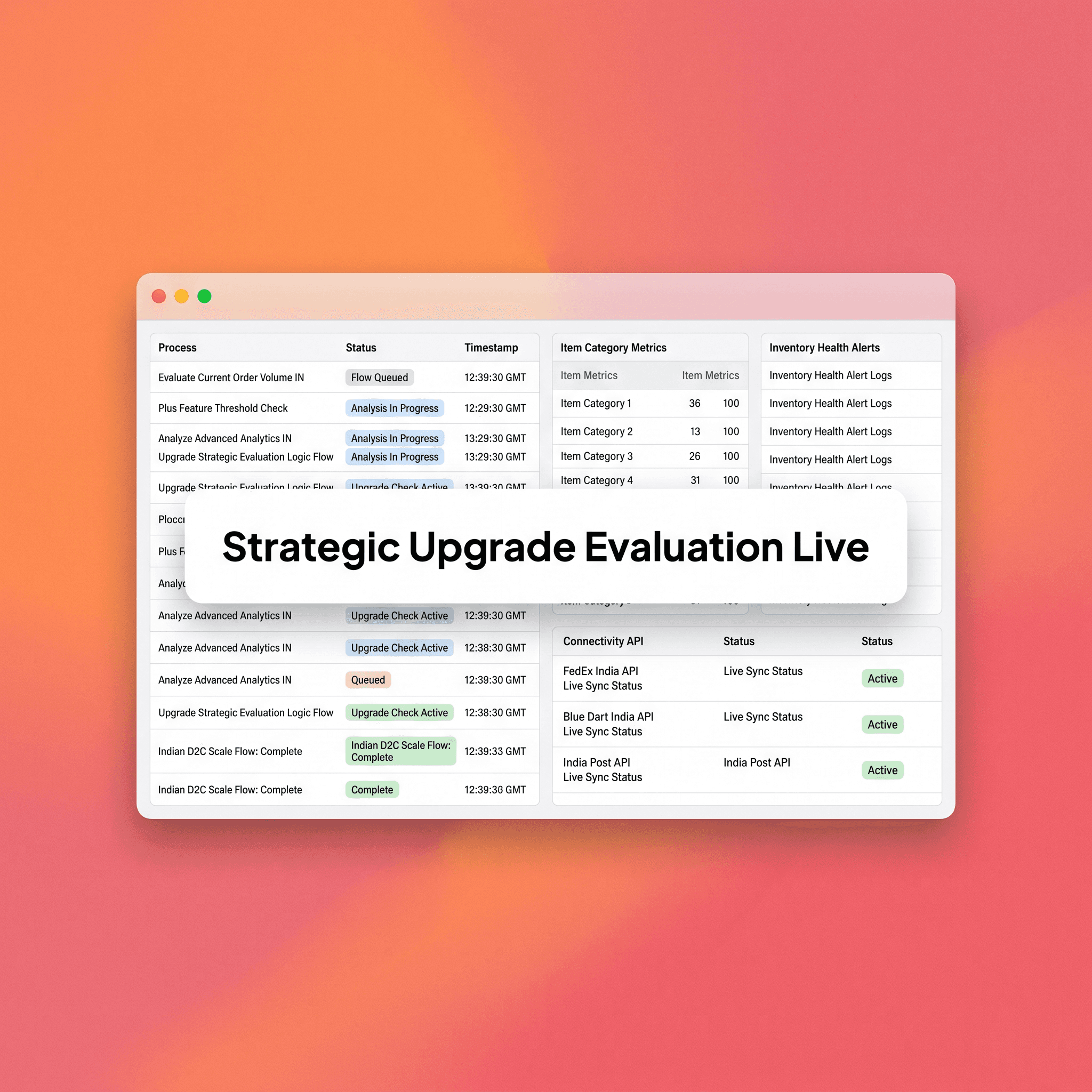
Shopify Plus for Indian D2C Brands: When Does the Upgrade Actually Make Sense? Shopify Plus gets recommended a lot by agencies looking to upsell and developers looking for more complex environments. It also gets sold to brands that aren't ready for it, leading to wasted capital and unused features that sit idle in the admin panel. If you're running a D2C brand in India and someone — a developer, an agency, or a random LinkedIn thread — has told you it's time to upgrade, this guide will help you decide whether they're right or if they are simply chasing a commission.
The short version: Shopify Plus is genuinely powerful, but it's designed for a specific operational scale where technical constraints inhibit growth. Below that scale, you're paying for infrastructure you won't use and increasing your overhead without any corresponding lift in operational efficiency.
Above it, not upgrading is what holds you back, as standard plans lack the robustness to handle the high-volume traffic spikes and intricate checkout logic typical of maturing brands. Here's how to know which side of that line you're on by evaluating your internal processes, technical debt, and long-term expansion roadmap.
What Shopify Plus Actually Is (And What It Isn't)
Shopify Plus is Shopify's enterprise tier, serving as the backbone for some of the largest global e-commerce operations. It's not just a faster or more premium version of the standard plan — it's a completely different operational environment built for brands running complex, high-volume commerce that requires granular control. What you actually get beyond standard Shopify includes:
Shopify Scripts — Access to server-side customising checkout logic, allowing for highly specific discounts, shipping rules, and payment method routing that standard themes cannot handle.
Checkout Extensibility — Deeper UI and logic control at the checkout stage, enabling brands to inject custom fields and messaging without losing the stability of the hosted, PCI-compliant environment.
Shopify Flow — Access to a powerful visual automation engine for advanced workflows across fulfilment, inventory tagging, fraud mitigation, and high-value customer retention efforts.
Expansion Stores — Up to 9 additional stores under a single contract, which is incredibly useful for multi-region localization, brand splitting, or separating your B2B and D2C customer journeys.
Dedicated Support — Access to a dedicated merchant success manager who can assist with platform navigation, roadmap planning, and troubleshooting during high-traffic sales events.
Launchpad — A comprehensive tool for scheduling automated campaigns, seasonal sales, and inventory changes, ensuring that your site shifts perfectly in sync with your marketing calendar.
Transaction Fee Optimization — Significantly lower transaction fees for brands operating at very high GMV, which can result in thousands of dollars of monthly savings.
B2B Commerce Tools — Native support for wholesale portals, net payment terms, custom price lists, and customer-specific product visibility, unifying your retail and wholesale operations. What Shopify Plus is not: a magic conversion fix that will solve your marketing problems, a substitute for a strong in-house tech stack, or a universal requirement for every brand simply doing serious revenue without operational complexity.
The Real Question: Scale, Complexity, or Both?
Most upgrade decisions come down to one of two distinct drivers — scale or complexity — and understanding which one is pushing you matters immensely, because they point to fundamentally different solutions.
Scale-Driven Upgrade
You're doing volume that standard Shopify handles technically, but the economics no longer work in your favour. Transaction fees at scale become a meaningful drag on your bottom line, and at higher revenue levels, the flat fee of Plus is almost always cheaper than the variable percentage fees on standard plans. The performance ceiling also starts showing during major festive traffic spikes in India, and you need the SLA-backed uptime guarantees that only an enterprise tier can provide to ensure your site doesn't crash when you have hundreds of thousands of concurrent visitors.
Complexity-Driven Upgrade
Your checkout logic has outgrown standard Shopify's capabilities, forcing you to use messy workarounds that break frequently and frustrate your users. You're running multiple brands or geographies from one account, necessitating centralized inventory and customer data management that standard Shopify cannot handle. Your retention and operations team needs sophisticated, automated triggers that Shopify Flow can handle but standard Shopify can't access, forcing your team to perform high-volume tasks manually. Your wholesale or B2B channel is growing alongside D2C, requiring a unified backend to prevent inventory silos. The honest answer for most Indian D2C brands: complexity is usually the real trigger, not scale alone, as operational bottlenecks cost far more in wasted human labor than simple transaction fees.
The Plus Readiness Matrix — 6 Signals for Indian D2C Brands
Use this to pressure-test whether you're actually ready for Shopify Plus or whether the upgrade is premature and likely to become an expensive distraction.
Signal 1: GMV Threshold — If your monthly GMV is consistently above ₹2–3 crore and growing, the transaction fee savings on Plus start to offset the platform cost, justifying the migration on pure financial merit. Below that level, run the numbers carefully before committing — standard Shopify or Advanced may still be the better economic decision for your current profit margins.
Signal 2: Checkout Customisation Needs — Are you constantly working around checkout limitations with buggy third-party apps or custom hacks? Custom discount logic, complex conditional free shipping, loyalty redemption at the final payment stage, and dynamic COD/prepaid routing are all high-level requirements — if you're trying to build this and hitting technical walls, that is a definitive Plus signal.
Signal 3: Campaign Operations Complexity — If you're running frequent flash sales, influencer-driven drops, or large-scale festive sales and your team is manually enabling and disabling discounts, changing themes, and updating inventory thresholds by hand, Launchpad is the solution. If you do only one or two small sales events a year, the manual effort is negligible and not worth the overhead of an enterprise upgrade.
Signal 4: Multi-Store or Multi-Brand Architecture — Running more than one brand or planning international expansion into new currencies and markets? The expansion store model in Shopify Plus lets you manage multiple storefronts under one master account with shared apps and billing, which is essential for brand consistency. If your current architecture involves separate, disjointed accounts and duplicate overheads for every new brand, Plus consolidates this cleanly and efficiently.
Signal 5: Automation Debt — Count the manual operational tasks your team runs every week: tagging high-value customers, routing orders to specific fulfilment partners, handling fraud flags, managing restock alerts, and sending post-purchase sequences. If a meaningful part of your team's time is dedicated to these repetitive, rule-based tasks, Shopify Flow can eliminate most of it. Standard Shopify cannot access Flow, meaning you are essentially paying for "human software" that could be automated for a fraction of the cost.
Signal 6: B2B or Wholesale Channel — Indian D2C brands increasingly run hybrid models involving retail partnerships, institutional buyers, and corporate gifting programmes. If you're managing a B2B channel separately—perhaps using spreadsheets, Tally, or a completely different site—Shopify Plus's B2B tools can bring this under one roof with proper pricing tiers and payment terms, significantly streamlining your order-to-cash process. Score yourself: if 3 or more signals apply clearly to your current situation, the upgrade is worth a serious evaluation. If 1 or 2 apply, you may benefit more from optimising your current setup or utilizing a more robust app stack before moving to enterprise tiers.
What Shopify Plus Costs (India Context)
Shopify Plus pricing is not publicly fixed — it's negotiated, but the base entry is typically around $2,000/month USD on a revenue-share or fixed-fee model depending on your specific GMV. At current exchange rates, that's a significant line item that impacts your monthly operational budget. For Indian brands, this matters because many D2C brands at ₹2–5 crore monthly GMV are scaling but still remain highly margin-sensitive, meaning every dollar spent must be justified by clear ROI. The Plus cost must be weighed against transaction fee savings, reduced app costs (as some premium apps are effectively folded into the Plus feature set), and the operational time saved through automation that would otherwise require additional headcount. The dedicated merchant success manager and priority support are real, but they are not always transformational for every team unless you are actively engaging with them to solve platform-level architectural challenges. Run a simple break-even analysis: calculate what you currently pay in transaction fees on standard or Advanced Shopify, add the cost of apps you'd consolidate or eliminate on Plus, and subtract that from the projected Plus platform fee. If the gap is within ₹1–2L/month, the long-term operational benefits of Plus make the difference worth the investment.
Common Mistakes Indian D2C Brands Make Around This Decision
Upgrading for the brand signal, not the operational need, is a vanity trap where brands feel like they "have arrived" because they are on enterprise infrastructure, even if they aren't using a single enterprise feature. Assuming Plus solves conversion problems is another critical error, as checkout customisation can improve conversion at the margin, but Plus doesn't fix a weak product page, unclear pricing, or poor mobile UX — those are distinct content and design problems that require CRO testing, not a platform upgrade. Not negotiating the contract is a common oversight; Shopify Plus pricing is highly negotiable, especially if you come in with clear GMV projections, a transparent growth timeline, and a competitive reason for them to win your account. Upgrading too early and sitting on unused features is a major mistake, as Flow, Launchpad, expansion stores, and Scripts all require high operational maturity and team bandwidth to actually deploy. Brands that upgrade before they're staffed to use these features end up paying for enterprise infrastructure that they completely ignore, essentially burning cash. Finally, staying on standard Shopify too long at high GMV is the opposite mistake; letting transaction fee bleed continue while working around checkout limitations with expensive app stacks is just as costly as upgrading too early, as it creates immense technical debt and limits your potential for rapid experimentation.
Shopify Plus vs Shopify Advanced: The Actual Trade-Off
For Indian brands between ₹1–4 crore monthly GMV, the decision is often between Advanced (₹22,000+/month approximately) and Plus, which represent two very different levels of operational freedom. Shopify Advanced gives you the best available reporting, third-party calculated shipping rates, and a lower transaction fee than standard plans, making it the sweet spot for many growing brands. It does not, however, give you access to Scripts, Flow, Launchpad, expansion stores, or checkout extensibility, which are the true differentiators of the enterprise tier. If your primary need is granular reporting and slightly lower transaction fees without the need for custom checkout code, Advanced is the right stop for the next 12 to 18 months. If you're hitting hard checkout customisation walls or your operations team is drowning in manual tasks that only Flow can solve, Advanced won't solve it — Plus is the next logical step, and skipping directly to it makes sense to future-proof your growth rather than wasting time on a plan that will eventually become a bottleneck anyway.
Shopify Plus for Indian D2C Brands: When Does the Upgrade Actually Make Sense? Shopify Plus gets recommended a lot by agencies looking to upsell and developers looking for more complex environments. It also gets sold to brands that aren't ready for it, leading to wasted capital and unused features that sit idle in the admin panel. If you're running a D2C brand in India and someone — a developer, an agency, or a random LinkedIn thread — has told you it's time to upgrade, this guide will help you decide whether they're right or if they are simply chasing a commission.
The short version: Shopify Plus is genuinely powerful, but it's designed for a specific operational scale where technical constraints inhibit growth. Below that scale, you're paying for infrastructure you won't use and increasing your overhead without any corresponding lift in operational efficiency.
Above it, not upgrading is what holds you back, as standard plans lack the robustness to handle the high-volume traffic spikes and intricate checkout logic typical of maturing brands. Here's how to know which side of that line you're on by evaluating your internal processes, technical debt, and long-term expansion roadmap.
What Shopify Plus Actually Is (And What It Isn't)
Shopify Plus is Shopify's enterprise tier, serving as the backbone for some of the largest global e-commerce operations. It's not just a faster or more premium version of the standard plan — it's a completely different operational environment built for brands running complex, high-volume commerce that requires granular control. What you actually get beyond standard Shopify includes:
Shopify Scripts — Access to server-side customising checkout logic, allowing for highly specific discounts, shipping rules, and payment method routing that standard themes cannot handle.
Checkout Extensibility — Deeper UI and logic control at the checkout stage, enabling brands to inject custom fields and messaging without losing the stability of the hosted, PCI-compliant environment.
Shopify Flow — Access to a powerful visual automation engine for advanced workflows across fulfilment, inventory tagging, fraud mitigation, and high-value customer retention efforts.
Expansion Stores — Up to 9 additional stores under a single contract, which is incredibly useful for multi-region localization, brand splitting, or separating your B2B and D2C customer journeys.
Dedicated Support — Access to a dedicated merchant success manager who can assist with platform navigation, roadmap planning, and troubleshooting during high-traffic sales events.
Launchpad — A comprehensive tool for scheduling automated campaigns, seasonal sales, and inventory changes, ensuring that your site shifts perfectly in sync with your marketing calendar.
Transaction Fee Optimization — Significantly lower transaction fees for brands operating at very high GMV, which can result in thousands of dollars of monthly savings.
B2B Commerce Tools — Native support for wholesale portals, net payment terms, custom price lists, and customer-specific product visibility, unifying your retail and wholesale operations. What Shopify Plus is not: a magic conversion fix that will solve your marketing problems, a substitute for a strong in-house tech stack, or a universal requirement for every brand simply doing serious revenue without operational complexity.
The Real Question: Scale, Complexity, or Both?
Most upgrade decisions come down to one of two distinct drivers — scale or complexity — and understanding which one is pushing you matters immensely, because they point to fundamentally different solutions.
Scale-Driven Upgrade
You're doing volume that standard Shopify handles technically, but the economics no longer work in your favour. Transaction fees at scale become a meaningful drag on your bottom line, and at higher revenue levels, the flat fee of Plus is almost always cheaper than the variable percentage fees on standard plans. The performance ceiling also starts showing during major festive traffic spikes in India, and you need the SLA-backed uptime guarantees that only an enterprise tier can provide to ensure your site doesn't crash when you have hundreds of thousands of concurrent visitors.
Complexity-Driven Upgrade
Your checkout logic has outgrown standard Shopify's capabilities, forcing you to use messy workarounds that break frequently and frustrate your users. You're running multiple brands or geographies from one account, necessitating centralized inventory and customer data management that standard Shopify cannot handle. Your retention and operations team needs sophisticated, automated triggers that Shopify Flow can handle but standard Shopify can't access, forcing your team to perform high-volume tasks manually. Your wholesale or B2B channel is growing alongside D2C, requiring a unified backend to prevent inventory silos. The honest answer for most Indian D2C brands: complexity is usually the real trigger, not scale alone, as operational bottlenecks cost far more in wasted human labor than simple transaction fees.
The Plus Readiness Matrix — 6 Signals for Indian D2C Brands
Use this to pressure-test whether you're actually ready for Shopify Plus or whether the upgrade is premature and likely to become an expensive distraction.
Signal 1: GMV Threshold — If your monthly GMV is consistently above ₹2–3 crore and growing, the transaction fee savings on Plus start to offset the platform cost, justifying the migration on pure financial merit. Below that level, run the numbers carefully before committing — standard Shopify or Advanced may still be the better economic decision for your current profit margins.
Signal 2: Checkout Customisation Needs — Are you constantly working around checkout limitations with buggy third-party apps or custom hacks? Custom discount logic, complex conditional free shipping, loyalty redemption at the final payment stage, and dynamic COD/prepaid routing are all high-level requirements — if you're trying to build this and hitting technical walls, that is a definitive Plus signal.
Signal 3: Campaign Operations Complexity — If you're running frequent flash sales, influencer-driven drops, or large-scale festive sales and your team is manually enabling and disabling discounts, changing themes, and updating inventory thresholds by hand, Launchpad is the solution. If you do only one or two small sales events a year, the manual effort is negligible and not worth the overhead of an enterprise upgrade.
Signal 4: Multi-Store or Multi-Brand Architecture — Running more than one brand or planning international expansion into new currencies and markets? The expansion store model in Shopify Plus lets you manage multiple storefronts under one master account with shared apps and billing, which is essential for brand consistency. If your current architecture involves separate, disjointed accounts and duplicate overheads for every new brand, Plus consolidates this cleanly and efficiently.
Signal 5: Automation Debt — Count the manual operational tasks your team runs every week: tagging high-value customers, routing orders to specific fulfilment partners, handling fraud flags, managing restock alerts, and sending post-purchase sequences. If a meaningful part of your team's time is dedicated to these repetitive, rule-based tasks, Shopify Flow can eliminate most of it. Standard Shopify cannot access Flow, meaning you are essentially paying for "human software" that could be automated for a fraction of the cost.
Signal 6: B2B or Wholesale Channel — Indian D2C brands increasingly run hybrid models involving retail partnerships, institutional buyers, and corporate gifting programmes. If you're managing a B2B channel separately—perhaps using spreadsheets, Tally, or a completely different site—Shopify Plus's B2B tools can bring this under one roof with proper pricing tiers and payment terms, significantly streamlining your order-to-cash process. Score yourself: if 3 or more signals apply clearly to your current situation, the upgrade is worth a serious evaluation. If 1 or 2 apply, you may benefit more from optimising your current setup or utilizing a more robust app stack before moving to enterprise tiers.
What Shopify Plus Costs (India Context)
Shopify Plus pricing is not publicly fixed — it's negotiated, but the base entry is typically around $2,000/month USD on a revenue-share or fixed-fee model depending on your specific GMV. At current exchange rates, that's a significant line item that impacts your monthly operational budget. For Indian brands, this matters because many D2C brands at ₹2–5 crore monthly GMV are scaling but still remain highly margin-sensitive, meaning every dollar spent must be justified by clear ROI. The Plus cost must be weighed against transaction fee savings, reduced app costs (as some premium apps are effectively folded into the Plus feature set), and the operational time saved through automation that would otherwise require additional headcount. The dedicated merchant success manager and priority support are real, but they are not always transformational for every team unless you are actively engaging with them to solve platform-level architectural challenges. Run a simple break-even analysis: calculate what you currently pay in transaction fees on standard or Advanced Shopify, add the cost of apps you'd consolidate or eliminate on Plus, and subtract that from the projected Plus platform fee. If the gap is within ₹1–2L/month, the long-term operational benefits of Plus make the difference worth the investment.
Common Mistakes Indian D2C Brands Make Around This Decision
Upgrading for the brand signal, not the operational need, is a vanity trap where brands feel like they "have arrived" because they are on enterprise infrastructure, even if they aren't using a single enterprise feature. Assuming Plus solves conversion problems is another critical error, as checkout customisation can improve conversion at the margin, but Plus doesn't fix a weak product page, unclear pricing, or poor mobile UX — those are distinct content and design problems that require CRO testing, not a platform upgrade. Not negotiating the contract is a common oversight; Shopify Plus pricing is highly negotiable, especially if you come in with clear GMV projections, a transparent growth timeline, and a competitive reason for them to win your account. Upgrading too early and sitting on unused features is a major mistake, as Flow, Launchpad, expansion stores, and Scripts all require high operational maturity and team bandwidth to actually deploy. Brands that upgrade before they're staffed to use these features end up paying for enterprise infrastructure that they completely ignore, essentially burning cash. Finally, staying on standard Shopify too long at high GMV is the opposite mistake; letting transaction fee bleed continue while working around checkout limitations with expensive app stacks is just as costly as upgrading too early, as it creates immense technical debt and limits your potential for rapid experimentation.
Shopify Plus vs Shopify Advanced: The Actual Trade-Off
For Indian brands between ₹1–4 crore monthly GMV, the decision is often between Advanced (₹22,000+/month approximately) and Plus, which represent two very different levels of operational freedom. Shopify Advanced gives you the best available reporting, third-party calculated shipping rates, and a lower transaction fee than standard plans, making it the sweet spot for many growing brands. It does not, however, give you access to Scripts, Flow, Launchpad, expansion stores, or checkout extensibility, which are the true differentiators of the enterprise tier. If your primary need is granular reporting and slightly lower transaction fees without the need for custom checkout code, Advanced is the right stop for the next 12 to 18 months. If you're hitting hard checkout customisation walls or your operations team is drowning in manual tasks that only Flow can solve, Advanced won't solve it — Plus is the next logical step, and skipping directly to it makes sense to future-proof your growth rather than wasting time on a plan that will eventually become a bottleneck anyway.
FAQ
What is the minimum revenue to justify Shopify Plus in India?
There's no universal number, but most operators find the economics start to work between ₹2–3 crore in monthly GMV. Below that, the platform cost often outweighs the transaction fee savings. The stronger trigger is operational complexity — checkout logic, automation needs, or multi-brand architecture — rather than revenue alone.
Can Indian payment gateways like Razorpay and PayU work on Shopify Plus?
Yes. Razorpay, PayU, Cashfree, and other major Indian payment gateways are compatible with Shopify Plus. Shopify Payments is not currently available in India, so third-party payment providers remain the standard setup regardless of plan tier.
Does Shopify Plus reduce transaction fees for Indian brands?
Yes. Shopify Plus reduces or eliminates Shopify's transaction fee (the fee charged when you use a third-party payment gateway instead of Shopify Payments). For high-GMV brands, this can represent meaningful savings. The exact rate depends on your contract terms.
What is Shopify Scripts and why does it matter for D2C brands?
Shopify Scripts lets you write custom logic that runs directly in the checkout — things like conditional discounts, automatic gift-with-purchase, COD vs prepaid routing, or tiered shipping rules. Standard Shopify cannot do this natively. For D2C brands with complex promotional mechanics or loyalty integrations, Scripts is often the single most valuable Plus feature.
Is Shopify Plus worth it for a brand doing ₹50L–₹1 crore monthly?
Probably not yet, unless you have a specific, acute complexity problem that Scripts or Flow would solve. At that revenue range, Shopify Advanced typically covers what you need at a fraction of the cost. Revisit the evaluation at ₹2 crore+ monthly.
Can I run multiple brands or storefronts on one Shopify Plus account?
Yes. Shopify Plus includes up to 9 expansion stores under a single contract, all sharing billing and many shared apps. This is one of the strongest reasons to consolidate multiple-brand operations under Plus rather than maintaining separate accounts.
How long does a Shopify Plus migration or upgrade take?
If you're upgrading from an existing Shopify plan, the account upgrade itself is near-instant. The time investment is in actually building out the Plus-specific features — Scripts, Flow automations, Launchpad campaigns, and any checkout extensibility work. Budget 4–8 weeks for a well-structured implementation with the right development support.
insights
Explore more on AI, Design and Growth

SEO
Google AI & Local SEO: Rank in Both (2026 Guide)
Learn how to optimize content for Google AI search and local SEO simultaneously to rank in AI Overviews, maps, and organic search results.
SEO
Semantic Content Clusters for SEO & AEO (Templates)
Learn how to build semantic content clusters for SEO and AEO. Includes practical templates, internal linking structures, and examples for ranking in AI search.

SEO
How Google AI Search Works: RankBrain to Gemini (2026)
Discover how Google’s AI search evolved from RankBrain to Gemini and what it means for SEO, AI search results, and ranking strategies in 2026.
SEO
Google AI & Local SEO: Rank in Both (2026 Guide)
Learn how to optimize content for Google AI search and local SEO simultaneously to rank in AI Overviews, maps, and organic search results.
SEO
Semantic Content Clusters for SEO & AEO (Templates)
Learn how to build semantic content clusters for SEO and AEO. Includes practical templates, internal linking structures, and examples for ranking in AI search.
get in touch
Ready to Grow From Day One?
Strategy, execution, and digital experiences designed to move together. Fill out the form below and our team will contact you shortly.
get in touch
Ready to Grow From Day One?
Strategy, execution, and digital experiences designed to move together. Fill out the form below and our team will contact you shortly.
get in touch
Ready to Grow From Day One?
Strategy, execution, and digital experiences designed to move together. Fill out the form below and our team will contact you shortly.
Services
We'd love to hear from you.
Tell us what you're building and where you need support.
© 2026 projectsupply AI, Data and Digital Engineering
Company. Pune, India. All rights reserved.
Part of Tangle
Services
We'd love to hear from you.
Tell us what you're building and where you need support.
© 2026 projectsupply AI, Data and Digital Engineering
Company. Pune, India. All rights reserved.
Part of Tangle
Services
We'd love to hear from you.
Tell us what you're building and where you need support.
© 2026 projectsupply AI, Data and Digital Engineering
Company. Pune, India. All rights reserved.
Part of Tangle