
Ecommerce Development
08 min read
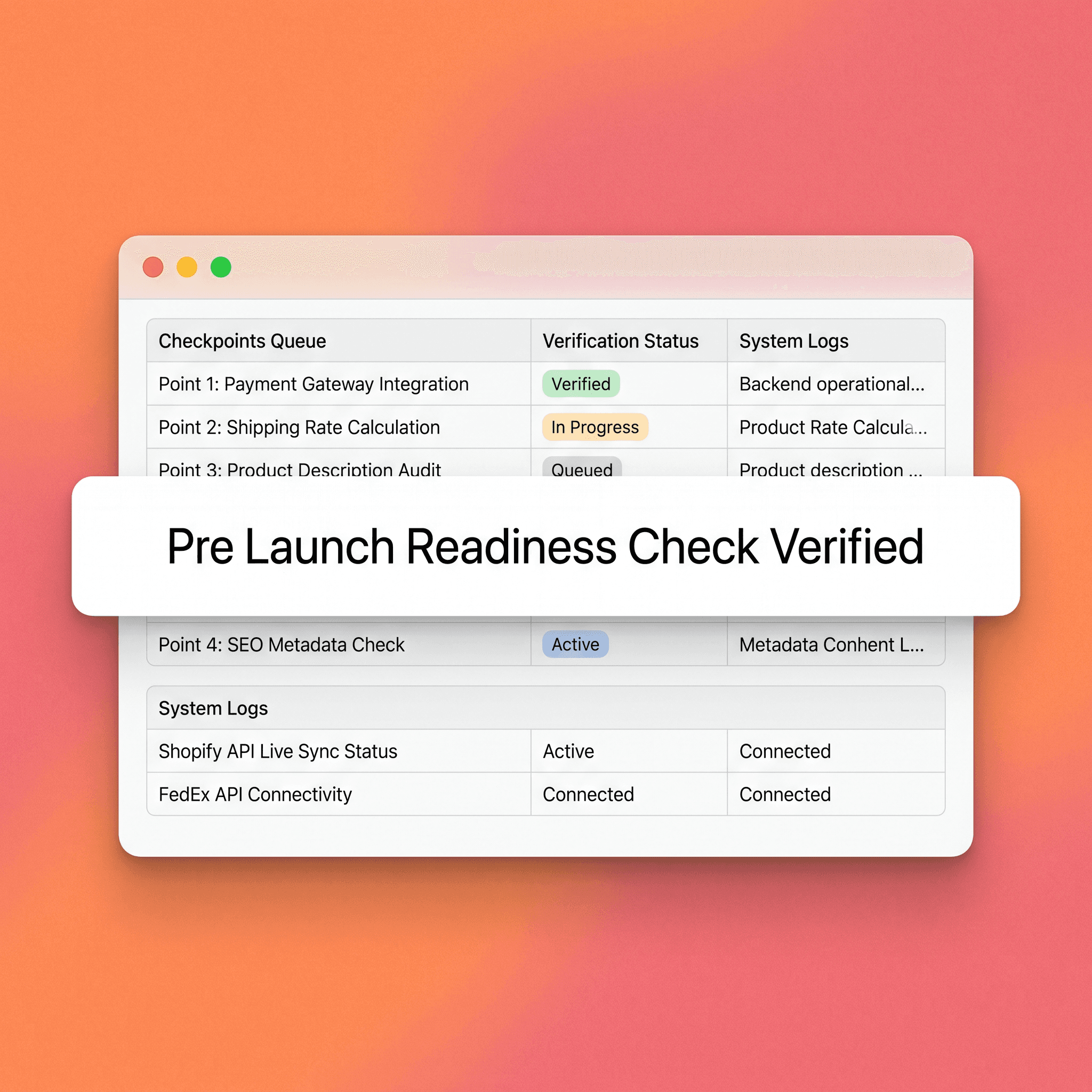
Most Shopify stores don't fail at launch because the product is wrong. They fail because the store wasn't ready — broken checkout flows, missing trust signals, unverified email sequences, and SEO foundations left completely untouched. By failing to perform a rigorous diagnostic check, founders often invite technical debt and conversion friction that cripples their initial customer acquisition efforts. Implementing a systematic pre-launch protocol ensures that every pixel, payment gateway, and email trigger is synchronized to handle real traffic, thereby protecting your brand equity from the start.
This Shopify pre-launch checklist gives D2C founders and ecommerce teams a single, structured test to run before going live. It covers everything from technical configuration to conversion readiness, organized into the six areas that matter most. By segmenting the launch into manageable operational buckets, teams can delegate specific responsibilities while maintaining visibility over the total project health. This modular approach allows for rapid iterations, ensuring that complex technical hurdles do not bottleneck the overarching go-to-market timeline.
Work through it once. Fix what's broken. Then launch with confidence. Establishing this baseline operational standard prevents the common panic of discovering critical site errors during high-intent traffic periods like launch day or influencer pushes. When your infrastructure is battle-tested against this checklist, you shift your focus from emergency bug fixing to revenue-driving activities like acquisition and community building, which are essential for long-term scalability in the competitive D2C landscape.
The Project Supply 30-Point Launch Readiness Test
This framework organizes your Shopify pre-launch audit into six categories. Each point is a direct action or verification — not a vague suggestion. Following this granular methodology provides a foolproof mechanism for audit accountability, allowing stakeholders to track progress via a binary pass-fail system. This level of precision is vital for minimizing the risk of post-deployment downtime or user experience degradation.
Section 1: Store Configuration & Technical Setup
Before anything customer-facing matters, your store's foundation needs to be solid. A shaky foundation in DNS propagation or SSL security can lead to immediate bounce rates and browser warnings that permanently damage trust. Ensuring these technical pillars are rock-solid is the first prerequisite for any successful commerce engine.
1. Custom domain connected and propagated. Confirm your domain resolves correctly with no redirect errors. Test from multiple browsers and devices. Verifying DNS propagation prevents the classic "store unreachable" error during your public announcement, ensuring that your DNS records are correctly mapped to Shopify’s A and CNAME targets to prevent downtime.
2. SSL certificate active. Every page should load over HTTPS. Shopify provides this by default, but verify it hasn't been misconfigured. SSL is not just for security; it is a fundamental requirement for modern web browsers to mark your site as "secure," and Google utilizes this as a direct signal for search indexing and page ranking performance.
3. Checkout subdomain confirmed. Your checkout URL should match your brand domain, not a generic Shopify subdomain where avoidable. Maintaining domain continuity through the checkout journey is essential for minimizing abandonment rates, as users feel a profound sense of anxiety when the URL switches abruptly to a third-party host.
4. Default Shopify pages removed or replaced. Delete or customize placeholder pages (default homepage, sample products, dawn theme boilerplate copy). Leaving boilerplate content live suggests a lack of brand maturity and can lead to confusion if a user inadvertently lands on a half-finished product page that lacks pricing or shipping logic.
5. 404 page customized. A branded 404 page with navigation options reduces bounce and keeps users on-site. By turning a dead end into an opportunity for discovery, you retain traffic that might otherwise leave the site, effectively turning a technical error into a navigational utility that guides users back toward your primary product collections.
6. Favicon uploaded. Small detail, high trust signal in browser tabs and bookmarks. This minor branding element provides a visual anchor in the user's browser bar, making it easier for them to identify and return to your store amidst a sea of open tabs while reinforcing professional brand perception.
Section 2: Product & Catalogue Readiness
Your product pages carry most of the conversion weight. They need to be clean, complete, and credible. A product page is essentially your digital sales representative; if the data is incomplete or conflicting, the consumer's cognitive load increases, often leading to them abandoning their cart in favor of a competitor.
7. All products have primary and variant images. No placeholder or missing images on any active SKU. High-fidelity visual consistency is the primary driver of digital consumer confidence, and missing imagery creates a jarring, unprofessional experience that suggests the business is either inactive or unreliable.
8. Product descriptions are written for the buyer, not the algorithm. Clear benefit language, not just spec lists. Avoid duplicate or thin copy across variants. High-converting descriptions leverage psychological triggers and benefit-led storytelling, ensuring that the unique value proposition of every item is articulated in a way that resonates with the specific pain points of your target customer base.
9. Pricing is correct across all variants. Check that compare-at prices, sale pricing, and currency display correctly. Price discrepancies during the checkout process are an instant trust-breaker, as shoppers perceive inconsistent pricing as either a system error or a deceptive marketing tactic, both of which erode long-term customer loyalty.
10. Inventory tracked and quantities set. Decide upfront whether to allow overselling, and configure accordingly. Managing inventory status accurately allows you to leverage scarcity marketing effectively, as showing "Low Stock" can drive urgency without the operational nightmare of being unable to fulfill orders that you have technically promised to deliver.
11. Product collections are logical and named correctly. Navigation should reflect how your customer thinks, not how your backend is organized. By creating collections that map to user personas or intent, you significantly shorten the path to purchase, allowing the shopper to find exactly what they are looking for without excessive clicking or confusing categorization.
12. Product tags are consistent. Tags drive filtering and internal search. Inconsistent tagging creates gaps in the buying experience. Standardizing your taxonomy across the entire catalog ensures that the on-site search bar and product filters function as intended, preventing the "zero results found" experience that kills conversion rates.
Section 3: Checkout & Payment Configuration
Checkout is where revenue is won or lost. This section has zero tolerance for errors. Any friction during the final transaction phase represents a direct loss of profit, meaning that this section must be audited for speed, simplicity, and total technical accuracy to guarantee that every customer dollar is processed without interruption.
13. All payment gateways tested with real transactions. Run at least one live test order using each active payment method. Refund it afterward. Simulating the real customer journey is the only way to identify silent failures in gateway handshakes, allowing you to catch misconfigurations before real customers encounter a decline or timeout error.
14. Shopify Payments or third-party gateway fully verified. Ensure your account is approved and not in a pending or restricted state. Nothing stops a launch faster than a frozen payment account; verifying the status of your gateway ensures you are compliant with all financial KYC (Know Your Customer) regulations, thereby avoiding sudden payment blocks.
15. Shipping rates configured and tested. Confirm rates calculate correctly at checkout for all major regions you plan to serve. Shipping miscalculations, such as incorrect carrier rates or missing tax calculations, are one of the most common reasons for checkout abandonment, making it critical to verify these zones before scaling marketing spend.
16. Tax settings reviewed for your primary markets. Shopify can automate some tax rules, but verify the settings apply correctly for your jurisdiction. Regulatory compliance regarding sales tax is a complex, region-specific requirement that, if mishandled, can lead to significant financial liability and legal headaches for the brand owner down the road.
17. Order confirmation email sends correctly. Trigger a test order and confirm the confirmation email arrives, is branded, and contains the right information. The post-purchase email is the first moment of validation for the customer; ensuring it is branded and contains accurate details confirms the legitimacy of the order and provides peace of mind.
18. Abandoned cart recovery is active. Configure at least one abandoned checkout email sequence before launch, not after. Implementing this sequence from day one captures high-intent lost revenue, creating a safety net for your marketing efforts that automatically re-engages potential customers who might have been distracted during the checkout process.
Section 4: SEO & Discoverability
You won't rank immediately, but you can set up correctly from day one. Fixing SEO retroactively is significantly more work. Proactive SEO is an investment in your long-term organic acquisition channel, preventing you from having to spend excess budget on paid media later to compensate for a lack of natural search presence.
19. Page titles and meta descriptions written for all key pages. Homepage, collection pages, and top product pages at minimum. These snippets are the primary touchpoints for search engines and potential visitors; having them optimized allows you to control your brand's narrative and influence click-through rates from the SERP.
20. URL handles are clean and keyword-relevant. Shopify auto-generates handles, but they often need manual cleanup (e.g., remove redundant words, ensure consistency). Clean URLs help Google's crawlers interpret the structure of your site more effectively, while also providing a better, more readable experience for humans sharing links across social media.
21. Alt text added to primary product and banner images. Descriptive alt text improves accessibility and image search indexing. This step ensures that your site is ADA compliant while simultaneously opening a secondary traffic stream through Google Images, which is often neglected by competitors who rely solely on textual SEO.
22. Sitemap submitted to Google Search Console. Your Shopify sitemap is auto-generated at yourdomain.com/sitemap.xml. Submit it before launch. This acts as a map for search engine spiders, signaling to Google exactly which pages you want them to crawl and index, thereby accelerating the time it takes for your new site to appear in search results.
23. Google Analytics 4 (or equivalent) installed and tracking. Confirm events fire on page view, add to cart, and purchase. Test in GA4 DebugView. Without accurate data collection, you are flying blind; establishing event-level tracking from launch day allows you to perform data-driven optimizations as soon as you have your first cohort of users.
24. No-index tags removed from active pages. Shopify sometimes sets staging or development preferences that carry over. Audit before going live. Accidentally keeping the site "no-indexed" is a fatal error that prevents your store from ever appearing in search results, effectively neutering your SEO potential before the launch campaign even begins.
Section 5: Brand Trust & Conversion Readiness
Visitors decide whether to trust your store within seconds. These elements reduce friction and build credibility without requiring a hard sell. Trust is the currency of ecommerce; by clearly displaying your policies and contact information, you eliminate the "suspicion gap" that prevents new visitors from entering their credit card details.
25. Privacy Policy, Terms of Service, and Refund Policy pages live. Shopify has generators for these. They need to exist and be findable in your footer. Providing legal transparency is not only a requirement for payment processors and local commerce laws, but it also signals to the user that your brand is an established, reputable entity.
26. Contact information visible and functional. An email address, contact form, or live chat option signals legitimacy. Test that messages actually arrive. Being easily reachable gives customers confidence that they will be supported after the sale, which is a major factor in reducing purchase anxiety during the checkout flow.
27. Social proof present where it matters. Even a handful of real reviews, press mentions, or recognizable platform logos on key pages improves conversion rate meaningfully. Social proof functions as a psychological shortcut, signaling to new visitors that other people have successfully transacted with you, thus lowering the perceived risk of the purchase.
28. Navigation is clean and tested on mobile. More than half of D2C traffic is mobile. Walk the full browse-to-checkout journey on a phone before launch. Mobile-first design is no longer optional; if your navigation is clunky or the checkout buttons are misaligned on smaller screens, you are actively driving away the majority of your mobile-bound traffic.
29. Page load speed tested. Run your homepage and a core product page through Google PageSpeed Insights. Address any critical issues. Aim for a mobile score above 60 as a baseline. Load speed directly impacts conversion; every incremental millisecond of latency is correlated with a measurable drop in user engagement and an increase in bounce rate.
Section 6: Email & Post-Purchase Flows
Most D2C brands underestimate how much revenue lives in post-purchase. Set these up before launch, even if they're minimal at first. Email is one of the only owned channels that remains immune to algorithmic changes, making it the most important long-term asset in your post-launch growth strategy.
30. Welcome series configured for new subscribers. If you're collecting emails at launch (pop-up, embedded form, or checkout opt-in), there should be at least a two-step welcome sequence active and tested before the first subscriber arrives. A well-crafted welcome series establishes your brand voice and introduces your core products, creating an immediate opportunity to convert a casual visitor into a first-time buyer.
Common Shopify Pre-Launch Mistakes (And How to Avoid Them)
Launching without a test order is the most frequent and costly error. Run a complete test transaction using a real payment method on the actual live domain. Staging behavior does not always match production behavior. Many store owners rely on sandbox environments, only to find that live settings like 3D Secure or tax calculations behave differently, creating a catastrophic failure point on launch day.
Ignoring mobile entirely until after launch is a critical oversight. Desktop-first development is still common, but most D2C traffic lands on mobile. A broken mobile checkout will cost you real revenue from day one. You must audit every interactive element on a physical device, as touch targets and keyboard overlays often break on mobile even if they appear perfect in desktop browser inspectors.
Setting SEO aside as a "post-launch task" is a strategic mistake. Clean URLs, page titles, and a submitted sitemap take roughly an hour to configure. The compounding benefit of starting correctly outweighs any time saved by skipping it. Proactive SEO ensures that you begin building your authority score from the very first indexation, which is much easier than trying to re-optimize a site that has already been crawled with messy metadata.
Over-automating email before testing it is a recipe for disaster. An abandoned cart sequence that fires with broken links or wrong product data is worse than no sequence. Test every automated flow end-to-end, including on mobile. If your automation contains faulty placeholders, you destroy the customer's trust in your technical capability before they have even received their package.
Treating the checklist as a one-time exercise limits its utility. This framework is most useful as a repeatable process — run it at launch, run it again after major theme or app changes, and run it before any significant traffic campaign. Regularly auditing your site ensures that you are constantly maintaining high standards and catching regressions that inevitably happen during regular day-to-day store management.
Using This Checklist Across Your Team
If you're working with a team, assign each section to the relevant owner: technical setup to your developer or agency, product content to your brand or creative team, SEO to your growth operator, and checkout testing to whoever manages your payment accounts. Clearly defined responsibilities prevent tasks from slipping through the cracks and allow your team to operate in parallel, ensuring that all 30 points are covered by subject matter experts.
Build this checklist into your standard operating procedure. The stores that launch cleanly are the ones that treated launch readiness as a project phase, not an afterthought. By making this document a foundational part of your operational playbook, you ensure that every new feature, seasonal campaign, or site update is held to the same high standard of readiness as your initial store launch.
FAQs
Web Personalisation
Framer is a design tool that allows you to design websites on a freeform canvas, and then publish them as websites with a single click.
UI and UX Design
Framer is a design tool that allows you to design websites on a freeform canvas, and then publish them as websites with a single click.
Search Engine Optimisation
Framer is a design tool that allows you to design websites on a freeform canvas, and then publish them as websites with a single click.
CRM and ERP Solutions
Framer is a design tool that allows you to design websites on a freeform canvas, and then publish them as websites with a single click.
Ecommerce
Framer is a design tool that allows you to design websites on a freeform canvas, and then publish them as websites with a single click.
Email Marketing
Framer is a design tool that allows you to design websites on a freeform canvas, and then publish them as websites with a single click.
Marketing Automation
Framer is a design tool that allows you to design websites on a freeform canvas, and then publish them as websites with a single click.
Chatbots and Conversational AI
Framer is a design tool that allows you to design websites on a freeform canvas, and then publish them as websites with a single click.
Chatbots and Conversational AI
Framer is a design tool that allows you to design websites on a freeform canvas, and then publish them as websites with a single click.
Related Blogs
We know your space
Explore our latest UI/UX Case Studies that showcase how our process-driven creativity transforms complex ideas into real, measurable business results, step by step.


