
Performance Media
08 min read
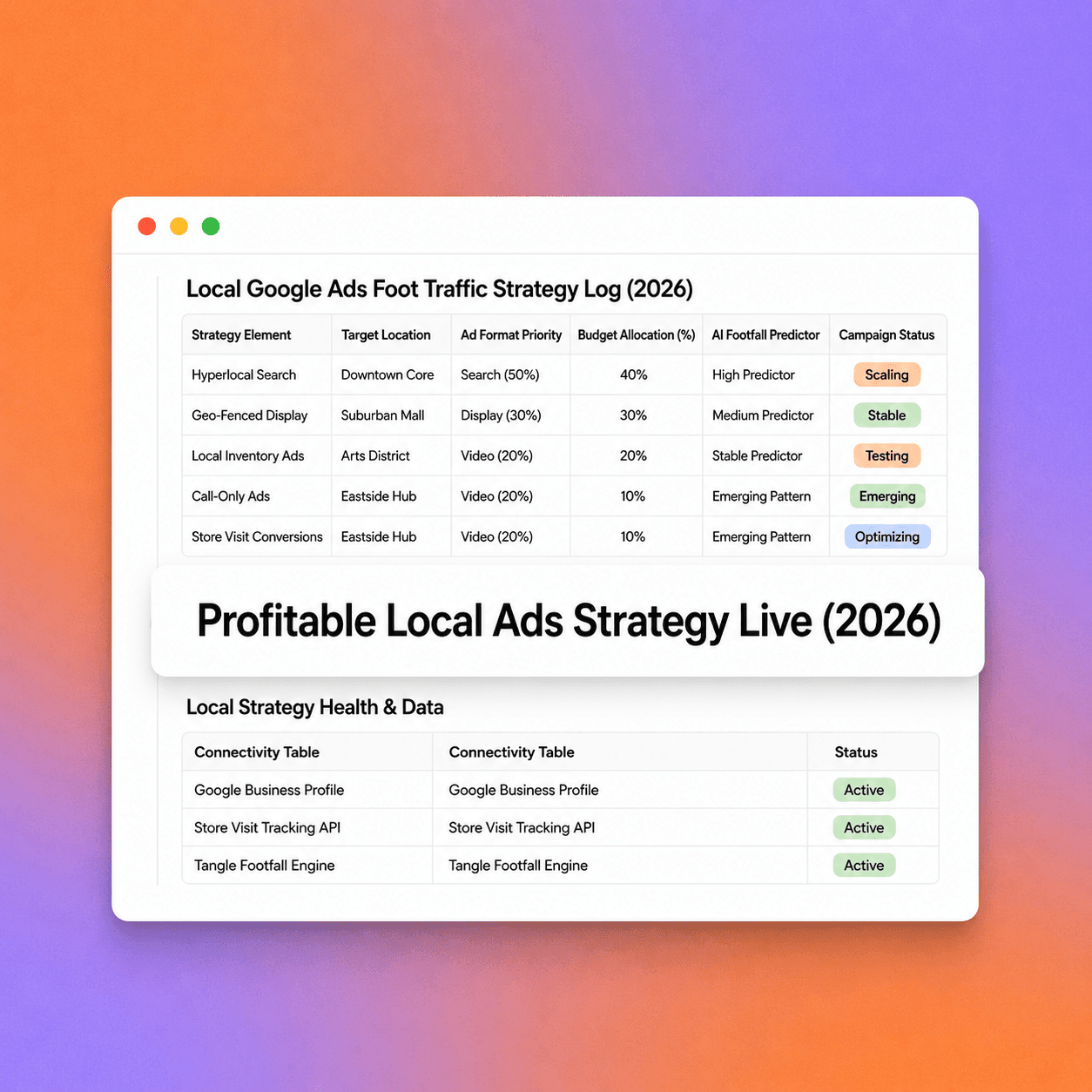
The Objective: Profitable Foot Traffic, Not Just Clicks Local businesses often mismanage Google Ads by optimizing for clicks or calls alone, a common mistake that treats advertising as a brand-awareness exercise rather than a performance-based revenue engine. The correct objective is measurable, profitable store visits that directly contribute to your physical sales volume and bottom-line growth. That requires deep clarity on:
Average transaction value: Understanding the specific dollar amount a customer spends per visit allows you to establish a firm bid ceiling that prevents you from paying more to acquire a visitor than they are worth.
This metric is the cornerstone of your financial planning, as it defines the upper bound of your permissible acquisition cost. Without this baseline, you are effectively flying blind, unable to discern whether your current bidding strategy is yielding actual profit or simply burning capital on low-margin traffic. By calculating this value across different services or product categories, you can intelligently adjust your bids to favor high-value transactions, ensuring that your ad budget is consistently prioritized toward the most profitable segments of your physical business operations.
Close rate from call to sale: Because many local leads begin with a phone inquiry, knowing how effectively your front-of-house staff converts these calls into actual visits is essential for calculating true lead quality. This variable is frequently overlooked but acts as the primary bridge between your digital ad spend and your offline revenue realization. If your team has a low close rate, your cost-per-lead must be significantly lower to remain profitable, making staff training and call-script optimization just as important as your keyword selection.
By tracking this rate, you can pinpoint whether a campaign's poor performance is due to ineffective ad targeting or internal operational bottlenecks, allowing for surgical improvements that boost your overall conversion efficiency without increasing your total marketing spend.
In-store conversion rate: This metric helps you bridge the gap between digital attribution and physical sales, identifying how many of your walk-ins originated from your online advertising efforts.
Utilizing offline conversion imports is the only way to accurately close this loop, providing you with the necessary data to train Google’s machine learning algorithms on actual business outcomes rather than mere button clicks. This visibility allows you to distinguish between "window shoppers" and genuine customers, empowering you to optimize your campaigns to attract the demographics most likely to complete a purchase. When you understand this rate, you gain the confidence to scale high-performing geo-segments, knowing exactly how much impact your digital presence has on your physical storefront foot traffic.
Customer lifetime value: By evaluating the long-term potential of a local client, you can justify slightly higher initial acquisition costs, knowing that retention will drive significant future profit. This strategic view prevents you from prematurely cutting off profitable campaigns that may appear expensive on a first-visit basis but yield immense returns through repeat business and high brand loyalty. In the local service industry, the profit is rarely in the first transaction, but rather in the recurring relationship; therefore, factoring in the long-term value of a repeat client ensures you remain competitive in auctions where rivals only consider single-purchase metrics.
This data-driven perspective shifts your advertising strategy from a transactional expense to a long-term investment in your brand’s sustainability and market dominance. Allowable CAC per store visit: This financial guardrail ensures that your advertising budget remains tied to business health rather than vanity metrics, keeping your growth sustainable and margin-protected. By defining your maximum cost-per-acquisition (CAC), you create a protective barrier around your profit margins, ensuring that your growth is never achieved at the expense of your bottom line.
Without this rigorous financial discipline, campaign scaling becomes dangerous guesswork, as you lack the empirical data required to determine which keywords or geographic segments are actually fueling your profitability. This metric serves as the final arbiter for all budget allocation decisions, forcing a discipline that keeps your account profitable regardless of market fluctuations or aggressive competitor behavior in the auction environment.
High-Intent Local Search Capture Strategy
Local Google Ads works exceptionally well because it captures high-urgency intent from users who are ready to make an immediate purchasing decision in their immediate vicinity.
Dentist near me: This query represents a user who is likely experiencing a specific need and is actively scanning the local area for a trusted professional provider to solve their problem immediately. The high level of urgency inherent in this search means these users are the least price-sensitive and the most likely to convert, provided your ad copy speaks directly to your immediate availability and professional credibility. By bidding aggressively on these terms, you position your practice as the first point of contact for patients in crisis, effectively securing high-value long-term clients with a single, well-placed advertisement. This specific query type should be the absolute top priority for your local bidding strategy, as it delivers the highest return on investment by reaching customers at the exact moment they need your professional services the most.
Salon open now: By searching for current availability, the user is signaling they are ready to transact at this exact moment, prioritizing convenience and speed of service over extensive research. This intent signal is extremely valuable, as it removes the typical customer discovery cycle, allowing your ad to act as the direct solution to their immediate need. Your strategy here must focus on location relevance and visible "now-based" offers, ensuring that your ad appears at the top of the local map pack to capture this spontaneous demand before it flows to a competitor. These searches are the lifeblood of retail and personal service businesses, providing a steady, high-conversion flow of traffic that can be reliably turned into revenue through precise, hyper-local ad scheduling and targeting.
AC repair Pune: This indicates an urgent domestic need where the searcher is seeking a local expert who can resolve a functional breakdown within their home or office environment. These users are typically experiencing a stressful situation, which makes them highly motivated to select the first reliable provider who can promise a swift resolution. Your landing page must reflect this urgency, showcasing your rapid response times, service area coverage, and certified expertise to alleviate their anxiety and prompt an immediate click-to-call action. Because these are high-stakes, service-based queries, they command a higher CPC, but they also offer a superior conversion rate that justifies the spend, making them the most efficient engine for scaling a home-service business in a competitive metro market.
Best café in Bandra: This search behavior demonstrates a local consumer looking for high-quality recommendations, often leading to immediate discovery and a visit to the physical storefront. While these users may be slightly higher in the funnel than "repair" or "dentist" searchers, they are actively looking to fulfill a social or dietary need, making them high-potential visitors who just need the right visual cue or offer to choose your location. Your ad presence should prioritize high-quality imagery, star ratings, and clear navigational cues to encourage an immediate trip, transforming a general interest search into a concrete visit to your cafe. These inquiries represent the "intent-to-explore" segment, which, when managed with localized, review-rich ads, becomes an essential, reliable driver of consistent daily foot traffic.
Campaign Structure for Local Profitability
A high-performing local account typically includes several distinct layers to ensure budget is allocated effectively across the different stages of local intent.
Brand Search: Essential for defending your market presence and ensuring that users specifically searching for your business name find your official digital door. By dominating this space, you prevent competitors from poaching your most loyal customers and maintain total control over the narrative and user experience, which is essential for protecting your reputation. This layer serves as the most stable, low-cost anchor for your entire advertising account, consistently delivering the highest conversion rates and lowest cost-per-click, which helps to maintain an attractive average account-wide ROI. Keeping your brand ads active also ensures that you remain the clear, professional choice when potential customers are vetting your business against competitors, effectively shielding your most valuable traffic from being intercepted.
Non-Brand Local Search: This is your primary engine for acquiring new customers who have not yet discovered your business but are searching for your specific product or service category. By meticulously segmenting these campaigns based on service type, location modifiers, and urgency, you can precisely align your messaging with the specific problem your customers are trying to solve. This layer represents your greatest opportunity for exponential growth, as it opens the door to thousands of potential customers who are already in the market but simply haven't encountered your specific brand yet. A successful strategy requires constant keyword refinement, negative keyword management, and tight alignment between the search query and your destination landing page, ensuring that your spend is focused purely on high-intent leads who are ready to visit your location.
Competitor Conquesting: A strategic approach to bidding on local rival names, allowing you to highlight your unique selling proposition to those who are already shopping in your space. This is a high-risk, high-reward layer that must be handled with extreme care; it should only be deployed when your offer is clearly superior to the competitor's, whether that is in pricing, speed, quality, or service range. If done correctly, it allows you to intercept traffic from established rivals who are already paying for your service category, effectively diverting their prospects to your shop. However, if your landing page fails to deliver a compelling reason for the switch, you risk wasting your budget on clicks that will never convert, making this the most sensitive layer of your account structure that requires constant, margin-based monitoring.
Performance Max (Store Goals): A sophisticated, automated campaign type that leverages Google's machine learning to find prospects likely to visit your physical location. By utilizing Google's extensive data on user behavior, location history, and search intent, this campaign type acts as a force multiplier for businesses that have successfully configured their offline conversion tracking. It is best suited for businesses with stable historical data that can feed the algorithm the signals it needs to effectively identify "store-visit-ready" prospects. Because it is highly automated, it should only be scaled once you have achieved a proven, profitable baseline in your search campaigns, as it requires a high volume of quality conversion data to consistently outperform manual bidding strategies.
Call-Only Campaigns: Targeted specifically at mobile users who require immediate contact with your business, cutting out the friction of a website visit to drive instant inquiries. These campaigns are highly effective for service-based businesses where the conversion happens during a phone conversation rather than a website form fill. By sending the user directly to a phone dialer, you reduce the time-to-contact, which is critical for customers who are in the middle of an urgent situation and need immediate help. These campaigns demand excellent phone-based sales handling, as they put the onus on your staff to close the deal once the connection is made; when optimized correctly, they often provide the highest-quality leads for the lowest total cost-per-acquisition.
Remarketing (Display / YouTube): Crucial for staying in front of local prospects who visited your site previously, maintaining your brand presence until they are ready to make a trip to your store. This layer serves as a constant reminder, keeping your business top-of-mind for those who have already expressed interest but weren't ready to convert in their first visit. By using targeted visual storytelling, you can highlight customer success stories, store amenities, or special limited-time local offers to gently nudge hesitant prospects back into your sales funnel. This is a vital component of a comprehensive marketing ecosystem, ensuring that your previous advertising investment doesn't go to waste by effectively nurturing leads until they are fully prepared to visit your physical address.
Brand Search: Defensive and Efficient
Brand keywords consistently provide the lowest CPC and the highest conversion rate, serving as the most stable foundation for any local advertising account. They protect your reputation from competitors who might bid on your name, and even if you rank organically, paid brand coverage provides total control over the messaging and site links displayed to the user. This is a low-CAC layer that should always remain active, ensuring that your most loyal customers are always greeted by an official, professional result that encourages a quick path to purchase.
Non-Brand Local Search: The Core Growth Driver
This layer captures users actively looking for services in your area, representing your biggest opportunity for net-new customer acquisition and sustained store growth. Segment your efforts by service type, location modifiers, and urgency intent. Use Exact and Phrase match first to build a clean baseline of performance data, and only move toward Broad match when your Smart Bidding strategy is stable and backed by verified conversion results.
Competitor Conquesting: Strategic, Not Emotional
Bidding on competitor names can work, but only when your offer is clearly differentiated from your rivals and you have a high-converting landing page that highlights why you are the better choice. If your offer is not compelling enough, you will likely see your CPC rise without achieving a corresponding increase in profitable store visits. This strategy must remain within your margin tolerance, as the goal is not to win an auction vanity war, but to effectively divert customers from your competitors who are already in the market for your services.
Google Maps & Location Extensions: Visibility Layer
Location extensions are mandatory for any brick-and-mortar strategy, as they tie your digital ad to your physical address, providing the trust signals users need to feel confident visiting. They increase call volume, provide immediate access to directions, and serve as key store visit signals that Google's algorithm uses to optimize your account. For multi-location brands, use location asset groups carefully to avoid internal competition between your own storefronts, ensuring that each ad highlights the address closest to the searching user. Maps visibility is often the highest-converting placement for local businesses, as it directly puts your business on the digital map that your target customers are using to navigate their daily activities.
Performance Max for Store Goals
Performance Max can optimize toward store visits, calls, and directions, acting as a force-multiplier for local businesses that have the data to support automation. Use it when you have enough historical conversion data, have properly configured your offline conversion imports, and have your location assets fully synchronized. Do not use it if your tracking is weak or fragmented, as the system relies heavily on signal strength to learn and iterate; automation without sufficient data often results in wasted spend and poor-quality traffic that never converts into meaningful physical revenue.
Smart Bidding vs Manual for Local
Manual CPC works best when call tracking is not fully integrated, your search volume is low, or you require tight, hands-on cost control to prevent budget leakage. Smart Bidding (Max Conversions or tCPA) works best when you have achieved accurate call tracking, have store visit tracking active, and are consistently generating 30+ monthly conversions to feed the system. Local campaigns will almost always fail when bidding is automated without verified conversion data, as the algorithm has no way of knowing what a successful physical business outcome actually looks like for your specific store.
Conversion Tracking for Brick-and-Mortar
A robust tracking setup is the backbone of local success, with a minimum requirement of call tracking, store visit tracking, and offline conversion uploads via CRM. Enhanced Conversions provide the additional precision needed to bridge the gap between online interactions and physical sales. Without these offline data inputs, Google will continue to optimize for clicks rather than revenue, leaving your business to pay for traffic that may never result in a single in-store purchase or a fulfilled local service request.
Budget Allocation Logic for Local Campaigns
Budget decisions should follow a logical hierarchy: fully fund your brand search to protect your territory, followed by high-intent non-brand terms that act as your primary revenue growth driver. Next, allocate resources to competitor capture, and only then look toward Performance Max scaling. If your Impression Share Lost (Budget) exceeds 20% on your most profitable campaigns, increase your budget gradually, never exceeding a 20% jump at a time, to ensure the algorithm has time to digest the changes without disrupting your established cost-per-acquisition.
Quality Score in Local Campaigns
Quality Score directly impacts your CPC, ad rank, and impression share, effectively serving as a tax on your advertising efficiency. Improve it by matching your keywords tightly to your ad copy, including location terms in headlines to increase relevance, and using location-specific landing pages that directly address the user's local search. Sending “Dentist in Pune” traffic to a generic homepage is a major conversion killer, as it increases CPA unnecessarily and creates an experience mismatch that forces the user to navigate away before finding the local proof they came for.
Landing Page Alignment for Local Intent
Every service must feature a dedicated service page that includes location-specific messaging, a clear call button, a map embed for easy navigation, and trust signals like reviews and certifications. Intent mismatch between the search query, the ad copy, and the destination page increases your CPC, bounce rate, and CPA while simultaneously lowering your ad rank. Continuity between keyword, ad, and landing page is the only way to protect your margin and ensure that every click you pay for is delivered to a page designed to turn that visitor into a real, physical customer.
Cost Structure Thinking: Local CAC Model
For example, if your average sale value is ₹3,000, your close rate from call is 50%, and your allowable CAC is ₹600, then your cost-per-call must not exceed ₹1,200. If your metrics exceed these thresholds, you are mathematically unprofitable regardless of how many clicks your ads generate. Your break-even CPC should be calculated as your conversion rate multiplied by your allowable CPA, providing a hard target for your team. Local campaigns must be evaluated by these financial metrics, not by simplistic vanity figures like CTR, which often fail to reveal the true profitability of your brick-and-mortar marketing efforts.
Use-Case Segmentation
Clinics: Focus heavily on high-intent service terms and rigorous call optimization, as your patients require both medical authority and proximity to make their selection. You must ensure your ads emphasize certifications, clear location details, and an easy path to booking, as medical decisions are rarely impulsive. By segmenting campaigns by service (e.g., dental implants vs. routine cleaning), you can deliver specific, highly relevant messaging that addresses the user's primary concern. This precision not only improves your conversion rate but also elevates your Quality Score, which directly lowers your average CPC, making your acquisition costs more sustainable over the long term. Effective local clinics treat every call as a potential patient, using CRM data to track the full lifecycle of the lead from the initial search to the final in-clinic visit, allowing for granular adjustments that maximize the return on every advertising rupee.
Restaurants: Prioritize “near me” queries, implement peak-hour bidding adjustments to capture lunch and dinner rushes, and maximize your visibility on local maps. Because dining decisions are often time-sensitive and highly location-dependent, your ads should feature attractive, appetizing visuals, clear call-to-action buttons for reservations or directions, and real-time updates on specials or table availability. By timing your bids to intensify during the hours leading up to meal times, you capture high-intent users at the exact moment they are deciding where to go, effectively increasing your store visit rate. This granular approach ensures you aren't wasting budget during quiet hours while maintaining aggressive, high-visibility positioning during your busiest, most profitable windows of operation, turning your local advertising into a dynamic and highly efficient revenue engine.
Home Services: Utilize urgency-driven keywords and call-only campaigns to ensure you are the first responder for customers with immediate, critical needs. In home service niches like plumbing, HVAC, or emergency repairs, the customer is often facing a high-stress situation that requires a fast, reliable, and professional expert who can arrive at their location immediately. By focusing your ad copy on "Same Day Service," "Emergency Response," and "Licensed Experts," you position your business as the most reliable, low-risk choice for a customer who needs the problem solved right now. Call-only campaigns are particularly effective here, as they bypass the need for a web page visit and connect the customer directly to a dispatcher, drastically shortening the time to conversion and ensuring you capture the lead before your competitors can respond.
Retail Stores: Combine Shopping campaigns with geo-targeted Search to capture both product-specific intent and general retail traffic using store visit tracking. By feeding your product feed data into Shopping campaigns, you can showcase specific inventory, prices, and stock availability directly in the ad, providing high-intent shoppers with the information they need to visit your physical store. Geo-targeting is key here; you must ensure your ads only trigger for users within a reasonable driving radius, preventing wasted spend on distant prospects who are unlikely to make the trip. Combining this with search terms focused on your retail category allows you to dominate both the product-specific and the brand-discovery segments of the market, effectively funneling every potential buyer in your vicinity toward your storefront doors.
Multi-Location Enterprises: Employ location-specific campaign structures to prevent budget cannibalization and ensure each location’s unique inventory or service list is correctly represented. Using customizers and location asset groups allows you to scale your local presence while maintaining total control over the messaging for each branch, which is crucial when different stores have different regional strengths or inventory profiles. By structuring your account this way, you gain the granular data necessary to compare the performance of individual locations, allowing you to reallocate budget toward your most successful stores while optimizing the laggards. This disciplined, location-centric architecture turns the complexity of multi-branch marketing into a scalable, manageable system that consistently drives growth across your entire regional enterprise.
Common Structural Mistakes
Most local performance problems are entirely structural rather than platform-driven. Common pitfalls include running only one generic campaign, neglecting brand defense, failing to implement call tracking, sending traffic to a generic homepage, overusing broad match, and scaling without a clear understanding of your margins. By fixing these foundational architecture issues, you create a much more stable and scalable environment for your advertising, turning your account into a reliable engine for physical store growth.
Bottom Line: What Metrics Should Drive Your Decision?
For local businesses, focus exclusively on Cost Per Call, Cost Per Store Visit, Cost Per Direction Request, Allowable CAC, Close Rate, Average Order Value, and Impression Share. Metrics like Clicks, Impressions, and CTR are vanity figures; instead, base every decision on your revenue per click. Use Lost IS (Budget) to identify your biggest scaling opportunities, Lost IS (Rank) to diagnose ad relevance issues, and track your conversion rate from click to call, which for high-intent campaigns should often exceed 10–20% in many service categories. Your break-even CPC is the final word on your maximum sustainable bid.
Forward View (2026 and Beyond)
Local Google Ads will become increasingly automated, with AI-driven bidding relying heavily on offline conversion imports, first-party CRM data, and sophisticated store visit modeling. As privacy shifts continue to reduce visibility into individual-level behavior, advertisers who fail to integrate their own CRM data into the Google ecosystem will inevitably lose their bidding efficiency. Performance Max will likely dominate the local landscape, but the primary risk remains over-automation without the discipline of high-quality conversion signals. High-intent local search demand remains durable, and "near me" behavior is not declining; businesses that build the necessary tracking infrastructure will gain a massive cost advantage, as competitive edge in 2026 will come not from design, but from attribution accuracy and unwavering margin discipline.
FAQs
Why is offline conversion tracking the single most important factor for local Google Ads success?
Framer is a design tool that allows you to design websites on a freeform canvas, and then publish them as websites with a single click.
Web Personalisation
Framer is a design tool that allows you to design websites on a freeform canvas, and then publish them as websites with a single click.
UI and UX Design
Framer is a design tool that allows you to design websites on a freeform canvas, and then publish them as websites with a single click.
Search Engine Optimisation
Framer is a design tool that allows you to design websites on a freeform canvas, and then publish them as websites with a single click.
CRM and ERP Solutions
Framer is a design tool that allows you to design websites on a freeform canvas, and then publish them as websites with a single click.
Ecommerce
Framer is a design tool that allows you to design websites on a freeform canvas, and then publish them as websites with a single click.
Email Marketing
Framer is a design tool that allows you to design websites on a freeform canvas, and then publish them as websites with a single click.
Marketing Automation
Framer is a design tool that allows you to design websites on a freeform canvas, and then publish them as websites with a single click.
Chatbots and Conversational AI
Framer is a design tool that allows you to design websites on a freeform canvas, and then publish them as websites with a single click.
Chatbots and Conversational AI
Framer is a design tool that allows you to design websites on a freeform canvas, and then publish them as websites with a single click.
Related Blogs
We know your space
Explore our latest UI/UX Case Studies that showcase how our process-driven creativity transforms complex ideas into real, measurable business results, step by step.


