
Ecommerce Development
Shopify Discount Strategy: How to Run Sales Without Training Customers to Wait
Shopify Discount Strategy: How to Run Sales Without Training Customers to Wait
08 min read
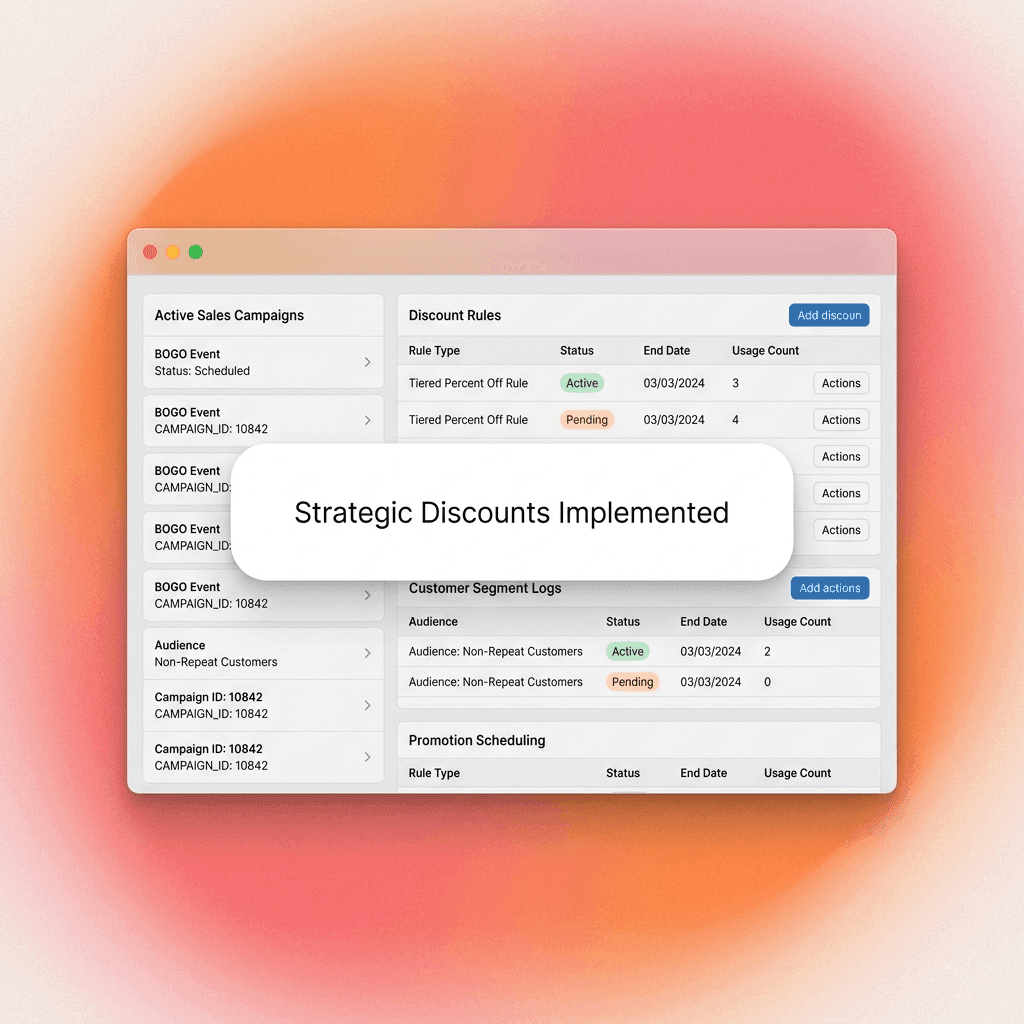
Most D2C brands know discounting is a risk, yet few have a systemic operational framework for managing it effectively. The result is almost always predictable: sitewide sales become a recurring crutch, email lists get conditioned to wait for the next drop, and your hard-earned full-price revenue quietly erodes quarter by quarter. By the time this problem is obvious to stakeholders, it is already embedded in the business structure, making it difficult to reverse without losing short-term volume. This guide breaks down exactly how to build a robust Shopify discount strategy that drives revenue precisely when you need it—without creating a customer base that will only buy at 20% off, thereby protecting your brand equity and long-term profitability.
Why Discount Conditioning Happens (And Why It's Hard to Undo)
Discount conditioning is not merely a customer attitude problem; it is a direct result of an operational pattern you trained them into over time. When a brand runs predictable, broad, and frequent discounts, customers learn to wait for the inevitable next cycle because that learning is entirely rational. If a 20% off code reliably appears in their inbox every six weeks, paying full price is simply bad purchasing behavior from the customer's perspective, and they will adjust their habits accordingly. The damage compounds in three distinct, painful ways that affect your bottom line. First, your full-price conversion rate drops significantly because high-intent buyers hold off on their purchases to wait for the inevitable promotion. Second, your email list becomes less valuable because your subscribers are present for the deals, not for your brand's unique value proposition. Third, your margin profile shifts downward, and what looked like a traffic acquisition win initially becomes a profitability problem at scale. The fix is not to stop discounting entirely, but rather to discount with absolute intent, on your terms, in ways that do not broadcast predictability to your audience.
The Discount Conditioning Risk Matrix
Before deciding whether to run a promotion, every offer should be evaluated against two axes: Discount Visibility and Discount Frequency. This is the proprietary framework we call the Discount Conditioning Risk Matrix.
Axis 1: Visibility
Low visibility discounts are highly targeted—sent only to a specific segment, triggered by granular user behavior, or gated behind a loyalty tier or a specific referral action. The customer who receives this offer does not assume every other customer received it, which preserves the sense of exclusivity. High visibility discounts are announced broadly—sitewide banners, mass email blasts, or social posts. Every single customer sees them and subconsciously learns your promotional cadence, creating a negative feedback loop for future full-price sales.
Axis 2: Frequency
Low frequency means discounts are rare or unpredictable enough that customers cannot time their purchases around them effectively. High frequency means discounts appear reliably—weekly flash sales, monthly sitewide promos, or perpetual homepage banners.
The Four Quadrants
High Visibility + High Frequency is the dangerous conditioning zone where brands actively train customers to wait. High Visibility + Low Frequency is manageable but needs incredibly careful execution. Low Visibility + High Frequency represents moderate risk; loyalty-gated offers can run often without public conditioning if the segmentation is tight. Low Visibility + Low Frequency is the safest, most effective zone where the strongest D2C brands operate. Use this matrix to audit every promotion before it goes live; if a planned offer lands in the conditioning zone, you must narrow the audience or reframe the mechanism entirely.
Seven Discount Types, Ranked by Conditioning Risk
Not all promotions are equal, and some structures are inherently safer than others for protecting your brand's perceived value. Here is how common Shopify discount structures compare on conditioning risk, ranked from lowest to highest:
Referral Rewards: Conditioning risk is very low because the discount is earned through a specific action, is not broadly announced, and is structurally tied to acquisition rather than general retention.
Loyalty Tier Discounts: Conditioning risk is low because buyers in a loyalty program already expect benefits as part of a value exchange, not a signal that prices are generally negotiable.
Abandoned Cart Recovery Offers: Conditioning risk is low to moderate; however, you must monitor whether your cart abandonment rate rises as customers learn to abandon intentionally to trigger an offer.
Post-Purchase Upsell Discounts: Conditioning risk is low because, when presented immediately after purchase, these offers do not signal to the broader customer base that discounts are available.
Birthday or Anniversary Discounts: Conditioning risk is low because they are time-locked to a personal milestone rather than a store-wide event, building genuine relationship value.
New Subscriber Welcome Discounts: Conditioning risk is moderate; while necessary for list growth, you must constantly review the percentage of revenue flowing through these codes versus full-price purchases.
Sitewide Percentage Sales: Conditioning risk is high; this is the most dangerous format, especially when run on a predictable schedule, and should be kept rare and time-compressed.
How Shopify Discount Architecture Can Work Against You
Shopify makes it technically easy to create discount codes, automatic discounts, and tiered pricing, but that ease often leads to unmanaged margin leakage. Most stores have codes that are years old, still active on coupon aggregator sites, and applied on orders where no discount was actually needed. A functional Shopify discount architecture includes three core habits:
Regular Code Audits: Review all active discount codes in your Shopify admin at least quarterly and deactivate everything tied to expired campaigns.
Usage Caps on Evergreen Codes: If you run an ongoing affiliate or referral program, always cap individual code usage or set strict expiry windows to prevent indefinite circulation.
Discount Stacking Controls: Use Shopify’s internal settings to control whether customers can combine codes; default to non-combinable unless there is a specific, high-value strategic reason.
Building a Full-Price Culture Without Abandoning Promotions
The goal is not a zero-discount strategy, but rather a brand where full price is the default expectation and discounts are a deliberate, rare exception. Three practices move the needle here:
Lead with Value: Brands vulnerable to conditioning lead with price; instead, lead with product outcomes, brand stories, or quality to attract buyers who aren't primarily motivated by the lowest number.
Create Urgency Through Exclusivity: Use limited drops, exclusive colorways, or early access for loyal subscribers to create genuine urgency without resorting to countdown timers and percentage-off events.
Separate Acquisition from Retention: Your welcome offer and your loyalty offer should target entirely different customer behaviors; if the same structure is doing both jobs, your strategy is likely failing.
Common Mistakes D2C Brands Make With Discounting
These patterns appear most often when a brand's strategy has drifted toward reactive discounting:
Fixing Revenue Slowdowns: Using a sale to fix a slow week works once, but then it becomes the default playbook, training customers to wait for the next lull.
Substituting for Retention: Discounts can reactivate lapsed customers, but they do not fix the underlying reason for the lapse; if your win-backs are discount-dependent, you have not actually solved the problem.
Ignoring Full-Price KPIs: You must track full-price conversion rate as a standalone metric, otherwise you will not see the erosion until the margin damage is severe.
Teasing Sales: Announcing "something big is coming" creates a cannibalization window where every full-price purchase becomes a lost opportunity for a future, cheaper conversion.
Broadcasting to Best Customers: Your high-LTV customers see every email; if you teach them that waiting is rewarded, you effectively turn your best segments into bargain hunters.
Applying This to Your Shopify Store: A Decision Checklist
Before activating any promotion, audit your plan against these core operational questions to ensure you aren't training your customers to ignore your full-price value:
Risk Mapping: Where does this specific offer land on the Discount Conditioning Risk Matrix?
Segmentation: Is this discount visible to all customers or is it strictly targeted to a specific, high-value segment?
Cadence Check: Have we run a similar offer in the last 60 days that would create a predictable pattern?
Hard Controls: Does the discount have a hard expiry date and a strict usage cap to prevent leakages?
Conflict Review: Are there any active, conflicting codes that this new promotion could potentially stack with?
KPI Impact: What is the expected impact on this month's full-price conversion rate?
Strategic Intent: What is the clear acquisition or retention goal this offer is designed to serve?
Most D2C brands know discounting is a risk, yet few have a systemic operational framework for managing it effectively. The result is almost always predictable: sitewide sales become a recurring crutch, email lists get conditioned to wait for the next drop, and your hard-earned full-price revenue quietly erodes quarter by quarter. By the time this problem is obvious to stakeholders, it is already embedded in the business structure, making it difficult to reverse without losing short-term volume. This guide breaks down exactly how to build a robust Shopify discount strategy that drives revenue precisely when you need it—without creating a customer base that will only buy at 20% off, thereby protecting your brand equity and long-term profitability.
Why Discount Conditioning Happens (And Why It's Hard to Undo)
Discount conditioning is not merely a customer attitude problem; it is a direct result of an operational pattern you trained them into over time. When a brand runs predictable, broad, and frequent discounts, customers learn to wait for the inevitable next cycle because that learning is entirely rational. If a 20% off code reliably appears in their inbox every six weeks, paying full price is simply bad purchasing behavior from the customer's perspective, and they will adjust their habits accordingly. The damage compounds in three distinct, painful ways that affect your bottom line. First, your full-price conversion rate drops significantly because high-intent buyers hold off on their purchases to wait for the inevitable promotion. Second, your email list becomes less valuable because your subscribers are present for the deals, not for your brand's unique value proposition. Third, your margin profile shifts downward, and what looked like a traffic acquisition win initially becomes a profitability problem at scale. The fix is not to stop discounting entirely, but rather to discount with absolute intent, on your terms, in ways that do not broadcast predictability to your audience.
The Discount Conditioning Risk Matrix
Before deciding whether to run a promotion, every offer should be evaluated against two axes: Discount Visibility and Discount Frequency. This is the proprietary framework we call the Discount Conditioning Risk Matrix.
Axis 1: Visibility
Low visibility discounts are highly targeted—sent only to a specific segment, triggered by granular user behavior, or gated behind a loyalty tier or a specific referral action. The customer who receives this offer does not assume every other customer received it, which preserves the sense of exclusivity. High visibility discounts are announced broadly—sitewide banners, mass email blasts, or social posts. Every single customer sees them and subconsciously learns your promotional cadence, creating a negative feedback loop for future full-price sales.
Axis 2: Frequency
Low frequency means discounts are rare or unpredictable enough that customers cannot time their purchases around them effectively. High frequency means discounts appear reliably—weekly flash sales, monthly sitewide promos, or perpetual homepage banners.
The Four Quadrants
High Visibility + High Frequency is the dangerous conditioning zone where brands actively train customers to wait. High Visibility + Low Frequency is manageable but needs incredibly careful execution. Low Visibility + High Frequency represents moderate risk; loyalty-gated offers can run often without public conditioning if the segmentation is tight. Low Visibility + Low Frequency is the safest, most effective zone where the strongest D2C brands operate. Use this matrix to audit every promotion before it goes live; if a planned offer lands in the conditioning zone, you must narrow the audience or reframe the mechanism entirely.
Seven Discount Types, Ranked by Conditioning Risk
Not all promotions are equal, and some structures are inherently safer than others for protecting your brand's perceived value. Here is how common Shopify discount structures compare on conditioning risk, ranked from lowest to highest:
Referral Rewards: Conditioning risk is very low because the discount is earned through a specific action, is not broadly announced, and is structurally tied to acquisition rather than general retention.
Loyalty Tier Discounts: Conditioning risk is low because buyers in a loyalty program already expect benefits as part of a value exchange, not a signal that prices are generally negotiable.
Abandoned Cart Recovery Offers: Conditioning risk is low to moderate; however, you must monitor whether your cart abandonment rate rises as customers learn to abandon intentionally to trigger an offer.
Post-Purchase Upsell Discounts: Conditioning risk is low because, when presented immediately after purchase, these offers do not signal to the broader customer base that discounts are available.
Birthday or Anniversary Discounts: Conditioning risk is low because they are time-locked to a personal milestone rather than a store-wide event, building genuine relationship value.
New Subscriber Welcome Discounts: Conditioning risk is moderate; while necessary for list growth, you must constantly review the percentage of revenue flowing through these codes versus full-price purchases.
Sitewide Percentage Sales: Conditioning risk is high; this is the most dangerous format, especially when run on a predictable schedule, and should be kept rare and time-compressed.
How Shopify Discount Architecture Can Work Against You
Shopify makes it technically easy to create discount codes, automatic discounts, and tiered pricing, but that ease often leads to unmanaged margin leakage. Most stores have codes that are years old, still active on coupon aggregator sites, and applied on orders where no discount was actually needed. A functional Shopify discount architecture includes three core habits:
Regular Code Audits: Review all active discount codes in your Shopify admin at least quarterly and deactivate everything tied to expired campaigns.
Usage Caps on Evergreen Codes: If you run an ongoing affiliate or referral program, always cap individual code usage or set strict expiry windows to prevent indefinite circulation.
Discount Stacking Controls: Use Shopify’s internal settings to control whether customers can combine codes; default to non-combinable unless there is a specific, high-value strategic reason.
Building a Full-Price Culture Without Abandoning Promotions
The goal is not a zero-discount strategy, but rather a brand where full price is the default expectation and discounts are a deliberate, rare exception. Three practices move the needle here:
Lead with Value: Brands vulnerable to conditioning lead with price; instead, lead with product outcomes, brand stories, or quality to attract buyers who aren't primarily motivated by the lowest number.
Create Urgency Through Exclusivity: Use limited drops, exclusive colorways, or early access for loyal subscribers to create genuine urgency without resorting to countdown timers and percentage-off events.
Separate Acquisition from Retention: Your welcome offer and your loyalty offer should target entirely different customer behaviors; if the same structure is doing both jobs, your strategy is likely failing.
Common Mistakes D2C Brands Make With Discounting
These patterns appear most often when a brand's strategy has drifted toward reactive discounting:
Fixing Revenue Slowdowns: Using a sale to fix a slow week works once, but then it becomes the default playbook, training customers to wait for the next lull.
Substituting for Retention: Discounts can reactivate lapsed customers, but they do not fix the underlying reason for the lapse; if your win-backs are discount-dependent, you have not actually solved the problem.
Ignoring Full-Price KPIs: You must track full-price conversion rate as a standalone metric, otherwise you will not see the erosion until the margin damage is severe.
Teasing Sales: Announcing "something big is coming" creates a cannibalization window where every full-price purchase becomes a lost opportunity for a future, cheaper conversion.
Broadcasting to Best Customers: Your high-LTV customers see every email; if you teach them that waiting is rewarded, you effectively turn your best segments into bargain hunters.
Applying This to Your Shopify Store: A Decision Checklist
Before activating any promotion, audit your plan against these core operational questions to ensure you aren't training your customers to ignore your full-price value:
Risk Mapping: Where does this specific offer land on the Discount Conditioning Risk Matrix?
Segmentation: Is this discount visible to all customers or is it strictly targeted to a specific, high-value segment?
Cadence Check: Have we run a similar offer in the last 60 days that would create a predictable pattern?
Hard Controls: Does the discount have a hard expiry date and a strict usage cap to prevent leakages?
Conflict Review: Are there any active, conflicting codes that this new promotion could potentially stack with?
KPI Impact: What is the expected impact on this month's full-price conversion rate?
Strategic Intent: What is the clear acquisition or retention goal this offer is designed to serve?
FAQs
Web Personalisation
Framer is a design tool that allows you to design websites on a freeform canvas, and then publish them as websites with a single click.
UI and UX Design
Framer is a design tool that allows you to design websites on a freeform canvas, and then publish them as websites with a single click.
Search Engine Optimisation
Framer is a design tool that allows you to design websites on a freeform canvas, and then publish them as websites with a single click.
CRM and ERP Solutions
Framer is a design tool that allows you to design websites on a freeform canvas, and then publish them as websites with a single click.
Ecommerce
Framer is a design tool that allows you to design websites on a freeform canvas, and then publish them as websites with a single click.
Email Marketing
Framer is a design tool that allows you to design websites on a freeform canvas, and then publish them as websites with a single click.
Marketing Automation
Framer is a design tool that allows you to design websites on a freeform canvas, and then publish them as websites with a single click.
Chatbots and Conversational AI
Framer is a design tool that allows you to design websites on a freeform canvas, and then publish them as websites with a single click.
Chatbots and Conversational AI
Framer is a design tool that allows you to design websites on a freeform canvas, and then publish them as websites with a single click.
Related Blogs
We know your space
Explore our latest UI/UX Case Studies that showcase how our process-driven creativity transforms complex ideas into real, measurable business results, step by step.

AI and Data Analytics
•
Aug 19, 2026
Context Engineering for Enterprise AI Agents: Memory, Retrieval, Tools and State Management

AI and Data Analytics
•
Aug 19, 2026
Enterprise RAG vs Agentic RAG vs AI Search: Which Architecture Should You Build?

AI and Data Analytics
•
Aug 19, 2026
Enterprise Semantic Layer for AI Agents: How to Produce Trusted Business Answers
Let's work together
Have a project in mind?
Let's make it real.
Tell us what you're building. We'll bring the design, technology, and thinking to make it happen.
Fill up the following form to start a conversation
with our team
Let's work together
Have a project in mind?
Let's make it real.
Tell us what you're building. We'll bring the design, technology, and thinking to make it happen.
Fill up the following form to start a conversation with our team
Let's work together
Have a project in mind?
Let's make it real.
Tell us what you're building. We'll bring the design, technology, and thinking to make it happen.
Fill up the following form to start a conversation
with our team
Services
Services
© 2026 projectsupply
Part of Tangle
Services
© 2026 projectsupply
Part of Tangle