Shopify

Shopify vs Amazon for D2C Brands: The Real Financial Difference

Shopify vs Amazon for D2C Brands: The Real Financial Difference

Shopify and Amazon both generate D2C revenue — but their economics are completely different. Here's how to compare margin, data ownership, and long-term brand value before you choose.

Shopify and Amazon both generate D2C revenue — but their economics are completely different. Here's how to compare margin, data ownership, and long-term brand value before you choose.

08 min read

Most D2C founders frame the Amazon versus Shopify question as a distribution decision. It isn't. It's a financial architecture decision — one that shapes your margin structure, your customer ownership, and your brand's long-term valuation. This fundamental choice dictates your ability to scale profitably while navigating the tightening constraints of modern digital advertising landscapes. By choosing between a closed ecosystem and an open platform, you are essentially determining the long-term equity of your business and the durability of your customer acquisition funnel in an increasingly competitive global marketplace.

Both platforms generate revenue. But they do it in fundamentally different ways, with fundamentally different costs. If you're building a D2C business and you haven't mapped the economics side by side, you're making channel decisions in the dark. Misunderstanding these underlying costs can lead to cash flow traps where revenue growth masks underlying margin erosion, preventing founders from reinvesting in critical product development or brand identity initiatives that drive sustainable long-term success.

This post breaks down exactly how Shopify and Amazon differ on the numbers that actually matter. By analyzing the structural components of each platform, we can identify which financial levers drive growth and which ones act as hidden taxes on your operational efficiency, ultimately allowing for a more informed strategic roadmap.

Why Channel Economics Matter More Than Channel Reach

Amazon offers immediate access to hundreds of millions of buyers. Shopify gives you a blank canvas and a payment processor. The difference isn't which one has more customers — it's what you pay to reach them, what you keep after the sale, and what you own when the transaction is done. Achieving massive reach is a vanity metric if the cost of maintaining that presence consumes the entirety of your operating margin, leaving the business unable to sustain itself through market fluctuations or changes in platform-specific advertising costs.

For a D2C brand, those three variables determine whether you're building equity or renting revenue. Renting revenue from a massive marketplace can provide a necessary boost during early stages of growth, but it often sacrifices the long-term stability required for brand building, meaning you must carefully balance the immediate need for volume with the imperative to build an asset base that you truly own and control.

The D2C Channel Economics Matrix

Use this framework to evaluate any sales channel, not just these two. For each channel, score it across five dimensions:

  • Gross Margin Retention — What percentage of revenue do you actually keep after platform fees? This serves as your foundational baseline for profitability, ensuring that every unit sold contributes positively to your bottom line after factoring in the unavoidable costs of platform participation.

  • Customer Data Ownership — Do you own the buyer relationship, or does the platform? Possessing direct access to customer data is the single most important factor in driving long-term customer lifetime value, as it allows for personalized communication and retention strategies that are immune to platform interference.

  • Acquisition Cost Structure — Is your CAC paid once (owned) or forever (rented)? Understanding the decay rate of your acquisition cost is vital for sustainable growth, as relying on rented traffic channels often creates a perpetual cycle of reinvestment where success is tied entirely to increasing advertising spend.

  • Brand Equity Contribution — Does the sale build your brand, or the platform's? Every transaction should ideally reinforce your brand’s value proposition in the customer's mind, creating a mental association that encourages repeat purchases and word-of-mouth referrals outside of the original shopping environment.

  • Operational Leverage — Does volume reduce your unit cost, or does it increase platform dependency? True operational leverage occurs when scaling your business allows for economies of scale that protect your margins, rather than simply increasing the percentage of your revenue that must be paid out in fees to the host platform.

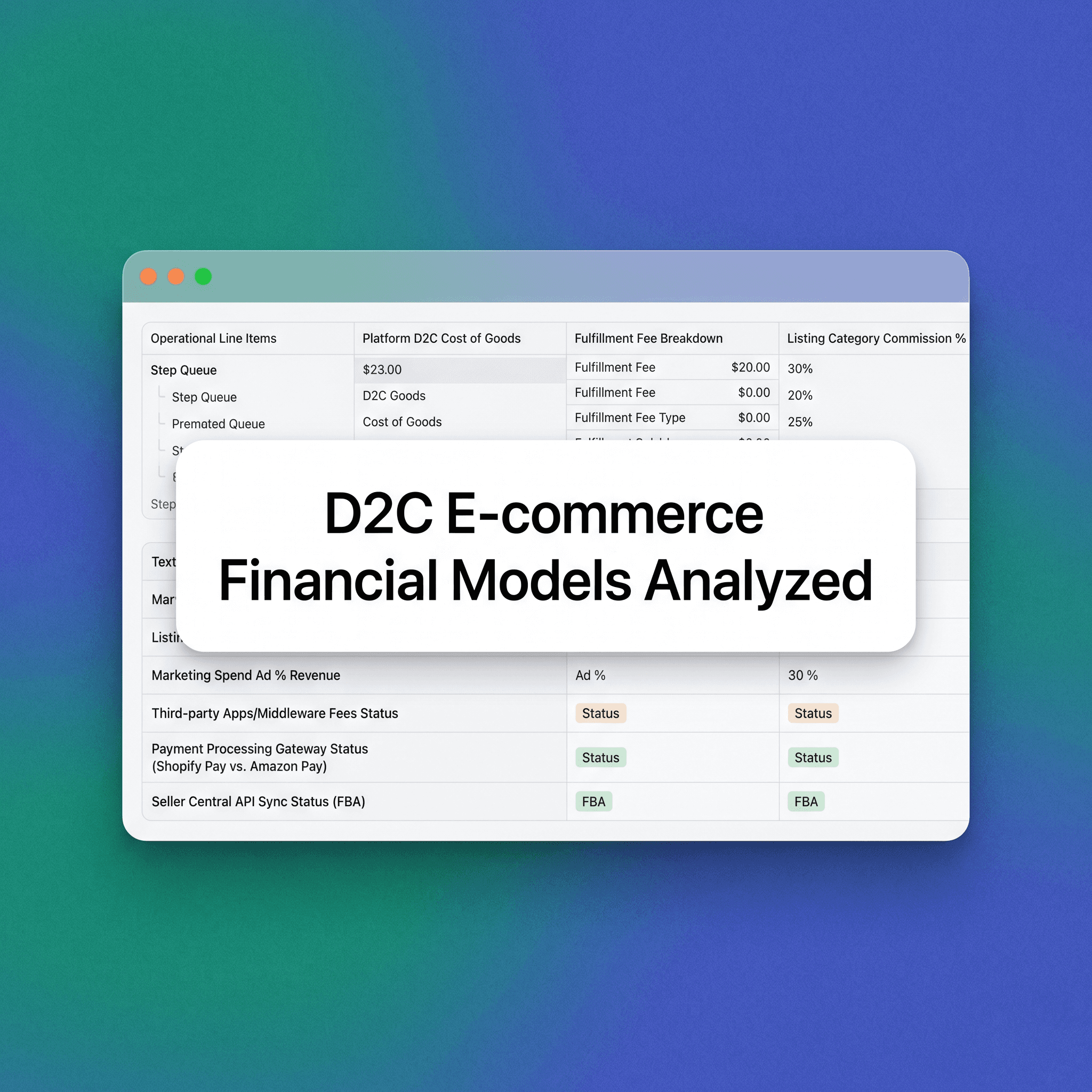
    Running both Amazon and Shopify through this matrix produces a clear picture. Here's what the analysis shows. When these variables are plotted, the stark contrast between a marketplace-dependent model and an owned-DTC model becomes apparent, highlighting the trade-offs between rapid, low-friction entry and the long-term protection of your brand's economic health.

Amazon Marketplace Economics: What You're Actually Paying

Amazon's fee structure is layered in ways that aren't immediately obvious. Most brands focus on the referral fee and stop there. That's a mistake. The true cost of doing business on Amazon includes a complex web of logistics, storage, and promotional requirements that can silently erode your profitability if you are not tracking every individual line item associated with your unit economics.

What Amazon Takes From Each Sale

For a typical consumer product at a $40 price point, the cost stack looks roughly like this:

  • Referral fee: 8–15% depending on category (many soft goods and consumables sit at 15%) which is deducted automatically before any funds hit your settlement account, representing a fixed tax on gross revenue that applies regardless of your net profitability.

  • FBA fulfillment fee: $3–$7 per unit depending on size and weight, covering the pick, pack, and ship logistics that Amazon manages on your behalf, effectively outsourcing your warehouse operations but introducing significant dependency on their internal logistics pricing tiers.

  • FBA storage fee: Monthly cost that compounds with slow-moving SKUs, penalizing brands for inefficient inventory management and forcing a faster cash conversion cycle that may not align with your actual product manufacturing or supply chain timelines.

  • Advertising (Sponsored Products): Most competitive categories require 10–25% ACoS to maintain visibility, creating a "pay-to-play" environment where organic ranking is often subordinate to your ability to outbid competitors for prime digital real estate.

  • Returns processing: Amazon's return policy is generous — to the buyer, not the seller, meaning that you often absorb the entire cost of the reverse logistics, including inspection and disposal or refurbishment, which can decimate the margin on products with higher-than-average return rates.

    Before you account for COGS and inbound freight, a $40 product sold through FBA with modest advertising can leave you with 20–30% gross margin. In competitive categories, that compresses further. This compressed margin environment requires highly disciplined inventory and financial oversight, as even minor fluctuations in advertising costs or inbound freight prices can quickly push your business into a net-loss position on a per-unit basis.

What Amazon Does Not Give You

The more consequential cost is invisible in the P&L. Amazon does not give you:

  • The buyer's email address, which is the cornerstone of any effective retention and community-building strategy, effectively locking your customers within the Amazon ecosystem and preventing you from initiating direct contact or lifecycle campaigns.

  • Behavioral purchase data you can act on, as Amazon retains the rich demographic and intent data generated by your customers to fuel its own competitive intelligence, potentially identifying your high-performing products for their own private-label initiatives.

  • Any mechanism to re-market to customers outside the platform, forcing you to rely entirely on the platform's internal re-marketing tools, which are often more expensive and less effective than your own customized email or SMS marketing automation workflows.

  • A brand experience you control, as your products are often listed alongside competitors in an interface designed to prioritize convenience over your specific brand story, making it nearly impossible to differentiate through unique packaging, storytelling, or custom site features.

    Every sale on Amazon is a transaction. The customer relationship belongs to Amazon. If you want to reach that buyer again, you pay Amazon again. This reality transforms your brand into a commodity supplier rather than a consumer-facing entity, where loyalty is directed toward the platform for its shipping reliability rather than toward your product for its quality or values.

When Amazon Makes Sense Anyway

This isn't an argument against Amazon. For the right brand at the right stage, the margin trade-off is worth it. Amazon makes sense when:

  • You're in a category where buyers default to Amazon search, allowing you to capture high-intent demand that would otherwise require astronomical customer acquisition costs on paid social or search channels.

  • You need volume velocity to fund manufacturing minimums, as the sheer scale of the Amazon marketplace can help clear inventory faster than an early-stage D2C site, providing the necessary liquidity to bridge the gap between production runs.

  • You're using Amazon as a customer acquisition channel with a plan to migrate repeat buyers to a DTC channel, essentially treating the platform as a lead generation tool where you accept lower initial margins in exchange for capturing the customer for future, higher-margin transactions.

  • Your product has low return rates and strong organic ranking potential, meaning the mechanics of the Amazon algorithm are likely to reward you with visibility without requiring unsustainable ad spend, thus stabilizing your margins while you build out your brand's presence elsewhere.

    The key phrase is "with a plan." Amazon without a migration strategy is a margin leak with no exit. Founders must treat the marketplace as a tactical asset rather than an endpoint, ensuring that every dollar earned on Amazon is actively serving the broader objective of establishing a long-term, self-sufficient brand equity.

Shopify Channel Economics: The Real Cost of Ownership

Shopify is often described as "free from fees" compared to Amazon. That framing is misleading. Shopify shifts costs rather than eliminating them. While you gain immense control, you assume the burden of being the primary traffic driver and technical operator, which introduces a new set of risks and costs that are often overlooked by founders focused solely on the difference in platform commissions.

What Shopify Takes From Each Sale

Shopify's platform fees are relatively modest:

  • Subscription fee: $39–$399/month depending on plan (Shopify Payments removes transaction fees; third-party gateways add 0.5–2%), representing a predictable, fixed operational expense that scales based on the sophistication and feature set of your store rather than your revenue volume.

  • Payment processing: 2.4–2.9% + $0.30 per transaction via Shopify Payments, which is the industry standard for credit card processing, offering significant cost savings compared to the hidden fulfillment and advertising fees endemic to third-party marketplaces.

  • Apps: The average Shopify brand runs 6–10 paid apps — this adds $200–$800/month in operational overhead that's easy to undercount, as these tools are essential for everything from loyalty programs to advanced email capture, creating a complex software stack that must be managed and optimized for return on investment.

    On a $40 sale, platform and payment costs might run $2–$4. That's a meaningfully better retention rate than Amazon. By consolidating these costs into predictable recurring charges and transparent percentage-based processing fees, you are better positioned to project your long-term profitability and allocate resources toward growth-oriented activities.

What Shopify Requires You to Fund

The cost Shopify doesn't charge is the cost you have to build yourself: traffic. Amazon comes with an audience. Shopify does not. Every visitor to your Shopify store has to be acquired, and acquisition is not cheap. You are effectively shifting from paying a platform fee to paying a marketing fee, where the success of your channel depends entirely on your ability to generate high-intent traffic through creative, content, and paid media execution.

  • Paid social (Meta, TikTok): CPMs are rising across every major platform. Blended CAC for new D2C brands in competitive categories regularly runs $30–$80 per customer, necessitating a sophisticated grasp of creative performance and funnel optimization to ensure that the lifetime value of your acquired customers exceeds the cost of acquisition.

  • Paid search (Google): Branded and non-branded search campaigns require ongoing investment and management, serving as a critical touchpoint for users who are actively seeking solutions that your products provide, provided you have the budget to sustain competitive bid strategies.

  • Email and SMS: These are high-ROI channels — but they require a list, and building that list costs acquisition budget upfront, meaning you must invest heavily in top-of-funnel conversion tactics to ensure you have a long-term asset to leverage for repeat business.

    The honest Shopify economics picture: lower platform fees, higher CAC, better margin on repeat customers. That last part is the strategic insight most founders miss. By focusing on the customer journey beyond the first sale, you turn a high-CAC transaction into a sustainable long-term revenue engine that is not solely dependent on perpetual advertising spend.

The Repeat Customer Math

On Amazon, your second sale to the same buyer costs almost as much as the first — you're paying advertising or referral fees every time. On Shopify, a customer in your email list costs pennies to re-engage. This is why LTV on Shopify customers is structurally higher than LTV on Amazon customers, even if the first transaction is less profitable. Developing this internal retention engine is how you build a resilient business that can survive shifts in digital advertising costs that would otherwise crush a company reliant exclusively on new customer acquisition.

If your product has a repurchase cycle — consumables, apparel, beauty, supplements — the Shopify economics improve dramatically by year two and beyond. Once you have established a loyal base of repeat purchasers, your blended acquisition cost begins to drop, enabling you to reinvest those savings into further expansion or product innovation, effectively creating a flywheel of compounding profitability that is unavailable in the marketplace-rented model.

Common Mistakes D2C Brands Make When Evaluating Channels
Comparing first-order margin instead of LTV-adjusted margin

A brand that wins on Amazon's first-order economics but never builds an owned audience is running a high-risk business. The right comparison is lifetime contribution margin per channel, not revenue per transaction. Failing to account for the full economic life of the customer leads to short-term thinking that favors rapid volume over long-term enterprise value, potentially leaving you vulnerable to changes in platform policy or competitive dynamics that you are powerless to influence.

Treating Amazon and Shopify as mutually exclusive

They aren't. The most efficient model for many D2C brands is to use Amazon for customer acquisition and top-of-funnel awareness, and Shopify for retention and LTV. This requires a deliberate strategy, not just running both channels independently. By utilizing Amazon as a discovery engine and Shopify as a brand-experience hub, you create a holistic ecosystem that maximizes the strengths of both platforms while minimizing the inherent risks of relying exclusively on one.

Underestimating Shopify's operational overhead

Shopify is not a passive channel. It requires active investment in traffic, conversion rate optimization, email flows, and retention mechanics. Founders who expect Shopify to generate revenue without that investment are consistently disappointed. You are the architect of your own growth on Shopify, which means you must constantly experiment with site experience, creative assets, and marketing automation to ensure that your store remains a competitive destination for your target audience.

Overweighting short-term Amazon velocity

Ranking well on Amazon today does not protect you tomorrow. Algorithm changes, increased competition, and rising advertising costs can erode a strong Amazon position faster than most founders expect. An Amazon-only brand has no defensible moat, meaning that your entire business model can be undermined by a single update to the marketplace’s internal ranking logic or the entry of a well-funded competitor with a more aggressive advertising strategy.

Ignoring the valuation difference

When brands are acquired, Shopify-native businesses with strong email lists and high repeat purchase rates command higher multiples than Amazon-dependent businesses. Customer ownership is a balance sheet asset, even if it doesn't appear on one. Investors place a premium on companies that own their relationships and possess actionable data, recognizing that such businesses have lower risk profiles and higher long-term growth potential than those tethered to the whims of a third-party marketplace.

The Channel Mix Decision Framework

Rather than asking "Amazon or Shopify?" ask three questions:

  • 1. Where does my customer first discover this product category? If they search Amazon first, Amazon needs to be part of your strategy. If they find it through social content or editorial, Shopify-first may be more efficient. Understanding your customer's behavioral journey is essential to optimizing your channel mix, ensuring that you meet your audience where they are most likely to convert while minimizing wasteful spending on channels that do not align with their discovery habits.

  • 2. What is my product's natural repurchase cycle? High-frequency repurchase products (every 30–90 days) benefit enormously from owned-channel economics. Low-frequency or one-time purchases shift the math back toward Amazon's high-reach model. Aligning your platform strategy with the physiological or psychological nature of your product is the most effective way to optimize your margins and leverage the inherent advantages of either high-reach marketplaces or high-retention D2C stores.

  • 3. What does my business look like in three years? If you're building toward acquisition or funding, customer data ownership and repeat purchase metrics will matter to buyers and investors. If you're optimizing for near-term cash flow, Amazon's volume infrastructure may be the right short-term tool. Defining your end goal early allows you to construct a channel strategy that prioritizes the metrics that will drive your target valuation, ensuring that you aren't forced to pivot your entire operational model just to satisfy potential acquirers later on.


Most D2C founders frame the Amazon versus Shopify question as a distribution decision. It isn't. It's a financial architecture decision — one that shapes your margin structure, your customer ownership, and your brand's long-term valuation. This fundamental choice dictates your ability to scale profitably while navigating the tightening constraints of modern digital advertising landscapes. By choosing between a closed ecosystem and an open platform, you are essentially determining the long-term equity of your business and the durability of your customer acquisition funnel in an increasingly competitive global marketplace.

Both platforms generate revenue. But they do it in fundamentally different ways, with fundamentally different costs. If you're building a D2C business and you haven't mapped the economics side by side, you're making channel decisions in the dark. Misunderstanding these underlying costs can lead to cash flow traps where revenue growth masks underlying margin erosion, preventing founders from reinvesting in critical product development or brand identity initiatives that drive sustainable long-term success.

This post breaks down exactly how Shopify and Amazon differ on the numbers that actually matter. By analyzing the structural components of each platform, we can identify which financial levers drive growth and which ones act as hidden taxes on your operational efficiency, ultimately allowing for a more informed strategic roadmap.

Why Channel Economics Matter More Than Channel Reach

Amazon offers immediate access to hundreds of millions of buyers. Shopify gives you a blank canvas and a payment processor. The difference isn't which one has more customers — it's what you pay to reach them, what you keep after the sale, and what you own when the transaction is done. Achieving massive reach is a vanity metric if the cost of maintaining that presence consumes the entirety of your operating margin, leaving the business unable to sustain itself through market fluctuations or changes in platform-specific advertising costs.

For a D2C brand, those three variables determine whether you're building equity or renting revenue. Renting revenue from a massive marketplace can provide a necessary boost during early stages of growth, but it often sacrifices the long-term stability required for brand building, meaning you must carefully balance the immediate need for volume with the imperative to build an asset base that you truly own and control.

The D2C Channel Economics Matrix

Use this framework to evaluate any sales channel, not just these two. For each channel, score it across five dimensions:

  • Gross Margin Retention — What percentage of revenue do you actually keep after platform fees? This serves as your foundational baseline for profitability, ensuring that every unit sold contributes positively to your bottom line after factoring in the unavoidable costs of platform participation.

  • Customer Data Ownership — Do you own the buyer relationship, or does the platform? Possessing direct access to customer data is the single most important factor in driving long-term customer lifetime value, as it allows for personalized communication and retention strategies that are immune to platform interference.

  • Acquisition Cost Structure — Is your CAC paid once (owned) or forever (rented)? Understanding the decay rate of your acquisition cost is vital for sustainable growth, as relying on rented traffic channels often creates a perpetual cycle of reinvestment where success is tied entirely to increasing advertising spend.

  • Brand Equity Contribution — Does the sale build your brand, or the platform's? Every transaction should ideally reinforce your brand’s value proposition in the customer's mind, creating a mental association that encourages repeat purchases and word-of-mouth referrals outside of the original shopping environment.

  • Operational Leverage — Does volume reduce your unit cost, or does it increase platform dependency? True operational leverage occurs when scaling your business allows for economies of scale that protect your margins, rather than simply increasing the percentage of your revenue that must be paid out in fees to the host platform.

    Running both Amazon and Shopify through this matrix produces a clear picture. Here's what the analysis shows. When these variables are plotted, the stark contrast between a marketplace-dependent model and an owned-DTC model becomes apparent, highlighting the trade-offs between rapid, low-friction entry and the long-term protection of your brand's economic health.

Amazon Marketplace Economics: What You're Actually Paying

Amazon's fee structure is layered in ways that aren't immediately obvious. Most brands focus on the referral fee and stop there. That's a mistake. The true cost of doing business on Amazon includes a complex web of logistics, storage, and promotional requirements that can silently erode your profitability if you are not tracking every individual line item associated with your unit economics.

What Amazon Takes From Each Sale

For a typical consumer product at a $40 price point, the cost stack looks roughly like this:

  • Referral fee: 8–15% depending on category (many soft goods and consumables sit at 15%) which is deducted automatically before any funds hit your settlement account, representing a fixed tax on gross revenue that applies regardless of your net profitability.

  • FBA fulfillment fee: $3–$7 per unit depending on size and weight, covering the pick, pack, and ship logistics that Amazon manages on your behalf, effectively outsourcing your warehouse operations but introducing significant dependency on their internal logistics pricing tiers.

  • FBA storage fee: Monthly cost that compounds with slow-moving SKUs, penalizing brands for inefficient inventory management and forcing a faster cash conversion cycle that may not align with your actual product manufacturing or supply chain timelines.

  • Advertising (Sponsored Products): Most competitive categories require 10–25% ACoS to maintain visibility, creating a "pay-to-play" environment where organic ranking is often subordinate to your ability to outbid competitors for prime digital real estate.

  • Returns processing: Amazon's return policy is generous — to the buyer, not the seller, meaning that you often absorb the entire cost of the reverse logistics, including inspection and disposal or refurbishment, which can decimate the margin on products with higher-than-average return rates.

    Before you account for COGS and inbound freight, a $40 product sold through FBA with modest advertising can leave you with 20–30% gross margin. In competitive categories, that compresses further. This compressed margin environment requires highly disciplined inventory and financial oversight, as even minor fluctuations in advertising costs or inbound freight prices can quickly push your business into a net-loss position on a per-unit basis.

What Amazon Does Not Give You

The more consequential cost is invisible in the P&L. Amazon does not give you:

  • The buyer's email address, which is the cornerstone of any effective retention and community-building strategy, effectively locking your customers within the Amazon ecosystem and preventing you from initiating direct contact or lifecycle campaigns.

  • Behavioral purchase data you can act on, as Amazon retains the rich demographic and intent data generated by your customers to fuel its own competitive intelligence, potentially identifying your high-performing products for their own private-label initiatives.

  • Any mechanism to re-market to customers outside the platform, forcing you to rely entirely on the platform's internal re-marketing tools, which are often more expensive and less effective than your own customized email or SMS marketing automation workflows.

  • A brand experience you control, as your products are often listed alongside competitors in an interface designed to prioritize convenience over your specific brand story, making it nearly impossible to differentiate through unique packaging, storytelling, or custom site features.

    Every sale on Amazon is a transaction. The customer relationship belongs to Amazon. If you want to reach that buyer again, you pay Amazon again. This reality transforms your brand into a commodity supplier rather than a consumer-facing entity, where loyalty is directed toward the platform for its shipping reliability rather than toward your product for its quality or values.

When Amazon Makes Sense Anyway

This isn't an argument against Amazon. For the right brand at the right stage, the margin trade-off is worth it. Amazon makes sense when:

  • You're in a category where buyers default to Amazon search, allowing you to capture high-intent demand that would otherwise require astronomical customer acquisition costs on paid social or search channels.

  • You need volume velocity to fund manufacturing minimums, as the sheer scale of the Amazon marketplace can help clear inventory faster than an early-stage D2C site, providing the necessary liquidity to bridge the gap between production runs.

  • You're using Amazon as a customer acquisition channel with a plan to migrate repeat buyers to a DTC channel, essentially treating the platform as a lead generation tool where you accept lower initial margins in exchange for capturing the customer for future, higher-margin transactions.

  • Your product has low return rates and strong organic ranking potential, meaning the mechanics of the Amazon algorithm are likely to reward you with visibility without requiring unsustainable ad spend, thus stabilizing your margins while you build out your brand's presence elsewhere.

    The key phrase is "with a plan." Amazon without a migration strategy is a margin leak with no exit. Founders must treat the marketplace as a tactical asset rather than an endpoint, ensuring that every dollar earned on Amazon is actively serving the broader objective of establishing a long-term, self-sufficient brand equity.

Shopify Channel Economics: The Real Cost of Ownership

Shopify is often described as "free from fees" compared to Amazon. That framing is misleading. Shopify shifts costs rather than eliminating them. While you gain immense control, you assume the burden of being the primary traffic driver and technical operator, which introduces a new set of risks and costs that are often overlooked by founders focused solely on the difference in platform commissions.

What Shopify Takes From Each Sale

Shopify's platform fees are relatively modest:

  • Subscription fee: $39–$399/month depending on plan (Shopify Payments removes transaction fees; third-party gateways add 0.5–2%), representing a predictable, fixed operational expense that scales based on the sophistication and feature set of your store rather than your revenue volume.

  • Payment processing: 2.4–2.9% + $0.30 per transaction via Shopify Payments, which is the industry standard for credit card processing, offering significant cost savings compared to the hidden fulfillment and advertising fees endemic to third-party marketplaces.

  • Apps: The average Shopify brand runs 6–10 paid apps — this adds $200–$800/month in operational overhead that's easy to undercount, as these tools are essential for everything from loyalty programs to advanced email capture, creating a complex software stack that must be managed and optimized for return on investment.

    On a $40 sale, platform and payment costs might run $2–$4. That's a meaningfully better retention rate than Amazon. By consolidating these costs into predictable recurring charges and transparent percentage-based processing fees, you are better positioned to project your long-term profitability and allocate resources toward growth-oriented activities.

What Shopify Requires You to Fund

The cost Shopify doesn't charge is the cost you have to build yourself: traffic. Amazon comes with an audience. Shopify does not. Every visitor to your Shopify store has to be acquired, and acquisition is not cheap. You are effectively shifting from paying a platform fee to paying a marketing fee, where the success of your channel depends entirely on your ability to generate high-intent traffic through creative, content, and paid media execution.

  • Paid social (Meta, TikTok): CPMs are rising across every major platform. Blended CAC for new D2C brands in competitive categories regularly runs $30–$80 per customer, necessitating a sophisticated grasp of creative performance and funnel optimization to ensure that the lifetime value of your acquired customers exceeds the cost of acquisition.

  • Paid search (Google): Branded and non-branded search campaigns require ongoing investment and management, serving as a critical touchpoint for users who are actively seeking solutions that your products provide, provided you have the budget to sustain competitive bid strategies.

  • Email and SMS: These are high-ROI channels — but they require a list, and building that list costs acquisition budget upfront, meaning you must invest heavily in top-of-funnel conversion tactics to ensure you have a long-term asset to leverage for repeat business.

    The honest Shopify economics picture: lower platform fees, higher CAC, better margin on repeat customers. That last part is the strategic insight most founders miss. By focusing on the customer journey beyond the first sale, you turn a high-CAC transaction into a sustainable long-term revenue engine that is not solely dependent on perpetual advertising spend.

The Repeat Customer Math

On Amazon, your second sale to the same buyer costs almost as much as the first — you're paying advertising or referral fees every time. On Shopify, a customer in your email list costs pennies to re-engage. This is why LTV on Shopify customers is structurally higher than LTV on Amazon customers, even if the first transaction is less profitable. Developing this internal retention engine is how you build a resilient business that can survive shifts in digital advertising costs that would otherwise crush a company reliant exclusively on new customer acquisition.

If your product has a repurchase cycle — consumables, apparel, beauty, supplements — the Shopify economics improve dramatically by year two and beyond. Once you have established a loyal base of repeat purchasers, your blended acquisition cost begins to drop, enabling you to reinvest those savings into further expansion or product innovation, effectively creating a flywheel of compounding profitability that is unavailable in the marketplace-rented model.

Common Mistakes D2C Brands Make When Evaluating Channels
Comparing first-order margin instead of LTV-adjusted margin

A brand that wins on Amazon's first-order economics but never builds an owned audience is running a high-risk business. The right comparison is lifetime contribution margin per channel, not revenue per transaction. Failing to account for the full economic life of the customer leads to short-term thinking that favors rapid volume over long-term enterprise value, potentially leaving you vulnerable to changes in platform policy or competitive dynamics that you are powerless to influence.

Treating Amazon and Shopify as mutually exclusive

They aren't. The most efficient model for many D2C brands is to use Amazon for customer acquisition and top-of-funnel awareness, and Shopify for retention and LTV. This requires a deliberate strategy, not just running both channels independently. By utilizing Amazon as a discovery engine and Shopify as a brand-experience hub, you create a holistic ecosystem that maximizes the strengths of both platforms while minimizing the inherent risks of relying exclusively on one.

Underestimating Shopify's operational overhead

Shopify is not a passive channel. It requires active investment in traffic, conversion rate optimization, email flows, and retention mechanics. Founders who expect Shopify to generate revenue without that investment are consistently disappointed. You are the architect of your own growth on Shopify, which means you must constantly experiment with site experience, creative assets, and marketing automation to ensure that your store remains a competitive destination for your target audience.

Overweighting short-term Amazon velocity

Ranking well on Amazon today does not protect you tomorrow. Algorithm changes, increased competition, and rising advertising costs can erode a strong Amazon position faster than most founders expect. An Amazon-only brand has no defensible moat, meaning that your entire business model can be undermined by a single update to the marketplace’s internal ranking logic or the entry of a well-funded competitor with a more aggressive advertising strategy.

Ignoring the valuation difference

When brands are acquired, Shopify-native businesses with strong email lists and high repeat purchase rates command higher multiples than Amazon-dependent businesses. Customer ownership is a balance sheet asset, even if it doesn't appear on one. Investors place a premium on companies that own their relationships and possess actionable data, recognizing that such businesses have lower risk profiles and higher long-term growth potential than those tethered to the whims of a third-party marketplace.

The Channel Mix Decision Framework

Rather than asking "Amazon or Shopify?" ask three questions:

  • 1. Where does my customer first discover this product category? If they search Amazon first, Amazon needs to be part of your strategy. If they find it through social content or editorial, Shopify-first may be more efficient. Understanding your customer's behavioral journey is essential to optimizing your channel mix, ensuring that you meet your audience where they are most likely to convert while minimizing wasteful spending on channels that do not align with their discovery habits.

  • 2. What is my product's natural repurchase cycle? High-frequency repurchase products (every 30–90 days) benefit enormously from owned-channel economics. Low-frequency or one-time purchases shift the math back toward Amazon's high-reach model. Aligning your platform strategy with the physiological or psychological nature of your product is the most effective way to optimize your margins and leverage the inherent advantages of either high-reach marketplaces or high-retention D2C stores.

  • 3. What does my business look like in three years? If you're building toward acquisition or funding, customer data ownership and repeat purchase metrics will matter to buyers and investors. If you're optimizing for near-term cash flow, Amazon's volume infrastructure may be the right short-term tool. Defining your end goal early allows you to construct a channel strategy that prioritizes the metrics that will drive your target valuation, ensuring that you aren't forced to pivot your entire operational model just to satisfy potential acquirers later on.


FAQs

What are the main fees D2C brands pay on Amazon vs Shopify?

Amazon charges referral fees (8–15%), FBA fulfillment fees ($3–7+ per unit), storage fees, and advertising costs that typically run 10–25% of revenue in competitive categories. Shopify charges a monthly subscription ($39–$399), payment processing (2.4–2.9%), and app costs. The net platform cost on Amazon is generally 30–50% of revenue when advertising is included. On Shopify, it depends almost entirely on your paid traffic spend. This distinction is critical because while Shopify's costs are largely within your control through marketing efficiency, Amazon's costs are largely baked into the platform architecture, creating a much higher floor for the cost of doing business regardless of your internal efficiency.

Is Shopify more profitable than Amazon for D2C brands?

It depends on the product and the time horizon. On a per-transaction basis, Amazon can be comparable or worse depending on category fees and advertising. On a lifetime value basis, Shopify is typically more profitable because you own the customer relationship and repeat purchase costs are much lower. This is because the initial acquisition cost on Shopify is offset by the significantly higher contribution margin from second, third, and fourth purchases, which are fueled by your owned email and SMS lists rather than a platform-managed advertising environment.

Can D2C brands sell on both Amazon and Shopify at the same time?

Yes, and many successful brands do. The strategic approach is to use Amazon for reach and new customer acquisition, then use post-purchase touchpoints (inserts, packaging, warranty registration) to move customers toward owned channels like email and Shopify. This requires deliberate execution and should be planned in advance. By leveraging the reach of Amazon as a top-of-funnel acquisition engine and then converting those customers into long-term subscribers on your own site, you can capture the best of both worlds, provided you navigate Amazon's strict policies against diverting traffic away from their platform.

How does customer data ownership differ between Amazon and Shopify?

On Amazon, you receive no customer contact data and have no direct marketing access to buyers. On Shopify, you own all customer data including email, purchase history, and behavioral data. This owned data is the foundation of email marketing, SMS campaigns, and personalization — all high-ROI channels that don't exist on Amazon. Without this data, your ability to create a personalized brand experience is severely limited, which in turn stifles your ability to cultivate the deep, emotional loyalty that transforms a one-time buyer into a lifetime advocate for your brand.

How does channel choice affect brand valuation at exit?

Acquirers and investors evaluate D2C brands on metrics including customer LTV, repeat purchase rate, email list size, and channel diversification. Brands with strong Shopify-native customer bases and low Amazon dependency typically command higher multiples because the revenue is more defensible and the customer relationships are transferable. Amazon-only revenue is considered higher risk because the acquirer is essentially buying a business that is at the mercy of platform algorithm changes, which can instantly render previously successful products invisible.

When should a D2C brand prioritize Amazon over Shopify?

Prioritize Amazon when you're in a high-intent search category, need volume to reach manufacturing minimums, or are early-stage and need proof-of-purchase data before investing in owned-channel infrastructure. Amazon is a legitimate growth tool — the problem is treating it as a long-term strategy rather than a stage. By using Amazon as an early-stage accelerator, brands can gain the financial runway needed to build out the sophisticated marketing and site infrastructure that will eventually allow them to compete more effectively on their own terms.

get in touch

Ready to Grow From Day One?

Strategy, execution, and digital experiences designed to move together. Fill out the form below and our team will contact you shortly.

get in touch

Ready to Grow From Day One?

Strategy, execution, and digital experiences designed to move together. Fill out the form below and our team will contact you shortly.

get in touch

Ready to Grow From Day One?

Strategy, execution, and digital experiences designed to move together. Fill out the form below and our team will contact you shortly.

© 2026 projectsupply AI, Data and Digital Engineering 

Company. Pune, India. All rights reserved.

Part of Tangle

© 2026 projectsupply AI, Data and Digital Engineering 

Company. Pune, India. All rights reserved.

Part of Tangle

© 2026 projectsupply AI, Data and Digital Engineering 

Company. Pune, India. All rights reserved.

Part of Tangle