SEO & Search
08 min read
Why Your GBP Probably Needs Work Right Now
At some point, most local businesses realize their Google Business Profile sits in a state of neglect. The initial setup happened years ago, perhaps by someone who no longer works there, and the profile has remained largely untouched since.
This matters more than most business owners realize. A BrightLocal study found that 98% of consumers use the internet to find local businesses, and Google Business Profile appears in 93% of those searches. Yet according to Sterling Sky's 2024 analysis, fewer than 30% of businesses have fully optimized their profiles.
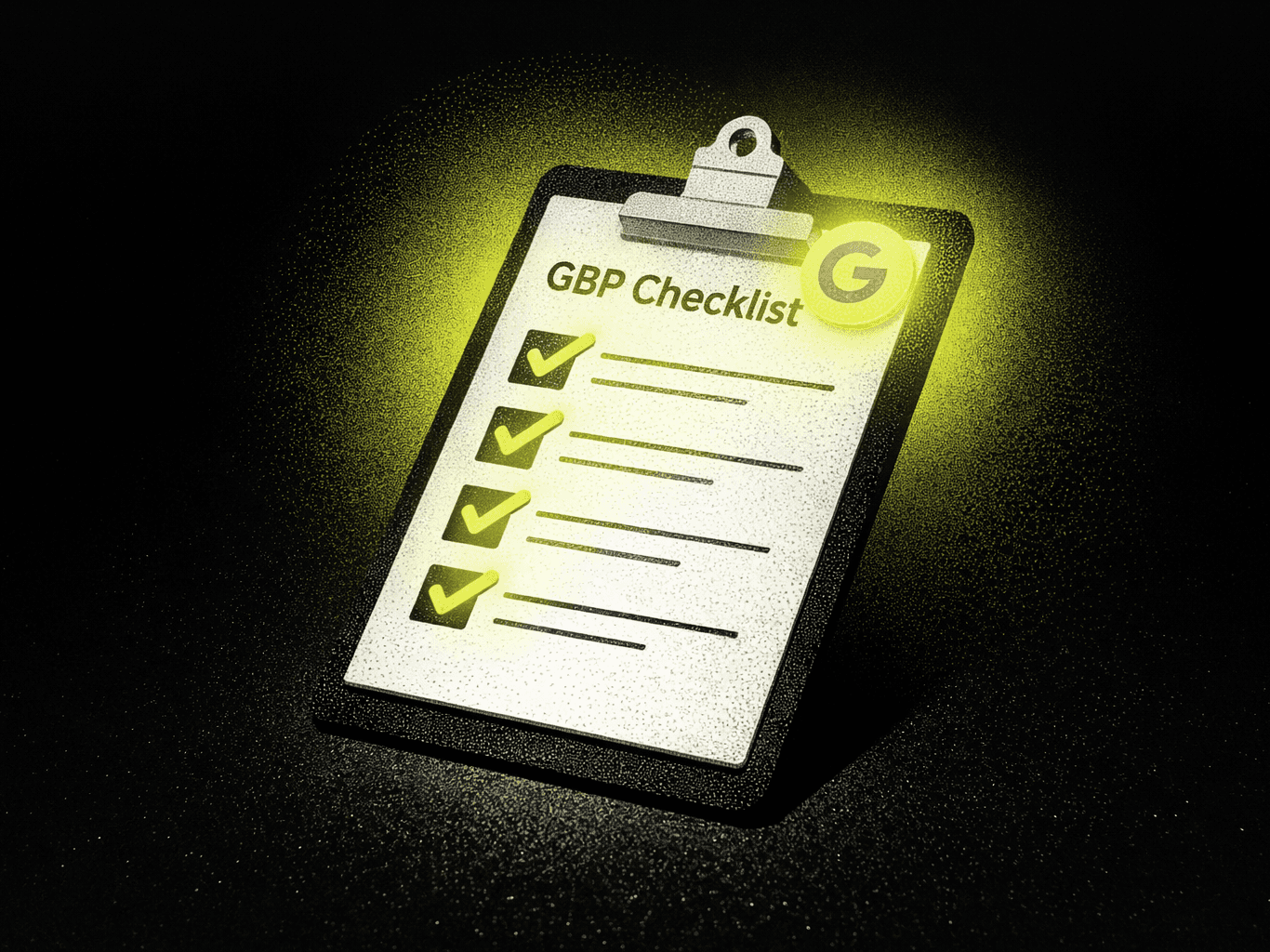
The gap between basic setup and true GBP optimization represents lost visibility, missed customer connections, and revenue left on the table. This checklist addresses that gap with specific, actionable steps that move beyond basic completion to strategic optimization.
THE CORE PROBLEM Basic setup and true optimization are not the same thing. Most businesses stop at "claimed and verified" — the real competitive advantage starts after that. |
Section 1: Foundational Information & Verification
The first optimization step involves ensuring foundational accuracy. Google's algorithm prioritizes consistency, and even minor discrepancies between your profile and other web citations can suppress visibility.
NAP Consistency: The Non-Negotiable Foundation
Business name, address, and phone number must match exactly across all platforms. This means identical formatting — no "Suite" vs "Ste" variations, and consistent phone number presentation everywhere your business appears online.
DATA POINT A 2024 Moz study found that NAP inconsistencies reduced local pack visibility by an average of 23%. That's nearly a quarter of your potential reach gone from a formatting mismatch. |
Verification Status
Verification deserves attention beyond the initial badge. Businesses should request video verification when available, as this provides additional credibility signals. For multi-location businesses, each location requires individual verification and optimization — there are no shortcuts here.
Category Selection: Your Most Powerful Ranking Signal
Categories determine which searches your profile is eligible to appear in. Get this wrong and no amount of optimization elsewhere will compensate.
Category Type | What It Does | Best Practice |
Primary Category | Carries the most weight for ranking signals | Choose the most specific option that accurately describes your core business |
Secondary Categories | Expand potential search visibility for related services | Add only genuinely relevant categories — adding irrelevant ones can dilute relevance |
Category Accuracy | Signals legitimacy to Google's quality filters | Only claim categories that reflect actual services — e.g., "Event Venue" only if you actually host events |
Foundational Checklist
Business name matches legal name or DBA — no keywords added
Address formatted identically across all online directories
Phone number consistent across website, GBP, and citations
Video verification requested (where available)
Each business location individually verified
Primary category is the most specific accurate option
Secondary categories added for all genuine service areas
Section 2: Content Optimization & Regular Updates
Content optimization transforms a directory listing into a marketing asset. Each content element serves both search algorithms and customer decision-making.
Business Description: Your 750-Character Pitch
The business description serves as prime real estate for natural keyword integration. The 750-character limit requires concision, but Google's algorithm weighs early content more heavily. The first 250 characters should communicate core offerings and location — treat them like a meta description.
STRUCTURE YOUR DESCRIPTION First 250 characters: Core service + location + primary differentiator. Characters 251-500: Key services and specializations. Characters 501-750: Trust signals, credentials, or unique attributes. |
Photo Strategy: Volume and Diversity Both Matter
Photos influence consumer behavior measurably. Google reports that businesses with photos receive 42% more requests for directions and 35% more click-throughs to websites. The algorithm also appears to favor profiles with regular photo updates — freshness signals extend beyond posts.
Photo Type | Search Intent It Serves | Upload Frequency | Priority |
Exterior shots | "Is this the right place?" navigation intent | Once + seasonal updates | Essential |
Interior views | Ambiance and first-impression evaluation | Quarterly refresh | Essential |
Product images | Purchase and service evaluation | Monthly | High |
Team photos | Trust and personalization signals | When team changes | High |
Work in progress | Demonstrates active business operations | Weekly if possible | Medium |
Target: at least 5 new photos per month, with descriptive file names set before upload (e.g., "chicago-italian-restaurant-outdoor-seating.jpg" rather than "IMG_4832.jpg").
Posts: The Freshness Signal Most Businesses Ignore
While post content doesn't appear to directly impact rankings, profiles with weekly posts show 23% higher engagement rates according to PlePer Analytics. Focus posts on offers, events, and updates — not generic content that could belong to any business.
Post Type | Best Used For | Posting Frequency |
Offer posts | Promotions, discounts, seasonal deals | As promotions run |
Event posts | Workshops, open days, community events | 2 weeks before event |
Update posts | New services, hours changes, announcements | As needed + weekly filler |
Product posts | Featured products or new arrivals | Weekly |
Services & Products: The Keyword Goldmine
Services and products listings create additional keyword opportunities that most businesses squander with thin descriptions. Each service should include a description of 100-300 words, naturally incorporating relevant search terms. For product listings, price accuracy is critical — Google penalizes profiles with consistently outdated pricing information.
Content Optimization Checklist
Business description written with core offering in first 250 characters
Description avoids keyword stuffing but includes natural search terms
Minimum 10 photos uploaded across all categories
Photo file names are descriptive before upload
At least 5 new photos added each month
Weekly post schedule in place
Every service listed with a 100-300 word description
Product pricing kept current and accurate
Section 3: Review Strategy & Response Management
Review quantity and recency influence both rankings and conversion. The strategy extends well beyond simply asking customers to leave reviews.
87% of consumers read reviews for local businesses | 79% trust online reviews as much as personal recommendations | 0.12★ average rating improvement from responding to negative reviews (Harvard Business School) |
Response Protocol: Speed and Personalization
Response rate and response time both appear to factor into Google's quality signals. The goal is to respond to all reviews within 48 hours, with personalized responses rather than templates. A response that references specific details from the review signals authenticity to both Google and future readers.
Review Type | Response Approach | Response Goal | Timeline |
Positive (4-5 stars) | Reference specific details; invite return visit | Reinforce relationship and signal engagement | Within 24 hours |
Neutral (3 stars) | Acknowledge both positives and the gap; offer resolution | Demonstrate responsiveness and care | Within 24 hours |
Negative (1-2 stars) | Acknowledge issue, explain corrective action, move offline | Mitigate damage; show accountability | Within 12 hours |
Review Velocity: Steady Beats Sudden
Sudden spikes in reviews can trigger spam filters, while steady accumulation signals genuine business activity. Target 4-8 new reviews per month rather than requesting bulk reviews during annual campaigns.
GETTING KEYWORD-RICH REVIEWS When customers naturally mention specific services or attributes in reviews, Google's algorithm associates those terms with your business. Make it easy for customers to leave detailed reviews by sending follow-up messages with specific prompts — ask them to describe the particular service they received. |
Review Strategy Checklist
Response process in place for all new reviews within 48 hours
Negative reviews receive personalized, non-defensive responses
Follow-up system sends review requests after each service
Review prompts encourage specific service mentions
Monthly review velocity tracked (target: 4-8 new reviews/month)
No bulk review requests or incentivized review campaigns
Section 4: Technical Optimization & Attributes
Technical completeness provides the structured data Google needs to accurately understand and rank your business. This section often separates good profiles from great ones.
Attributes: Structured Data Google Uses Directly
Attributes provide structured data that helps Google understand business characteristics and match your profile to more specific searches. The available attributes vary by category, but all relevant attributes should be completed.
Attribute Category | Examples | Why It Matters |
Accessibility | Wheelchair accessible entrance, accessible parking | Surfaces profile for accessibility-filtered searches |
Amenities | Wi-Fi, outdoor seating, parking available | Matches amenity-specific search queries |
Payment methods | Credit cards, NFC payments, cheques accepted | Reduces pre-visit friction for customers |
Service options | Dine-in, takeaway, delivery, in-store pickup | Critical for filtered local searches |
Ownership | Women-led, veteran-owned, LGBTQ+ friendly | Surfaces profile for identity-based searches |
Business Hours: Accuracy Is a Ranking Signal
Business hours require meticulous accuracy, including special hours for holidays updated at least two weeks in advance. Google appears to suppress profiles that show consistent discrepancies between stated hours and actual availability based on user reports.
Booking & Conversion Features
Feature | Impact | Setup Priority |
Appointment links | Profiles with direct booking see 40% higher conversion rates (Google internal data) | High — enable immediately |
Messaging | Sub-hour response profiles generate 2.3x more message volume | Enable only if <1 hour response is sustainable |
Website URL | Link to relevant landing page, not homepage — especially critical for multi-location businesses | Review and update quarterly |
Technical Optimization Checklist
All relevant attributes completed for your business category
Accessibility attributes filled in accurately
Payment method attributes complete
Business hours accurate including all special/holiday hours
Holiday hours updated at least 2 weeks in advance
Appointment booking link connected to scheduling platform
Messaging enabled only if sub-hour response time is sustainable
Website URL points to relevant landing page (not just homepage)
Multi-location profiles each link to location-specific pages
Section 5: Q&A Management & Community Engagement
The Questions and Answers section represents both opportunity and risk. Anyone can ask questions on a business profile, and anyone can answer them — including competitors or misinformed community members.
THE RISK YOU'RE PROBABLY NOT MANAGING If you're not actively managing your Q&A section, someone else is filling it for you. Competitors, well-meaning but inaccurate customers, and even trolls can post answers that appear on your profile. Check this section weekly. |
Proactive Q&A: Seed Before They Ask
Proactive Q&A management involves anticipating common questions and publishing answers preemptively. Some businesses seed their Q&A section with 8-10 common questions answered with detailed, keyword-rich responses, creating a knowledge base that serves customers while controlling the narrative.
Question Category | Common Examples | Answer Strategy |
Hours & location | "Are you open on Sundays?" "Where do I park?" | Detailed answer with any seasonal variations noted |
Pricing | "Do you offer payment plans?" "What does X service cost?" | Give ranges or link to pricing page — avoid outdated specifics |
Service availability | "Do you do X?" "Do you serve Y area?" | Clear yes/no with context — great for keyword relevance |
Booking process | "How do I make an appointment?" "Do I need a referral?" | Step-by-step instructions with booking link |
Profiles with active, accurate Q&A sections show 17% higher engagement rates according to 2024 Whitespark data. The content within answers also contributes to the overall keyword relevance of the profile.
Q&A Management Checklist
Q&A section monitored weekly for new questions and inaccurate answers
8-10 common questions pre-seeded with keyword-rich answers
All inaccurate community answers corrected or flagged
Booking and hours questions answered with current information
Answers reviewed quarterly to ensure accuracy
Section 6: Performance Monitoring & Iterative Improvement
Google Business Profile Insights provides data that most businesses underutilize. The dashboard shows how customers find the listing, what actions they take, and where they come from geographically.
The Metrics That Actually Matter
Metric | What It Reveals | What to Do With It |
Search queries | Which terms actually drive profile visibility | Update description and posts to reflect high-impression queries with low action rates |
Phone calls | Direct revenue-intent actions | Track against optimization changes to measure impact |
Website clicks | Research and evaluation intent | Ensure landing page matches the search intent driving clicks |
Direction requests | High commercial intent — ready-to-visit customers | Map against photo uploads; more photos correlate with more requests |
Photo views | Content engagement and profile freshness signal | Identify which photo categories get most views; add more of those |
Competitor Analysis: Know Where You Stand
Tools like BrightLocal or Whitespark allow businesses to track their rankings against specific competitors for target keywords. This reveals both opportunities and threats in local search positioning. Sophisticated businesses maintain a spreadsheet correlating profile changes with metric shifts — simple but powerful.
REAL EXAMPLE Search Query Data Revealing a Messaging Gap "Emergency plumber Phoenix" was driving significant impressions for one business but generating very few action clicks. The profile had no mention of emergency or after-hours services. Adding this to the description and posting weekly about emergency availability resolved the gap within 60 days. | ||
60 days To resolve the messaging gap | 0 mentions Of emergency service in original profile | 3x Action rate improvement after fix |
Monthly Audit Routine
This checklist should become a recurring task rather than a one-time project. Set a calendar reminder for the first business day of each month.
Timing | Tasks to Complete |
Weekly | Publish one post; respond to all new reviews; check Q&A for new questions or inaccurate answers |
Monthly | Review Insights data; add 5+ new photos; audit review velocity; check for new attribute options |
Quarterly | Full NAP audit across all directories; update website URL if needed; competitor benchmark check; refresh service descriptions |
Annually | Review all categories for accuracy; rewrite business description; full profile completeness audit; update team photos |
Performance Monitoring Checklist
Monthly Insights review scheduled on calendar
Search query data reviewed and actioned each month
Spreadsheet tracking profile changes vs. metric shifts
Competitor ranking tracked for 3-5 target keywords
Monthly review velocity logged and reviewed
Action metrics (calls, clicks, directions) tracked month-over-month
The Bottom Line: Optimization Is an Ongoing Commitment
Google Business Profile optimization represents an ongoing commitment rather than a completion milestone. The businesses that treat their profiles as dynamic marketing assets rather than static directories consistently outperform those that set and forget.
The checklist outlined here addresses the full spectrum of optimization opportunities, from foundational accuracy to advanced engagement strategies. Each element contributes to visibility, credibility, and conversion. Implementation doesn't require simultaneous execution — start with foundational accuracy and verification, then progress through content optimization, review management, and technical enhancements.
For businesses managing multiple locations or seeking systematic implementation, documented processes and assignment of ownership prevent optimization gaps. The investment of 2-3 hours monthly generates measurable returns in local visibility and customer acquisition.
2-3 hrs monthly investment required for ongoing optimization | 23% visibility reduction from NAP inconsistencies (Moz 2024) | 40% higher conversions with booking integration enabled |
ADDITIONAL RESOURCES For structured guidance, documented processes, and category-specific best practices that extend beyond this general framework, visit tanglemedia.com — where location-specific optimization strategies are compiled for businesses managing multi-location or complex GBP setups. |
How long does GBP optimization actually take to show results?
Foundational changes like NAP consistency and category fixes can show impact within 2-4 weeks. Content updates and photo additions typically take 4-8 weeks to register. Review velocity and Q&A improvements build over 3-6 months. This is why monthly audits matter — incremental improvements compound.
Can I keyword-stuff my business name to rank for more searches?
No — and the risk is account suspension, not just a ranking penalty. Google's guidelines are explicit: your business name must reflect your real-world name. Keyword additions violate this and can result in your listing being suspended or significantly suppressed.
How many reviews do I need to be competitive in local search?
It depends heavily on your category and market. The more useful benchmark is review velocity. Are you getting 4-8 new reviews per month consistently? A business with 40 recent reviews will typically outrank one with 200 old ones in competitive categories.
Should I enable messaging if I can't always respond quickly?
No. Google displays your average response time publicly, and slow responses actively hurt your profile's performance. Enable messaging only when you have a system to respond within one hour. Otherwise, the feature does more harm than good.
What's the single highest-impact thing I can do today?
Run a NAP audit. Check your business name, address, and phone number on your GBP, your website, and your top 5 directory listings (Yelp, Facebook, Apple Maps, Bing Places, your industry directory). Fix any discrepancy you find. This single action removes a suppression signal that could be costing you 20%+ visibility right now.
insights