

Performance
Google Search Ads vs Display Ads: Which Should You Use in 2026?
Google Search Ads vs Display Ads: Which Should You Use in 2026?
Compare Google Search Ads vs Display Ads in 2026. Learn which drives better conversions, lower CAC, and scalable ROAS for growing businesses.
Compare Google Search Ads vs Display Ads in 2026. Learn which drives better conversions, lower CAC, and scalable ROAS for growing businesses.
08 min read
The Real Question: Intent Capture vs Demand Creation
When businesses ask whether to use Search Ads or Display Ads, they’re often asking the wrong question because they fail to account for the fundamental psychological state of the target consumer at the moment of ad exposure. The real decision is whether you need to capture existing demand or create awareness and nurture future demand for your brand in a competitive marketplace.
Inside Google Ads, Search and Display operate on completely different psychological triggers that dictate the effectiveness of your campaign architecture. Search captures intent by aligning with active user queries, whereas Display interrupts attention by placing visual messaging in front of users who are not currently searching for your services.
If your goal is immediate conversions and controlled CAC, the distinction matters significantly because it dictates whether you are harvesting a pre-existing harvest or planting seeds that require time and consistent nurturing to bear fruit. Understanding this dichotomy allows you to allocate your budget with surgical precision, ensuring that your capital is not wasted on speculative awareness when your primary business objective is the immediate generation of high-quality leads or sales.
What Are Google Search Ads?
Google Search Ads appear when users actively type queries into Google, meaning they are triggered by keywords, search intent, and commercial queries. Example searches include "Buy CRM software", "Best accounting software pricing", or "Emergency plumber near me". Because these users are actively seeking solutions, Search Ads often produce higher conversion rates, lower CPA, stronger ROAS, and faster payback periods compared to passive advertising formats.
Essentially, search is the ultimate form of demand capture, as it meets the customer at the precise moment they have acknowledged a problem and are seeking a provider to resolve it. This high level of relevance and alignment ensures that your ads are only shown to individuals who are already in the market, effectively eliminating the noise and inefficiency common in other advertising channels while providing a direct path to revenue.
What Are Google Display Ads?
Google Display Ads appear across websites, apps, and YouTube via the Google Display Network, and they are triggered by audience targeting, demographics, interests, and remarketing lists. Users are not actively searching when they see these ads, so Display builds awareness, supports remarketing, reinforces brand presence, and nurtures consideration.
Consequently, Display is demand influence rather than demand capture, acting as a visual touchpoint that keeps your brand top-of-mind even when the user is not in a buying mindset. By leveraging these visual placements, you can cultivate long-term brand equity and keep your products or services visible to high-potential prospects, which is essential for shortening the sales cycle when those prospects finally do reach the point of active purchase intent.
Conversion Rate Reality: The Performance Gap
For most industries in 2026, the performance gap between these two channels remains significant due to the nature of the user's journey.
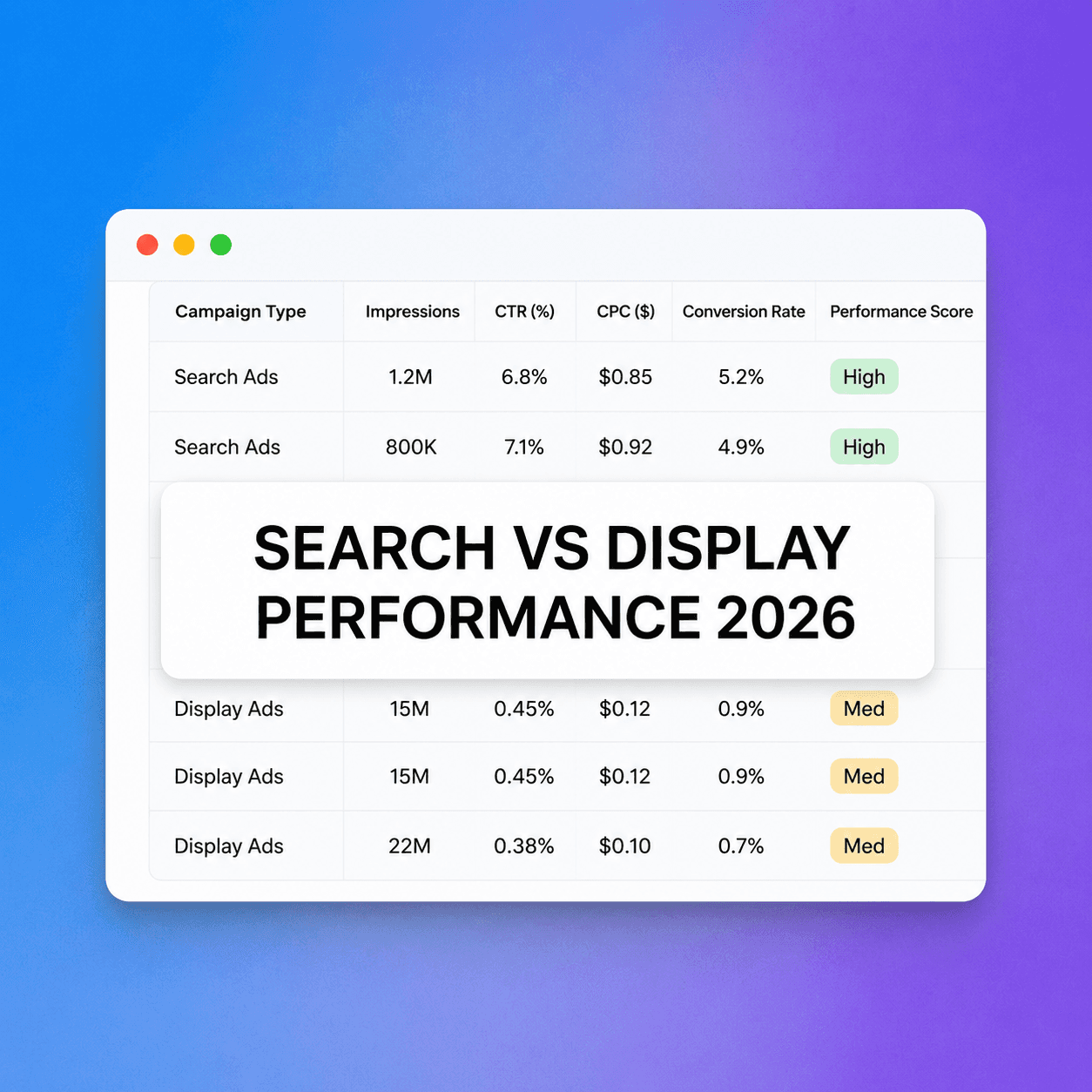
Search: High intent level with an average conversion rate of 3–10% because the user initiated the action, the problem is immediate, and buying intent exists.
Display: Low intent level with an average conversion rate of 0.5–2% because the user was browsing for other content, the purchase trigger wasn’t active, and awareness must precede action. If you need pipeline now, Search wins because it connects you directly with users who have already signaled their willingness to purchase. Display traffic converts slower because it acts as a foundational step in a longer marketing funnel, meaning that businesses relying exclusively on Display for immediate revenue often struggle with poor conversion metrics and high costs per acquisition that can jeopardize their short-term financial health.
CAC and CPA Comparison
Search Ads
Pros: Controlled targeting, high buyer intent, easier CPA forecasting, and better attribution clarity.
Cons: Higher CPC in competitive niches and limited by search volume, which can create a ceiling on how many leads you can generate.
Display Ads
Pros: Lower CPC, massive reach, useful for remarketing, and strong top-of-funnel support.
Cons: Lower direct conversion rate, harder to measure true ROI, and a higher risk of wasted impressions on audiences that are not ready to engage. For growing businesses managing cash flow, predictable CAC usually matters more than pure reach, making Search the more robust option for initial scaling efforts.
Budget Strategy by Growth Stage
Early-Stage or Cash-Constrained Businesses
Use primarily Search Ads because you cannot afford awareness without conversion flow and you need measurable ROI quickly. Focus on high-intent keywords, brand protection, and conversion optimization, with Display limited strictly to remarketing.
Growth-Stage Businesses
Layer Display strategically by using it for remarketing to site visitors, competitor audience targeting, and brand reinforcement. While Search remains the revenue engine, Display supports acceleration and helps to fill the funnel for future conversions.
Established Brands
Display becomes more powerful when brand recognition exists, lifetime value is high, and market share expansion is the primary goal. At scale, Display influences multi-touch attribution rather than just last-click conversions, allowing large companies to dominate the digital landscape through omnipresence.
When Search Ads Should Be Your Priority
Choose Search when you sell high-intent services, you operate locally, your sales cycle is short, you need immediate conversions, or your budget is under $20K/month. Search delivers faster ROI clarity because it taps into existing demand, providing a low-risk environment for testing messaging and pricing.
By concentrating your resources on keywords that signal high urgency, you create a stable financial backbone for your business that allows for more flexible decision-making as you start to scale up your operations and explore broader marketing channels.
When Display Ads Make Strategic Sense
Choose Display when you have strong remarketing audiences, your product requires awareness education, you’re launching a new offer, or you need market visibility. Display is especially effective for e-commerce remarketing and SaaS retargeting, where keeping your brand visible to people who have already interacted with you significantly increases the likelihood of conversion.
Without remarketing lists, Display can become inefficient quickly, so ensure you have a solid foundation of site traffic or a robust CRM list before you start investing in prospecting-level display campaigns that might otherwise lack the necessary intent to convert.
The Role of Performance Max
Performance Max blends Search, Display, YouTube, Discover, and Shopping into one campaign type, using automation to expand reach, optimize across channels, and allocate spend dynamically.
However, it reduces transparency, may cannibalize branded Search traffic, and requires strong conversion data to function correctly. Performance Max is best introduced after Search campaigns are stable, brand traffic is isolated, and conversion tracking is accurate; it is never a substitute for strategic Search planning or intentional campaign design.
Example Allocation Framework
For a $40,000/month budget, a balanced approach ensures revenue stability before awareness expansion.
Search (High-Intent): 55% allocation for core revenue generation.
Brand Search: 10% allocation for demand capture and reputation control.
Display Remarketing: 15% allocation for conversion reinforcement.
Display Prospecting: 10% allocation for awareness building.
Testing / Expansion: 10% allocation for innovation and market research.
Attribution Considerations
Search Ads typically win in last-click attribution and direct conversion reporting because the user is often ready to convert immediately upon clicking the ad. Display Ads often contribute in assisted conversions, view-through conversions, and multi-touch paths that recognize the role of top-of-funnel branding.
If you only measure last-click, Display may appear weaker than its true influence, but that influence must still justify spend through overall ROAS improvement. Smart marketers use custom attribution models to view the full journey, ensuring they don't cut off channels that provide the initial discovery needed for eventual search-based conversions.
Common Strategic Mistakes
Running Display before Search is optimized creates a situation where you are building awareness for a funnel that cannot effectively convert traffic, leading to massive financial waste. Scaling Display prospecting without remarketing lists is equally dangerous, as you are likely targeting cold users who have no prior relationship with your brand.
Judging Display purely on clicks often leads to premature budget cuts, as these ads provide value through impressions and brand recall that metrics like CPC don't fully capture. Ignoring impression share in Search or mixing brand and non-brand campaigns leads to poor data quality that prevents accurate scaling decisions. Search is measurable intent, while Display is psychological reinforcement, so you must use each accordingly to maintain a healthy advertising system.
Bottom Line: Which Should You Use?
If your goal is immediate conversions, use Search Ads; if your goal is brand awareness or strategic remarketing, use Display Ads. Growing businesses should typically follow a sequential order of Brand Search, followed by High-Intent Non-Brand Search, Remarketing Display, Controlled Display Prospecting, and finally Performance Max expansion. Prioritize profitability before expansion, and always choose the channel that maintains target CPA, a 3:1 LTV:CAC minimum, a stable conversion rate, and a controlled payback period. Search almost always stabilizes first, providing the cash flow necessary to experiment with the more complex, brand-building nature of Display.
Forward View: 2026 and Beyond
As automation increases in 2026, Display targeting will become more AI-driven, audience signals will improve, and Search will expand via Broad Match and Smart Bidding. Cross-channel blending will grow, yet intent-based advertising will remain superior for direct response and high-stakes conversions.
Search will continue to dominate for lead generation and service-based businesses, while Display will evolve as a sophisticated brand influence layer and retargeting engine. The winning strategy isn’t an either/or choice, but a disciplined sequencing of channels that aligns with the customer's buying journey, leveraging the technical precision of Search alongside the reach and influence of Display.
The Real Question: Intent Capture vs Demand Creation
When businesses ask whether to use Search Ads or Display Ads, they’re often asking the wrong question because they fail to account for the fundamental psychological state of the target consumer at the moment of ad exposure. The real decision is whether you need to capture existing demand or create awareness and nurture future demand for your brand in a competitive marketplace.
Inside Google Ads, Search and Display operate on completely different psychological triggers that dictate the effectiveness of your campaign architecture. Search captures intent by aligning with active user queries, whereas Display interrupts attention by placing visual messaging in front of users who are not currently searching for your services.
If your goal is immediate conversions and controlled CAC, the distinction matters significantly because it dictates whether you are harvesting a pre-existing harvest or planting seeds that require time and consistent nurturing to bear fruit. Understanding this dichotomy allows you to allocate your budget with surgical precision, ensuring that your capital is not wasted on speculative awareness when your primary business objective is the immediate generation of high-quality leads or sales.
What Are Google Search Ads?
Google Search Ads appear when users actively type queries into Google, meaning they are triggered by keywords, search intent, and commercial queries. Example searches include "Buy CRM software", "Best accounting software pricing", or "Emergency plumber near me". Because these users are actively seeking solutions, Search Ads often produce higher conversion rates, lower CPA, stronger ROAS, and faster payback periods compared to passive advertising formats.
Essentially, search is the ultimate form of demand capture, as it meets the customer at the precise moment they have acknowledged a problem and are seeking a provider to resolve it. This high level of relevance and alignment ensures that your ads are only shown to individuals who are already in the market, effectively eliminating the noise and inefficiency common in other advertising channels while providing a direct path to revenue.
What Are Google Display Ads?
Google Display Ads appear across websites, apps, and YouTube via the Google Display Network, and they are triggered by audience targeting, demographics, interests, and remarketing lists. Users are not actively searching when they see these ads, so Display builds awareness, supports remarketing, reinforces brand presence, and nurtures consideration.
Consequently, Display is demand influence rather than demand capture, acting as a visual touchpoint that keeps your brand top-of-mind even when the user is not in a buying mindset. By leveraging these visual placements, you can cultivate long-term brand equity and keep your products or services visible to high-potential prospects, which is essential for shortening the sales cycle when those prospects finally do reach the point of active purchase intent.
Conversion Rate Reality: The Performance Gap
For most industries in 2026, the performance gap between these two channels remains significant due to the nature of the user's journey.
Search: High intent level with an average conversion rate of 3–10% because the user initiated the action, the problem is immediate, and buying intent exists.
Display: Low intent level with an average conversion rate of 0.5–2% because the user was browsing for other content, the purchase trigger wasn’t active, and awareness must precede action. If you need pipeline now, Search wins because it connects you directly with users who have already signaled their willingness to purchase. Display traffic converts slower because it acts as a foundational step in a longer marketing funnel, meaning that businesses relying exclusively on Display for immediate revenue often struggle with poor conversion metrics and high costs per acquisition that can jeopardize their short-term financial health.
CAC and CPA Comparison
Search Ads
Pros: Controlled targeting, high buyer intent, easier CPA forecasting, and better attribution clarity.
Cons: Higher CPC in competitive niches and limited by search volume, which can create a ceiling on how many leads you can generate.
Display Ads
Pros: Lower CPC, massive reach, useful for remarketing, and strong top-of-funnel support.
Cons: Lower direct conversion rate, harder to measure true ROI, and a higher risk of wasted impressions on audiences that are not ready to engage. For growing businesses managing cash flow, predictable CAC usually matters more than pure reach, making Search the more robust option for initial scaling efforts.
Budget Strategy by Growth Stage
Early-Stage or Cash-Constrained Businesses
Use primarily Search Ads because you cannot afford awareness without conversion flow and you need measurable ROI quickly. Focus on high-intent keywords, brand protection, and conversion optimization, with Display limited strictly to remarketing.
Growth-Stage Businesses
Layer Display strategically by using it for remarketing to site visitors, competitor audience targeting, and brand reinforcement. While Search remains the revenue engine, Display supports acceleration and helps to fill the funnel for future conversions.
Established Brands
Display becomes more powerful when brand recognition exists, lifetime value is high, and market share expansion is the primary goal. At scale, Display influences multi-touch attribution rather than just last-click conversions, allowing large companies to dominate the digital landscape through omnipresence.
When Search Ads Should Be Your Priority
Choose Search when you sell high-intent services, you operate locally, your sales cycle is short, you need immediate conversions, or your budget is under $20K/month. Search delivers faster ROI clarity because it taps into existing demand, providing a low-risk environment for testing messaging and pricing.
By concentrating your resources on keywords that signal high urgency, you create a stable financial backbone for your business that allows for more flexible decision-making as you start to scale up your operations and explore broader marketing channels.
When Display Ads Make Strategic Sense
Choose Display when you have strong remarketing audiences, your product requires awareness education, you’re launching a new offer, or you need market visibility. Display is especially effective for e-commerce remarketing and SaaS retargeting, where keeping your brand visible to people who have already interacted with you significantly increases the likelihood of conversion.
Without remarketing lists, Display can become inefficient quickly, so ensure you have a solid foundation of site traffic or a robust CRM list before you start investing in prospecting-level display campaigns that might otherwise lack the necessary intent to convert.
The Role of Performance Max
Performance Max blends Search, Display, YouTube, Discover, and Shopping into one campaign type, using automation to expand reach, optimize across channels, and allocate spend dynamically.
However, it reduces transparency, may cannibalize branded Search traffic, and requires strong conversion data to function correctly. Performance Max is best introduced after Search campaigns are stable, brand traffic is isolated, and conversion tracking is accurate; it is never a substitute for strategic Search planning or intentional campaign design.
Example Allocation Framework
For a $40,000/month budget, a balanced approach ensures revenue stability before awareness expansion.
Search (High-Intent): 55% allocation for core revenue generation.
Brand Search: 10% allocation for demand capture and reputation control.
Display Remarketing: 15% allocation for conversion reinforcement.
Display Prospecting: 10% allocation for awareness building.
Testing / Expansion: 10% allocation for innovation and market research.
Attribution Considerations
Search Ads typically win in last-click attribution and direct conversion reporting because the user is often ready to convert immediately upon clicking the ad. Display Ads often contribute in assisted conversions, view-through conversions, and multi-touch paths that recognize the role of top-of-funnel branding.
If you only measure last-click, Display may appear weaker than its true influence, but that influence must still justify spend through overall ROAS improvement. Smart marketers use custom attribution models to view the full journey, ensuring they don't cut off channels that provide the initial discovery needed for eventual search-based conversions.
Common Strategic Mistakes
Running Display before Search is optimized creates a situation where you are building awareness for a funnel that cannot effectively convert traffic, leading to massive financial waste. Scaling Display prospecting without remarketing lists is equally dangerous, as you are likely targeting cold users who have no prior relationship with your brand.
Judging Display purely on clicks often leads to premature budget cuts, as these ads provide value through impressions and brand recall that metrics like CPC don't fully capture. Ignoring impression share in Search or mixing brand and non-brand campaigns leads to poor data quality that prevents accurate scaling decisions. Search is measurable intent, while Display is psychological reinforcement, so you must use each accordingly to maintain a healthy advertising system.
Bottom Line: Which Should You Use?
If your goal is immediate conversions, use Search Ads; if your goal is brand awareness or strategic remarketing, use Display Ads. Growing businesses should typically follow a sequential order of Brand Search, followed by High-Intent Non-Brand Search, Remarketing Display, Controlled Display Prospecting, and finally Performance Max expansion. Prioritize profitability before expansion, and always choose the channel that maintains target CPA, a 3:1 LTV:CAC minimum, a stable conversion rate, and a controlled payback period. Search almost always stabilizes first, providing the cash flow necessary to experiment with the more complex, brand-building nature of Display.
Forward View: 2026 and Beyond
As automation increases in 2026, Display targeting will become more AI-driven, audience signals will improve, and Search will expand via Broad Match and Smart Bidding. Cross-channel blending will grow, yet intent-based advertising will remain superior for direct response and high-stakes conversions.
Search will continue to dominate for lead generation and service-based businesses, while Display will evolve as a sophisticated brand influence layer and retargeting engine. The winning strategy isn’t an either/or choice, but a disciplined sequencing of channels that aligns with the customer's buying journey, leveraging the technical precision of Search alongside the reach and influence of Display.
FAQs
Should startups use Display Ads?
Only for remarketing. Prospecting Display may dilute limited budgets.
Is Display good for B2B?
Yes for retargeting and account-based strategies, less effective for cold traffic.
How much budget should go to Display?
Typically 15–30% after Search campaigns are profitable.
Does Display help Search performance?
It can improve brand recall, increasing branded search volume over time.
What’s the biggest mistake when comparing Search vs Display?
Expecting Display to convert like Search without adjusting expectations or measurement models.
insights
Explore more on AI, Design and Growth

SEO
Google AI & Local SEO: Rank in Both (2026 Guide)
Learn how to optimize content for Google AI search and local SEO simultaneously to rank in AI Overviews, maps, and organic search results.
SEO
Semantic Content Clusters for SEO & AEO (Templates)
Learn how to build semantic content clusters for SEO and AEO. Includes practical templates, internal linking structures, and examples for ranking in AI search.

SEO
How Google AI Search Works: RankBrain to Gemini (2026)
Discover how Google’s AI search evolved from RankBrain to Gemini and what it means for SEO, AI search results, and ranking strategies in 2026.
SEO
Google AI & Local SEO: Rank in Both (2026 Guide)
Learn how to optimize content for Google AI search and local SEO simultaneously to rank in AI Overviews, maps, and organic search results.
SEO
Semantic Content Clusters for SEO & AEO (Templates)
Learn how to build semantic content clusters for SEO and AEO. Includes practical templates, internal linking structures, and examples for ranking in AI search.
get in touch
Ready to Grow From Day One?
Strategy, execution, and digital experiences designed to move together. Fill out the form below and our team will contact you shortly.
get in touch
Ready to Grow From Day One?
Strategy, execution, and digital experiences designed to move together. Fill out the form below and our team will contact you shortly.
get in touch
Ready to Grow From Day One?
Strategy, execution, and digital experiences designed to move together. Fill out the form below and our team will contact you shortly.
Services
We'd love to hear from you.
Tell us what you're building and where you need support.
© 2026 projectsupply AI, Data and Digital Engineering
Company. Pune, India. All rights reserved.
Part of Tangle
Services
We'd love to hear from you.
Tell us what you're building and where you need support.
© 2026 projectsupply AI, Data and Digital Engineering
Company. Pune, India. All rights reserved.
Part of Tangle
Services
We'd love to hear from you.
Tell us what you're building and where you need support.
© 2026 projectsupply AI, Data and Digital Engineering
Company. Pune, India. All rights reserved.
Part of Tangle