Shopify
08 min read
How to Launch Your Shopify Store in 30 Days
Reframing the 30-Day Shopify Launch Strategy
Most “launch a Shopify store in 30 days” guides focus on setup checklists. That approach rarely produces a profitable store.
For operators scaling toward $1M–$20M revenue, the real objective is different:
Launch a commercially viable Shopify architecture that can scale without expensive re-builds.
That means making the right decisions early around:
theme architecture
checkout structure
app stack discipline
marketing integrations
operational workflows
conversion infrastructure
The timeline below assumes you are building on Shopify with the intent to scale — not simply “test an idea.”
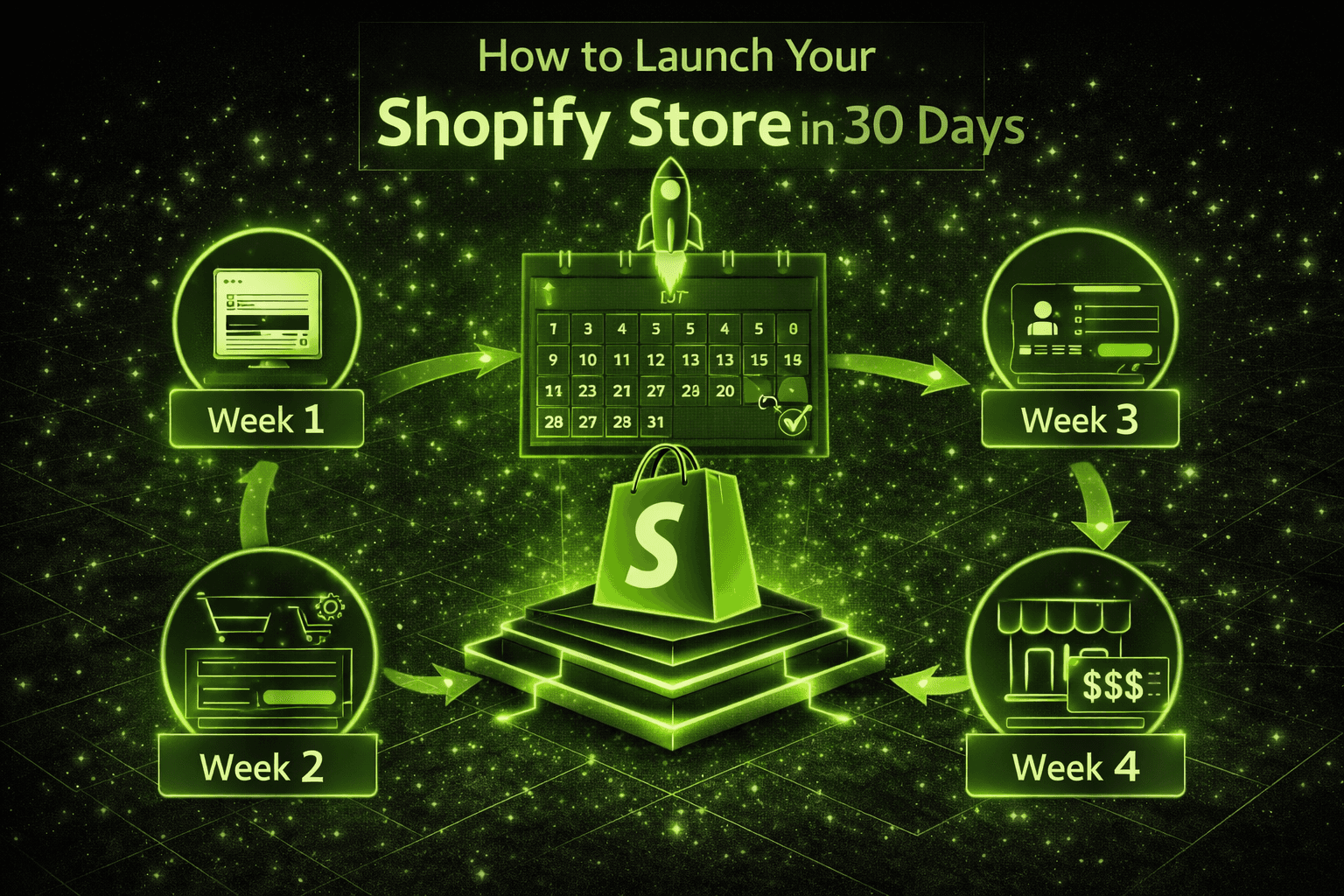
Week 1: Strategic Foundations (Business Model + Architecture)
Define the Revenue Model First
Before building anything in Shopify, clarify how revenue will actually be generated.
Operators should model:
Variable | Strategic Importance |
|---|---|
Average Order Value | Determines ad viability |
Product margin | Defines paid acquisition limits |
Fulfillment cost | Impacts contribution margin |
SKU complexity | Influences theme architecture |
Repeat purchase cycle | Drives retention stack |
For example:
High repeat products → strong subscription infrastructure
High AOV items → stronger product storytelling and landing pages
Large SKU catalog → robust collection filtering
Architecture decisions start here.
Choose Shopify vs Shopify Plus Early
Many brands delay this decision, but it affects technical architecture.
Platform | Best For | Key Limitations |
|---|---|---|
Shopify | early stage DTC | checkout limitations |
Shopify Plus | scaling brands | higher monthly cost |
Key Shopify Plus advantages:
checkout extensibility
higher API limits
automation tools
advanced B2B functionality
Brands expecting rapid scaling often start on standard Shopify and upgrade later.
But if you require:
custom checkout flows
heavy automation
complex B2B pricing
Plus should be evaluated early.
Theme Architecture: Prebuilt vs Custom
Your theme decision influences both cost and performance.
Approach | Cost Range | Advantages | Risks |
|---|---|---|---|
Premium theme | $300–$400 | fast launch | limited differentiation |
Custom theme build | $8k–$25k | tailored CRO | longer timeline |
Headless architecture | $30k+ | performance control | operational complexity |
Most brands launching in 30 days should choose:
Premium Shopify theme + targeted CRO customization
This approach balances:
speed
performance
manageable cost
Headless builds rarely make sense before $10M+ revenue.
Week 2: Shopify Store Infrastructure
Build the Core Shopify Architecture
Inside Shopify, configure:
Core system settings:
payment gateways
shipping zones
tax configuration
inventory logic
international settings
Common operational mistakes at this stage:
poorly structured product taxonomy
messy collections
inconsistent product variants
weak URL structure
Fixing these later creates SEO and operational issues.
Product Page Conversion Infrastructure
Most revenue leakage occurs on product pages.
A high-performing Shopify product template should include:
Component | CRO Impact |
|---|---|
trust badges | reduces checkout hesitation |
social proof | improves credibility |
product comparison | reduces decision friction |
delivery messaging | reduces abandonment |
review integration | boosts conversion |
Operators should treat product templates as conversion infrastructure, not design elements.
Shopify App Stack Strategy
The Shopify App Store contains thousands of tools.
Most stores install too many.
A disciplined app stack typically includes:
Category | Example Function |
|---|---|
reviews | social proof |
email / SMS | retention |
upsells | AOV expansion |
analytics | attribution clarity |
subscriptions | recurring revenue |
Typical monthly app stack cost:
early stage store: $150–$400
scaling brand: $400–$1,200+
App bloat is a major performance killer.
Each app adds:
page load time
operational complexity
cost
Week 3: Conversion Optimization and Marketing Readiness
Landing Page Architecture
Traffic should rarely go directly to the homepage.
Instead, create:
campaign landing pages
product education pages
collection funnels
bundle landing pages
This allows marketing teams to match intent with messaging.
Without this structure, paid traffic underperforms.
Checkout Experience Optimization
Checkout friction is a major revenue killer.
Critical improvements include:
accelerated payments
clear shipping costs
trust indicators
cart upsells
Shopify’s native checkout already performs well.
But Shopify Plus allows deeper customization.
Operators must evaluate whether those improvements justify the upgrade.
Marketing Stack Integration
Before launch, integrate:
Platform | Purpose |
|---|---|
Meta | paid acquisition |
search + shopping | |
Klaviyo | lifecycle marketing |
GA4 | analytics |
attribution tools | marketing clarity |
Poor tracking leads to incorrect ad decisions.
Week 4: Operational Systems and Launch Readiness
Fulfillment and Logistics Workflow
Operational efficiency affects margins more than many founders realize.
Key considerations:
warehouse management
shipping rate logic
returns automation
inventory syncing
Manual operations become expensive quickly.
Automation is critical as order volume increases.
Testing the Entire Commerce Flow
Before launch, simulate full customer journeys.
Test scenarios:
checkout on mobile
international shipping
discount codes
subscription purchase
refund workflow
Many stores discover operational problems only after orders arrive.
Soft Launch Strategy
Instead of a large launch day push, use a soft launch.
Initial traffic sources:
email list
organic social
small paid campaigns
Objectives:
validate conversion rate
test fulfillment speed
confirm tracking accuracy
This stage protects marketing budgets from early inefficiencies.
Bottom Line: What Metrics Should Drive Your Shopify Decision?
Operators should evaluate launch performance using commercial metrics, not vanity numbers.
Core performance indicators include:
Metric | Why It Matters |
|---|---|
Conversion Rate | Measures store effectiveness |
Average Order Value | Determines revenue per visitor |
Customer Acquisition Cost | Defines marketing viability |
ROAS / MER | Indicates marketing efficiency |
Contribution Margin | Shows real profitability |
Lifetime Value | Determines growth potential |
Refund Rate | Signals product issues |
Operational Cost Per Order | Impacts margin sustainability |
Cost modeling must also include:
Cost Category | Typical Range |
|---|---|
Shopify platform | $39–$2,000/month |
App stack | $150–$1,200/month |
development | $5k–$30k |
design | $2k–$15k |
Break-even modeling should calculate how many orders are required to recover:
development investment
marketing launch spend
technology costs
Operators scaling toward $20M revenue treat these numbers as core operating metrics.
Forward View (2026 and Beyond)
The Shopify ecosystem is evolving rapidly.
Several structural shifts will impact store launches over the next few years.
Shopify AI integrations
AI is increasingly embedded across the platform:
merchandising automation
predictive search
automated product descriptions
marketing content generation
However, AI advantage will come from data quality, not tools.
Commerce automation expansion
Expect deeper automation across:
inventory management
customer segmentation
marketing workflows
pricing optimization
Operational efficiency will become a major competitive advantage.
App consolidation
Brands are increasingly reducing app stacks.
Reasons include:
performance issues
cost creep
data fragmentation
Multi-function platforms will replace many single-purpose apps.
First-party data dominance
Privacy changes have permanently altered advertising.
Successful Shopify brands will invest heavily in:
email
SMS
loyalty programs
owned audience channels
Customer data is becoming the most valuable asset in commerce.
Retail + DTC convergence
Online brands are expanding into retail.
Shopify’s POS ecosystem supports:
unified inventory
omnichannel customer data
in-store pickup
Operators must design stores with omnichannel growth in mind.
Margin compression reality
Advertising costs continue rising.
Brands must offset this through:
higher AOV
retention strategies
operational efficiency
disciplined tech stacks
The Shopify stores that scale fastest will be those built with profit architecture, not just design.
FAQs
Is Shopify suitable for high-growth DTC brands?
Yes. Many global brands scale past $100M using Shopify. The platform’s scalability, ecosystem, and checkout performance make it one of the strongest commerce infrastructures available.
When should a Shopify store consider going headless?
Headless architecture typically makes sense only when brands require advanced front-end performance, unique user experiences, or complex integrations. This usually occurs after reaching $10M+ revenue.
How important is CRO during the Shopify launch phase?
Conversion rate optimization is critical from the start. Even small improvements in product pages, checkout clarity, and trust signals can significantly increase revenue from the same traffic volume.
What is the biggest mistake founders make when launching Shopify stores?
The most common mistake is prioritizing design over commerce architecture. Without strong product structure, CRO systems, and marketing integration, even beautiful stores struggle to generate profitable revenue.
How should Shopify brands think about their app stack?
Apps should be evaluated based on ROI and operational impact. Each app should either increase revenue, improve retention, or reduce operational workload. If it does none of these, it likely adds unnecessary complexity.
Direct Q&A
How long does it take to launch a Shopify store?
A Shopify store can technically launch in a few days, but building a commercially viable store with proper product architecture, CRO infrastructure, marketing integrations, and operational workflows typically takes about 3–4 weeks.
What does it cost to launch a Shopify store?
Most serious Shopify launches cost between $5,000 and $30,000 depending on theme customization, development work, branding, and app integrations. Ongoing monthly software costs usually range from $150 to $1,200.
Should a new brand use Shopify Plus immediately?
Most early-stage brands should start on standard Shopify and upgrade to Shopify Plus when they require checkout customization, advanced automation, or when revenue approaches $5M–$10M annually.
How many apps should a Shopify store use at launch?
A disciplined launch stack usually includes 5–10 core apps covering reviews, email marketing, analytics, upsells, and subscriptions. Installing too many apps increases costs and reduces store performance.
Is a custom Shopify theme necessary at launch?
Not usually. Most brands should start with a premium theme and invest in CRO improvements before considering a full custom theme build.
insights