

Shopify
Shopify Abandoned Cart Recovery: The Complete Multi-Channel Strategy
Shopify Abandoned Cart Recovery: The Complete Multi-Channel Strategy
Learn how to recover abandoned carts on Shopify using a proven multi-channel strategy — email, SMS, retargeting, and push. Includes the CART Recovery Matrix.
Learn how to recover abandoned carts on Shopify using a proven multi-channel strategy — email, SMS, retargeting, and push. Includes the CART Recovery Matrix.
08 min read
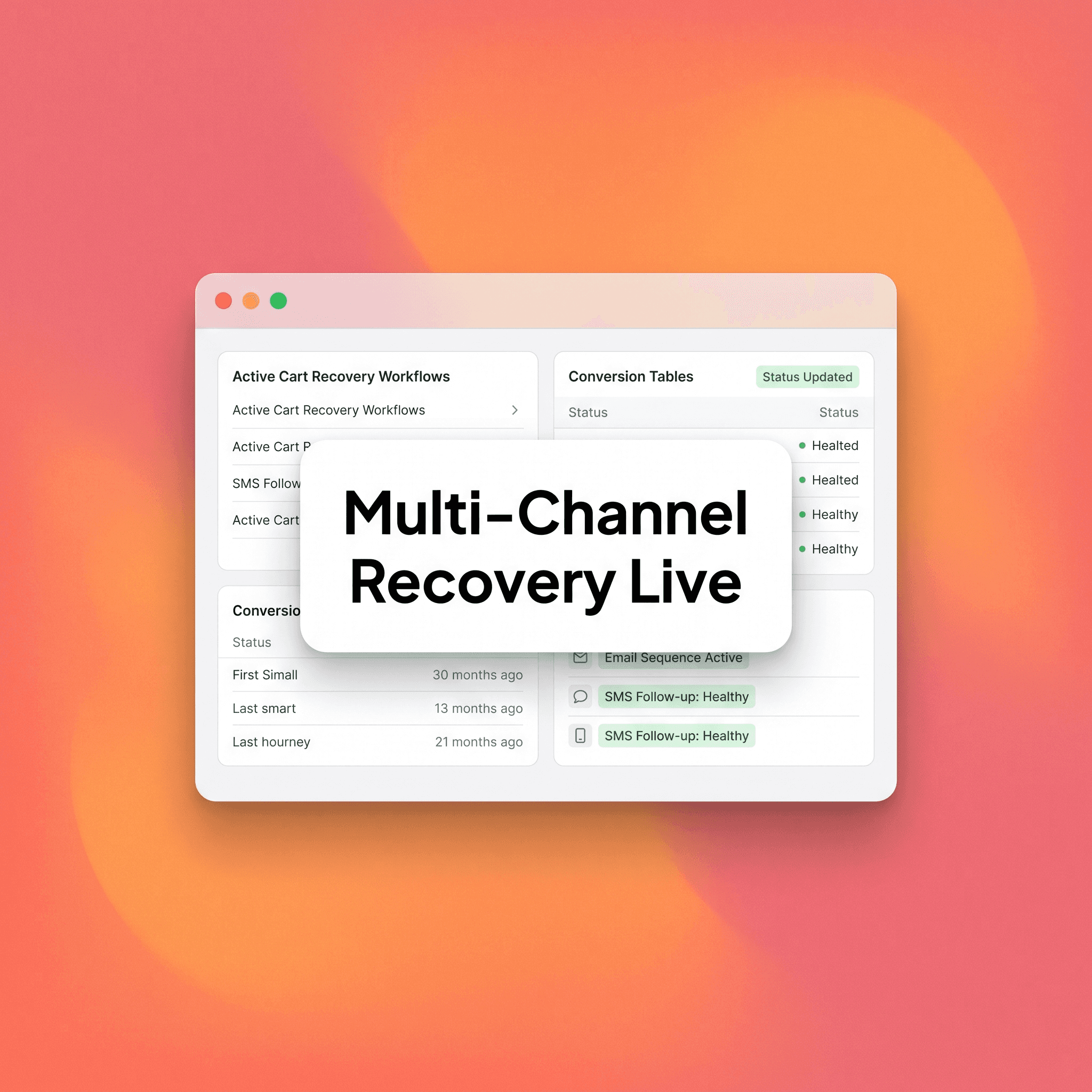
Shopify abandoned cart recovery is one of the highest-leverage activities available to any e-commerce operator, representing a direct path to reclaiming lost revenue that is already sitting at the finish line. The average cart abandonment rate across e-commerce sits somewhere between 65% and 80%, which means the vast majority of consumers who initiate a checkout process on your store never actually complete the purchase.
This persistent issue is rarely a reflection of a flawed product, but rather a direct result of a breakdown in the buyer's journey that can be corrected with a sophisticated recovery problem approach. Most Shopify stores commit the strategic error of running a single, generic recovery email and calling it a finished strategy, which fails to account for the complex psychology of a modern online shopper.
Truly effective cart recovery requires highly coordinated, channel-appropriate outreach that fundamentally respects where the buyer is in their specific decision-making process, which communication channel they prefer, and what specific objection is actually stalling their intent.
This comprehensive guide covers the entire landscape of this challenge: why carts are abandoned, how to professionally structure a multi-channel recovery system, and a practical, data-driven framework you can apply to your Shopify store immediately to start recapturing these lost conversions.
Why Shopify Carts Get Abandoned
Understanding the root cause of abandonment is the necessary upstream work required before you can deploy any effective recovery tactic, as the symptoms are rarely random and usually cluster into five predictable categories.
Cost surprises at checkout: Shipping fees, unexpected taxes, or hidden minimum order thresholds often appear late in the funnel and act as immediate deal-breakers that break the buyer's momentum and intent.
Account friction: Forcing a user to create a new account or navigate a long, convoluted registration process at the very moment they are ready to pay creates unnecessary friction that interrupts the purchase flow.
Trust gaps: A lack of visible, verified reviews, ambiguous or restrictive return policies, or the presence of unfamiliar payment methods creates hesitation and triggers defensive decision-making in the shopper.
Distraction or intent shift: Many buyers are simply browsing with low immediate intent; they left your store because life happened in the real world, not because they actively decided that your product was not right for them.
Price comparison: A significant segment of users are intentionally checking your competitors' sites while your checkout page is open, comparing your total landed price against other options before they commit.
Each of these distinct scenarios requires a fundamentally different recovery message to be effective; a buyer who abandoned due to unexpected shipping costs needs a value-based incentive or policy clarification, whereas a buyer who simply got distracted by a phone call needs a gentle, low-friction reminder. Recovery flows that ignore this distinction between objection-based abandonment and accidental abandonment will inevitably underperform and annoy your potential customers.
The CART Recovery Matrix
The CART Recovery Matrix is a specialized, four-column prioritization framework designed for deciding which communication channel to use, for which customer audience, at which specific recency window, and triggered by exactly what user behavior. It prevents the common, amateur mistake of blasting every single abandoned cart visitor with the exact same, ineffective email sequence regardless of their history or intent level.
C — Channel: Define your contact method, including email, SMS, push notification, paid retargeting ads, or even high-touch direct mail for VIP segments.
A — Audience: Categorize your users into segments like current subscribers, known past customers, totally anonymous visitors, or high-intent prospects who have engaged with your brand previously.
R — Recency: Set your timing windows at logical intervals such as 1 hour, 6 hours, 24 hours, 3 days, and 7 days to avoid spamming the user.
T — Trigger: Identify the specific action that started the flow, such as a simple cart abandon, a checkout initiate, a product view with no add-to-cart, or a chronic repeat abandoner pattern.
Before building any single recovery flow, you must map your abandoned cart segments to each column in this matrix to ensure relevance. A known, loyal customer who has purchased twice and initiated a checkout should receive an entirely different, more personal sequence than an anonymous first-time visitor who merely added one item to their cart. Here is how the matrix applies in practice for your team:
High-value known customer, checkout initiated, 1 hour ago: You should trigger an SMS first because it is a personal channel with an exceptionally high open rate, followed by an email at the 6-hour mark, and finally a retargeting ad if no recovery has occurred by 48 hours.
Anonymous visitor, added to cart only, email captured: Deploy an automated email sequence starting exactly 1 hour after abandonment, with social media retargeting ads running in parallel to ensure brand visibility.
Known customer, repeat abandoner: Send an email containing a direct, exclusive offer or incentive, as repeated abandonment without a purchase often signals a specific price or trust objection that is worth addressing directly.
Always utilize this matrix to map your strategy before writing a single word of copy, as channel selection and precise timing are at least as important to your conversion rate as the actual message content itself.
Channel-by-Channel Recovery Strategy
Email: Still the Highest ROI Channel for Shopify Cart Recovery
Email remains the most cost-effective and reliable recovery channel for the vast majority of Shopify stores, provided you understand that the key to success is careful, logical sequencing rather than sending a single, desperate message.
Email 1 — The reminder (1 hour after abandonment): Keep this message simple, short, and entirely free of pressure. Your goal is to remind them what they left behind by including a clear product image, the specific product name, and a single, obvious return-to-cart link. Do not include a discount at this stage, as this email is designed solely to catch the distracted buyer who simply lost their place in the funnel.
Email 2 — The nudge (24 hours after abandonment): Now is the time to add social proof, such as a verified customer review, a star rating, or a quick trust signal about your quality. Use this space to address a likely objection; if your return policy is strong, surface it clearly here to reduce anxiety. Continue to avoid discounting unless your specific margin strategy explicitly allows for it at this mid-funnel stage.
Email 3 — The decision email (72 hours after abandonment): This is your final closer. If you are going to offer an incentive, do it here—not in the first email. A small, targeted discount or a free shipping offer works incredibly well, but only if it is clearly positioned as a one-time, expiring benefit. Vague, permanent offers train your customers to intentionally abandon their carts in the hopes of triggering a discount, which destroys your long-term profit margins.
Keep the subject line approach functional for the first email, such as "You left something behind," while the second can lean into curiosity or social proof, and the third should carry legitimate, non-manufactured urgency.
SMS: Fast, Personal, and Underused
SMS recovery works exceptionally well because it reaches potential buyers exactly where they already are, and because open rates are substantially higher than email, the window of attention is effectively immediate.
Compliance and Opt-in: SMS recovery only works when the subscriber has explicitly provided their consent to receive marketing messages, which is a strictly enforced legal requirement in most major global markets.
Brevity: The message must be incredibly short, ideally limited to one or two sentences and exactly one actionable link.
Timing: Deploy the message within 30 to 60 minutes of the abandonment event, as this is the narrow window of time before the buyer's immediate purchase intent completely evaporates.
A Shopify SMS recovery message should never read like a long-form email; using copy like "Hey—you left [Product Name] in your cart. Grab it before it sells out: [link]" will significantly outperform a long paragraph of marketing copy every single time. Utilize specialized tools like Klaviyo, Postscript, or Attentive to build these SMS flows so they are natively connected to your Shopify abandoned checkout data, ensuring that your tracking and suppression logic remains perfectly accurate.
Paid Retargeting: Recovering Anonymous Traffic
Email and SMS marketing only work when you have successfully captured the user's contact information, but paid retargeting—primarily through platforms like Meta and Google—allows you to recover high-intent abandoners you cannot reach through your owned channels.
Add-to-cart abandoners: Show them the specific product they added and include a review or trust element to reassure them that they are making a smart decision.
Checkout initiators: Show urgency, potentially including a small incentive or highlighting a free shipping threshold to push them over the line.
Product viewers (no add-to-cart): This is an upper-funnel interaction, so focus your creative on brand building and social proof rather than a hard, aggressive sales push.
Set your standard retargeting windows at 7 days for most everyday products, but extend them to 14 or 30 days for high-ticket items where the consideration window is naturally much longer. Always remember to exclude people who have already converted; most modern Shopify pixel integrations with Meta and Google allow you to set this exclusion as a default, which is vital to avoiding wasted spend and annoying your recent purchasers.
Push Notifications: A Secondary Channel Worth Testing
Browser push and app push notifications provide you with an additional, lightweight touchpoint for abandonment recovery, which is particularly effective for stores with a mobile-first customer base or those that have already invested in a dedicated mobile app. Push notifications are fast and do not require an email opt-in, but they carry a significantly higher risk of user opt-out if you over-message them or send irrelevant content. Use push as a supplemental, secondary channel—never as your lead recovery method. A single, well-timed push notification sent within the first hour of abandonment, as a complement to your primary email flow, is the optimal approach for most stores looking to capture extra conversion percentage points.
Building the Multi-Channel Sequence
A practical, multi-channel recovery sequence for a mid-volume Shopify store targeting customers who have opted into both email and SMS involves precise timing and careful suppression.
T+30 minutes: Send an SMS reminder, reserved strictly for known customers or high-intent prospects who have a history of engagement.
T+1 hour: Send Email 1, focusing entirely on the cart reminder, product image, and a direct return-to-cart link.
T+6 hours: Begin your paid retargeting campaigns on Meta and Google for all identified abandoners.
T+24 hours: Send Email 2, focusing on trust signals, objection handling, and social proof to answer lingering questions.
T+48 hours: Send a supplemental push notification or a secondary SMS if your engagement data shows that this specific user is responsive to these channels.
T+72 hours: Send Email 3, which acts as the final decision email, introducing urgency and a potential conditional incentive to close the gap.
T+7 days: Conclude your retargeting ads for standard products, extending this window only for high-ticket items with longer decision cycles.
This sequence is a starting point, not a rigid, unchangeable rule; your specific suppression logic, sunset policies, and offer strategies will need to be refined based on your store's unique data.
Shopify abandoned cart recovery is one of the highest-leverage activities available to any e-commerce operator, representing a direct path to reclaiming lost revenue that is already sitting at the finish line. The average cart abandonment rate across e-commerce sits somewhere between 65% and 80%, which means the vast majority of consumers who initiate a checkout process on your store never actually complete the purchase.
This persistent issue is rarely a reflection of a flawed product, but rather a direct result of a breakdown in the buyer's journey that can be corrected with a sophisticated recovery problem approach. Most Shopify stores commit the strategic error of running a single, generic recovery email and calling it a finished strategy, which fails to account for the complex psychology of a modern online shopper.
Truly effective cart recovery requires highly coordinated, channel-appropriate outreach that fundamentally respects where the buyer is in their specific decision-making process, which communication channel they prefer, and what specific objection is actually stalling their intent.
This comprehensive guide covers the entire landscape of this challenge: why carts are abandoned, how to professionally structure a multi-channel recovery system, and a practical, data-driven framework you can apply to your Shopify store immediately to start recapturing these lost conversions.
Why Shopify Carts Get Abandoned
Understanding the root cause of abandonment is the necessary upstream work required before you can deploy any effective recovery tactic, as the symptoms are rarely random and usually cluster into five predictable categories.
Cost surprises at checkout: Shipping fees, unexpected taxes, or hidden minimum order thresholds often appear late in the funnel and act as immediate deal-breakers that break the buyer's momentum and intent.
Account friction: Forcing a user to create a new account or navigate a long, convoluted registration process at the very moment they are ready to pay creates unnecessary friction that interrupts the purchase flow.
Trust gaps: A lack of visible, verified reviews, ambiguous or restrictive return policies, or the presence of unfamiliar payment methods creates hesitation and triggers defensive decision-making in the shopper.
Distraction or intent shift: Many buyers are simply browsing with low immediate intent; they left your store because life happened in the real world, not because they actively decided that your product was not right for them.
Price comparison: A significant segment of users are intentionally checking your competitors' sites while your checkout page is open, comparing your total landed price against other options before they commit.
Each of these distinct scenarios requires a fundamentally different recovery message to be effective; a buyer who abandoned due to unexpected shipping costs needs a value-based incentive or policy clarification, whereas a buyer who simply got distracted by a phone call needs a gentle, low-friction reminder. Recovery flows that ignore this distinction between objection-based abandonment and accidental abandonment will inevitably underperform and annoy your potential customers.
The CART Recovery Matrix
The CART Recovery Matrix is a specialized, four-column prioritization framework designed for deciding which communication channel to use, for which customer audience, at which specific recency window, and triggered by exactly what user behavior. It prevents the common, amateur mistake of blasting every single abandoned cart visitor with the exact same, ineffective email sequence regardless of their history or intent level.
C — Channel: Define your contact method, including email, SMS, push notification, paid retargeting ads, or even high-touch direct mail for VIP segments.
A — Audience: Categorize your users into segments like current subscribers, known past customers, totally anonymous visitors, or high-intent prospects who have engaged with your brand previously.
R — Recency: Set your timing windows at logical intervals such as 1 hour, 6 hours, 24 hours, 3 days, and 7 days to avoid spamming the user.
T — Trigger: Identify the specific action that started the flow, such as a simple cart abandon, a checkout initiate, a product view with no add-to-cart, or a chronic repeat abandoner pattern.
Before building any single recovery flow, you must map your abandoned cart segments to each column in this matrix to ensure relevance. A known, loyal customer who has purchased twice and initiated a checkout should receive an entirely different, more personal sequence than an anonymous first-time visitor who merely added one item to their cart. Here is how the matrix applies in practice for your team:
High-value known customer, checkout initiated, 1 hour ago: You should trigger an SMS first because it is a personal channel with an exceptionally high open rate, followed by an email at the 6-hour mark, and finally a retargeting ad if no recovery has occurred by 48 hours.
Anonymous visitor, added to cart only, email captured: Deploy an automated email sequence starting exactly 1 hour after abandonment, with social media retargeting ads running in parallel to ensure brand visibility.
Known customer, repeat abandoner: Send an email containing a direct, exclusive offer or incentive, as repeated abandonment without a purchase often signals a specific price or trust objection that is worth addressing directly.
Always utilize this matrix to map your strategy before writing a single word of copy, as channel selection and precise timing are at least as important to your conversion rate as the actual message content itself.
Channel-by-Channel Recovery Strategy
Email: Still the Highest ROI Channel for Shopify Cart Recovery
Email remains the most cost-effective and reliable recovery channel for the vast majority of Shopify stores, provided you understand that the key to success is careful, logical sequencing rather than sending a single, desperate message.
Email 1 — The reminder (1 hour after abandonment): Keep this message simple, short, and entirely free of pressure. Your goal is to remind them what they left behind by including a clear product image, the specific product name, and a single, obvious return-to-cart link. Do not include a discount at this stage, as this email is designed solely to catch the distracted buyer who simply lost their place in the funnel.
Email 2 — The nudge (24 hours after abandonment): Now is the time to add social proof, such as a verified customer review, a star rating, or a quick trust signal about your quality. Use this space to address a likely objection; if your return policy is strong, surface it clearly here to reduce anxiety. Continue to avoid discounting unless your specific margin strategy explicitly allows for it at this mid-funnel stage.
Email 3 — The decision email (72 hours after abandonment): This is your final closer. If you are going to offer an incentive, do it here—not in the first email. A small, targeted discount or a free shipping offer works incredibly well, but only if it is clearly positioned as a one-time, expiring benefit. Vague, permanent offers train your customers to intentionally abandon their carts in the hopes of triggering a discount, which destroys your long-term profit margins.
Keep the subject line approach functional for the first email, such as "You left something behind," while the second can lean into curiosity or social proof, and the third should carry legitimate, non-manufactured urgency.
SMS: Fast, Personal, and Underused
SMS recovery works exceptionally well because it reaches potential buyers exactly where they already are, and because open rates are substantially higher than email, the window of attention is effectively immediate.
Compliance and Opt-in: SMS recovery only works when the subscriber has explicitly provided their consent to receive marketing messages, which is a strictly enforced legal requirement in most major global markets.
Brevity: The message must be incredibly short, ideally limited to one or two sentences and exactly one actionable link.
Timing: Deploy the message within 30 to 60 minutes of the abandonment event, as this is the narrow window of time before the buyer's immediate purchase intent completely evaporates.
A Shopify SMS recovery message should never read like a long-form email; using copy like "Hey—you left [Product Name] in your cart. Grab it before it sells out: [link]" will significantly outperform a long paragraph of marketing copy every single time. Utilize specialized tools like Klaviyo, Postscript, or Attentive to build these SMS flows so they are natively connected to your Shopify abandoned checkout data, ensuring that your tracking and suppression logic remains perfectly accurate.
Paid Retargeting: Recovering Anonymous Traffic
Email and SMS marketing only work when you have successfully captured the user's contact information, but paid retargeting—primarily through platforms like Meta and Google—allows you to recover high-intent abandoners you cannot reach through your owned channels.
Add-to-cart abandoners: Show them the specific product they added and include a review or trust element to reassure them that they are making a smart decision.
Checkout initiators: Show urgency, potentially including a small incentive or highlighting a free shipping threshold to push them over the line.
Product viewers (no add-to-cart): This is an upper-funnel interaction, so focus your creative on brand building and social proof rather than a hard, aggressive sales push.
Set your standard retargeting windows at 7 days for most everyday products, but extend them to 14 or 30 days for high-ticket items where the consideration window is naturally much longer. Always remember to exclude people who have already converted; most modern Shopify pixel integrations with Meta and Google allow you to set this exclusion as a default, which is vital to avoiding wasted spend and annoying your recent purchasers.
Push Notifications: A Secondary Channel Worth Testing
Browser push and app push notifications provide you with an additional, lightweight touchpoint for abandonment recovery, which is particularly effective for stores with a mobile-first customer base or those that have already invested in a dedicated mobile app. Push notifications are fast and do not require an email opt-in, but they carry a significantly higher risk of user opt-out if you over-message them or send irrelevant content. Use push as a supplemental, secondary channel—never as your lead recovery method. A single, well-timed push notification sent within the first hour of abandonment, as a complement to your primary email flow, is the optimal approach for most stores looking to capture extra conversion percentage points.
Building the Multi-Channel Sequence
A practical, multi-channel recovery sequence for a mid-volume Shopify store targeting customers who have opted into both email and SMS involves precise timing and careful suppression.
T+30 minutes: Send an SMS reminder, reserved strictly for known customers or high-intent prospects who have a history of engagement.
T+1 hour: Send Email 1, focusing entirely on the cart reminder, product image, and a direct return-to-cart link.
T+6 hours: Begin your paid retargeting campaigns on Meta and Google for all identified abandoners.
T+24 hours: Send Email 2, focusing on trust signals, objection handling, and social proof to answer lingering questions.
T+48 hours: Send a supplemental push notification or a secondary SMS if your engagement data shows that this specific user is responsive to these channels.
T+72 hours: Send Email 3, which acts as the final decision email, introducing urgency and a potential conditional incentive to close the gap.
T+7 days: Conclude your retargeting ads for standard products, extending this window only for high-ticket items with longer decision cycles.
This sequence is a starting point, not a rigid, unchangeable rule; your specific suppression logic, sunset policies, and offer strategies will need to be refined based on your store's unique data.
FAQ
How long should a Shopify abandoned cart email sequence run?
Most recovery sequences should run between 3 and 7 days. For standard-priced consumer products, 72 hours captures the majority of recoverable revenue. For high-ticket or considered purchases — furniture, B2B equipment, premium apparel — extending the window to 7 to 14 days is reasonable. Beyond that, the lead is generally cold enough to move into a long-term nurture flow rather than an active recovery sequence.
Should I offer a discount in my abandoned cart emails?
Not in the first email. Discounting immediately trains customers to abandon intentionally, which erodes margin over time. Reserve discount offers for the final touchpoint in your sequence — typically the third email — and frame them as limited-time to create genuine urgency. Offer only what your margin can support. Many stores see strong recovery rates without discounting at all when their trust signals and copy are strong.
What's the difference between abandoned cart and abandoned checkout on Shopify?
Shopify distinguishes between these two events. An abandoned cart is when a customer adds items to their cart but doesn't reach the checkout page. An abandoned checkout is when they begin the checkout process — entering contact information — but don't complete the purchase. Abandoned checkout is higher intent and typically recovers at a higher rate. Build separate flows for each if your volume supports it.
How many recovery emails should I send?
Three is the right number for most stores. One email is a nudge. Three emails is a sequence with escalating logic. Sending more than three in a short window increases unsubscribes without a proportional lift in recovery. If someone hasn't responded after three emails, shift them into a standard re-engagement flow or a longer-term retargeting window rather than continuing active abandonment outreach.
Can I recover carts from anonymous visitors who didn't give their email?
Not through email or SMS — you don't have their contact information. Paid retargeting (Meta, Google, TikTok) is the primary recovery channel for anonymous abandoners. Pixel-based audiences allow you to serve ads to people who visited your store or added to cart, even without identifying information. This is why retargeting and owned channel recovery work best when run simultaneously rather than sequentially.
What Shopify abandoned cart recovery rate should I expect?
Recovery rates vary significantly by industry, average order value, and how well the recovery sequence is built. A well-structured multi-channel flow for a mid-market DTC brand can recover between 5% and 15% of abandoned carts. Email alone typically recovers less. Combining email, SMS, and retargeting moves the upper end of that range. If your rate is below 3%, there's almost certainly a structural problem in the sequence — poor timing, weak copy, missing suppression logic, or a single-email flow.
Does Shopify have built-in abandoned cart recovery?
Shopify includes a basic abandoned checkout email that can be enabled natively in the platform. It sends a single email after a set time window. For very early-stage stores with low volume, this is a functional starting point. For any store with meaningful revenue, the native tool is too limited — it doesn't support multi-step flows, segmentation, SMS, or retargeting coordination. Connecting Klaviyo or a comparable platform unlocks the full multi-channel capability described in this guide.
insights
Explore more on AI, Design and Growth

SEO
Google AI & Local SEO: Rank in Both (2026 Guide)
Learn how to optimize content for Google AI search and local SEO simultaneously to rank in AI Overviews, maps, and organic search results.
SEO
Semantic Content Clusters for SEO & AEO (Templates)
Learn how to build semantic content clusters for SEO and AEO. Includes practical templates, internal linking structures, and examples for ranking in AI search.

SEO
How Google AI Search Works: RankBrain to Gemini (2026)
Discover how Google’s AI search evolved from RankBrain to Gemini and what it means for SEO, AI search results, and ranking strategies in 2026.
SEO
Google AI & Local SEO: Rank in Both (2026 Guide)
Learn how to optimize content for Google AI search and local SEO simultaneously to rank in AI Overviews, maps, and organic search results.
SEO
Semantic Content Clusters for SEO & AEO (Templates)
Learn how to build semantic content clusters for SEO and AEO. Includes practical templates, internal linking structures, and examples for ranking in AI search.
get in touch
Ready to Grow From Day One?
Strategy, execution, and digital experiences designed to move together. Fill out the form below and our team will contact you shortly.
get in touch
Ready to Grow From Day One?
Strategy, execution, and digital experiences designed to move together. Fill out the form below and our team will contact you shortly.
get in touch
Ready to Grow From Day One?
Strategy, execution, and digital experiences designed to move together. Fill out the form below and our team will contact you shortly.
Services
We'd love to hear from you.
Tell us what you're building and where you need support.
© 2026 projectsupply AI, Data and Digital Engineering
Company. Pune, India. All rights reserved.
Part of Tangle
Services
We'd love to hear from you.
Tell us what you're building and where you need support.
© 2026 projectsupply AI, Data and Digital Engineering
Company. Pune, India. All rights reserved.
Part of Tangle
Services
We'd love to hear from you.
Tell us what you're building and where you need support.
© 2026 projectsupply AI, Data and Digital Engineering
Company. Pune, India. All rights reserved.
Part of Tangle