
Ecommerce Development
Shopify AEO Strategy: How to Get Your Store Cited by ChatGPT and Perplexity in 2026
Shopify AEO Strategy: How to Get Your Store Cited by ChatGPT and Perplexity in 2026
08 min read
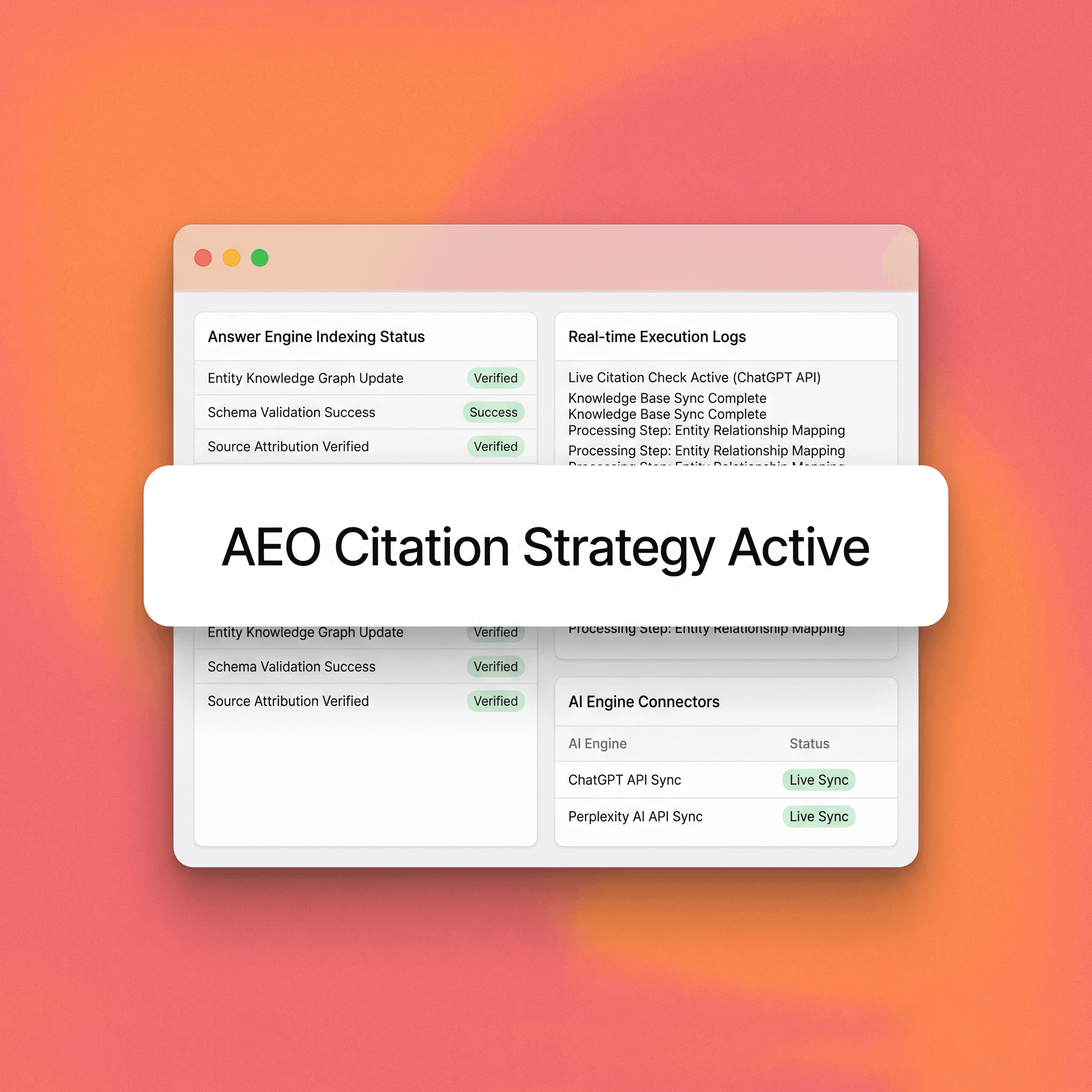
If you run a Shopify store and your entire search strategy is built around Google ranking positions, you are already behind one critical curve. A growing share of buying decisions now begin inside AI answer engines — ChatGPT, Perplexity, Google AI Overviews, and Bing Copilot. These platforms do not serve ten blue links. They synthesize a single answer, cite two or three sources, and move on. Your Shopify AEO strategy determines whether one of those citations is yours or a competitor's. This is a fundamental shift in how digital storefronts must interface with modern query processing, as AI-native search effectively collapses the buyer journey by removing the need for manual navigation through search result pages (SERPs). By failing to adapt, brands risk becoming invisible to a demographic that prioritizes efficiency and synthesized expertise over traditional brand discovery methods, thus missing out on the high-conversion traffic that AI platforms drive to those they deem authoritative.
This guide breaks down what answer engine optimization (AEO) actually means for Shopify stores, why it differs from standard SEO, and the concrete steps growth operators can take right now to build AI search visibility before it becomes a paid media arms race. Achieving this requires a transition from legacy keyword-stuffing methodologies toward a sophisticated architecture that prioritizes machine-readable intent and semantic clarity. Growth teams must treat their Shopify infrastructure not just as a retail destination, but as a structured knowledge base that provides AI models with the precise, verifiable data points required to populate their synthesis engines.
What Is AEO and Why Does It Matter for Shopify Brands?
Answer Engine Optimization is the practice of structuring your content so that AI systems can confidently extract, synthesize, and cite your brand when answering user queries. It is not a replacement for SEO. It is a layer on top of it. AEO represents the convergence of technical data hygiene and high-authority content production, demanding a level of precision that legacy SEO often overlooked. By optimizing for extraction, brands position themselves as the definitive experts within their vertical, ensuring that when an AI model queries its internal database or live web index, the brand’s site is flagged as a high-confidence, low-ambiguity source of truth. This is critical because AI models function by weighing the reliability of information, and consistent, well-structured content creates a mathematical advantage for your store in the selection process.
For Shopify brands specifically, the stakes are practical and immediate:
User Query Example: A user types "best supplement brand for endurance athletes" into Perplexity and gets a four-sentence answer citing three brands. Those three brands did not pay for that placement. They earned it through content authority.
ChatGPT Integration: A user asks ChatGPT for skincare recommendations for sensitive skin. ChatGPT pulls from indexed content that clearly, confidently, and specifically answers the question.
Google AI Overviews: A D2C sneaker brand gets mentioned in a Google AI Overview under "most durable trail running shoes under $150." That brand's product page includes structured comparison data and detailed use-case copy.
This is not hypothetical. It is already happening, and most Shopify stores are not structured to participate in it. Because the majority of platforms rely on proprietary Large Language Models (LLMs), the inability to provide clean, semantic data prevents these engines from recognizing the product as a viable solution to the user's specific problem. Without this visibility, brands lose the critical "first-mover" advantage in the AI-assisted shopping experience, ceding ground to competitors who have successfully mapped their product features to the semantic parameters used by these evolving answer engines.
How AI Answer Engines Decide What to Cite
Before building a strategy, operators need to understand how these systems make citation decisions. They are not random and they are not purely based on domain authority. The decision-making process is rooted in the model's need to minimize "hallucination" and maximize factual accuracy, which leads these systems to prefer content that exhibits high levels of objective specificity and structural integrity.
Confidence and Clarity of the Source
AI answer engines prioritize sources that answer questions directly, without ambiguity. If your product description reads like a marketing tagline, it will not be cited. If your blog post states the answer to a question in the first two sentences and supports it with specifics, it becomes a viable source. By minimizing the ratio of fluff to functional information, you reduce the processing burden on the AI, making it more likely that your content will be parsed correctly. Modern AI models are engineered to value efficiency, and providing a direct, factual answer at the start of a response allows the model to fulfill its function without having to scan through layers of irrelevant brand narrative, thereby increasing the probability of a citation.
Topical Authority Within a Niche
Perplexity and ChatGPT tend to cite sources that have covered a topic consistently and in depth. A Shopify store that has published ten substantive articles on one specific problem — say, joint health for active adults — is more likely to be cited than a brand that has fifteen generic category-level posts scattered across topics. This reflects the "Expertise, Experience, Authoritativeness, and Trustworthiness" (E-E-A-T) principles as interpreted by machine learning algorithms, which favor deep vertical integration over broad-spectrum content strategies. By concentrating your intellectual property within a narrow niche, you build a dense semantic map that acts as a signal of authority, making your site a beacon for AI models seeking to provide comprehensive answers on that specific subject matter.
Structured, Extractable Information
AI systems extract structured information more easily than they extract prose buried in a page. Clear definitions, comparison tables, numbered processes, and schema markup all increase extractability. This is the intersection where technical SEO and AEO meet. Using Schema.org vocabulary allows developers to explicitly label product prices, review counts, and FAQ pairs in a language that bots understand natively. Without this markup, your content is essentially "hidden" in natural language blocks that require the model to interpret the context, whereas structured data provides the metadata necessary for the AI to instantly verify the accuracy of the information being ingested, significantly increasing your chances of being featured in a snippet or citation.
Third-Party Corroboration
When the same brand or claim is referenced across multiple credible sources — editorial coverage, review platforms, Reddit threads, industry publications — AI engines treat that brand as a validated entity. Single-source authority is fragile. Multi-source entity strength is durable. This external validation creates a "consensus loop" where the AI model can cross-reference your site's own claims with independent mentions elsewhere on the web, thereby verifying the brand's legitimacy. As AI systems become more adept at filtering out promotional bias, this independent, off-site validation becomes the primary metric for trustworthiness, effectively transforming public relations and community management into a critical pillar of technical search performance.
The Shopify AEO Readiness Matrix
Use this matrix to evaluate where your store currently stands and where to prioritize effort. Score each dimension from 1 (weak) to 4 (strong).
Dimension 1 — Content Clarity: Does your content answer specific questions directly and early? Weak stores bury the answer. Strong stores lead with it.
Dimension 2 — Topical Depth: Do you own a content cluster around your core category? Weak stores have scattered posts. Strong stores have 8–15 interlinked articles that collectively answer every relevant question in their niche.
Dimension 3 — Structured Data: Do your product pages, blog posts, and FAQs include schema markup (Product, Article, FAQPage, BreadcrumbList)? Weak stores have no schema. Strong stores have validated schema across all primary templates.
Dimension 4 — Entity Strength: Is your brand mentioned and consistent across external sources — press, reviews, directories, social profiles? Weak stores exist only on their own domain. Strong stores have an ecosystem of external validation.
Dimension 5 — Technical Crawlability: Are your key pages indexed, load quickly, and free of crawl barriers? Weak stores have indexing gaps or slow Core Web Vitals. Strong stores pass technical audits cleanly.
Dimension 6 — Answer-Format Content: Does your content include definitions, step-by-step explanations, and direct Q&A-style copy? Weak stores publish campaign copy. Strong stores publish reference content.
Score 20–24: High AEO readiness. Focus on content expansion and entity building.
Score 13–19: Moderate readiness. Prioritize content restructuring and schema implementation.
Score 6–12: Low readiness. Start with technical foundation and one focused content cluster.
Building Your Shopify AEO Strategy: Six Operational Priorities
1. Restructure Your Content for Direct-Answer Format
Every blog post and landing page on your Shopify store should be reviewed through one question: does this page answer something specific that a buyer, researcher, or journalist would type into an AI engine? If the answer is no, the page is not contributing to your AEO footprint. Restructuring involves a pivot toward "query-first" writing, where the goal is to provide immediate utility rather than brand narrative. By optimizing for the specific questions being asked by your target persona, you transform every piece of content into a high-value data node that AI engines can confidently reference without needing to synthesize their own original answers from fragmented sources.
Restructuring means:
Leading with a clear, one-to-two sentence answer before elaborating
Including the primary question as a visible H2 or H3 heading (not just in the meta)
Defining key terms explicitly, not assuming the reader knows them
Using numbered steps or structured comparisons wherever a process or decision is involved
This applies to product descriptions too. "Engineered for peak performance" is not an answer. "Supports sustained energy during efforts lasting 2–4 hours due to a 2:1 maltodextrin-to-fructose ratio" is an answer an AI engine can cite. By providing technical, granular data within product descriptions, you satisfy the requirements for both search bots and high-intent human shoppers who are looking for quantifiable specifications. This transition from emotional, branding-heavy copy to specification-rich copy is the key to winning in an AI-dominated search landscape, as models are programmed to favor factual, verifiable data points that assist in comparative product analysis.
2. Build One Deep Content Cluster Before Expanding
Most Shopify brands make the same mistake: they publish content broadly and shallowly across their category. AI engines reward depth over breadth, especially for newer or mid-authority domains. Pick one core topic — the one that best represents your product's primary use case — and build a full content cluster around it. A functional cluster includes:
A comprehensive pillar article (1,500–2,500 words) that covers the topic at a high level
Three to five supporting articles that go deep on specific subtopics
A FAQ page targeting the long-tail questions buyers actually ask
Product pages that link into the cluster contextually
Once that cluster earns topical authority in AI engines, expand to the next core topic. By establishing yourself as the primary source for a specific sub-niche, you minimize the "noise" that AI models must filter through when evaluating sources, making your brand the most logical citation choice. This methodical approach to content generation is inherently more sustainable than "shotgun" blogging, as it creates an interconnected knowledge ecosystem that reinforces the authority of each individual piece of content within the cluster, ultimately signaling to algorithms that your site is a comprehensive authority on the subject.
3. Implement Schema Markup Across Your Shopify Store
Shopify does not automatically generate rich schema for all page types. You will need to add it — either through a dedicated schema app, a custom theme modification, or your development team. Priority schema types for AEO include Product, FAQPage, Article, BreadcrumbList, and Organization. These markups act as a bridge between your front-end display and the back-end data processing layers of AI search engines. By providing a clean, machine-readable format of your store's essential information, you effectively "train" the AI on the specifics of your product catalog, significantly increasing the precision with which it can answer queries involving your brand. Validate all schema with Google's Rich Results Test and Schema Markup Validator before publishing to ensure that the data is not only present but also correctly structured to meet the strict technical requirements of modern search and AI indexing bots.
4. Strengthen Your Brand's Entity Footprint
Entity-based search is the mechanism that connects AI engines to real-world brands. If your brand is not a clearly defined entity across the web, AI engines have no foundation on which to cite you confidently. Practical entity-building steps for Shopify brands include claiming your Google Business Profile, maintaining consistent citations across directories, and pursuing authoritative editorial coverage. By ensuring that your NAP (Name, Address, Phone) and core brand identifiers remain perfectly consistent across every digital platform, you solidify your "Entity ID" in the knowledge graph. This consistency acts as a trust signal that AI systems use to distinguish your brand from imposters or less reliable sources, eventually allowing your brand to be recognized as a stable, reputable entity whenever a related query arises.
5. Optimize Product Pages for Comparison and Specificity
AI engines frequently synthesize answers to comparison-style queries — "best X for Y use case," "X versus Y," or "how to choose between X and Y." These are high-purchase-intent queries that Shopify brands rarely optimize for. Winning this type of citation means your product page or supporting content needs to explicitly state who the product is for and who it is not for. It also requires the inclusion of quantifiable metrics—dimensions, materials, and certifications—surfaced in headings that facilitate easy parsing by AI crawlers. By explicitly acknowledging the trade-offs or use-cases of your products, you provide the AI with the nuanced data it needs to construct helpful, comparative responses that ultimately point the user toward your store as the optimal solution for their specific needs.
6. Publish a Linkable, Citable Reference Asset
Every successful AEO strategy at the brand level includes at least one piece of reference content that other sites want to link to and that AI engines can cite repeatedly. For Shopify brands, this is typically a definitive buyer's guide, an original dataset, a comparison framework, or a glossary of industry-specific terms. This asset should live on your Shopify blog or a dedicated page, be updated annually, and be actively promoted to journalists, bloggers, and communities in your niche. Because AI engines treat links from credible, external sites as votes of confidence, creating a highly referenceable asset effectively builds a "backlink moat" that protects your search authority. This investment in high-value, evergreen reference content generates a consistent stream of citations, proving to AI algorithms that your brand is a trusted, industry-leading source whose data is worth surfacing in synthesis results.
Common Mistakes Shopify Brands Make With AEO
Treating AEO like a one-time technical fix is a pervasive error, as schema alone cannot overcome a lack of relevant, authoritative, and well-structured content. Brands that focus solely on the technical implementation without addressing the underlying content quality find that their visibility remains stagnant because the models lack a substantive foundation to justify frequent citations. Similarly, publishing for volume instead of depth causes brands to lose the topical authority battle, as AI models prioritize the comprehensive, high-depth resources that can provide a holistic answer rather than a collection of thin, fragmented posts. Product pages are frequently ignored as an AEO asset, yet they are the most critical interface for conversion; optimizing these pages with specific, data-rich descriptions is the single most effective way to turn AI visibility into actual revenue. Furthermore, ignoring the necessity of multi-platform optimization—recognizing that Google AI Overviews, ChatGPT, and Perplexity all consume data differently—can lead to a narrow search profile that fails to capitalize on the unique advantages of each AI ecosystem. Finally, neglecting the external entity layer is fatal to AEO; even the most well-optimized store will struggle if it lacks the off-site credibility signals that tell AI models your brand is a verified entity within the broader, real-world marketplace.
Trade-offs to Understand Before You Start
AEO is a long-term commitment that requires a departure from the quick, ephemeral wins typical of short-term paid advertising campaigns. You must be prepared for a substantial "lag period" where you invest resources into content restructuring and entity building without immediate, direct attribution in your analytics dashboards. Because deep content clusters demand extreme focus, you will likely need to make difficult choices about which product categories to prioritize, potentially at the expense of others, to ensure you reach the critical threshold of authority required for citations. Additionally, building a persistent brand identity across the web is a non-linear, often frustrating process that relies as much on external PR and organic community sentiment as it does on your internal efforts. Finally, the technical demands of schema and crawl optimization necessitate a consistent budget for development, as your store’s structure must evolve in lockstep with the rapidly changing requirements of the AI platforms themselves, making this a recurring operational cost rather than a one-time project fee.
If you run a Shopify store and your entire search strategy is built around Google ranking positions, you are already behind one critical curve. A growing share of buying decisions now begin inside AI answer engines — ChatGPT, Perplexity, Google AI Overviews, and Bing Copilot. These platforms do not serve ten blue links. They synthesize a single answer, cite two or three sources, and move on. Your Shopify AEO strategy determines whether one of those citations is yours or a competitor's. This is a fundamental shift in how digital storefronts must interface with modern query processing, as AI-native search effectively collapses the buyer journey by removing the need for manual navigation through search result pages (SERPs). By failing to adapt, brands risk becoming invisible to a demographic that prioritizes efficiency and synthesized expertise over traditional brand discovery methods, thus missing out on the high-conversion traffic that AI platforms drive to those they deem authoritative.
This guide breaks down what answer engine optimization (AEO) actually means for Shopify stores, why it differs from standard SEO, and the concrete steps growth operators can take right now to build AI search visibility before it becomes a paid media arms race. Achieving this requires a transition from legacy keyword-stuffing methodologies toward a sophisticated architecture that prioritizes machine-readable intent and semantic clarity. Growth teams must treat their Shopify infrastructure not just as a retail destination, but as a structured knowledge base that provides AI models with the precise, verifiable data points required to populate their synthesis engines.
What Is AEO and Why Does It Matter for Shopify Brands?
Answer Engine Optimization is the practice of structuring your content so that AI systems can confidently extract, synthesize, and cite your brand when answering user queries. It is not a replacement for SEO. It is a layer on top of it. AEO represents the convergence of technical data hygiene and high-authority content production, demanding a level of precision that legacy SEO often overlooked. By optimizing for extraction, brands position themselves as the definitive experts within their vertical, ensuring that when an AI model queries its internal database or live web index, the brand’s site is flagged as a high-confidence, low-ambiguity source of truth. This is critical because AI models function by weighing the reliability of information, and consistent, well-structured content creates a mathematical advantage for your store in the selection process.
For Shopify brands specifically, the stakes are practical and immediate:
User Query Example: A user types "best supplement brand for endurance athletes" into Perplexity and gets a four-sentence answer citing three brands. Those three brands did not pay for that placement. They earned it through content authority.
ChatGPT Integration: A user asks ChatGPT for skincare recommendations for sensitive skin. ChatGPT pulls from indexed content that clearly, confidently, and specifically answers the question.
Google AI Overviews: A D2C sneaker brand gets mentioned in a Google AI Overview under "most durable trail running shoes under $150." That brand's product page includes structured comparison data and detailed use-case copy.
This is not hypothetical. It is already happening, and most Shopify stores are not structured to participate in it. Because the majority of platforms rely on proprietary Large Language Models (LLMs), the inability to provide clean, semantic data prevents these engines from recognizing the product as a viable solution to the user's specific problem. Without this visibility, brands lose the critical "first-mover" advantage in the AI-assisted shopping experience, ceding ground to competitors who have successfully mapped their product features to the semantic parameters used by these evolving answer engines.
How AI Answer Engines Decide What to Cite
Before building a strategy, operators need to understand how these systems make citation decisions. They are not random and they are not purely based on domain authority. The decision-making process is rooted in the model's need to minimize "hallucination" and maximize factual accuracy, which leads these systems to prefer content that exhibits high levels of objective specificity and structural integrity.
Confidence and Clarity of the Source
AI answer engines prioritize sources that answer questions directly, without ambiguity. If your product description reads like a marketing tagline, it will not be cited. If your blog post states the answer to a question in the first two sentences and supports it with specifics, it becomes a viable source. By minimizing the ratio of fluff to functional information, you reduce the processing burden on the AI, making it more likely that your content will be parsed correctly. Modern AI models are engineered to value efficiency, and providing a direct, factual answer at the start of a response allows the model to fulfill its function without having to scan through layers of irrelevant brand narrative, thereby increasing the probability of a citation.
Topical Authority Within a Niche
Perplexity and ChatGPT tend to cite sources that have covered a topic consistently and in depth. A Shopify store that has published ten substantive articles on one specific problem — say, joint health for active adults — is more likely to be cited than a brand that has fifteen generic category-level posts scattered across topics. This reflects the "Expertise, Experience, Authoritativeness, and Trustworthiness" (E-E-A-T) principles as interpreted by machine learning algorithms, which favor deep vertical integration over broad-spectrum content strategies. By concentrating your intellectual property within a narrow niche, you build a dense semantic map that acts as a signal of authority, making your site a beacon for AI models seeking to provide comprehensive answers on that specific subject matter.
Structured, Extractable Information
AI systems extract structured information more easily than they extract prose buried in a page. Clear definitions, comparison tables, numbered processes, and schema markup all increase extractability. This is the intersection where technical SEO and AEO meet. Using Schema.org vocabulary allows developers to explicitly label product prices, review counts, and FAQ pairs in a language that bots understand natively. Without this markup, your content is essentially "hidden" in natural language blocks that require the model to interpret the context, whereas structured data provides the metadata necessary for the AI to instantly verify the accuracy of the information being ingested, significantly increasing your chances of being featured in a snippet or citation.
Third-Party Corroboration
When the same brand or claim is referenced across multiple credible sources — editorial coverage, review platforms, Reddit threads, industry publications — AI engines treat that brand as a validated entity. Single-source authority is fragile. Multi-source entity strength is durable. This external validation creates a "consensus loop" where the AI model can cross-reference your site's own claims with independent mentions elsewhere on the web, thereby verifying the brand's legitimacy. As AI systems become more adept at filtering out promotional bias, this independent, off-site validation becomes the primary metric for trustworthiness, effectively transforming public relations and community management into a critical pillar of technical search performance.
The Shopify AEO Readiness Matrix
Use this matrix to evaluate where your store currently stands and where to prioritize effort. Score each dimension from 1 (weak) to 4 (strong).
Dimension 1 — Content Clarity: Does your content answer specific questions directly and early? Weak stores bury the answer. Strong stores lead with it.
Dimension 2 — Topical Depth: Do you own a content cluster around your core category? Weak stores have scattered posts. Strong stores have 8–15 interlinked articles that collectively answer every relevant question in their niche.
Dimension 3 — Structured Data: Do your product pages, blog posts, and FAQs include schema markup (Product, Article, FAQPage, BreadcrumbList)? Weak stores have no schema. Strong stores have validated schema across all primary templates.
Dimension 4 — Entity Strength: Is your brand mentioned and consistent across external sources — press, reviews, directories, social profiles? Weak stores exist only on their own domain. Strong stores have an ecosystem of external validation.
Dimension 5 — Technical Crawlability: Are your key pages indexed, load quickly, and free of crawl barriers? Weak stores have indexing gaps or slow Core Web Vitals. Strong stores pass technical audits cleanly.
Dimension 6 — Answer-Format Content: Does your content include definitions, step-by-step explanations, and direct Q&A-style copy? Weak stores publish campaign copy. Strong stores publish reference content.
Score 20–24: High AEO readiness. Focus on content expansion and entity building.
Score 13–19: Moderate readiness. Prioritize content restructuring and schema implementation.
Score 6–12: Low readiness. Start with technical foundation and one focused content cluster.
Building Your Shopify AEO Strategy: Six Operational Priorities
1. Restructure Your Content for Direct-Answer Format
Every blog post and landing page on your Shopify store should be reviewed through one question: does this page answer something specific that a buyer, researcher, or journalist would type into an AI engine? If the answer is no, the page is not contributing to your AEO footprint. Restructuring involves a pivot toward "query-first" writing, where the goal is to provide immediate utility rather than brand narrative. By optimizing for the specific questions being asked by your target persona, you transform every piece of content into a high-value data node that AI engines can confidently reference without needing to synthesize their own original answers from fragmented sources.
Restructuring means:
Leading with a clear, one-to-two sentence answer before elaborating
Including the primary question as a visible H2 or H3 heading (not just in the meta)
Defining key terms explicitly, not assuming the reader knows them
Using numbered steps or structured comparisons wherever a process or decision is involved
This applies to product descriptions too. "Engineered for peak performance" is not an answer. "Supports sustained energy during efforts lasting 2–4 hours due to a 2:1 maltodextrin-to-fructose ratio" is an answer an AI engine can cite. By providing technical, granular data within product descriptions, you satisfy the requirements for both search bots and high-intent human shoppers who are looking for quantifiable specifications. This transition from emotional, branding-heavy copy to specification-rich copy is the key to winning in an AI-dominated search landscape, as models are programmed to favor factual, verifiable data points that assist in comparative product analysis.
2. Build One Deep Content Cluster Before Expanding
Most Shopify brands make the same mistake: they publish content broadly and shallowly across their category. AI engines reward depth over breadth, especially for newer or mid-authority domains. Pick one core topic — the one that best represents your product's primary use case — and build a full content cluster around it. A functional cluster includes:
A comprehensive pillar article (1,500–2,500 words) that covers the topic at a high level
Three to five supporting articles that go deep on specific subtopics
A FAQ page targeting the long-tail questions buyers actually ask
Product pages that link into the cluster contextually
Once that cluster earns topical authority in AI engines, expand to the next core topic. By establishing yourself as the primary source for a specific sub-niche, you minimize the "noise" that AI models must filter through when evaluating sources, making your brand the most logical citation choice. This methodical approach to content generation is inherently more sustainable than "shotgun" blogging, as it creates an interconnected knowledge ecosystem that reinforces the authority of each individual piece of content within the cluster, ultimately signaling to algorithms that your site is a comprehensive authority on the subject.
3. Implement Schema Markup Across Your Shopify Store
Shopify does not automatically generate rich schema for all page types. You will need to add it — either through a dedicated schema app, a custom theme modification, or your development team. Priority schema types for AEO include Product, FAQPage, Article, BreadcrumbList, and Organization. These markups act as a bridge between your front-end display and the back-end data processing layers of AI search engines. By providing a clean, machine-readable format of your store's essential information, you effectively "train" the AI on the specifics of your product catalog, significantly increasing the precision with which it can answer queries involving your brand. Validate all schema with Google's Rich Results Test and Schema Markup Validator before publishing to ensure that the data is not only present but also correctly structured to meet the strict technical requirements of modern search and AI indexing bots.
4. Strengthen Your Brand's Entity Footprint
Entity-based search is the mechanism that connects AI engines to real-world brands. If your brand is not a clearly defined entity across the web, AI engines have no foundation on which to cite you confidently. Practical entity-building steps for Shopify brands include claiming your Google Business Profile, maintaining consistent citations across directories, and pursuing authoritative editorial coverage. By ensuring that your NAP (Name, Address, Phone) and core brand identifiers remain perfectly consistent across every digital platform, you solidify your "Entity ID" in the knowledge graph. This consistency acts as a trust signal that AI systems use to distinguish your brand from imposters or less reliable sources, eventually allowing your brand to be recognized as a stable, reputable entity whenever a related query arises.
5. Optimize Product Pages for Comparison and Specificity
AI engines frequently synthesize answers to comparison-style queries — "best X for Y use case," "X versus Y," or "how to choose between X and Y." These are high-purchase-intent queries that Shopify brands rarely optimize for. Winning this type of citation means your product page or supporting content needs to explicitly state who the product is for and who it is not for. It also requires the inclusion of quantifiable metrics—dimensions, materials, and certifications—surfaced in headings that facilitate easy parsing by AI crawlers. By explicitly acknowledging the trade-offs or use-cases of your products, you provide the AI with the nuanced data it needs to construct helpful, comparative responses that ultimately point the user toward your store as the optimal solution for their specific needs.
6. Publish a Linkable, Citable Reference Asset
Every successful AEO strategy at the brand level includes at least one piece of reference content that other sites want to link to and that AI engines can cite repeatedly. For Shopify brands, this is typically a definitive buyer's guide, an original dataset, a comparison framework, or a glossary of industry-specific terms. This asset should live on your Shopify blog or a dedicated page, be updated annually, and be actively promoted to journalists, bloggers, and communities in your niche. Because AI engines treat links from credible, external sites as votes of confidence, creating a highly referenceable asset effectively builds a "backlink moat" that protects your search authority. This investment in high-value, evergreen reference content generates a consistent stream of citations, proving to AI algorithms that your brand is a trusted, industry-leading source whose data is worth surfacing in synthesis results.
Common Mistakes Shopify Brands Make With AEO
Treating AEO like a one-time technical fix is a pervasive error, as schema alone cannot overcome a lack of relevant, authoritative, and well-structured content. Brands that focus solely on the technical implementation without addressing the underlying content quality find that their visibility remains stagnant because the models lack a substantive foundation to justify frequent citations. Similarly, publishing for volume instead of depth causes brands to lose the topical authority battle, as AI models prioritize the comprehensive, high-depth resources that can provide a holistic answer rather than a collection of thin, fragmented posts. Product pages are frequently ignored as an AEO asset, yet they are the most critical interface for conversion; optimizing these pages with specific, data-rich descriptions is the single most effective way to turn AI visibility into actual revenue. Furthermore, ignoring the necessity of multi-platform optimization—recognizing that Google AI Overviews, ChatGPT, and Perplexity all consume data differently—can lead to a narrow search profile that fails to capitalize on the unique advantages of each AI ecosystem. Finally, neglecting the external entity layer is fatal to AEO; even the most well-optimized store will struggle if it lacks the off-site credibility signals that tell AI models your brand is a verified entity within the broader, real-world marketplace.
Trade-offs to Understand Before You Start
AEO is a long-term commitment that requires a departure from the quick, ephemeral wins typical of short-term paid advertising campaigns. You must be prepared for a substantial "lag period" where you invest resources into content restructuring and entity building without immediate, direct attribution in your analytics dashboards. Because deep content clusters demand extreme focus, you will likely need to make difficult choices about which product categories to prioritize, potentially at the expense of others, to ensure you reach the critical threshold of authority required for citations. Additionally, building a persistent brand identity across the web is a non-linear, often frustrating process that relies as much on external PR and organic community sentiment as it does on your internal efforts. Finally, the technical demands of schema and crawl optimization necessitate a consistent budget for development, as your store’s structure must evolve in lockstep with the rapidly changing requirements of the AI platforms themselves, making this a recurring operational cost rather than a one-time project fee.
FAQs
Web Personalisation
Framer is a design tool that allows you to design websites on a freeform canvas, and then publish them as websites with a single click.
UI and UX Design
Framer is a design tool that allows you to design websites on a freeform canvas, and then publish them as websites with a single click.
Search Engine Optimisation
Framer is a design tool that allows you to design websites on a freeform canvas, and then publish them as websites with a single click.
CRM and ERP Solutions
Framer is a design tool that allows you to design websites on a freeform canvas, and then publish them as websites with a single click.
Ecommerce
Framer is a design tool that allows you to design websites on a freeform canvas, and then publish them as websites with a single click.
Email Marketing
Framer is a design tool that allows you to design websites on a freeform canvas, and then publish them as websites with a single click.
Marketing Automation
Framer is a design tool that allows you to design websites on a freeform canvas, and then publish them as websites with a single click.
Chatbots and Conversational AI
Framer is a design tool that allows you to design websites on a freeform canvas, and then publish them as websites with a single click.
Chatbots and Conversational AI
Framer is a design tool that allows you to design websites on a freeform canvas, and then publish them as websites with a single click.
Related Blogs
We know your space
Explore our latest UI/UX Case Studies that showcase how our process-driven creativity transforms complex ideas into real, measurable business results, step by step.

AI and Data Analytics
•
Aug 19, 2026
Context Engineering for Enterprise AI Agents: Memory, Retrieval, Tools and State Management

AI and Data Analytics
•
Aug 19, 2026
Enterprise RAG vs Agentic RAG vs AI Search: Which Architecture Should You Build?

AI and Data Analytics
•
Aug 19, 2026
Enterprise Semantic Layer for AI Agents: How to Produce Trusted Business Answers
Let's work together
Have a project in mind?
Let's make it real.
Tell us what you're building. We'll bring the design, technology, and thinking to make it happen.
Fill up the following form to start a conversation
with our team
Let's work together
Have a project in mind?
Let's make it real.
Tell us what you're building. We'll bring the design, technology, and thinking to make it happen.
Fill up the following form to start a conversation with our team
Let's work together
Have a project in mind?
Let's make it real.
Tell us what you're building. We'll bring the design, technology, and thinking to make it happen.
Fill up the following form to start a conversation
with our team
Services
Services
© 2026 projectsupply
Part of Tangle
Services
© 2026 projectsupply
Part of Tangle