

Shopify
AI Email Subject Lines for Shopify: Does AI Actually Improve Open Rates?
AI Email Subject Lines for Shopify: Does AI Actually Improve Open Rates?
Do AI-generated email subject lines outperform human-written ones for Shopify brands? We break down a real testing framework, the honest trade-offs, and when to use each approach.
Do AI-generated email subject lines outperform human-written ones for Shopify brands? We break down a real testing framework, the honest trade-offs, and when to use each approach.
08 min read
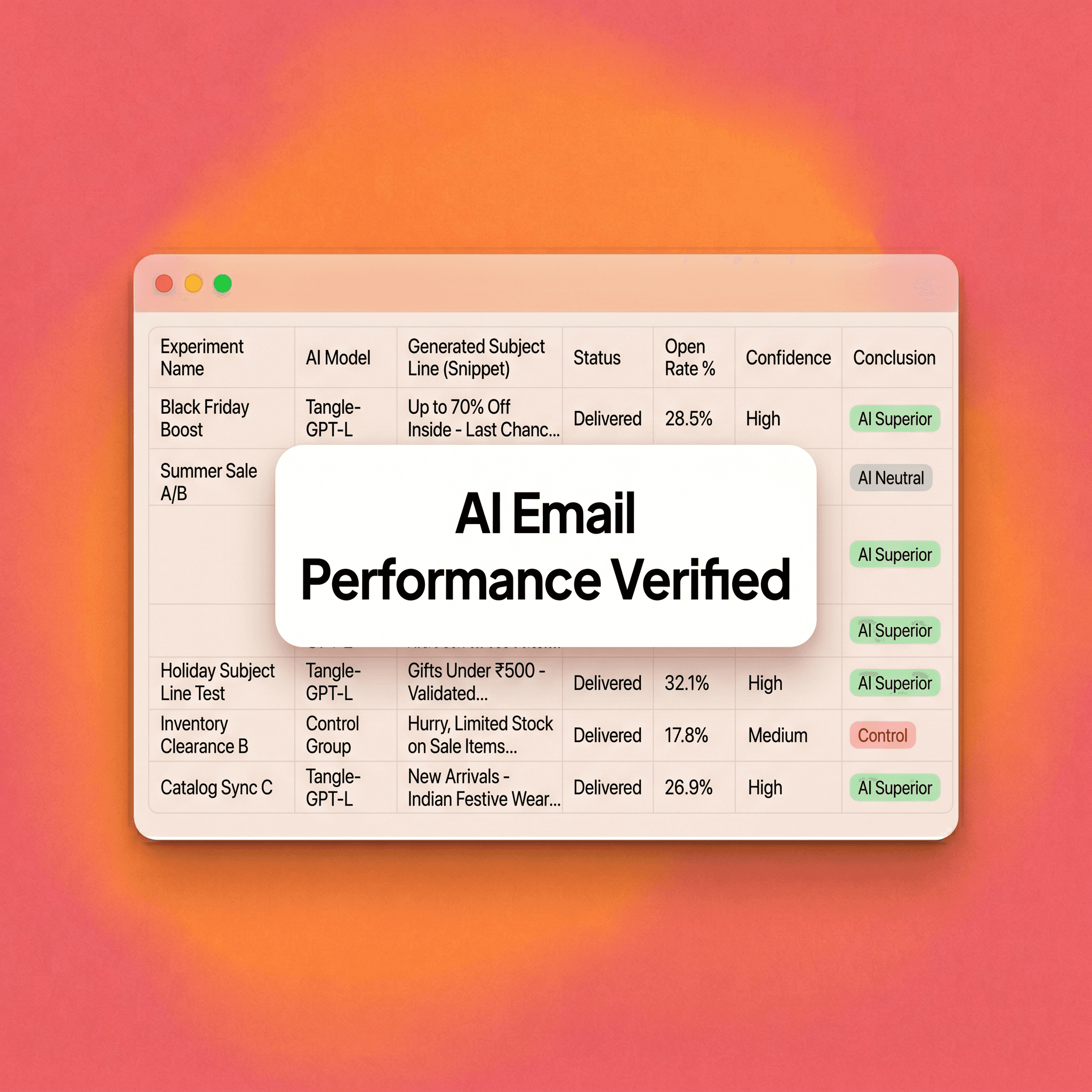
Shopify AI Email Subject Lines: Does AI Actually Improve Open Rates? AI-generated email subject lines are everywhere right now. Klaviyo has it built in. ChatGPT can spit out fifty variations in thirty seconds. Every email tool worth its subscription fee is offering some version of "AI-powered copy." But for Shopify brands running real campaigns with real revenue on the line, the actual question is simpler: do they work better? In the hyper-competitive 2026 digital commerce ecosystem, merchants cannot afford to rely on unverified software features or automated marketing promises. Scaling an online direct-to-consumer store requires a strict, evidence-based approach to every communication channel, ensuring that ad spend and email real estate yield maximum financial throughput. Relying on basic AI copy production lines without configuring strict performance guardrails frequently introduces tonal drift and dilutes your brand authority across core customer cohorts. True lifecycle marketing mastery means balancing automated asset production with disciplined data validation to protect long-term list health and preserve customer acquisition cost efficiencies. This post breaks down how to test it properly, what the data signals actually mean, and when AI is genuinely useful versus when a human writer still wins. Navigating the operational complexities of outbound marketing demands that data analytics groups build clean, non-fragmented testing loops that isolate specific transactional behaviors. This operational diagnostic guide provides growth operators with a clear path to separate software marketing claims from real-world statistical lift. By evaluating your digital retention campaigns against structured performance indicators, your team can eliminate conversion leaks and minimize churn. Use these optimization guidelines to transition your owned media programs from unmonitored messaging batches to highly optimized, capital-efficient retention networks.
What "Better" Means for Email Subject Lines
Before running any test, you need to agree on what you're measuring. Open rate is the obvious starting point, but it's only part of the picture. Relying exclusively on standard platform open metrics can mask deep conversion leaks within your broader email system, as Apple’s Mail Privacy Protection and automated security filters routinely report inflated tracking signals. Financial planning and analysis leads must look beyond basic interaction data and focus on metrics that directly impact your company’s liquid runway. A high-weight open rate means absolutely nothing if the traffic fails to move through your conversion funnels and validate your customer lifetime value assumptions. Operational excellence requires a strict connection between front-end engagement indicators and backend ledger outcomes. A subject line can win on open rate and lose on revenue. A curiosity-gap subject line like "You're going to want to see this" might generate a 42% open rate and zero conversions if the email body doesn't deliver. A specific, product-forward subject line — "The jacket you saved is back in stock" — might open at 28% and drive three times the revenue. This massive behavioral variance highlights why copywriting choices must stay tightly aligned with the specific products being promoted and current inventory cycles. Pushing misleading or overly dramatic headlines simply to hit short-term open milestones damages consumer trust and breaks down long-term engagement curves. Growth operators must evaluate subject copy based on its capacity to drive intentional, high-margin transaction sequences rather than fleeting customer curiosity. What you actually want to measure:
Open rate (initial signal). This basic metric tracks baseline storefront visibility and gives your media teams a directional look at immediate subject lines performance.
Click-to-open rate (CTOR) — are openers engaging with the content? This core percentage measures the relationship between your envelope copy and body content, proving that your messaging remains cohesive.
Revenue per recipient — the metric that closes the argument. This unblended financial indicator serves as your ultimate source of truth, connecting marketing copy straight to business profits.
Unsubscribe rate — a high-open, high-unsub line is damaging your list. Monitoring list drop-offs acts as an operational defense system, ensuring single-campaign wins aren't destroying long-term asset health. Define your measurement stack before you generate a single subject line. Attempting to track performance across separate dashboards or updating criteria mid-test leads to massive data errors and misallocated optimization budgets. Growth leads must establish unified data schema constraints across all analytical engines to keep experimental results completely transparent. Front-loading these configuration choices allows your lifecycle teams to pull reliable cohort data and make definitive, data-driven decisions.
How AI Subject Line Tools Actually Work
Most AI subject line generators in the ecommerce space — whether native to Klaviyo, running on GPT-4, or embedded in tools like Omnisend or Privy — use one of two approaches. These software tools utilize advanced large language model frameworks to process textual store inputs and predict optimal string sequences based on global performance tables. Understanding the underlying technology allows engineering and marketing teams to better configure prompt constraints and manage integration lifecycles. By analyzing how these generation layers work, operators can protect their data pipelines from junk text generations. The first is completion-based generation. You give it context (product type, discount, tone) and it predicts statistically likely, high-engagement phrasing based on training data. It's fast and consistent. This machine learning methodology analyzes millions of historical e-commerce data strings, assembling word combinations that exhibit a strong statistical link to historical user engagement. While this automated production method delivers high speed for large variant pools, it tends to repeat common industry phrasing, flattening your brand identity into a generic tone. Growth managers must actively apply custom style rules to prevent these automated completion models from watering down their core brand language. The second is performance-prediction scoring. Some tools claim to score subject lines before you send them based on predicted open rate benchmarks. These scores are directionally useful but should not be treated as guarantees — they're trained on broad datasets, not your specific list. Aggregated performance tables frequently overlook localized customer biases, regional holiday cycles, and category-specific purchasing habits within your target segments. Relying blindly on pre-send platform scores without running live split-tests can lead teams to launch campaigns that fail to resonate with actual buyers. Treat pre-calculated predictive scores as initial baseline guidance rather than an absolute measure of commercial success. Neither approach replaces knowing your audience. They accelerate drafting. That distinction matters. AI copywriting applications operate as efficient workflow enhancers, freeing up creative leads from repetitive text generation tasks rather than completely replacing human psychological insight. A software algorithm can track historical word patterns, but it cannot map the subtle subcultural references, inside jokes, and authentic empathy that drive genuine brand loyalty. Operations leads must position AI tools purely as scalable brainstorming assistants within a tightly controlled, human-led publishing routine.
The Subject Line Test Framework: How to Run It Properly
Most Shopify brands run informal A/B tests that don't produce actionable data. Here's a structured approach. Loose, unmonitored testing methodologies fail to track proper statistical metrics, leading companies to build long-term marketing plans on misleading data noise. To establish clear, predictable retention growth, media teams must treat every email deployment as a rigorous scientific trial with clear data boundaries. This structured testing process demands complete control over list segmentation, variables, and platform configurations to isolate clear success signals. Implement the systematic operational steps detailed below to eliminate technical debt and ensure your owned media optimization metrics remain perfectly valid.
Setting Up a Valid Test
Minimum list size: 2,000 contacts per variant for statistical relevance. Enforcing this minimum sample size limits statistical anomalies, ensuring that your observed performance gains stem from real copy preference rather than random distribution behavior.
Test one variable at a time — subject line only, same send time, same segment. Isolating your testing variables ensures your backend analytics can attribute open rate fluctuations directly to the copywriting changes without data noise from secondary adjustments.
Use your email platform's built-in A/B or multivariate test (Klaviyo, Omnisend, Mailchimp all support this). Leveraging native platform testing components ensures that tracking data stays secure and takes advantage of automated routing frameworks.
Run tests across a minimum of three sends before drawing conclusions. Relying on multiple sequential deployments helps teams average out day-specific behavioral noise, confirming the long-term consistency of your optimization data.
Hold the winning condition constant: define before testing whether "winner" means highest open rate or highest revenue. Setting this performance yardstick prevents internal team reporting adjustments, forcing growth leads to prioritize long-term capital efficiency over short-term vanity metrics.
What to Actually Test
Don't test AI versus human as a binary. Test specific attributes:
Personalization tokens (first name, product saved, last purchase) vs. no personalization. This structural test isolates whether dynamic user metadata integrations drive real conversions or introduce customer friction across specific retention flows.
Specificity ("Save 20% on running gear this weekend") vs. intrigue ("We're doing something we've never done before"). Sifting through these messaging pillars defines whether your active audience segment responds best to immediate value clarity or creative curiosity hooks.
Emoji use vs. no emoji — results vary significantly by brand and audience age. Testing graphic tokens allows visual designers to analyze regional design expectations, helping the brand blend cleanly into crowded mobile notifications.
Length — under 40 characters vs. 50-60 characters. Tracking text length limits helps your development team optimize layouts for small device viewports, preventing truncated subject strings from cutting off core marketing hooks. AI tools can rapidly generate variants across all of these dimensions. That's where they earn their place in the workflow. Instead of forcing copywriters to manually spend hours building minor structural adjustments, operations leads can use language models to output diverse variant options based on clear programmatic constraints. This specialized division of labor allows your human creators to focus completely on higher-level content strategy, brand guardrails, and message relevance. Automating these structural formatting layers speeds up your testing volume and significantly drops corporate asset production costs.
The Subject Line Signal Matrix
This is the framework for deciding when to use AI-generated lines versus human-written ones. Use it to guide your production workflow, not replace judgment. This cross-functional planning index removes operational ambiguity from your creative department, ensuring asset generation choices are guided by objective risk parameters and resource constraints. By systematically analyzing your outbound campaigns through this specialized lens, operations managers can allocate human writing resources to high-value launches while using automation to scale up routine messages. Adopting this matrix optimizes team output and safeguards your core brand voice across all digital customer touchpoints. The Subject Line Signal Matrix: AI vs. Human — When to Use Which
Situation: High-volume send (100k+) needing fast variants | Recommended Approach: AI-generated, human-reviewed | Reason: Speed and scale; review catches tone drift. This structural arrangement helps growth teams output diverse localized variations without overwhelming internal copy groups, maintaining steady, fast-paced deployment rhythms.
Situation: Brand voice is tightly defined and unusual | Recommended Approach: Human-first, AI as secondary option | Reason: AI defaults to median ecommerce tone. Specialized D2C companies that win on dry humor or subcultural context must avoid generic copy generations to keep from diluting their brand capital.
Situation: Transactional / behavioral trigger emails | Recommended Approach: AI performs well | Reason: Context-driven, lower creative variance needed. High-frequency automated alerts—such as back-in-stock confirmations or shipping tracking logs—prioritize functional clarity over deep brand storytelling, making them ideal targets for language model automation.
Situation: Major campaign (BFCM, product launch) | Recommended Approach: Human-led with AI brainstorming | Reason: Stakes too high to rely on statistical averages. High-priority holiday events demand custom, deeply empathetic messaging that links up perfectly with manufacturing schedules and unique financial promos.
Situation: Reengagement campaigns | Recommended Approach: Human — requires nuance and empathy | Reason: AI often produces generic "We miss you" lines. Winning back disengaged buyers requires careful emotional balancing and deep customer lifecycle insight that standard completion models cannot replicate without sounding robotic.
Situation: Routine promotional sends | Recommended Approach: AI with A/B test | Reason: Good use case for AI efficiency. Regular, high-volume seasonal inventory features simple value angles, giving automated generation tools the ideal sandbox to test and optimize copy options.
Situation: Niche audience with specific language norms | Recommended Approach: Human — AI lacks subcultural awareness | Reason: Risk of sounding out of touch. Markets built around highly technical product features or distinct lifestyles require an advanced linguistic precision that current AI models cannot reliably output without creating consumer friction. Save this matrix and use it in your email planning workflow. Integrating these specific situational guardrails directly into your content calendars turns asset creation into a structured corporate process. Teams can review upcoming pipelines during weekly syncs, automatically mapping resource needs based on objective campaign profiles rather than personal design preferences. This systematic approach preserves working capital and ensures that your creative investments focus where they will drive the highest returns.
What the Honest Trade-offs Look Like
Where AI subject lines tend to win
AI-generated subject lines tend to perform well in controlled, repeatable situations. Promotional emails with clear value propositions, cart abandonment sequences, and back-in-stock notifications are well-suited. The inputs are clear, the desired action is obvious, and the AI generates competent, efficient copy fast. These specific communication verticals function on highly structured transactional data, providing language models with explicit text context to guide output generation. Because behavioral notifications are triggered by single user events, the messaging goals remain focused on functional clarity rather than abstract brand storytelling. For teams producing high email volume — multiple sends per week across segmented lists — AI dramatically reduces the time cost of subject line production. That's real value. This efficiency gain transforms content team output parameters, letting a lean growth group build multi-layered testing funnels without scaling up full-time human copywriting costs. This optimization helps brands divert critical working capital away from administrative copy creation and channel it directly toward performance creative testing or supply chain optimizations.
Where AI subject lines fall short
Brand voice is the most common failure point. If your brand has a specific personality — dry humor, irreverence, a particular cultural reference frame — AI will sand it down toward the middle. The output is grammatically correct and structurally reasonable. It's also forgettable. Large language models inherently optimize for linguistic probability matrices, meaning their default generations gravitate toward common, uninspiring industry terms. This standardization strips away the distinct edge that separate fast-growing, founder-led direct-to-consumer businesses from faceless marketplace competitors. AI also struggles with moment-specific copy. A subject line that references a cultural event, a community inside joke, or a very specific customer behavior pattern requires contextual awareness that current tools don't reliably have. The output often lands as slightly off — not wrong, just not right. Missing these localized nuances breaks down consumer affinity loops, making your automated communications feel like sterile, out-of-touch corporate broadcasts. Human copywriters remain indispensable for building real connections by wrapping brand positioning in timely, authentic social contexts.
The unsubscribe risk
Clickbait subject lines — which AI can confidently produce because they score well on predicted open rates — can damage your list health over time. If your audience repeatedly opens expecting one thing and gets another, unsubscribes and spam complaints follow. A good short-term open rate metric can mask long-term list erosion. Automated optimization engines often chase immediate front-end clicks by maximizing curiosity gaps, completely ignoring how aggressive copy angles choices can alienate users over time. This short-sighted optimization strategy destroys the value of your first-party databases and can push your messages straight to global email spam filters.
Common Mistakes Shopify Teams Make When Testing This
Running a single A/B test and calling it done. One test is a data point, not a conclusion. Seasonal factors, send time, and list segment all affect the result. Three or more tests across different campaign types are the minimum. Growth leads frequently make this mistake during quick optimization sprints, treating a single successful variant as permanent proof of an absolute strategy. This rash conclusion ignores shifting ad platform deliverability metrics and dynamic consumer fatigue patterns, which can quickly make old results irrelevant. Using open rate as the only metric. Revenue per recipient is the metric that matters. Open rate tells you about the subject line. Revenue tells you about the whole system. Performance marketers often suffer from dashboard isolation, spending months chasing sky-high open levels while completely overlooking declining conversion rates and flat bottom-line results. Financial controllers must step in to bridge email engagement data straight with your store’s live sales ledgers to protect unit economics. Not reviewing AI output before sending. AI-generated subject lines occasionally produce phrasing that's technically correct but tonally wrong for a specific brand or audience. Every line should pass a human review before it goes out. Leaving software generators completely unmonitored invites awkward structural logic, broken personalization token fields, and off-brand formatting to reach live user folders. Build explicit editorial checkout workflows to protect your brand's digital presence. Testing AI on your most important campaigns first. BFCM, major launches, and reactivation campaigns are not the place to experiment with an unproven approach. Test on routine sends first. Build confidence in what works, then scale it. Committing unverified automated copy lines to your primary revenue channels exposes your entire capitalization roadmap to unnecessary downside risks if the text framework fails to convert core buyers. Ignoring deliverability signals. High open rates from subject lines with spam-trigger language can produce short-term gains and long-term inbox placement problems. Check your deliverability metrics alongside your open rate data. If your copywriting strategy triggers central domain flags across major platforms like Google or Apple, your overall inbox placement metrics will collapse, cutting off your primary organic retention pipeline.
Shopify AI Email Subject Lines: Does AI Actually Improve Open Rates? AI-generated email subject lines are everywhere right now. Klaviyo has it built in. ChatGPT can spit out fifty variations in thirty seconds. Every email tool worth its subscription fee is offering some version of "AI-powered copy." But for Shopify brands running real campaigns with real revenue on the line, the actual question is simpler: do they work better? In the hyper-competitive 2026 digital commerce ecosystem, merchants cannot afford to rely on unverified software features or automated marketing promises. Scaling an online direct-to-consumer store requires a strict, evidence-based approach to every communication channel, ensuring that ad spend and email real estate yield maximum financial throughput. Relying on basic AI copy production lines without configuring strict performance guardrails frequently introduces tonal drift and dilutes your brand authority across core customer cohorts. True lifecycle marketing mastery means balancing automated asset production with disciplined data validation to protect long-term list health and preserve customer acquisition cost efficiencies. This post breaks down how to test it properly, what the data signals actually mean, and when AI is genuinely useful versus when a human writer still wins. Navigating the operational complexities of outbound marketing demands that data analytics groups build clean, non-fragmented testing loops that isolate specific transactional behaviors. This operational diagnostic guide provides growth operators with a clear path to separate software marketing claims from real-world statistical lift. By evaluating your digital retention campaigns against structured performance indicators, your team can eliminate conversion leaks and minimize churn. Use these optimization guidelines to transition your owned media programs from unmonitored messaging batches to highly optimized, capital-efficient retention networks.
What "Better" Means for Email Subject Lines
Before running any test, you need to agree on what you're measuring. Open rate is the obvious starting point, but it's only part of the picture. Relying exclusively on standard platform open metrics can mask deep conversion leaks within your broader email system, as Apple’s Mail Privacy Protection and automated security filters routinely report inflated tracking signals. Financial planning and analysis leads must look beyond basic interaction data and focus on metrics that directly impact your company’s liquid runway. A high-weight open rate means absolutely nothing if the traffic fails to move through your conversion funnels and validate your customer lifetime value assumptions. Operational excellence requires a strict connection between front-end engagement indicators and backend ledger outcomes. A subject line can win on open rate and lose on revenue. A curiosity-gap subject line like "You're going to want to see this" might generate a 42% open rate and zero conversions if the email body doesn't deliver. A specific, product-forward subject line — "The jacket you saved is back in stock" — might open at 28% and drive three times the revenue. This massive behavioral variance highlights why copywriting choices must stay tightly aligned with the specific products being promoted and current inventory cycles. Pushing misleading or overly dramatic headlines simply to hit short-term open milestones damages consumer trust and breaks down long-term engagement curves. Growth operators must evaluate subject copy based on its capacity to drive intentional, high-margin transaction sequences rather than fleeting customer curiosity. What you actually want to measure:
Open rate (initial signal). This basic metric tracks baseline storefront visibility and gives your media teams a directional look at immediate subject lines performance.
Click-to-open rate (CTOR) — are openers engaging with the content? This core percentage measures the relationship between your envelope copy and body content, proving that your messaging remains cohesive.
Revenue per recipient — the metric that closes the argument. This unblended financial indicator serves as your ultimate source of truth, connecting marketing copy straight to business profits.
Unsubscribe rate — a high-open, high-unsub line is damaging your list. Monitoring list drop-offs acts as an operational defense system, ensuring single-campaign wins aren't destroying long-term asset health. Define your measurement stack before you generate a single subject line. Attempting to track performance across separate dashboards or updating criteria mid-test leads to massive data errors and misallocated optimization budgets. Growth leads must establish unified data schema constraints across all analytical engines to keep experimental results completely transparent. Front-loading these configuration choices allows your lifecycle teams to pull reliable cohort data and make definitive, data-driven decisions.
How AI Subject Line Tools Actually Work
Most AI subject line generators in the ecommerce space — whether native to Klaviyo, running on GPT-4, or embedded in tools like Omnisend or Privy — use one of two approaches. These software tools utilize advanced large language model frameworks to process textual store inputs and predict optimal string sequences based on global performance tables. Understanding the underlying technology allows engineering and marketing teams to better configure prompt constraints and manage integration lifecycles. By analyzing how these generation layers work, operators can protect their data pipelines from junk text generations. The first is completion-based generation. You give it context (product type, discount, tone) and it predicts statistically likely, high-engagement phrasing based on training data. It's fast and consistent. This machine learning methodology analyzes millions of historical e-commerce data strings, assembling word combinations that exhibit a strong statistical link to historical user engagement. While this automated production method delivers high speed for large variant pools, it tends to repeat common industry phrasing, flattening your brand identity into a generic tone. Growth managers must actively apply custom style rules to prevent these automated completion models from watering down their core brand language. The second is performance-prediction scoring. Some tools claim to score subject lines before you send them based on predicted open rate benchmarks. These scores are directionally useful but should not be treated as guarantees — they're trained on broad datasets, not your specific list. Aggregated performance tables frequently overlook localized customer biases, regional holiday cycles, and category-specific purchasing habits within your target segments. Relying blindly on pre-send platform scores without running live split-tests can lead teams to launch campaigns that fail to resonate with actual buyers. Treat pre-calculated predictive scores as initial baseline guidance rather than an absolute measure of commercial success. Neither approach replaces knowing your audience. They accelerate drafting. That distinction matters. AI copywriting applications operate as efficient workflow enhancers, freeing up creative leads from repetitive text generation tasks rather than completely replacing human psychological insight. A software algorithm can track historical word patterns, but it cannot map the subtle subcultural references, inside jokes, and authentic empathy that drive genuine brand loyalty. Operations leads must position AI tools purely as scalable brainstorming assistants within a tightly controlled, human-led publishing routine.
The Subject Line Test Framework: How to Run It Properly
Most Shopify brands run informal A/B tests that don't produce actionable data. Here's a structured approach. Loose, unmonitored testing methodologies fail to track proper statistical metrics, leading companies to build long-term marketing plans on misleading data noise. To establish clear, predictable retention growth, media teams must treat every email deployment as a rigorous scientific trial with clear data boundaries. This structured testing process demands complete control over list segmentation, variables, and platform configurations to isolate clear success signals. Implement the systematic operational steps detailed below to eliminate technical debt and ensure your owned media optimization metrics remain perfectly valid.
Setting Up a Valid Test
Minimum list size: 2,000 contacts per variant for statistical relevance. Enforcing this minimum sample size limits statistical anomalies, ensuring that your observed performance gains stem from real copy preference rather than random distribution behavior.
Test one variable at a time — subject line only, same send time, same segment. Isolating your testing variables ensures your backend analytics can attribute open rate fluctuations directly to the copywriting changes without data noise from secondary adjustments.
Use your email platform's built-in A/B or multivariate test (Klaviyo, Omnisend, Mailchimp all support this). Leveraging native platform testing components ensures that tracking data stays secure and takes advantage of automated routing frameworks.
Run tests across a minimum of three sends before drawing conclusions. Relying on multiple sequential deployments helps teams average out day-specific behavioral noise, confirming the long-term consistency of your optimization data.
Hold the winning condition constant: define before testing whether "winner" means highest open rate or highest revenue. Setting this performance yardstick prevents internal team reporting adjustments, forcing growth leads to prioritize long-term capital efficiency over short-term vanity metrics.
What to Actually Test
Don't test AI versus human as a binary. Test specific attributes:
Personalization tokens (first name, product saved, last purchase) vs. no personalization. This structural test isolates whether dynamic user metadata integrations drive real conversions or introduce customer friction across specific retention flows.
Specificity ("Save 20% on running gear this weekend") vs. intrigue ("We're doing something we've never done before"). Sifting through these messaging pillars defines whether your active audience segment responds best to immediate value clarity or creative curiosity hooks.
Emoji use vs. no emoji — results vary significantly by brand and audience age. Testing graphic tokens allows visual designers to analyze regional design expectations, helping the brand blend cleanly into crowded mobile notifications.
Length — under 40 characters vs. 50-60 characters. Tracking text length limits helps your development team optimize layouts for small device viewports, preventing truncated subject strings from cutting off core marketing hooks. AI tools can rapidly generate variants across all of these dimensions. That's where they earn their place in the workflow. Instead of forcing copywriters to manually spend hours building minor structural adjustments, operations leads can use language models to output diverse variant options based on clear programmatic constraints. This specialized division of labor allows your human creators to focus completely on higher-level content strategy, brand guardrails, and message relevance. Automating these structural formatting layers speeds up your testing volume and significantly drops corporate asset production costs.
The Subject Line Signal Matrix
This is the framework for deciding when to use AI-generated lines versus human-written ones. Use it to guide your production workflow, not replace judgment. This cross-functional planning index removes operational ambiguity from your creative department, ensuring asset generation choices are guided by objective risk parameters and resource constraints. By systematically analyzing your outbound campaigns through this specialized lens, operations managers can allocate human writing resources to high-value launches while using automation to scale up routine messages. Adopting this matrix optimizes team output and safeguards your core brand voice across all digital customer touchpoints. The Subject Line Signal Matrix: AI vs. Human — When to Use Which
Situation: High-volume send (100k+) needing fast variants | Recommended Approach: AI-generated, human-reviewed | Reason: Speed and scale; review catches tone drift. This structural arrangement helps growth teams output diverse localized variations without overwhelming internal copy groups, maintaining steady, fast-paced deployment rhythms.
Situation: Brand voice is tightly defined and unusual | Recommended Approach: Human-first, AI as secondary option | Reason: AI defaults to median ecommerce tone. Specialized D2C companies that win on dry humor or subcultural context must avoid generic copy generations to keep from diluting their brand capital.
Situation: Transactional / behavioral trigger emails | Recommended Approach: AI performs well | Reason: Context-driven, lower creative variance needed. High-frequency automated alerts—such as back-in-stock confirmations or shipping tracking logs—prioritize functional clarity over deep brand storytelling, making them ideal targets for language model automation.
Situation: Major campaign (BFCM, product launch) | Recommended Approach: Human-led with AI brainstorming | Reason: Stakes too high to rely on statistical averages. High-priority holiday events demand custom, deeply empathetic messaging that links up perfectly with manufacturing schedules and unique financial promos.
Situation: Reengagement campaigns | Recommended Approach: Human — requires nuance and empathy | Reason: AI often produces generic "We miss you" lines. Winning back disengaged buyers requires careful emotional balancing and deep customer lifecycle insight that standard completion models cannot replicate without sounding robotic.
Situation: Routine promotional sends | Recommended Approach: AI with A/B test | Reason: Good use case for AI efficiency. Regular, high-volume seasonal inventory features simple value angles, giving automated generation tools the ideal sandbox to test and optimize copy options.
Situation: Niche audience with specific language norms | Recommended Approach: Human — AI lacks subcultural awareness | Reason: Risk of sounding out of touch. Markets built around highly technical product features or distinct lifestyles require an advanced linguistic precision that current AI models cannot reliably output without creating consumer friction. Save this matrix and use it in your email planning workflow. Integrating these specific situational guardrails directly into your content calendars turns asset creation into a structured corporate process. Teams can review upcoming pipelines during weekly syncs, automatically mapping resource needs based on objective campaign profiles rather than personal design preferences. This systematic approach preserves working capital and ensures that your creative investments focus where they will drive the highest returns.
What the Honest Trade-offs Look Like
Where AI subject lines tend to win
AI-generated subject lines tend to perform well in controlled, repeatable situations. Promotional emails with clear value propositions, cart abandonment sequences, and back-in-stock notifications are well-suited. The inputs are clear, the desired action is obvious, and the AI generates competent, efficient copy fast. These specific communication verticals function on highly structured transactional data, providing language models with explicit text context to guide output generation. Because behavioral notifications are triggered by single user events, the messaging goals remain focused on functional clarity rather than abstract brand storytelling. For teams producing high email volume — multiple sends per week across segmented lists — AI dramatically reduces the time cost of subject line production. That's real value. This efficiency gain transforms content team output parameters, letting a lean growth group build multi-layered testing funnels without scaling up full-time human copywriting costs. This optimization helps brands divert critical working capital away from administrative copy creation and channel it directly toward performance creative testing or supply chain optimizations.
Where AI subject lines fall short
Brand voice is the most common failure point. If your brand has a specific personality — dry humor, irreverence, a particular cultural reference frame — AI will sand it down toward the middle. The output is grammatically correct and structurally reasonable. It's also forgettable. Large language models inherently optimize for linguistic probability matrices, meaning their default generations gravitate toward common, uninspiring industry terms. This standardization strips away the distinct edge that separate fast-growing, founder-led direct-to-consumer businesses from faceless marketplace competitors. AI also struggles with moment-specific copy. A subject line that references a cultural event, a community inside joke, or a very specific customer behavior pattern requires contextual awareness that current tools don't reliably have. The output often lands as slightly off — not wrong, just not right. Missing these localized nuances breaks down consumer affinity loops, making your automated communications feel like sterile, out-of-touch corporate broadcasts. Human copywriters remain indispensable for building real connections by wrapping brand positioning in timely, authentic social contexts.
The unsubscribe risk
Clickbait subject lines — which AI can confidently produce because they score well on predicted open rates — can damage your list health over time. If your audience repeatedly opens expecting one thing and gets another, unsubscribes and spam complaints follow. A good short-term open rate metric can mask long-term list erosion. Automated optimization engines often chase immediate front-end clicks by maximizing curiosity gaps, completely ignoring how aggressive copy angles choices can alienate users over time. This short-sighted optimization strategy destroys the value of your first-party databases and can push your messages straight to global email spam filters.
Common Mistakes Shopify Teams Make When Testing This
Running a single A/B test and calling it done. One test is a data point, not a conclusion. Seasonal factors, send time, and list segment all affect the result. Three or more tests across different campaign types are the minimum. Growth leads frequently make this mistake during quick optimization sprints, treating a single successful variant as permanent proof of an absolute strategy. This rash conclusion ignores shifting ad platform deliverability metrics and dynamic consumer fatigue patterns, which can quickly make old results irrelevant. Using open rate as the only metric. Revenue per recipient is the metric that matters. Open rate tells you about the subject line. Revenue tells you about the whole system. Performance marketers often suffer from dashboard isolation, spending months chasing sky-high open levels while completely overlooking declining conversion rates and flat bottom-line results. Financial controllers must step in to bridge email engagement data straight with your store’s live sales ledgers to protect unit economics. Not reviewing AI output before sending. AI-generated subject lines occasionally produce phrasing that's technically correct but tonally wrong for a specific brand or audience. Every line should pass a human review before it goes out. Leaving software generators completely unmonitored invites awkward structural logic, broken personalization token fields, and off-brand formatting to reach live user folders. Build explicit editorial checkout workflows to protect your brand's digital presence. Testing AI on your most important campaigns first. BFCM, major launches, and reactivation campaigns are not the place to experiment with an unproven approach. Test on routine sends first. Build confidence in what works, then scale it. Committing unverified automated copy lines to your primary revenue channels exposes your entire capitalization roadmap to unnecessary downside risks if the text framework fails to convert core buyers. Ignoring deliverability signals. High open rates from subject lines with spam-trigger language can produce short-term gains and long-term inbox placement problems. Check your deliverability metrics alongside your open rate data. If your copywriting strategy triggers central domain flags across major platforms like Google or Apple, your overall inbox placement metrics will collapse, cutting off your primary organic retention pipeline.
FAQ
Does AI actually improve email open rates for Shopify brands?
It depends on the campaign type and how the test is set up. For routine promotional sends and transactional sequences, AI-generated subject lines frequently perform on par with or better than un-tested human-written lines. For brand-voice-heavy campaigns or nuanced audience segments, human-written lines typically outperform. The honest answer is: test it against your own list rather than defaulting to either answer. Media buyers must regularly audit these open rate patterns against real cohort lifetime values to prevent scaling unoptimized copy paths. Calibrating this metric means shifting your focus away from short-term platform data and looking closely at multi-month contribution margins, ensuring your email program targets high-value customer cohorts.
What's the best AI tool for generating Shopify email subject lines?
Klaviyo's built-in AI subject line tool is the most practical starting point for Shopify brands already using the platform — it's native, requires no additional workflow, and generates contextually relevant output based on email content. ChatGPT and Claude are useful for brainstorming large variant pools when you want more creative control over the prompts. No single tool is definitively "best" — your results depend on how well you're briefing the AI and reviewing the output. Data teams can use these extensive API fields to construct deep multi-channel marketing models and map comprehensive product margin journeys. Centralizing your text generation parameters within structured developer repositories ensures that your copy rules remain consistent, version-controlled, and instantly available to power marketing campaigns.
How many subject line variants should I test at once?
For most Shopify brands, two to three variants per test is the practical ceiling. Testing more variants requires a significantly larger list to reach statistical significance, and it complicates interpretation. Two variants — one control, one test — is cleanest for isolating the variable you're actually measuring. Small-scale operators must realize that running complex multivariate trials across thin data sets prevents them from unlocking clear statistical patterns, leaving them exposed to misleading metric data. To make early lifecycle experiments sustainable, brands must focus on maximizing sample sizes per split and keeping test parameters completely focused.
Can AI subject lines hurt my email deliverability?
They can if the output leans on spam-trigger phrasing — excessive capitalization, certain promotional language patterns, or clickbait structures that generate high open rates but also high complaint rates. Review every AI-generated line before sending and run it through your email platform's built-in spam score check if one is available. Failing to secure these operational validation steps before processing bulk campaigns can lead to immediate domain suspensions across major inbox networks and trigger serious delivery drops. Operations leads must treat these automated spam checks as mandatory pre-send prerequisites, keeping your business compliant with modern deliverability frameworks.
What open rate lift should I expect from AI subject lines?
Be skeptical of any claim that promises a specific lift percentage. Open rates vary enormously by industry, list quality, send frequency, and audience segment. A reasonable expectation from any subject line optimization effort — AI or otherwise — is incremental improvement over time, not a step-change from a single test. If a tool promises 20% open rate improvement, ask to see the methodology behind that claim. Financial planning teams must build these historical performance ranges directly into their retention models rather than treating software marketing targets as guaranteed financial returns. Regularly auditing these copy improvements against changing network privacy updates is essential to keeping marketing projections grounded.
Should I use personalization in AI-generated subject lines?
Yes, where it's relevant and accurate. First-name personalization still produces a measurable lift for many audiences, and product-specific personalization — "Your saved item is almost gone" — consistently outperforms generic alternatives in behavioral trigger emails. AI tools handle token-based personalization well. The risk is over-using it to the point where every subject line feels formulaic. If a consumer clicks an automated notification and encounters broken variables or irrelevant recommendations, it breaks the customer journey and wastes database engagement capital. Engineers must ensure your data fields use clean metadata strings to drive optimal checkout performance.
At what email list size does it make sense to start testing AI subject lines?
A list of at least 4,000 to 5,000 active contacts is the practical floor for running tests that produce statistically useful results. Below that threshold, variance between sends makes it difficult to separate signal from noise. Smaller lists should focus on improving list quality and segmentation before investing heavily in subject line optimization. Early-stage operations benefit from focusing on broad audience cleanups and consistent delivery patterns, while scaled high-volume enterprises must build advanced data modeling pipelines to split tests across specific customer segments. Maintaining a tight operating cadence ensures that your marketing infrastructure can scale efficiently as your audience grows.
insights
Explore more on AI, Design and Growth

SEO
Google AI & Local SEO: Rank in Both (2026 Guide)
Learn how to optimize content for Google AI search and local SEO simultaneously to rank in AI Overviews, maps, and organic search results.

SEO
Semantic Content Clusters for SEO & AEO (Templates)
Learn how to build semantic content clusters for SEO and AEO. Includes practical templates, internal linking structures, and examples for ranking in AI search.

SEO
How Google AI Search Works: RankBrain to Gemini (2026)
Discover how Google’s AI search evolved from RankBrain to Gemini and what it means for SEO, AI search results, and ranking strategies in 2026.
SEO
Google AI & Local SEO: Rank in Both (2026 Guide)
Learn how to optimize content for Google AI search and local SEO simultaneously to rank in AI Overviews, maps, and organic search results.
SEO
Semantic Content Clusters for SEO & AEO (Templates)
Learn how to build semantic content clusters for SEO and AEO. Includes practical templates, internal linking structures, and examples for ranking in AI search.
get in touch
Ready to Grow From Day One?
Strategy, execution, and digital experiences designed to move together. Fill out the form below and our team will contact you shortly.
get in touch
Ready to Grow From Day One?
Strategy, execution, and digital experiences designed to move together. Fill out the form below and our team will contact you shortly.
get in touch
Ready to Grow From Day One?
Strategy, execution, and digital experiences designed to move together. Fill out the form below and our team will contact you shortly.
Services
We'd love to hear from you.
Tell us what you're building and where you need support.
© 2026 projectsupply AI, Data and Digital Engineering
Company. Pune, India. All rights reserved.
Part of Tangle
Services
We'd love to hear from you.
Tell us what you're building and where you need support.
© 2026 projectsupply AI, Data and Digital Engineering
Company. Pune, India. All rights reserved.
Part of Tangle
Services
We'd love to hear from you.
Tell us what you're building and where you need support.
© 2026 projectsupply AI, Data and Digital Engineering
Company. Pune, India. All rights reserved.
Part of Tangle