

Shopify
Shopify AI for Visual Merchandising: Optimise Product Display and Collection Order
Shopify AI for Visual Merchandising: Optimise Product Display and Collection Order
Learn how to use Shopify AI tools to optimise product display, collection order, and visual merchandising — with a practical framework for D2C brands ready to convert more browsers into buyers.
Learn how to use Shopify AI tools to optimise product display, collection order, and visual merchandising — with a practical framework for D2C brands ready to convert more browsers into buyers.
08 min read
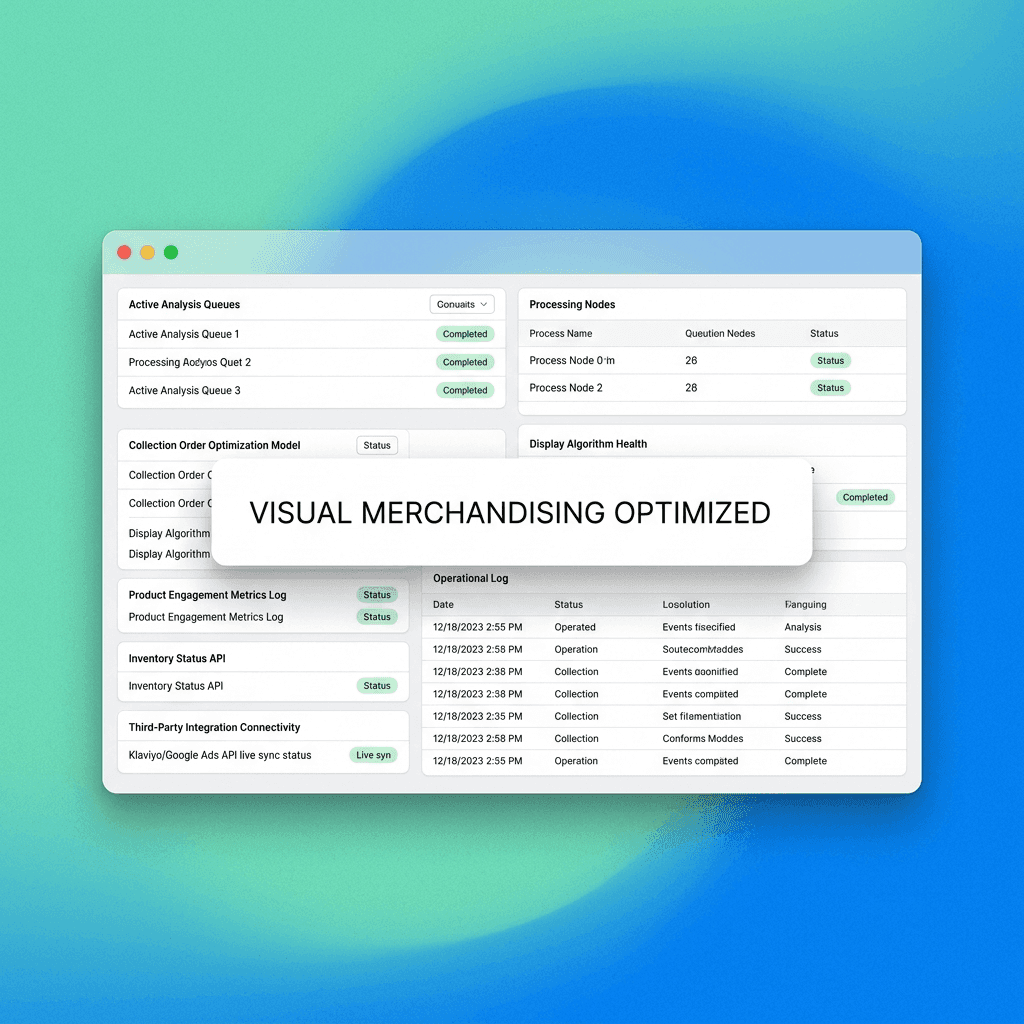
Most Shopify stores are leaving money on the surface. Not buried in checkout flows or hidden in ad spend — right there on the collection page, in the order products appear, in what shoppers see first. This phenomenon occurs because static grids prioritize chronological convenience over psychological conversion, effectively wasting the high-intent traffic that brands work so hard to acquire. By failing to curate the visual experience, store owners inadvertently force visitors to perform the heavy lifting of product discovery themselves, which is a friction point that modern, speed-conscious consumers will rarely tolerate. Shopify AI for visual merchandising changes that. It gives ecommerce teams the ability to move beyond gut-feel sorting and manual drag-and-drop, and instead let data drive what goes where — and why. By leveraging machine learning models that analyze site-wide performance metrics, teams can transform static page layouts into dynamic conversion engines that adapt in real-time to shifting consumer demand, inventory fluctuations, and marketing campaign requirements. This guide breaks down how it works, which tools matter, where most teams go wrong, and a practical framework you can apply directly to your store. Through deep optimization of these digital shelves, D2C brands can ensure that their most profitable and relevant items are always in the optimal position to catch the shopper's eye, thereby maximizing the revenue potential of every single session.
What Visual Merchandising Actually Means in Ecommerce
In physical retail, visual merchandising is the discipline of product placement — what goes in the window, what gets eye-level shelf space, what's near the register. Every position is a decision. This offline heritage translates directly into the digital realm, where the digital equivalent of eye-level shelf space is the first row of a product collection or the items featured within a sticky mobile menu. On Shopify, the equivalent decisions are:
Product Positioning: Which products appear at the top of a collection.
Navigation Logic: How collections are ordered on the homepage or navigation.
Discovery Surfaces: What products are surfaced in search results or filters.
Conversion Modules: Which items get promoted in bundles, recommendations, or cross-sells.
Most brands make these decisions based on recency (newest products first), manual gut feel, or default Shopify sorting. None of those approaches are optimised for revenue because they fail to account for the actual, observed path-to-purchase taken by your specific customer base. AI changes the variable. Instead of static rules, AI-driven merchandising uses behavioural data — clicks, add-to-carts, purchase sequences, scroll depth, inventory levels, and margin signals — to dynamically rank and surface products in the positions most likely to convert. By utilizing these intelligence layers, brands can ensure that their catalog remains responsive to the unique browsing habits of their audience, effectively curating a bespoke shopping experience for every visitor while reducing the manual overhead traditionally required to maintain such high standards of site organization.
The Business Case for Getting This Right
Visual merchandising is a multiplier. It doesn't generate traffic — it converts the traffic you already have. By treating your collection pages as an active, high-intent landing zone rather than a static list, you can drastically reduce the bounce rate and increase the average order value of every visitor. Consider what's at stake on a collection page: a shopper who loads a 60-product collection and sees uninspiring or irrelevant items in positions one through eight is likely to bounce before they scroll. They don't disappear because of a bad ad, a slow page, or poor product-market fit. They disappear because the wrong products were shown first. This failure to align product visibility with user intent creates a massive leak in the marketing funnel, where the cost of acquiring the customer is fixed, but the potential revenue is stifled by a poorly organized storefront. For D2C brands spending on paid acquisition, this is a compounding problem. You're paying to bring people to pages that aren't optimised to receive them. Fixing collection order and product display is one of the highest-leverage, lowest-cost improvements a Shopify team can make — because the traffic is already there. When you align your display strategy with actual performance data, you effectively "buy back" the lost conversion potential of your existing sessions, turning previously wasted traffic into high-margin revenue without needing to increase your monthly marketing budget or lower your CAC thresholds.
How Shopify AI Tools Approach Merchandising
Shopify's native ecosystem and third-party apps have matured significantly in this space. Understanding what each layer does helps teams build a coherent approach rather than stacking tools randomly.
Shopify's Native AI Capabilities
Shopify Search & Discovery (the free native app) allows stores to configure product boosts, synonyms, and filters — giving merchandisers manual control over what appears prominently in search results. It's rule-based more than AI-driven, but it's a baseline every store should configure before adding anything else. Shopify Semantic Search, introduced in recent updates, uses natural language processing to better match shopper queries to products — even when exact keyword matches don't exist. A search for "summer dress for a wedding" can surface relevant products even if none are titled that way. For larger catalogs, this has meaningful impact on conversion from on-site search. This semantic layer bridges the gap between how a brand describes a product and how a customer actually thinks about their purchase, significantly reducing the "no results found" error rate and ensuring that long-tail search queries are handled with high intent-alignment, effectively acting as an intelligent sales assistant for your store.
Third-Party AI Merchandising Apps
The most capable tools in this category sit in the Shopify App Store and operate as layered intelligence on top of your existing catalog. Key players include:
Searchanise / Boost Commerce: Collection and search merchandising with rule-based boosting, pinning, and burying. Suitable for stores that want control without full AI automation.
Nosto: Personalisation and collection sorting based on individual shopper behaviour. Surfaces different product rankings to different visitor segments. Strong for larger D2C brands with rich behavioural data.
Visually.io: A/B testing for collection layout and product display, with AI-assisted ranking. Good for teams that want to validate merchandising decisions before committing.
Rebuy Engine: AI-driven product recommendations across PDPs, cart, checkout, and post-purchase flows. Not a collection merchandiser in the traditional sense, but critical for surfacing related products at the right moment.
LimeSpot: Personalised product display across multiple page types using ML-based ranking. Plugs into collections, homepages, and email.
No single tool does everything. Most mature Shopify stores layer a collection-sorting tool with a recommendation engine and run A/B tests to validate decisions. By creating a unified technical stack where these tools communicate via consistent data hooks, you can create a seamless, intelligent shopping loop that guides the customer from their initial search queries all the way through to personalized checkout upsells, ensuring that every touchpoint on the site is optimized for maximum revenue conversion.
The VMOS Framework: A Four-Step System for AI-Driven Visual Merchandising on Shopify
This is a practical operating framework — not a vendor prescription. Apply it to whatever tooling your store uses.
Step 1 — Visibility Audit
Before adding any AI layer, establish a baseline. Export your current collection data and answer: Which products appear in positions 1–8 across your top five collections? What is the average click-through rate on those positions versus positions 9–20? Which high-margin or high-AOV products are buried below the fold? Are out-of-stock or low-inventory products appearing prominently? This audit reveals the gap between where your best products are and where shoppers actually look. Most stores find significant misalignment — their bestsellers aren't in their best positions, and slow movers are taking premium real estate. By quantifying this disparity, you establish a clear mandate for improvement, allowing you to prioritize which collections require immediate intervention and providing a measurable benchmark against which you can track the performance improvements generated by your future AI implementations.
Step 2 — Merchandising Signal Stack
Identify which signals you want AI to weight when sorting your collections. The most commonly used signals in Shopify AI tools include: Revenue per product, Conversion rate by product, Add-to-cart rate, Inventory depth, Margin, Recency, and Personalisation signals. Not every signal should carry equal weight. A clearance-focused brand should weight margin and inventory differently than a premium brand focused on brand perception and AOV. Define your signal stack before configuring any tool. By clearly defining which inputs drive your AI's decision-making process, you effectively encode your business strategy directly into your store's infrastructure, ensuring that your automated merchandising efforts aren't just boosting clicks, but are intentionally driving toward the specific commercial outcomes—such as liquidating aged stock or promoting high-margin bundles—that move the needle for your business's bottom line.
Step 3 — Rule and Override Architecture
AI should work within guardrails — not operate without them. Build a rule layer that sits above the AI logic: Pin hero products in position one for major launches, bury or exclude products that are being discontinued, lock seasonal collections to a specific sort during campaign periods, and ensure new arrivals get a minimum exposure window. This prevents the AI from optimising itself into a corner — for example, showing only your three bestselling SKUs on every collection because they have the highest CVR, while suppressing new products that haven't yet accumulated data. By establishing these hard-coded business rules, you maintain full brand control over the aesthetic and strategic direction of your store, ensuring that human creativity remains the final decision-maker while the AI handles the heavy lifting of real-time optimization to ensure that your carefully crafted campaigns receive the exposure they deserve.
Step 4 — Test, Measure, Iterate
Merchandising decisions should be tested the same way any CRO hypothesis is tested: with a clear control, a variant, a defined metric, and a sufficient sample size. Run collection-level A/B tests where possible. Measure: Collection page conversion rate, Revenue per session, Average scroll depth, and Product click distribution. Review results on a rolling basis — weekly for high-traffic collections, monthly for lower-volume ones. Merchandising is not a set-and-forget function. Consumer behaviour shifts, inventory changes, and seasonality all affect what the right sort order looks like. By fostering a culture of continuous experimentation, you ensure that your visual merchandising strategy evolves alongside your brand's growth, allowing you to consistently refine your collection layouts based on hard evidence rather than assumption, which is the hallmark of a high-growth, data-driven ecommerce operation.
Common Mistakes in Shopify Visual Merchandising
Defaulting to "Best Selling" Sort and Calling It Done
Shopify's native "best selling" sort is better than random, but it's a blunt instrument. It doesn't account for margin, inventory levels, seasonality, or new products that need visibility. Treating it as a merchandising strategy is leaving optimisation on the table. When you rely solely on this default setting, you surrender control over your store's narrative and profit potential to a simplistic algorithm that is unaware of your unique brand goals, effectively hiding your most strategic items while pushing stagnant inventory to the front simply because it historically happened to sell well during a different product lifecycle phase.
Over-Indexing on Personalisation Too Early
Personalisation tools require data to work. A store with low traffic or a small customer base will not generate the behavioural signals needed for meaningful AI personalisation. Implementing a personalisation platform before you have the data density to feed it produces marginal or even negative results. Focus on catalog-level sorting logic first. By attempting to deploy granular personalisation before establishing a foundation of clean, broad-spectrum catalog data, you risk introducing noise into your site experience, which can confuse visitors and negatively impact conversion rates rather than providing the tailored experience you intended.
Ignoring the Mobile Experience
Product display decisions made on desktop don't always translate to mobile. A four-column grid on desktop becomes a one- or two-column view on mobile, which means position one through eight on desktop may be position one through two on mobile. Any merchandising strategy needs to be validated on mobile, where the majority of Shopify traffic now originates. Neglecting this reality means that your most critical "above the fold" products might be completely invisible to mobile users, causing a significant disconnect between your intended merchandising hierarchy and the actual user journey, ultimately suppressing your mobile conversion rates.
Stacking Tools Without a Defined Architecture
Running Nosto, Rebuy, and a Boost Commerce collection sort simultaneously without a clear configuration plan creates conflicts — products get boosted by multiple systems with competing logic, recommendation widgets show the same SKUs across every page, and the result is a fragmented shopper experience. Define which tool owns which surface area before deploying. Without a clear ownership map, you risk creating an unmanageable technical debt where conflicting logic layers fight for control of the site's real estate, leading to inconsistent product presentation that confuses customers and complicates your team's ability to debug site performance issues.
Not Accounting for New Product Bias
AI ranking systems learn from historical data. New products, by definition, have no history. Without manual rules or a new-arrivals boost, new SKUs get ranked at the bottom of collections and never accumulate the clicks and purchases they'd need to surface organically. Build explicit logic for how new products get introduced into the ranking system. This failure to provide a "launch pad" for new inventory is a critical oversight that stunts the discovery of your latest product drops, ensuring they never receive the necessary visibility to build a sales history, thereby creating a cycle where only your old, established items continue to win, which can lead to brand fatigue and a stagnant product catalog.
Practical Application: Where to Start on a Shopify Store
If your store is early in this process and you want a sequenced approach, this order of operations works for most D2C brands:
Phase 1: Configure Shopify Search & Discovery fully — set up synonyms, boosts, and filter logic before adding anything else.
Phase 2: Run a visibility audit using your Shopify analytics and any available heatmap or scroll data.
Phase 3: Define your signal stack and determine which sorting logic aligns with your business model.
Phase 4: Select one collection-sorting tool and implement it across your top three to five collections.
Phase 5: Set up A/B testing on your highest-traffic collection to validate your baseline configuration.
Phase 6: Add a product recommendation engine (Rebuy or equivalent) for PDP and cart surfaces once collection sorting is stable.
Phase 7: Revisit and retest on a monthly cadence.
Adding complexity before fundamentals are in place tends to create noise rather than results. By strictly following this sequence, you ensure that each investment in tooling builds upon the previous one, creating a stable, high-performing foundation that maximizes your ROI at every stage of the implementation process while minimizing the disruption to your existing operational workflows.
Most Shopify stores are leaving money on the surface. Not buried in checkout flows or hidden in ad spend — right there on the collection page, in the order products appear, in what shoppers see first. This phenomenon occurs because static grids prioritize chronological convenience over psychological conversion, effectively wasting the high-intent traffic that brands work so hard to acquire. By failing to curate the visual experience, store owners inadvertently force visitors to perform the heavy lifting of product discovery themselves, which is a friction point that modern, speed-conscious consumers will rarely tolerate. Shopify AI for visual merchandising changes that. It gives ecommerce teams the ability to move beyond gut-feel sorting and manual drag-and-drop, and instead let data drive what goes where — and why. By leveraging machine learning models that analyze site-wide performance metrics, teams can transform static page layouts into dynamic conversion engines that adapt in real-time to shifting consumer demand, inventory fluctuations, and marketing campaign requirements. This guide breaks down how it works, which tools matter, where most teams go wrong, and a practical framework you can apply directly to your store. Through deep optimization of these digital shelves, D2C brands can ensure that their most profitable and relevant items are always in the optimal position to catch the shopper's eye, thereby maximizing the revenue potential of every single session.
What Visual Merchandising Actually Means in Ecommerce
In physical retail, visual merchandising is the discipline of product placement — what goes in the window, what gets eye-level shelf space, what's near the register. Every position is a decision. This offline heritage translates directly into the digital realm, where the digital equivalent of eye-level shelf space is the first row of a product collection or the items featured within a sticky mobile menu. On Shopify, the equivalent decisions are:
Product Positioning: Which products appear at the top of a collection.
Navigation Logic: How collections are ordered on the homepage or navigation.
Discovery Surfaces: What products are surfaced in search results or filters.
Conversion Modules: Which items get promoted in bundles, recommendations, or cross-sells.
Most brands make these decisions based on recency (newest products first), manual gut feel, or default Shopify sorting. None of those approaches are optimised for revenue because they fail to account for the actual, observed path-to-purchase taken by your specific customer base. AI changes the variable. Instead of static rules, AI-driven merchandising uses behavioural data — clicks, add-to-carts, purchase sequences, scroll depth, inventory levels, and margin signals — to dynamically rank and surface products in the positions most likely to convert. By utilizing these intelligence layers, brands can ensure that their catalog remains responsive to the unique browsing habits of their audience, effectively curating a bespoke shopping experience for every visitor while reducing the manual overhead traditionally required to maintain such high standards of site organization.
The Business Case for Getting This Right
Visual merchandising is a multiplier. It doesn't generate traffic — it converts the traffic you already have. By treating your collection pages as an active, high-intent landing zone rather than a static list, you can drastically reduce the bounce rate and increase the average order value of every visitor. Consider what's at stake on a collection page: a shopper who loads a 60-product collection and sees uninspiring or irrelevant items in positions one through eight is likely to bounce before they scroll. They don't disappear because of a bad ad, a slow page, or poor product-market fit. They disappear because the wrong products were shown first. This failure to align product visibility with user intent creates a massive leak in the marketing funnel, where the cost of acquiring the customer is fixed, but the potential revenue is stifled by a poorly organized storefront. For D2C brands spending on paid acquisition, this is a compounding problem. You're paying to bring people to pages that aren't optimised to receive them. Fixing collection order and product display is one of the highest-leverage, lowest-cost improvements a Shopify team can make — because the traffic is already there. When you align your display strategy with actual performance data, you effectively "buy back" the lost conversion potential of your existing sessions, turning previously wasted traffic into high-margin revenue without needing to increase your monthly marketing budget or lower your CAC thresholds.
How Shopify AI Tools Approach Merchandising
Shopify's native ecosystem and third-party apps have matured significantly in this space. Understanding what each layer does helps teams build a coherent approach rather than stacking tools randomly.
Shopify's Native AI Capabilities
Shopify Search & Discovery (the free native app) allows stores to configure product boosts, synonyms, and filters — giving merchandisers manual control over what appears prominently in search results. It's rule-based more than AI-driven, but it's a baseline every store should configure before adding anything else. Shopify Semantic Search, introduced in recent updates, uses natural language processing to better match shopper queries to products — even when exact keyword matches don't exist. A search for "summer dress for a wedding" can surface relevant products even if none are titled that way. For larger catalogs, this has meaningful impact on conversion from on-site search. This semantic layer bridges the gap between how a brand describes a product and how a customer actually thinks about their purchase, significantly reducing the "no results found" error rate and ensuring that long-tail search queries are handled with high intent-alignment, effectively acting as an intelligent sales assistant for your store.
Third-Party AI Merchandising Apps
The most capable tools in this category sit in the Shopify App Store and operate as layered intelligence on top of your existing catalog. Key players include:
Searchanise / Boost Commerce: Collection and search merchandising with rule-based boosting, pinning, and burying. Suitable for stores that want control without full AI automation.
Nosto: Personalisation and collection sorting based on individual shopper behaviour. Surfaces different product rankings to different visitor segments. Strong for larger D2C brands with rich behavioural data.
Visually.io: A/B testing for collection layout and product display, with AI-assisted ranking. Good for teams that want to validate merchandising decisions before committing.
Rebuy Engine: AI-driven product recommendations across PDPs, cart, checkout, and post-purchase flows. Not a collection merchandiser in the traditional sense, but critical for surfacing related products at the right moment.
LimeSpot: Personalised product display across multiple page types using ML-based ranking. Plugs into collections, homepages, and email.
No single tool does everything. Most mature Shopify stores layer a collection-sorting tool with a recommendation engine and run A/B tests to validate decisions. By creating a unified technical stack where these tools communicate via consistent data hooks, you can create a seamless, intelligent shopping loop that guides the customer from their initial search queries all the way through to personalized checkout upsells, ensuring that every touchpoint on the site is optimized for maximum revenue conversion.
The VMOS Framework: A Four-Step System for AI-Driven Visual Merchandising on Shopify
This is a practical operating framework — not a vendor prescription. Apply it to whatever tooling your store uses.
Step 1 — Visibility Audit
Before adding any AI layer, establish a baseline. Export your current collection data and answer: Which products appear in positions 1–8 across your top five collections? What is the average click-through rate on those positions versus positions 9–20? Which high-margin or high-AOV products are buried below the fold? Are out-of-stock or low-inventory products appearing prominently? This audit reveals the gap between where your best products are and where shoppers actually look. Most stores find significant misalignment — their bestsellers aren't in their best positions, and slow movers are taking premium real estate. By quantifying this disparity, you establish a clear mandate for improvement, allowing you to prioritize which collections require immediate intervention and providing a measurable benchmark against which you can track the performance improvements generated by your future AI implementations.
Step 2 — Merchandising Signal Stack
Identify which signals you want AI to weight when sorting your collections. The most commonly used signals in Shopify AI tools include: Revenue per product, Conversion rate by product, Add-to-cart rate, Inventory depth, Margin, Recency, and Personalisation signals. Not every signal should carry equal weight. A clearance-focused brand should weight margin and inventory differently than a premium brand focused on brand perception and AOV. Define your signal stack before configuring any tool. By clearly defining which inputs drive your AI's decision-making process, you effectively encode your business strategy directly into your store's infrastructure, ensuring that your automated merchandising efforts aren't just boosting clicks, but are intentionally driving toward the specific commercial outcomes—such as liquidating aged stock or promoting high-margin bundles—that move the needle for your business's bottom line.
Step 3 — Rule and Override Architecture
AI should work within guardrails — not operate without them. Build a rule layer that sits above the AI logic: Pin hero products in position one for major launches, bury or exclude products that are being discontinued, lock seasonal collections to a specific sort during campaign periods, and ensure new arrivals get a minimum exposure window. This prevents the AI from optimising itself into a corner — for example, showing only your three bestselling SKUs on every collection because they have the highest CVR, while suppressing new products that haven't yet accumulated data. By establishing these hard-coded business rules, you maintain full brand control over the aesthetic and strategic direction of your store, ensuring that human creativity remains the final decision-maker while the AI handles the heavy lifting of real-time optimization to ensure that your carefully crafted campaigns receive the exposure they deserve.
Step 4 — Test, Measure, Iterate
Merchandising decisions should be tested the same way any CRO hypothesis is tested: with a clear control, a variant, a defined metric, and a sufficient sample size. Run collection-level A/B tests where possible. Measure: Collection page conversion rate, Revenue per session, Average scroll depth, and Product click distribution. Review results on a rolling basis — weekly for high-traffic collections, monthly for lower-volume ones. Merchandising is not a set-and-forget function. Consumer behaviour shifts, inventory changes, and seasonality all affect what the right sort order looks like. By fostering a culture of continuous experimentation, you ensure that your visual merchandising strategy evolves alongside your brand's growth, allowing you to consistently refine your collection layouts based on hard evidence rather than assumption, which is the hallmark of a high-growth, data-driven ecommerce operation.
Common Mistakes in Shopify Visual Merchandising
Defaulting to "Best Selling" Sort and Calling It Done
Shopify's native "best selling" sort is better than random, but it's a blunt instrument. It doesn't account for margin, inventory levels, seasonality, or new products that need visibility. Treating it as a merchandising strategy is leaving optimisation on the table. When you rely solely on this default setting, you surrender control over your store's narrative and profit potential to a simplistic algorithm that is unaware of your unique brand goals, effectively hiding your most strategic items while pushing stagnant inventory to the front simply because it historically happened to sell well during a different product lifecycle phase.
Over-Indexing on Personalisation Too Early
Personalisation tools require data to work. A store with low traffic or a small customer base will not generate the behavioural signals needed for meaningful AI personalisation. Implementing a personalisation platform before you have the data density to feed it produces marginal or even negative results. Focus on catalog-level sorting logic first. By attempting to deploy granular personalisation before establishing a foundation of clean, broad-spectrum catalog data, you risk introducing noise into your site experience, which can confuse visitors and negatively impact conversion rates rather than providing the tailored experience you intended.
Ignoring the Mobile Experience
Product display decisions made on desktop don't always translate to mobile. A four-column grid on desktop becomes a one- or two-column view on mobile, which means position one through eight on desktop may be position one through two on mobile. Any merchandising strategy needs to be validated on mobile, where the majority of Shopify traffic now originates. Neglecting this reality means that your most critical "above the fold" products might be completely invisible to mobile users, causing a significant disconnect between your intended merchandising hierarchy and the actual user journey, ultimately suppressing your mobile conversion rates.
Stacking Tools Without a Defined Architecture
Running Nosto, Rebuy, and a Boost Commerce collection sort simultaneously without a clear configuration plan creates conflicts — products get boosted by multiple systems with competing logic, recommendation widgets show the same SKUs across every page, and the result is a fragmented shopper experience. Define which tool owns which surface area before deploying. Without a clear ownership map, you risk creating an unmanageable technical debt where conflicting logic layers fight for control of the site's real estate, leading to inconsistent product presentation that confuses customers and complicates your team's ability to debug site performance issues.
Not Accounting for New Product Bias
AI ranking systems learn from historical data. New products, by definition, have no history. Without manual rules or a new-arrivals boost, new SKUs get ranked at the bottom of collections and never accumulate the clicks and purchases they'd need to surface organically. Build explicit logic for how new products get introduced into the ranking system. This failure to provide a "launch pad" for new inventory is a critical oversight that stunts the discovery of your latest product drops, ensuring they never receive the necessary visibility to build a sales history, thereby creating a cycle where only your old, established items continue to win, which can lead to brand fatigue and a stagnant product catalog.
Practical Application: Where to Start on a Shopify Store
If your store is early in this process and you want a sequenced approach, this order of operations works for most D2C brands:
Phase 1: Configure Shopify Search & Discovery fully — set up synonyms, boosts, and filter logic before adding anything else.
Phase 2: Run a visibility audit using your Shopify analytics and any available heatmap or scroll data.
Phase 3: Define your signal stack and determine which sorting logic aligns with your business model.
Phase 4: Select one collection-sorting tool and implement it across your top three to five collections.
Phase 5: Set up A/B testing on your highest-traffic collection to validate your baseline configuration.
Phase 6: Add a product recommendation engine (Rebuy or equivalent) for PDP and cart surfaces once collection sorting is stable.
Phase 7: Revisit and retest on a monthly cadence.
Adding complexity before fundamentals are in place tends to create noise rather than results. By strictly following this sequence, you ensure that each investment in tooling builds upon the previous one, creating a stable, high-performing foundation that maximizes your ROI at every stage of the implementation process while minimizing the disruption to your existing operational workflows.
FAQs
What is visual merchandising on Shopify?
Visual merchandising on Shopify refers to how products are arranged and displayed across collection pages, search results, homepages, and recommendation widgets. It encompasses decisions about which products appear first, how collections are ordered, and which items are surfaced to shoppers at different stages of their browsing session. The goal is to put the right products in front of shoppers at the moment they're most likely to convert. By carefully curating these touchpoints, brands can influence shopper psychology, guiding them toward high-margin items or curated collections that align with their specific browsing intent. This strategic arrangement is not just about aesthetics; it is a fundamental conversion optimization tactic that relies on data to eliminate friction and enhance the overall shopping experience.
How does AI improve product sorting on Shopify?
AI improves product sorting by replacing static rules — like "sort by bestselling" — with dynamic ranking based on multiple behavioural and commercial signals. AI tools analyse data including click rates, add-to-cart behaviour, conversion rates, inventory levels, and margin to determine which products should appear in which positions. Unlike manual sorting, AI adjusts rankings continuously as new data comes in, which means the sort order can respond to shifts in demand, seasonality, or catalog changes without requiring manual updates. This continuous, self-optimizing loop ensures that the most relevant products are always prioritized, allowing for a hyper-personalized storefront that evolves with your customers' needs in real-time, thereby significantly increasing the efficiency of your collection pages.
Which Shopify apps are best for AI merchandising?
The most capable AI merchandising tools on Shopify include Nosto (for personalised collection sorting and segmented ranking), Rebuy Engine (for AI product recommendations across PDP, cart, and checkout), Visually.io (for A/B testing layout and display decisions), and Boost Commerce or Searchanise (for rule-based and AI-assisted collection and search merchandising). The right combination depends on store size, traffic volume, and the specific page types you want to optimise. By carefully selecting a suite of tools that integrate cleanly with your core Shopify infrastructure, you can create a unified merchandising architecture that handles everything from initial search queries to post-purchase upselling, providing a cohesive brand experience that drives long-term customer loyalty and repeat engagement.
Does AI merchandising work for small Shopify stores?
AI personalisation tools work best when they have significant behavioural data to learn from, which typically means stores with substantial monthly traffic. For smaller stores, catalog-level sorting logic — using revenue, margin, and conversion data — tends to deliver better results than behavioural personalisation. Shopify's native Search & Discovery app and a straightforward boost-and-bury rule set can drive meaningful improvements without requiring enterprise-level traffic volumes. By focusing on fundamental data-driven strategies rather than complex behavioral algorithms, smaller retailers can achieve substantial revenue gains while laying the necessary groundwork for future, more advanced AI integrations as their traffic scales over time.
How do I measure whether my merchandising changes are working?
The primary metrics for evaluating collection merchandising changes are collection page conversion rate, revenue per session on the collection page, and click distribution across product positions. Secondary indicators include average scroll depth (which tells you whether shoppers are engaging with products below the fold) and add-to-cart rate by product position. Running A/B tests on collection sort order — with a clean control and variant — is the most reliable way to isolate the impact of merchandising changes from other variables. By establishing these clear KPIs, you can move away from subjective debates about product placement and instead rely on empirical evidence to guide your merchandising decisions, ensuring every change results in verifiable bottom-line growth.
Can AI override manual merchandising rules on Shopify?
Most AI merchandising tools allow a layered configuration: you define manual rules (pinned products, excluded SKUs, new-arrival windows) at a higher priority level, and the AI operates within those constraints. This means your hero product for a major launch stays pinned in position one regardless of what the AI's ranking logic would suggest, while everything else is ranked dynamically. Well-configured tools should not override intentional manual decisions without your permission. This hybrid approach gives you the best of both worlds: the strategic, human-led control needed for brand storytelling and campaign alignment, combined with the computational power of AI to optimize the remaining catalog and ensure maximum performance.
What is the difference between collection sorting and product recommendations?
Collection sorting determines the order in which products appear within a browsed collection — it affects every shopper who lands on that collection page in the same way (or with personalised variations). Product recommendations are typically displayed in separate widgets on PDPs, cart pages, or checkout, and surface related or complementary products based on individual shopper behaviour. Both serve visual merchandising goals, but they operate on different page surfaces and require different tools. Most mature Shopify stores use both in combination, creating a holistic conversion ecosystem where every surface is strategically managed to guide the customer through their shopping journey, from discovery in a collection to consideration on a PDP and final conversion in the cart.
insights
Explore more on AI, Design and Growth

SEO
Google AI & Local SEO: Rank in Both (2026 Guide)
Learn how to optimize content for Google AI search and local SEO simultaneously to rank in AI Overviews, maps, and organic search results.
SEO
Semantic Content Clusters for SEO & AEO (Templates)
Learn how to build semantic content clusters for SEO and AEO. Includes practical templates, internal linking structures, and examples for ranking in AI search.

SEO
How Google AI Search Works: RankBrain to Gemini (2026)
Discover how Google’s AI search evolved from RankBrain to Gemini and what it means for SEO, AI search results, and ranking strategies in 2026.
SEO
Google AI & Local SEO: Rank in Both (2026 Guide)
Learn how to optimize content for Google AI search and local SEO simultaneously to rank in AI Overviews, maps, and organic search results.
SEO
Semantic Content Clusters for SEO & AEO (Templates)
Learn how to build semantic content clusters for SEO and AEO. Includes practical templates, internal linking structures, and examples for ranking in AI search.
get in touch
Ready to Grow From Day One?
Strategy, execution, and digital experiences designed to move together. Fill out the form below and our team will contact you shortly.
get in touch
Ready to Grow From Day One?
Strategy, execution, and digital experiences designed to move together. Fill out the form below and our team will contact you shortly.
get in touch
Ready to Grow From Day One?
Strategy, execution, and digital experiences designed to move together. Fill out the form below and our team will contact you shortly.
Services
We'd love to hear from you.
Tell us what you're building and where you need support.
© 2026 projectsupply AI, Data and Digital Engineering
Company. Pune, India. All rights reserved.
Part of Tangle
Services
We'd love to hear from you.
Tell us what you're building and where you need support.
© 2026 projectsupply AI, Data and Digital Engineering
Company. Pune, India. All rights reserved.
Part of Tangle
Services
We'd love to hear from you.
Tell us what you're building and where you need support.
© 2026 projectsupply AI, Data and Digital Engineering
Company. Pune, India. All rights reserved.
Part of Tangle