

Shopify
Shopify Attribution Models Explained: First-Click vs Last-Click vs Data-Driven
Shopify Attribution Models Explained: First-Click vs Last-Click vs Data-Driven
Learn how Shopify attribution models work, the real difference between first-click, last-click, and data-driven attribution, and how to choose the right model for your D2C store.
Learn how Shopify attribution models work, the real difference between first-click, last-click, and data-driven attribution, and how to choose the right model for your D2C store.
08 min read
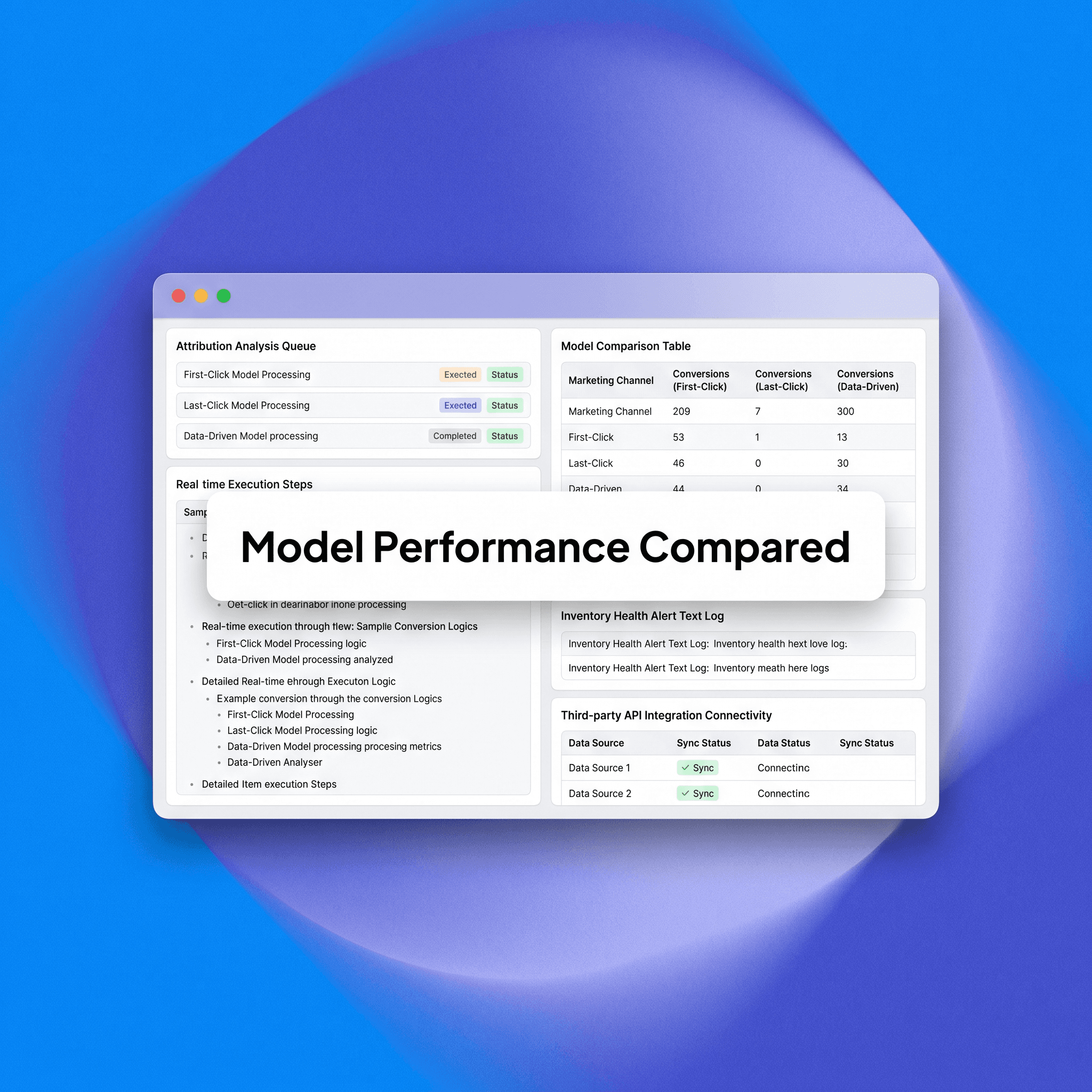
If you're scaling a Shopify store across paid social, search, email, and organic, you've likely stared at two completely different revenue numbers — one from Shopify analytics, one from Meta or Google — and wondered which one to believe. This discrepancy often leads to internal friction, confusion among stakeholders, and the dangerous temptation to "choose" the dashboard that provides the most favorable ROAS numbers. That disconnect almost always comes down to attribution models. By understanding the underlying mechanics of how these platforms assign credit, you move from passive reporting to strategic budget optimization, ensuring your capital is deployed effectively. Shopify attribution models determine which marketing touchpoints get credit for a sale. The model you're using shapes how you read performance data, where you allocate budget, and which channels you scale or cut. Getting this wrong is one of the most common and expensive mistakes in D2C marketing, as it leads to the premature cutting of effective awareness campaigns or the over-funding of redundant retargeting efforts. This post breaks down how each model works, where each one fails, and how to make a deliberate choice for your store to ensure your data informs, rather than misleads, your growth trajectory.
What Is a Shopify Attribution Model?
An attribution model is a rule — or a set of rules — that assigns credit for a conversion to one or more marketing touchpoints in a customer's journey. By defining these parameters, you create a standardized language for evaluating your marketing mix, allowing for an apples-to-apples comparison of diverse traffic sources. A customer might see a TikTok ad on Monday, click a Google search result on Wednesday, open a promotional email on Friday, and finally purchase after clicking a retargeting ad on Saturday. Four touchpoints. One conversion. Which one gets the credit? Your attribution model answers that question by applying a specific logic to the sequence of interactions. And depending on which model you use, your entire read of which channels are "working" can shift dramatically, potentially flipping your understanding of a channel from a "bottom-line driver" to a "useless spend." Shopify natively uses a last-click, 30-day attribution window by default. That means the channel a customer clicked most recently before purchasing gets 100% of the credit. Most advertising platforms, by contrast, use their own models — which is why your Meta dashboard and your Shopify dashboard rarely tell the same story. This structural divergence necessitates a robust, platform-agnostic view of your data, such as a Blended Marketing Efficiency Ratio, to prevent being misled by the inherent biases of walled-garden analytics.
The Three Core Shopify Attribution Models
First-Click Attribution
First-click attribution gives 100% of the conversion credit to the very first touchpoint a customer interacted with. If someone discovered your brand through a Google search, then later purchased through an email click, Google gets all the credit. This model is fundamentally designed to reward discovery, making it a critical tool for mapping the beginning of the consumer pipeline.
Where it's useful:
Demand Generation: Understanding which channels are best at generating new demand.
Top-of-Funnel: Measuring top-of-funnel acquisition performance.
Awareness Campaigns: Evaluating brand awareness campaigns and cold traffic channels.
Where it falls short:
Nurture Neglect: Completely ignores the nurture journey between discovery and purchase.
Value Distortions: Overvalues broad awareness channels and undervalues closing channels.
Scaling Risk: Can lead to over-investment in acquisition and underinvestment in retention or retargeting.
If your average customer takes 7 days and 4 touchpoints to convert, first-click attribution tells you almost nothing about what actually drove the decision to buy, rendering it dangerous for short-term performance monitoring despite its utility for long-term brand equity tracking.
Last-Click Attribution
Last-click attribution gives 100% of the credit to the final touchpoint before the conversion. This is Shopify's default model and the most commonly used across ecommerce. It's simple, consistent, and easy to action because it maps directly to the final "action" that results in cash flow.
Where it's useful:
Closing Performance: Measuring which channels are closing sales.
Efficiency Focus: Running efficient direct-response campaigns.
Retargeting Insight: Evaluating retargeting and email performance.
Where it falls short:
Awareness Blindness: Ignores every earlier touchpoint that built awareness or consideration.
Value Bias: Systematically undervalues upper-funnel channels like SEO, content, influencer, and paid social prospecting.
Intent Capture: Creates a bias toward retargeting and branded search, which often capture intent created by channels that get no credit.
The classic problem: you scale up retargeting because it looks like your best-performing channel. Conversions stay flat. You later realize retargeting was harvesting demand created by the organic content you cut six months ago, proving that relying solely on last-click data is essentially an exercise in "demand harvesting" rather than "demand creation."
Data-Driven Attribution
Data-driven attribution uses machine learning to distribute conversion credit across all touchpoints based on their actual contribution to the conversion path. Rather than applying a fixed rule, it analyzes patterns across thousands of conversion journeys and assigns fractional credit to each channel based on how much it influenced the final outcome. Google Analytics 4 and Google Ads both offer data-driven attribution as a default or option. Shopify itself does not offer native data-driven attribution — you need a third-party tool or a GA4 integration to access it.
Where it's useful:
Statistical Meaning: Multi-channel brands with sufficient conversion volume (typically 600+ conversions per month to generate reliable models).
Budget Optimization: Brands that need to optimize budget across multiple paid channels simultaneously.
Accuracy Requirements: Growth teams that have outgrown single-channel attribution and need a more accurate picture.
Where it falls short:
Volume Thresholds: Requires volume to be statistically meaningful — low-traffic stores will get unreliable outputs.
Tracking Gaps: Still limited by data access — if a channel isn't tracked, it doesn't exist in the model.
Complexity: Can be difficult to interpret and action without analytical support.
Black-Box Logic: Black-box outputs make it hard to explain budget decisions to stakeholders.
Other Attribution Models Worth Knowing
Not every team will use data-driven attribution, and first-click vs last-click is a false binary. Several rule-based models sit in between.
Linear attribution: Divides credit equally across all touchpoints. Useful for understanding the full channel mix but provides no signal about which touchpoints matter most, often resulting in "flat" data that fails to highlight high-leverage levers.
Time-decay attribution: Gives more credit to touchpoints closer to the conversion. Logically intuitive for short purchase cycles; undervalues brand-building for longer ones, which can lead to the premature termination of mid-funnel content efforts.
Position-based (U-shaped) attribution: Gives 40% credit to the first touch, 40% to the last touch, and distributes the remaining 20% across middle touchpoints. A reasonable middle ground for teams that value both acquisition and closing, ensuring you reward both the "opener" and the "closer."
The Attribution Decision Matrix
Use this framework to select the right attribution model based on where your store is and how your marketing operates. The Project Supply Attribution Decision Matrix:
Early-stage, single channel: Short (1–3 days) purchase cycle, 1–2 channels — Last-click.
Growth stage, multi-channel: Medium (3–10 days) purchase cycle, 3–5 channels — Position-based or linear.
Scaling, performance-focused: Medium to long purchase cycle, 5+ channels, paid heavy — Data-driven (GA4 or third-party).
Brand-building focus: Long (10+ days) purchase cycle, heavy content and awareness — First-click + linear combined view.
Low volume, testing phase: Any purchase cycle, any channel mix — Last-click with manual review.
The model you choose should match the complexity of your customer journey — not the model your ad platform defaults to.
Why Shopify's Default Attribution Creates Problems for Multi-Channel Brands
Shopify's native analytics use last-click attribution with a 30-day cookie window. For a brand running one or two channels with short purchase cycles, this is workable. For a brand running Meta prospecting, Google search, SEO-driven content, email flows, and influencer partnerships simultaneously, it creates serious distortions that lead to suboptimal resource allocation. The specific problems that appear include organic search and content getting no credit for assisted conversions, retargeting appearing to generate sales it did not create, email getting over-credited for conversions driven by paid prospecting, and upper-funnel spend looking unprofitable and getting cut, reducing the pipeline that feeds lower-funnel channels. If you're relying solely on Shopify's native attribution to make budget decisions across a multi-channel stack, you are almost certainly mis-allocating spend and starving your top-of-funnel engines.
Common Attribution Mistakes Ecommerce Teams Make
Default Bias: Using the platform's default without questioning it. Meta, Google, and Shopify all default to models that favor their own channels or the simplest rule. That's a starting point, not a strategy.
Window Mismatch: Comparing channels using different attribution windows. If Meta is reporting on a 7-day click window and you're comparing it to Shopify's 30-day last-click data, the numbers are not comparable and will lead to flawed reporting.
Truth Fallacy: Treating any attribution model as ground truth. Every model is an approximation. Attribution is a lens, not a ledger. Make decisions with it, but hold it loosely.
View-Through Confusion: Ignoring view-through attribution entirely — or trusting it completely. View-through attribution (credit for ads someone saw but didn't click) is real but easily inflated. Meta's default view-through window is 1 day; leaving it at 7 days significantly overstates performance.
ROAS Flattery: Scaling based on attributed ROAS without cross-referencing blended MER. Marketing Efficiency Ratio (total revenue divided by total ad spend) is a platform-agnostic sanity check. If attributed ROAS looks strong but blended MER is declining, your attribution model is flattering you.
How to Audit Your Attribution Setup on Shopify
Before changing your attribution model, audit what you currently have to ensure you are starting from a place of data integrity.
Confirm Analytics: Confirm which model Shopify Analytics is using (Settings > Analytics).
Verify Windows: Confirm the attribution window for each ad platform (Meta, Google, TikTok) to normalize the comparison.
Enable GA4: Check whether GA4 is installed and configured with data-driven attribution enabled to capture cross-channel behavior.
Standardize Tracking: Identify whether UTM parameters are consistently applied across all channels to ensure the data is being passed through properly.
Map Gaps: Check for attribution gaps: any channels running without tracking or UTM tagging are invisible to every model.
Inconsistent UTM tagging is the single most common root cause of attribution confusion. If your attribution data looks unreliable, fix the tracking infrastructure before switching models, as switching to a "better" model on top of "bad" data will only produce faster, more confident incorrect decisions.
If you're scaling a Shopify store across paid social, search, email, and organic, you've likely stared at two completely different revenue numbers — one from Shopify analytics, one from Meta or Google — and wondered which one to believe. This discrepancy often leads to internal friction, confusion among stakeholders, and the dangerous temptation to "choose" the dashboard that provides the most favorable ROAS numbers. That disconnect almost always comes down to attribution models. By understanding the underlying mechanics of how these platforms assign credit, you move from passive reporting to strategic budget optimization, ensuring your capital is deployed effectively. Shopify attribution models determine which marketing touchpoints get credit for a sale. The model you're using shapes how you read performance data, where you allocate budget, and which channels you scale or cut. Getting this wrong is one of the most common and expensive mistakes in D2C marketing, as it leads to the premature cutting of effective awareness campaigns or the over-funding of redundant retargeting efforts. This post breaks down how each model works, where each one fails, and how to make a deliberate choice for your store to ensure your data informs, rather than misleads, your growth trajectory.
What Is a Shopify Attribution Model?
An attribution model is a rule — or a set of rules — that assigns credit for a conversion to one or more marketing touchpoints in a customer's journey. By defining these parameters, you create a standardized language for evaluating your marketing mix, allowing for an apples-to-apples comparison of diverse traffic sources. A customer might see a TikTok ad on Monday, click a Google search result on Wednesday, open a promotional email on Friday, and finally purchase after clicking a retargeting ad on Saturday. Four touchpoints. One conversion. Which one gets the credit? Your attribution model answers that question by applying a specific logic to the sequence of interactions. And depending on which model you use, your entire read of which channels are "working" can shift dramatically, potentially flipping your understanding of a channel from a "bottom-line driver" to a "useless spend." Shopify natively uses a last-click, 30-day attribution window by default. That means the channel a customer clicked most recently before purchasing gets 100% of the credit. Most advertising platforms, by contrast, use their own models — which is why your Meta dashboard and your Shopify dashboard rarely tell the same story. This structural divergence necessitates a robust, platform-agnostic view of your data, such as a Blended Marketing Efficiency Ratio, to prevent being misled by the inherent biases of walled-garden analytics.
The Three Core Shopify Attribution Models
First-Click Attribution
First-click attribution gives 100% of the conversion credit to the very first touchpoint a customer interacted with. If someone discovered your brand through a Google search, then later purchased through an email click, Google gets all the credit. This model is fundamentally designed to reward discovery, making it a critical tool for mapping the beginning of the consumer pipeline.
Where it's useful:
Demand Generation: Understanding which channels are best at generating new demand.
Top-of-Funnel: Measuring top-of-funnel acquisition performance.
Awareness Campaigns: Evaluating brand awareness campaigns and cold traffic channels.
Where it falls short:
Nurture Neglect: Completely ignores the nurture journey between discovery and purchase.
Value Distortions: Overvalues broad awareness channels and undervalues closing channels.
Scaling Risk: Can lead to over-investment in acquisition and underinvestment in retention or retargeting.
If your average customer takes 7 days and 4 touchpoints to convert, first-click attribution tells you almost nothing about what actually drove the decision to buy, rendering it dangerous for short-term performance monitoring despite its utility for long-term brand equity tracking.
Last-Click Attribution
Last-click attribution gives 100% of the credit to the final touchpoint before the conversion. This is Shopify's default model and the most commonly used across ecommerce. It's simple, consistent, and easy to action because it maps directly to the final "action" that results in cash flow.
Where it's useful:
Closing Performance: Measuring which channels are closing sales.
Efficiency Focus: Running efficient direct-response campaigns.
Retargeting Insight: Evaluating retargeting and email performance.
Where it falls short:
Awareness Blindness: Ignores every earlier touchpoint that built awareness or consideration.
Value Bias: Systematically undervalues upper-funnel channels like SEO, content, influencer, and paid social prospecting.
Intent Capture: Creates a bias toward retargeting and branded search, which often capture intent created by channels that get no credit.
The classic problem: you scale up retargeting because it looks like your best-performing channel. Conversions stay flat. You later realize retargeting was harvesting demand created by the organic content you cut six months ago, proving that relying solely on last-click data is essentially an exercise in "demand harvesting" rather than "demand creation."
Data-Driven Attribution
Data-driven attribution uses machine learning to distribute conversion credit across all touchpoints based on their actual contribution to the conversion path. Rather than applying a fixed rule, it analyzes patterns across thousands of conversion journeys and assigns fractional credit to each channel based on how much it influenced the final outcome. Google Analytics 4 and Google Ads both offer data-driven attribution as a default or option. Shopify itself does not offer native data-driven attribution — you need a third-party tool or a GA4 integration to access it.
Where it's useful:
Statistical Meaning: Multi-channel brands with sufficient conversion volume (typically 600+ conversions per month to generate reliable models).
Budget Optimization: Brands that need to optimize budget across multiple paid channels simultaneously.
Accuracy Requirements: Growth teams that have outgrown single-channel attribution and need a more accurate picture.
Where it falls short:
Volume Thresholds: Requires volume to be statistically meaningful — low-traffic stores will get unreliable outputs.
Tracking Gaps: Still limited by data access — if a channel isn't tracked, it doesn't exist in the model.
Complexity: Can be difficult to interpret and action without analytical support.
Black-Box Logic: Black-box outputs make it hard to explain budget decisions to stakeholders.
Other Attribution Models Worth Knowing
Not every team will use data-driven attribution, and first-click vs last-click is a false binary. Several rule-based models sit in between.
Linear attribution: Divides credit equally across all touchpoints. Useful for understanding the full channel mix but provides no signal about which touchpoints matter most, often resulting in "flat" data that fails to highlight high-leverage levers.
Time-decay attribution: Gives more credit to touchpoints closer to the conversion. Logically intuitive for short purchase cycles; undervalues brand-building for longer ones, which can lead to the premature termination of mid-funnel content efforts.
Position-based (U-shaped) attribution: Gives 40% credit to the first touch, 40% to the last touch, and distributes the remaining 20% across middle touchpoints. A reasonable middle ground for teams that value both acquisition and closing, ensuring you reward both the "opener" and the "closer."
The Attribution Decision Matrix
Use this framework to select the right attribution model based on where your store is and how your marketing operates. The Project Supply Attribution Decision Matrix:
Early-stage, single channel: Short (1–3 days) purchase cycle, 1–2 channels — Last-click.
Growth stage, multi-channel: Medium (3–10 days) purchase cycle, 3–5 channels — Position-based or linear.
Scaling, performance-focused: Medium to long purchase cycle, 5+ channels, paid heavy — Data-driven (GA4 or third-party).
Brand-building focus: Long (10+ days) purchase cycle, heavy content and awareness — First-click + linear combined view.
Low volume, testing phase: Any purchase cycle, any channel mix — Last-click with manual review.
The model you choose should match the complexity of your customer journey — not the model your ad platform defaults to.
Why Shopify's Default Attribution Creates Problems for Multi-Channel Brands
Shopify's native analytics use last-click attribution with a 30-day cookie window. For a brand running one or two channels with short purchase cycles, this is workable. For a brand running Meta prospecting, Google search, SEO-driven content, email flows, and influencer partnerships simultaneously, it creates serious distortions that lead to suboptimal resource allocation. The specific problems that appear include organic search and content getting no credit for assisted conversions, retargeting appearing to generate sales it did not create, email getting over-credited for conversions driven by paid prospecting, and upper-funnel spend looking unprofitable and getting cut, reducing the pipeline that feeds lower-funnel channels. If you're relying solely on Shopify's native attribution to make budget decisions across a multi-channel stack, you are almost certainly mis-allocating spend and starving your top-of-funnel engines.
Common Attribution Mistakes Ecommerce Teams Make
Default Bias: Using the platform's default without questioning it. Meta, Google, and Shopify all default to models that favor their own channels or the simplest rule. That's a starting point, not a strategy.
Window Mismatch: Comparing channels using different attribution windows. If Meta is reporting on a 7-day click window and you're comparing it to Shopify's 30-day last-click data, the numbers are not comparable and will lead to flawed reporting.
Truth Fallacy: Treating any attribution model as ground truth. Every model is an approximation. Attribution is a lens, not a ledger. Make decisions with it, but hold it loosely.
View-Through Confusion: Ignoring view-through attribution entirely — or trusting it completely. View-through attribution (credit for ads someone saw but didn't click) is real but easily inflated. Meta's default view-through window is 1 day; leaving it at 7 days significantly overstates performance.
ROAS Flattery: Scaling based on attributed ROAS without cross-referencing blended MER. Marketing Efficiency Ratio (total revenue divided by total ad spend) is a platform-agnostic sanity check. If attributed ROAS looks strong but blended MER is declining, your attribution model is flattering you.
How to Audit Your Attribution Setup on Shopify
Before changing your attribution model, audit what you currently have to ensure you are starting from a place of data integrity.
Confirm Analytics: Confirm which model Shopify Analytics is using (Settings > Analytics).
Verify Windows: Confirm the attribution window for each ad platform (Meta, Google, TikTok) to normalize the comparison.
Enable GA4: Check whether GA4 is installed and configured with data-driven attribution enabled to capture cross-channel behavior.
Standardize Tracking: Identify whether UTM parameters are consistently applied across all channels to ensure the data is being passed through properly.
Map Gaps: Check for attribution gaps: any channels running without tracking or UTM tagging are invisible to every model.
Inconsistent UTM tagging is the single most common root cause of attribution confusion. If your attribution data looks unreliable, fix the tracking infrastructure before switching models, as switching to a "better" model on top of "bad" data will only produce faster, more confident incorrect decisions.
FAQ
What attribution model does Shopify use by default?
Shopify Analytics uses last-click attribution with a 30-day conversion window by default. The most recent channel a customer clicked before purchasing receives 100% of the conversion credit. You can view attribution data under Analytics in your Shopify admin, but Shopify does not currently offer native multi-touch or data-driven attribution.
Why does my Shopify revenue differ from my Meta Ads revenue?
The two platforms use different attribution models and different conversion windows. Meta may use a 7-day click or 1-day view attribution window and counts conversions that occurred after an ad interaction, even if another channel was the final click. Shopify attributes to the last click it tracked. When a customer interacts with multiple channels, both platforms may claim the same sale. This double-counting is normal, not an error, and is why blended metrics matter.
Is data-driven attribution better than last-click?
Data-driven attribution is more accurate for multi-channel brands with sufficient volume, because it distributes credit based on actual conversion patterns rather than a fixed rule. However, it requires a minimum level of conversion data to produce reliable outputs, and it still only models the channels you're tracking. For early-stage stores or single-channel operations, last-click is simpler and sufficient.
How many conversions do I need for data-driven attribution to work?
Google's data-driven attribution model requires a minimum of approximately 300–3,000 conversions per month depending on the specific tool, with more volume producing more reliable outputs. GA4's data-driven model requires at least 400 conversions in 30 days and 400 sessions from the relevant traffic source. Below these thresholds, rule-based models like position-based or linear are more reliable.
Can I use multiple attribution models at the same time?
Yes, and this is often the right approach. Many growth teams maintain a primary model for day-to-day budget decisions (typically last-click or data-driven) while running a secondary view (linear or first-click) to monitor upper-funnel channel health. The goal isn't to find one true model — it's to use attribution as a diagnostic tool across multiple perspectives.
What is blended MER and why does it matter for attribution?
Marketing Efficiency Ratio (MER) is calculated as total revenue divided by total marketing spend, across all channels, with no attribution logic applied. It is a platform-agnostic performance signal that serves as a reality check against attributed ROAS. If your attributed ROAS shows strong performance but MER is declining, your attribution model is likely over-crediting certain channels. MER should be tracked weekly alongside channel-level attribution data.
Should I change my attribution model if I'm just starting out on Shopify?
Not immediately. If you're early-stage and running one or two channels, Shopify's default last-click attribution is sufficient. Focus first on clean UTM tracking and consistent naming conventions across all channels. Attribution model sophistication should match the complexity of your channel mix — adding complexity before you need it creates noise, not clarity.
insights
Explore more on AI, Design and Growth
SEO
Google AI & Local SEO: Rank in Both (2026 Guide)
Learn how to optimize content for Google AI search and local SEO simultaneously to rank in AI Overviews, maps, and organic search results.

SEO
Semantic Content Clusters for SEO & AEO (Templates)
Learn how to build semantic content clusters for SEO and AEO. Includes practical templates, internal linking structures, and examples for ranking in AI search.

SEO
How Google AI Search Works: RankBrain to Gemini (2026)
Discover how Google’s AI search evolved from RankBrain to Gemini and what it means for SEO, AI search results, and ranking strategies in 2026.
SEO
Google AI & Local SEO: Rank in Both (2026 Guide)
Learn how to optimize content for Google AI search and local SEO simultaneously to rank in AI Overviews, maps, and organic search results.
SEO
Semantic Content Clusters for SEO & AEO (Templates)
Learn how to build semantic content clusters for SEO and AEO. Includes practical templates, internal linking structures, and examples for ranking in AI search.
get in touch
Go from online presence to real business impact
Strategy, execution, and digital experiences designed to move together. Fill out the form below and our team will contact you shortly.
get in touch
Go from online presence to real business impact
Strategy, execution, and digital experiences designed to move together. Fill out the form below and our team will contact you shortly.
get in touch
Go from online presence to real business impact
Strategy, execution, and digital experiences designed to move together. Fill out the form below and our team will contact you shortly.
projectsupply
Services
We'd love to hear from you.
Tell us what you're building and where you need support.
projectsupply
Services
We'd love to hear from you.
Tell us what you're building and where you need support.
projectsupply
Services
We'd love to hear from you.
Tell us what you're building and where you need support.