

Shopify
Shopify Conversion Rate by Traffic Source: How to Measure and Improve CVR for Each Channel
Shopify Conversion Rate by Traffic Source: How to Measure and Improve CVR for Each Channel
Learn how to measure and improve your Shopify conversion rate by traffic source. Understand why CVR varies across paid, organic, email, and social channels — and how to fix it.
Learn how to measure and improve your Shopify conversion rate by traffic source. Understand why CVR varies across paid, organic, email, and social channels — and how to fix it.
08 min read
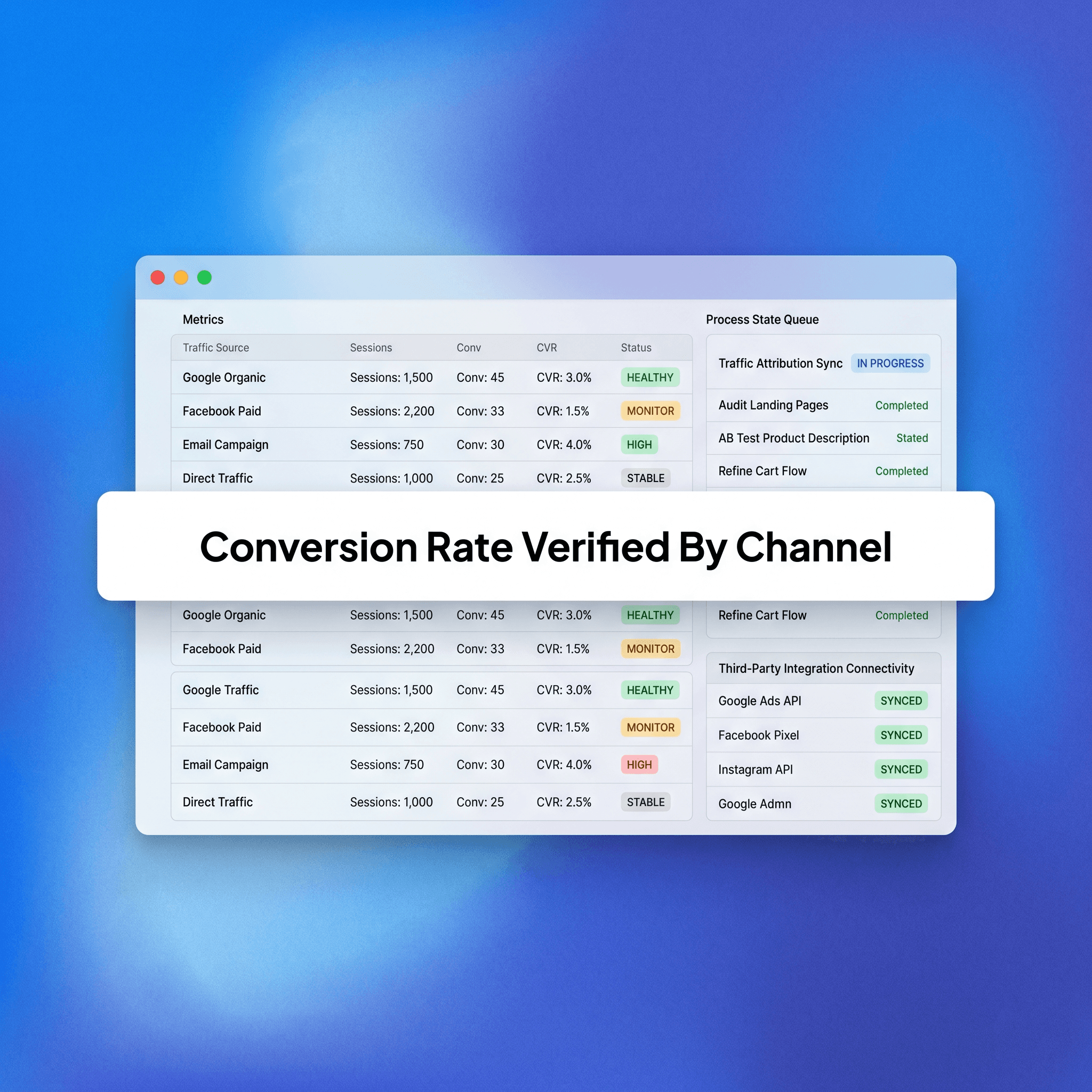
Most Shopify brands track their overall conversion rate as a single number and optimise against it as if every visitor arrives in the same state of intent. They do not. A customer who found your store by searching your brand name, a customer who clicked a Meta retargeting ad, and a customer who arrived through an influencer's link are three completely different people with different levels of awareness, different expectations, and different thresholds for converting. Treating them as one blended metric means your optimisation efforts are often pointed in the wrong direction. You might be running CRO experiments on a landing page that is perfectly functional for the traffic it was designed for, while a different channel is silently dragging your blended CVR down and eating acquisition budget you cannot justify. By the end of this guide, you will know how to segment your Shopify conversion rate by traffic source, what healthy performance looks like for each channel, why CVR varies so significantly between channels, and what to do when a specific source is underperforming relative to its potential. Because global CVR masks the nuance of user behavior, operators must decouple these segments to isolate where friction exists in the customer journey. This requires an analytical transition from viewing the website as a monolithic entity to understanding it as a series of destination points designed to satisfy specific visitor expectations based on the origin of their arrival.
Why Shopify Conversion Rate Varies by Traffic Source
Conversion rate is not a property of your website in isolation. It is a product of the relationship between the visitor's prior intent and the experience they encounter when they land. This is the insight that most channel-level CVR analysis misses, and it is the reason why a brand might see email traffic converting at four times the rate of cold paid social — not because the landing page experience is better for email visitors, but because the visitor arriving from email already knows the brand, has purchased before or been nurtured over time, and arrives with a near-decision mindset. The page does not need to work as hard. That same page confronted with a cold Meta prospect who has never heard of the brand and clicked on a creative that caught their attention for three seconds faces a completely different challenge. Such visitors require immediate, high-impact education and social validation to overcome the friction of an unknown entity. Without accounting for these pre-existing mental models, marketing teams often misattribute poor conversion to technical page failure rather than a misalignment of visitor expectations versus current site content. Operational maturity in this area involves auditing the "distance" between the ad click and the destination page to ensure the value proposition matches the visitor’s pre-arrival journey.
Understanding this distinction changes how you evaluate performance and where you direct resources. A low CVR from cold paid social is not automatically a sign that your landing page is broken. It may be structurally appropriate for the conversion dynamics of that channel, and the right optimisation target is cost per click, creative quality, and offer structure — not the checkout flow. Conversely, a low CVR from branded organic search almost certainly does indicate a site or product page problem, because those visitors are arriving with high intent and the store is failing to close them. The first step toward intelligent CVR optimisation is understanding the intent profile of each traffic source before you make any changes. By mapping every channel to an intent tier, teams can establish realistic KPIs that prevent reactive, unnecessary changes to core product pages.
The Channel CVR Diagnostic Matrix
The Channel CVR Diagnostic Matrix is a structured model for evaluating Shopify conversion rate performance at the source level. It organises each traffic channel across four dimensions: visitor intent level, expected CVR range relative to site average, primary CVR drivers, and the most likely causes of underperformance. Using this matrix as your starting point prevents the most common CVR analysis error, which is applying the same diagnostic logic across every channel regardless of its unique conversion dynamics. This matrix serves as an operational roadmap for D2C growth managers who need to justify spend increases or identify where technical friction is hindering the scalability of specific acquisition funnels.
Branded Search
Branded search — visitors who arrive through Google after searching your brand name or a specific product by name — represents the highest-intent traffic source in almost every Shopify store's mix. These visitors already know what they are looking for and are effectively seeking confirmation before purchasing. The CVR benchmark for branded search should be significantly above your site average. If it is not, the problem is almost never the ad or the landing page destination. It is most often a product page that fails to reassure — missing reviews, unclear sizing or specifications, an unclear return policy, or a checkout experience that introduces friction at the moment of highest intent. Branded search underperformance is a signal to audit your product detail pages and checkout, not your acquisition strategy.
Non-Branded Organic Search
Non-branded organic search brings visitors who found your store through a category or problem-based query. Their intent is real — they are actively searching — but it is comparative rather than committed. They may be looking for the best option in a category, not specifically your brand. CVR from non-branded organic tends to run below branded search but above cold paid social. The primary driver of performance here is how well your product pages answer the specific question the visitor was trying to answer when they searched. Page relevance, clear category messaging, pricing transparency, and a compelling value proposition above the fold all matter significantly for this segment. If organic CVR is low, the most productive place to investigate is whether the landing pages that organic visitors are arriving on actually match the intent of the queries driving that traffic.
Paid Search — Branded and Non-Branded
Paid search splits meaningfully between branded and non-branded campaigns, and combining them into a single CVR figure produces a misleading number. Branded paid search should convert similarly to branded organic search — if it does not, you have a landing page or offer problem. Non-branded paid search, particularly Google Shopping, tends to convert at a rate that reflects both how competitive the query is and how clearly your product listing differentiates itself from alternatives. Poor performance on non-branded paid search is often a combination of weak product imagery in the Shopping feed, pricing that is out of position relative to competitors, or a landing page that fails to immediately address the question the search query implied. The fix here is usually offer and presentation, not traffic volume.
Paid Social — Cold and Retargeting
Paid social from Meta, TikTok, or Pinterest splits into two very different intent tiers: cold prospecting and retargeting. Cold paid social visitors are interruption-driven. They were not looking for your product when your ad appeared. They clicked because the creative was interesting enough to pause the scroll. Cold paid social will almost always show the lowest CVR of any channel in your mix, and this is structurally expected. The job of cold paid social is to introduce brand and category to people who may convert on a subsequent session. Retargeting paid social operates at a much higher intent level — these visitors have already engaged with your brand, visited product pages, or initiated checkout — and should convert at rates closer to organic or email benchmarks. If your retargeting CVR is still low, the problem is usually audience overlap between cold and retargeting campaigns, stale creative causing ad blindness, or an offer in the retargeting ad that does not give the undecided visitor a reason to act now.
Email and SMS
Email and SMS traffic consistently converts at the highest rates in most Shopify stores because the visitor is already a customer, a subscriber with expressed interest, or someone who has been nurtured through a sequence that builds trust before the click happens. The bar for email CVR should be high, and low performance from this channel is almost always a segmentation or relevance problem. Sending a product promotion to a segment that has no stated interest in that product category, or sending a broad broadcast to a cold subscriber list that has not been nurtured, will produce email CVR that looks deceptively similar to cold paid social. When email is segmented correctly and the message is matched to the recipient's position in the customer lifecycle, CVR should run well above site average.
Social — Organic and Influencer Referral
Organic social and influencer referral traffic behaves differently from paid social because the discovery context is different. A visitor who arrives through an influencer's genuine recommendation arrives with a degree of social proof already applied. They have heard someone they trust endorse the product before they clicked. This social proof effect can significantly improve CVR relative to cold paid social if the landing page maintains that momentum. The most common failure point for influencer referral traffic is a mismatch between what the influencer communicated and what the landing page presents. If the influencer promoted a specific product with a specific message and the visitor lands on a general homepage, the social proof context is immediately lost. Influencer referral traffic deserves dedicated landing pages that continue the narrative the creator established.
How to Measure Shopify Conversion Rate by Traffic Source
Accurate channel-level CVR measurement requires the right reporting setup before any optimisation work can begin. Many Shopify brands attempt to interpret channel CVR from Shopify's native analytics alone, which surfaces only high-level session data without the granularity needed for diagnostic decisions. A proper measurement setup requires Google Analytics 4, accurate UTM tagging across all paid and email channels, and a consistent approach to session attribution before you can trust the numbers you are reading. Without this foundational architecture, data hygiene suffers, leading to fragmented insights and poor decision-making regarding budget allocation.
Step 1: Configure Google Analytics 4 with Shopify
Install GA4 on your Shopify store using the Google and YouTube sales channel or through a Google Tag Manager container. Ensure that the Shopify checkout is included in the tracking configuration — this is a common gap that results in transaction data not being recorded correctly in GA4. Set up your purchase conversion event and verify it is firing accurately using GA4's debug view before you begin any channel analysis. Without accurate purchase event data, your CVR calculations will be unreliable regardless of how well you segment your traffic. This configuration is the bedrock of your analytics stack; failure here invalidates all downstream reporting.
Step 2: Apply Consistent UTM Parameters to All Paid and Email Traffic
Every paid campaign across Meta, Google, TikTok, and any other channel must use UTM parameters that are consistent, descriptive, and structured to allow meaningful segmentation. The minimum required parameters are utm_source, utm_medium, and utm_campaign. For paid social, including utm_content to tag creative variants allows you to correlate CVR performance with specific ad creatives. Email campaigns should be tagged with utm_source set to the ESP name, utm_medium set to email, and utm_campaign identifying the specific send. Without consistent UTM tagging, GA4 will misclassify sessions into the direct or referral bucket, and your channel CVR data will be structurally inaccurate. Consistent taxonomy allows for precise cross-channel attribution modeling.
Step 3: Build a Channel CVR Report in GA4
In GA4, navigate to Explorations and build a free-form report with session source and medium as your row dimension, sessions and transactions as your metrics, and a calculated metric for session conversion rate. Filter out any sources generating fewer than 200 sessions in the period you are analysing to remove statistical noise from small-volume referrers. Export this report monthly and track it in a simple dashboard — a Google Sheets or Looker Studio setup works well — so you can observe CVR trends by channel over time rather than reacting to single-period snapshots that may not be representative. Aggregation over time minimizes the impact of anomalies.
Step 4: Establish Your Channel CVR Benchmarks
Before you can identify which channels are underperforming, you need a reference point. Calculate your overall store conversion rate for the period, then identify which channels are running above and below that average. Channels that should be above average based on intent profile but are running at or below average are your highest-priority diagnostic targets. Channels that are structurally expected to run below average — cold paid social, for example — should be evaluated against their own historical trend rather than against the site average. A channel whose CVR is declining over time while spend is increasing represents a compounding efficiency problem regardless of where it sits relative to the site average. This benchmarking allows for objective performance reviews.
Step 5: Diagnose and Prioritise by Channel
For each underperforming channel, work through a structured diagnostic sequence. Start with the landing page — does it match the intent and context of the visitor arriving from that source? Then evaluate the offer — is there a clear and specific reason for the visitor to act at this point in their journey? Then evaluate the trust infrastructure on the page — are there reviews, clear return terms, and social proof visible above the fold? Finally, check the technical experience — page load speed on mobile, checkout friction, and form completion rates. Each of these variables can independently suppress CVR, and fixing the wrong one wastes resources without improving the number. Systematic diagnostic testing is the only way to ensure ROI on your optimization efforts.
Common Mistakes in Channel-Level CVR Analysis
Most Shopify operators make a predictable set of errors when they first attempt channel-level CVR analysis. Recognising these mistakes before you build your reporting setup will save significant time and prevent decisions based on flawed data.
Intent Misalignment: Comparing cold paid social CVR directly to email CVR and concluding that paid social is broken, rather than recognising that the channels serve different intent tiers and will always convert at structurally different rates.
Measurement Reliance: Using Shopify's native analytics as the primary source for channel CVR data without cross-referencing GA4, which results in session misclassification inflating the direct traffic bucket.
A/B Testing Noise: Running A/B tests on landing pages using blended traffic that includes multiple channel sources, which produces inconclusive results because the visitor intent mix shifts the baseline conversion rate between variants.
Correlation Errors: Attributing all CVR improvement to a recent creative change when a seasonal shift in the channel mix — more high-intent organic visitors relative to cold paid social — is what actually moved the blended average.
Campaign Blending: Failing to separate branded and non-branded paid search into distinct segments, masking the fact that non-branded campaigns are converting at near-zero rates while the blended paid search figure looks acceptable.
Optimization Fatigue: Optimising email CVR by sending more frequently rather than segmenting more precisely, which eventually suppresses CVR through list fatigue without addressing the relevance problem.
Channel CVR Benchmark Comparison
Traffic Source | Intent Level | CVR Relative to Site Average | Primary CVR Driver | First Place to Investigate |
|---|---|---|---|---|
Branded organic search | Very high | Well above average | Product page quality and checkout clarity | PDPs, reviews, return policy |
Non-branded organic search | High | Slightly above or at average | Landing page relevance to query intent | Category and landing page content match |
Branded paid search | Very high | Well above average | Offer and product page reassurance | Product pages, pricing, trust signals |
Non-branded paid search | Medium-high | At or slightly below average | Product listing quality and price position | Shopping feed imagery, pricing, landing page |
Cold paid social | Low | Well below average | Creative quality and audience targeting precision | Ad creative, offer, post-click landing page |
Retargeting paid social | Medium-high | Above average | Offer differentiation and audience freshness | Retargeting audience segments, creative refresh cycles |
Email — segmented | Very high | Well above average | Segmentation relevance and send timing | List segmentation logic, offer-segment match |
Email — broadcast | Medium | At or below average | Offer relevance to broad subscriber base | Segmentation strategy, content personalisation |
Influencer referral | Medium-high | Above average if landing page maintains narrative | Social proof continuity from creator to landing page | Dedicated landing page, product-message match |
When Channel CVR Optimisation Is and Is Not Worth It
Not every channel-level CVR problem is worth pursuing immediately. Prioritising optimisation efforts requires understanding where a meaningful improvement would actually move the needle on revenue or blended acquisition efficiency.
It is worth optimising channel CVR when the channel accounts for more than 15 percent of total sessions, when the CVR gap between that channel and its intent-appropriate benchmark is more than 20 percent, when increasing that channel's CVR would reduce blended acquisition cost meaningfully, or when the channel is a strategic growth priority and its current performance is limiting how much budget can be profitably deployed. Strategic allocation ensures that optimization energy is spent on high-leverage activities that directly impact the bottom line.
It is not worth optimising channel CVR when the channel drives low session volume and the CVR calculation is statistically unreliable, when the underperformance is structural to the channel's intent level rather than a solvable page or offer problem, or when the resource required to meaningfully improve CVR in that channel would exceed the revenue benefit within a realistic timeframe. Focusing on low-impact channels leads to diminishing returns and wasted development capacity.
Most Shopify brands track their overall conversion rate as a single number and optimise against it as if every visitor arrives in the same state of intent. They do not. A customer who found your store by searching your brand name, a customer who clicked a Meta retargeting ad, and a customer who arrived through an influencer's link are three completely different people with different levels of awareness, different expectations, and different thresholds for converting. Treating them as one blended metric means your optimisation efforts are often pointed in the wrong direction. You might be running CRO experiments on a landing page that is perfectly functional for the traffic it was designed for, while a different channel is silently dragging your blended CVR down and eating acquisition budget you cannot justify. By the end of this guide, you will know how to segment your Shopify conversion rate by traffic source, what healthy performance looks like for each channel, why CVR varies so significantly between channels, and what to do when a specific source is underperforming relative to its potential. Because global CVR masks the nuance of user behavior, operators must decouple these segments to isolate where friction exists in the customer journey. This requires an analytical transition from viewing the website as a monolithic entity to understanding it as a series of destination points designed to satisfy specific visitor expectations based on the origin of their arrival.
Why Shopify Conversion Rate Varies by Traffic Source
Conversion rate is not a property of your website in isolation. It is a product of the relationship between the visitor's prior intent and the experience they encounter when they land. This is the insight that most channel-level CVR analysis misses, and it is the reason why a brand might see email traffic converting at four times the rate of cold paid social — not because the landing page experience is better for email visitors, but because the visitor arriving from email already knows the brand, has purchased before or been nurtured over time, and arrives with a near-decision mindset. The page does not need to work as hard. That same page confronted with a cold Meta prospect who has never heard of the brand and clicked on a creative that caught their attention for three seconds faces a completely different challenge. Such visitors require immediate, high-impact education and social validation to overcome the friction of an unknown entity. Without accounting for these pre-existing mental models, marketing teams often misattribute poor conversion to technical page failure rather than a misalignment of visitor expectations versus current site content. Operational maturity in this area involves auditing the "distance" between the ad click and the destination page to ensure the value proposition matches the visitor’s pre-arrival journey.
Understanding this distinction changes how you evaluate performance and where you direct resources. A low CVR from cold paid social is not automatically a sign that your landing page is broken. It may be structurally appropriate for the conversion dynamics of that channel, and the right optimisation target is cost per click, creative quality, and offer structure — not the checkout flow. Conversely, a low CVR from branded organic search almost certainly does indicate a site or product page problem, because those visitors are arriving with high intent and the store is failing to close them. The first step toward intelligent CVR optimisation is understanding the intent profile of each traffic source before you make any changes. By mapping every channel to an intent tier, teams can establish realistic KPIs that prevent reactive, unnecessary changes to core product pages.
The Channel CVR Diagnostic Matrix
The Channel CVR Diagnostic Matrix is a structured model for evaluating Shopify conversion rate performance at the source level. It organises each traffic channel across four dimensions: visitor intent level, expected CVR range relative to site average, primary CVR drivers, and the most likely causes of underperformance. Using this matrix as your starting point prevents the most common CVR analysis error, which is applying the same diagnostic logic across every channel regardless of its unique conversion dynamics. This matrix serves as an operational roadmap for D2C growth managers who need to justify spend increases or identify where technical friction is hindering the scalability of specific acquisition funnels.
Branded Search
Branded search — visitors who arrive through Google after searching your brand name or a specific product by name — represents the highest-intent traffic source in almost every Shopify store's mix. These visitors already know what they are looking for and are effectively seeking confirmation before purchasing. The CVR benchmark for branded search should be significantly above your site average. If it is not, the problem is almost never the ad or the landing page destination. It is most often a product page that fails to reassure — missing reviews, unclear sizing or specifications, an unclear return policy, or a checkout experience that introduces friction at the moment of highest intent. Branded search underperformance is a signal to audit your product detail pages and checkout, not your acquisition strategy.
Non-Branded Organic Search
Non-branded organic search brings visitors who found your store through a category or problem-based query. Their intent is real — they are actively searching — but it is comparative rather than committed. They may be looking for the best option in a category, not specifically your brand. CVR from non-branded organic tends to run below branded search but above cold paid social. The primary driver of performance here is how well your product pages answer the specific question the visitor was trying to answer when they searched. Page relevance, clear category messaging, pricing transparency, and a compelling value proposition above the fold all matter significantly for this segment. If organic CVR is low, the most productive place to investigate is whether the landing pages that organic visitors are arriving on actually match the intent of the queries driving that traffic.
Paid Search — Branded and Non-Branded
Paid search splits meaningfully between branded and non-branded campaigns, and combining them into a single CVR figure produces a misleading number. Branded paid search should convert similarly to branded organic search — if it does not, you have a landing page or offer problem. Non-branded paid search, particularly Google Shopping, tends to convert at a rate that reflects both how competitive the query is and how clearly your product listing differentiates itself from alternatives. Poor performance on non-branded paid search is often a combination of weak product imagery in the Shopping feed, pricing that is out of position relative to competitors, or a landing page that fails to immediately address the question the search query implied. The fix here is usually offer and presentation, not traffic volume.
Paid Social — Cold and Retargeting
Paid social from Meta, TikTok, or Pinterest splits into two very different intent tiers: cold prospecting and retargeting. Cold paid social visitors are interruption-driven. They were not looking for your product when your ad appeared. They clicked because the creative was interesting enough to pause the scroll. Cold paid social will almost always show the lowest CVR of any channel in your mix, and this is structurally expected. The job of cold paid social is to introduce brand and category to people who may convert on a subsequent session. Retargeting paid social operates at a much higher intent level — these visitors have already engaged with your brand, visited product pages, or initiated checkout — and should convert at rates closer to organic or email benchmarks. If your retargeting CVR is still low, the problem is usually audience overlap between cold and retargeting campaigns, stale creative causing ad blindness, or an offer in the retargeting ad that does not give the undecided visitor a reason to act now.
Email and SMS
Email and SMS traffic consistently converts at the highest rates in most Shopify stores because the visitor is already a customer, a subscriber with expressed interest, or someone who has been nurtured through a sequence that builds trust before the click happens. The bar for email CVR should be high, and low performance from this channel is almost always a segmentation or relevance problem. Sending a product promotion to a segment that has no stated interest in that product category, or sending a broad broadcast to a cold subscriber list that has not been nurtured, will produce email CVR that looks deceptively similar to cold paid social. When email is segmented correctly and the message is matched to the recipient's position in the customer lifecycle, CVR should run well above site average.
Social — Organic and Influencer Referral
Organic social and influencer referral traffic behaves differently from paid social because the discovery context is different. A visitor who arrives through an influencer's genuine recommendation arrives with a degree of social proof already applied. They have heard someone they trust endorse the product before they clicked. This social proof effect can significantly improve CVR relative to cold paid social if the landing page maintains that momentum. The most common failure point for influencer referral traffic is a mismatch between what the influencer communicated and what the landing page presents. If the influencer promoted a specific product with a specific message and the visitor lands on a general homepage, the social proof context is immediately lost. Influencer referral traffic deserves dedicated landing pages that continue the narrative the creator established.
How to Measure Shopify Conversion Rate by Traffic Source
Accurate channel-level CVR measurement requires the right reporting setup before any optimisation work can begin. Many Shopify brands attempt to interpret channel CVR from Shopify's native analytics alone, which surfaces only high-level session data without the granularity needed for diagnostic decisions. A proper measurement setup requires Google Analytics 4, accurate UTM tagging across all paid and email channels, and a consistent approach to session attribution before you can trust the numbers you are reading. Without this foundational architecture, data hygiene suffers, leading to fragmented insights and poor decision-making regarding budget allocation.
Step 1: Configure Google Analytics 4 with Shopify
Install GA4 on your Shopify store using the Google and YouTube sales channel or through a Google Tag Manager container. Ensure that the Shopify checkout is included in the tracking configuration — this is a common gap that results in transaction data not being recorded correctly in GA4. Set up your purchase conversion event and verify it is firing accurately using GA4's debug view before you begin any channel analysis. Without accurate purchase event data, your CVR calculations will be unreliable regardless of how well you segment your traffic. This configuration is the bedrock of your analytics stack; failure here invalidates all downstream reporting.
Step 2: Apply Consistent UTM Parameters to All Paid and Email Traffic
Every paid campaign across Meta, Google, TikTok, and any other channel must use UTM parameters that are consistent, descriptive, and structured to allow meaningful segmentation. The minimum required parameters are utm_source, utm_medium, and utm_campaign. For paid social, including utm_content to tag creative variants allows you to correlate CVR performance with specific ad creatives. Email campaigns should be tagged with utm_source set to the ESP name, utm_medium set to email, and utm_campaign identifying the specific send. Without consistent UTM tagging, GA4 will misclassify sessions into the direct or referral bucket, and your channel CVR data will be structurally inaccurate. Consistent taxonomy allows for precise cross-channel attribution modeling.
Step 3: Build a Channel CVR Report in GA4
In GA4, navigate to Explorations and build a free-form report with session source and medium as your row dimension, sessions and transactions as your metrics, and a calculated metric for session conversion rate. Filter out any sources generating fewer than 200 sessions in the period you are analysing to remove statistical noise from small-volume referrers. Export this report monthly and track it in a simple dashboard — a Google Sheets or Looker Studio setup works well — so you can observe CVR trends by channel over time rather than reacting to single-period snapshots that may not be representative. Aggregation over time minimizes the impact of anomalies.
Step 4: Establish Your Channel CVR Benchmarks
Before you can identify which channels are underperforming, you need a reference point. Calculate your overall store conversion rate for the period, then identify which channels are running above and below that average. Channels that should be above average based on intent profile but are running at or below average are your highest-priority diagnostic targets. Channels that are structurally expected to run below average — cold paid social, for example — should be evaluated against their own historical trend rather than against the site average. A channel whose CVR is declining over time while spend is increasing represents a compounding efficiency problem regardless of where it sits relative to the site average. This benchmarking allows for objective performance reviews.
Step 5: Diagnose and Prioritise by Channel
For each underperforming channel, work through a structured diagnostic sequence. Start with the landing page — does it match the intent and context of the visitor arriving from that source? Then evaluate the offer — is there a clear and specific reason for the visitor to act at this point in their journey? Then evaluate the trust infrastructure on the page — are there reviews, clear return terms, and social proof visible above the fold? Finally, check the technical experience — page load speed on mobile, checkout friction, and form completion rates. Each of these variables can independently suppress CVR, and fixing the wrong one wastes resources without improving the number. Systematic diagnostic testing is the only way to ensure ROI on your optimization efforts.
Common Mistakes in Channel-Level CVR Analysis
Most Shopify operators make a predictable set of errors when they first attempt channel-level CVR analysis. Recognising these mistakes before you build your reporting setup will save significant time and prevent decisions based on flawed data.
Intent Misalignment: Comparing cold paid social CVR directly to email CVR and concluding that paid social is broken, rather than recognising that the channels serve different intent tiers and will always convert at structurally different rates.
Measurement Reliance: Using Shopify's native analytics as the primary source for channel CVR data without cross-referencing GA4, which results in session misclassification inflating the direct traffic bucket.
A/B Testing Noise: Running A/B tests on landing pages using blended traffic that includes multiple channel sources, which produces inconclusive results because the visitor intent mix shifts the baseline conversion rate between variants.
Correlation Errors: Attributing all CVR improvement to a recent creative change when a seasonal shift in the channel mix — more high-intent organic visitors relative to cold paid social — is what actually moved the blended average.
Campaign Blending: Failing to separate branded and non-branded paid search into distinct segments, masking the fact that non-branded campaigns are converting at near-zero rates while the blended paid search figure looks acceptable.
Optimization Fatigue: Optimising email CVR by sending more frequently rather than segmenting more precisely, which eventually suppresses CVR through list fatigue without addressing the relevance problem.
Channel CVR Benchmark Comparison
Traffic Source | Intent Level | CVR Relative to Site Average | Primary CVR Driver | First Place to Investigate |
|---|---|---|---|---|
Branded organic search | Very high | Well above average | Product page quality and checkout clarity | PDPs, reviews, return policy |
Non-branded organic search | High | Slightly above or at average | Landing page relevance to query intent | Category and landing page content match |
Branded paid search | Very high | Well above average | Offer and product page reassurance | Product pages, pricing, trust signals |
Non-branded paid search | Medium-high | At or slightly below average | Product listing quality and price position | Shopping feed imagery, pricing, landing page |
Cold paid social | Low | Well below average | Creative quality and audience targeting precision | Ad creative, offer, post-click landing page |
Retargeting paid social | Medium-high | Above average | Offer differentiation and audience freshness | Retargeting audience segments, creative refresh cycles |
Email — segmented | Very high | Well above average | Segmentation relevance and send timing | List segmentation logic, offer-segment match |
Email — broadcast | Medium | At or below average | Offer relevance to broad subscriber base | Segmentation strategy, content personalisation |
Influencer referral | Medium-high | Above average if landing page maintains narrative | Social proof continuity from creator to landing page | Dedicated landing page, product-message match |
When Channel CVR Optimisation Is and Is Not Worth It
Not every channel-level CVR problem is worth pursuing immediately. Prioritising optimisation efforts requires understanding where a meaningful improvement would actually move the needle on revenue or blended acquisition efficiency.
It is worth optimising channel CVR when the channel accounts for more than 15 percent of total sessions, when the CVR gap between that channel and its intent-appropriate benchmark is more than 20 percent, when increasing that channel's CVR would reduce blended acquisition cost meaningfully, or when the channel is a strategic growth priority and its current performance is limiting how much budget can be profitably deployed. Strategic allocation ensures that optimization energy is spent on high-leverage activities that directly impact the bottom line.
It is not worth optimising channel CVR when the channel drives low session volume and the CVR calculation is statistically unreliable, when the underperformance is structural to the channel's intent level rather than a solvable page or offer problem, or when the resource required to meaningfully improve CVR in that channel would exceed the revenue benefit within a realistic timeframe. Focusing on low-impact channels leads to diminishing returns and wasted development capacity.
FAQs
What is Shopify conversion rate by traffic source and why does it matter?
Shopify conversion rate by traffic source is the percentage of sessions from a specific acquisition channel that result in a completed purchase, calculated separately for each channel rather than as a blended site-wide figure. It matters because every channel sends visitors with different levels of intent, awareness, and purchase readiness, and treating them as a single metric conceals the real performance story of your acquisition mix. A brand with a blended CVR of 2.8 percent might have email converting at 6 percent and cold paid social converting at 0.9 percent — and the right response to each of those numbers is completely different. Without channel-level segmentation, optimisation is unfocused and resource-intensive without clear returns. By isolating these metrics, operators can pinpoint whether a drop in conversion is a widespread site issue or a specific channel mismatch requiring targeted intervention.
How do I access channel-level CVR data in Shopify?
Shopify's native analytics provides session and conversion data with some channel segmentation through the Sessions by Traffic Source report, but the channel classification in Shopify analytics is less granular and less accurate than what is available in Google Analytics 4. For reliable channel-level CVR data, connecting your Shopify store to GA4 with accurate UTM tagging across all paid and email channels is the recommended approach. GA4's Explorations section allows you to build custom reports that break down sessions, transactions, and conversion rate by source and medium with full control over the segmentation logic and attribution window. Relying on advanced analytics tools provides the necessary fidelity to make informed, data-driven decisions that simple dashboards often lack.
What is a good conversion rate for paid social traffic on Shopify?
Cold paid social CVR on Shopify varies significantly by product category, price point, and creative quality, but it should not be benchmarked against your overall store CVR or against high-intent channels like email or branded search. For cold prospecting traffic on Meta or TikTok, a CVR between 0.5 and 1.5 percent is common across many D2C categories, and performance within that range should be evaluated by channel-level ROAS and cost per acquisition rather than CVR in isolation. The more useful question for cold paid social is whether your cost per acquisition from that channel is sustainably below your customer lifetime value — not whether the raw CVR number matches what email achieves. Evaluating this channel requires a long-term view of acquisition economics rather than immediate, transactional conversion metrics.
Why is my email traffic converting so much better than paid traffic?
Email traffic converts at significantly higher rates than cold paid traffic because the visitors arriving from email are in a fundamentally different relationship with your brand. They opted in, they have been communicated with over time, and the email they clicked was a deliberate choice rather than an interrupted moment. Cold paid traffic requires your store to do the work of establishing trust, relevance, and desire in a single session with a stranger. Email traffic arrives with trust pre-established and often with a specific offer or product communicated before the click. The gap between email and cold paid social CVR is structural and expected. If email CVR is still low despite this intent advantage, the most likely causes are poor list segmentation, irrelevant offer-to-audience matching, or a subscriber base that has been over-mailed and is no longer engaged.
How often should I review channel-level CVR data?
Channel-level CVR should be reviewed on a monthly basis for trending purposes and on a campaign-by-campaign basis when evaluating the performance of a new launch, a creative test, or a significant change to a landing page. Monthly trend analysis allows you to observe whether individual channels are improving, declining, or holding steady over time without overreacting to weekly fluctuations that may reflect normal variance. Weekly CVR data at the channel level is useful for monitoring active campaigns but is rarely reliable enough to drive structural changes to landing pages, offers, or audience targeting without a longer observation window to confirm that the trend is real. Consistent monitoring helps filter out noise and identifies genuine, actionable insights for growth.
Can a slow website cause different CVR impacts across different channels?
Yes, and this effect is often underestimated. Page load speed has a compounding impact on channels that generate lower-intent or more impatient visitors. Cold paid social visitors who arrived mid-scroll on a mobile device are significantly more likely to abandon a slow-loading page than a visitor who typed your brand name into Google and is actively seeking your product. This means that a page speed problem can look like a paid social conversion problem when it is actually a technical issue affecting all channels but disproportionately punishing the channels where visitor patience is lowest. Testing your store's mobile load speed and running a Core Web Vitals report in Google Search Console is a useful baseline check before attributing channel CVR underperformance to offer or audience problems.
Should I use the same landing page for all traffic sources?
No, and this is one of the most impactful structural decisions a growing Shopify brand can make. Sending all traffic sources to the same product page or homepage ignores the fact that different visitors arrive with different contexts, questions, and objections. Cold paid social benefits from landing pages that front-load brand context, social proof, and offer clarity because the visitor has no prior relationship with the brand. Influencer referral traffic benefits from pages that continue the specific narrative the creator established. Retargeting traffic may benefit from pages that address the specific objection that prevented conversion on the first visit. Building dedicated landing pages for your highest-volume traffic sources and testing them independently from your main product pages is a systematic way to improve channel CVR without touching your core store architecture.
insights
Explore more on AI, Design and Growth

SEO
Google AI & Local SEO: Rank in Both (2026 Guide)
Learn how to optimize content for Google AI search and local SEO simultaneously to rank in AI Overviews, maps, and organic search results.

SEO
Semantic Content Clusters for SEO & AEO (Templates)
Learn how to build semantic content clusters for SEO and AEO. Includes practical templates, internal linking structures, and examples for ranking in AI search.

SEO
How Google AI Search Works: RankBrain to Gemini (2026)
Discover how Google’s AI search evolved from RankBrain to Gemini and what it means for SEO, AI search results, and ranking strategies in 2026.
SEO
Google AI & Local SEO: Rank in Both (2026 Guide)
Learn how to optimize content for Google AI search and local SEO simultaneously to rank in AI Overviews, maps, and organic search results.
SEO
Semantic Content Clusters for SEO & AEO (Templates)
Learn how to build semantic content clusters for SEO and AEO. Includes practical templates, internal linking structures, and examples for ranking in AI search.
get in touch
Ready to Grow From Day One?
Strategy, execution, and digital experiences designed to move together. Fill out the form below and our team will contact you shortly.
get in touch
Ready to Grow From Day One?
Strategy, execution, and digital experiences designed to move together. Fill out the form below and our team will contact you shortly.
get in touch
Ready to Grow From Day One?
Strategy, execution, and digital experiences designed to move together. Fill out the form below and our team will contact you shortly.
Services
We'd love to hear from you.
Tell us what you're building and where you need support.
© 2026 projectsupply AI, Data and Digital Engineering
Company. Pune, India. All rights reserved.
Part of Tangle
Services
We'd love to hear from you.
Tell us what you're building and where you need support.
© 2026 projectsupply AI, Data and Digital Engineering
Company. Pune, India. All rights reserved.
Part of Tangle
Services
We'd love to hear from you.
Tell us what you're building and where you need support.
© 2026 projectsupply AI, Data and Digital Engineering
Company. Pune, India. All rights reserved.
Part of Tangle