

Shopify
Shopify Customer Lifetime Value: How to Calculate and Increase LTV
Shopify Customer Lifetime Value: How to Calculate and Increase LTV
Learn how to calculate Shopify customer lifetime value, benchmark your LTV:CAC ratio, and use the LTV Leverage Stack to grow revenue per customer.
Learn how to calculate Shopify customer lifetime value, benchmark your LTV:CAC ratio, and use the LTV Leverage Stack to grow revenue per customer.
08 min read
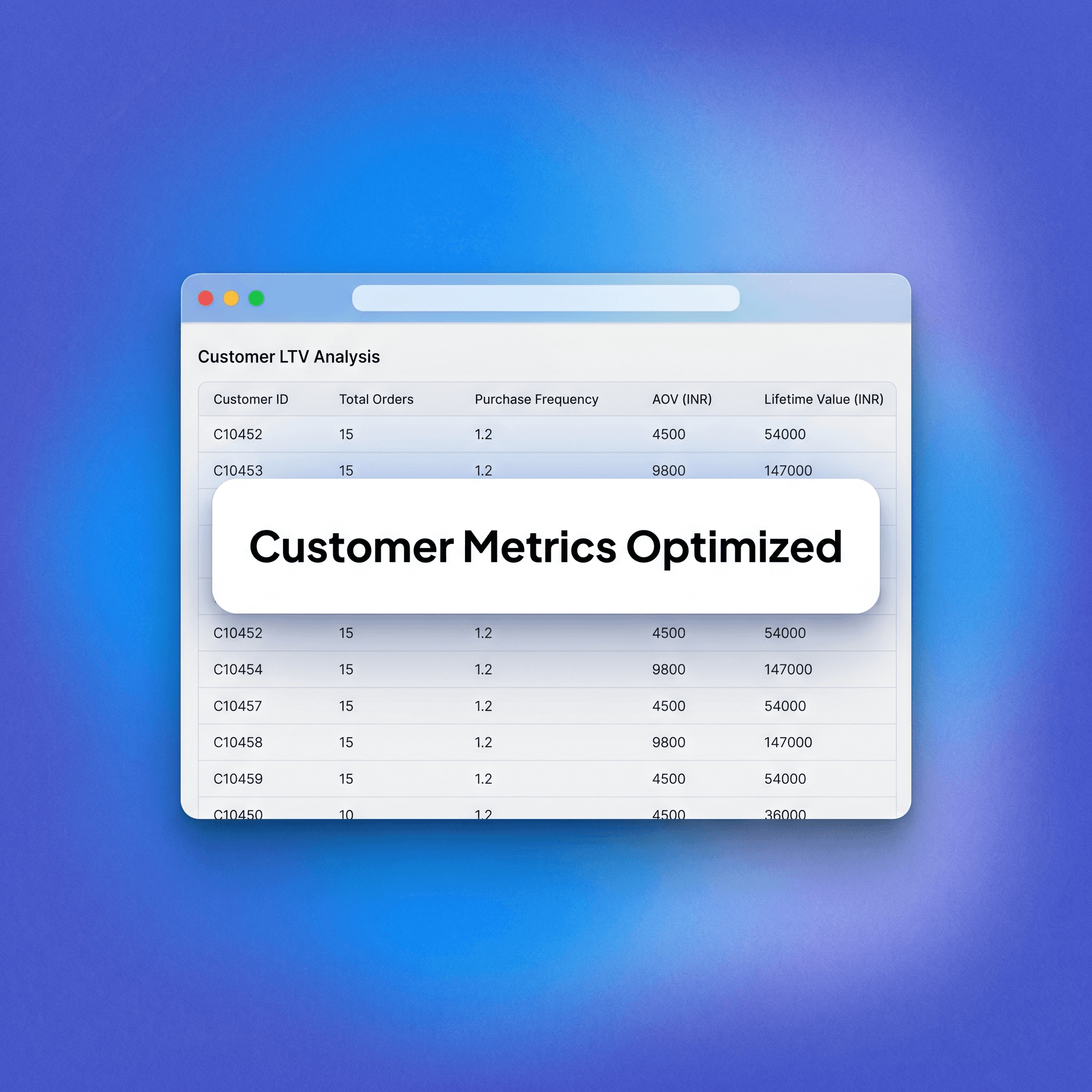
Shopify customer lifetime value (LTV) is one of the most important numbers in your business. It tells you how much revenue a customer generates across their entire relationship with your brand — and it determines whether your acquisition economics actually work. By quantifying the total historical and projected future value of a single customer, you gain a clear diagnostic tool for measuring the long-term health of your ecommerce operation.
This metric acts as the northern star for your financial planning, allowing you to bridge the gap between high-level brand awareness and hard, bottom-line profitability that sustains long-term growth. When you synthesize this data, you move away from vanity metrics and toward a disciplined approach that recognizes the true financial weight of every order processed through your Shopify backend. If your LTV is too low relative to what you spend to acquire customers, no amount of ad spend or conversion optimization will make your business profitable at scale.
This fundamental misalignment creates a "leaky bucket" scenario where your high acquisition costs cannibalize your profit margins, rendering the business unsustainable despite high top-line revenue growth. Getting LTV right is not a retention tactic; it is a business model decision that dictates how you allocate capital across your supply chain, marketing efforts, and product development cycles.
This guide covers how to calculate LTV accurately for a Shopify store, how to benchmark it, and which levers move it in a meaningful way to ensure your brand thrives in a competitive D2C landscape.
What Is Shopify Customer Lifetime Value?
Customer lifetime value is the total net revenue a customer is expected to generate over the full duration of their relationship with your brand.
It is sometimes called CLV or LTV, and the terms are used interchangeably. Understanding this value requires a shift in perspective, moving from transactional, one-off sales logic to a relational framework that values the cumulative impact of repeat interactions and sustained customer loyalty. By calculating this figure, you shift your focus from immediate return on ad spend to the long-term compounding effect of nurturing relationships, effectively allowing you to justify higher upfront acquisition costs if the long-term payoff is demonstrably larger.
For Shopify stores specifically, LTV matters because Shopify's native analytics give you average order value and purchase frequency — the two inputs that drive it — but they do not surface LTV as a primary dashboard metric by default.
This limitation is a common hurdle for founders who rely solely on default views, as it masks the true financial potential of your customer base and prevents you from identifying high-value segments that deserve increased marketing investment. That creates a gap between the data you see and the number that most directly tells you whether your business is healthy, forcing you to bridge this analytical divide by integrating external data sources or building custom reporting layers. LTV is most useful when compared to customer acquisition cost (CAC). T
he LTV:CAC ratio is the clearest single signal of whether a brand's growth model is sustainable, providing a high-level view of whether your machine is generating more value than it consumes in fuel.
How to Calculate Customer Lifetime Value for a Shopify Store
There are two versions of the LTV formula — a simplified version for fast orientation and a margin-adjusted version for operational decisions. Utilizing both models allows you to keep a pulse on top-line health while maintaining a strict discipline over the actual profitability of your acquisition efforts.
The Simplified LTV Formula
LTV = Average Order Value × Purchase Frequency × Average Customer Lifespan
Average Order Value (AOV): total revenue ÷ number of orders over a period, providing a measure of how much a customer spends per transaction.
Purchase Frequency: number of orders ÷ number of unique customers over a period, indicating how often the average buyer returns to shop.
Average Customer Lifespan: the average number of years (or months) a customer continues to buy from you, serving as an estimate of your brand's retention capacity.
Example: A skincare brand sees an AOV of $65, customers purchase 3.2 times per year on average, and the average customer buys for 2.4 years.
LTV = $65 × 3.2 × 2.4 = $499.20
This simplified version is fast and useful for benchmarking. It does not account for margin, meaning it should be treated as a revenue-focused indicator rather than a final bottom-line profitability report.
The Margin-Adjusted LTV Formula
Gross Margin LTV = LTV × Gross Margin %
If the same skincare brand operates at a 55% gross margin:
Margin-Adjusted LTV = $499.20 × 0.55 = $274.56
This is the number that matters for profitability decisions. It represents the actual dollars available to cover CAC, overhead, and profit. Use margin-adjusted LTV when setting CAC targets, planning paid media spend, or evaluating channel efficiency to ensure that your financial projections are rooted in reality rather than theoretical revenue.
Where to Pull These Numbers in Shopify
Shopify's Analytics section (Reports > Customers) gives you repeat customer rate, average order value by cohort, and purchase frequency. These granular reports are essential for understanding the behavioral patterns of your buyers, though they often lack the longitudinal depth required to project lifetime behavior without further interpretation. For lifespan and full LTV modeling, most brands use a third-party tool like Triple Whale, Lifetimely, or Northbeam, which calculate LTV by cohort and project forward based on retention curves. These advanced platforms digest your Shopify order data to create predictive models, enabling you to make data-backed adjustments to your acquisition strategy with a high degree of confidence.
LTV:CAC Benchmarks for Ecommerce Brands
The LTV:CAC ratio is the standard health check for D2C growth models. Here is how to interpret it:
Below 1:1 — You are losing money on every customer acquired. Not sustainable and requires immediate intervention in your pricing or acquisition efficiency.
1:1 to 2:1 — Marginal. You are recovering CAC but leaving little room for profit or reinvestment, which significantly slows your ability to scale operations.
3:1 — Generally considered a healthy baseline for D2C ecommerce. Enough margin to grow profitably and reinvest in customer acquisition at a stable, controlled rate.
4:1 or higher — Strong unit economics. Indicates pricing power, retention strength, or both, allowing you to dominate your market share aggressively.
These are directional benchmarks, not hard rules. A brand selling high-margin consumables can operate profitably at 2.5:1, whereas a brand with a 25% gross margin needs 5:1 or higher to sustain operations. The more important practice is tracking your LTV:CAC ratio by acquisition channel, by cohort, and by product line. Averages hide the channels that are bleeding money and the cohorts that carry the business, so you must disaggregate this data to truly understand where your growth is coming from and where it is being stalled by ineffective spend.
The LTV Leverage Stack
The LTV Leverage Stack is a framework for mapping the five primary drivers of Shopify customer lifetime value to specific tactics and tools. Rather than treating LTV improvement as a single initiative, it treats each driver as an independent lever — so you can identify which one is most constrained and prioritize accordingly.
The Five Drivers and Their Levers
Driver 1 — Average Order Value: The fastest lever to pull. Increases LTV without requiring additional purchases. Tactics: product bundling, volume discounts, cross-sell at cart and post-purchase, subscription upsells, threshold-based free shipping. Shopify tools: Rebuy, AfterSell, Bold Bundles, native discount logic.
Driver 2 — Purchase Frequency: How often customers come back. The difference between a one-purchase brand and a repeat-purchase brand. Tactics: subscription programs, loyalty points with tiered rewards, replenishment reminders, win-back SMS and email sequences timed to product consumption cycles. Shopify tools: Recharge, Yotpo Loyalty, Klaviyo, Attentive.
Driver 3 — Customer Lifespan: How long customers stay active before churning. Often the least-optimized driver because it is invisible until customers are already gone. Tactics: post-purchase onboarding sequences, VIP status programs, personalized product recommendations based on purchase history, proactive outreach at churn-risk windows. Shopify tools: Klaviyo, Gorgias, Lifetimely (for churn prediction), Yotpo.
Driver 4 — Gross Margin: LTV math changes fast when margin changes. Protecting and improving margin per order directly improves margin-adjusted LTV without touching customer behavior. Tactics: product mix optimization toward higher-margin SKUs, review of shipping cost allocation, supplier negotiations, reduction of return rates through better sizing guides or pre-purchase content.
Driver 5 — Cohort Quality: Not all customers are equal. Customers acquired through certain channels, during certain promotions, or on certain hero products tend to have structurally higher or lower LTV. Tactics: analyze LTV by acquisition source in your analytics tool, shift spend toward high-LTV channels, use first purchase product as a predictor of lifetime behavior. Shopify tools: Triple Whale, Northbeam, Lifetimely.
Common Mistakes That Keep LTV Low
Optimizing AOV at the expense of margin: Blanket discounting to increase basket size often increases AOV while compressing the margin that makes LTV meaningful. Optimize for margin-adjusted LTV, not revenue LTV.
Treating all customers as one cohort: Averaging LTV across all customers hides the channels, promotions, and entry products that generate high- and low-value customers. Segmenting LTV by cohort is not optional — it is how you know where to invest.
Ignoring the first 30 days: Most churn happens silently in the first month. Brands that have a structured post-purchase experience — at minimum, an onboarding email sequence and a clear reason to return — retain significantly more customers than those relying on the product to do the work alone.
Confusing repeat purchase rate with retention: A customer who buys twice and never returns is counted as a repeat buyer in most Shopify reports. True retention analysis looks at behavior across 6, 12, and 24-month windows to determine long-term loyalty.
Setting CAC targets from simplified LTV: If your LTV target does not account for gross margin, your CAC target will be higher than your business can support. Use margin-adjusted LTV for all financial decisions tied to acquisition spend.
How to Prioritize LTV Improvements Without Spreading Thin
Pull your current numbers across all five drivers in the LTV Leverage Stack. Identify the one driver that is furthest from industry-typical performance for your category. That is your first constraint, and by addressing it with singular focus, you prevent the dilution of resources that occurs when you try to move all metrics simultaneously without proper structure. For most brands early in their retention journey, Driver 2 (purchase frequency) and Driver 3 (customer lifespan) are the biggest gaps — because most acquisition-focused brands have not invested in the systems that bring customers back. Start with a 90-day sprint on one driver. Measure cohort LTV before and after. Then move to the next constraint. This is a slower path than trying to move all five levers at once, but it produces clear attribution, and clear attribution produces better decisions that compound over time rather than creating erratic, unmeasured spikes in your data.
Shopify customer lifetime value (LTV) is one of the most important numbers in your business. It tells you how much revenue a customer generates across their entire relationship with your brand — and it determines whether your acquisition economics actually work. By quantifying the total historical and projected future value of a single customer, you gain a clear diagnostic tool for measuring the long-term health of your ecommerce operation.
This metric acts as the northern star for your financial planning, allowing you to bridge the gap between high-level brand awareness and hard, bottom-line profitability that sustains long-term growth. When you synthesize this data, you move away from vanity metrics and toward a disciplined approach that recognizes the true financial weight of every order processed through your Shopify backend. If your LTV is too low relative to what you spend to acquire customers, no amount of ad spend or conversion optimization will make your business profitable at scale.
This fundamental misalignment creates a "leaky bucket" scenario where your high acquisition costs cannibalize your profit margins, rendering the business unsustainable despite high top-line revenue growth. Getting LTV right is not a retention tactic; it is a business model decision that dictates how you allocate capital across your supply chain, marketing efforts, and product development cycles.
This guide covers how to calculate LTV accurately for a Shopify store, how to benchmark it, and which levers move it in a meaningful way to ensure your brand thrives in a competitive D2C landscape.
What Is Shopify Customer Lifetime Value?
Customer lifetime value is the total net revenue a customer is expected to generate over the full duration of their relationship with your brand.
It is sometimes called CLV or LTV, and the terms are used interchangeably. Understanding this value requires a shift in perspective, moving from transactional, one-off sales logic to a relational framework that values the cumulative impact of repeat interactions and sustained customer loyalty. By calculating this figure, you shift your focus from immediate return on ad spend to the long-term compounding effect of nurturing relationships, effectively allowing you to justify higher upfront acquisition costs if the long-term payoff is demonstrably larger.
For Shopify stores specifically, LTV matters because Shopify's native analytics give you average order value and purchase frequency — the two inputs that drive it — but they do not surface LTV as a primary dashboard metric by default.
This limitation is a common hurdle for founders who rely solely on default views, as it masks the true financial potential of your customer base and prevents you from identifying high-value segments that deserve increased marketing investment. That creates a gap between the data you see and the number that most directly tells you whether your business is healthy, forcing you to bridge this analytical divide by integrating external data sources or building custom reporting layers. LTV is most useful when compared to customer acquisition cost (CAC). T
he LTV:CAC ratio is the clearest single signal of whether a brand's growth model is sustainable, providing a high-level view of whether your machine is generating more value than it consumes in fuel.
How to Calculate Customer Lifetime Value for a Shopify Store
There are two versions of the LTV formula — a simplified version for fast orientation and a margin-adjusted version for operational decisions. Utilizing both models allows you to keep a pulse on top-line health while maintaining a strict discipline over the actual profitability of your acquisition efforts.
The Simplified LTV Formula
LTV = Average Order Value × Purchase Frequency × Average Customer Lifespan
Average Order Value (AOV): total revenue ÷ number of orders over a period, providing a measure of how much a customer spends per transaction.
Purchase Frequency: number of orders ÷ number of unique customers over a period, indicating how often the average buyer returns to shop.
Average Customer Lifespan: the average number of years (or months) a customer continues to buy from you, serving as an estimate of your brand's retention capacity.
Example: A skincare brand sees an AOV of $65, customers purchase 3.2 times per year on average, and the average customer buys for 2.4 years.
LTV = $65 × 3.2 × 2.4 = $499.20
This simplified version is fast and useful for benchmarking. It does not account for margin, meaning it should be treated as a revenue-focused indicator rather than a final bottom-line profitability report.
The Margin-Adjusted LTV Formula
Gross Margin LTV = LTV × Gross Margin %
If the same skincare brand operates at a 55% gross margin:
Margin-Adjusted LTV = $499.20 × 0.55 = $274.56
This is the number that matters for profitability decisions. It represents the actual dollars available to cover CAC, overhead, and profit. Use margin-adjusted LTV when setting CAC targets, planning paid media spend, or evaluating channel efficiency to ensure that your financial projections are rooted in reality rather than theoretical revenue.
Where to Pull These Numbers in Shopify
Shopify's Analytics section (Reports > Customers) gives you repeat customer rate, average order value by cohort, and purchase frequency. These granular reports are essential for understanding the behavioral patterns of your buyers, though they often lack the longitudinal depth required to project lifetime behavior without further interpretation. For lifespan and full LTV modeling, most brands use a third-party tool like Triple Whale, Lifetimely, or Northbeam, which calculate LTV by cohort and project forward based on retention curves. These advanced platforms digest your Shopify order data to create predictive models, enabling you to make data-backed adjustments to your acquisition strategy with a high degree of confidence.
LTV:CAC Benchmarks for Ecommerce Brands
The LTV:CAC ratio is the standard health check for D2C growth models. Here is how to interpret it:
Below 1:1 — You are losing money on every customer acquired. Not sustainable and requires immediate intervention in your pricing or acquisition efficiency.
1:1 to 2:1 — Marginal. You are recovering CAC but leaving little room for profit or reinvestment, which significantly slows your ability to scale operations.
3:1 — Generally considered a healthy baseline for D2C ecommerce. Enough margin to grow profitably and reinvest in customer acquisition at a stable, controlled rate.
4:1 or higher — Strong unit economics. Indicates pricing power, retention strength, or both, allowing you to dominate your market share aggressively.
These are directional benchmarks, not hard rules. A brand selling high-margin consumables can operate profitably at 2.5:1, whereas a brand with a 25% gross margin needs 5:1 or higher to sustain operations. The more important practice is tracking your LTV:CAC ratio by acquisition channel, by cohort, and by product line. Averages hide the channels that are bleeding money and the cohorts that carry the business, so you must disaggregate this data to truly understand where your growth is coming from and where it is being stalled by ineffective spend.
The LTV Leverage Stack
The LTV Leverage Stack is a framework for mapping the five primary drivers of Shopify customer lifetime value to specific tactics and tools. Rather than treating LTV improvement as a single initiative, it treats each driver as an independent lever — so you can identify which one is most constrained and prioritize accordingly.
The Five Drivers and Their Levers
Driver 1 — Average Order Value: The fastest lever to pull. Increases LTV without requiring additional purchases. Tactics: product bundling, volume discounts, cross-sell at cart and post-purchase, subscription upsells, threshold-based free shipping. Shopify tools: Rebuy, AfterSell, Bold Bundles, native discount logic.
Driver 2 — Purchase Frequency: How often customers come back. The difference between a one-purchase brand and a repeat-purchase brand. Tactics: subscription programs, loyalty points with tiered rewards, replenishment reminders, win-back SMS and email sequences timed to product consumption cycles. Shopify tools: Recharge, Yotpo Loyalty, Klaviyo, Attentive.
Driver 3 — Customer Lifespan: How long customers stay active before churning. Often the least-optimized driver because it is invisible until customers are already gone. Tactics: post-purchase onboarding sequences, VIP status programs, personalized product recommendations based on purchase history, proactive outreach at churn-risk windows. Shopify tools: Klaviyo, Gorgias, Lifetimely (for churn prediction), Yotpo.
Driver 4 — Gross Margin: LTV math changes fast when margin changes. Protecting and improving margin per order directly improves margin-adjusted LTV without touching customer behavior. Tactics: product mix optimization toward higher-margin SKUs, review of shipping cost allocation, supplier negotiations, reduction of return rates through better sizing guides or pre-purchase content.
Driver 5 — Cohort Quality: Not all customers are equal. Customers acquired through certain channels, during certain promotions, or on certain hero products tend to have structurally higher or lower LTV. Tactics: analyze LTV by acquisition source in your analytics tool, shift spend toward high-LTV channels, use first purchase product as a predictor of lifetime behavior. Shopify tools: Triple Whale, Northbeam, Lifetimely.
Common Mistakes That Keep LTV Low
Optimizing AOV at the expense of margin: Blanket discounting to increase basket size often increases AOV while compressing the margin that makes LTV meaningful. Optimize for margin-adjusted LTV, not revenue LTV.
Treating all customers as one cohort: Averaging LTV across all customers hides the channels, promotions, and entry products that generate high- and low-value customers. Segmenting LTV by cohort is not optional — it is how you know where to invest.
Ignoring the first 30 days: Most churn happens silently in the first month. Brands that have a structured post-purchase experience — at minimum, an onboarding email sequence and a clear reason to return — retain significantly more customers than those relying on the product to do the work alone.
Confusing repeat purchase rate with retention: A customer who buys twice and never returns is counted as a repeat buyer in most Shopify reports. True retention analysis looks at behavior across 6, 12, and 24-month windows to determine long-term loyalty.
Setting CAC targets from simplified LTV: If your LTV target does not account for gross margin, your CAC target will be higher than your business can support. Use margin-adjusted LTV for all financial decisions tied to acquisition spend.
How to Prioritize LTV Improvements Without Spreading Thin
Pull your current numbers across all five drivers in the LTV Leverage Stack. Identify the one driver that is furthest from industry-typical performance for your category. That is your first constraint, and by addressing it with singular focus, you prevent the dilution of resources that occurs when you try to move all metrics simultaneously without proper structure. For most brands early in their retention journey, Driver 2 (purchase frequency) and Driver 3 (customer lifespan) are the biggest gaps — because most acquisition-focused brands have not invested in the systems that bring customers back. Start with a 90-day sprint on one driver. Measure cohort LTV before and after. Then move to the next constraint. This is a slower path than trying to move all five levers at once, but it produces clear attribution, and clear attribution produces better decisions that compound over time rather than creating erratic, unmeasured spikes in your data.
FAQ
What is a good customer lifetime value for a Shopify store?
There is no universal benchmark because LTV is highly dependent on product category, price point, and purchase frequency. A strong signal to watch instead is your LTV:CAC ratio. A ratio of 3:1 or above, calculated on margin-adjusted LTV, is a healthy baseline for most D2C ecommerce businesses. Category matters — consumables tend to produce higher LTV:CAC ratios than one-time-purchase products.
How do I find customer lifetime value in Shopify?
Shopify does not display a native LTV metric on its main dashboard. You can approximate it using the Customers report under Analytics, which shows average order value and repeat purchase behavior. For accurate LTV modeling by cohort, most brands use a dedicated tool such as Lifetimely, Triple Whale, or Northbeam, which calculate historical LTV and project forward based on retention curves.
What is the difference between LTV and CLV?
LTV (lifetime value) and CLV (customer lifetime value) refer to the same metric. The terms are used interchangeably across ecommerce, marketing, and finance. Some contexts use CLV to emphasize the customer-specific calculation versus an aggregate average, but operationally they mean the same thing.
How does LTV affect how much I can spend on ads?
LTV sets the ceiling for your sustainable customer acquisition cost. Your maximum CAC is a function of your margin-adjusted LTV and the profit margin you want to preserve after accounting for overhead. If your margin-adjusted LTV is $200 and you target a 3:1 LTV:CAC ratio, your target CAC is approximately $67. Increasing LTV directly expands how much you can spend to acquire a customer — which is why retention work and paid acquisition strategy are inseparable.
Which Shopify apps help increase customer lifetime value?
The most commonly used tools organized by LTV driver: Recharge and Bold Subscriptions for purchase frequency via subscriptions; Klaviyo and Attentive for lifecycle email and SMS that drives repeat purchases and reduces churn; Rebuy and AfterSell for AOV improvement at cart and post-purchase; Yotpo for loyalty programs; and Lifetimely or Triple Whale for LTV analytics and cohort tracking.
How long does it take to increase LTV on Shopify?
Meaningful LTV improvement typically shows up in cohort data within 90 to 180 days, depending on your product's natural repurchase cycle. Tactics that increase AOV (bundling, upsells) show impact quickly — often within 30 days. Tactics that extend customer lifespan (onboarding sequences, loyalty programs) take longer to validate because you are measuring behavior across multiple months. Tracking LTV by cohort rather than as a blended average is the only way to see improvement accurately.
Is LTV the same as revenue per customer?
Not exactly. Revenue per customer is a historical figure — the actual revenue a specific customer has generated to date. LTV is a forward-looking estimate that projects how much a customer will generate over their full relationship with the brand, based on behavioral patterns in your customer base. The distinction matters for planning: historical revenue per customer tells you what happened, while LTV informs what you can spend today to acquire tomorrow's customers.
insights
Explore more on AI, Design and Growth

SEO
Google AI & Local SEO: Rank in Both (2026 Guide)
Learn how to optimize content for Google AI search and local SEO simultaneously to rank in AI Overviews, maps, and organic search results.

SEO
Semantic Content Clusters for SEO & AEO (Templates)
Learn how to build semantic content clusters for SEO and AEO. Includes practical templates, internal linking structures, and examples for ranking in AI search.

SEO
How Google AI Search Works: RankBrain to Gemini (2026)
Discover how Google’s AI search evolved from RankBrain to Gemini and what it means for SEO, AI search results, and ranking strategies in 2026.
SEO
Google AI & Local SEO: Rank in Both (2026 Guide)
Learn how to optimize content for Google AI search and local SEO simultaneously to rank in AI Overviews, maps, and organic search results.
SEO
Semantic Content Clusters for SEO & AEO (Templates)
Learn how to build semantic content clusters for SEO and AEO. Includes practical templates, internal linking structures, and examples for ranking in AI search.
get in touch
Ready to Grow From Day One?
Strategy, execution, and digital experiences designed to move together. Fill out the form below and our team will contact you shortly.
get in touch
Ready to Grow From Day One?
Strategy, execution, and digital experiences designed to move together. Fill out the form below and our team will contact you shortly.
get in touch
Ready to Grow From Day One?
Strategy, execution, and digital experiences designed to move together. Fill out the form below and our team will contact you shortly.
Services
We'd love to hear from you.
Tell us what you're building and where you need support.
© 2026 projectsupply AI, Data and Digital Engineering
Company. Pune, India. All rights reserved.
Part of Tangle
Services
We'd love to hear from you.
Tell us what you're building and where you need support.
© 2026 projectsupply AI, Data and Digital Engineering
Company. Pune, India. All rights reserved.
Part of Tangle
Services
We'd love to hear from you.
Tell us what you're building and where you need support.
© 2026 projectsupply AI, Data and Digital Engineering
Company. Pune, India. All rights reserved.
Part of Tangle