

Shopify
Shopify Customer Lifetime Value: How to Calculate LTV at the Cohort Level
Shopify Customer Lifetime Value: How to Calculate LTV at the Cohort Level
Learn how to calculate Shopify customer lifetime value at the cohort level. Use this step-by-step framework to identify your most profitable customers and make smarter acquisition bets.
Learn how to calculate Shopify customer lifetime value at the cohort level. Use this step-by-step framework to identify your most profitable customers and make smarter acquisition bets.
08 min read
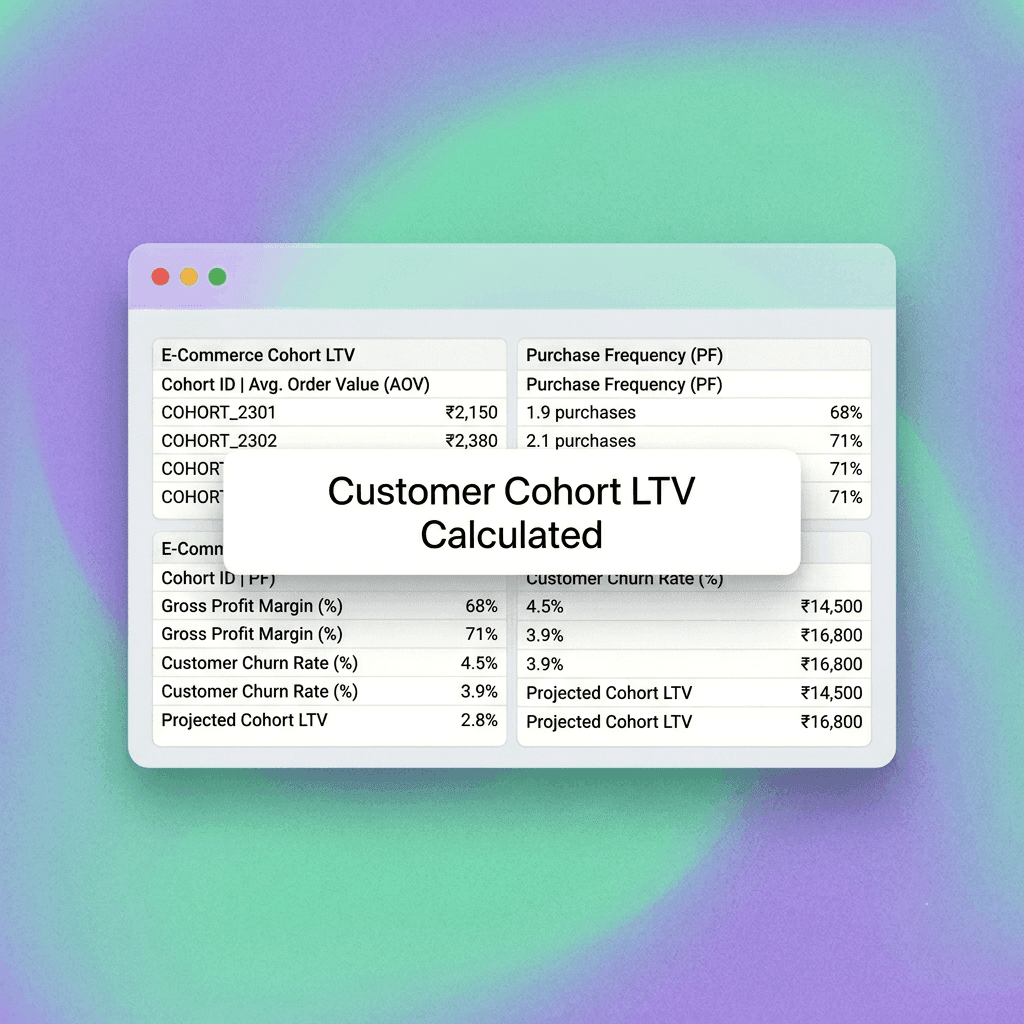
Most Shopify brands track LTV as a single number. One average, across all customers, across all time. That number is almost useless for making decisions. When growth operators rely solely on a blended average, they ignore the nuanced behavioral shifts that occur between different segments of their customer base, effectively obscuring the success or failure of specific acquisition campaigns. This surface-level metric often masks underlying operational inefficiencies, such as churn spikes in newer demographics or the diminishing returns of scaling a single marketing channel. By failing to disaggregate data, brands inadvertently treat high-intent repeat buyers the same as one-time discount shoppers, which leads to misaligned marketing spend and flawed inventory forecasting that can jeopardize long-term profitability.
Shopify customer lifetime value only becomes actionable when you break it down by cohort — the group of customers acquired in the same period, through the same channel, or under the same conditions. Cohort-level LTV tells you which customers are actually worth acquiring, where your retention is silently leaking, and which marketing channels are producing compounding returns versus one-hit purchasers. By mapping these specific segments, you gain visibility into the long-term viability of your business model, allowing for a surgical approach to customer acquisition and retention strategies. This granular analysis serves as the foundation for sophisticated budget allocation, enabling you to pivot resources toward channels that yield high-value, repeat-purchasing customers rather than those that simply pad your top-of-funnel metrics with transient, unprofitable traffic.
This guide walks through exactly how to calculate it, what to do with it, and where most operators go wrong. Understanding these mechanics is not merely an exercise in accounting; it is a vital operational discipline for any D2C founder aiming to survive and thrive in increasingly competitive digital markets. As you master the transition from blended metrics to cohort-based intelligence, you will find yourself better equipped to defend your margins, optimize your product mix, and ultimately build a resilient brand architecture that sustains growth through data-backed decision-making cycles.
Why Average LTV Misleads Shopify Brands
A blended LTV number hides variance. If your Black Friday cohort has an LTV of $180 and your organic cohort has an LTV of $340, averaging them to $260 tells you nothing useful — it actually pushes you toward the wrong decisions. When you view your store's health through a monolithic lens, you lose the ability to see which segments are funding your growth and which are burning through your operational cash flow. An average essentially creates a mirage of stability, where strong performance in one channel masks the severe underperformance of another, causing you to over-invest in campaigns that yield low-quality, high-churn customers who never transition to repeat status.
Cohort analysis solves this by isolating customer groups so you can compare like for like. You stop asking "what is our LTV?" and start asking "what is the LTV of customers acquired in Q1 via paid social, and how does that compare to customers who came in through email referral?" This transition to comparative analysis forces you to confront the reality of your customer acquisition cost versus their realized lifetime value, providing a clear map of your profit drivers. Instead of guessing the impact of your recent ad creative shifts or seasonal sales, you gain objective, time-bound evidence that allows for rapid iterative improvements to your overall marketing strategy.
That distinction changes how you allocate budget, how you structure retention campaigns, and how you evaluate payback periods on acquisition spend. By identifying which specific cohorts provide the highest internal rate of return, you can effectively shorten your cash conversion cycle and maximize the efficiency of your working capital. This approach empowers you to refine your promotional calendar, identify the most effective entry-level products, and build personalized CRM journeys that cater specifically to the behavior of high-potential cohorts, thereby transforming your marketing from a generic cost center into a precise, compounding investment engine.
The Cohort LTV Clarity Framework
This is a 5-step workflow for calculating and interpreting cohort-level LTV on Shopify. Use it to move from raw order data to a decision-ready retention picture. By adopting this structured approach, you strip away the noise of irrelevant data points and focus exclusively on the variables that drive recurring revenue and long-term brand affinity. This framework ensures that your analytical process is repeatable, scalable, and resilient against the rapid fluctuations typical of the ecommerce landscape, allowing you to maintain a consistent strategic focus as your store grows from a small shop to a multi-channel enterprise.
Step 1 — Define Your Cohort Boundaries
Before pulling any data, decide how you want to segment customers. The three most useful cohort types for Shopify brands are:
Acquisition month cohorts — all customers who made their first purchase in a given month. This is the baseline and the easiest to run. By observing these groups over time, you can detect seasonal trends and external market impacts that affect buyer behavior regardless of how they initially found your brand, establishing a reliable temporal baseline for all subsequent analysis.
Channel cohorts — customers grouped by their first acquisition source (paid search, paid social, organic, email, influencer). This connects LTV directly to marketing spend. This is the most critical segment for growth marketers as it enables a direct comparison between the quality of traffic sourced from high-cost platforms like Meta or Google versus the often higher-retention traffic from organic search or email newsletters.
Product cohorts — customers grouped by the first product they purchased. This reveals which entry-point SKUs produce repeat buyers versus one-and-done transactions. Identifying these "gateway" products allows you to refine your storefront landing pages and product bundles, prioritizing the promotion of items that have a statistically significant correlation with long-term retention.
Pick one to start. Acquisition month cohorts are the most practical entry point because every Shopify store has the data without needing additional UTM hygiene. Starting here allows you to build proficiency in your analytical pipeline without the added complexity of attribution modeling, ensuring you gain confidence in the core mathematical formulas before layering in the more nuanced data required for channel or product-specific breakdowns.
Step 2 — Pull the Right Data From Shopify
Shopify's native analytics includes a cohort report under Analytics > Reports > Customer Cohort Analysis. It shows you the percentage of customers from each cohort who returned to purchase in subsequent months. While limited, this report is the ideal sandbox to understand the basic mechanics of how cohorts degrade over time, giving you a quick visual representation of your customer churn and the typical intervals at which your users feel prompted to re-engage with your brand.
For more granular work — especially if you want to layer in channel data or first-product segmentation — you will need to export order data and work in a spreadsheet or BI tool. The fields you need for each order are:
Customer ID — ensuring you can uniquely identify and track individuals across multiple transactions, even if they use different email addresses or shipping details occasionally.
Order date — vital for calculating time-to-repurchase and the specific temporal windows required for accurate cohort modeling.
Order value (net of refunds) — ensuring your financial calculations are grounded in actual cash flow rather than theoretical top-line revenue that gets eroded by returns.
Acquisition source (if tracked via UTM or attribution tool) — providing the link between your advertising efforts and the actual transactional behavior of the customers those ads generate.
Product purchased — allowing for the granular SKU-level analysis that defines high-value versus low-value conversion pathways.
Pull a minimum of 12 months of data. Eighteen to twenty-four months gives you a much clearer picture of long-tail retention behavior. Having a multi-year data set is crucial for filtering out anomalies, such as one-off holiday surges or supply chain interruptions, and allows you to calculate true long-term value that covers your customers' entire journey from acquisition to churn, rather than just the initial window of excitement.
Step 3 — Calculate Cumulative Revenue Per Customer by Cohort
For each cohort, you want to track cumulative revenue per customer at regular intervals — typically at 30, 60, 90, 180, and 365 days from first purchase. This temporal segmentation is the industry gold standard because it aligns your financial data with typical consumer purchasing cycles, allowing you to identify exactly when the "magic window" for a second purchase closes and when your retention efforts are failing to convert dormant users into repeat buyers.
The calculation is straightforward:
Cumulative LTV at 90 days = Total revenue from cohort in first 90 days ÷ Number of customers in cohort — this simple formula provides a normalized view of how effectively your brand captures value from its user base within its first fiscal quarter.
Do this for each time interval and for each cohort. What you are building is a matrix — cohorts on one axis, time intervals on the other, LTV values in each cell. This structured data grid allows you to easily perform heat mapping or cross-cohort comparisons, helping you visualize the decay rate of your revenue and the long-term financial yield of customers acquired in different periods, which is the most reliable way to forecast your future cash flow.
This matrix is the core output of the Cohort LTV Clarity Framework. It is the asset that makes every retention and acquisition conversation data-grounded rather than opinion-driven. By moving the conversation away from anecdotes and into this empirical model, you minimize internal friction during planning meetings, ensure that team resources are prioritized based on actual business performance, and foster a culture of analytical rigor that scales alongside your company's revenue targets.
Step 4 — Calculate Retention Rate Alongside LTV
LTV in isolation is incomplete. You need retention rate running alongside it to understand whether LTV growth is being driven by more customers returning or by higher average order values from a shrinking loyal base. Understanding the interplay between these two metrics is what separates novice ecommerce managers from expert growth operators, as it allows you to see whether your brand is becoming a habit or if you are simply squeezing higher margins out of a dwindling group of loyalists.
For each cohort, calculate:
Month N Retention Rate = Customers who purchased in Month N ÷ Total customers in original cohort — this calculation effectively strips away the distraction of revenue and highlights the behavioral stability of your base, revealing which cohorts have a higher propensity to become brand evangelists versus those that are purely transactional.
A cohort with a 90-day LTV of $220 and a 90-day retention rate of 28% is healthier than a cohort with a $240 LTV and a 12% retention rate. The second cohort's higher revenue is concentrated in a small group of heavy buyers — which makes it fragile. By recognizing this disparity, you can tailor your risk management strategy, recognizing that the second cohort requires significantly more attention in your re-engagement flows to prevent a catastrophic collapse in value if those few power buyers ever stop purchasing from your store.
Step 5 — Interpret and Act
Once your matrix is built, you are looking for four things:
Which cohort has the highest 12-month LTV? Work backwards to understand what was different about acquisition conditions during that period. Identify the marketing creative, the discount level, or the promotional messaging used during that high-performing window and seek to replicate those exact conditions in your current campaigns.
Where does retention drop most sharply? If most cohorts lose 60% of customers between Month 1 and Month 3, that is your retention priority window. Focus your efforts on email automation, personalized SMS flows, or limited-time post-purchase incentives specifically within this danger zone to capture the at-risk customers before they churn permanently.
Which channel cohort produces the highest LTV? This informs where you should be willing to pay more per acquisition. By shifting your budget toward the highest-LTV channels, you increase your long-term return on ad spend, effectively creating a flywheel effect where your most profitable customers pay for the acquisition of new, equally profitable users.
Which first-product cohort retains best? This tells you which SKU to push to new customers and which to position as a second-purchase upsell. Aligning your marketing front-end with your most successful retention-driving products creates a smoother transition for customers, reduces friction in their buying journey, and naturally increases the likelihood that they will return for a second purchase.
None of this requires advanced tooling. A well-structured spreadsheet handles most of it. The value is in the questions you now have the data to answer. By taking ownership of your data in this way, you remove your dependency on expensive third-party platforms that often obscure the underlying business realities with flashy, simplified dashboards that don't always align with your unique operational metrics.
Tools That Support Cohort LTV Analysis on Shopify
Shopify's native cohort report covers the basics. For more control, the tools most commonly used by D2C operators are:
Lifetimely — purpose-built LTV and cohort analytics for Shopify, strong on channel attribution. This platform is excellent for teams that need to bridge the gap between ad spend and customer behavior without the overhead of building custom data pipelines.
Triple Whale — stronger on attribution and ad spend efficiency, with LTV data built in. This tool is a powerhouse for operators who prioritize real-time ROAS tracking alongside their LTV models, making it easier to adjust ad budgets on the fly based on predicted future revenue.
Glew — broader BI for ecommerce with cohort-level segmentation. This tool excels in environments where you need to combine Shopify data with other business streams, offering deep insights into inventory movement and broad product-level performance metrics.
Google Sheets or Excel — still the most flexible option if you want full control over your cohort definitions. While manual, this route is often the best for early-stage brands that need to deeply understand their unit economics before committing to a monthly subscription cost for third-party analytics software.
Most operators start in Shopify's native analytics, hit its limits, then move to a dedicated tool or a custom export. Knowing what questions you are trying to answer before you buy a tool saves significant time and cost. Evaluating your needs against the complexity of your current data will prevent "feature creep" where you end up paying for a comprehensive suite of tools when a simple, well-maintained spreadsheet would have sufficed.
Common Mistakes in Shopify LTV Analysis
Measuring too early
LTV calculated at 60 days looks very different from LTV at 12 months. Brands that optimize acquisition based on short-window LTV often undervalue channels with strong long-tail retention and overpay for channels that produce early purchasers who churn fast. By focusing exclusively on the short term, you create an operational bias that favors cheap, high-churn traffic while simultaneously neglecting the slower, more methodical channels that ultimately deliver the highest lifetime value and the most stability for your business.
Mixing refunds and gross revenue
If your LTV calculation uses gross order revenue without accounting for refunds and returns, your numbers are inflated. Always calculate on net revenue. For categories with high return rates — apparel, footwear — this distinction is material. Failing to net out these figures creates a false sense of security that can lead to aggressive acquisition budgets that your actual, real-world profit margins simply cannot support, leading to potential cash flow issues down the line.
Treating all customers in a cohort as equal
Some brands have power buyers who dramatically skew cohort LTV upward. A single customer who spends $2,000 in a cohort of 50 people inflates the average meaningfully. Running a median LTV alongside the mean gives you a more honest picture of typical customer behavior. This is essential for understanding your "average" customer experience; if your mean is being pulled up by a small group of outliers, your CRM strategies for the general population will likely fall flat as they aren't addressing the actual behavior of your core customer base.
Not controlling for promotional conditions
A Black Friday cohort will always look different from a standard acquisition cohort. Customers acquired at deep discounts often have lower repeat purchase rates and lower full-price AOV. If you do not separate promotional cohorts, you risk drawing misleading conclusions about retention. Always account for seasonal or promo-driven volatility by isolating these periods, ensuring that you don't confuse a successful "discount-driven spike" with a successful "brand-building strategy" when reviewing your long-term growth trajectory.
Assuming LTV improvement is a retention problem
Sometimes low LTV is an AOV problem, not a retention problem. If customers are returning but buying small, the lever is upsell and cross-sell strategy, not re-engagement campaigns. The cohort matrix helps you distinguish between the two. By isolating whether your churn is a symptom of failing to re-engage customers or simply a failure to maximize the wallet share of your existing customers during their active phases, you can apply the correct surgical intervention instead of wasting time on the wrong strategic lever.
LTV Trade-Offs Worth Understanding
Higher LTV does not always mean better unit economics. If the cost of generating that LTV — through retention emails, loyalty programs, customer service overhead, and promotions — is disproportionate, the net contribution can be lower than a cheaper-to-retain cohort. You must always maintain a view of the "cost to serve" alongside your revenue metrics, as an inefficiently maintained high-LTV segment can be a silent drain on your company's overall operational health and liquidity.
LTV analysis should always sit alongside CAC and contribution margin. A cohort with a 12-month LTV of $300 and a CAC of $60 is a better business than a cohort with a $400 LTV and a $180 CAC, assuming similar margins. When you look at these figures holistically, you identify that capital efficiency is the true driver of long-term survival, and that chasing the highest possible LTV at any cost is a recipe for unsustainable expansion that ignores the realities of margin maintenance.
The goal is not maximum LTV. The goal is maximum return on every dollar of acquisition and retention spend. By adopting this mindset, you optimize your business for the highest possible net profit, ensuring that every marketing dollar contributes to a sustainable, scalable growth engine that can withstand market volatility and provide predictable, compounding returns for your brand over the long term.
Most Shopify brands track LTV as a single number. One average, across all customers, across all time. That number is almost useless for making decisions. When growth operators rely solely on a blended average, they ignore the nuanced behavioral shifts that occur between different segments of their customer base, effectively obscuring the success or failure of specific acquisition campaigns. This surface-level metric often masks underlying operational inefficiencies, such as churn spikes in newer demographics or the diminishing returns of scaling a single marketing channel. By failing to disaggregate data, brands inadvertently treat high-intent repeat buyers the same as one-time discount shoppers, which leads to misaligned marketing spend and flawed inventory forecasting that can jeopardize long-term profitability.
Shopify customer lifetime value only becomes actionable when you break it down by cohort — the group of customers acquired in the same period, through the same channel, or under the same conditions. Cohort-level LTV tells you which customers are actually worth acquiring, where your retention is silently leaking, and which marketing channels are producing compounding returns versus one-hit purchasers. By mapping these specific segments, you gain visibility into the long-term viability of your business model, allowing for a surgical approach to customer acquisition and retention strategies. This granular analysis serves as the foundation for sophisticated budget allocation, enabling you to pivot resources toward channels that yield high-value, repeat-purchasing customers rather than those that simply pad your top-of-funnel metrics with transient, unprofitable traffic.
This guide walks through exactly how to calculate it, what to do with it, and where most operators go wrong. Understanding these mechanics is not merely an exercise in accounting; it is a vital operational discipline for any D2C founder aiming to survive and thrive in increasingly competitive digital markets. As you master the transition from blended metrics to cohort-based intelligence, you will find yourself better equipped to defend your margins, optimize your product mix, and ultimately build a resilient brand architecture that sustains growth through data-backed decision-making cycles.
Why Average LTV Misleads Shopify Brands
A blended LTV number hides variance. If your Black Friday cohort has an LTV of $180 and your organic cohort has an LTV of $340, averaging them to $260 tells you nothing useful — it actually pushes you toward the wrong decisions. When you view your store's health through a monolithic lens, you lose the ability to see which segments are funding your growth and which are burning through your operational cash flow. An average essentially creates a mirage of stability, where strong performance in one channel masks the severe underperformance of another, causing you to over-invest in campaigns that yield low-quality, high-churn customers who never transition to repeat status.
Cohort analysis solves this by isolating customer groups so you can compare like for like. You stop asking "what is our LTV?" and start asking "what is the LTV of customers acquired in Q1 via paid social, and how does that compare to customers who came in through email referral?" This transition to comparative analysis forces you to confront the reality of your customer acquisition cost versus their realized lifetime value, providing a clear map of your profit drivers. Instead of guessing the impact of your recent ad creative shifts or seasonal sales, you gain objective, time-bound evidence that allows for rapid iterative improvements to your overall marketing strategy.
That distinction changes how you allocate budget, how you structure retention campaigns, and how you evaluate payback periods on acquisition spend. By identifying which specific cohorts provide the highest internal rate of return, you can effectively shorten your cash conversion cycle and maximize the efficiency of your working capital. This approach empowers you to refine your promotional calendar, identify the most effective entry-level products, and build personalized CRM journeys that cater specifically to the behavior of high-potential cohorts, thereby transforming your marketing from a generic cost center into a precise, compounding investment engine.
The Cohort LTV Clarity Framework
This is a 5-step workflow for calculating and interpreting cohort-level LTV on Shopify. Use it to move from raw order data to a decision-ready retention picture. By adopting this structured approach, you strip away the noise of irrelevant data points and focus exclusively on the variables that drive recurring revenue and long-term brand affinity. This framework ensures that your analytical process is repeatable, scalable, and resilient against the rapid fluctuations typical of the ecommerce landscape, allowing you to maintain a consistent strategic focus as your store grows from a small shop to a multi-channel enterprise.
Step 1 — Define Your Cohort Boundaries
Before pulling any data, decide how you want to segment customers. The three most useful cohort types for Shopify brands are:
Acquisition month cohorts — all customers who made their first purchase in a given month. This is the baseline and the easiest to run. By observing these groups over time, you can detect seasonal trends and external market impacts that affect buyer behavior regardless of how they initially found your brand, establishing a reliable temporal baseline for all subsequent analysis.
Channel cohorts — customers grouped by their first acquisition source (paid search, paid social, organic, email, influencer). This connects LTV directly to marketing spend. This is the most critical segment for growth marketers as it enables a direct comparison between the quality of traffic sourced from high-cost platforms like Meta or Google versus the often higher-retention traffic from organic search or email newsletters.
Product cohorts — customers grouped by the first product they purchased. This reveals which entry-point SKUs produce repeat buyers versus one-and-done transactions. Identifying these "gateway" products allows you to refine your storefront landing pages and product bundles, prioritizing the promotion of items that have a statistically significant correlation with long-term retention.
Pick one to start. Acquisition month cohorts are the most practical entry point because every Shopify store has the data without needing additional UTM hygiene. Starting here allows you to build proficiency in your analytical pipeline without the added complexity of attribution modeling, ensuring you gain confidence in the core mathematical formulas before layering in the more nuanced data required for channel or product-specific breakdowns.
Step 2 — Pull the Right Data From Shopify
Shopify's native analytics includes a cohort report under Analytics > Reports > Customer Cohort Analysis. It shows you the percentage of customers from each cohort who returned to purchase in subsequent months. While limited, this report is the ideal sandbox to understand the basic mechanics of how cohorts degrade over time, giving you a quick visual representation of your customer churn and the typical intervals at which your users feel prompted to re-engage with your brand.
For more granular work — especially if you want to layer in channel data or first-product segmentation — you will need to export order data and work in a spreadsheet or BI tool. The fields you need for each order are:
Customer ID — ensuring you can uniquely identify and track individuals across multiple transactions, even if they use different email addresses or shipping details occasionally.
Order date — vital for calculating time-to-repurchase and the specific temporal windows required for accurate cohort modeling.
Order value (net of refunds) — ensuring your financial calculations are grounded in actual cash flow rather than theoretical top-line revenue that gets eroded by returns.
Acquisition source (if tracked via UTM or attribution tool) — providing the link between your advertising efforts and the actual transactional behavior of the customers those ads generate.
Product purchased — allowing for the granular SKU-level analysis that defines high-value versus low-value conversion pathways.
Pull a minimum of 12 months of data. Eighteen to twenty-four months gives you a much clearer picture of long-tail retention behavior. Having a multi-year data set is crucial for filtering out anomalies, such as one-off holiday surges or supply chain interruptions, and allows you to calculate true long-term value that covers your customers' entire journey from acquisition to churn, rather than just the initial window of excitement.
Step 3 — Calculate Cumulative Revenue Per Customer by Cohort
For each cohort, you want to track cumulative revenue per customer at regular intervals — typically at 30, 60, 90, 180, and 365 days from first purchase. This temporal segmentation is the industry gold standard because it aligns your financial data with typical consumer purchasing cycles, allowing you to identify exactly when the "magic window" for a second purchase closes and when your retention efforts are failing to convert dormant users into repeat buyers.
The calculation is straightforward:
Cumulative LTV at 90 days = Total revenue from cohort in first 90 days ÷ Number of customers in cohort — this simple formula provides a normalized view of how effectively your brand captures value from its user base within its first fiscal quarter.
Do this for each time interval and for each cohort. What you are building is a matrix — cohorts on one axis, time intervals on the other, LTV values in each cell. This structured data grid allows you to easily perform heat mapping or cross-cohort comparisons, helping you visualize the decay rate of your revenue and the long-term financial yield of customers acquired in different periods, which is the most reliable way to forecast your future cash flow.
This matrix is the core output of the Cohort LTV Clarity Framework. It is the asset that makes every retention and acquisition conversation data-grounded rather than opinion-driven. By moving the conversation away from anecdotes and into this empirical model, you minimize internal friction during planning meetings, ensure that team resources are prioritized based on actual business performance, and foster a culture of analytical rigor that scales alongside your company's revenue targets.
Step 4 — Calculate Retention Rate Alongside LTV
LTV in isolation is incomplete. You need retention rate running alongside it to understand whether LTV growth is being driven by more customers returning or by higher average order values from a shrinking loyal base. Understanding the interplay between these two metrics is what separates novice ecommerce managers from expert growth operators, as it allows you to see whether your brand is becoming a habit or if you are simply squeezing higher margins out of a dwindling group of loyalists.
For each cohort, calculate:
Month N Retention Rate = Customers who purchased in Month N ÷ Total customers in original cohort — this calculation effectively strips away the distraction of revenue and highlights the behavioral stability of your base, revealing which cohorts have a higher propensity to become brand evangelists versus those that are purely transactional.
A cohort with a 90-day LTV of $220 and a 90-day retention rate of 28% is healthier than a cohort with a $240 LTV and a 12% retention rate. The second cohort's higher revenue is concentrated in a small group of heavy buyers — which makes it fragile. By recognizing this disparity, you can tailor your risk management strategy, recognizing that the second cohort requires significantly more attention in your re-engagement flows to prevent a catastrophic collapse in value if those few power buyers ever stop purchasing from your store.
Step 5 — Interpret and Act
Once your matrix is built, you are looking for four things:
Which cohort has the highest 12-month LTV? Work backwards to understand what was different about acquisition conditions during that period. Identify the marketing creative, the discount level, or the promotional messaging used during that high-performing window and seek to replicate those exact conditions in your current campaigns.
Where does retention drop most sharply? If most cohorts lose 60% of customers between Month 1 and Month 3, that is your retention priority window. Focus your efforts on email automation, personalized SMS flows, or limited-time post-purchase incentives specifically within this danger zone to capture the at-risk customers before they churn permanently.
Which channel cohort produces the highest LTV? This informs where you should be willing to pay more per acquisition. By shifting your budget toward the highest-LTV channels, you increase your long-term return on ad spend, effectively creating a flywheel effect where your most profitable customers pay for the acquisition of new, equally profitable users.
Which first-product cohort retains best? This tells you which SKU to push to new customers and which to position as a second-purchase upsell. Aligning your marketing front-end with your most successful retention-driving products creates a smoother transition for customers, reduces friction in their buying journey, and naturally increases the likelihood that they will return for a second purchase.
None of this requires advanced tooling. A well-structured spreadsheet handles most of it. The value is in the questions you now have the data to answer. By taking ownership of your data in this way, you remove your dependency on expensive third-party platforms that often obscure the underlying business realities with flashy, simplified dashboards that don't always align with your unique operational metrics.
Tools That Support Cohort LTV Analysis on Shopify
Shopify's native cohort report covers the basics. For more control, the tools most commonly used by D2C operators are:
Lifetimely — purpose-built LTV and cohort analytics for Shopify, strong on channel attribution. This platform is excellent for teams that need to bridge the gap between ad spend and customer behavior without the overhead of building custom data pipelines.
Triple Whale — stronger on attribution and ad spend efficiency, with LTV data built in. This tool is a powerhouse for operators who prioritize real-time ROAS tracking alongside their LTV models, making it easier to adjust ad budgets on the fly based on predicted future revenue.
Glew — broader BI for ecommerce with cohort-level segmentation. This tool excels in environments where you need to combine Shopify data with other business streams, offering deep insights into inventory movement and broad product-level performance metrics.
Google Sheets or Excel — still the most flexible option if you want full control over your cohort definitions. While manual, this route is often the best for early-stage brands that need to deeply understand their unit economics before committing to a monthly subscription cost for third-party analytics software.
Most operators start in Shopify's native analytics, hit its limits, then move to a dedicated tool or a custom export. Knowing what questions you are trying to answer before you buy a tool saves significant time and cost. Evaluating your needs against the complexity of your current data will prevent "feature creep" where you end up paying for a comprehensive suite of tools when a simple, well-maintained spreadsheet would have sufficed.
Common Mistakes in Shopify LTV Analysis
Measuring too early
LTV calculated at 60 days looks very different from LTV at 12 months. Brands that optimize acquisition based on short-window LTV often undervalue channels with strong long-tail retention and overpay for channels that produce early purchasers who churn fast. By focusing exclusively on the short term, you create an operational bias that favors cheap, high-churn traffic while simultaneously neglecting the slower, more methodical channels that ultimately deliver the highest lifetime value and the most stability for your business.
Mixing refunds and gross revenue
If your LTV calculation uses gross order revenue without accounting for refunds and returns, your numbers are inflated. Always calculate on net revenue. For categories with high return rates — apparel, footwear — this distinction is material. Failing to net out these figures creates a false sense of security that can lead to aggressive acquisition budgets that your actual, real-world profit margins simply cannot support, leading to potential cash flow issues down the line.
Treating all customers in a cohort as equal
Some brands have power buyers who dramatically skew cohort LTV upward. A single customer who spends $2,000 in a cohort of 50 people inflates the average meaningfully. Running a median LTV alongside the mean gives you a more honest picture of typical customer behavior. This is essential for understanding your "average" customer experience; if your mean is being pulled up by a small group of outliers, your CRM strategies for the general population will likely fall flat as they aren't addressing the actual behavior of your core customer base.
Not controlling for promotional conditions
A Black Friday cohort will always look different from a standard acquisition cohort. Customers acquired at deep discounts often have lower repeat purchase rates and lower full-price AOV. If you do not separate promotional cohorts, you risk drawing misleading conclusions about retention. Always account for seasonal or promo-driven volatility by isolating these periods, ensuring that you don't confuse a successful "discount-driven spike" with a successful "brand-building strategy" when reviewing your long-term growth trajectory.
Assuming LTV improvement is a retention problem
Sometimes low LTV is an AOV problem, not a retention problem. If customers are returning but buying small, the lever is upsell and cross-sell strategy, not re-engagement campaigns. The cohort matrix helps you distinguish between the two. By isolating whether your churn is a symptom of failing to re-engage customers or simply a failure to maximize the wallet share of your existing customers during their active phases, you can apply the correct surgical intervention instead of wasting time on the wrong strategic lever.
LTV Trade-Offs Worth Understanding
Higher LTV does not always mean better unit economics. If the cost of generating that LTV — through retention emails, loyalty programs, customer service overhead, and promotions — is disproportionate, the net contribution can be lower than a cheaper-to-retain cohort. You must always maintain a view of the "cost to serve" alongside your revenue metrics, as an inefficiently maintained high-LTV segment can be a silent drain on your company's overall operational health and liquidity.
LTV analysis should always sit alongside CAC and contribution margin. A cohort with a 12-month LTV of $300 and a CAC of $60 is a better business than a cohort with a $400 LTV and a $180 CAC, assuming similar margins. When you look at these figures holistically, you identify that capital efficiency is the true driver of long-term survival, and that chasing the highest possible LTV at any cost is a recipe for unsustainable expansion that ignores the realities of margin maintenance.
The goal is not maximum LTV. The goal is maximum return on every dollar of acquisition and retention spend. By adopting this mindset, you optimize your business for the highest possible net profit, ensuring that every marketing dollar contributes to a sustainable, scalable growth engine that can withstand market volatility and provide predictable, compounding returns for your brand over the long term.
FAQs
What is customer lifetime value in Shopify?
Customer lifetime value in Shopify is the total net revenue a customer generates over their entire relationship with your store. Shopify calculates a basic LTV in its analytics dashboard, but the native figure is a blended average across all customers and all time periods. For decision-making, you need LTV segmented by cohort, channel, or first product to understand what is actually driving it. This foundational understanding allows you to look past the top-line numbers and really interrogate the health of your individual customer journeys, which is the only way to identify true opportunities for growth in an increasingly crowded ecommerce ecosystem where every dollar spent on acquisition must be accounted for and optimized against its expected future return.
How do I access cohort analysis in Shopify?
Shopify includes a Customer Cohort Analysis report under Analytics > Reports. It shows monthly retention rates for customer cohorts grouped by their first purchase month. This is a useful starting point, but it does not break down by acquisition channel or first product without additional tooling or data exports. To truly master your retention strategy, you will eventually need to move beyond this native toolset, utilizing advanced data exports to segment your base by behavior or acquisition source, as this will give you the precise insights required to tailor your CRM efforts and maximize the profitability of every customer segment you serve.
What is a good LTV for a Shopify brand?
There is no universal benchmark because LTV varies significantly by category, AOV, and purchase frequency. A subscription-adjacent consumables brand should expect higher LTV than a considered-purchase brand selling furniture. The more useful benchmark is your own LTV:CAC ratio — a ratio above 3:1 at 12 months is generally considered healthy, but what matters more is whether LTV is improving cohort over cohort. Tracking your own internal trend lines is far more important than comparing your business to abstract industry averages, as your specific product-market fit, cost structure, and target audience determine what success looks like for your business model.
How often should I recalculate LTV by cohort?
For most Shopify brands, recalculating cohort LTV monthly is sufficient. The more important discipline is consistency — using the same cohort definitions, the same time windows, and the same net revenue calculation each time. Changing methodology mid-analysis makes trend comparisons unreliable. By maintaining this steady, predictable reporting cadence, you enable your team to react effectively to emerging data trends, ensuring that your strategic decisions are always based on a reliable, historical context that hasn't been skewed by shifts in how you track or attribute your underlying customer interactions.
What is the difference between LTV and predicted LTV?What is the difference between LTV and predicted LTV?
Actual LTV is based on revenue customers have already generated. Predicted LTV uses historical cohort behavior to forecast how much a current customer will spend over a defined future window. Predicted LTV models are useful for acquisition bidding and budget planning but require enough historical data — typically 12 to 18 months of cohort behavior — to produce reliable estimates. While these predictive models can feel like a "crystal ball," they are only as good as the data you feed them, meaning you must have a high level of confidence in your historical data accuracy before you can rely on any model to drive your future marketing spend decisions.
Can I calculate cohort LTV without a paid analytics tool?
Yes. Shopify's order export gives you the raw data you need. With customer ID, order date, and order value, you can build a cohort LTV matrix in a spreadsheet without any paid tool. The manual process takes more time to set up but gives you full control over cohort definitions and calculation methodology. By doing this manually, you gain an intimate knowledge of your business's revenue drivers that you simply cannot get from an automated dashboard, giving you a competitive edge in how you perceive and exploit the nuances of your customer purchasing behaviors.
insights
Explore more on AI, Design and Growth

SEO
Google AI & Local SEO: Rank in Both (2026 Guide)
Learn how to optimize content for Google AI search and local SEO simultaneously to rank in AI Overviews, maps, and organic search results.

SEO
Semantic Content Clusters for SEO & AEO (Templates)
Learn how to build semantic content clusters for SEO and AEO. Includes practical templates, internal linking structures, and examples for ranking in AI search.

SEO
How Google AI Search Works: RankBrain to Gemini (2026)
Discover how Google’s AI search evolved from RankBrain to Gemini and what it means for SEO, AI search results, and ranking strategies in 2026.
SEO
Google AI & Local SEO: Rank in Both (2026 Guide)
Learn how to optimize content for Google AI search and local SEO simultaneously to rank in AI Overviews, maps, and organic search results.
SEO
Semantic Content Clusters for SEO & AEO (Templates)
Learn how to build semantic content clusters for SEO and AEO. Includes practical templates, internal linking structures, and examples for ranking in AI search.
get in touch
Ready to Grow From Day One?
Strategy, execution, and digital experiences designed to move together. Fill out the form below and our team will contact you shortly.
get in touch
Ready to Grow From Day One?
Strategy, execution, and digital experiences designed to move together. Fill out the form below and our team will contact you shortly.
get in touch
Ready to Grow From Day One?
Strategy, execution, and digital experiences designed to move together. Fill out the form below and our team will contact you shortly.
Services
We'd love to hear from you.
Tell us what you're building and where you need support.
© 2026 projectsupply AI, Data and Digital Engineering
Company. Pune, India. All rights reserved.
Part of Tangle
Services
We'd love to hear from you.
Tell us what you're building and where you need support.
© 2026 projectsupply AI, Data and Digital Engineering
Company. Pune, India. All rights reserved.
Part of Tangle
Services
We'd love to hear from you.
Tell us what you're building and where you need support.
© 2026 projectsupply AI, Data and Digital Engineering
Company. Pune, India. All rights reserved.
Part of Tangle