

Shopify
Shopify Fashion Collections: Seasonal Launch Strategy That Drives Revenue Spikes
Shopify Fashion Collections: Seasonal Launch Strategy That Drives Revenue Spikes
Learn how to plan and execute a Shopify fashion collection launch that drives real revenue spikes. Includes the Seasonal Launch Stack framework, pre-launch checklist, and common mistakes to avoid.
Learn how to plan and execute a Shopify fashion collection launch that drives real revenue spikes. Includes the Seasonal Launch Stack framework, pre-launch checklist, and common mistakes to avoid.
08 min read
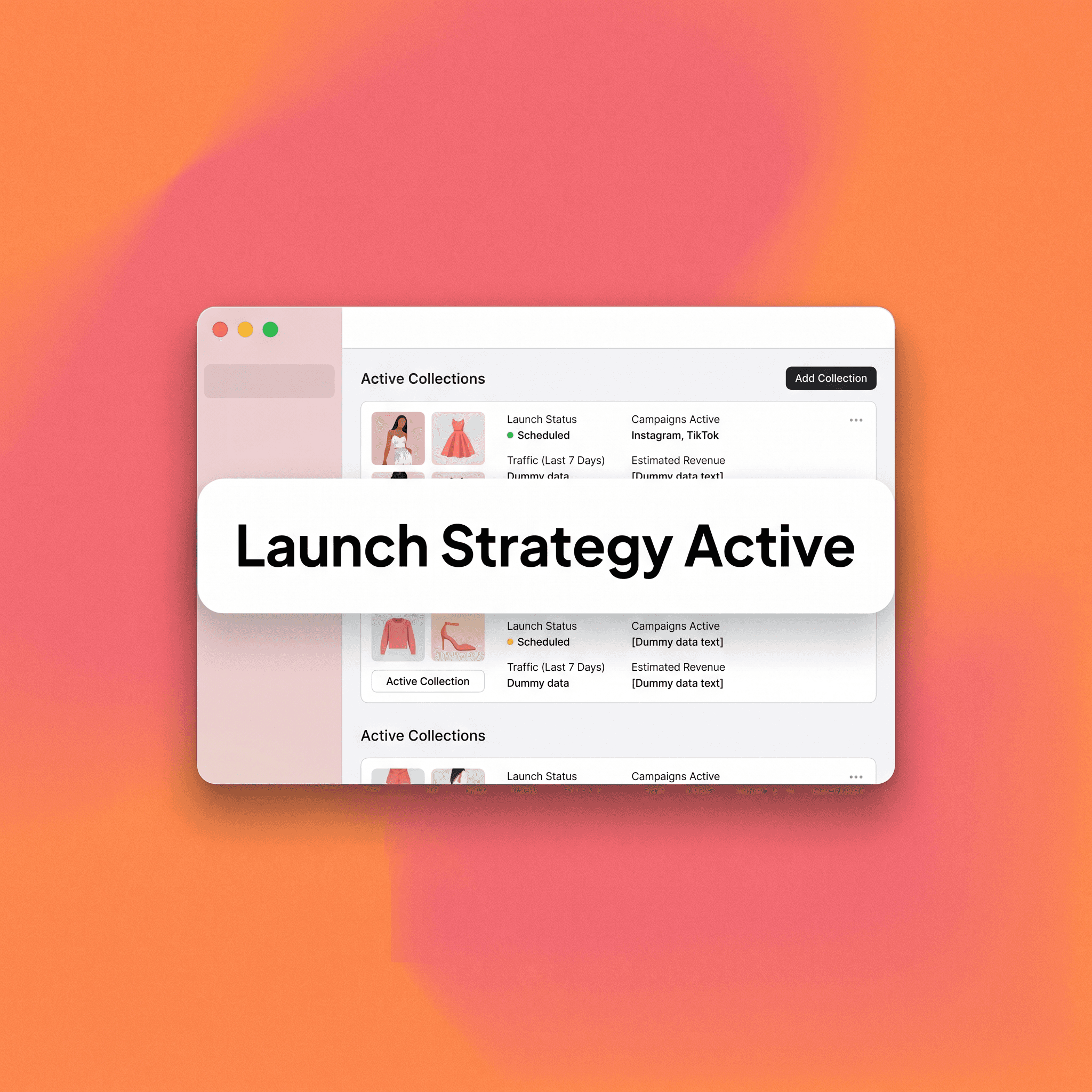
Shopify Fashion Collections: Seasonal Launch Strategy That Drives Revenue Spikes A seasonal collection launch is one of the highest-leverage moments in a fashion brand's calendar. Done well, it compresses demand, builds brand anticipation, and generates a concentrated revenue spike that compounds across the quarter. Done poorly, it's a product drop that no one noticed. Most Shopify fashion brands treat seasonal launches as a publishing event — update the collection, send an email, run an ad. That approach leaves serious revenue on the table. This guide covers how to build a Shopify fashion seasonal launch strategy that creates genuine demand momentum, not just a one-day traffic bump. By shifting your operational mindset from mere publication to orchestrated event management, you create an environment where product scarcity, aesthetic narrative, and tactical email sequencing coalesce to transform your store’s performance metrics. This is not just about moving inventory; it is about cultivating a rhythmic, high-frequency engagement cycle that keeps your customer base perpetually looking forward to your next release while solidifying your brand’s position in a hyper-competitive fashion landscape.
What Makes a Seasonal Launch Different From a Regular Product Drop
A regular product drop adds SKUs to your store. A seasonal launch is a commercial event. The distinction matters because the execution is fundamentally different. A seasonal launch has a defined pre-launch phase, a launch window, and a post-launch tail — each serving a different commercial purpose.
Pre-launch phase: Builds awareness and captures intent before the collection goes live.
Launch window: Concentrates purchases through urgency and availability signals.
Post-launch tail: Maximizes revenue from late movers and drives cross-sell. Brands that conflate these three phases — or skip the first one entirely — consistently underperform against their own revenue potential. The mechanics of Shopify make all three phases executable, but only if the strategy is structured before the first product goes live. When you differentiate between a standard inventory update and a deliberate seasonal activation, you unlock the ability to allocate your marketing budget and creative resources with surgical precision, ensuring that the heavy lifting of customer acquisition is completed well before the official release date, thereby allowing the launch window itself to function as a pure conversion engine.
The Seasonal Launch Stack: A 6-Phase Framework for Shopify Fashion Brands
The Seasonal Launch Stack is a repeatable pre-to-post launch system designed for D2C fashion brands operating on Shopify. It sequences every commercial action across a defined timeline so that nothing is reactive, and every phase has a clear output.
Phase 1 — Collection Architecture (8–10 Weeks Out)
Before any creative or campaign work begins, define the commercial structure of the collection itself. This means answering three questions:
Anchor SKU: What is the hero product or anchor SKU that the entire launch narrative will center on?
Architecture: What is the logical cross-sell and upsell architecture within the collection?
Taxonomy: Are collections on Shopify structured so that segmentation, filtering, and merchandising logic are clean at launch? Shopify's collection taxonomy is powerful but easy to get wrong. Automated collections driven by tags need to be configured correctly before products are added. Manual collections need a defined sort order. If this isn't done in Phase 1, your launch-day merchandising will be disorganized under traffic pressure. By front-loading the technical organization of your collection, you ensure that as traffic spikes during your launch window, the user experience remains frictionless, allowing customers to navigate, filter, and discover complementary items without encountering broken categorization or messy, non-curated product grids.
Phase 2 — Demand Signal Collection (6–8 Weeks Out)
This phase is about finding where buyer intent already exists before you spend a dollar on promotion. Practical actions in this phase:
Search Analysis: Pull search query data from Shopify Analytics and Google Search Console to identify which seasonal terms are already driving traffic to your store.
Performance Review: Review the previous season's collection performance — which SKUs converted fastest, which had the longest tail, which generated the most post-purchase reviews or UGC.
List Segmentation: Identify which customer segments purchased last season's equivalent collection and build an audience list specifically for early access or waitlist activation. The output of this phase is a prioritized demand map: you know which products have the highest purchase probability, which segments are most likely to buy early, and which channels showed organic intent last season. By leveraging historical data as your primary strategic asset, you eliminate the guesswork often associated with new collections, allowing you to focus your limited marketing capital on the products and customer cohorts that have already demonstrated a clear propensity to transact.
Phase 3 — Pre-Launch Activation (4–6 Weeks Out)
This is where most brands either build genuine momentum or miss their window entirely. Pre-launch activation is not just teasing creative on Instagram. It is structured intent capture. Actions that matter:
Landing Pages: Build a dedicated landing page on Shopify for early access sign-ups, linked from your primary navigation and email footer. Even 200–300 early access subscribers meaningfully improve launch-day conversion.
Notification Flows: Set up a back-in-stock or notify-me flow for the hero SKU if it has a prior-season equivalent. This reactivates existing buyers who already have purchase intent.
Creative Briefing: Brief your highest-performing organic content creators or brand partners with enough lead time to publish within 24–48 hours of your launch date. This phase should end with a confirmed early access list, a content calendar locked for launch week, and all Shopify automations (welcome flows for new sign-ups, early access discount codes, launch-day email sequences) built and tested. This stage essentially acts as a pre-flight checklist, ensuring that when the "go" signal is given, your infrastructure is already primed to receive and convert traffic at high speed without the last-minute panic that frequently compromises the professional aesthetic of a major brand release.
Phase 4 — Launch Window Execution (Day 1–7)
Launch week is the revenue concentration phase. The goal is not just traffic — it is converting warm intent that you built in the previous three phases. The 72-hour launch window is typically where 40–60% of seasonal launch revenue is generated for fashion brands with strong pre-launch activation. After that, the curve flattens sharply unless you extend urgency or introduce a new demand trigger. Shopify-specific execution priorities during launch week:
Early Access: Activate your early access segment first, at least 12–24 hours before public launch. This rewards loyalty and generates social proof (reviews, UGC, "sold out" signals) before the broader audience sees the collection.
Performance: Ensure your Shopify theme handles collection page performance under load — slow render times on mobile are the most common conversion killer on launch day.
Discount Strategy: Use Shopify's native discount logic carefully. Blanket sitewide discounts erode margin and train buyers to wait. Early access pricing or bundle incentives protect margin while still driving urgency.
Inventory Management: Monitor inventory depletion in real time. If a hero SKU sells out faster than expected, activate a waitlist immediately rather than showing an out-of-stock page with no path forward. These priorities transform your Shopify store from a static catalog into a high-octane conversion theater, where each decision—from the timing of your email blast to the technical load-balancing of your mobile site—is calculated to optimize the extraction of value from your most eager customer segments during their peak interest window.
Phase 5 — Post-Launch Revenue Tail (Week 2–4)
The post-launch phase is consistently under-exploited. Most brands stop pushing after day 7 and let the collection settle into passive catalog performance. A structured post-launch tail typically adds 20–35% on top of launch window revenue for fashion brands with seasonal collections priced above impulse thresholds. Actions that extend the revenue tail:
Non-Converter Nurture: Send a targeted follow-up sequence to non-purchasers from your early access list, specifically those who clicked but didn't convert. These are your highest-intent unconverted leads.
Retargeting: Deploy collection-focused retargeting to site visitors who viewed product pages but didn't add to cart. This is the highest-ROI paid segment during this phase.
Cross-Selling: Introduce a cross-sell sequence via email or post-purchase upsell (using Shopify's native post-purchase flow or a compatible app) to buyers from the first 72 hours. Do not discount the full collection in week two. If you need a demand trigger, use a limited bundle, a styling editorial, or a "complete the look" mechanic that protects SKU-level margin. By maintaining a consistent, narrative-driven presence in your customer’s inbox and social feeds throughout the month following the launch, you capture the late adopters and deliberative buyers who need extra social proof or styling guidance to make a final purchase decision, thereby extending the total revenue lifetime of your seasonal investment.
Phase 6 — Collection Performance Debrief (4 Weeks Post-Launch)
The debrief is not optional. It is the input that makes the next seasonal launch measurably better. Data to capture and document:
Revenue Tracking: Revenue by phase (pre-launch, launch window, post-launch tail).
Conversion Metrics: Conversion rate by segment (early access vs. general list vs. paid traffic).
Product Analytics: Hero SKU performance vs. forecast.
Marketing Efficiency: Email flow performance (open rate, click rate, revenue per recipient).
Forecasting Accuracy: Inventory accuracy: were sell-through projections close to actuals? Store this in a living launch debrief document. Over two to three seasonal cycles, patterns emerge that make demand forecasting and launch sequencing significantly more accurate. This reflective process institutionalizes your success, preventing the "memory loss" that often plagues creative teams and ensuring that every subsequent seasonal launch begins with an advantage over the last, progressively refining your ability to predict and influence customer behavior through structured, data-informed planning.
Shopify-Specific Configuration Checklist for Seasonal Launches
Before any seasonal launch goes live, run through this checklist inside your Shopify admin:
SEO & Metadata: Collection page title and meta description updated with seasonal keywords.
Automation Rules: Product tags consistent and collection automation rules verified.
Merchandising: Collection sort order set to launch-day merchandising logic (hero SKU first).
Media Optimization: All product images compressed and alt text updated.
Inventory Control: Inventory quantities confirmed and variants checked.
Recovery Tools: Notify-me or back-in-stock app active on hero SKU.
Checkout Reliability: Discount codes tested in checkout (no stacking conflicts).
UX/UI: Email flows activated and tested in staging.
Device Testing: Mobile collection page reviewed on at least two device sizes.
Analytics: Analytics events confirmed firing (add-to-cart, checkout initiated, purchase).
Common Mistakes That Kill Seasonal Launch Revenue
Pre-launch neglect: Launching Without a Pre-Built Audience. If your email list and paid audiences don't know the collection is coming, you are relying entirely on launch-day traffic to do all the work. Pre-launch activation is not optional — it is the mechanism that turns a product drop into a commercial event.
Narrative dilution: Treating All SKUs Equally. Every collection has a conversion hierarchy. Some products carry the narrative and drive traffic. Others convert on cross-sell. Promoting the entire collection with equal weight dilutes paid spend and muddies the brand story. Lead with one hero. Let the rest follow.
Margin erosion: Over-Discounting in Week One. A launch discount signals to your buyers that waiting is a viable strategy. If you condition your audience to expect a discount at launch, you will see declining full-price conversion over successive seasons. Use early access and exclusivity instead of blanket discounts.
Under-optimization: Ignoring the Post-Launch Tail. The buyers who didn't purchase in the first 72 hours are not lost. They are warm. A structured post-launch sequence to non-converters, retargeting pools, and post-purchase cross-sell is where under-optimized brands leave the most revenue behind.
Technical friction: Launching on a Technically Broken Collection Page. Slow load times, broken filters, out-of-stock variants showing first, or incorrect pricing logic on Shopify are all launch-day revenue killers that are 100% preventable with a pre-launch technical review.
Seasonal Launch Strategy by Collection Size
Not every launch deserves the same resource allocation. A useful heuristic:
Small Collections: For collections with fewer than 20 SKUs, compress the timeline. A 4-week pre-launch phase is sufficient. Focus on one hero SKU and one cross-sell pairing. Keep email sequences tight: two pre-launch touches, one launch-day send, one post-launch follow-up.
Mid-Sized Collections: For collections with 20–50 SKUs, the full 6-phase Seasonal Launch Stack applies. Invest in segmentation so that early access, paid, and organic audiences see different hero messaging based on purchase history or browse behavior.
Large Collections: For collections above 50 SKUs, the launch should be treated as a brand moment, not just a product event. This is where editorial content, lookbook-style collection pages, and influencer sequencing become material revenue drivers rather than optional brand-building.
Shopify Fashion Collections: Seasonal Launch Strategy That Drives Revenue Spikes A seasonal collection launch is one of the highest-leverage moments in a fashion brand's calendar. Done well, it compresses demand, builds brand anticipation, and generates a concentrated revenue spike that compounds across the quarter. Done poorly, it's a product drop that no one noticed. Most Shopify fashion brands treat seasonal launches as a publishing event — update the collection, send an email, run an ad. That approach leaves serious revenue on the table. This guide covers how to build a Shopify fashion seasonal launch strategy that creates genuine demand momentum, not just a one-day traffic bump. By shifting your operational mindset from mere publication to orchestrated event management, you create an environment where product scarcity, aesthetic narrative, and tactical email sequencing coalesce to transform your store’s performance metrics. This is not just about moving inventory; it is about cultivating a rhythmic, high-frequency engagement cycle that keeps your customer base perpetually looking forward to your next release while solidifying your brand’s position in a hyper-competitive fashion landscape.
What Makes a Seasonal Launch Different From a Regular Product Drop
A regular product drop adds SKUs to your store. A seasonal launch is a commercial event. The distinction matters because the execution is fundamentally different. A seasonal launch has a defined pre-launch phase, a launch window, and a post-launch tail — each serving a different commercial purpose.
Pre-launch phase: Builds awareness and captures intent before the collection goes live.
Launch window: Concentrates purchases through urgency and availability signals.
Post-launch tail: Maximizes revenue from late movers and drives cross-sell. Brands that conflate these three phases — or skip the first one entirely — consistently underperform against their own revenue potential. The mechanics of Shopify make all three phases executable, but only if the strategy is structured before the first product goes live. When you differentiate between a standard inventory update and a deliberate seasonal activation, you unlock the ability to allocate your marketing budget and creative resources with surgical precision, ensuring that the heavy lifting of customer acquisition is completed well before the official release date, thereby allowing the launch window itself to function as a pure conversion engine.
The Seasonal Launch Stack: A 6-Phase Framework for Shopify Fashion Brands
The Seasonal Launch Stack is a repeatable pre-to-post launch system designed for D2C fashion brands operating on Shopify. It sequences every commercial action across a defined timeline so that nothing is reactive, and every phase has a clear output.
Phase 1 — Collection Architecture (8–10 Weeks Out)
Before any creative or campaign work begins, define the commercial structure of the collection itself. This means answering three questions:
Anchor SKU: What is the hero product or anchor SKU that the entire launch narrative will center on?
Architecture: What is the logical cross-sell and upsell architecture within the collection?
Taxonomy: Are collections on Shopify structured so that segmentation, filtering, and merchandising logic are clean at launch? Shopify's collection taxonomy is powerful but easy to get wrong. Automated collections driven by tags need to be configured correctly before products are added. Manual collections need a defined sort order. If this isn't done in Phase 1, your launch-day merchandising will be disorganized under traffic pressure. By front-loading the technical organization of your collection, you ensure that as traffic spikes during your launch window, the user experience remains frictionless, allowing customers to navigate, filter, and discover complementary items without encountering broken categorization or messy, non-curated product grids.
Phase 2 — Demand Signal Collection (6–8 Weeks Out)
This phase is about finding where buyer intent already exists before you spend a dollar on promotion. Practical actions in this phase:
Search Analysis: Pull search query data from Shopify Analytics and Google Search Console to identify which seasonal terms are already driving traffic to your store.
Performance Review: Review the previous season's collection performance — which SKUs converted fastest, which had the longest tail, which generated the most post-purchase reviews or UGC.
List Segmentation: Identify which customer segments purchased last season's equivalent collection and build an audience list specifically for early access or waitlist activation. The output of this phase is a prioritized demand map: you know which products have the highest purchase probability, which segments are most likely to buy early, and which channels showed organic intent last season. By leveraging historical data as your primary strategic asset, you eliminate the guesswork often associated with new collections, allowing you to focus your limited marketing capital on the products and customer cohorts that have already demonstrated a clear propensity to transact.
Phase 3 — Pre-Launch Activation (4–6 Weeks Out)
This is where most brands either build genuine momentum or miss their window entirely. Pre-launch activation is not just teasing creative on Instagram. It is structured intent capture. Actions that matter:
Landing Pages: Build a dedicated landing page on Shopify for early access sign-ups, linked from your primary navigation and email footer. Even 200–300 early access subscribers meaningfully improve launch-day conversion.
Notification Flows: Set up a back-in-stock or notify-me flow for the hero SKU if it has a prior-season equivalent. This reactivates existing buyers who already have purchase intent.
Creative Briefing: Brief your highest-performing organic content creators or brand partners with enough lead time to publish within 24–48 hours of your launch date. This phase should end with a confirmed early access list, a content calendar locked for launch week, and all Shopify automations (welcome flows for new sign-ups, early access discount codes, launch-day email sequences) built and tested. This stage essentially acts as a pre-flight checklist, ensuring that when the "go" signal is given, your infrastructure is already primed to receive and convert traffic at high speed without the last-minute panic that frequently compromises the professional aesthetic of a major brand release.
Phase 4 — Launch Window Execution (Day 1–7)
Launch week is the revenue concentration phase. The goal is not just traffic — it is converting warm intent that you built in the previous three phases. The 72-hour launch window is typically where 40–60% of seasonal launch revenue is generated for fashion brands with strong pre-launch activation. After that, the curve flattens sharply unless you extend urgency or introduce a new demand trigger. Shopify-specific execution priorities during launch week:
Early Access: Activate your early access segment first, at least 12–24 hours before public launch. This rewards loyalty and generates social proof (reviews, UGC, "sold out" signals) before the broader audience sees the collection.
Performance: Ensure your Shopify theme handles collection page performance under load — slow render times on mobile are the most common conversion killer on launch day.
Discount Strategy: Use Shopify's native discount logic carefully. Blanket sitewide discounts erode margin and train buyers to wait. Early access pricing or bundle incentives protect margin while still driving urgency.
Inventory Management: Monitor inventory depletion in real time. If a hero SKU sells out faster than expected, activate a waitlist immediately rather than showing an out-of-stock page with no path forward. These priorities transform your Shopify store from a static catalog into a high-octane conversion theater, where each decision—from the timing of your email blast to the technical load-balancing of your mobile site—is calculated to optimize the extraction of value from your most eager customer segments during their peak interest window.
Phase 5 — Post-Launch Revenue Tail (Week 2–4)
The post-launch phase is consistently under-exploited. Most brands stop pushing after day 7 and let the collection settle into passive catalog performance. A structured post-launch tail typically adds 20–35% on top of launch window revenue for fashion brands with seasonal collections priced above impulse thresholds. Actions that extend the revenue tail:
Non-Converter Nurture: Send a targeted follow-up sequence to non-purchasers from your early access list, specifically those who clicked but didn't convert. These are your highest-intent unconverted leads.
Retargeting: Deploy collection-focused retargeting to site visitors who viewed product pages but didn't add to cart. This is the highest-ROI paid segment during this phase.
Cross-Selling: Introduce a cross-sell sequence via email or post-purchase upsell (using Shopify's native post-purchase flow or a compatible app) to buyers from the first 72 hours. Do not discount the full collection in week two. If you need a demand trigger, use a limited bundle, a styling editorial, or a "complete the look" mechanic that protects SKU-level margin. By maintaining a consistent, narrative-driven presence in your customer’s inbox and social feeds throughout the month following the launch, you capture the late adopters and deliberative buyers who need extra social proof or styling guidance to make a final purchase decision, thereby extending the total revenue lifetime of your seasonal investment.
Phase 6 — Collection Performance Debrief (4 Weeks Post-Launch)
The debrief is not optional. It is the input that makes the next seasonal launch measurably better. Data to capture and document:
Revenue Tracking: Revenue by phase (pre-launch, launch window, post-launch tail).
Conversion Metrics: Conversion rate by segment (early access vs. general list vs. paid traffic).
Product Analytics: Hero SKU performance vs. forecast.
Marketing Efficiency: Email flow performance (open rate, click rate, revenue per recipient).
Forecasting Accuracy: Inventory accuracy: were sell-through projections close to actuals? Store this in a living launch debrief document. Over two to three seasonal cycles, patterns emerge that make demand forecasting and launch sequencing significantly more accurate. This reflective process institutionalizes your success, preventing the "memory loss" that often plagues creative teams and ensuring that every subsequent seasonal launch begins with an advantage over the last, progressively refining your ability to predict and influence customer behavior through structured, data-informed planning.
Shopify-Specific Configuration Checklist for Seasonal Launches
Before any seasonal launch goes live, run through this checklist inside your Shopify admin:
SEO & Metadata: Collection page title and meta description updated with seasonal keywords.
Automation Rules: Product tags consistent and collection automation rules verified.
Merchandising: Collection sort order set to launch-day merchandising logic (hero SKU first).
Media Optimization: All product images compressed and alt text updated.
Inventory Control: Inventory quantities confirmed and variants checked.
Recovery Tools: Notify-me or back-in-stock app active on hero SKU.
Checkout Reliability: Discount codes tested in checkout (no stacking conflicts).
UX/UI: Email flows activated and tested in staging.
Device Testing: Mobile collection page reviewed on at least two device sizes.
Analytics: Analytics events confirmed firing (add-to-cart, checkout initiated, purchase).
Common Mistakes That Kill Seasonal Launch Revenue
Pre-launch neglect: Launching Without a Pre-Built Audience. If your email list and paid audiences don't know the collection is coming, you are relying entirely on launch-day traffic to do all the work. Pre-launch activation is not optional — it is the mechanism that turns a product drop into a commercial event.
Narrative dilution: Treating All SKUs Equally. Every collection has a conversion hierarchy. Some products carry the narrative and drive traffic. Others convert on cross-sell. Promoting the entire collection with equal weight dilutes paid spend and muddies the brand story. Lead with one hero. Let the rest follow.
Margin erosion: Over-Discounting in Week One. A launch discount signals to your buyers that waiting is a viable strategy. If you condition your audience to expect a discount at launch, you will see declining full-price conversion over successive seasons. Use early access and exclusivity instead of blanket discounts.
Under-optimization: Ignoring the Post-Launch Tail. The buyers who didn't purchase in the first 72 hours are not lost. They are warm. A structured post-launch sequence to non-converters, retargeting pools, and post-purchase cross-sell is where under-optimized brands leave the most revenue behind.
Technical friction: Launching on a Technically Broken Collection Page. Slow load times, broken filters, out-of-stock variants showing first, or incorrect pricing logic on Shopify are all launch-day revenue killers that are 100% preventable with a pre-launch technical review.
Seasonal Launch Strategy by Collection Size
Not every launch deserves the same resource allocation. A useful heuristic:
Small Collections: For collections with fewer than 20 SKUs, compress the timeline. A 4-week pre-launch phase is sufficient. Focus on one hero SKU and one cross-sell pairing. Keep email sequences tight: two pre-launch touches, one launch-day send, one post-launch follow-up.
Mid-Sized Collections: For collections with 20–50 SKUs, the full 6-phase Seasonal Launch Stack applies. Invest in segmentation so that early access, paid, and organic audiences see different hero messaging based on purchase history or browse behavior.
Large Collections: For collections above 50 SKUs, the launch should be treated as a brand moment, not just a product event. This is where editorial content, lookbook-style collection pages, and influencer sequencing become material revenue drivers rather than optional brand-building.
FAQ
What is the ideal timeline for a Shopify fashion collection launch?
A full Seasonal Launch Stack runs 10 weeks from collection architecture to post-launch debrief. For smaller collections or brands with limited resources, a compressed 4–6 week timeline covering pre-launch activation through the post-launch tail is workable. The non-negotiable is pre-launch intent capture — launching without a warm audience consistently underperforms regardless of collection quality.
How do I build pre-launch demand without revealing the full collection?
The most effective approach is hero-led teasing. Reveal one anchor product or a strong campaign visual tied to the collection theme. Offer early access sign-up as the conversion mechanic, not just a follow or like. This builds a qualified list of buyers who have explicitly opted in to purchase intent, rather than passive social awareness.
When should I send the launch-day email for a Shopify fashion collection?
Send your early access email 12–24 hours before public launch. Send your general list email on launch day between 8am and 10am in your primary buyer timezone. Avoid sending during weekend afternoons and avoid Monday mornings. Tuesday through Thursday launch windows consistently outperform for fashion collections in the mid-range price bracket.
Should I use Shopify discount codes for a seasonal launch?
Use them selectively. A blanket launch discount trains buyers to expect reduced pricing and erodes full-price conversion over time. More effective alternatives include early access pricing (same discount, but gated to a segment), bundle incentives that protect per-unit margin, or free shipping thresholds tied to the collection's average order value.
How do I measure whether a seasonal launch actually performed well?
The three most important metrics are revenue by phase (pre, launch window, post-launch tail), conversion rate by traffic source, and inventory sell-through rate versus forecast. A well-executed launch should see 40–60% of revenue in the first 72 hours, a meaningful post-launch tail driven by follow-up sequences, and inventory depletion close to projections for the hero SKU.
What Shopify apps actually help with seasonal collection launches?
The short answer: use native Shopify features first. Email flows, discount logic, post-purchase upsell, and collection automation are all strong out of the box. Where apps add meaningful value: back-in-stock notifications, advanced segmentation for email (Klaviyo is the standard), and landing page builders for pre-launch capture if your theme doesn't support standalone pages cleanly.
How do I prevent a seasonal collection from cannibalizing my permanent catalog?
Merchandising sequencing and clear navigation hierarchy solve most of this. Feature the seasonal collection prominently at launch — hero banner, top navigation, homepage editorial — but ensure your permanent catalog remains accessible and is not visually deprioritized. In post-launch email sequences, use the seasonal collection as an entry point and cross-sell into permanent catalog SKUs for buyers who purchased from the new drop.
insights
Explore more on AI, Design and Growth

SEO
Google AI & Local SEO: Rank in Both (2026 Guide)
Learn how to optimize content for Google AI search and local SEO simultaneously to rank in AI Overviews, maps, and organic search results.
SEO
Semantic Content Clusters for SEO & AEO (Templates)
Learn how to build semantic content clusters for SEO and AEO. Includes practical templates, internal linking structures, and examples for ranking in AI search.

SEO
How Google AI Search Works: RankBrain to Gemini (2026)
Discover how Google’s AI search evolved from RankBrain to Gemini and what it means for SEO, AI search results, and ranking strategies in 2026.
SEO
Google AI & Local SEO: Rank in Both (2026 Guide)
Learn how to optimize content for Google AI search and local SEO simultaneously to rank in AI Overviews, maps, and organic search results.
SEO
Semantic Content Clusters for SEO & AEO (Templates)
Learn how to build semantic content clusters for SEO and AEO. Includes practical templates, internal linking structures, and examples for ranking in AI search.
get in touch
Ready to Grow From Day One?
Strategy, execution, and digital experiences designed to move together. Fill out the form below and our team will contact you shortly.
get in touch
Ready to Grow From Day One?
Strategy, execution, and digital experiences designed to move together. Fill out the form below and our team will contact you shortly.
get in touch
Ready to Grow From Day One?
Strategy, execution, and digital experiences designed to move together. Fill out the form below and our team will contact you shortly.
Services
We'd love to hear from you.
Tell us what you're building and where you need support.
© 2026 projectsupply AI, Data and Digital Engineering
Company. Pune, India. All rights reserved.
Part of Tangle
Services
We'd love to hear from you.
Tell us what you're building and where you need support.
© 2026 projectsupply AI, Data and Digital Engineering
Company. Pune, India. All rights reserved.
Part of Tangle
Services
We'd love to hear from you.
Tell us what you're building and where you need support.
© 2026 projectsupply AI, Data and Digital Engineering
Company. Pune, India. All rights reserved.
Part of Tangle