Shopify
08 min read
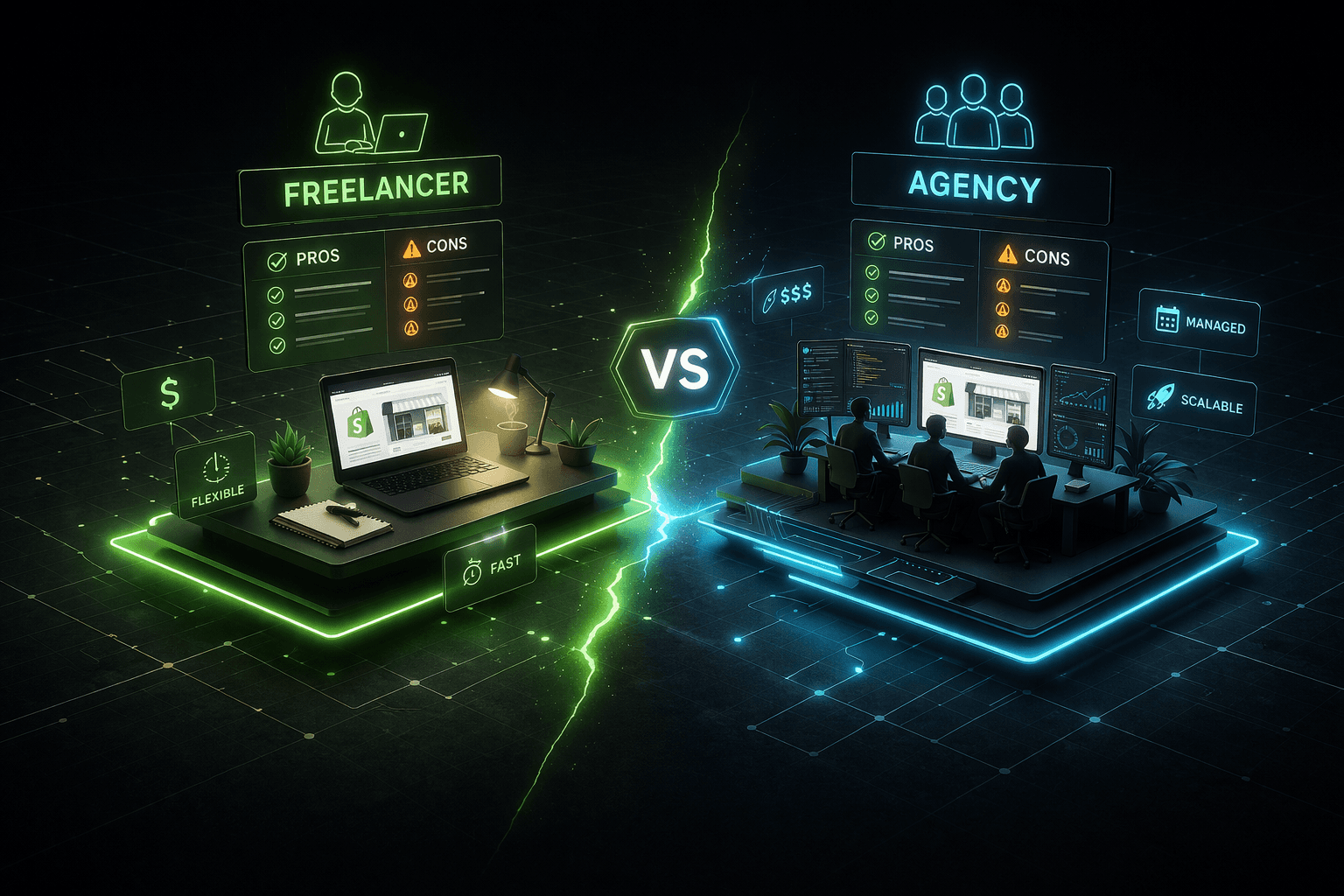
An Indian Shopify freelancer costs ₹1,500 to ₹5,000 per hour, or ₹30,000 to ₹2,50,000 for a full store build. A certified Indian Shopify agency charges ₹75,000 to ₹5,00,000+ for a full build. Shopify Plus projects start above ₹8,00,000. India's average D2C ecommerce conversion rate is 1.8%, with mobile converting at just 1.2% versus 3.1% on desktop, per Cognito IT's 2026 analysis of 100+ Shopify stores. The gap between those numbers is almost entirely a build quality problem.
Most D2C brands that rebuild within 18 months cite missing analytics configuration, poor mobile performance, and absent SEO structure, not design taste.The right choice is determinable in under ten minutes using the four-question PS4 Build Decision Matrix at the end of this section. India's D2C market reached USD 108.76 billion in 2026, growing at a 24.3% CAGR through 2031, per Mordor Intelligence. The window for building a conversion-grade store before competition intensifies is closing. Not sure which path fits your stage? Use the 4-question PS4 Build Decision Matrix at the end of this article, or book a free Shopify audit with ProjectSupply.
The Real Problem Is Not the Quote. It Is the Month-Three Revenue Gap.
Most founders make the Shopify freelancer vs agency decision based on one number: the initial quote. That is the wrong variable.
The question that actually matters is what you lose every month the store underperforms because the wrong choice was made before a single pixel was placed. India's average D2C conversion rate sits at 1.8%, while mobile, which carries 78% of Indian D2C traffic, converts at just 1.2% against desktop's 3.1%, according to Cognito IT's 2026 benchmark study of over 100 Indian Shopify stores. On a store with 50,000 monthly visitors and an average order value of ₹900, the difference between a 1.2% and a 2.5% mobile conversion rate is ₹5.85 lakh per month in lost revenue. That is not a traffic problem or a marketing problem. It is a build quality problem. And it traces directly to the Shopify freelancer vs agency decision made before launch.
This guide gives you the cost data, the failure pattern analysis, the decision framework, and the contract checklist to make that decision correctly for your specific stage of business.
The Actual Cost Breakdown for Indian D2C Brands in 2026
The cost data circulating online is almost always quoted in USD, averaged across global markets, and stripped of the contextual detail that makes it actionable. Here is what the Indian market looks like in 2026.
An Indian Shopify freelancer with two to four years of experience charges between ₹1,500 and ₹3,000 per hour. A senior freelancer with Shopify Plus exposure, custom Liquid development skills, or CRO experience charges ₹3,500 to ₹5,000 per hour. For project-based work, a basic theme-customized store with payment gateway integration and product upload costs ₹30,000 to ₹80,000. A custom-designed store with app integrations, speed optimization, GA4 setup, and basic SEO structure runs ₹1,20,000 to ₹2,50,000.
Agencies price differently because they are selling coordinated team capacity, not individual hours. A certified Shopify Partner agency in India typically starts at ₹75,000 for a scoped basic build and rises to ₹3,00,000 to ₹5,00,000 for a full D2C-grade store with CRO architecture, GA4 and Meta Pixel configuration, mobile performance engineering, and structured post-launch support. Shopify Plus migrations and enterprise builds with headless or multi-market requirements sit above ₹8,00,000, sometimes significantly. Shopify development in India for a custom store generally starts at ₹30,000 and can exceed ₹5,00,000 depending on scope, per current agency pricing data.
The cost gap looks dramatic until you account for what a freelancer's quote does not include. Most freelancer engagements do not price in project management, QA testing across device types, analytics configuration, post-launch troubleshooting, or the revisions that arise when a mobile checkout breaks on a Redmi device during a sale. Those costs arrive later as additional invoices or, more commonly, as revenue losses that never get attributed to the original build decision.
Engagement Type | Hourly Rate (INR) | Full Store Build (INR) | Shopify Plus Build (INR) |
|---|---|---|---|
Junior Freelancer (1–2 yrs) | ₹800 – ₹1,500 | ₹30,000 – ₹60,000 | Not recommended |
Mid-level Freelancer (2–4 yrs) | ₹1,500 – ₹3,000 | ₹60,000 – ₹1,50,000 | Limited scope only |
Senior Freelancer (4+ yrs, Plus exposure) | ₹3,500 – ₹5,000 | ₹1,50,000 – ₹2,50,000 | Case by case |
Certified Shopify Partner Agency | ₹2,500 – ₹6,000 | ₹75,000 – ₹5,00,000 | ₹8,00,000+ |
Shopify Plus Partner Agency | ₹4,000 – ₹8,000 | ₹2,00,000 – ₹5,00,000 | ₹8,00,000 – ₹20,00,000+ |
Sources: Storetasker, Blackbeltcommerce, Appco Software, ProjectSupply market analysis, 2025–2026.
Where Freelancers Genuinely Win
A Shopify freelancer is the right choice in several specific scenarios. It matters to name them precisely rather than treat this as a question that always resolves toward strategy.
If you need a scoped, contained task completed quickly, a freelancer is almost always faster and cheaper than routing it through an agency's intake and briefing process. Theme customizations, app installations and configuration, bug isolation and fixes, speed optimization audits, and minor feature additions are all legitimate freelancer use cases. A specialist freelancer who works exclusively in Shopify will often know the platform's Liquid architecture more intimately than a generalist developer at a mid-tier agency that works across multiple platforms.
For early-stage brands validating a product hypothesis with limited capital, a freelancer-built store on a solid premium theme is a sensible starting point. Getting a functional, well-structured store live in two weeks for ₹50,000 is a reasonable bet when you are still testing demand elasticity and unit economics. Committing ₹3,00,000 to an agency build before you know your repeat purchase rate or your customer acquisition cost ceiling is not.
The direct communication dynamic is also genuinely valuable for technically involved founders. When you work with a freelancer, you speak to the person building the thing. There is no account manager interpreting your brief before it reaches a developer. For founders who make granular store decisions themselves, the feedback loop is meaningfully tighter.
Where Freelancers Consistently Fail Scaling Brands
The failure mode is almost always identical. A brand crosses ₹30 to ₹40 lakh in monthly revenue, begins investing seriously in Meta and Google acquisition, and discovers the store was not built for what it is now being asked to do.
The gaps cluster predictably. GA4 and conversion events are misconfigured or absent, so the brand is running paid acquisition without knowing which traffic sources actually convert. The mobile experience was never stress-tested across Android mid-range devices, and the checkout drops sessions at the payment step on 4G connections. The store speed score looks acceptable on a MacBook but collapses on a Redmi Note because image compression and lazy loading were not implemented. The SEO structure is absent because the freelancer was hired to build, not to optimize for organic acquisition.
None of this is the freelancer's fault as a professional. It reflects a scope problem. A single person, regardless of skill, cannot simultaneously optimize for design quality, development precision, performance engineering, CRO strategy, analytics architecture, and SEO structure. These are distinct disciplines that take years to develop individually. Expecting one person to deliver all of them at a freelancer price point is not a reasonable expectation, and the brief usually does not ask for them explicitly.
This is the pattern reported consistently by Indian Shopify agencies in 2026: brands arriving with freelancer-built stores that require partial or full rebuilds before paid scaling can proceed safely. The rebuild cost frequently exceeds what a properly scoped agency build would have cost originally. ProjectSupply's Shopify development practice documents this across a significant share of inbound audit requests.
What Agencies Deliver That a Single Person Cannot
An agency's core value is not access to better individual talent. It is coordinated, simultaneous execution across multiple skill domains that cannot be compressed into a single person's working hours.
When a quality Shopify agency takes on a D2C store build, a designer is working on the visual system and component library while a developer configures the theme architecture. A CRO specialist is reviewing the product page hierarchy and checkout trust signals. Someone else is setting up GA4, Meta Pixel, and Conversion API in parallel, ensuring that paid acquisition data is clean from day one. A project manager is ensuring these workstreams do not produce contradictory outputs. That is structurally impossible with one person, regardless of how skilled they are.
Agencies also carry institutional knowledge about what breaks in Shopify stores under specific conditions. When your store processes high traffic during a BFCM sale and an app conflicts with another at checkout, an agency's development team has probably seen that specific conflict across prior clients. A freelancer encountering it for the first time will diagnose and resolve it, but the diagnostic phase will take longer, and your sale will already have started.
Post-launch support is structurally more reliable through an agency. If a freelancer becomes unavailable, moves to a better-paying client, or simply burns out, your access to the person who built your store disappears. An agency's continuity does not depend on any individual's availability. Support is contractual, not discretionary, and response time is typically governed by a service level agreement.
The PS4 Build Decision Matrix: Four Questions That Resolve the Choice
The right choice between a freelancer and an agency is almost always determinable before you request a single quote, if you answer these four questions honestly.
Question 1: Does the project require more than one core skill simultaneously? If you need design, development, analytics setup, and CRO thinking in the same engagement, you need a team. One person cannot deliver these in parallel without one of them being underweight.
Question 2: What is your monthly revenue today, and what does it need to be 90 days after launch? If the gap between those two numbers requires the store to convert from day one, the cost of a poor build, measured in lost revenue over three months, is likely higher than the cost difference between a freelancer and an agency. Run the calculation before you compare quotes.
Question 3: Do you have the operational bandwidth to manage a freelancer engagement actively? Freelancer projects without a project manager require founder or operator attention to stay on track. If you do not have that bandwidth, you are effectively paying agency rates in your own time without the output quality an agency provides.
Question 4: Is this a one-time task or an ongoing relationship? Scoped, contained tasks favour freelancers. Ongoing store development, CRO iteration, paid campaign landing page work, and scaling infrastructure favour agencies.
If questions one and two point toward an agency but your current budget constrains you to a freelancer, the honest path is to launch a minimal freelancer-built store on a clean premium theme, validate revenue and repeat purchase rate, and then migrate to an agency engagement once monthly cash flow justifies it. Many Indian D2C brands have executed this path successfully. The mistake is not starting with a freelancer. The mistake is maintaining freelancer-built infrastructure long after the store has outgrown it.
The Hidden Costs Neither Quote Covers
Both hiring paths carry costs that do not appear in the initial proposal. Founders who budget only against the submitted quote tend to find the gap at the worst time.
With a freelancer, the hidden costs typically arrive as additional hours for revisions not scoped in the original brief, your own time managing the project in the absence of a project manager, post-launch fix costs for problems discovered under real traffic, and the cost of hiring a second specialist when the first cannot deliver a specific capability that was assumed to be included.
With an agency, the hidden costs arrive differently. Scope creep is the most significant risk if the brief is not precisely defined before the contract is signed. Mid-project change requests at agency rates can add 20% to 40% to the final invoice. Monthly retainer agreements for post-launch support add a recurring cost that some brands underestimate when calculating total year-one spend.
The ProjectSupply 12-Month Total Cost of Ownership framework resolves this: calculate build cost plus revision costs plus fix costs plus your own management time valued at an equivalent hourly rate, plus the revenue lost during the months the store converts below your target rate. The option that looks cheaper at the proposal stage rarely looks cheaper at month twelve when this calculation is run honestly.
Download our free Shopify Build Checklist: 18 things to confirm before signing any freelancer or agency contract. Get the PDF here.
How to Evaluate a Shopify Agency in India Before You Sign
Three evaluation signals matter more than anything else in a proposal deck or a credentials presentation.
First, request live store URLs, not case study PDFs. Open those stores on a mid-range Android device, on a 4G connection, and test the actual purchase flow from product page to checkout completion. If the agency cannot give you live URLs or the stores fail basic mobile performance tests, the case studies are covering for something.
Second, ask specifically how they measure conversion rate before and after a build, and ask them to show you a before-and-after example from a client in your revenue range. An agency that cannot answer this question with a specific methodology has not built with commercial outcomes as a primary concern. They have built with delivery completion as the primary concern, which is a different thing.
Third, ask for a reference from a brand at a similar monthly revenue stage to yours. An agency experienced exclusively with enterprise clients is not necessarily the right fit for a ₹40 lakh monthly D2C brand. The problems, the pace, and the decisions are materially different at different revenue stages.
What a Shopify Agency Contract Must Contain Before You Sign
A contract that does not define these parameters creates disputes at launch, which is the worst possible time for both parties.
The contract must specify a detailed scope of work with explicit inclusions and exclusions rather than general descriptions. It must define the revision policy clearly, distinguishing between in-scope revisions and change requests that carry additional cost. Post-launch support terms need to include response time commitments and duration, not just a vague assurance of availability. Ownership of all code, design assets, and intellectual property must transfer to you on final payment, without qualification. Milestones must have specific, measurable acceptance criteria that both parties agree on before work begins.
If a proposed contract contains none of these elements, the agency is not sufficiently process-mature for a build where the store's conversion rate affects your paid acquisition returns from day one.
Metrics That Tell You Whether You Made the Right Choice
Metric | How to Calculate or Find It | What It Tells You |
|---|---|---|
Store Conversion Rate | (Total orders / Total sessions) x 100 in GA4 or Shopify Analytics | Whether the store converts at a rate that justifies your acquisition spend. Below 1.5% on an Indian D2C store typically signals a build quality or mobile UX problem, not a product problem. |
Mobile vs Desktop Conversion Gap | GA4, segment by device category, compare CVR | India's D2C traffic is 78% mobile. Mobile converting at less than half the desktop rate is a strong indicator the store was not built mobile-first. |
Checkout Abandonment Rate | (Checkout initiated minus completed orders) / Checkout initiated in Shopify Analytics | Identifies whether the problem is in the store experience or at the payment step. High abandonment post-payment page often traces to UPI or gateway configuration issues. |
Core Web Vitals (LCP, INP, CLS) | Google Search Console Performance tab, PageSpeed Insights | A store failing Core Web Vitals loses both organic ranking and paid Quality Score. Most freelancer builds do not pass LCP thresholds without explicit optimization. |
Post-Launch Support Response Time | Track time from first issue raised to confirmed resolution | A proxy for build partner reliability. Agencies with contractual SLAs resolve faster because accountability is defined. Freelancers resolve on availability. |
12-Month Total Cost of Ownership | Build cost + revision costs + fix costs + (management hours x your equivalent hourly rate) + revenue lost below target conversion rate | The only figure that tells you accurately whether you made the right choice. Most founders calculate only the build quote. |
Forward View: Three Forces Shaping This Decision Through 2027
AI tooling is accelerating freelancer delivery but not freelancer judgment. Cursor, GitHub Copilot, and Shopify's native AI features are allowing competent freelancers to build stores faster than they could 24 months ago. This genuinely benefits brands with contained, clearly scoped builds. The constraint is that AI tools accelerate code production, not strategic judgment. A freelancer with AI assistance builds faster but still cannot simultaneously apply CRO strategy, analytics architecture, performance engineering, and mobile UX thinking to the same project. As the baseline expectation for a high-performing Shopify store rises, the quality gap between a fast solo build and a coordinated team build is widening, not narrowing.
Shopify Plus adoption among Indian D2C brands is making the agency path mandatory at scale. Shopify Plus starts at approximately USD 2,500 per month, and Indian brands crossing ₹1 to ₹2 crore monthly revenue are migrating for checkout extensibility, B2B capabilities, and multi-market infrastructure. Plus implementations require certified Plus Partner expertise that most freelancers do not hold. Shopify's Partner directory lists a limited number of verified Plus Partners, and only a subset operate with genuine depth in the Indian D2C context. Brands planning Plus migrations through 2026 and 2027 are already encountering a supply constraint: qualified partners are fewer than the brands who need them. Engaging the right agency before that constraint intensifies is the lower-risk path. See ProjectSupply's Shopify Plus migration service for current availability.
Performance-linked contracts are becoming the commercial standard, not an exception. In 2026, a growing share of Indian D2C brands are structuring Shopify agency contracts with performance clauses tied to conversion rate improvement, site speed benchmarks, and revenue attribution outcomes. This was uncommon in the Indian market three years ago and is now a signal of a maturing procurement posture. Freelancers cannot accept performance-linked contracts because they cannot control all the variables that determine store performance. Agencies that build with CRO, analytics, and marketing integration as first-class outputs are positioning as growth partners, not vendors. The brands engaging them now are building institutional performance knowledge that latecomers will need to spend significantly to acquire.
The brands that make the right build partner decision in 2026 will not just have better-converting stores. They will have cleaner data, faster iteration capability, and a conversion foundation that compounds as acquisition spend scales. Those who delay will be allocating 2027 budget to rebuilds that should have been investments at launch.
FAQs
Are Shopify agencies worth the cost?
For scaling ecommerce businesses, agencies often deliver stronger ROI because they combine development expertise with commerce strategy.
Do large Shopify brands use freelancers?
Large brands occasionally hire freelancers for specific tasks, but most rely on agencies or internal teams for core development.
Can freelancers handle Shopify Plus development?
Some experienced freelancers can, but Shopify Plus projects often require multiple specialists.
What is the biggest advantage of working with an agency?
Access to multidisciplinary expertise including development, CRO, UX, and integrations.
What is the biggest advantage of freelancers?
Lower cost and flexibility for smaller projects.
Direct Answers
Is it better to hire a Shopify freelancer or an agency?
Freelancers are suitable for small tasks or early-stage stores, while agencies provide broader expertise for scaling ecommerce businesses.
How much does a Shopify freelancer cost?
Freelancers typically charge $30–$120 per hour depending on experience and project complexity.
How much do Shopify agencies charge?
Shopify agencies usually charge $120–$250 per hour or $4,000–$15,000 monthly retainers.
Can freelancers build full Shopify stores?
Yes, but complex stores with integrations and CRO requirements often benefit from agency teams.
insights