

Shopify
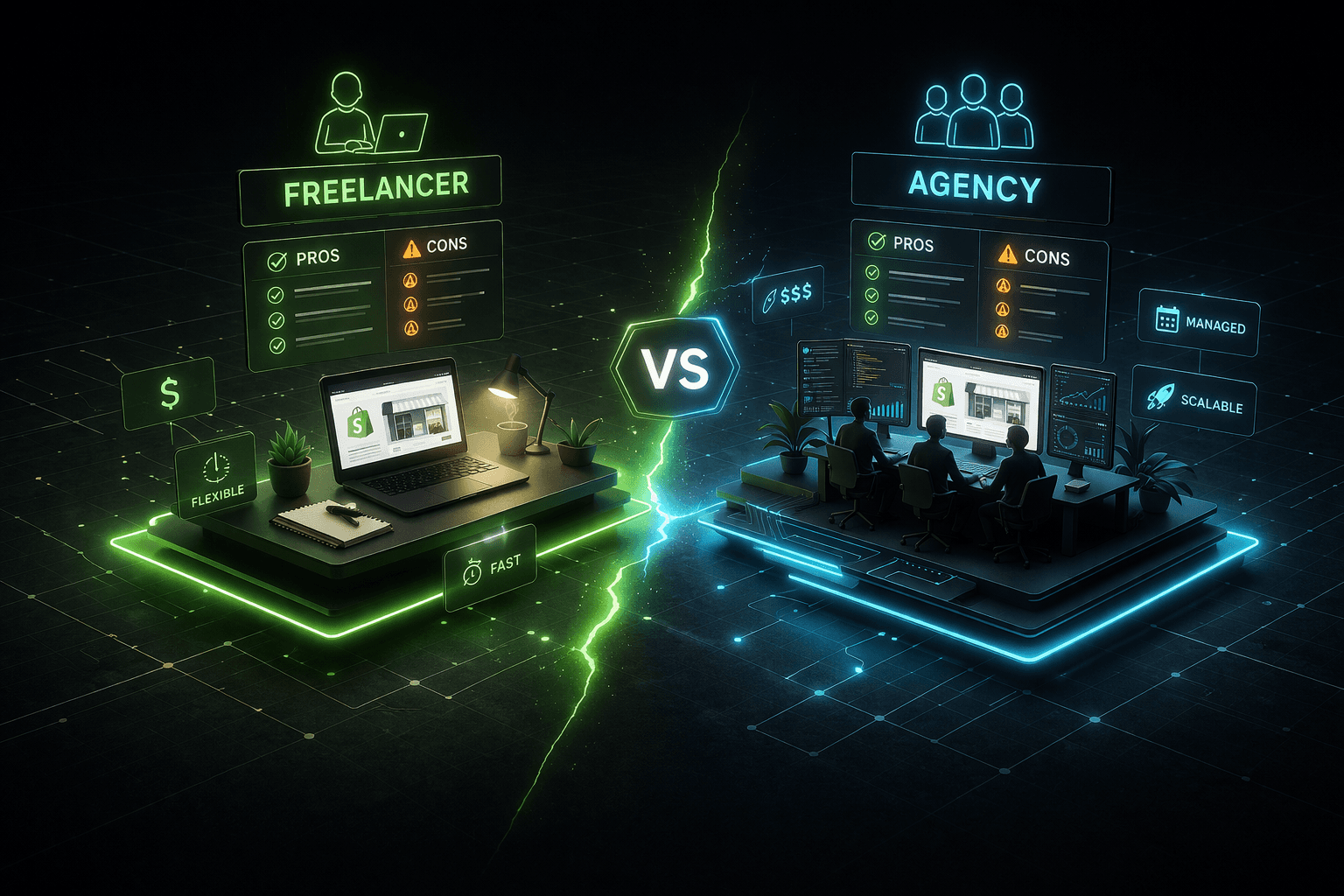
Shopify Freelancer vs Agency: Pros & Cons (2026)
Shopify freelancer vs agency: compare cost, expertise, speed, and ROI to choose the right development partner for your Shopify store in 2026.
08 min read
Core Strategic Sections
What Shopify Development Actually Includes Today
Before comparing freelancers and agencies, it's important to understand the scope of Shopify development in 2026.
Modern Shopify development involves multiple functions:
Development Layer | Responsibility |
|---|---|
Theme architecture | UI performance, page speed |
CRO infrastructure | landing pages, experimentation |
Checkout optimization | cart flows, upsells |
App integrations | subscriptions, reviews, loyalty |
Custom development | unique features |
Backend integrations | ERP, fulfillment, CRM |
Automation workflows | operational efficiency |
Because Shopify development spans multiple disciplines, the choice between freelancer and agency affects how many of these areas can be covered.
Shopify Freelancer: What It Typically Looks Like
A Shopify freelancer is an individual developer or small independent contractor.
Freelancers usually specialize in one or two areas:
theme customization
bug fixes
minor feature development
small integrations
Typical freelancer workflow:
hired for specific tasks
hourly billing
limited strategic involvement
Freelancers are often a good option for stores that require occasional technical work rather than continuous development.
Shopify Agency: What It Typically Looks Like
Shopify agencies provide teams of specialists covering different areas of ecommerce development.
A typical Shopify agency team includes:
Shopify developers
UX designers
CRO specialists
integration engineers
solution architects
Agencies often work across many Shopify stores, giving them deeper exposure to platform features like Shopify Plus capabilities and automation tools such as Shopify Flow.
This experience often translates into faster implementation of advanced commerce functionality.
Cost Comparison: Freelancer vs Agency
Cost is the most obvious difference between freelancers and agencies.
Typical pricing structure:
Option | Typical Cost |
|---|---|
Shopify freelancer | $30 – $120/hour |
senior Shopify freelancer | $100 – $200/hour |
Shopify agency | $120 – $250/hour |
agency retainer | $4,000 – $15,000/month |
Freelancers appear cheaper, but agencies often provide access to multiple specialists for the same engagement.
Cost efficiency therefore depends on project complexity.
Expertise Breadth
One of the biggest differences between freelancers and agencies is expertise coverage.
Capability | Freelancer | Agency |
|---|---|---|
theme development | strong | strong |
CRO expertise | limited | strong |
UX design | limited | strong |
integrations | moderate | strong |
automation architecture | limited | strong |
platform strategy | limited | strong |
Freelancers excel in execution tasks.
Agencies typically excel in strategic commerce architecture.
Execution Speed
Execution speed often differs depending on project size.
Project Type | Freelancer Speed | Agency Speed |
|---|---|---|
small fixes | fast | moderate |
feature development | moderate | fast |
full store build | slower | faster |
complex integrations | slower | faster |
CRO experimentation | limited | faster |
Agencies usually deploy structured workflows and teams, which helps accelerate large development projects.
Strategic Thinking vs Task Execution
Freelancers often work as task-based developers.
Example tasks:
updating theme sections
installing apps
fixing bugs
implementing small design changes
Agencies typically operate as commerce partners, contributing to:
CRO strategy
technical architecture
tech stack planning
performance optimization
For scaling ecommerce brands, this strategic layer becomes increasingly valuable.
Operational Reliability
Reliability is another factor businesses should consider.
Freelancer risks include:
limited availability
project interruptions
single point of failure
slower turnaround during high demand
Agencies mitigate these risks through:
structured project management
multiple developers
documented processes
redundancy within teams
This reliability becomes especially important for high-traffic ecommerce stores.
Scalability and Long-Term Growth
As Shopify brands scale, their development needs expand.
Scaling often requires:
ongoing CRO testing
marketing experimentation infrastructure
complex integrations
automation workflows
international expansion
Agencies usually handle these scaling challenges more effectively because they maintain multidisciplinary teams.
Freelancers can still play a role but may struggle to cover every requirement alone.
When a Freelancer Makes the Most Sense
Freelancers are often the right choice when:
the store is early-stage
development needs are occasional
budgets are limited
tasks are clearly defined
Common freelancer use cases:
theme tweaks
product page updates
small bug fixes
installing apps
When a Shopify Agency Is the Better Choice
Agencies usually make sense when:
the business is scaling rapidly
continuous development is required
integrations are complex
CRO optimization becomes important
Agency use cases include:
full Shopify store builds
major redesigns
Shopify Plus implementations
ongoing optimization retainers
Hybrid Model: The Most Common Setup
Many successful Shopify brands eventually adopt a hybrid structure.
Typical setup:
Function | Owner |
|---|---|
day-to-day fixes | freelancer or internal developer |
major development | agency |
CRO experiments | agency |
architecture planning | agency |
marketing integrations | agency |
This approach balances cost efficiency with access to specialized expertise.
Bottom Line: What Metrics Should Drive the Decision?
Choosing between a freelancer and an agency should ultimately be based on business performance outcomes.
Key metrics include:
conversion rate
average order value (AOV)
customer acquisition cost (CAC)
ROAS or MER
contribution margin
customer lifetime value (LTV)
operational cost per order
app stack subscription cost
development investment vs payback period
Example ROI Scenario
Assume:
100,000 monthly visitors
2.1% conversion rate
$90 AOV
Monthly revenue ≈ $189,000.
If improved development and CRO infrastructure increase conversion to 2.6%, revenue becomes ≈ $234,000.
That $45,000 monthly lift can easily justify a stronger development partner.
The question becomes which partner structure delivers that improvement faster.
Forward View (2026 and Beyond)
The Shopify ecosystem is evolving rapidly, which will influence how businesses choose development partners.
Several major trends are shaping this shift.
AI-assisted commerce
Tools like Shopify Magic are accelerating product content generation and merchandising insights.
Automation-driven operations
Automation workflows are increasingly replacing manual operational tasks.
App stack consolidation
Shopify continues integrating features previously handled by third-party apps.
Unified commerce infrastructure
Retail stores, marketplaces, and direct-to-consumer channels are becoming part of unified commerce ecosystems.
As Shopify development becomes more complex, businesses will increasingly prioritize partners who combine technical expertise with commerce strategy.
FAQs
Are Shopify agencies worth the cost?
For scaling ecommerce businesses, agencies often deliver stronger ROI because they combine development expertise with commerce strategy.
Do large Shopify brands use freelancers?
Large brands occasionally hire freelancers for specific tasks, but most rely on agencies or internal teams for core development.
Can freelancers handle Shopify Plus development?
Some experienced freelancers can, but Shopify Plus projects often require multiple specialists.
What is the biggest advantage of working with an agency?
Access to multidisciplinary expertise including development, CRO, UX, and integrations.
What is the biggest advantage of freelancers?
Lower cost and flexibility for smaller projects.
Direct Answers
Is it better to hire a Shopify freelancer or an agency?
Freelancers are suitable for small tasks or early-stage stores, while agencies provide broader expertise for scaling ecommerce businesses.
How much does a Shopify freelancer cost?
Freelancers typically charge $30–$120 per hour depending on experience and project complexity.
How much do Shopify agencies charge?
Shopify agencies usually charge $120–$250 per hour or $4,000–$15,000 monthly retainers.
Can freelancers build full Shopify stores?
Yes, but complex stores with integrations and CRO requirements often benefit from agency teams.
INSIGHTS
Expert perspectives on design, AI, and growth.
Explore our latest strategies for scaling high-performance creative in a digital world.



View more