

Shopify
Shopify Fulfilment Cost Per Order: How to Calculate Your True D2C Cost
Shopify Fulfilment Cost Per Order: How to Calculate Your True D2C Cost
Most Shopify brands underestimate their fulfilment cost per order. Use this framework to calculate every cost layer — from pick and pack to returns — and protect your margins.
Most Shopify brands underestimate their fulfilment cost per order. Use this framework to calculate every cost layer — from pick and pack to returns — and protect your margins.
08 min read
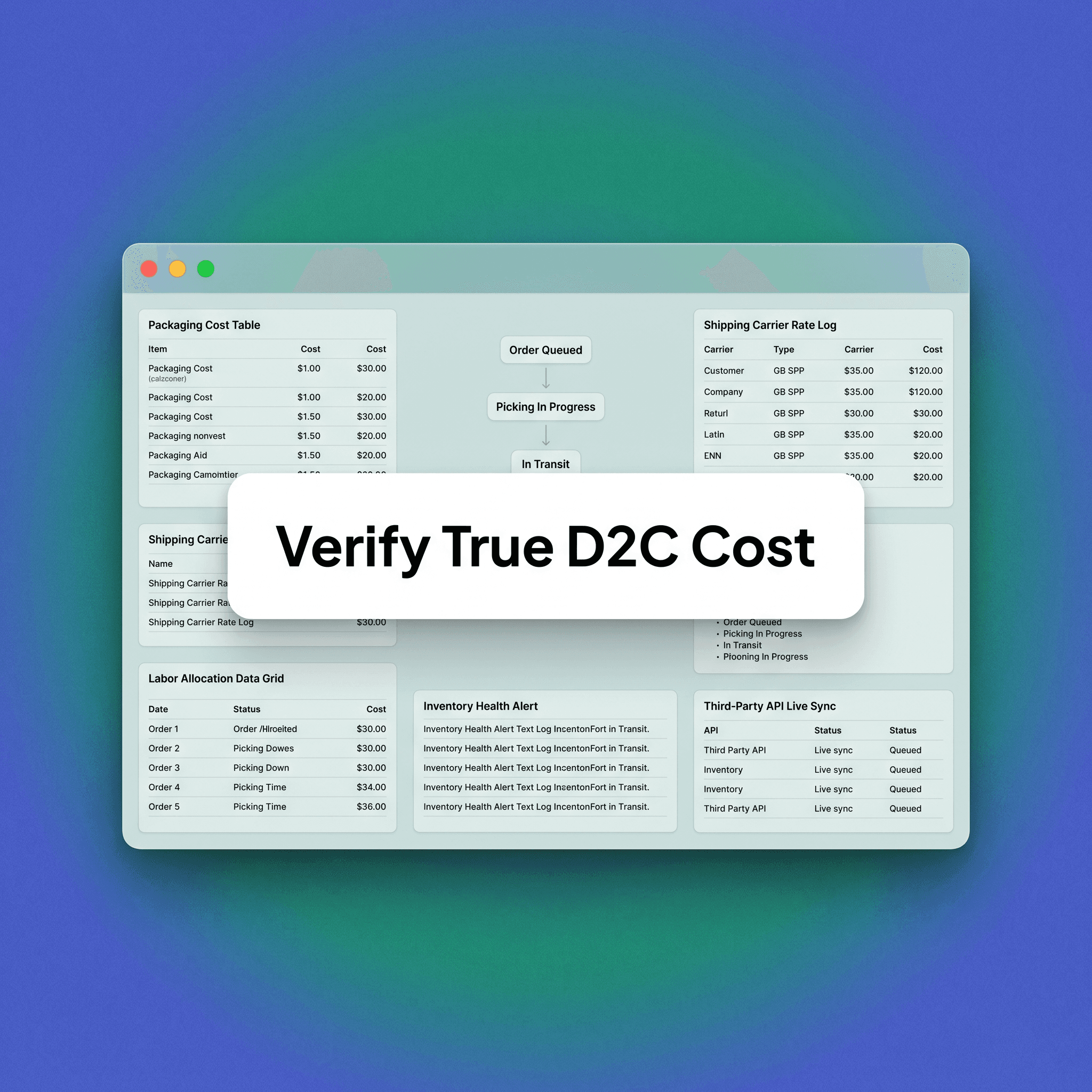
Shopify Fulfilment Cost Per Order: How to Calculate Your True D2C Fulfilment Cost. Most Shopify brands know their shipping label cost, yet very few know their actual fulfilment cost per order — and that gap is quietly eroding margin on every single shipment. By failing to account for the operational reality of moving products from warehouse shelves to customers' doorsteps, brands risk subsidizing their own growth through hidden inefficiencies that stay buried in aggregate overhead reports.
Your carrier rate is not your fulfilment cost; it is merely one isolated line item in a much longer, more complex bill that encompasses every touchpoint of your supply chain. If you are pricing products, setting free shipping thresholds, or evaluating a 3PL without knowing your true cost per order, you are making critical business decisions on incomplete, potentially misleading data.
This post walks through exactly how to calculate your real fulfilment cost using The True Fulfilment Cost Stack — a layered framework built specifically for D2C operators who need absolute clarity, not just a rough or estimated number, to ensure long-term profitability.
Why Most D2C Brands Misread Their Fulfilment Cost
The most common mistake is treating the postage cost as the total fulfilment cost. A Shopify store sees $7.20 on a shipping label and records that as the cost to ship the order, but the actual cost is closer to $12–18 once you account for everything that touched that order before and after it left the building. This pervasive error occurs because fulfilment costs are distributed across multiple cost centres — warehousing, labour, packaging, software, and returns — none of which appear on the standard carrier shipping invoice.
They show up in disparate ledger line items, or they are absorbed into general overhead without being attributed to fulfilment at all, masking the true operational drag on your bottom line. The result is a unit economics model that looks significantly healthier than it actually is, leading founders to double down on acquisition strategies that are ultimately draining their cash reserves. By failing to segment these costs, operators lose the ability to identify whether their profitability issue is driven by poor conversion, high product returns, or an inefficient physical logistics process that requires immediate restructuring.
The True Fulfilment Cost Stack
This is the framework used by top-tier D2C brands. Apply it to one individual order, then scale it across your average monthly volume to get a highly reliable per-order figure that reflects your true operational reality.
Layer 1: Inbound and Storage Costs
Before an order ever ships, you are already paying to receive, process, and store your inventory, which acts as a foundational tax on every item in your catalog.
Inbound receiving fees: Charged per pallet, carton, or SKU if you are utilizing a 3PL service for your logistics.
Storage fees: Typically charged per pallet, bin, or cubic metre per week or month based on your physical footprint.
Inventory management overhead: The hidden costs of staff time or software allocations dedicated specifically to stock reconciliation and management.
To calculate the storage cost per order accurately, you must divide your total monthly storage spend by the total number of orders shipped that month. If you are holding slow-moving stock that sits for extended periods, this number spikes dramatically and directly cannibalizes the margin of your faster-moving items. This layer is crucial for identifying 'dead weight' in your inventory that inflates your storage footprint without contributing to your overall revenue velocity.
Layer 2: Pick and Pack Labour
This is the most variable cost in the stack and the one most commonly underreported by brands that are attempting to manage their own fulfilment in-house without precise tracking.
Pick fee: The actual labour cost to locate and retrieve each individual SKU from its specific storage location within your facility.
Pack fee: The labour time required to assemble, protect, and seal each order into its shipping container for the courier.
Quality check time: Any necessary inspection, gift note inclusion, or verification step performed per order to ensure accuracy before dispatch.
For in-house operations, calculate this by tracking the number of orders packed per hour and dividing your total hourly labour cost (including on-costs like payroll tax and benefits) by that figure. A reasonable in-house benchmark is 3–6 minutes per order depending on the complexity of your SKU count. At $25/hour fully loaded, that represents $1.25–$2.50 in labour per order before you have touched a single shipping label. 3PLs will quote this as a per-order pick fee plus a per-item fee, and you must read the contract carefully because multi-SKU orders can cause these costs to escalate much faster than anticipated.
Layer 3: Packaging Materials
Often treated as a COGS (Cost of Goods Sold) line rather than a fulfilment line, which effectively distorts both of these critical financial numbers in your reporting.
Outer carton or mailer: The primary vessel for your shipment, which varies significantly by product dimensions.
Void fill, tissue paper, or protective inserts: The secondary materials used to prevent damage during transit and enhance the unboxing experience.
Branded packaging premium: The extra cost associated with custom printing, high-end materials, or unique unboxing design elements.
Tape, labels, desiccants, or product-specific packaging: Small items that are easy to ignore but add up to significant costs over thousands of shipments.
Calculate the average landed cost of your packaging materials per order based on your actual procurement spend. If you buy in bulk, use your actual cost per unit at your typical order volume — not the best-case price you could theoretically achieve at a volume you aren't currently hitting. This transparency is vital because packaging choice is one of the few variables you can easily adjust to improve margins without sacrificing the speed or quality of your logistical execution.
Layer 4: Carrier and Postage Cost
This is the number most brands already track diligently, but it often misses the fine print that adds hidden dollars to every single delivery.
Base carrier rate: The primary cost charged by the service provider for the movement of the package.
Fuel surcharge: Variable fees that are added by carriers to account for fluctuating energy market prices.
Residential delivery surcharge: Additional fees often applied when delivering to non-commercial addresses.
Oversize or dimensional weight uplift: Penalties incurred when the box size is disproportionate to the actual weight of the contents.
Signature or special handling fees: Extra services required for high-value items or sensitive goods.
Any carrier insurance or declared value charge: Protection fees that ensure you are covered against lost or damaged parcels during transit.
Your Shopify Shipping or carrier dashboard will show the label cost, but you must pull a 30-day average across all orders to get a reliable mean. Segment these costs by shipping zone or weight tier if your product mix varies significantly, as shipping a heavy, low-value item to a distant zone can completely destroy the profitability of that specific transaction.
Layer 5: Fulfilment Software and Platform Fees
These are very real operational costs that are too often ignored, yet they must be attributed to fulfilment to accurately measure the cost of your logistics platform.
Order management system (OMS) fees: The monthly cost of software that coordinates your order flow from your website to the warehouse.
Warehouse management system (WMS) fees: Costs associated with software if you are using a 3PL that passes these fees through directly.
Shipping rate comparison tools or plugins: Subscriptions for software that helps you choose the cheapest carrier option for each shipment.
Barcode scanning or printing infrastructure: Amortized costs of scanners, printers, and labels based on your annual order volume.
Divide your monthly total software cost for all fulfilment tools by your monthly order volume to find the per-order allocation. On low volumes, this per-order cost is surprisingly high, highlighting why scaling your volume is necessary to normalize these fixed software costs.
Layer 6: Returns Processing
Returns are fundamentally a fulfilment cost, yet most brands only track the refund amount while ignoring the heavy operational labour required for reverse logistics.
Return postage: The cost incurred if your brand offers free or prepaid return shipping for customers.
Returns processing labour: The time required to receive, inspect, grade, and handle the returned item.
Repackaging cost: The expense of fresh polybags, new boxes, or tissue paper to make the item 'like new' for resale.
Write-off cost: The total value lost when a returned item is damaged or unsellable and must be liquidated or discarded.
Calculate your average return rate (total returns divided by total orders), then estimate the average cost to process one return. Multiply these together and add the result as a per-order allocation across all your orders shipped. If your return rate is 15% and returns cost you $8 to process, that is $1.20 allocated to every order you ship — including the 85% of orders that were never returned.
Layer 7: Overhead Allocation
For brands running their own warehouse or private fulfilment space, overhead must be included in your unit economics to get an honest assessment of profitability.
Rent or lease cost: The portion of your warehouse footprint dedicated exclusively to fulfilment activities.
Utilities: Costs for power, internet, and HVAC proportional to your fulfilment operations.
Insurance: General liability and cargo insurance coverage for your warehouse and stock.
Equipment depreciation: The aging costs of forklifts, shelving units, packing stations, and conveyor systems.
Divide the monthly overhead by your order volume. This is often the specific number that makes in-house fulfilment look significantly less competitive than assumed when compared honestly to a third-party 3PL quote. By failing to include this, you are effectively hiding your facility costs inside your business's general P&L rather than attaching them to the cost of fulfilling your customers' orders.
How to Run the Calculation
Add up all seven layers for a given month, then divide by the total number of orders shipped in that month to derive your True Fulfilment Cost Per Order.
True Fulfilment Cost Per Order = (Inbound + Storage + Pick & Pack + Packaging + Postage + Software + Returns + Overhead) ÷ Orders Shipped. Run this calculation at your current volume, then model it at 1.5x and 2x volume to understand exactly how your cost structure scales under pressure.
Some costs are fixed, such as overhead and software, which will improve per order as your volume grows, effectively increasing your margins. Other costs, such as postage and pick fees, are variable and will not scale down easily, which dictates your long-term ability to maintain profitability at higher volumes.
That distinction is the primary factor for deciding whether you should continue to scale in-house operations or shift your fulfillment to a professional 3PL partner that specializes in these efficiencies.
Common Mistakes When Calculating Fulfilment Cost
Treating postage as the total cost: This is the most pervasive error in the D2C space, as it ignores the 40–60% of costs occurring inside the warehouse walls.
Ignoring in-house labour on-costs: Gross hourly wage is not your true cost; you must add payroll tax, mandatory employer contributions, leave entitlements, and management oversight to get an accurate figure.
Using best-case packaging costs: Do not use the price you would pay if you ordered 10,000 units; use the cost you actually pay at your current, realistic order volume and reorder frequency.
Forgetting dimensional weight: Carriers charge based on dimensional weight when it exceeds actual weight, meaning a lightweight product in a large box is rarely cheap to ship.
Not attributing returns to fulfilment: Returns are an essential, non-negotiable part of the fulfillment cycle, and excluding them leads to significantly overstated gross margins.
Comparing 3PL quotes to in-house postage only: A 3PL quote bundles pick, pack, and postage; compare it to your entire True Fulfilment Cost Stack, not just your base carrier rate.
What a Healthy Fulfilment Cost Looks Like
There is no universal benchmark because product weight, order value, and geography vary too much, but these reference frames are essential for any audit.
Fulfilment cost as a percentage of revenue: The industry standard for sustainable D2C brands is to target between 8–15% of your total order revenue.
Low-AOV products (under $40): For these items, the fulfilment cost percentage is often your biggest margin risk, requiring extreme efficiency in packaging and shipping selection.
High-AOV products (over $120): Here, the fulfilment cost is generally more manageable, but it remains worth auditing to ensure that you aren't losing money on 'free shipping' promises.
If your fulfilment cost is consistently above 20% of your revenue and your AOV is under $60, that is a structural problem that growth will not fix — it will only amplify your losses. You must either raise prices, improve your AOV through bundling, or fundamentally overhaul your logistics to bring these costs into alignment with your financial goals.
When to Reassess Your Fulfilment Setup
Run the True Fulfilment Cost Stack calculation quarterly, or immediately if any of these triggers occur in your business cycle:
Volume shifts: You are approaching a new volume tier, such as moving from 500 to 2,000 orders per month, which changes your leverage with 3PLs and carriers.
Product changes: You are launching a new product category that has significantly different weight or dimension profiles than your current catalog.
Geographic expansion: You are entering new geographies or adding international shipping, which introduces complex tax and customs complications.
3PL evaluation: You receive a new 3PL quote and need to compare it honestly against your current, fully loaded in-house performance.
Margin compression: Your gross margin has unexpectedly declined and you cannot identify exactly which operational layer is causing the erosion.
The final number changes constantly with volume, carrier rate negotiations, supplier price shifts, and changes in your product mix. Recalculating this stack regularly keeps your unit economics honest and ensures your brand remains structurally sound as it scales to meet market demand.
Shopify Fulfilment Cost Per Order: How to Calculate Your True D2C Fulfilment Cost. Most Shopify brands know their shipping label cost, yet very few know their actual fulfilment cost per order — and that gap is quietly eroding margin on every single shipment. By failing to account for the operational reality of moving products from warehouse shelves to customers' doorsteps, brands risk subsidizing their own growth through hidden inefficiencies that stay buried in aggregate overhead reports.
Your carrier rate is not your fulfilment cost; it is merely one isolated line item in a much longer, more complex bill that encompasses every touchpoint of your supply chain. If you are pricing products, setting free shipping thresholds, or evaluating a 3PL without knowing your true cost per order, you are making critical business decisions on incomplete, potentially misleading data.
This post walks through exactly how to calculate your real fulfilment cost using The True Fulfilment Cost Stack — a layered framework built specifically for D2C operators who need absolute clarity, not just a rough or estimated number, to ensure long-term profitability.
Why Most D2C Brands Misread Their Fulfilment Cost
The most common mistake is treating the postage cost as the total fulfilment cost. A Shopify store sees $7.20 on a shipping label and records that as the cost to ship the order, but the actual cost is closer to $12–18 once you account for everything that touched that order before and after it left the building. This pervasive error occurs because fulfilment costs are distributed across multiple cost centres — warehousing, labour, packaging, software, and returns — none of which appear on the standard carrier shipping invoice.
They show up in disparate ledger line items, or they are absorbed into general overhead without being attributed to fulfilment at all, masking the true operational drag on your bottom line. The result is a unit economics model that looks significantly healthier than it actually is, leading founders to double down on acquisition strategies that are ultimately draining their cash reserves. By failing to segment these costs, operators lose the ability to identify whether their profitability issue is driven by poor conversion, high product returns, or an inefficient physical logistics process that requires immediate restructuring.
The True Fulfilment Cost Stack
This is the framework used by top-tier D2C brands. Apply it to one individual order, then scale it across your average monthly volume to get a highly reliable per-order figure that reflects your true operational reality.
Layer 1: Inbound and Storage Costs
Before an order ever ships, you are already paying to receive, process, and store your inventory, which acts as a foundational tax on every item in your catalog.
Inbound receiving fees: Charged per pallet, carton, or SKU if you are utilizing a 3PL service for your logistics.
Storage fees: Typically charged per pallet, bin, or cubic metre per week or month based on your physical footprint.
Inventory management overhead: The hidden costs of staff time or software allocations dedicated specifically to stock reconciliation and management.
To calculate the storage cost per order accurately, you must divide your total monthly storage spend by the total number of orders shipped that month. If you are holding slow-moving stock that sits for extended periods, this number spikes dramatically and directly cannibalizes the margin of your faster-moving items. This layer is crucial for identifying 'dead weight' in your inventory that inflates your storage footprint without contributing to your overall revenue velocity.
Layer 2: Pick and Pack Labour
This is the most variable cost in the stack and the one most commonly underreported by brands that are attempting to manage their own fulfilment in-house without precise tracking.
Pick fee: The actual labour cost to locate and retrieve each individual SKU from its specific storage location within your facility.
Pack fee: The labour time required to assemble, protect, and seal each order into its shipping container for the courier.
Quality check time: Any necessary inspection, gift note inclusion, or verification step performed per order to ensure accuracy before dispatch.
For in-house operations, calculate this by tracking the number of orders packed per hour and dividing your total hourly labour cost (including on-costs like payroll tax and benefits) by that figure. A reasonable in-house benchmark is 3–6 minutes per order depending on the complexity of your SKU count. At $25/hour fully loaded, that represents $1.25–$2.50 in labour per order before you have touched a single shipping label. 3PLs will quote this as a per-order pick fee plus a per-item fee, and you must read the contract carefully because multi-SKU orders can cause these costs to escalate much faster than anticipated.
Layer 3: Packaging Materials
Often treated as a COGS (Cost of Goods Sold) line rather than a fulfilment line, which effectively distorts both of these critical financial numbers in your reporting.
Outer carton or mailer: The primary vessel for your shipment, which varies significantly by product dimensions.
Void fill, tissue paper, or protective inserts: The secondary materials used to prevent damage during transit and enhance the unboxing experience.
Branded packaging premium: The extra cost associated with custom printing, high-end materials, or unique unboxing design elements.
Tape, labels, desiccants, or product-specific packaging: Small items that are easy to ignore but add up to significant costs over thousands of shipments.
Calculate the average landed cost of your packaging materials per order based on your actual procurement spend. If you buy in bulk, use your actual cost per unit at your typical order volume — not the best-case price you could theoretically achieve at a volume you aren't currently hitting. This transparency is vital because packaging choice is one of the few variables you can easily adjust to improve margins without sacrificing the speed or quality of your logistical execution.
Layer 4: Carrier and Postage Cost
This is the number most brands already track diligently, but it often misses the fine print that adds hidden dollars to every single delivery.
Base carrier rate: The primary cost charged by the service provider for the movement of the package.
Fuel surcharge: Variable fees that are added by carriers to account for fluctuating energy market prices.
Residential delivery surcharge: Additional fees often applied when delivering to non-commercial addresses.
Oversize or dimensional weight uplift: Penalties incurred when the box size is disproportionate to the actual weight of the contents.
Signature or special handling fees: Extra services required for high-value items or sensitive goods.
Any carrier insurance or declared value charge: Protection fees that ensure you are covered against lost or damaged parcels during transit.
Your Shopify Shipping or carrier dashboard will show the label cost, but you must pull a 30-day average across all orders to get a reliable mean. Segment these costs by shipping zone or weight tier if your product mix varies significantly, as shipping a heavy, low-value item to a distant zone can completely destroy the profitability of that specific transaction.
Layer 5: Fulfilment Software and Platform Fees
These are very real operational costs that are too often ignored, yet they must be attributed to fulfilment to accurately measure the cost of your logistics platform.
Order management system (OMS) fees: The monthly cost of software that coordinates your order flow from your website to the warehouse.
Warehouse management system (WMS) fees: Costs associated with software if you are using a 3PL that passes these fees through directly.
Shipping rate comparison tools or plugins: Subscriptions for software that helps you choose the cheapest carrier option for each shipment.
Barcode scanning or printing infrastructure: Amortized costs of scanners, printers, and labels based on your annual order volume.
Divide your monthly total software cost for all fulfilment tools by your monthly order volume to find the per-order allocation. On low volumes, this per-order cost is surprisingly high, highlighting why scaling your volume is necessary to normalize these fixed software costs.
Layer 6: Returns Processing
Returns are fundamentally a fulfilment cost, yet most brands only track the refund amount while ignoring the heavy operational labour required for reverse logistics.
Return postage: The cost incurred if your brand offers free or prepaid return shipping for customers.
Returns processing labour: The time required to receive, inspect, grade, and handle the returned item.
Repackaging cost: The expense of fresh polybags, new boxes, or tissue paper to make the item 'like new' for resale.
Write-off cost: The total value lost when a returned item is damaged or unsellable and must be liquidated or discarded.
Calculate your average return rate (total returns divided by total orders), then estimate the average cost to process one return. Multiply these together and add the result as a per-order allocation across all your orders shipped. If your return rate is 15% and returns cost you $8 to process, that is $1.20 allocated to every order you ship — including the 85% of orders that were never returned.
Layer 7: Overhead Allocation
For brands running their own warehouse or private fulfilment space, overhead must be included in your unit economics to get an honest assessment of profitability.
Rent or lease cost: The portion of your warehouse footprint dedicated exclusively to fulfilment activities.
Utilities: Costs for power, internet, and HVAC proportional to your fulfilment operations.
Insurance: General liability and cargo insurance coverage for your warehouse and stock.
Equipment depreciation: The aging costs of forklifts, shelving units, packing stations, and conveyor systems.
Divide the monthly overhead by your order volume. This is often the specific number that makes in-house fulfilment look significantly less competitive than assumed when compared honestly to a third-party 3PL quote. By failing to include this, you are effectively hiding your facility costs inside your business's general P&L rather than attaching them to the cost of fulfilling your customers' orders.
How to Run the Calculation
Add up all seven layers for a given month, then divide by the total number of orders shipped in that month to derive your True Fulfilment Cost Per Order.
True Fulfilment Cost Per Order = (Inbound + Storage + Pick & Pack + Packaging + Postage + Software + Returns + Overhead) ÷ Orders Shipped. Run this calculation at your current volume, then model it at 1.5x and 2x volume to understand exactly how your cost structure scales under pressure.
Some costs are fixed, such as overhead and software, which will improve per order as your volume grows, effectively increasing your margins. Other costs, such as postage and pick fees, are variable and will not scale down easily, which dictates your long-term ability to maintain profitability at higher volumes.
That distinction is the primary factor for deciding whether you should continue to scale in-house operations or shift your fulfillment to a professional 3PL partner that specializes in these efficiencies.
Common Mistakes When Calculating Fulfilment Cost
Treating postage as the total cost: This is the most pervasive error in the D2C space, as it ignores the 40–60% of costs occurring inside the warehouse walls.
Ignoring in-house labour on-costs: Gross hourly wage is not your true cost; you must add payroll tax, mandatory employer contributions, leave entitlements, and management oversight to get an accurate figure.
Using best-case packaging costs: Do not use the price you would pay if you ordered 10,000 units; use the cost you actually pay at your current, realistic order volume and reorder frequency.
Forgetting dimensional weight: Carriers charge based on dimensional weight when it exceeds actual weight, meaning a lightweight product in a large box is rarely cheap to ship.
Not attributing returns to fulfilment: Returns are an essential, non-negotiable part of the fulfillment cycle, and excluding them leads to significantly overstated gross margins.
Comparing 3PL quotes to in-house postage only: A 3PL quote bundles pick, pack, and postage; compare it to your entire True Fulfilment Cost Stack, not just your base carrier rate.
What a Healthy Fulfilment Cost Looks Like
There is no universal benchmark because product weight, order value, and geography vary too much, but these reference frames are essential for any audit.
Fulfilment cost as a percentage of revenue: The industry standard for sustainable D2C brands is to target between 8–15% of your total order revenue.
Low-AOV products (under $40): For these items, the fulfilment cost percentage is often your biggest margin risk, requiring extreme efficiency in packaging and shipping selection.
High-AOV products (over $120): Here, the fulfilment cost is generally more manageable, but it remains worth auditing to ensure that you aren't losing money on 'free shipping' promises.
If your fulfilment cost is consistently above 20% of your revenue and your AOV is under $60, that is a structural problem that growth will not fix — it will only amplify your losses. You must either raise prices, improve your AOV through bundling, or fundamentally overhaul your logistics to bring these costs into alignment with your financial goals.
When to Reassess Your Fulfilment Setup
Run the True Fulfilment Cost Stack calculation quarterly, or immediately if any of these triggers occur in your business cycle:
Volume shifts: You are approaching a new volume tier, such as moving from 500 to 2,000 orders per month, which changes your leverage with 3PLs and carriers.
Product changes: You are launching a new product category that has significantly different weight or dimension profiles than your current catalog.
Geographic expansion: You are entering new geographies or adding international shipping, which introduces complex tax and customs complications.
3PL evaluation: You receive a new 3PL quote and need to compare it honestly against your current, fully loaded in-house performance.
Margin compression: Your gross margin has unexpectedly declined and you cannot identify exactly which operational layer is causing the erosion.
The final number changes constantly with volume, carrier rate negotiations, supplier price shifts, and changes in your product mix. Recalculating this stack regularly keeps your unit economics honest and ensures your brand remains structurally sound as it scales to meet market demand.
FAQ
What is included in Shopify fulfilment cost per order?
Shopify fulfilment cost per order includes every cost required to receive, store, pick, pack, ship, and process returns for a single order. This covers inbound and storage fees, pick and pack labour, packaging materials, carrier postage (including surcharges), fulfilment software fees, returns processing, and warehouse overhead. Most brands only track postage, which significantly understates the true cost.
How do I calculate fulfilment cost per order for my Shopify store?
Add up all fulfilment-related costs for a given month — including labour, storage, packaging, postage, software, and returns — and divide by the number of orders shipped in that period. This gives you your average true fulfilment cost per order. The True Fulfilment Cost Stack framework in this post provides a layer-by-layer structure for capturing every cost category.
Why is my actual fulfilment cost higher than my shipping label cost?
Your shipping label only reflects the carrier charge. Fulfilment also includes the labour to pick and pack the order, the cost of packaging materials, the cost of storing inventory before it ships, the returns processing cost allocated across all orders, and any software or overhead costs attributed to fulfilment operations. Each of these layers adds to the true cost.
What is a reasonable fulfilment cost per order for a D2C brand?
It depends on product type, order value, and shipping geography, but most sustainable D2C brands target fulfilment cost at 8–15% of revenue. If fulfilment cost exceeds 20% of revenue and your average order value is under $60, it is worth reviewing your packaging, carrier rates, and operational model before scaling.
How does dimensional weight affect my fulfilment cost on Shopify?
Carriers calculate the shipping charge based on whichever is greater — the actual weight or the dimensional weight (box volume divided by the carrier's DIM factor). If your product is lightweight but ships in a larger box, you may be charged far more than the product's actual weight suggests. Always check dimensional weight for each SKU and factor it into your true carrier cost calculation.
When should I compare in-house fulfilment to a 3PL?
Compare when your volume is growing, when your per-order cost is increasing rather than decreasing with scale, or when your team's time is increasingly absorbed by operational tasks rather than growth work. The comparison must use your full True Fulfilment Cost Stack — not just carrier rates — otherwise the analysis will be skewed.
How does returns rate affect my cost per order?
Returns create a cost that must be allocated across all orders shipped, not just returned ones. If your return rate is 15% and it costs $8 to process each return, you are adding $1.20 to the effective cost of every order you ship. High return rates in particular categories (apparel, footwear) can materially shift your unit economics if not included in the calculation.
insights
Explore more on AI, Design and Growth

SEO
Google AI & Local SEO: Rank in Both (2026 Guide)
Learn how to optimize content for Google AI search and local SEO simultaneously to rank in AI Overviews, maps, and organic search results.

SEO
Semantic Content Clusters for SEO & AEO (Templates)
Learn how to build semantic content clusters for SEO and AEO. Includes practical templates, internal linking structures, and examples for ranking in AI search.

SEO
How Google AI Search Works: RankBrain to Gemini (2026)
Discover how Google’s AI search evolved from RankBrain to Gemini and what it means for SEO, AI search results, and ranking strategies in 2026.
SEO
Google AI & Local SEO: Rank in Both (2026 Guide)
Learn how to optimize content for Google AI search and local SEO simultaneously to rank in AI Overviews, maps, and organic search results.
SEO
Semantic Content Clusters for SEO & AEO (Templates)
Learn how to build semantic content clusters for SEO and AEO. Includes practical templates, internal linking structures, and examples for ranking in AI search.
get in touch
Ready to Grow From Day One?
Strategy, execution, and digital experiences designed to move together. Fill out the form below and our team will contact you shortly.
get in touch
Ready to Grow From Day One?
Strategy, execution, and digital experiences designed to move together. Fill out the form below and our team will contact you shortly.
get in touch
Ready to Grow From Day One?
Strategy, execution, and digital experiences designed to move together. Fill out the form below and our team will contact you shortly.
Services
We'd love to hear from you.
Tell us what you're building and where you need support.
© 2026 projectsupply AI, Data and Digital Engineering
Company. Pune, India. All rights reserved.
Part of Tangle
Services
We'd love to hear from you.
Tell us what you're building and where you need support.
© 2026 projectsupply AI, Data and Digital Engineering
Company. Pune, India. All rights reserved.
Part of Tangle
Services
We'd love to hear from you.
Tell us what you're building and where you need support.
© 2026 projectsupply AI, Data and Digital Engineering
Company. Pune, India. All rights reserved.
Part of Tangle