
Ecommerce Development
Shopify Health Brand Store Template: Compliance-Safe Page Architecture That Converts
Shopify Health Brand Store Template: Compliance-Safe Page Architecture That Converts
08 min read
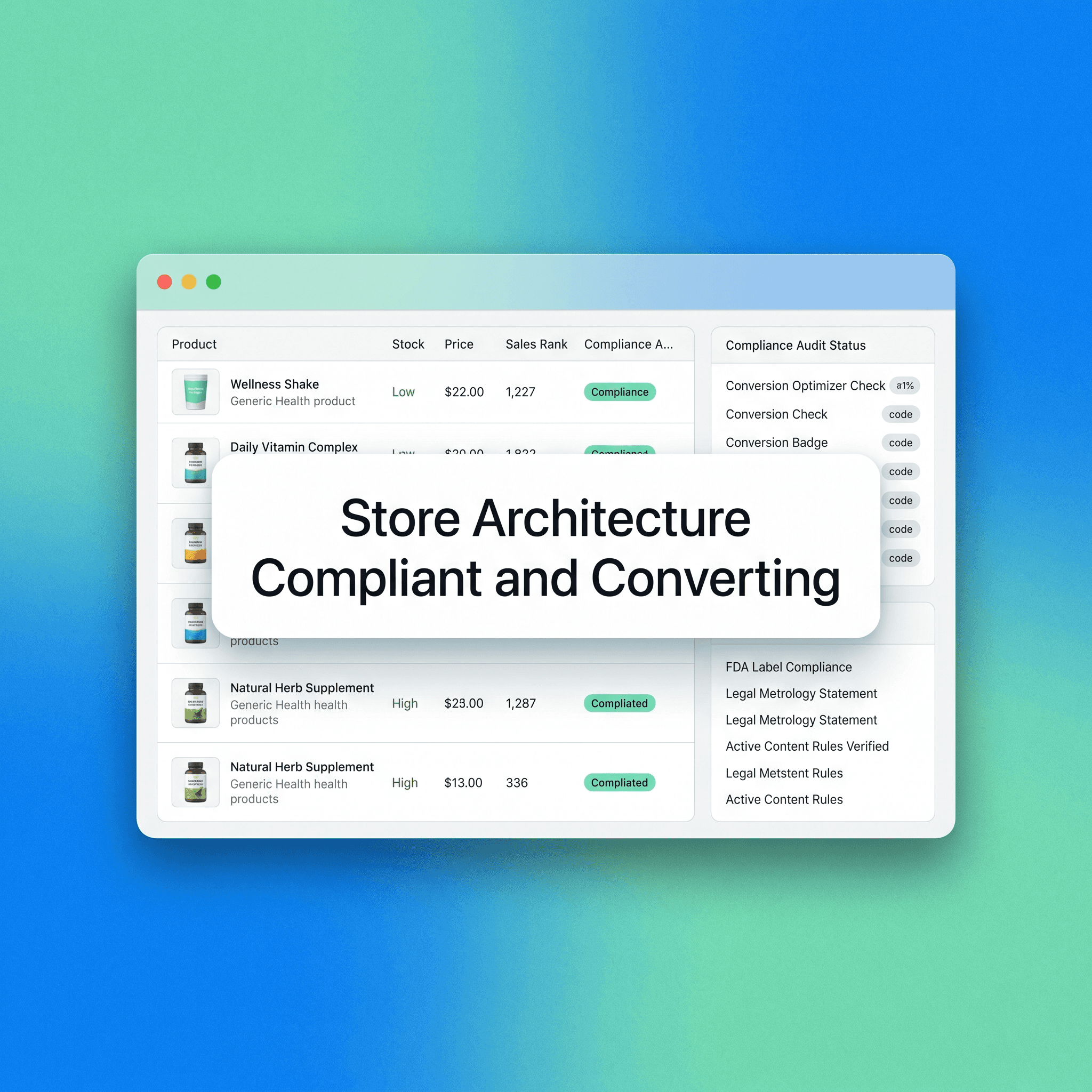
Building a Shopify health brand store isn't the same as building any other ecommerce store, as it requires a specialized approach to digital infrastructure. Health, supplement, and wellness brands operate under a specific set of advertising restrictions, claims regulations, and platform policies that other verticals don't face, making the initial build phase critical for long-term viability. Get the page architecture wrong, and you're looking at ad account flags, payment processor reviews, or worse — regulatory exposure that could halt your revenue stream entirely. This guide gives you a working template, a page-by-page structure designed for Shopify health brands that need to convert without cutting compliance corners. We call it the HBCA Framework, a proprietary methodology built to align conversion optimization with the strict requirements of health-adjacent digital commerce.
What Makes a Health Brand Shopify Store Different?
Most Shopify store guides are written for general ecommerce, yet health brands have three primary constraints that fundamentally change the entire build strategy.
Regulatory claims risk. The FDA regulates what supplement and wellness brands can say on-page, and structure/function claims require specific, prominent disclaimers. Disease claims are prohibited entirely, meaning your entire content strategy must be curated to remain within safe, legal boundaries. Your page copy needs to be written with this in mind from the start — not patched in after launch, as the FDA has the authority to monitor digital storefronts for non-compliant health promises.
Ad platform sensitivity. Meta and Google both flag health-related stores for policy review, and automated crawlers are becoming increasingly aggressive in identifying non-compliant language. Landing pages, product pages, and checkout flows are scanned continuously for trigger words, before/after language, and medical imagery, which can cause platform-wide account suspensions long before you have established a reliable customer base.
Payment processor scrutiny. Stripe, Shopify Payments, and other processors flag high-risk verticals including supplements and CBD because of the inherent chargeback and regulatory risks associated with the industry. Your store's page content, refund policy, and business documentation all factor into account reviews, and a non-compliant or confusing store architecture is often the first reason a processor will terminate a merchant account.
None of these are reasons to avoid the space, as health and wellness remains a massive, high-growth sector. They are simply reasons to build the store correctly the first time, ensuring that your compliance is as robust as your marketing funnel.
The HBCA Framework: Health Brand Compliance Architecture
The HBCA Framework is a page-level structure for Shopify health brand stores that treats compliance as a foundational conversion element rather than an obstacle. It maps every core page to its specific compliance requirement and its intended conversion function, proving that the two are not in conflict — a fully compliant page can and should be a high-converting asset. The framework covers seven page categories, including the Homepage, Product Detail Page, Collections Page, About/Brand Story Page, Ingredient/Science Page, Compliance Anchor Pages, and the Checkout/Post-Purchase flow. Each is covered below with specific structural, copy guidance, and compliance notes designed to insulate your brand from platform or regulatory scrutiny.
Homepage Architecture
What Does the Health Brand Homepage Need to Do?
The homepage needs to establish brand trust quickly, route visitors to the right product, and avoid any language that triggers ad policy flags or FTC scrutiny, as this is the page most likely to be reviewed by platform compliance teams.
Structural elements:
Hero section with a benefit-led headline — focus on outcome, not medical claim, such as "Feel sharper. Sleep deeper." which outperforms "Cures insomnia."
Social proof strip containing review counts, press mentions, or relevant certifications, ensuring all testimonials are genuine and not artificially invented.
Product or collection highlight that provides a direct, low-friction path to the primary PDP for faster path-to-purchase.
Brand differentiators highlighting your sourcing, formulation standards, and commitment to third-party testing to differentiate your product from commoditized competitors.
Footer with required compliance links ensuring all legal documentation is easily accessible from any page on the site.
Compliance notes for the homepage:
Keep hero language aspirational and outcome-based, explicitly avoiding terms like "clinically proven," "FDA approved" (unless it is verified), "treats," "prevents," or "cures." If you use any claims-adjacent phrase anywhere above the fold, you must add the standard FD&C disclaimer nearby, ensuring customers are fully informed of the regulatory status of the product. This disclaimer states: These statements have not been evaluated by the Food and Drug Administration. This product is not intended to diagnose, treat, cure, or prevent any disease. Place that disclaimer in the footer at a minimum, though for aggressive benefit-led headlines, consider a second, visible instance near the claim itself to maintain a high trust factor.
Product Detail Page (PDP) Architecture
How Should a Health Brand PDP Be Structured?
The PDP is your highest-conversion page and your highest compliance risk page, so both problems must be solved with the same rigor: specificity without overreach.
PDP structure, top to bottom:
Product name and a benefit-led, compliant subheadline.
Primary product image that is clean, professional, and devoid of medical imagery or deceptive body transformation visuals.
Price, subscription toggle, and a clear, high-contrast add-to-cart button.
Short benefit summary consisting of 3 to 5 bullet points that remain strictly outcome-focused.
Supplement facts panel or a transparent ingredient breakdown that complies with labeling requirements.
Full product description written in strictly compliant language that avoids medical terminology.
Third-party testing badges or relevant industry certifications to bolster credibility.
Review block curated for authenticity and transparency.
FAQ accordion that is specific to the product to reduce customer support friction.
FDA disclaimer which is required on every single PDP to maintain regulatory alignment.
Copy guidance for PDPs:
Write benefit bullets using "supports" and "promotes" language rather than active medical claim language, as "Supports healthy cortisol response" is allowable while "Reduces cortisol" is a prohibited claim. "Promotes restful sleep" is generally safe, but "Treats sleep disorders" is not and will trigger compliance flags. If your product has clinical studies behind its ingredients, you can reference them, but you must link to the actual study, avoid summarizing selectively, and never imply the study proves your specific product works.
Collections Page Architecture
Does the Collections Page Need Compliance Consideration?
Yes, collections pages are often overlooked in compliance reviews, but they surface in ad traffic flows and get crawled by automated bots, making them a point of regulatory interest. Category-level health claims — such as "Our sleep solutions" — are generally acceptable, but phrases like "Our products that cure sleep problems" carry significant, avoidable risk.
Collections page structure:
Clear category headline that is benefit-based rather than claim-based.
Filter and sort functionality which is particularly useful for supplement brands with large SKU counts, enhancing UX and conversion.
Product cards including the image, name, short benefit phrase, and price for a streamlined shopping experience.
No editorial copy that makes sweeping, unverifiable health claims across all products in a single collection.
Keep the page functional because collections pages convert through clarity, navigation, and user experience, not through aggressive, persuasive health claims.
About / Brand Story Page Architecture
Why Does the About Page Matter for Health Brand Conversions?
Health is a trust-dependent vertical where customers want to know who formulated the product, what standards were applied, and whether the brand is credible, making the About page carry more conversion weight than in standard e-commerce.
About page elements:
Founder story or brand origin that is specific, honest, and free of exaggerated transformation narratives.
Formulation philosophy outlining the standards you use, what you intentionally avoid, and why your approach differs from the industry norm.
Manufacturing and sourcing standards such as cGMP compliance, NSF certification, and specific third-party testing protocols.
Team credentials where relevant, ensuring you cite actual qualifications and never manufacture expert authority.
What to avoid:
Avoid framing the brand story as a personal health cure, as "I was suffering from X until I created this product" narratives attract massive FTC scrutiny when paired with product sales. These stories, especially if they imply the product resolved a medical condition, can be used as evidence of illegal claims, so focus your origin stories strictly on quality, passion, and your brand's philosophy.
Ingredient or Science Page Architecture
Should a Health Brand Build a Dedicated Ingredient Page?
If you have more than three or four hero ingredients, yes, as a dedicated ingredient or science page allows you to go deep on formulation evidence without overloading every PDP. It acts as a powerful SEO asset for ingredient-based searches, capturing traffic from shoppers performing deep research.
Ingredient page structure:
Overview of formulation philosophy that establishes the brand’s scientific rigor.
Individual ingredient profiles detailing the name, source, and function using accepted structure/function language, alongside links to research.
Dosage transparency explaining why you chose the specific dose in your formulation to build consumer trust.
Exclusion list detailing what the product does not include, such as fillers, proprietary blends, or artificial additives.
This page does the heavy lifting for skeptical buyers and informed shoppers, and it provides a compliant home for research citations that might otherwise trigger flags if placed improperly on the PDP.
Compliance Anchor Pages
Which Legal Pages Does a Shopify Health Brand Actually Need?
These pages are not optional and serve as your primary defense against regulators, payment processors, and aggressive ad platform scanners.
Required pages:
Privacy Policy for ad pixels and GDPR/CCPA compliance, using custom copy rather than generic, dangerous templates.
Terms of Service outlining purchase terms, dispute resolution, and limitations of liability.
Refund and Return Policy which must be clear and accessible; vague policies are a leading cause of chargeback issues and payment processor reviews.
Shipping Policy detailing fulfillment timelines, carrier information, and international shipping disclaimers.
FDA Disclaimer Page to provide a centralized, linkable location for regulatory language.
Subscribe and Save Terms to ensure that all recurring billing terms are transparent and compliant with FTC regulations, preventing "subscription trap" accusations.
All of these pages should be clearly linked in the footer of your store; never bury them, as transparency is a signal of brand legitimacy to both users and regulators.
Checkout and Post-Purchase Flow
What Compliance Risks Exist in the Checkout Flow?
Checkout is the highest-scrutiny area for subscription billing, upsells, and order bump language, where the FTC and state attorneys general have frequently taken action against supplement brands for deceptive practices.
Checkout compliance checklist:
Subscription pre-selection must be an active opt-in, never defaulted to automatic.
Subscription price must be clearly visible to the customer before they finalize the purchase.
Order bumps must describe exactly what is being added and clearly state the total cost.
Cancellation must be possible without needing to contact customer service, meeting ROSCA requirements.
Post-purchase upsells should never utilize countdown timers or false urgency, as these tactics are increasingly viewed as deceptive.
Keep the experience clean, fast, and frictionless, because health brand customers are already skeptical; every extra field or unclear term will lead to abandoned carts and lost trust.
Common Mistakes in Health Brand Shopify Stores
What Are the Most Expensive Mistakes Health Brands Make on Shopify?
These mistakes are common, expensive, and entirely avoidable with a disciplined approach to store operations and compliance management.
Mistake 1: Claims creep in copy as teams add, edit, and change landing pages over time, leading to unauthorized claims. Build a central one-page reference document for all approved language and use it across every single touchpoint.
Mistake 2: Before/after imagery which Meta prohibits, leading to immediate ad account flags. Remove all transformation photos from your site if you intend to run paid social.
Mistake 3: Missing or buried FDA disclaimer which needs to be present on every page making a claim. A single link in the footer is rarely sufficient for high-conversion landing pages.
Mistake 4: Subscription terms hidden in checkout which creates major regulatory exposure. Ensure all terms are unambiguous and clearly displayed before the final click.
Mistake 5: Copy written for conversion, not reviewed for compliance. Never launch new content without a dedicated compliance review, even if it adds time to the project.
The HBCA Framework: Quick Reference Checklist
Use this list before every launch or as a regular quarterly audit tool to maintain compliance standards across your digital ecosystem.
Homepage — Benefit-led hero, no disease claims, FDA disclaimer in footer, compliance links in footer.
Product Detail Page — Structure/function language only, supplement facts panel present, FDA disclaimer on page, no transformation imagery.
Collections Page — Category labels are benefit-based, no sweeping claims in editorial copy.
About Page — No personal health cure narrative, manufacturing and sourcing standards clearly documented.
Ingredient/Science Page — Research links to actual studies, dosage transparency clearly explained.
Legal Pages — Privacy policy, ToS, refund policy, and shipping policy are all published, accurate, and linked.
Checkout — Subscription is strictly opt-in, billing terms are visible pre-confirmation, and post-purchase upsells are fully transparent.
Building a Shopify health brand store isn't the same as building any other ecommerce store, as it requires a specialized approach to digital infrastructure. Health, supplement, and wellness brands operate under a specific set of advertising restrictions, claims regulations, and platform policies that other verticals don't face, making the initial build phase critical for long-term viability. Get the page architecture wrong, and you're looking at ad account flags, payment processor reviews, or worse — regulatory exposure that could halt your revenue stream entirely. This guide gives you a working template, a page-by-page structure designed for Shopify health brands that need to convert without cutting compliance corners. We call it the HBCA Framework, a proprietary methodology built to align conversion optimization with the strict requirements of health-adjacent digital commerce.
What Makes a Health Brand Shopify Store Different?
Most Shopify store guides are written for general ecommerce, yet health brands have three primary constraints that fundamentally change the entire build strategy.
Regulatory claims risk. The FDA regulates what supplement and wellness brands can say on-page, and structure/function claims require specific, prominent disclaimers. Disease claims are prohibited entirely, meaning your entire content strategy must be curated to remain within safe, legal boundaries. Your page copy needs to be written with this in mind from the start — not patched in after launch, as the FDA has the authority to monitor digital storefronts for non-compliant health promises.
Ad platform sensitivity. Meta and Google both flag health-related stores for policy review, and automated crawlers are becoming increasingly aggressive in identifying non-compliant language. Landing pages, product pages, and checkout flows are scanned continuously for trigger words, before/after language, and medical imagery, which can cause platform-wide account suspensions long before you have established a reliable customer base.
Payment processor scrutiny. Stripe, Shopify Payments, and other processors flag high-risk verticals including supplements and CBD because of the inherent chargeback and regulatory risks associated with the industry. Your store's page content, refund policy, and business documentation all factor into account reviews, and a non-compliant or confusing store architecture is often the first reason a processor will terminate a merchant account.
None of these are reasons to avoid the space, as health and wellness remains a massive, high-growth sector. They are simply reasons to build the store correctly the first time, ensuring that your compliance is as robust as your marketing funnel.
The HBCA Framework: Health Brand Compliance Architecture
The HBCA Framework is a page-level structure for Shopify health brand stores that treats compliance as a foundational conversion element rather than an obstacle. It maps every core page to its specific compliance requirement and its intended conversion function, proving that the two are not in conflict — a fully compliant page can and should be a high-converting asset. The framework covers seven page categories, including the Homepage, Product Detail Page, Collections Page, About/Brand Story Page, Ingredient/Science Page, Compliance Anchor Pages, and the Checkout/Post-Purchase flow. Each is covered below with specific structural, copy guidance, and compliance notes designed to insulate your brand from platform or regulatory scrutiny.
Homepage Architecture
What Does the Health Brand Homepage Need to Do?
The homepage needs to establish brand trust quickly, route visitors to the right product, and avoid any language that triggers ad policy flags or FTC scrutiny, as this is the page most likely to be reviewed by platform compliance teams.
Structural elements:
Hero section with a benefit-led headline — focus on outcome, not medical claim, such as "Feel sharper. Sleep deeper." which outperforms "Cures insomnia."
Social proof strip containing review counts, press mentions, or relevant certifications, ensuring all testimonials are genuine and not artificially invented.
Product or collection highlight that provides a direct, low-friction path to the primary PDP for faster path-to-purchase.
Brand differentiators highlighting your sourcing, formulation standards, and commitment to third-party testing to differentiate your product from commoditized competitors.
Footer with required compliance links ensuring all legal documentation is easily accessible from any page on the site.
Compliance notes for the homepage:
Keep hero language aspirational and outcome-based, explicitly avoiding terms like "clinically proven," "FDA approved" (unless it is verified), "treats," "prevents," or "cures." If you use any claims-adjacent phrase anywhere above the fold, you must add the standard FD&C disclaimer nearby, ensuring customers are fully informed of the regulatory status of the product. This disclaimer states: These statements have not been evaluated by the Food and Drug Administration. This product is not intended to diagnose, treat, cure, or prevent any disease. Place that disclaimer in the footer at a minimum, though for aggressive benefit-led headlines, consider a second, visible instance near the claim itself to maintain a high trust factor.
Product Detail Page (PDP) Architecture
How Should a Health Brand PDP Be Structured?
The PDP is your highest-conversion page and your highest compliance risk page, so both problems must be solved with the same rigor: specificity without overreach.
PDP structure, top to bottom:
Product name and a benefit-led, compliant subheadline.
Primary product image that is clean, professional, and devoid of medical imagery or deceptive body transformation visuals.
Price, subscription toggle, and a clear, high-contrast add-to-cart button.
Short benefit summary consisting of 3 to 5 bullet points that remain strictly outcome-focused.
Supplement facts panel or a transparent ingredient breakdown that complies with labeling requirements.
Full product description written in strictly compliant language that avoids medical terminology.
Third-party testing badges or relevant industry certifications to bolster credibility.
Review block curated for authenticity and transparency.
FAQ accordion that is specific to the product to reduce customer support friction.
FDA disclaimer which is required on every single PDP to maintain regulatory alignment.
Copy guidance for PDPs:
Write benefit bullets using "supports" and "promotes" language rather than active medical claim language, as "Supports healthy cortisol response" is allowable while "Reduces cortisol" is a prohibited claim. "Promotes restful sleep" is generally safe, but "Treats sleep disorders" is not and will trigger compliance flags. If your product has clinical studies behind its ingredients, you can reference them, but you must link to the actual study, avoid summarizing selectively, and never imply the study proves your specific product works.
Collections Page Architecture
Does the Collections Page Need Compliance Consideration?
Yes, collections pages are often overlooked in compliance reviews, but they surface in ad traffic flows and get crawled by automated bots, making them a point of regulatory interest. Category-level health claims — such as "Our sleep solutions" — are generally acceptable, but phrases like "Our products that cure sleep problems" carry significant, avoidable risk.
Collections page structure:
Clear category headline that is benefit-based rather than claim-based.
Filter and sort functionality which is particularly useful for supplement brands with large SKU counts, enhancing UX and conversion.
Product cards including the image, name, short benefit phrase, and price for a streamlined shopping experience.
No editorial copy that makes sweeping, unverifiable health claims across all products in a single collection.
Keep the page functional because collections pages convert through clarity, navigation, and user experience, not through aggressive, persuasive health claims.
About / Brand Story Page Architecture
Why Does the About Page Matter for Health Brand Conversions?
Health is a trust-dependent vertical where customers want to know who formulated the product, what standards were applied, and whether the brand is credible, making the About page carry more conversion weight than in standard e-commerce.
About page elements:
Founder story or brand origin that is specific, honest, and free of exaggerated transformation narratives.
Formulation philosophy outlining the standards you use, what you intentionally avoid, and why your approach differs from the industry norm.
Manufacturing and sourcing standards such as cGMP compliance, NSF certification, and specific third-party testing protocols.
Team credentials where relevant, ensuring you cite actual qualifications and never manufacture expert authority.
What to avoid:
Avoid framing the brand story as a personal health cure, as "I was suffering from X until I created this product" narratives attract massive FTC scrutiny when paired with product sales. These stories, especially if they imply the product resolved a medical condition, can be used as evidence of illegal claims, so focus your origin stories strictly on quality, passion, and your brand's philosophy.
Ingredient or Science Page Architecture
Should a Health Brand Build a Dedicated Ingredient Page?
If you have more than three or four hero ingredients, yes, as a dedicated ingredient or science page allows you to go deep on formulation evidence without overloading every PDP. It acts as a powerful SEO asset for ingredient-based searches, capturing traffic from shoppers performing deep research.
Ingredient page structure:
Overview of formulation philosophy that establishes the brand’s scientific rigor.
Individual ingredient profiles detailing the name, source, and function using accepted structure/function language, alongside links to research.
Dosage transparency explaining why you chose the specific dose in your formulation to build consumer trust.
Exclusion list detailing what the product does not include, such as fillers, proprietary blends, or artificial additives.
This page does the heavy lifting for skeptical buyers and informed shoppers, and it provides a compliant home for research citations that might otherwise trigger flags if placed improperly on the PDP.
Compliance Anchor Pages
Which Legal Pages Does a Shopify Health Brand Actually Need?
These pages are not optional and serve as your primary defense against regulators, payment processors, and aggressive ad platform scanners.
Required pages:
Privacy Policy for ad pixels and GDPR/CCPA compliance, using custom copy rather than generic, dangerous templates.
Terms of Service outlining purchase terms, dispute resolution, and limitations of liability.
Refund and Return Policy which must be clear and accessible; vague policies are a leading cause of chargeback issues and payment processor reviews.
Shipping Policy detailing fulfillment timelines, carrier information, and international shipping disclaimers.
FDA Disclaimer Page to provide a centralized, linkable location for regulatory language.
Subscribe and Save Terms to ensure that all recurring billing terms are transparent and compliant with FTC regulations, preventing "subscription trap" accusations.
All of these pages should be clearly linked in the footer of your store; never bury them, as transparency is a signal of brand legitimacy to both users and regulators.
Checkout and Post-Purchase Flow
What Compliance Risks Exist in the Checkout Flow?
Checkout is the highest-scrutiny area for subscription billing, upsells, and order bump language, where the FTC and state attorneys general have frequently taken action against supplement brands for deceptive practices.
Checkout compliance checklist:
Subscription pre-selection must be an active opt-in, never defaulted to automatic.
Subscription price must be clearly visible to the customer before they finalize the purchase.
Order bumps must describe exactly what is being added and clearly state the total cost.
Cancellation must be possible without needing to contact customer service, meeting ROSCA requirements.
Post-purchase upsells should never utilize countdown timers or false urgency, as these tactics are increasingly viewed as deceptive.
Keep the experience clean, fast, and frictionless, because health brand customers are already skeptical; every extra field or unclear term will lead to abandoned carts and lost trust.
Common Mistakes in Health Brand Shopify Stores
What Are the Most Expensive Mistakes Health Brands Make on Shopify?
These mistakes are common, expensive, and entirely avoidable with a disciplined approach to store operations and compliance management.
Mistake 1: Claims creep in copy as teams add, edit, and change landing pages over time, leading to unauthorized claims. Build a central one-page reference document for all approved language and use it across every single touchpoint.
Mistake 2: Before/after imagery which Meta prohibits, leading to immediate ad account flags. Remove all transformation photos from your site if you intend to run paid social.
Mistake 3: Missing or buried FDA disclaimer which needs to be present on every page making a claim. A single link in the footer is rarely sufficient for high-conversion landing pages.
Mistake 4: Subscription terms hidden in checkout which creates major regulatory exposure. Ensure all terms are unambiguous and clearly displayed before the final click.
Mistake 5: Copy written for conversion, not reviewed for compliance. Never launch new content without a dedicated compliance review, even if it adds time to the project.
The HBCA Framework: Quick Reference Checklist
Use this list before every launch or as a regular quarterly audit tool to maintain compliance standards across your digital ecosystem.
Homepage — Benefit-led hero, no disease claims, FDA disclaimer in footer, compliance links in footer.
Product Detail Page — Structure/function language only, supplement facts panel present, FDA disclaimer on page, no transformation imagery.
Collections Page — Category labels are benefit-based, no sweeping claims in editorial copy.
About Page — No personal health cure narrative, manufacturing and sourcing standards clearly documented.
Ingredient/Science Page — Research links to actual studies, dosage transparency clearly explained.
Legal Pages — Privacy policy, ToS, refund policy, and shipping policy are all published, accurate, and linked.
Checkout — Subscription is strictly opt-in, billing terms are visible pre-confirmation, and post-purchase upsells are fully transparent.
FAQs
Web Personalisation
Framer is a design tool that allows you to design websites on a freeform canvas, and then publish them as websites with a single click.
UI and UX Design
Framer is a design tool that allows you to design websites on a freeform canvas, and then publish them as websites with a single click.
Search Engine Optimisation
Framer is a design tool that allows you to design websites on a freeform canvas, and then publish them as websites with a single click.
CRM and ERP Solutions
Framer is a design tool that allows you to design websites on a freeform canvas, and then publish them as websites with a single click.
Ecommerce
Framer is a design tool that allows you to design websites on a freeform canvas, and then publish them as websites with a single click.
Email Marketing
Framer is a design tool that allows you to design websites on a freeform canvas, and then publish them as websites with a single click.
Marketing Automation
Framer is a design tool that allows you to design websites on a freeform canvas, and then publish them as websites with a single click.
Chatbots and Conversational AI
Framer is a design tool that allows you to design websites on a freeform canvas, and then publish them as websites with a single click.
Chatbots and Conversational AI
Framer is a design tool that allows you to design websites on a freeform canvas, and then publish them as websites with a single click.
Related Blogs
We know your space
Explore our latest UI/UX Case Studies that showcase how our process-driven creativity transforms complex ideas into real, measurable business results, step by step.

AI and Data Analytics
•
Aug 19, 2026
Context Engineering for Enterprise AI Agents: Memory, Retrieval, Tools and State Management

AI and Data Analytics
•
Aug 19, 2026
Enterprise RAG vs Agentic RAG vs AI Search: Which Architecture Should You Build?

AI and Data Analytics
•
Aug 19, 2026
Enterprise Semantic Layer for AI Agents: How to Produce Trusted Business Answers
Let's work together
Have a project in mind?
Let's make it real.
Tell us what you're building. We'll bring the design, technology, and thinking to make it happen.
Fill up the following form to start a conversation
with our team
Let's work together
Have a project in mind?
Let's make it real.
Tell us what you're building. We'll bring the design, technology, and thinking to make it happen.
Fill up the following form to start a conversation with our team
Let's work together
Have a project in mind?
Let's make it real.
Tell us what you're building. We'll bring the design, technology, and thinking to make it happen.
Fill up the following form to start a conversation
with our team
Services
Services
© 2026 projectsupply
Part of Tangle
Services
© 2026 projectsupply
Part of Tangle