

Shopify
Shopify Influencer Marketing: How to Find, Brief, and Measure Influencers That Drive Sales
Shopify Influencer Marketing: How to Find, Brief, and Measure Influencers That Drive Sales
A practical guide to Shopify influencer marketing — how to find the right creators, write briefs that convert, and measure the campaigns that actually move revenue.
A practical guide to Shopify influencer marketing — how to find the right creators, write briefs that convert, and measure the campaigns that actually move revenue.
08 min read
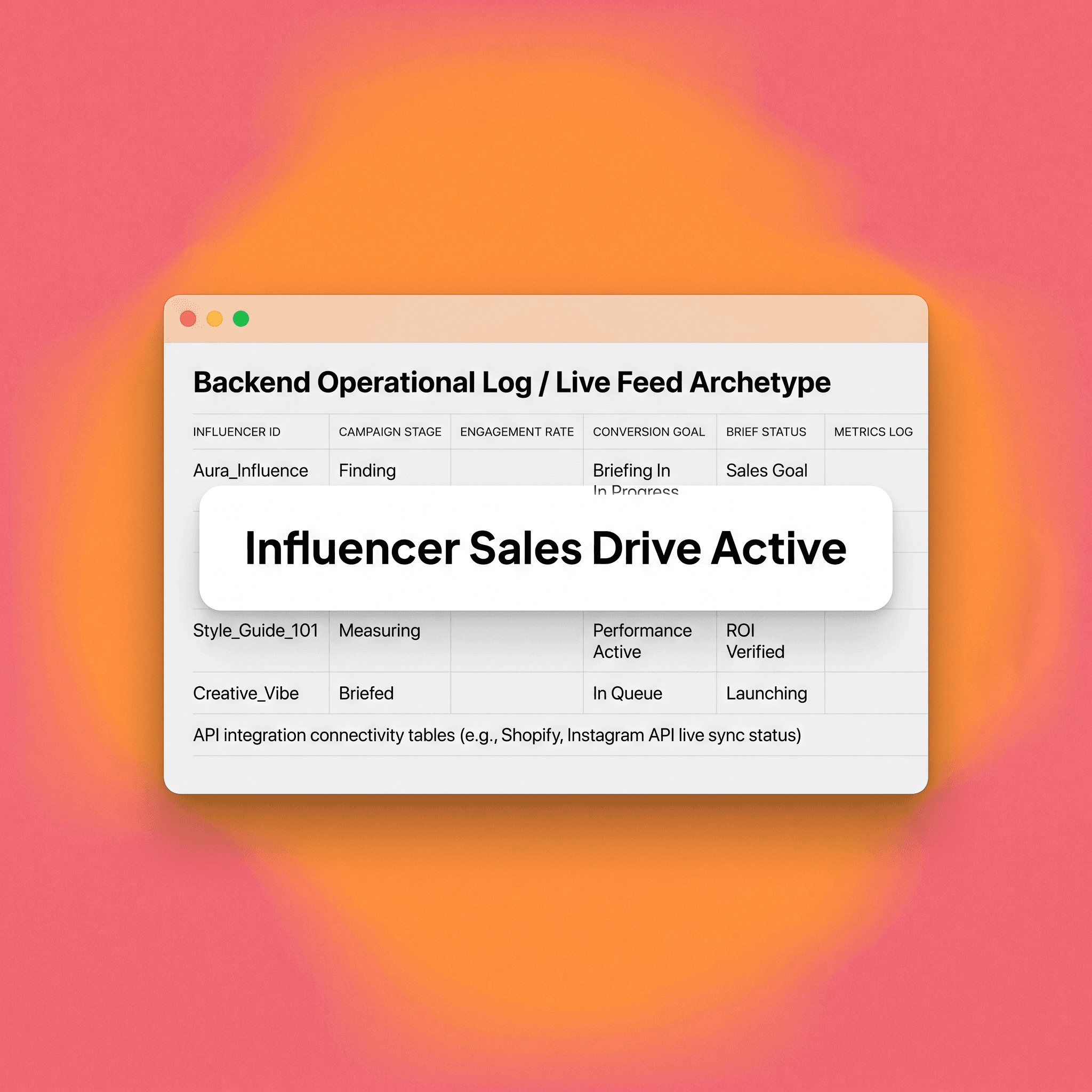
Shopify influencer marketing is one of the highest-leverage growth channels available to D2C brands — and one of the most consistently mismanaged. Most brands waste their first influencer budget on the wrong creators, vague briefs, and zero measurement infrastructure, essentially treating a powerful marketing lever like a speculative gamble. They confuse reach with revenue, prioritizing vanity metrics that look good in a deck but provide no indication of actual business health.
They mistake engagement rate for purchase intent, ignoring the reality that followers often like a post without ever intending to open their wallets. And when results fall short, they write off the channel entirely as "not for them," failing to realize that the issue lies in the operational execution rather than the influencer model itself.
This guide covers the full process: how to identify creators worth paying, how to brief them for conversion rather than just vanity-driven content, and how to measure what actually matters to your bottom line. By formalizing your influencer workflow into a repeatable, data-backed engine, you can transform this channel into a predictable driver of customer acquisition and brand equity that scales alongside your Shopify store’s operational maturity.
What Makes Shopify Influencer Marketing Different From General Creator Campaigns
Running influencer campaigns for a Shopify store has operational characteristics that generic influencer advice ignores, primarily because you are managing a direct path from discovery to transaction. Your attribution lives inside a specific stack, meaning that every click, session, and conversion must be accounted for within your ecosystem. Shopify's discount codes, UTM parameters, and post-purchase surveys are your measurement layer, and these tools should be the foundation upon which your outreach is built. If you're not building campaigns around these tools from the start, you're flying blind, unable to distinguish between genuine interest and passive exposure.
Your purchase funnel is short, and unlike software or high-ticket services where the consideration phase can span months, D2C ecommerce conversions can happen within hours of first exposure. That means you can get clean data faster — but you also lose the sale quickly if the offer or landing experience isn't tight and optimized for the specific audience segment the influencer is directing to your site.
Your inventory and margin structure matters, as a campaign that drives 500 units at a negative contribution margin isn't a win, but a fiscal error that can jeopardize your cash flow. Influencer-driven CAC needs to be modeled against product margin and LTV before you commit budgets to ensure you are scaling profitable volume rather than just depleting stock.
These constraints shape every decision that follows, demanding that you manage influencers with the same precision and financial rigor that you apply to paid search or social media advertising.
Phase 1: Finding the Right Influencers for Your Shopify Brand
What "right" means before you search
Before opening any influencer platform, define your criteria on two axes: audience fit and content behavior. Audience fit asks: does this creator's audience resemble your customer? Not just demographically — behaviorally. Do their followers buy products they recommend, or do they simply consume content for entertainment? Are they aspirational buyers who engage with high-ticket trends or window shoppers who only engage with steep discounts? Content behavior asks: does this creator produce content that looks like it could work in your category? A beauty micro-influencer with strong "get ready with me" content may outperform a lifestyle mega-influencer with broader reach but weaker purchase signals, simply because the former has mastered the art of explaining a product's utility to a receptive audience. By auditing the past performance of their sponsored posts, you can determine if they have the credibility to convert an audience that is inherently skeptical of paid endorsements.
The Shopify Influencer Fit Matrix
Use this framework to evaluate any potential creator before outreach. Score each dimension 1–3, then multiply the two axis scores to get a composite.
Axis A — Audience Alignment
Demographic match: Demographic match to your core customer (age, location, income signal): 1–3
Category relevance: Category relevance (do they post in your product space?): 1–3
Audience authenticity: Audience authenticity (follower growth patterns, comment quality, bot risk): 1–3
Axis B — Commercial Behavior
Prior performance: Prior paid post performance (have sponsored posts driven engagement?): 1–3
Direct response: Link-in-bio or swipe-up usage (do they direct followers to purchase?): 1–3
Risk assessment: Brand alignment risk (nothing in their content history that creates association risk): 1–3
Composite score range: 6–18. Prioritize creators scoring 14 or above for paid campaigns. Creators scoring 10–13 are suitable for gifting-first or affiliate structures. Below 10, move on. This matrix is not a perfect filter — but it eliminates the clearest mismatches before you spend a budget or a briefing hour.
Where to find creators worth considering
Influencer databases (Aspire, Grin, Creator.co) are useful for volume searches but tend to surface the same over-pitched creators who may be burnt out or over-exposed. They're a starting point, not a shortcut, and relying exclusively on them often leads to a "cookie-cutter" marketing aesthetic. More reliable signals come from searching your own tagged posts and mentions — people already buying and posting are warm by definition and represent the highest potential for authentic brand advocacy.
Look at who your direct competitors have worked with by checking sponsored post disclosures on Instagram and TikTok, as this is a shortcut to finding creators who are already vetted for your category. Monitor hashtags specific to your product category and filter for consistent posting rather than one-hit content, as consistency indicates a reliable creator who can build a narrative around your product over time.
Affiliate and UGC networks that surface creators with a track record of driving clicks and purchases are also invaluable, as they shift the conversation from "influence" to "proven performance." For most early-stage Shopify brands, the highest-ROI starting point is 10–20 micro-influencers (5k–100k followers) in a tightly relevant niche rather than one macro campaign, as the data is cleaner, the risk is lower, and the content is often more authentic.
Phase 2: Briefing Influencers for Conversion, Not Just Content
Why most influencer briefs fail
The average influencer brief reads like a brand guidelines document, which is an immediate turn-off for a creator who values their own creative voice. It tells creators what not to do, how to position the product, which hashtags to use, and which claims to avoid. What it rarely tells them is what outcome the brand is trying to drive — and what the audience actually needs to hear to buy. Creators know their audiences far better than you do, and they understand the "social language" that causes their followers to stop scrolling and click. A brief that over-constrains content produces polished content that feels like an ad and converts like one, which is essentially the kiss of death in a social environment that demands organic-feeling authenticity.
What a high-performing brief includes
Clear objective: Clear objective, stated plainly. "We want first purchases from your audience, driven by this specific product and landing page." Not "raise awareness."
Primary message: One primary message. What is the single thing their audience should take away? Not three things. One. Usually this is the product's clearest functional benefit, framed in terms the audience already uses.
Offer and destination: Offer and destination. Which discount code are they using? What's the URL? What does the landing page look like? Brief the offer as clearly as the content requirements.
Format guidance: Format guidance, not a script. Specify format (Reel, Story, TikTok video, long-form), minimum duration or length, and any mandatory disclosures. Leave creative execution to the creator.
What to avoid: What to avoid, briefly. A short list of claims or contexts to steer clear of. Three to five items maximum.
Process and timeline: Approval process and timeline. When drafts are due, how feedback works, when it goes live, and what the payment or delivery trigger is.
A note on creative freedom
The brands that consistently outperform with influencer marketing give creators real latitude within clear strategic constraints. Tight messaging, loose execution. When you write a script and force a creator to read it, you get a video that their audience can detect as scripted in the first ten seconds — and they disengage immediately. By trusting the creator to interpret your brief in a way that resonates with their specific community, you unlock the kind of organic, persuasive storytelling that no internal creative team could ever replicate, and you reduce the "paid ad" friction that causes users to skip past sponsored content.
Phase 3: Measuring What Actually Matters
The four metrics worth tracking
Attributed revenue: Attributed revenue per creator. This is your primary signal. Use a unique discount code per creator (trackable inside Shopify) and UTM parameters on any links. Compare revenue generated against the cost of that creator (fee plus product cost).
Conversion rate: Conversion rate on traffic sent. Clicks are vanity. The ratio of clicks to purchases tells you whether the audience intent was there or whether the landing experience failed them. If traffic arrives and doesn't convert, the problem may not be the creator — it may be your page.
Content value: Content asset value. High-performing influencer content can be repurposed as paid social creative, email assets, or on-product pages. Track which pieces generate strong organic engagement — that's a signal the creative is worth amplifying with spend.
CAC benchmarking: Cost per acquisition vs. channel average. Compare influencer-driven CAC against your paid social and other acquisition channels. Influencer CAC is often higher initially and improves with relationship and creative optimization over time. Don't benchmark a single campaign against your blended CAC — benchmark it against the same funnel stage in paid.
Post-purchase surveys as a measurement layer
Shopify brands running multi-channel acquisition should use a post-purchase survey (tools like Fairing or KnoCommerce integrate cleanly with Shopify) asking "How did you hear about us?" Add an option for the specific influencer name or handle if you're running a concentrated campaign. Self-reported attribution is imprecise but picks up the dark social and first-touch exposure that UTMs miss, especially when a user sees an influencer post but later finds your site via a Google search. This data layer is vital for closing the loop on "last-click" attribution, which often credits Google for a sale that was originally inspired by an influencer discovery.
What to do with the data
After four to eight weeks of data from an initial creator cohort, rank them by attributed revenue, conversion rate, and content asset quality. Double down on the top third, increasing spend or frequency to capture more of that high-performing traffic. Restructure the middle third — perhaps by testing a different product, a different video format, or moving them to an affiliate-only revenue-share model to mitigate risk. Discontinue the bottom third that fails to drive meaningful conversions or engagement. This optimization loop — run, measure, reallocate — is what separates brands that build scalable influencer channels from brands that run influencer campaigns and then wonder why results were inconsistent.
Common Mistakes in Shopify Influencer Campaigns
Follower count: Choosing creators by follower count. Reach is the least predictive metric of purchase behavior. A creator with 8,000 highly engaged followers in your exact niche will typically outperform a creator with 200,000 followers and a generic lifestyle audience.
Tracking void: Sending product without a tracking mechanism. Gifting without a code or UTM means you'll never know whether it worked. Every creator touch — even unpaid gifting — should include a tracking mechanism.
Product clutter: Briefing too many products at once. When a brief asks a creator to feature your full product range, you get a commercial that covers everything and lands nothing. Pick one product, one message, one offer.
One-off thinking: Treating influencer marketing as a one-time event. A single campaign is an experiment. A repeatable program — with a stable roster of vetted creators, a structured brief process, and a measurement cadence — is a channel.
Impression obsession: Optimizing for impressions in post-campaign reporting. Impressions tell you who could have seen the content. They tell you nothing about who bought. Build your reporting around conversion metrics from day one.
Shopify influencer marketing is one of the highest-leverage growth channels available to D2C brands — and one of the most consistently mismanaged. Most brands waste their first influencer budget on the wrong creators, vague briefs, and zero measurement infrastructure, essentially treating a powerful marketing lever like a speculative gamble. They confuse reach with revenue, prioritizing vanity metrics that look good in a deck but provide no indication of actual business health.
They mistake engagement rate for purchase intent, ignoring the reality that followers often like a post without ever intending to open their wallets. And when results fall short, they write off the channel entirely as "not for them," failing to realize that the issue lies in the operational execution rather than the influencer model itself.
This guide covers the full process: how to identify creators worth paying, how to brief them for conversion rather than just vanity-driven content, and how to measure what actually matters to your bottom line. By formalizing your influencer workflow into a repeatable, data-backed engine, you can transform this channel into a predictable driver of customer acquisition and brand equity that scales alongside your Shopify store’s operational maturity.
What Makes Shopify Influencer Marketing Different From General Creator Campaigns
Running influencer campaigns for a Shopify store has operational characteristics that generic influencer advice ignores, primarily because you are managing a direct path from discovery to transaction. Your attribution lives inside a specific stack, meaning that every click, session, and conversion must be accounted for within your ecosystem. Shopify's discount codes, UTM parameters, and post-purchase surveys are your measurement layer, and these tools should be the foundation upon which your outreach is built. If you're not building campaigns around these tools from the start, you're flying blind, unable to distinguish between genuine interest and passive exposure.
Your purchase funnel is short, and unlike software or high-ticket services where the consideration phase can span months, D2C ecommerce conversions can happen within hours of first exposure. That means you can get clean data faster — but you also lose the sale quickly if the offer or landing experience isn't tight and optimized for the specific audience segment the influencer is directing to your site.
Your inventory and margin structure matters, as a campaign that drives 500 units at a negative contribution margin isn't a win, but a fiscal error that can jeopardize your cash flow. Influencer-driven CAC needs to be modeled against product margin and LTV before you commit budgets to ensure you are scaling profitable volume rather than just depleting stock.
These constraints shape every decision that follows, demanding that you manage influencers with the same precision and financial rigor that you apply to paid search or social media advertising.
Phase 1: Finding the Right Influencers for Your Shopify Brand
What "right" means before you search
Before opening any influencer platform, define your criteria on two axes: audience fit and content behavior. Audience fit asks: does this creator's audience resemble your customer? Not just demographically — behaviorally. Do their followers buy products they recommend, or do they simply consume content for entertainment? Are they aspirational buyers who engage with high-ticket trends or window shoppers who only engage with steep discounts? Content behavior asks: does this creator produce content that looks like it could work in your category? A beauty micro-influencer with strong "get ready with me" content may outperform a lifestyle mega-influencer with broader reach but weaker purchase signals, simply because the former has mastered the art of explaining a product's utility to a receptive audience. By auditing the past performance of their sponsored posts, you can determine if they have the credibility to convert an audience that is inherently skeptical of paid endorsements.
The Shopify Influencer Fit Matrix
Use this framework to evaluate any potential creator before outreach. Score each dimension 1–3, then multiply the two axis scores to get a composite.
Axis A — Audience Alignment
Demographic match: Demographic match to your core customer (age, location, income signal): 1–3
Category relevance: Category relevance (do they post in your product space?): 1–3
Audience authenticity: Audience authenticity (follower growth patterns, comment quality, bot risk): 1–3
Axis B — Commercial Behavior
Prior performance: Prior paid post performance (have sponsored posts driven engagement?): 1–3
Direct response: Link-in-bio or swipe-up usage (do they direct followers to purchase?): 1–3
Risk assessment: Brand alignment risk (nothing in their content history that creates association risk): 1–3
Composite score range: 6–18. Prioritize creators scoring 14 or above for paid campaigns. Creators scoring 10–13 are suitable for gifting-first or affiliate structures. Below 10, move on. This matrix is not a perfect filter — but it eliminates the clearest mismatches before you spend a budget or a briefing hour.
Where to find creators worth considering
Influencer databases (Aspire, Grin, Creator.co) are useful for volume searches but tend to surface the same over-pitched creators who may be burnt out or over-exposed. They're a starting point, not a shortcut, and relying exclusively on them often leads to a "cookie-cutter" marketing aesthetic. More reliable signals come from searching your own tagged posts and mentions — people already buying and posting are warm by definition and represent the highest potential for authentic brand advocacy.
Look at who your direct competitors have worked with by checking sponsored post disclosures on Instagram and TikTok, as this is a shortcut to finding creators who are already vetted for your category. Monitor hashtags specific to your product category and filter for consistent posting rather than one-hit content, as consistency indicates a reliable creator who can build a narrative around your product over time.
Affiliate and UGC networks that surface creators with a track record of driving clicks and purchases are also invaluable, as they shift the conversation from "influence" to "proven performance." For most early-stage Shopify brands, the highest-ROI starting point is 10–20 micro-influencers (5k–100k followers) in a tightly relevant niche rather than one macro campaign, as the data is cleaner, the risk is lower, and the content is often more authentic.
Phase 2: Briefing Influencers for Conversion, Not Just Content
Why most influencer briefs fail
The average influencer brief reads like a brand guidelines document, which is an immediate turn-off for a creator who values their own creative voice. It tells creators what not to do, how to position the product, which hashtags to use, and which claims to avoid. What it rarely tells them is what outcome the brand is trying to drive — and what the audience actually needs to hear to buy. Creators know their audiences far better than you do, and they understand the "social language" that causes their followers to stop scrolling and click. A brief that over-constrains content produces polished content that feels like an ad and converts like one, which is essentially the kiss of death in a social environment that demands organic-feeling authenticity.
What a high-performing brief includes
Clear objective: Clear objective, stated plainly. "We want first purchases from your audience, driven by this specific product and landing page." Not "raise awareness."
Primary message: One primary message. What is the single thing their audience should take away? Not three things. One. Usually this is the product's clearest functional benefit, framed in terms the audience already uses.
Offer and destination: Offer and destination. Which discount code are they using? What's the URL? What does the landing page look like? Brief the offer as clearly as the content requirements.
Format guidance: Format guidance, not a script. Specify format (Reel, Story, TikTok video, long-form), minimum duration or length, and any mandatory disclosures. Leave creative execution to the creator.
What to avoid: What to avoid, briefly. A short list of claims or contexts to steer clear of. Three to five items maximum.
Process and timeline: Approval process and timeline. When drafts are due, how feedback works, when it goes live, and what the payment or delivery trigger is.
A note on creative freedom
The brands that consistently outperform with influencer marketing give creators real latitude within clear strategic constraints. Tight messaging, loose execution. When you write a script and force a creator to read it, you get a video that their audience can detect as scripted in the first ten seconds — and they disengage immediately. By trusting the creator to interpret your brief in a way that resonates with their specific community, you unlock the kind of organic, persuasive storytelling that no internal creative team could ever replicate, and you reduce the "paid ad" friction that causes users to skip past sponsored content.
Phase 3: Measuring What Actually Matters
The four metrics worth tracking
Attributed revenue: Attributed revenue per creator. This is your primary signal. Use a unique discount code per creator (trackable inside Shopify) and UTM parameters on any links. Compare revenue generated against the cost of that creator (fee plus product cost).
Conversion rate: Conversion rate on traffic sent. Clicks are vanity. The ratio of clicks to purchases tells you whether the audience intent was there or whether the landing experience failed them. If traffic arrives and doesn't convert, the problem may not be the creator — it may be your page.
Content value: Content asset value. High-performing influencer content can be repurposed as paid social creative, email assets, or on-product pages. Track which pieces generate strong organic engagement — that's a signal the creative is worth amplifying with spend.
CAC benchmarking: Cost per acquisition vs. channel average. Compare influencer-driven CAC against your paid social and other acquisition channels. Influencer CAC is often higher initially and improves with relationship and creative optimization over time. Don't benchmark a single campaign against your blended CAC — benchmark it against the same funnel stage in paid.
Post-purchase surveys as a measurement layer
Shopify brands running multi-channel acquisition should use a post-purchase survey (tools like Fairing or KnoCommerce integrate cleanly with Shopify) asking "How did you hear about us?" Add an option for the specific influencer name or handle if you're running a concentrated campaign. Self-reported attribution is imprecise but picks up the dark social and first-touch exposure that UTMs miss, especially when a user sees an influencer post but later finds your site via a Google search. This data layer is vital for closing the loop on "last-click" attribution, which often credits Google for a sale that was originally inspired by an influencer discovery.
What to do with the data
After four to eight weeks of data from an initial creator cohort, rank them by attributed revenue, conversion rate, and content asset quality. Double down on the top third, increasing spend or frequency to capture more of that high-performing traffic. Restructure the middle third — perhaps by testing a different product, a different video format, or moving them to an affiliate-only revenue-share model to mitigate risk. Discontinue the bottom third that fails to drive meaningful conversions or engagement. This optimization loop — run, measure, reallocate — is what separates brands that build scalable influencer channels from brands that run influencer campaigns and then wonder why results were inconsistent.
Common Mistakes in Shopify Influencer Campaigns
Follower count: Choosing creators by follower count. Reach is the least predictive metric of purchase behavior. A creator with 8,000 highly engaged followers in your exact niche will typically outperform a creator with 200,000 followers and a generic lifestyle audience.
Tracking void: Sending product without a tracking mechanism. Gifting without a code or UTM means you'll never know whether it worked. Every creator touch — even unpaid gifting — should include a tracking mechanism.
Product clutter: Briefing too many products at once. When a brief asks a creator to feature your full product range, you get a commercial that covers everything and lands nothing. Pick one product, one message, one offer.
One-off thinking: Treating influencer marketing as a one-time event. A single campaign is an experiment. A repeatable program — with a stable roster of vetted creators, a structured brief process, and a measurement cadence — is a channel.
Impression obsession: Optimizing for impressions in post-campaign reporting. Impressions tell you who could have seen the content. They tell you nothing about who bought. Build your reporting around conversion metrics from day one.
FAQ
What is Shopify influencer marketing?
Shopify influencer marketing is the practice of partnering with content creators to promote your Shopify store's products. Creators share content with their audience — usually on Instagram, TikTok, or YouTube — using trackable links or discount codes that attribute traffic and sales back to that specific creator partnership.
How do I find influencers for my Shopify store?
Start with your own customer base — people already buying and posting about your brand. Supplement with hashtag research in your product category, competitor campaign analysis, and influencer platforms like Aspire or Grin. Evaluate creators using audience fit and commercial behavior signals before reaching out, not after.
How many influencers should I start with?
For most Shopify brands, starting with 10–20 micro-influencers (5k–100k followers) in a tightly relevant niche gives better data and lower risk than a single large campaign. It lets you test creative angles, offers, and creator types before concentrating budget.
How do I measure influencer ROI for my Shopify store?
Use a unique discount code per creator (native to Shopify), UTM parameters on all links, and a post-purchase survey for self-reported attribution. Measure attributed revenue per creator, conversion rate on traffic sent, and cost per acquisition relative to your other channels. Impressions and engagement are secondary.
What should I put in an influencer brief?
A brief should include: a clear campaign objective, one primary message, the discount code and landing page URL, format and length requirements, a short list of things to avoid, and the timeline and approval process. Do not script the content — give the creator latitude on execution within clear strategic constraints.
What's a realistic CAC for influencer-driven Shopify sales?
It varies by category, margin, and creator tier, but influencer CAC is typically higher than mature paid social in the early stages of a program. The goal is to bring it in line with — or below — your blended acquisition CAC over time as you optimize the creator roster and creative approach. Model it against product margin and LTV, not just acquisition cost in isolation.
When should I pay influencers versus gifting product?
Gifting works for low-cost products, audience testing, and building early relationships with smaller creators. Once a creator has demonstrated commercial behavior (their audience buys what they recommend), moving to a paid structure — flat fee, affiliate commission, or hybrid — creates alignment and produces more deliberate content. Don't gift indefinitely to creators who aren't generating measurable outcomes.
insights
Explore more on AI, Design and Growth

SEO
Google AI & Local SEO: Rank in Both (2026 Guide)
Learn how to optimize content for Google AI search and local SEO simultaneously to rank in AI Overviews, maps, and organic search results.

SEO
Semantic Content Clusters for SEO & AEO (Templates)
Learn how to build semantic content clusters for SEO and AEO. Includes practical templates, internal linking structures, and examples for ranking in AI search.

SEO
How Google AI Search Works: RankBrain to Gemini (2026)
Discover how Google’s AI search evolved from RankBrain to Gemini and what it means for SEO, AI search results, and ranking strategies in 2026.
SEO
Google AI & Local SEO: Rank in Both (2026 Guide)
Learn how to optimize content for Google AI search and local SEO simultaneously to rank in AI Overviews, maps, and organic search results.
SEO
Semantic Content Clusters for SEO & AEO (Templates)
Learn how to build semantic content clusters for SEO and AEO. Includes practical templates, internal linking structures, and examples for ranking in AI search.
get in touch
Ready to Grow From Day One?
Strategy, execution, and digital experiences designed to move together. Fill out the form below and our team will contact you shortly.
get in touch
Ready to Grow From Day One?
Strategy, execution, and digital experiences designed to move together. Fill out the form below and our team will contact you shortly.
get in touch
Ready to Grow From Day One?
Strategy, execution, and digital experiences designed to move together. Fill out the form below and our team will contact you shortly.
Services
We'd love to hear from you.
Tell us what you're building and where you need support.
© 2026 projectsupply AI, Data and Digital Engineering
Company. Pune, India. All rights reserved.
Part of Tangle
Services
We'd love to hear from you.
Tell us what you're building and where you need support.
© 2026 projectsupply AI, Data and Digital Engineering
Company. Pune, India. All rights reserved.
Part of Tangle
Services
We'd love to hear from you.
Tell us what you're building and where you need support.
© 2026 projectsupply AI, Data and Digital Engineering
Company. Pune, India. All rights reserved.
Part of Tangle