

Shopify
Shopify LTV:CAC Ratio: What's a Good Number and How to Improve Yours
Shopify LTV:CAC Ratio: What's a Good Number and How to Improve Yours
Not sure if your Shopify LTV:CAC ratio is healthy? Learn what benchmarks actually mean, why most brands measure it wrong, and how to improve yours with a clear framework.
Not sure if your Shopify LTV:CAC ratio is healthy? Learn what benchmarks actually mean, why most brands measure it wrong, and how to improve yours with a clear framework.
08 min read
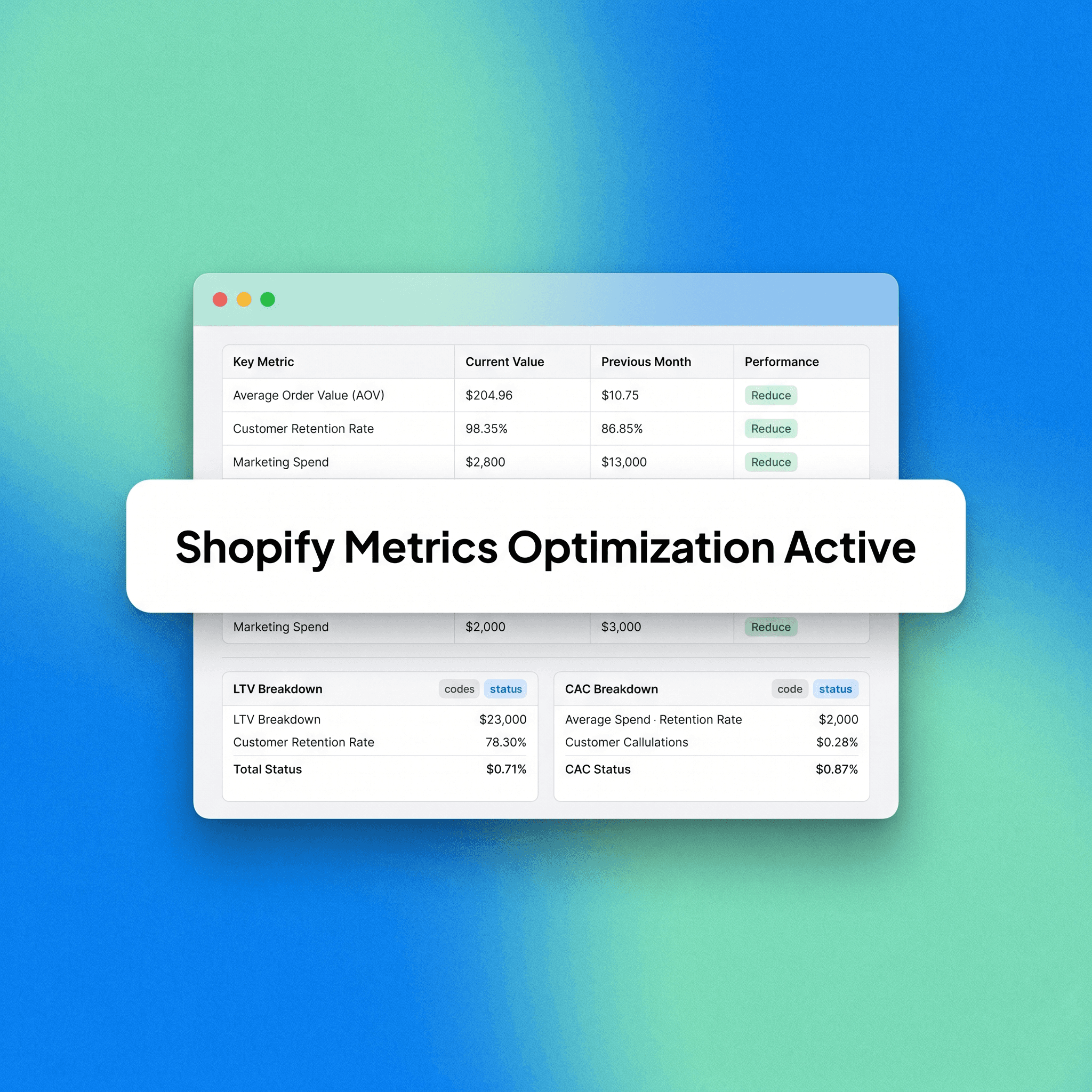
If you're running a Shopify brand and paying for customer acquisition, the LTV:CAC ratio is one of the few analytical metrics that tells you whether your entire business model is actually functioning as intended.
This ratio is not limited to a single marketing channel or a specific promotional campaign; it is a holistic diagnostic tool that integrates your marketing spend, your operational costs, and your long-term customer behavior into a single, actionable health score. Most founders make the mistake of checking this ratio once, feeling roughly okay about the resulting figure, and then moving on to other tasks, assuming the business is naturally scaling in the right direction.
That approach is almost always a critical strategic mistake, as the LTV:CAC number is inherently dynamic—it changes constantly as your advertising costs shift, your product mix evolves through new launches or SKU consolidation, and your retention programs either gain or lose effectiveness in the competitive landscape. A ratio that looked healthy and sustainable last year can quietly become a dangerous liability this year without triggering any obvious alarms in your standard dashboards.
This guide breaks down exactly what the Shopify LTV:CAC ratio signifies for your business, what counts as a genuinely healthy benchmark across different e-commerce categories, where most brands go wrong during the measurement phase, and a practical, repeatable framework for improving your ratio to drive sustainable profit.
What Is the LTV:CAC Ratio and Why Does It Matter for Shopify Brands?
LTV:CAC compares two vital, interconnected data points: how much revenue a customer generates over their lifetime with your brand versus how much it actually cost your company to acquire that customer in the first place.
LTV (Customer Lifetime Value): The total projected gross profit you expect to realize from a single customer across all their recurring purchases with your brand throughout the duration of their relationship.
CAC (Customer Acquisition Cost): The total, fully-loaded cost spent to acquire one new customer, which must include your paid media ad spend, professional agency fees, creative production costs, and any channel-specific overhead or personnel expenses required to facilitate that acquisition.
The math behind the ratio itself is deceptively simple: if a customer generates £180 in total gross profit over their lifetime and it cost you £60 to acquire them, your resulting LTV:CAC is 3:1. What this ratio fundamentally tells you is whether your acquisition engine is successfully building tangible value for your shareholders or quietly destroying it through inefficient spending.
A ratio below 1 means you are losing capital on every single customer you bring into the ecosystem, while a ratio of exactly 1 means you are only breaking even on your investment. Anything above 3 is generally considered the threshold where profitable, sustainable, and scalable growth truly lives in the modern D2C environment.
For Shopify brands specifically, this ratio matters significantly more than most single-channel ROAS figures, because while ROAS tells you how a specific campaign performed, the LTV:CAC ratio acts as the final judge on whether your entire business model is operationally performant.
How to Calculate Your Shopify LTV:CAC Ratio Correctly
Step 1: Calculate Customer Lifetime Value (LTV)
There are several ways to calculate LTV depending on your business model, but for most Shopify brands, the most practical and defensible approach is defined by this formula: LTV = Average Order Value × Purchase Frequency × Gross Margin × Average Customer Lifespan.
For example, if your average order value is £75, your purchase frequency per year is 2.5, your gross margin is 55%, and your average customer lifespan is 2 years, your
LTV = £75 × 2.5 × 0.55 × 2 = £206.25. It is absolutely vital that you use gross profit LTV rather than revenue LTV, because revenue-based calculations artificially inflate the number and make your acquisition economics look significantly better than they are in reality. By stripping out the cost of goods sold, you ensure that you are making strategic decisions based on the actual cash available to cover your acquisition expenses and overhead.
Step 2: Calculate Customer Acquisition Cost (CAC)
The formula for CAC is: CAC = Total Acquisition Spend ÷ New Customers Acquired within the same period. Your total acquisition spend must be comprehensive and include every dollar spent on paid media (such as Meta, Google, TikTok), influencer fees, referral program payouts, agency retainers, and the full cost of creative production.
Do not mix in your retention-related spending, such as loyalty program rewards or win-back email tool fees, as that fundamentally distorts the cost of acquisition for new customers. You need a clean, unvarnished look at what it costs to pull a stranger into your store, which allows you to separate the cost of finding new growth from the cost of keeping current customers satisfied.
Step 3: Divide
LTV:CAC = LTV ÷ CAC. If your calculated LTV is £206 and your fully-loaded CAC is £58, your resulting ratio is roughly 3.5:1. This single number serves as the North Star for your growth team, providing an immediate snapshot of whether your current marketing investment is producing a positive return on capital or if your customer acquisition efforts are essentially paying for their own loss. If your ratio is lower than expected, you now have the clarity to look at both the LTV side and the CAC side to identify exactly where the leakage is occurring within your business model, rather than guessing which levers to pull.
Common Calculation Mistakes
Using revenue instead of gross profit: This is the most prevalent error, as it leads to a false sense of security regarding your unit economics.
Including existing customer spend: By blending retention spend into your CAC calculation, you hide the true cost of acquiring new traffic, leading to poor budget allocation decisions.
Using blended CAC: Calculating CAC across your entire customer base instead of new-customer-only CAC obscures the efficiency of your paid media campaigns.
Ignoring hidden creative costs: Failing to include agency fees or high-end production budgets means you are significantly underestimating the true cost of each customer acquisition.
Stale lifespan estimates: Using a fixed lifespan estimate that has not been updated in over a year ignores the reality of customer churn and changing market dynamics.
What Is a Good Shopify LTV:CAC Ratio?
There is no single universal number that applies to every brand, but there are meaningful, industry-standard benchmarks that help you judge your performance.
Below 1:1: You are actively losing money on every acquisition, and no amount of clever retention strategy can fix this foundational math error; an immediate, top-to-bottom business review is required.
1:1 to 2:1: The situation is marginal, meaning you are recovering your acquisition costs but not generating meaningful net profit to fund further growth or cover your fixed operational expenses. This can only be sustained with extremely high order volumes, significant external venture capital, or an aggressive plan to pivot your unit economics.
3:1: This is the classic industry standard benchmark, frequently cited as the point where acquisition economics are healthy, stable, and leave enough margin for you to safely reinvest in further growth initiatives.
4:1 to 6:1: This range is considered strong, indicating you have the strategic room to either scale your ad spend aggressively or build out sophisticated, defensible retention programs without feeling constant pressure on your cash flow.
Above 6:1: This is very healthy, but it is actually worth questioning whether you are being too conservative and underinvesting in acquisition; you may be leaving significant growth on the table by not spending enough to capture more market share.
These benchmarks must shift depending on your specific product category, your company's payback period requirements, and how capital-efficient your business needs to be. For instance, a subscription-based brand with a 12-month payback window can comfortably sustain a 2:1 ratio because the LTV accumulates predictably, whereas a fast-fashion brand with thin margins and high churn rates absolutely requires a 4:1 ratio or better just to remain fundamentally solvent.
The LTV:CAC Health Matrix for Shopify Brands
This is the Project Supply LTV:CAC Health Matrix—a high-level diagnostic tool designed for quickly understanding not just the final ratio, but the operational forces that are driving it and the specific areas where you must act.
Quadrant 1 — High LTV, Low CAC (Healthy and Scalable): Your internal retention engine is performing optimally and your acquisition strategy is incredibly efficient. The priority is to invest in scaling your winning campaigns without breaking the delicate balance, while keeping a close eye on potential channel saturation that could increase your costs over time.
Quadrant 2 — High LTV, High CAC (Profitable but Expensive): Your customers stay loyal and spend well, but they simply cost too much to identify and attract initially. The priority here is to improve your acquisition efficiency through rigorous creative testing, broader channel diversification, or improved referral programs; avoid cutting spend abruptly, as you do not want to starve a system that actually produces high-value customers.
Quadrant 3 — Low LTV, Low CAC (Cheap but Shallow): It is very easy to acquire these customers, but they do not stick around long enough to provide meaningful value to your business. The priority is to improve your onboarding sequence, the post-purchase experience, and your core product mix to deepen the relationship; you should critically examine whether your current offer is attracting the wrong type of customer entirely.
Quadrant 4 — Low LTV, High CAC (Unsustainable): This is the most dangerous quadrant. You are paying a premium to acquire customers who leave almost immediately, creating a constant churn treadmill that is impossible to outrun. The priority is to stop scaling immediately, conduct a deep diagnostic to find the root cause, and fix your product-customer fit before you resume any significant growth investment.
You should use this matrix at least once every quarter. Plot where your brand currently sits and identify which lever to move first—either LTV or CAC—before committing to new tactics.
How to Improve Your Shopify LTV:CAC Ratio
There are always two sides to this ratio, yet most brands fixate solely on CAC reduction while drastically underinvesting in LTV improvement, which is a massive missed opportunity. The faster, more reliable path to growth is usually focusing on both levers in the correct sequence.
Improving LTV on Shopify
Build a post-purchase email sequence that earns the second order: The highest-leverage window for driving retention is the 14 to 45 days immediately following a first purchase. A structured, data-backed flow—covering confirmation, educational content, usage prompts, replenishment reminders, and relevant cross-sells—consistently improves your repeat purchase rate by keeping the brand top-of-mind during the critical adoption phase.
Identify your highest-LTV customer profile and acquire more of them: Use your Shopify customer data or a third-party analytics tool to segment your base by LTV and look for common, shared traits like acquisition source, the specific first product purchased, total order value, and geographical location. Once you define these patterns, you can build custom lookalike audiences around that high-value segment, significantly tilting your acquisition strategy toward your most profitable customer archetypes.
Introduce a subscription or replenishment option: If your product catalog contains consumable or replenishable items, launching a subscription model predictably increases your LTV by compressing the purchase interval and naturally reducing churn. Even a modest opt-in rate from a small percentage of your base can massively increase the average LTV across the entire customer pool over the course of a fiscal year.
Raise average order value through strategic bundling: Bundles and tiered, quantity-based offers at the point of purchase are incredibly effective at increasing the revenue per transaction without increasing your underlying acquisition cost. Even a seemingly small 10% improvement in your average order value will compound significantly across your entire database, acting as a massive multiplier on your overall profitability.
Reduce passive churn: Many customers do not leave because they are unhappy, but because they simply forget your brand exists after the initial excitement fades. Implementing robust win-back flows, loyalty program nudges, and proactive engagement strategies at key predicted drop-off points will consistently recover a meaningful percentage of this "forgotten" group without additional ad spend.
Reducing CAC on Shopify
Audit your blended CAC by channel: Most brands have one or two hidden channels where the CAC is 30 to 50% lower than their current blended store-wide average. Find these high-performing niches and weight your budget accordingly before trying to fix underperforming, expensive channels that may just be fundamentally unsuitable for your brand.
Tighten your creative testing process: Creative execution is the most controllable variable in your CAC management within paid social media. A structured test-and-scale approach—testing one variable at a time, scaling the proven concepts, and retiring fatigued assets—is the most reliable way to lower your CAC without sacrificing volume.
Build owned acquisition channels: Investing in SEO, email capture strategies, and community building all reduce your long-term dependence on expensive, volatile paid acquisition channels. These will not replace paid media overnight, but they effectively lower your blended CAC floor as they scale, providing you with a more resilient business model.
Improve landing page conversion rates: The same amount of ad spend directed at a higher-converting landing page will naturally lower your effective CAC. A modest 0.5% improvement in conversion rate on your meaningful traffic is often worth far more than most creative optimizations, as it makes every single visitor you pay for significantly more likely to convert.
Common Mistakes Shopify Brands Make With LTV:CAC
Treating it as a one-time audit: The LTV:CAC ratio is a living, breathing metric that requires constant monitoring. As your cost per click rises and your retention programs mature or decay, the number shifts, so you must build this calculation into your standard monthly operating review.
Optimizing CAC in isolation: Some CAC reduction tactics—such as heavy, store-wide discounting or targeting low-intent traffic—inevitably attract customers with much worse LTV profiles. You lower the cost to acquire, but you also lower the return, meaning the ratio stays flat or even worsens over time.
Measuring it at the brand level only: Your overall LTV:CAC can look perfectly healthy on the surface while specific channels or customer cohorts are actually deeply, dangerously unprofitable. Segment by acquisition source and specific cohort to find where the business model is actually working and where it is bleeding cash.
Ignoring payback period: While a 3:1 LTV:CAC ratio is useful, if 80% of that LTV comes in year three, you will face a severe cash flow problem in the short term. Always pair your ratio with a strict payback period analysis to understand precisely when you actually recover your initial acquisition spend.
Calculating LTV from revenue rather than gross profit: This is the single most damaging error a brand can make. Revenue-based LTV is merely a vanity metric that hides your true cost structure; gross profit LTV is the only number that connects directly to the long-term, sustainable health of your bank account.
If you're running a Shopify brand and paying for customer acquisition, the LTV:CAC ratio is one of the few analytical metrics that tells you whether your entire business model is actually functioning as intended.
This ratio is not limited to a single marketing channel or a specific promotional campaign; it is a holistic diagnostic tool that integrates your marketing spend, your operational costs, and your long-term customer behavior into a single, actionable health score. Most founders make the mistake of checking this ratio once, feeling roughly okay about the resulting figure, and then moving on to other tasks, assuming the business is naturally scaling in the right direction.
That approach is almost always a critical strategic mistake, as the LTV:CAC number is inherently dynamic—it changes constantly as your advertising costs shift, your product mix evolves through new launches or SKU consolidation, and your retention programs either gain or lose effectiveness in the competitive landscape. A ratio that looked healthy and sustainable last year can quietly become a dangerous liability this year without triggering any obvious alarms in your standard dashboards.
This guide breaks down exactly what the Shopify LTV:CAC ratio signifies for your business, what counts as a genuinely healthy benchmark across different e-commerce categories, where most brands go wrong during the measurement phase, and a practical, repeatable framework for improving your ratio to drive sustainable profit.
What Is the LTV:CAC Ratio and Why Does It Matter for Shopify Brands?
LTV:CAC compares two vital, interconnected data points: how much revenue a customer generates over their lifetime with your brand versus how much it actually cost your company to acquire that customer in the first place.
LTV (Customer Lifetime Value): The total projected gross profit you expect to realize from a single customer across all their recurring purchases with your brand throughout the duration of their relationship.
CAC (Customer Acquisition Cost): The total, fully-loaded cost spent to acquire one new customer, which must include your paid media ad spend, professional agency fees, creative production costs, and any channel-specific overhead or personnel expenses required to facilitate that acquisition.
The math behind the ratio itself is deceptively simple: if a customer generates £180 in total gross profit over their lifetime and it cost you £60 to acquire them, your resulting LTV:CAC is 3:1. What this ratio fundamentally tells you is whether your acquisition engine is successfully building tangible value for your shareholders or quietly destroying it through inefficient spending.
A ratio below 1 means you are losing capital on every single customer you bring into the ecosystem, while a ratio of exactly 1 means you are only breaking even on your investment. Anything above 3 is generally considered the threshold where profitable, sustainable, and scalable growth truly lives in the modern D2C environment.
For Shopify brands specifically, this ratio matters significantly more than most single-channel ROAS figures, because while ROAS tells you how a specific campaign performed, the LTV:CAC ratio acts as the final judge on whether your entire business model is operationally performant.
How to Calculate Your Shopify LTV:CAC Ratio Correctly
Step 1: Calculate Customer Lifetime Value (LTV)
There are several ways to calculate LTV depending on your business model, but for most Shopify brands, the most practical and defensible approach is defined by this formula: LTV = Average Order Value × Purchase Frequency × Gross Margin × Average Customer Lifespan.
For example, if your average order value is £75, your purchase frequency per year is 2.5, your gross margin is 55%, and your average customer lifespan is 2 years, your
LTV = £75 × 2.5 × 0.55 × 2 = £206.25. It is absolutely vital that you use gross profit LTV rather than revenue LTV, because revenue-based calculations artificially inflate the number and make your acquisition economics look significantly better than they are in reality. By stripping out the cost of goods sold, you ensure that you are making strategic decisions based on the actual cash available to cover your acquisition expenses and overhead.
Step 2: Calculate Customer Acquisition Cost (CAC)
The formula for CAC is: CAC = Total Acquisition Spend ÷ New Customers Acquired within the same period. Your total acquisition spend must be comprehensive and include every dollar spent on paid media (such as Meta, Google, TikTok), influencer fees, referral program payouts, agency retainers, and the full cost of creative production.
Do not mix in your retention-related spending, such as loyalty program rewards or win-back email tool fees, as that fundamentally distorts the cost of acquisition for new customers. You need a clean, unvarnished look at what it costs to pull a stranger into your store, which allows you to separate the cost of finding new growth from the cost of keeping current customers satisfied.
Step 3: Divide
LTV:CAC = LTV ÷ CAC. If your calculated LTV is £206 and your fully-loaded CAC is £58, your resulting ratio is roughly 3.5:1. This single number serves as the North Star for your growth team, providing an immediate snapshot of whether your current marketing investment is producing a positive return on capital or if your customer acquisition efforts are essentially paying for their own loss. If your ratio is lower than expected, you now have the clarity to look at both the LTV side and the CAC side to identify exactly where the leakage is occurring within your business model, rather than guessing which levers to pull.
Common Calculation Mistakes
Using revenue instead of gross profit: This is the most prevalent error, as it leads to a false sense of security regarding your unit economics.
Including existing customer spend: By blending retention spend into your CAC calculation, you hide the true cost of acquiring new traffic, leading to poor budget allocation decisions.
Using blended CAC: Calculating CAC across your entire customer base instead of new-customer-only CAC obscures the efficiency of your paid media campaigns.
Ignoring hidden creative costs: Failing to include agency fees or high-end production budgets means you are significantly underestimating the true cost of each customer acquisition.
Stale lifespan estimates: Using a fixed lifespan estimate that has not been updated in over a year ignores the reality of customer churn and changing market dynamics.
What Is a Good Shopify LTV:CAC Ratio?
There is no single universal number that applies to every brand, but there are meaningful, industry-standard benchmarks that help you judge your performance.
Below 1:1: You are actively losing money on every acquisition, and no amount of clever retention strategy can fix this foundational math error; an immediate, top-to-bottom business review is required.
1:1 to 2:1: The situation is marginal, meaning you are recovering your acquisition costs but not generating meaningful net profit to fund further growth or cover your fixed operational expenses. This can only be sustained with extremely high order volumes, significant external venture capital, or an aggressive plan to pivot your unit economics.
3:1: This is the classic industry standard benchmark, frequently cited as the point where acquisition economics are healthy, stable, and leave enough margin for you to safely reinvest in further growth initiatives.
4:1 to 6:1: This range is considered strong, indicating you have the strategic room to either scale your ad spend aggressively or build out sophisticated, defensible retention programs without feeling constant pressure on your cash flow.
Above 6:1: This is very healthy, but it is actually worth questioning whether you are being too conservative and underinvesting in acquisition; you may be leaving significant growth on the table by not spending enough to capture more market share.
These benchmarks must shift depending on your specific product category, your company's payback period requirements, and how capital-efficient your business needs to be. For instance, a subscription-based brand with a 12-month payback window can comfortably sustain a 2:1 ratio because the LTV accumulates predictably, whereas a fast-fashion brand with thin margins and high churn rates absolutely requires a 4:1 ratio or better just to remain fundamentally solvent.
The LTV:CAC Health Matrix for Shopify Brands
This is the Project Supply LTV:CAC Health Matrix—a high-level diagnostic tool designed for quickly understanding not just the final ratio, but the operational forces that are driving it and the specific areas where you must act.
Quadrant 1 — High LTV, Low CAC (Healthy and Scalable): Your internal retention engine is performing optimally and your acquisition strategy is incredibly efficient. The priority is to invest in scaling your winning campaigns without breaking the delicate balance, while keeping a close eye on potential channel saturation that could increase your costs over time.
Quadrant 2 — High LTV, High CAC (Profitable but Expensive): Your customers stay loyal and spend well, but they simply cost too much to identify and attract initially. The priority here is to improve your acquisition efficiency through rigorous creative testing, broader channel diversification, or improved referral programs; avoid cutting spend abruptly, as you do not want to starve a system that actually produces high-value customers.
Quadrant 3 — Low LTV, Low CAC (Cheap but Shallow): It is very easy to acquire these customers, but they do not stick around long enough to provide meaningful value to your business. The priority is to improve your onboarding sequence, the post-purchase experience, and your core product mix to deepen the relationship; you should critically examine whether your current offer is attracting the wrong type of customer entirely.
Quadrant 4 — Low LTV, High CAC (Unsustainable): This is the most dangerous quadrant. You are paying a premium to acquire customers who leave almost immediately, creating a constant churn treadmill that is impossible to outrun. The priority is to stop scaling immediately, conduct a deep diagnostic to find the root cause, and fix your product-customer fit before you resume any significant growth investment.
You should use this matrix at least once every quarter. Plot where your brand currently sits and identify which lever to move first—either LTV or CAC—before committing to new tactics.
How to Improve Your Shopify LTV:CAC Ratio
There are always two sides to this ratio, yet most brands fixate solely on CAC reduction while drastically underinvesting in LTV improvement, which is a massive missed opportunity. The faster, more reliable path to growth is usually focusing on both levers in the correct sequence.
Improving LTV on Shopify
Build a post-purchase email sequence that earns the second order: The highest-leverage window for driving retention is the 14 to 45 days immediately following a first purchase. A structured, data-backed flow—covering confirmation, educational content, usage prompts, replenishment reminders, and relevant cross-sells—consistently improves your repeat purchase rate by keeping the brand top-of-mind during the critical adoption phase.
Identify your highest-LTV customer profile and acquire more of them: Use your Shopify customer data or a third-party analytics tool to segment your base by LTV and look for common, shared traits like acquisition source, the specific first product purchased, total order value, and geographical location. Once you define these patterns, you can build custom lookalike audiences around that high-value segment, significantly tilting your acquisition strategy toward your most profitable customer archetypes.
Introduce a subscription or replenishment option: If your product catalog contains consumable or replenishable items, launching a subscription model predictably increases your LTV by compressing the purchase interval and naturally reducing churn. Even a modest opt-in rate from a small percentage of your base can massively increase the average LTV across the entire customer pool over the course of a fiscal year.
Raise average order value through strategic bundling: Bundles and tiered, quantity-based offers at the point of purchase are incredibly effective at increasing the revenue per transaction without increasing your underlying acquisition cost. Even a seemingly small 10% improvement in your average order value will compound significantly across your entire database, acting as a massive multiplier on your overall profitability.
Reduce passive churn: Many customers do not leave because they are unhappy, but because they simply forget your brand exists after the initial excitement fades. Implementing robust win-back flows, loyalty program nudges, and proactive engagement strategies at key predicted drop-off points will consistently recover a meaningful percentage of this "forgotten" group without additional ad spend.
Reducing CAC on Shopify
Audit your blended CAC by channel: Most brands have one or two hidden channels where the CAC is 30 to 50% lower than their current blended store-wide average. Find these high-performing niches and weight your budget accordingly before trying to fix underperforming, expensive channels that may just be fundamentally unsuitable for your brand.
Tighten your creative testing process: Creative execution is the most controllable variable in your CAC management within paid social media. A structured test-and-scale approach—testing one variable at a time, scaling the proven concepts, and retiring fatigued assets—is the most reliable way to lower your CAC without sacrificing volume.
Build owned acquisition channels: Investing in SEO, email capture strategies, and community building all reduce your long-term dependence on expensive, volatile paid acquisition channels. These will not replace paid media overnight, but they effectively lower your blended CAC floor as they scale, providing you with a more resilient business model.
Improve landing page conversion rates: The same amount of ad spend directed at a higher-converting landing page will naturally lower your effective CAC. A modest 0.5% improvement in conversion rate on your meaningful traffic is often worth far more than most creative optimizations, as it makes every single visitor you pay for significantly more likely to convert.
Common Mistakes Shopify Brands Make With LTV:CAC
Treating it as a one-time audit: The LTV:CAC ratio is a living, breathing metric that requires constant monitoring. As your cost per click rises and your retention programs mature or decay, the number shifts, so you must build this calculation into your standard monthly operating review.
Optimizing CAC in isolation: Some CAC reduction tactics—such as heavy, store-wide discounting or targeting low-intent traffic—inevitably attract customers with much worse LTV profiles. You lower the cost to acquire, but you also lower the return, meaning the ratio stays flat or even worsens over time.
Measuring it at the brand level only: Your overall LTV:CAC can look perfectly healthy on the surface while specific channels or customer cohorts are actually deeply, dangerously unprofitable. Segment by acquisition source and specific cohort to find where the business model is actually working and where it is bleeding cash.
Ignoring payback period: While a 3:1 LTV:CAC ratio is useful, if 80% of that LTV comes in year three, you will face a severe cash flow problem in the short term. Always pair your ratio with a strict payback period analysis to understand precisely when you actually recover your initial acquisition spend.
Calculating LTV from revenue rather than gross profit: This is the single most damaging error a brand can make. Revenue-based LTV is merely a vanity metric that hides your true cost structure; gross profit LTV is the only number that connects directly to the long-term, sustainable health of your bank account.
FAQ
What is a good LTV:CAC ratio for a Shopify brand?
A ratio of 3:1 is the most widely accepted benchmark — meaning every £1 spent on acquisition returns £3 in gross profit over the customer's lifetime. Ratios below 2:1 signal a problem with acquisition cost or retention. Ratios above 5:1 are strong but may indicate underinvestment in growth. The right number depends on your category, margins, and payback period requirements.
How do I calculate LTV for my Shopify store?
Multiply your average order value by your purchase frequency, then by your gross margin, then by the average number of years a customer stays active. Use gross profit, not revenue. Shopify analytics gives you the raw data; the calculation itself should be done in a spreadsheet or a dedicated analytics tool where you can segment by cohort.
Why is my LTV:CAC ratio getting worse?
The most common reasons are rising paid media costs (CAC increasing), declining repeat purchase rate (LTV falling), a shift in customer mix toward lower-value segments, or a combination of all three. Start by isolating which side of the ratio is moving and when the change began. Cohort analysis is the clearest way to diagnose this.
Should I focus on improving LTV or reducing CAC first?
It depends on where the gap is. If your CAC has spiked due to rising media costs and your retention is already strong, focus on acquisition efficiency. If your retention is weak and customers are not returning, improving LTV will have a larger compounding effect. In most cases, the fastest improvement comes from a small move on both sides simultaneously rather than fixing one exclusively.
How often should I review my Shopify LTV:CAC ratio?
At minimum, monthly as part of your operating metrics. Build it into your reporting dashboard alongside CAC by channel, payback period, and repeat purchase rate. If you are scaling spend significantly, review it more frequently — a ratio shift can compound quickly when acquisition budgets are large.
Does LTV:CAC ratio differ by acquisition channel?
Yes, significantly. Customers acquired through organic search, referral, or email often have higher LTV than those acquired through broad paid social campaigns. This is partly because intent is higher and partly because the customer profile differs. Segmenting LTV:CAC by acquisition channel is one of the most valuable analyses a Shopify brand can run.
What is the difference between LTV:CAC and ROAS?
ROAS measures revenue returned per pound of ad spend within a defined window, typically short-term. LTV:CAC measures gross profit returned per pound of acquisition spend across the full customer lifetime. ROAS is a channel-level efficiency metric. LTV:CAC is a business-model health metric. Both are useful; neither replaces the other.
insights
Explore more on AI, Design and Growth

SEO
Google AI & Local SEO: Rank in Both (2026 Guide)
Learn how to optimize content for Google AI search and local SEO simultaneously to rank in AI Overviews, maps, and organic search results.

SEO
Semantic Content Clusters for SEO & AEO (Templates)
Learn how to build semantic content clusters for SEO and AEO. Includes practical templates, internal linking structures, and examples for ranking in AI search.

SEO
How Google AI Search Works: RankBrain to Gemini (2026)
Discover how Google’s AI search evolved from RankBrain to Gemini and what it means for SEO, AI search results, and ranking strategies in 2026.
SEO
Google AI & Local SEO: Rank in Both (2026 Guide)
Learn how to optimize content for Google AI search and local SEO simultaneously to rank in AI Overviews, maps, and organic search results.
SEO
Semantic Content Clusters for SEO & AEO (Templates)
Learn how to build semantic content clusters for SEO and AEO. Includes practical templates, internal linking structures, and examples for ranking in AI search.
get in touch
Ready to Grow From Day One?
Strategy, execution, and digital experiences designed to move together. Fill out the form below and our team will contact you shortly.
get in touch
Ready to Grow From Day One?
Strategy, execution, and digital experiences designed to move together. Fill out the form below and our team will contact you shortly.
get in touch
Ready to Grow From Day One?
Strategy, execution, and digital experiences designed to move together. Fill out the form below and our team will contact you shortly.
Services
We'd love to hear from you.
Tell us what you're building and where you need support.
© 2026 projectsupply AI, Data and Digital Engineering
Company. Pune, India. All rights reserved.
Part of Tangle
Services
We'd love to hear from you.
Tell us what you're building and where you need support.
© 2026 projectsupply AI, Data and Digital Engineering
Company. Pune, India. All rights reserved.
Part of Tangle
Services
We'd love to hear from you.
Tell us what you're building and where you need support.
© 2026 projectsupply AI, Data and Digital Engineering
Company. Pune, India. All rights reserved.
Part of Tangle