Shopify
08 min read
Shopify and ONDC India: What the Open Network Means for D2C Brands If you run a Shopify store in India, ONDC has probably crossed your radar — either as a headline you half-read or a conversation you've been meaning to finish. Either way, it deserves a clear answer: what is it, does it affect your Shopify setup, and should you actually do anything about it? In the fast-shifting Indian e-commerce landscape of 2026, direct-to-consumer brands must approach structural distribution changes with clinical operational discipline. Capital markets and competitive dynamics no longer reward unvouched channel expansion or platform hopping without a rigorous analysis of unit economics and technical overhead. As digital advertising networks face severe margin compression and customer acquisition costs continue to climb, optimizing your multichannel data pipelines becomes a prerequisite for institutional survival. Founders can no longer afford to ignore government-backed digital public infrastructure, yet rushing into open protocols without a precise integration playbook can introduce massive tracking friction and inventory fragmentation. True architectural optimization requires an objective strategy that seamlessly bridges your high-converting, owned checkout engine with decentralized sovereign transaction networks to maximize corporate capital velocity. This post answers all three questions without the hype. Navigating the operational shifts that occur between early direct-to-consumer traction and widespread localized marketplace scaling demands a data-driven look at your technology stack's core dependencies. This strategic structural guide provides growth operators, technical leads, and finance managers with an actionable playbook to evaluate the real-world operational realities of India's open network. By checking your current store parameters against verified category transaction volumes, your organization can avoid costly software engineering debt and design clean, automated distribution workflows. Use these guidelines to turn your transactional infrastructure from an isolated digital store into a highly capital-efficient, multi-node retail network.
What ONDC Actually Is (And What It Isn't)
ONDC — the Open Network for Digital Commerce — is a government-backed initiative by India's Department for Promotion of Industry and Internal Trade (DPIIT). It's designed to democratize ecommerce by decoupling the buyer side from the seller side using open protocols, much like UPI did for payments. This unbundled network layer strips away the absolute monopoly of walled-garden marketplaces, transforming online product discoverability into a shared utility space. By establishing a common cryptographic framework for order routing, the network enables small independent merchants to compete on equal terms with legacy enterprise operators across the sub-continent. Managing your brand positioning within this open environment requires a deep technical understanding of decentralized data exchanges and server-to-server validation loops. In simple terms: a buyer on any ONDC-compliant app can purchase from a seller listed on any other ONDC-compliant platform. No single platform owns the transaction. This zero-gatekeeper architecture allows a consumer browsing through their banking or mobility applications to instantly purchase products housed inside external supplier databases, completely breaking down legacy platform silos. The network dynamically coordinates the entire transaction loop, passing order data strings, payment details, and logistics milestones across separate compliant entities through an automated message protocol. For direct-to-consumer brands, this decentralized infrastructure layer presents an unprecedented top-of-funnel discovery mechanism that bypasses typical digital advertising networks. What ONDC is not:
It is not a marketplace you list on, like Amazon or Flipkart. It acts as an open, un-siloed protocol layer rather than a centralized corporate platform with its own locked-in merchant accounts and custom storefront themes.
It is not a Shopify competitor. The network provides a distributed transaction framework rather than a front-end content management tool, customizable checkout path, or personalized consumer conversion engine.
It is not a plugin or app you install. Connecting your catalog to the open network requires building explicit data integrations with verified external technology service nodes rather than toggling a native app store feature.
It is not a mandatory requirement (yet). While participation remains a strategic capital-allocation choice for business boards, monitoring its adoption is essential to protect long-term market presence. The network runs on Beckn Protocol — an open-source specification that lets buyer-side apps (like Paytm, Magicpin, or Mystore) communicate with seller-side apps (like Seller App, GoFrugal, or eSamudaay). Your Shopify store sits outside this network by default. This protocol-driven framework coordinates search, discovery, ordering, and fulfillment interactions through standardized, machine-readable JSON payloads, making software interoperability the core operational constraint. Without an explicit technical bridge configured to translate your store's relational database entries into compliant open-network messages, your product inventory stays completely invisible to buyer-side platforms. Systems leads must carefully evaluate how these server-to-server application layers interact with your existing enterprise resource planning software to avoid transaction lag.
How ONDC Differs From Your Current Shopify Setup
Your Shopify store is a direct-to-consumer channel. Customers come to your domain, you own the relationship, and your order data lives in your Shopify admin. That's the fundamental value of D2C — channel ownership. This centralized architecture gives brands complete control over user tracking scripts, conversion rate optimization tools, first-party cookie lifespans, and automated post-purchase upsell workflows. Operating an independent web store lets you design rich brand experiences that build deep customer affinity and protect raw product-level margins from third-party commission cuts. This ownership model forms the foundation for calculating accurate customer lifetime value (LTV) metrics and running disciplined paid media scaling campaigns. ONDC operates differently. Buyers discover products through ONDC-enabled buyer apps, and purchases flow through the network to the seller-side node you're connected to. You gain discoverability across a wider buyer pool. You lose some of the direct relationship. Because the network emphasizes transactional transparency and structural proximity over editorial brand narratives, your products display alongside numerous competitors inside generalized, comparison-driven interface layouts. This structural change treats individual items as commoditized listings, prioritizing delivery speed, local fulfillment readiness, and price clarity over creative copy hooks. Growth leads must realize that converting traffic in this decentralized space requires a complete pivot from standard conversion marketing toward tight supply chain execution. The comparison isn't Shopify vs ONDC. The better framing is:
Shopify = owned channel, controlled experience, full data ownership. This system acts as your primary visual and financial database anchor, controlling personalized customer retention loops and premium product lines.
ONDC = distributed discovery, open transaction layer, shared infrastructure. This network serves as a highly scalable distribution arm, piping high-volume transactions directly from regional buyer engines into your operations core. A brand can — and likely should, depending on their category and scale — operate both. They serve different functions. Integrating these two distinct digital paths requires designing a secure hybrid infrastructure that protects your core brand identity while maximizing volume across open distribution nodes. Transactions recorded across the network must feed back seamlessly into your main fulfillment workflows without creating data errors or inventory lag inside your direct-to-consumer store. Utilizing this parallel operational structure enables Indian brands to hedge against changing platform algorithms and capture diverse regional buyer groups.
The ONDC-Shopify Readiness Matrix
Use this framework to evaluate whether ONDC integration makes sense for your brand right now. This structural diagnostic tool forces corporate boards to objectively grade historical fulfillment capabilities and data hygiene against real-world network requirements, removing executive bias and software assumptions. Following this structured comparative path safeguards your working capital, preventing brands from entering complex integrations before their internal tech teams can support it. Treat this readiness matrix as a strict set of operational quality gates that must be cleared sequentially to protect company capital and maximize distribution efficiency. The ONDC-Shopify Readiness Matrix Score your brand on each factor: High / Medium / Low
Monthly order volume on Shopify: High = 1,000+ orders/month. You have the operational baseline to handle additional channels without quality slipping. Processing a consistent transaction volume proves that your packaging staff, automated labeling engines, and cash-on-delivery verification loops can handle the operational strain of multi-channel order spikes.
Category demand on ONDC buyer apps: High = your category (grocery, F&B, fashion, electronics, health) is already active and showing buyer adoption on Paytm, Magicpin, or similar. Low = niche or emerging category with thin buyer-side traffic. Mapping these regional buying habits ensures your technical integration capital targets spaces with active consumer density.
Logistics readiness: High = you have LSP (Logistics Service Provider) integrations or existing 3PL relationships that can handle ONDC's fulfillment requirements. Low = you're managing logistics manually or through a single courier. The network enforces strict fulfillment tracking timelines, making automated manifest printing and real-time shipping weight reconciliation crucial demands.
Tech team bandwidth: High = you have a developer or agency capable of connecting your inventory to an ONDC seller-side node. Low = your team is stretched, and new integrations create risk. Managing custom API webhooks, data field transformations, and inventory syncing requires dedicated technical bandwidth.
Brand differentiation need: High = your brand equity drives purchases; being commoditized on a price-discovery network would hurt you. Low = you compete on availability and price, and broader discoverability helps. Premium, storyteller brands must analyze whether price-discovery interfaces will dilute their marketplace capital. Reading the matrix: If you score High on volume, category demand, and logistics — and Low on brand differentiation sensitivity — ONDC is worth exploring this quarter. If you score High on brand differentiation and Low on category demand, protect your Shopify channel first and monitor ONDC adoption before committing resources. Financial and marketing leads must utilize these clear strategic indicators during quarterly roadmap planning, ensuring tech expansions align perfectly with core operating realities. Forcing a lean growth team to manage complex open network connections before stabilizing your primary storefront conversion loops can overwhelm your warehouse and create tracking errors.
Where Shopify Brands Can Actually Connect to ONDC
Shopify does not have a native ONDC integration as of 2026. To connect your Shopify catalog to ONDC, you need a seller-side service provider (Seller Node / TSP — Technology Service Provider) to act as the bridge. These third-party nodes function as translator layers, converting your e-commerce platform's database variables and inventory counts into the precise cryptographic formats mandated by the central network registries. Finding and configuring a dependable technology partner is a critical step in building a secure multi-channel pipeline. Options currently available:
Mystore — a Shopify-adjacent storefront that also functions as an ONDC seller node, providing pre-configured catalog sync tools and localized checkout connections.
eSamudaay and similar seller apps — connect your catalog via API or CSV feed, giving operations managers direct control over custom product attribute definitions.
Third-party middleware — some agencies and SaaS tools are building Shopify-to-ONDC connectors; adoption is early and product stability varies. Developers must closely audit these custom middleware layers to handle automated order ingestion smoothly. The practical workflow looks like this:
Choose a TSP (Technology Service Provider / Seller Node) that matches your technical skill level and catalog structure.
Sync your Shopify product catalog to the TSP using automated GraphQL API hooks or database reference keys.
Configure logistics through an ONDC-approved LSP, setting up clear service level agreements around pickup velocities and automated tracking updates.
Set pricing, GST, and return policies in line with ONDC requirements, ensuring your base tax codes satisfy Indian central tax audits.
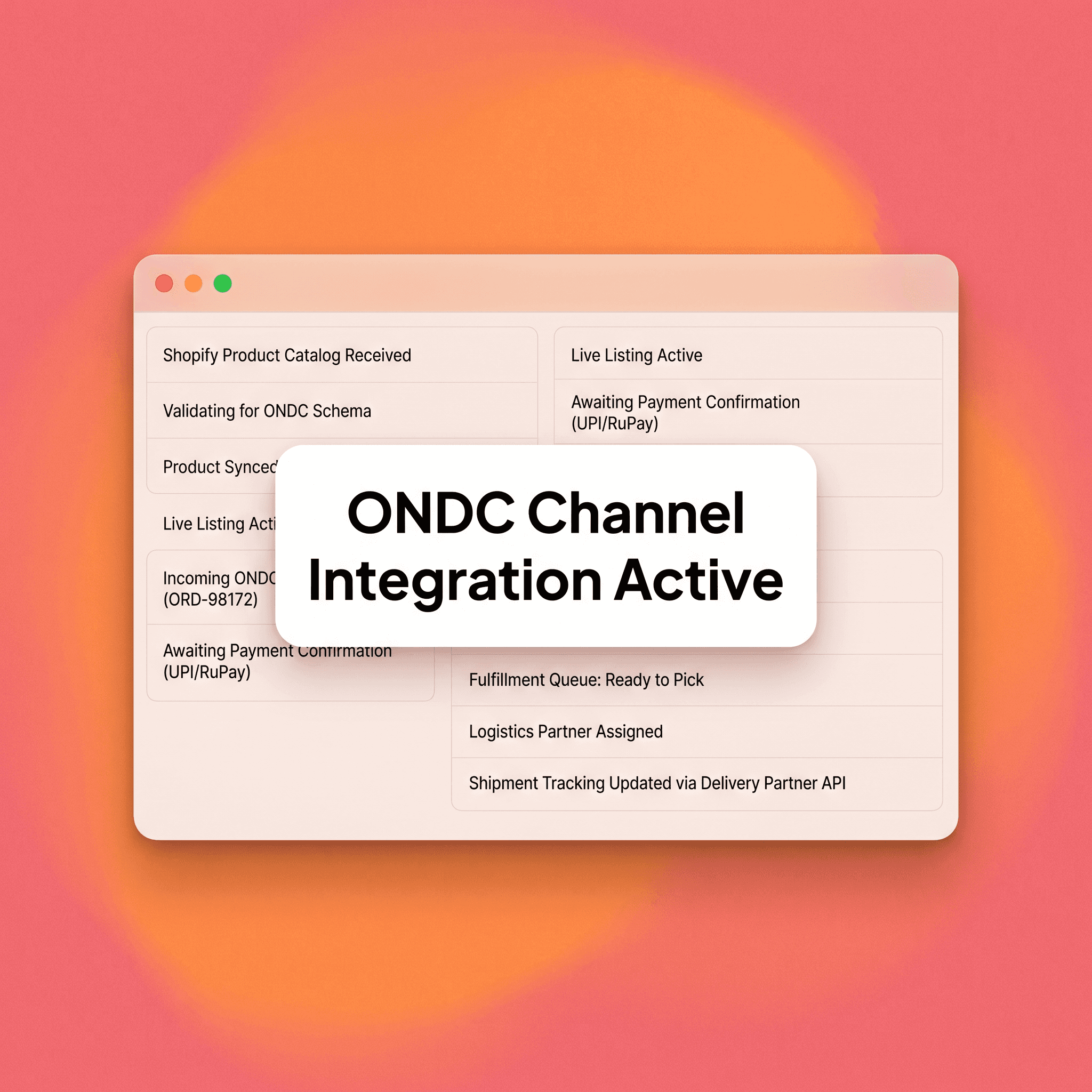
Go live on the network; orders flow into the TSP dashboard or back to Shopify depending on the integration setup. Important: catalog sync, order management, and returns are not automatic. You need a deliberate operations layer before going live, or you risk order failures that damage your seller rating on the network. When a foreign transaction processes but your background databases suffer from inventory sync lags, the open network can penalize your seller account, lowering your organic visibility across all buyer apps. Systems leads must design secure webhook alert monitors to ensure data flows execute flawlessly without introducing payload corruption during peak traffic events.
What ONDC Means for D2C Brand Strategy on Shopify
ONDC changes the competitive landscape in a few ways that D2C founders should think through carefully. The introduction of open transactional networks forces direct-to-consumer operators to completely rethink how they allocate their customer acquisition budgets and evaluate channel performance metrics.
Discoverability shifts toward price and proximity. Buyer apps on ONDC often surface products based on price, ratings, and location. Brands that rely on storytelling, creative, and community to drive preference may find ONDC a weak channel — not because the network is bad, but because the discovery mechanism doesn't reward brand equity the same way Instagram or a DTC site does. This geographic logic means local fulfillment capabilities and neighborhood micro-warehouse deployments will heavily influence your organic placement.
It creates a path for category-led growth. If you're in categories like health supplements, personal care, or packaged food — where buyers are searching by need, not brand — ONDC can expand your top-of-funnel efficiently without expensive paid acquisition. Capitalizing on this intent-driven search traffic allows operations teams to clear slow-moving warehouse lines and reduce their overall dependence on expensive digital media buying.
Marketplace dependency is a real risk. D2C brands that moved away from Amazon to own their channel built something valuable. Entering ONDC without a clear strategy can recreate some of that dependency. Define what you want from the network before integrating. Financial analysts must track channel-specific margin returns carefully to ensure high-volume open network sales aren't cannibalizing full-priced website direct transactions.
Data ownership is partial. On ONDC, transactional data flows through the network. Your Shopify store remains your richest data asset. Don't let ONDC volume crowd out your focus on Shopify conversion, retention, and customer lifetime value. Protecting your first-party database assets ensures your team can run highly profitable email and SMS lifecycle marketing programs that scale independent of external networks.
Common Mistakes D2C Brands Make When Evaluating ONDC
Treating ONDC as a marketing channel
It's a transaction network. Discovery happens through buyer apps; you don't advertise on ONDC directly. If you're expecting ONDC to replace your Meta spend, recalibrate. Marketing leads must treat the open network as a pure physical distribution layer, focusing creative investments on building strong brand equity across social platforms to pull users directly to your owned Shopify storefront.
Rushing integration before operations are ready
Order failures on ONDC affect your seller score network-wide. A botched early launch can hurt discoverability before you've built any traction. When an organization rushes into open protocols without a synchronized inventory management engine, the sudden influx of unverified cash-on-delivery orders can quickly overwhelm warehouse staff, causing delayed dispatches and immediate system penalties.
Assuming Shopify needs to be replaced
ONDC is not a replacement for your Shopify store. Brands that frame it as an either/or choice are solving the wrong problem. Dropping your native direct-to-consumer web architecture strips your business of its primary user testing sandbox and cuts off your direct user communication channels. Use the open network to expand your reach while keeping Shopify as your definitive corporate financial anchor.
Ignoring GST and compliance requirements
ONDC transactions require proper GST invoicing. If your backend isn't configured for this, fix it before going live. Indian financial compliance mandates require matching tax parameters, HSN codes, and inter-state tax allocations precisely across every transaction line item. Leaving these accounting definitions unmapped can introduce critical errors into your monthly GSTR-1 filings, triggering expensive state tax audits.
Following competitors blindly
If a brand in your category is on ONDC, that doesn't confirm it's working for them. Validate the decision with your own volume, category, and margin data. Public marketing announcements and competitor press releases routinely omit high return-to-origin (RTO) rates, high technology integration fees, and low net contribution margins to present an optimized brand image. Rely on clean, internal corporate metrics rather than unvalidated market trends.
FAQ
What is ONDC and how does it relate to Shopify?
ONDC (Open Network for Digital Commerce) is an open protocol network backed by India's DPIIT that enables any buyer app to transact with any seller node. Shopify is an ecommerce platform for building owned D2C stores. They're not competitors — ONDC is a distribution network, and Shopify is your core commerce infrastructure. A Shopify store can connect to ONDC through a third-party seller node but doesn't do so natively. This unbundled design separates front-end customer interaction paths from backend logistics fulfillment flows, helping businesses tap into regional buyer applications while keeping full command over their primary digital brand property.
Does connecting to ONDC mean I have to change my Shopify store?
No. Your Shopify store stays as-is. Connecting to ONDC means syncing your catalog to a TSP (Technology Service Provider) that acts as the bridge between your inventory and the ONDC network. Orders from ONDC may feed back into your fulfillment workflow, but your Shopify storefront, checkout, and customer experience remain unchanged. Data developers must configure secure API endpoints to pass product metafield parameters cleanly to the seller node, preventing text glitches or broken variant records from showing up on buyer-facing platform screens.
Will ONDC reduce my dependence on Amazon and Flipkart?
It can, but it requires realistic expectations. ONDC's buyer-side adoption is growing but uneven across categories. For some brands, it offers a meaningful alternative discovery channel. For others, buyer volume on ONDC is still too thin to replace marketplace revenue. Monitor category-specific adoption before making it a strategic priority. Growth leads must continuously analyze incoming transaction logs to balance multi-channel volume, ensuring that reliance on a few third-party networks doesn't create systemic vulnerabilities across your broader supply chain.
Is ONDC free to use for sellers?
The network itself operates on open protocols, but you'll pay fees to your TSP and potentially your LSP. Pricing varies by provider. There's no single flat ONDC seller fee — cost depends on the service layer you choose. Financial planning teams must model these variable platform processing fees, cash-handling percentages, and reverse logistics provisions directly into their product margin ledgers to confirm that open-network sales maintain acceptable per-order contribution margins.
Should I prioritize ONDC over improving my Shopify conversion rate?
In most cases, no. Your Shopify store is your most controllable revenue lever. Conversion rate, retention, and average order value improvements compound over time and don't depend on third-party network adoption. ONDC should be additive to a strong Shopify foundation, not a substitute for one. Maximizing your owned site's conversion metrics generates stable first-party customer cohorts that directly drive long-term business valuation, helping you scale independent of changing third-party protocol rules.
Which product categories are seeing the most traction on ONDC right now?
The strongest buyer-side adoption on ONDC has been in grocery, food delivery, mobility, and hyperlocal retail. Fashion, electronics, and health are active but earlier-stage. Niche or premium D2C categories have seen limited traction so far. Inventory managers must evaluate these sector-specific traffic indices before allocating engineering bandwidth, ensuring that product manufacturing volumes match up with actual, verified regional purchasing trends on the network.
What's the minimum order volume where ONDC integration makes operational sense?
There's no universal threshold, but brands processing fewer than 300–400 orders per month on Shopify typically find ONDC integration adds operational complexity before meaningful volume arrives. Build your Shopify baseline first, then evaluate ONDC as a distribution layer. Small direct brands should keep their technology stack simple to save working capital, only investing in advanced open network tools once steady order density and consistent team resources call for a structured operational change.
DIRECT QUESTIONS:
How should an Indian e-commerce data engineer configure custom GraphQL API calls inside Shopify to map HSN codes and state-specific GST structures straight into an ONDC-compliant Beckn protocol payload?
To translate your storefront catalog data into an ONDC-compliant Beckn protocol payload accurately, a data engineer must construct an automated data transformation layer that maps dynamic tax attributes directly inside your staging models. Shopify's native database structure stores tax settings as localized country rules, an approach that lacks the explicit Harmonized System of Nomenclature (HSN) numbers and specific state tax breakdowns required by Indian digital public infrastructure. Developers must create structured product metafields to house exact HSN identifiers, separate CGST/SGST/IGST rate indicators, and clear product tax tier tags for every individual SKU variant. When an ONDC buyer application executes a discovery search, your external middleware layer must fetch these custom metafield parameters via fast GraphQL API queries, converting the variables into standardized Beckn-compliant objects within the transaction string. Maintaining this tight data mapping ensures that your backend systems calculate correct tax collections automatically, completely preventing pricing errors and keeping your automated tax records ready for central audits.
What specific webhook configuration settings must be deployed between a Shopify store and an ONDC Technology Service Provider (TSP) to eliminate the risk of duplicate order creation during flash sales spikes?
Eliminating order duplication errors caused by slow payload responses or network timeouts during high-traffic promotional events requires engineering a strict database deduplication workflow at the middleware level. When an open network transaction completes, the buyer application issues an automated transaction log to your seller-side TSP, which then maps the data fields and attempts to push the order into your Shopify database using secure API requests. If your backend infrastructure faces traffic congestion or lags during high-volume drops, the TSP may execute duplicate webhook delivery attempts, leading to multi-fired order rows that distort inventory metrics and create warehouse processing bottlenecks. Systems leads must enforce strict transaction token validation rules within Shopify's administrative control panel, using the unique ONDC network transaction ID (transaction_id) as an unchangeable cryptographic key. The system must verify that this specific token does not already exist within your live order logs before authorizing a new row creation, safely dropping duplicate payloads and keeping fulfillment pipelines clean.
How do variations in return-to-origin (RTO) metrics for cash-on-delivery (COD) orders across tier-2 and tier-3 Indian pin codes alter the required break-even pricing matrices for brands selling over open networks?
High return-to-origin (RTO) rates across tier-2 and tier-3 Indian pin codes radically alter the break-even pricing floor for open network listings by adding severe forward and reverse logistics costs directly to your variable cost mix. Cash-on-delivery (COD) transactions make up a massive share of purchase orders across rural and semi-urban Indian retail channels, but they carry a high risk of consumer doorstep cancellations and delivery refusal failures. When an RTO failure occurs on the network, the brand must absorb the full out-of-pocket costs for double carrier freight—both forward delivery and reverse transport—along with packaging losses and potential inventory damage, all without capturing any revenue. Financial leads must look past unadjusted platform ROAS data and adjust their base pricing models upward, building in regional RTO discount parameters based on historical carrier performance tables to protect net contribution margins (CM2). Additionally, implementing automated address-verification tools and smart IVR confirmation flows helps teams filter out low-intent buyers before items leave fulfillment centers.
Why does running a distributed warehouse model via regional Indian 3PL hubs directly protect a Shopify brand’s organic discovery rank across ONDC buyer applications?
Running a distributed warehouse model using regional third-party logistics (3PL) hubs directly boosts your organic rank across open network buyer applications because ONDC’s core search routing algorithms heavily prioritize hyper-local availability and delivery speed. Unlike centralized e-commerce marketplaces that run walled-garden ad engines to dictate visibility, the open network functions on a democratic protocol layer that scores listings based on real proximity and actual delivery costs. When a consumer initiates a search on a buyer app like Paytm or Magicpin, the network reads their geolocated coordinates and screens available seller nodes to find matching inventory in the closest geographic circle. By forward-deploying your top-turning SKUs across regional hubs in major delivery zones like Delhi NCR, Mumbai MMR, and Bengaluru, your network nodes can consistently offer shorter delivery windows and lower shipping rates. This localized delivery readiness keeps your products at the top of intent-driven search queries, helping you grow top-of-funnel transaction volumes without heavy paid media investments.
What technical architecture boundaries must be established between a direct Shopify checkout funnel and an ONDC seller node to prevent customer identity matching data from being corrupted by network transaction protocols?
Establishing strict technical boundaries between your native Shopify checkout system and your open network seller node is essential to prevent first-party customer profile data from being corrupted by external transaction protocols. A standard Shopify direct-to-consumer store relies on a unified relational database where email identifiers, mobile numbers, historical order records, and personalized loyalty tokens match up cleanly under unique customer profiles. When transactions route through the open network, however, buyer applications often redact or block personal user contact strings to protect consumer privacy, passing abstract network identifiers instead. If your integration software attempts to merge these incomplete network logs directly into your store's core CRM ledger without a clear data bridge, the system can overwrite valid user entries or create duplicate placeholder accounts. Systems engineers must decouple these data structures, treating network transactions as separate operational rows inside an isolated database partition while keeping your direct customer files completely clean.
How do the shelf-life batch tracking attributes inside an integrated Indian warehouse management system (WMS) shape the automated markdown logic for food and beverage brands selling on open networks?
Connecting an automated warehouse management system (WMS) that features batch-level shelf-life tracking directly to your open network sales portal lets food and beverage brands cut down on inventory write-offs by running smart, automated markdowns on aging stock. Packaged food and consumable wellness lines face strict expiration boundaries, meaning that if a specific manufacturing run stalls on fulfillment shelves, the items lose all commercial value once they pass quality gates. When warehouse employees use handheld scanning devices to log incoming inventory into explicit, expiration-tagged bin locations, the system feeds these batch lifespans straight into your e-commerce product files via live API channels. This data connection allows your growth managers to build automated pricing logic that dynamically drops retail prices on ONDC seller nodes for units matching the older batch numbers, capturing price-sensitive regional buyers before items spoil. Clearing out excess inventory through these targeted network markdowns protects your balance sheet valuations and keeps warehouse space open for fresh production runs.
What multi-channel inventory allocation challenges arise when a direct-to-consumer lifestyle brand integrates quick-commerce nodes (e.g., Zepto) with a central Shopify admin and an open network framework simultaneously?
Integrating ultra-fast quick-commerce channels alongside an open network framework and a central Shopify administrative instance builds severe multi-channel inventory allocation challenges due to the stark differences in fulfillment timelines and distribution requirements across platforms. Nationwide e-commerce platforms and open network seller nodes operate on standard twenty-four to forty-eight hour fulfillment cycles, using centralized regional distribution points and bulk carrier freight to manage transit paths over large areas. Quick-commerce platforms, conversely, function on hyper-localized, fifteen-minute doorstep delivery agreements that require forward-deploying dedicated inventory blocks within decentralized dark stores. Attempting to manage these separate distribution models through a single, slow-updating inventory ledger creates immediate data sync lag, leading to severe stockouts or automated cancellation penalties that can violate platform agreements. Technical leads must decouple these tracking channels, building high-priority API endpoints that isolate dedicated buffer inventory slots exclusively for fast-fulfillment nodes.
insights