

Shopify
Shopify Purchase Order Management: A D2C Guide From Supplier Quote to Stock in Your Warehouse
Shopify Purchase Order Management: A D2C Guide From Supplier Quote to Stock in Your Warehouse
Learn how to manage purchase orders for your Shopify store from supplier quoting to warehouse receiving. A practical D2C guide with a proven 6-stage framework.
Learn how to manage purchase orders for your Shopify store from supplier quoting to warehouse receiving. A practical D2C guide with a proven 6-stage framework.
08 min read
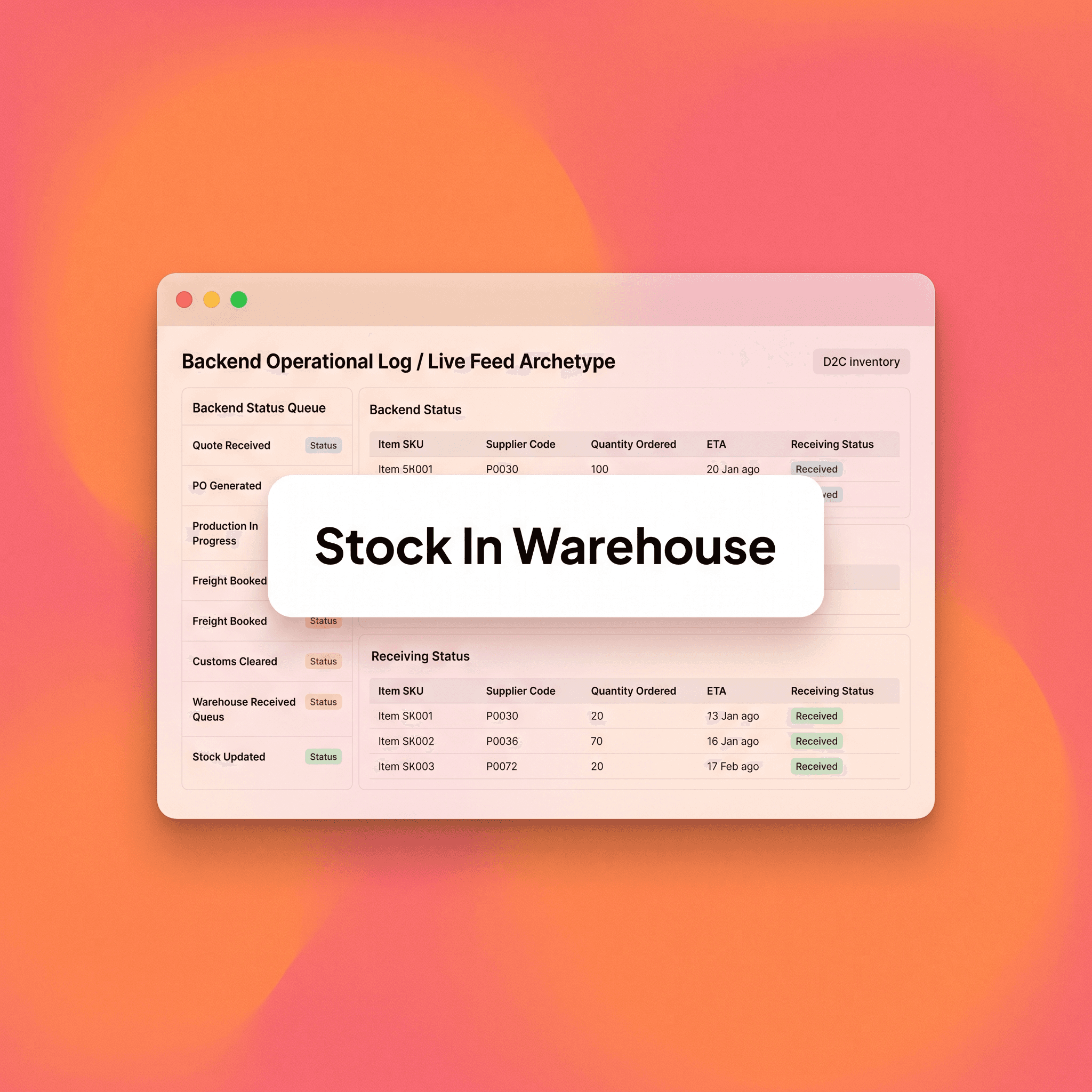
Most D2C brands get their Shopify storefront right before they get their operations right. The product looks good. The ads convert. Then a supplier ships the wrong quantity, a PO gets lost in a Gmail thread, and a SKU goes out of stock during a peak week. This disconnect between front-end marketing success and back-end fulfillment reality is a leading cause of stagnation for scaling e-commerce businesses.
When you lack a formal procurement system, you lose visibility into your true cost of goods sold, fail to account for supplier lead time variances, and ultimately damage your customer experience through avoidable stockouts. Transitioning from informal, ad-hoc ordering to a structured purchase order (PO) framework is the single most important operational shift a brand can make to protect its margins and maintain growth velocity.
This guide covers the full process from initial supplier quote to stock confirmed in your warehouse and gives you a framework you can use immediately, whether you're managing 5 suppliers or 50. Implementing these rigorous steps transforms your supply chain from a reactive burden into a predictable, scalable engine that supports your Shopify storefront's daily demand.
What Is a Purchase Order in a D2C Context?
A purchase order (PO) is a formal document your business sends to a supplier authorizing the purchase of specific goods at agreed terms. For a D2C brand running on Shopify, it is the operational link between your demand forecast and your physical inventory. Beyond merely acting as a shopping list, a PO serves as a binding legal contract that defines product specifications, pricing hierarchies, and agreed-upon delivery timelines, which are essential for navigating international manufacturing or complex wholesale relationships. It is not a quote.
It is not an email confirmation. It is a documented agreement that protects both parties and creates a traceable record across your supply chain. Without this document, your business is exposed to significant financial risk, as informal requests often lead to disputes over payment, product quality, or fulfillment errors that your team will be ill-equipped to resolve. Where most D2C teams fail is treating POs as administrative paperwork rather than operational infrastructure.
A well-managed PO process directly impacts your cash flow, stock availability, and supplier relationships, turning procurement into a strategic lever that stabilizes your inventory levels and enables more accurate long-term financial planning.
The D2C Purchase Order Lifecycle Map
This is a 6-stage framework for managing purchase orders from first contact with a supplier to stock confirmed in your warehouse. Use it to audit your current process or build one from scratch. Adopting this standardized lifecycle ensures that every stakeholder, from your procurement manager to your warehouse lead, remains aligned throughout the high-stakes period between ordering and receiving.
Stage 1: Demand Signal and Reorder Trigger
Before a PO is raised, you need a clear signal that stock is required. This should never be a gut call. Relying on intuition for inventory planning leads to overstocking, which ties up your operating capital in slow-moving assets, or understocking, which results in lost revenue and penalized search rankings on your sales channels.
Days of stock remaining (based on average daily sales velocity) for each core product line to ensure you maintain a safety buffer against unexpected demand surges.
A minimum stock threshold set per SKU, which acts as a technical floor for your warehouse inventory and initiates an automated procurement alert.
A planned campaign or seasonal push that will spike demand, requiring you to forward-load your inventory ahead of expected traffic volume increases.
A supplier lead time buffer that requires earlier ordering to account for international shipping transit times, port congestion, or seasonal factory shutdowns.
If you are managing this inside Shopify, native inventory alerts give you a basic signal, but they do not account for lead time or demand variability. Most growing brands layer a tool like Inventory Planner, Cin7, or a simple spreadsheet model to generate smarter reorder signals. The output of Stage 1 is a reorder decision with a quantity estimate attached.
Stage 2: Supplier Quote Request and Negotiation
Once you know what you need, you request a quote. Do this in writing, every time, even with suppliers you have worked with for years. Standardizing your request process prevents ambiguity in your supplier interactions, which is the root cause of 90% of order errors involving wrong colorways, incorrect dimensions, or improper material composition.
SKU name, code, and specification (size, color, variant, material) to ensure absolute clarity on the manufacturing requirements for your production run.
Quantity required, which should be finalized based on your forecast models to leverage bulk pricing tiers or optimize your container utilization.
Required delivery window, providing the factory with a clear target date that factors in your marketing launch schedules and warehouse intake capacity.
Delivery destination (warehouse address or 3PL), which impacts logistics costs and is essential for calculating your delivered cost of goods.
Any packaging or labeling requirements, such as FNSKU stickers or master carton markings, which are vital for meeting the entry standards of your specific fulfillment center.
When the supplier returns a quote, check it against your last accepted price, current market rates, and your margin targets before accepting. If you are ordering higher volumes, this is the moment to negotiate pricing, lead time, or payment terms. The output of Stage 2 is an accepted, documented quote.
Stage 3: Purchase Order Creation and Approval
The PO is now raised from the accepted quote. A well-structured PO includes all the technical specifications and legal terms necessary to hold a supplier accountable for the delivery of your inventory. Relying on a standardized PO template prevents "scope creep" where suppliers might alter production specs or delivery dates without prior authorization.
A unique PO number, which serves as your primary tracking key for all future communication, payment processing, and inventory intake audits.
Supplier name and contact details to facilitate fast communication if production hitches or logistic delays occur mid-transit.
Your business name and billing address, ensuring your financial records are legally compliant and your tax reporting is accurate for your jurisdiction.
Delivery address to prevent costly mid-transit re-routing or failed delivery attempts by logistics providers.
Line items: SKU, description, quantity, unit cost, total cost, allowing for easy verification against the original supplier quote and final invoice.
Payment terms (e.g., 30% deposit on order, 70% before dispatch) to manage your cash outflows effectively and maintain healthy leverage with manufacturing partners.
Expected delivery date that serves as your primary benchmark for success and a basis for penalty clauses if contract terms are violated.
Any reference to the original quote number to keep a clean audit trail between your initial inquiry and the final purchase contract.
The PO is sent to the supplier for confirmation. Do not treat a sent PO as a confirmed PO. You need written acknowledgment from the supplier that they have received and accepted the order as written. For Shopify-native operations, you can create and track POs inside Shopify if you are on the Retail plan, or use a connected tool like Stocky, Trade Gecko, or a dedicated procurement platform. The method matters less than the discipline: every PO must exist as a document, not as an assumption. The output of Stage 3 is a confirmed PO with supplier acknowledgment on file.
Stage 4: Production Monitoring and Pre-Shipment
For brands sourcing manufactured goods — especially from overseas suppliers — the period between PO confirmation and dispatch is where things go wrong silently. Lead times slip. Quality issues emerge. Quantities change. Proactive communication during this window identifies manufacturing bottlenecks before they become permanent delays in your Shopify store.
Set a midpoint check-in with the supplier to confirm production is on track and that raw materials have been secured according to the agreed schedule.
Request pre-shipment photos or a video walkthrough for new SKUs or large orders to verify product finishing, quality, and overall assembly standards.
Clarify who is responsible for quality inspection (you, the supplier, a third-party inspector) to set strict performance expectations before the goods depart.
Confirm packaging, labeling, and carton markings before dispatch to ensure your goods meet the specific receiving standards of your receiving warehouse or 3PL.
If you use a freight forwarder or 3PL, loop them in at this stage so they are ready to receive when goods ship. The output of Stage 4 is shipment confirmation with agreed documentation (commercial invoice, packing list, bill of lading if relevant).
Stage 5: Shipment Tracking and Inbound Receiving Prep
Once goods are in transit, your warehouse or 3PL needs to know what is coming and when. An unannounced inbound shipment creates delays, receiving errors, and unhappy ops teams. Sending detailed Advance Shipping Notices (ASN) is the professional standard for high-volume retailers and is essential for keeping your inventory intake fast and accurate.
PO number to allow your warehouse team to match incoming goods against the specific purchase order record in your procurement system.
Expected arrival date, providing the logistics team with the lead time they need to allocate personnel, dock space, and storage capacity.
Number of cartons and total units per SKU to ensure the warehouse manager can plan the shelf space and reconcile the intake volume effectively.
Any special handling instructions, such as temperature requirements or fragile item handling, to prevent damage during the unloading and storage process.
At this stage, also prepare your Shopify inventory update plan. Decide whether stock will be live immediately upon arrival or held pending a quality check. Make sure your team knows the process before goods arrive. The output of Stage 5 is an ASN sent, warehouse prepped, and Shopify receiving workflow confirmed.
Stage 6: Goods Received and PO Reconciliation
Goods arrive. Now close the loop. Failing to reconcile your incoming goods with your PO records is the most common cause of inventory shrinkage and "phantom stock" that plagues growing D2C brands, leading to significant financial discrepancies.
Actual quantity received vs. PO quantity, noting any immediate physical shortages or overages to determine if your warehouse has processed the full batch.
Any credits, claims, or adjustments raised with the supplier if the delivered items do not meet the quality or quantity specifications set in the PO.
Invoice matched against PO and goods received note (three-way match), which serves as your final financial safeguard before you issue payment to your supplier.
PO marked as closed in your system to prevent duplicate orders or confusion regarding which inventory intake tasks are still outstanding.
When stock is received, your warehouse team should physically count and verify it against the PO and packing list. Any discrepancies — short shipments, damaged units, wrong variants — must be documented immediately and communicated to the supplier in writing. The output of Stage 6 is a closed PO, updated Shopify inventory, and any supplier claims actioned.
Common Mistakes D2C Brands Make With Purchase Orders
Raising POs verbally or by informal message, which denies you any legal or operational recourse when shipments arrive late, damaged, or in incorrect quantities.
Not accounting for lead time in reorder triggers, which frequently leads to costly gaps in availability that result in lost sales and decreased search visibility for your best-performing products.
Skipping supplier acknowledgment, leaving your procurement team operating on assumptions that the factory has accepted your delivery dates, which rarely survives the reality of manufacturing logistics.
Managing POs in email threads, a chaotic practice that inevitably leads to misplaced files, forgotten orders, and an inability to track historical spend or performance data.
Entering received stock into Shopify before verification, creating a "dirty" database that forces you to manually backtrack and correct your inventory counts after discrepancies are identified.
Ignoring the three-way match, the cornerstone of financial control that ensures your payments are only issued for goods you have received in the expected quality and quantity.
How Shopify Handles Purchase Orders
Shopify's native PO functionality, available via the Stocky app or directly in Shopify for Retail plan users, covers the basics: you can create POs, send them to suppliers, and receive stock against them to update inventory. For early-stage brands managing a small number of SKUs and suppliers, this is functional. It is clean, it connects directly to your inventory, and it requires no additional tooling. Where it falls short at scale: no demand forecasting to inform reorder quantities, limited supplier management features (no quote history, contact management, or negotiation tracking), no multi-location receiving sophistication, no built-in three-way match for accounts payable, and limited reporting on PO performance, lead time accuracy, or supplier reliability. Brands that are growing quickly or managing complex supplier relationships typically layer on a dedicated inventory or procurement tool that integrates with Shopify. The right tool depends on your volume, SKU count, and supplier complexity — not a single right answer for every brand.
When to Upgrade Your System
You likely need a more structured approach to purchase order management when: you are managing more than three to five active suppliers, you have had a stockout caused by a missed or delayed reorder, your accounts team cannot reconcile supplier invoices against what was actually received, you are growing quickly enough that your ops process is visibly lagging behind your revenue, or you are considering a 3PL and need your inbound process to be documented and repeatable. The upgrade does not have to be a major platform change. It often starts with process discipline — formalizing your PO template, building a reorder trigger model, and establishing a receiving checklist — before adding software. By professionalizing these touchpoints, you build the internal organizational muscle required to manage complex inventory flows, ultimately creating the foundation needed to handle 10x or 100x your current volume without fracturing your supplier trust or warehouse efficiency.
Most D2C brands get their Shopify storefront right before they get their operations right. The product looks good. The ads convert. Then a supplier ships the wrong quantity, a PO gets lost in a Gmail thread, and a SKU goes out of stock during a peak week. This disconnect between front-end marketing success and back-end fulfillment reality is a leading cause of stagnation for scaling e-commerce businesses.
When you lack a formal procurement system, you lose visibility into your true cost of goods sold, fail to account for supplier lead time variances, and ultimately damage your customer experience through avoidable stockouts. Transitioning from informal, ad-hoc ordering to a structured purchase order (PO) framework is the single most important operational shift a brand can make to protect its margins and maintain growth velocity.
This guide covers the full process from initial supplier quote to stock confirmed in your warehouse and gives you a framework you can use immediately, whether you're managing 5 suppliers or 50. Implementing these rigorous steps transforms your supply chain from a reactive burden into a predictable, scalable engine that supports your Shopify storefront's daily demand.
What Is a Purchase Order in a D2C Context?
A purchase order (PO) is a formal document your business sends to a supplier authorizing the purchase of specific goods at agreed terms. For a D2C brand running on Shopify, it is the operational link between your demand forecast and your physical inventory. Beyond merely acting as a shopping list, a PO serves as a binding legal contract that defines product specifications, pricing hierarchies, and agreed-upon delivery timelines, which are essential for navigating international manufacturing or complex wholesale relationships. It is not a quote.
It is not an email confirmation. It is a documented agreement that protects both parties and creates a traceable record across your supply chain. Without this document, your business is exposed to significant financial risk, as informal requests often lead to disputes over payment, product quality, or fulfillment errors that your team will be ill-equipped to resolve. Where most D2C teams fail is treating POs as administrative paperwork rather than operational infrastructure.
A well-managed PO process directly impacts your cash flow, stock availability, and supplier relationships, turning procurement into a strategic lever that stabilizes your inventory levels and enables more accurate long-term financial planning.
The D2C Purchase Order Lifecycle Map
This is a 6-stage framework for managing purchase orders from first contact with a supplier to stock confirmed in your warehouse. Use it to audit your current process or build one from scratch. Adopting this standardized lifecycle ensures that every stakeholder, from your procurement manager to your warehouse lead, remains aligned throughout the high-stakes period between ordering and receiving.
Stage 1: Demand Signal and Reorder Trigger
Before a PO is raised, you need a clear signal that stock is required. This should never be a gut call. Relying on intuition for inventory planning leads to overstocking, which ties up your operating capital in slow-moving assets, or understocking, which results in lost revenue and penalized search rankings on your sales channels.
Days of stock remaining (based on average daily sales velocity) for each core product line to ensure you maintain a safety buffer against unexpected demand surges.
A minimum stock threshold set per SKU, which acts as a technical floor for your warehouse inventory and initiates an automated procurement alert.
A planned campaign or seasonal push that will spike demand, requiring you to forward-load your inventory ahead of expected traffic volume increases.
A supplier lead time buffer that requires earlier ordering to account for international shipping transit times, port congestion, or seasonal factory shutdowns.
If you are managing this inside Shopify, native inventory alerts give you a basic signal, but they do not account for lead time or demand variability. Most growing brands layer a tool like Inventory Planner, Cin7, or a simple spreadsheet model to generate smarter reorder signals. The output of Stage 1 is a reorder decision with a quantity estimate attached.
Stage 2: Supplier Quote Request and Negotiation
Once you know what you need, you request a quote. Do this in writing, every time, even with suppliers you have worked with for years. Standardizing your request process prevents ambiguity in your supplier interactions, which is the root cause of 90% of order errors involving wrong colorways, incorrect dimensions, or improper material composition.
SKU name, code, and specification (size, color, variant, material) to ensure absolute clarity on the manufacturing requirements for your production run.
Quantity required, which should be finalized based on your forecast models to leverage bulk pricing tiers or optimize your container utilization.
Required delivery window, providing the factory with a clear target date that factors in your marketing launch schedules and warehouse intake capacity.
Delivery destination (warehouse address or 3PL), which impacts logistics costs and is essential for calculating your delivered cost of goods.
Any packaging or labeling requirements, such as FNSKU stickers or master carton markings, which are vital for meeting the entry standards of your specific fulfillment center.
When the supplier returns a quote, check it against your last accepted price, current market rates, and your margin targets before accepting. If you are ordering higher volumes, this is the moment to negotiate pricing, lead time, or payment terms. The output of Stage 2 is an accepted, documented quote.
Stage 3: Purchase Order Creation and Approval
The PO is now raised from the accepted quote. A well-structured PO includes all the technical specifications and legal terms necessary to hold a supplier accountable for the delivery of your inventory. Relying on a standardized PO template prevents "scope creep" where suppliers might alter production specs or delivery dates without prior authorization.
A unique PO number, which serves as your primary tracking key for all future communication, payment processing, and inventory intake audits.
Supplier name and contact details to facilitate fast communication if production hitches or logistic delays occur mid-transit.
Your business name and billing address, ensuring your financial records are legally compliant and your tax reporting is accurate for your jurisdiction.
Delivery address to prevent costly mid-transit re-routing or failed delivery attempts by logistics providers.
Line items: SKU, description, quantity, unit cost, total cost, allowing for easy verification against the original supplier quote and final invoice.
Payment terms (e.g., 30% deposit on order, 70% before dispatch) to manage your cash outflows effectively and maintain healthy leverage with manufacturing partners.
Expected delivery date that serves as your primary benchmark for success and a basis for penalty clauses if contract terms are violated.
Any reference to the original quote number to keep a clean audit trail between your initial inquiry and the final purchase contract.
The PO is sent to the supplier for confirmation. Do not treat a sent PO as a confirmed PO. You need written acknowledgment from the supplier that they have received and accepted the order as written. For Shopify-native operations, you can create and track POs inside Shopify if you are on the Retail plan, or use a connected tool like Stocky, Trade Gecko, or a dedicated procurement platform. The method matters less than the discipline: every PO must exist as a document, not as an assumption. The output of Stage 3 is a confirmed PO with supplier acknowledgment on file.
Stage 4: Production Monitoring and Pre-Shipment
For brands sourcing manufactured goods — especially from overseas suppliers — the period between PO confirmation and dispatch is where things go wrong silently. Lead times slip. Quality issues emerge. Quantities change. Proactive communication during this window identifies manufacturing bottlenecks before they become permanent delays in your Shopify store.
Set a midpoint check-in with the supplier to confirm production is on track and that raw materials have been secured according to the agreed schedule.
Request pre-shipment photos or a video walkthrough for new SKUs or large orders to verify product finishing, quality, and overall assembly standards.
Clarify who is responsible for quality inspection (you, the supplier, a third-party inspector) to set strict performance expectations before the goods depart.
Confirm packaging, labeling, and carton markings before dispatch to ensure your goods meet the specific receiving standards of your receiving warehouse or 3PL.
If you use a freight forwarder or 3PL, loop them in at this stage so they are ready to receive when goods ship. The output of Stage 4 is shipment confirmation with agreed documentation (commercial invoice, packing list, bill of lading if relevant).
Stage 5: Shipment Tracking and Inbound Receiving Prep
Once goods are in transit, your warehouse or 3PL needs to know what is coming and when. An unannounced inbound shipment creates delays, receiving errors, and unhappy ops teams. Sending detailed Advance Shipping Notices (ASN) is the professional standard for high-volume retailers and is essential for keeping your inventory intake fast and accurate.
PO number to allow your warehouse team to match incoming goods against the specific purchase order record in your procurement system.
Expected arrival date, providing the logistics team with the lead time they need to allocate personnel, dock space, and storage capacity.
Number of cartons and total units per SKU to ensure the warehouse manager can plan the shelf space and reconcile the intake volume effectively.
Any special handling instructions, such as temperature requirements or fragile item handling, to prevent damage during the unloading and storage process.
At this stage, also prepare your Shopify inventory update plan. Decide whether stock will be live immediately upon arrival or held pending a quality check. Make sure your team knows the process before goods arrive. The output of Stage 5 is an ASN sent, warehouse prepped, and Shopify receiving workflow confirmed.
Stage 6: Goods Received and PO Reconciliation
Goods arrive. Now close the loop. Failing to reconcile your incoming goods with your PO records is the most common cause of inventory shrinkage and "phantom stock" that plagues growing D2C brands, leading to significant financial discrepancies.
Actual quantity received vs. PO quantity, noting any immediate physical shortages or overages to determine if your warehouse has processed the full batch.
Any credits, claims, or adjustments raised with the supplier if the delivered items do not meet the quality or quantity specifications set in the PO.
Invoice matched against PO and goods received note (three-way match), which serves as your final financial safeguard before you issue payment to your supplier.
PO marked as closed in your system to prevent duplicate orders or confusion regarding which inventory intake tasks are still outstanding.
When stock is received, your warehouse team should physically count and verify it against the PO and packing list. Any discrepancies — short shipments, damaged units, wrong variants — must be documented immediately and communicated to the supplier in writing. The output of Stage 6 is a closed PO, updated Shopify inventory, and any supplier claims actioned.
Common Mistakes D2C Brands Make With Purchase Orders
Raising POs verbally or by informal message, which denies you any legal or operational recourse when shipments arrive late, damaged, or in incorrect quantities.
Not accounting for lead time in reorder triggers, which frequently leads to costly gaps in availability that result in lost sales and decreased search visibility for your best-performing products.
Skipping supplier acknowledgment, leaving your procurement team operating on assumptions that the factory has accepted your delivery dates, which rarely survives the reality of manufacturing logistics.
Managing POs in email threads, a chaotic practice that inevitably leads to misplaced files, forgotten orders, and an inability to track historical spend or performance data.
Entering received stock into Shopify before verification, creating a "dirty" database that forces you to manually backtrack and correct your inventory counts after discrepancies are identified.
Ignoring the three-way match, the cornerstone of financial control that ensures your payments are only issued for goods you have received in the expected quality and quantity.
How Shopify Handles Purchase Orders
Shopify's native PO functionality, available via the Stocky app or directly in Shopify for Retail plan users, covers the basics: you can create POs, send them to suppliers, and receive stock against them to update inventory. For early-stage brands managing a small number of SKUs and suppliers, this is functional. It is clean, it connects directly to your inventory, and it requires no additional tooling. Where it falls short at scale: no demand forecasting to inform reorder quantities, limited supplier management features (no quote history, contact management, or negotiation tracking), no multi-location receiving sophistication, no built-in three-way match for accounts payable, and limited reporting on PO performance, lead time accuracy, or supplier reliability. Brands that are growing quickly or managing complex supplier relationships typically layer on a dedicated inventory or procurement tool that integrates with Shopify. The right tool depends on your volume, SKU count, and supplier complexity — not a single right answer for every brand.
When to Upgrade Your System
You likely need a more structured approach to purchase order management when: you are managing more than three to five active suppliers, you have had a stockout caused by a missed or delayed reorder, your accounts team cannot reconcile supplier invoices against what was actually received, you are growing quickly enough that your ops process is visibly lagging behind your revenue, or you are considering a 3PL and need your inbound process to be documented and repeatable. The upgrade does not have to be a major platform change. It often starts with process discipline — formalizing your PO template, building a reorder trigger model, and establishing a receiving checklist — before adding software. By professionalizing these touchpoints, you build the internal organizational muscle required to manage complex inventory flows, ultimately creating the foundation needed to handle 10x or 100x your current volume without fracturing your supplier trust or warehouse efficiency.
What is the difference between a purchase order and a supplier invoice?
A purchase order is issued by your business to a supplier, authorizing the purchase of specific goods at agreed terms before goods are dispatched. An invoice is issued by the supplier to your business after goods have been shipped or delivered, requesting payment. The PO sets the terms; the invoice requests fulfillment of those terms.
Does Shopify have a built-in purchase order system?
Shopify offers basic purchase order functionality through the Stocky app and, for Retail plan users, directly in the Shopify admin. It allows you to create POs, send them to suppliers, and update inventory upon receipt. For more advanced procurement needs — forecasting, supplier management, multi-location receiving — most scaling brands integrate a third-party tool.
How do I calculate the right reorder quantity for my Shopify store?
A reliable starting point is to calculate your average daily sales velocity for each SKU, multiply it by your supplier's lead time in days, and add a safety stock buffer for demand variability or supplier delays. This gives you the quantity needed to cover the reorder window. Tools like Inventory Planner automate this calculation, but a well-structured spreadsheet works at lower volumes.
What should a purchase order include for a D2C ecommerce brand?
A complete PO should include a unique PO number, your business details, the supplier's details, delivery address, line items with SKU codes and descriptions, quantities, unit costs and total value, payment terms, expected delivery date, and reference to any accepted quote. For brands sourcing internationally, you may also need to include incoterms and country of origin requirements.
How do I handle a supplier shipment that doesn't match my purchase order?
Document the discrepancy immediately. Compare the actual goods received against the PO and the supplier's packing list. Note any shortages, damaged units, or wrong variants in writing and photograph evidence where possible. Notify the supplier in writing with your documentation attached. Agree on a resolution — whether that is a credit, a replacement shipment, or a revised invoice — before closing the PO.
What is a three-way match in purchase order management?
A three-way match is an accounts payable control that compares three documents before approving a supplier payment: the purchase order (what you agreed to buy), the goods received note (what was actually delivered), and the supplier invoice (what you are being asked to pay). If the three documents align, the invoice is approved. If they do not, the discrepancy is investigated before payment is released. This prevents overpayment and catches supplier errors.
When should a D2C brand move beyond spreadsheets for purchase order management?
When manual tracking is creating errors, delays, or stockouts, it is time to formalize your system. Specific signals include managing five or more active suppliers, experiencing reconciliation issues at accounts payable, running multiple sales channels from a single inventory pool, or preparing to move to a 3PL. You do not necessarily need expensive software — a structured process with a clear PO template and a simple tracking tool can take you a long way.
insights
Explore more on AI, Design and Growth

SEO
Google AI & Local SEO: Rank in Both (2026 Guide)
Learn how to optimize content for Google AI search and local SEO simultaneously to rank in AI Overviews, maps, and organic search results.
SEO
Semantic Content Clusters for SEO & AEO (Templates)
Learn how to build semantic content clusters for SEO and AEO. Includes practical templates, internal linking structures, and examples for ranking in AI search.

SEO
How Google AI Search Works: RankBrain to Gemini (2026)
Discover how Google’s AI search evolved from RankBrain to Gemini and what it means for SEO, AI search results, and ranking strategies in 2026.
SEO
Google AI & Local SEO: Rank in Both (2026 Guide)
Learn how to optimize content for Google AI search and local SEO simultaneously to rank in AI Overviews, maps, and organic search results.
SEO
Semantic Content Clusters for SEO & AEO (Templates)
Learn how to build semantic content clusters for SEO and AEO. Includes practical templates, internal linking structures, and examples for ranking in AI search.
get in touch
Ready to Grow From Day One?
Strategy, execution, and digital experiences designed to move together. Fill out the form below and our team will contact you shortly.
get in touch
Ready to Grow From Day One?
Strategy, execution, and digital experiences designed to move together. Fill out the form below and our team will contact you shortly.
get in touch
Ready to Grow From Day One?
Strategy, execution, and digital experiences designed to move together. Fill out the form below and our team will contact you shortly.
Services
We'd love to hear from you.
Tell us what you're building and where you need support.
© 2026 projectsupply AI, Data and Digital Engineering
Company. Pune, India. All rights reserved.
Part of Tangle
Services
We'd love to hear from you.
Tell us what you're building and where you need support.
© 2026 projectsupply AI, Data and Digital Engineering
Company. Pune, India. All rights reserved.
Part of Tangle
Services
We'd love to hear from you.
Tell us what you're building and where you need support.
© 2026 projectsupply AI, Data and Digital Engineering
Company. Pune, India. All rights reserved.
Part of Tangle