

Shopify
Shopify RFM Analysis: How to Segment Customers by Recency, Frequency & Monetary Value
Shopify RFM Analysis: How to Segment Customers by Recency, Frequency & Monetary Value
Learn how to run RFM analysis on your Shopify store to segment customers by recency, frequency, and monetary value — and turn that data into retention and revenue.
Learn how to run RFM analysis on your Shopify store to segment customers by recency, frequency, and monetary value — and turn that data into retention and revenue.
08 min read
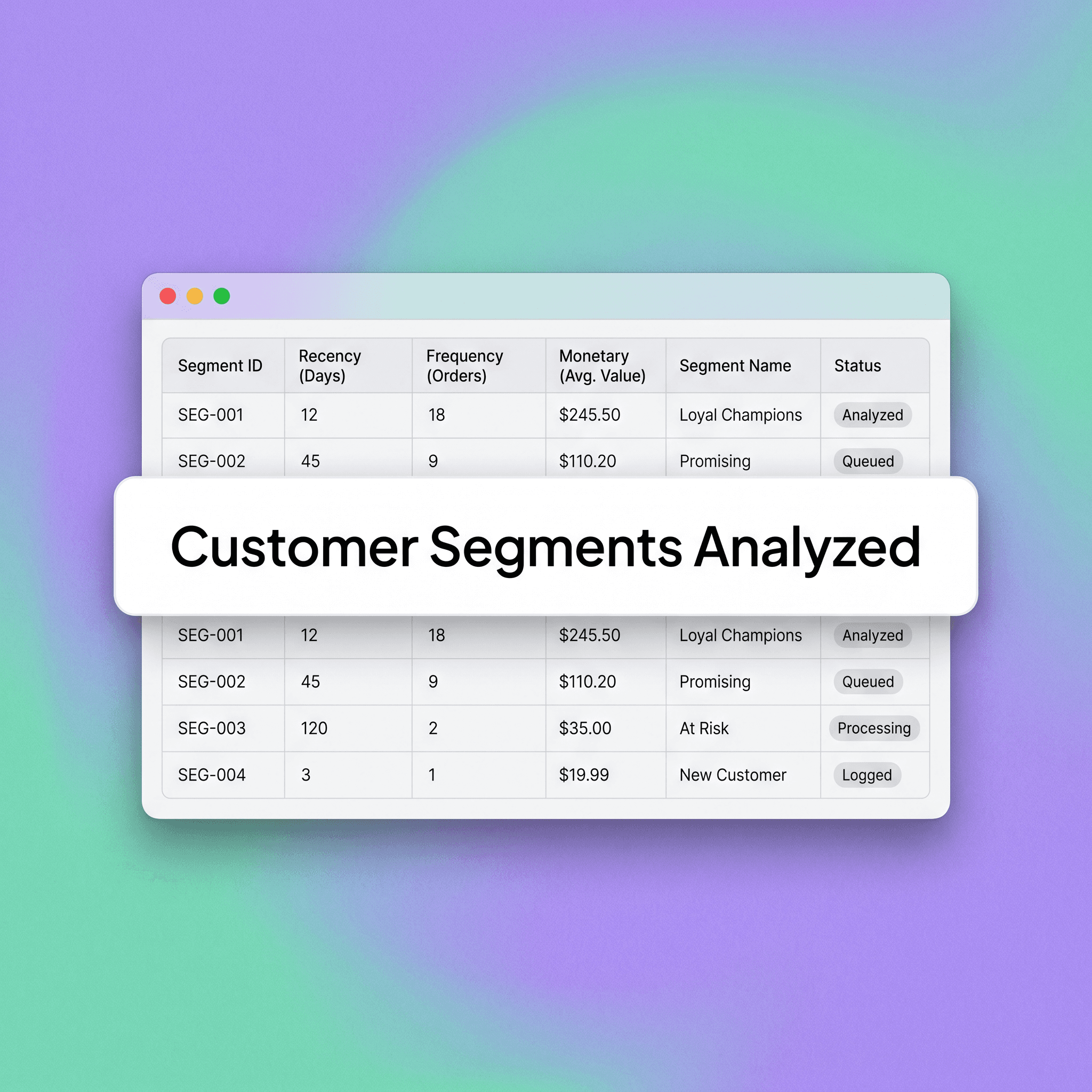
Most Shopify stores have more customer data than they know what to do with. Orders, sessions, tags, lifetime value columns sitting in exports — raw and unused. This abundance of information often leads to "analysis paralysis," where operators feel overwhelmed by the sheer volume of variables, yet fail to extract the high-level insights required to drive meaningful customer-centric growth initiatives. By failing to synthesize these data points, brands miss the opportunity to correlate specific user behaviors with their underlying psychological drivers, ultimately leaving significant revenue on the table due to generic, non-personalized marketing tactics that treat all customers as a monolith.
RFM analysis is how you turn that data into something actionable. It's one of the most durable frameworks in ecommerce, and it works especially well for Shopify stores that are past the scrappy growth phase and starting to think seriously about retention, segmentation, and margin. This methodology transcends vanity metrics by focusing strictly on the hard evidence of transactional behavior, providing a clear map for resource allocation that prioritizes high-impact customer interactions over broad-spectrum outreach. When implemented with rigor, RFM transforms raw database exports into a sophisticated, multi-dimensional view of the consumer lifecycle that guides every decision from inventory planning to personalized brand communication.
This guide covers what RFM is, how to build it for a Shopify store, how to act on each segment, and where most operators make mistakes with it. As a foundational pillar of modern D2C CRM strategy, mastering this approach allows store owners to pivot from a purely acquisition-heavy mindset toward a balanced growth model that champions sustainable, repeatable revenue from existing cohorts. By understanding the intricate mechanics of your historical order data, you can build a defensive moat around your brand, ensuring that high-value segments receive the specialized attention necessary to prevent churn and maximize long-term asset value.
What Is RFM Analysis?
RFM stands for Recency, Frequency, and Monetary Value. It's a method for scoring your customers based on three behavioral dimensions:
Recency — How recently did they buy? A customer who purchased last week is more valuable than one who last bought 18 months ago, all else equal. This metric serves as a high-fidelity indicator of a brand’s top-of-mind awareness and the current health of the consumer relationship. By tracking the decay of this metric, operators can pinpoint the exact moment when a customer transitions from an active user to an "at-risk" status, allowing for surgical intervention before the relationship reaches a point of no return.
Frequency — How many times have they bought? Repeat buyers signal product-market fit and brand affinity. A high frequency score is the ultimate validation of your core value proposition, indicating that the product successfully integrates into the customer’s lifestyle or solves a persistent pain point. Analyzing this dimension helps identify the "super-users" who advocate for the brand, as well as the segments that are currently struggling to transition from a trial phase to a habitual, recurring purchase state.
Monetary Value — How much have they spent in total? High spenders aren't always your most frequent buyers, but they carry disproportionate revenue weight. This metric allows you to weight your marketing investment according to the actual financial contribution of a specific segment, ensuring that your most generous patrons are properly incentivized and acknowledged. Even customers with low frequency can become high monetary scorers via a single large, high-margin transaction, representing a distinct opportunity for upsell or service-based premium offerings.
When you combine these three scores, you get a profile for every customer in your store. That profile tells you who to prioritize, who to re-engage, who to reward, and who to stop spending acquisition budget trying to win back. By utilizing these scores, you effectively categorize your entire database into discrete, manageable buckets that allow for automated, hyper-relevant communication flows. This structured approach moves beyond the limitations of basic demographics, focusing instead on the actual economic footprint left by each shopper, which provides a significantly more accurate predictor of future behavior than age, location, or acquisition source alone.
RFM doesn't require a data science team. It requires a structured approach and clean data — both of which are achievable in Shopify. While the mathematical output provides the foundation, the true value lies in the operational discipline of translating those outputs into repeatable, automated workflows that scale alongside the business. By democratizing access to this level of customer intelligence, smaller teams can achieve a level of strategic agility previously reserved for enterprise-level retail organizations, significantly lowering the barrier to entry for professional-grade CRM execution.
Why RFM Works Particularly Well for Shopify Stores
Shopify gives you transactional data in a format that maps cleanly onto RFM inputs: order date, order count, and order value are all standard fields. Whether you're pulling from native Shopify reports, a CSV export, or a connected analytics tool, the data is there. This inherent structural integrity of Shopify's data environment makes it an ideal platform for implementing RFM models, as the consistency of the order objects ensures that your calculations remain reliable across all time periods and customer segments. By leveraging the standardized architecture of Shopify’s backend, operators can quickly move from data ingestion to segment creation, minimizing the technical overhead typically associated with complex data warehouse projects.
More importantly, most D2C brands on Shopify are running email, SMS, paid retargeting, and loyalty programs where segment quality directly determines spend efficiency. Sending the same message to a lapsed customer who spent $12 once and a loyal customer who has spent $3,000 across 14 orders is a waste — and a missed opportunity. This spray-and-pray approach not only erodes brand equity through irrelevance but also triggers negative engagement metrics like spam reports and unsubscribes, which can permanently damage the deliverability and effectiveness of your marketing infrastructure. By segmenting via RFM, you align your content strategy with the specific lifecycle stage of the customer, drastically increasing the relevance and conversion rate of every touchpoint.
RFM gives you the structure to treat those two customers differently, systematically, at scale. Rather than relying on gut feeling, this systematic approach creates a scalable protocol for customer relationship management that grows more accurate as your data history deepens. Through this lens, you stop reacting to individual customer inquiries and start managing entire cohorts based on their demonstrated value, allowing you to maximize the ROI of your messaging, optimize your advertising spend, and create a more personalized shopping experience that fosters long-term brand loyalty.
The Project Supply RFM Segmentation Matrix for Shopify
Rather than assign arbitrary numerical scores, the most practical approach for most Shopify stores is to build a named segment matrix — a set of clearly defined customer groups based on RFM thresholds that match your own store's data distribution. Below is the Project Supply RFM Segmentation Matrix, designed for D2C Shopify brands with at least 12 months of order history.
Tier 1 — High-Value Active Segments
Champions — Bought recently, buy often, high total spend. These are your best customers. Protect them. Give them early access, loyalty benefits, and referral incentives — not discounts. Because these individuals represent the backbone of your recurring revenue, the primary operational goal is maintaining their engagement and preventing any decline in their status. Treating them as VIPs through exclusive content and early-access privileges creates a profound psychological connection that protects them from competitive poaching, ensuring they remain loyal long-term brand advocates.
Loyal Customers — High frequency and decent spend, but not necessarily the most recent. Slightly different from Champions — these customers have deep history with you. They respond well to appreciation messaging and product launches. Their historical engagement suggests they possess a foundational trust in your brand, making them the ideal audience for high-level brand storytelling and new product launches that capitalize on their established affinity. Re-engaging this group through personalized recognition serves as a powerful reminder of why they chose your brand in the first place, often serving as the nudge needed to bring them back into the active rotation.
Big Spenders (Recent) — High monetary value, recent purchase, but low frequency. They've spent a lot but rarely. Often one large order or a single high-ticket item. Worth nurturing toward a second purchase. This segment represents a significant revenue opportunity, as their high initial spending demonstrates a strong appetite for your premium offerings; however, they require careful guidance to establish a consistent purchasing habit. By analyzing what drove their initial high-value acquisition, you can tailor subsequent messaging to mirror that value, gently guiding them toward a secondary purchase that confirms their transition from a one-off buyer to a repeat customer.
Tier 2 — Opportunity Segments
Promising — Recent first purchase, low frequency, modest spend. These are new customers worth investing in. The goal is a second purchase within the right window — which depends on your product's natural repurchase cycle. Because these users have only engaged with the brand once, they are currently in the most sensitive stage of their lifecycle, making this the critical window for effective onboarding and educational content. Providing value-driven communication that reinforces the utility of their first purchase is essential, as this creates the necessary momentum to convert them into multi-purchase customers before their initial enthusiasm begins to wane.
Needs Attention — Used to buy with moderate regularity, but Recency is slipping. Not yet lapsed, but trending that way. These customers respond well to well-timed, relevant re-engagement — not panic discounts. Since their past behavior confirms a propensity for repeat purchasing, the drop in their frequency is often a sign of a shift in their needs or a temporary dissatisfaction that can be resolved with proactive support. Re-engaging them with non-discount, value-first messaging acknowledges their history without compromising your profit margins, providing a sophisticated bridge back to active status that respects their previous loyalty.
Potential Loyalists — Recent buyers with a couple of orders. They're showing signs of a pattern. The job here is reinforcement: review requests, loyalty program onboarding, and content that deepens product affinity. This segment is on the cusp of becoming your most valuable asset, requiring strategic reinforcement that stabilizes their nascent buying pattern. By introducing them to community-building initiatives or gamified loyalty elements at this precise stage, you lock in their engagement, creating a reliable, long-term repeat customer who feels like a genuine part of your brand’s ecosystem rather than just another transaction.
Tier 3 — Lapsed and At-Risk Segments
At Risk — Were once valuable — good frequency or spend — but Recency has dropped significantly. These are worth a structured win-back sequence. Not infinite budget, but a deliberate attempt. Because these customers have a demonstrated track record of value, the goal is to identify if their silence is due to a specific product issue or a simple lack of awareness of recent developments. Executing a highly targeted, multi-touch win-back campaign—rather than a generic blast—allows you to re-establish the connection in a way that feels intentional and respectful of the relationship they previously shared with your brand.
Can't Lose Them — High lifetime value, high historical frequency, but they haven't bought in a long time. A small group, but worth a personal touch — direct email, a founder note, or a meaningful offer. Since this segment represents the most significant historical contributors to your growth, the cost of re-engagement is often justified by the high probability of return if addressed correctly. By utilizing a highly personalized, human-centric approach that deviates from the standard automation, you demonstrate that your brand truly values their long-term partnership, which is often the only way to successfully recover a relationship that has become dormant.
Hibernating — Low scores across all three dimensions. Low recency, low frequency, low spend. These customers are not worth heavy investment. They can sit in a broad reactivation list, but they should not receive the same treatment as higher tiers. Managing this group efficiently means recognizing that the return on effort for intensive re-engagement is likely to be negative, making it better to focus your energy on higher-probability segments. They remain in your database for general brand updates, but they should be excluded from your primary marketing focus to protect your overall campaign performance metrics and deliverability rates.
Lost — Last purchased well outside your store's average repurchase window. Effectively churned. You can attempt one final reactivation message annually, but do not allocate meaningful budget here. Acknowledging that these users have moved on is a key part of maintaining operational efficiency, allowing you to clean your active lists and focus resources on segments with genuine growth potential. By treating this segment as truly churned, you prevent the dilution of your marketing results, ensuring that your core KPIs reflect the performance of your genuinely engaged and active customer base.
How to Build RFM Segments in Shopify
There are three practical routes, depending on your store's size and tool stack.
Option 1: Native Shopify Reports (Shopify Plus)
Shopify Plus includes a built-in RFM-style analysis under Analytics > Reports > Customer cohort analysis and the Customers section. You can filter by purchase count, date ranges, and spend thresholds. It's not a full RFM scoring system, but it covers the fundamentals for smaller teams. While this built-in capability is excellent for high-level visibility, it does not allow for the granular, multi-dimensional segmentation required to execute complex CRM strategies. This tool is best used as a starting point to understand your baseline metrics, but as your complexity grows, you will eventually outpace its static reporting capabilities, necessitating a more robust, specialized data solution.
The limitation is flexibility. You can't easily build custom named segments or export a scored customer list without additional manipulation. This rigidity means that you are effectively locked into the platform’s predetermined definitions, which may not always align with the unique lifecycle of your specific products. For teams looking to execute highly nuanced messaging that differentiates between "at-risk" vs. "hibernating" states based on specific purchase intervals, the native interface acts as a bottleneck that prevents the level of tactical precision required to truly drive incremental growth.
Option 2: Manual CSV Segmentation
Export your customer order data from Shopify (Orders > Export). Your key columns are customer email, order date, order count, and total spend. From there, you can build RFM scores in a spreadsheet:
Recency thresholds — Set based on days since last order (e.g., 0–30, 31–90, 91–180, 180+).
Frequency thresholds — Set based on order count distribution across your customer base.
Monetary thresholds — Set based on LTV percentile buckets.
Score each dimension 1–5, sum or weight the scores, and assign each customer to a named segment. This is manual but transparent, and it forces your team to make deliberate decisions about what the thresholds mean for your specific store. The primary advantage here is total ownership of the logic, as you aren't reliant on a third-party algorithm that might hide its decision-making process. By manually mapping these tiers in a spreadsheet, you develop a deep, visceral understanding of your customer data, which frequently leads to strategic breakthroughs that you would otherwise miss if you were simply relying on a black-box tool.
Option 3: Third-Party Tools (Recommended for Scale)
For stores doing meaningful volume, tools like Klaviyo (with its predictive analytics and segment builder), Triple Whale, Lifetimely, or Segments by Tresl can automate much of this. Klaviyo in particular allows you to build dynamic segments based on purchase behavior that update in real time. The ability to automatically trigger an email or SMS as soon as a customer shifts into a new RFM category is a massive operational leap forward, as it ensures your marketing response is perfectly timed to the customer’s behavior. This level of automation allows a small team to manage a customer base of tens of thousands, ensuring that every individual receives the right communication without requiring constant manual intervention.
The advantage of using a dedicated tool is that your segments stay current without manual rebuilds. The risk is relying on default configurations without understanding the logic underneath — which leads to poor segment decisions. If you allow a tool to define your "Loyal" segment using generic industry standards, you may inadvertently mischaracterize your customers, leading to a disconnect between your automated messaging and the reality of their shopping behavior. Always audit your chosen tool's segment definitions to ensure they align with your specific product cycles and business goals, using the tool as an accelerator rather than a replacement for strategic judgment. Whatever option you use, the quality of your RFM output is only as good as your tagging and order data hygiene in Shopify.
How to Act on Each RFM Segment
Building the segments is the analysis. Acting on them is the strategy. Here's a practical framework for how each segment should be treated across your main channels.
Email and SMS
Champions and Loyal Customers should receive your highest-quality content: product launches, early access, loyalty milestones, and community moments. Keep commercial pressure low — they're already buying. This segment appreciates recognition for their loyalty; by providing them with "insider" experiences, you reinforce the value of their ongoing relationship with your brand. Avoiding aggressive promotional tactics with these groups prevents the commoditization of your products, allowing you to maintain healthy margins while keeping your most profitable customers engaged and excited about the future of your brand’s evolution.
Promising and Potential Loyalists should receive onboarding flows focused on the second or third purchase. Education, social proof, and replenishment reminders if relevant. Since their path to becoming a "Champion" is currently being paved, these messages should be laser-focused on value demonstration and utility. By presenting content that highlights the benefits they’ve already experienced, you build the psychological bridge necessary to encourage that critical follow-up purchase, effectively creating the habit loops that serve as the foundation of your long-term retention metrics and overall customer lifetime value.
At Risk and Needs Attention customers should receive a deliberate re-engagement sequence — no more than three to four emails — that leads with value, not a discount code. If they don't respond, move them down. The goal is to identify if there’s a genuine friction point—like a service issue or a product mismatch—that can be corrected. Using this limited, high-intent sequence prevents the exhaustion of your list and avoids the common pitfall of training customers to wait for discounts, ensuring that your attempts to recover their business are perceived as helpful rather than desperate.
Can't Lose Them warrants a more personal approach: direct, non-automated messaging that acknowledges their history with your brand. This segment is your highest-value asset, and they deserve the extra effort required for a human touch, such as a note from a founder or a high-level account manager. By sidestepping standard marketing automation, you demonstrate that you view them as more than just a data point, which is often the most effective way to address the underlying reasons for their inactivity and regain their trust.
Hibernating and Lost customers should be excluded from regular campaigns. They inflate your list size, damage deliverability, and skew your engagement metrics. Keeping these inactive users in your primary segments dilutes the effectiveness of your data, making it harder to track the performance of your active audience. By pruning them, you improve your email sender reputation, lower your overhead costs, and sharpen your focus on the customers who are actually engaging with your brand’s current mission and offerings.
Paid Retargeting
Suppress Hibernating and Lost customers from paid audiences. Include Champions and Loyal Customers in lookalike audiences. Use Promising and Potential Loyalists for upsell-focused retargeting, not broad acquisition. By cleaning your retargeting lists, you eliminate wasted ad spend on people who have already demonstrated they aren't interested in a repeat purchase. Simultaneously, leveraging your best customers to build lookalike audiences allows your ad platforms to identify high-quality new prospects, effectively using your own historical data to optimize the acquisition cost and improve the quality of your top-of-funnel traffic.
Inventory and Merchandising
Champions are your best feedback source for new product development. At Risk and Needs Attention patterns can reveal product issues, subscription drop-offs, or fulfillment problems worth investigating. Because these users are the most intimate with your product, their feedback is the most accurate indicator of what is working and what is not. By systematically collecting and acting on their insights, you can proactively resolve issues before they propagate across your entire customer base, turning potential churn points into opportunities for service improvements and product innovation that benefit the brand as a whole.
Common Mistakes in Shopify RFM Analysis
Using absolute numbers instead of relative thresholds. A "high frequency" customer for a consumables brand that sells monthly might be someone who's ordered 12 times. For a furniture brand, it might be someone who's ordered twice. Set thresholds relative to your store's data distribution, not a generic benchmark. Applying external metrics without considering the specific nature of your product category is a fatal error that results in meaningless segmentation. Your data should reflect the reality of your store's specific customer journey, ensuring that your tiers represent actual, distinct behavioral clusters that are unique to your brand's specific context.
Treating all high-spend customers the same. A single large order three years ago is not the same signal as $3,000 spread across consistent purchases over two years. Break your monetary dimension down carefully. A high monetary score can hide a dormant or churning customer if it’s based on a single outlier event; by cross-referencing your monetary value with recency, you ensure that you aren't misidentifying a one-time purchaser as a "Champion." Distinguishing between these two types of high-value shoppers allows you to tailor your communication—treating the long-term consistent buyer with appreciation and the one-time high-ticket buyer with an onboarding-focused retention strategy.
Over-segmenting early. If your store has fewer than 2,000 customers with meaningful order history, a full 10-segment RFM matrix is unnecessary overhead. Start with four to five meaningful groups and expand as your data matures. Complexity for the sake of complexity often leads to thin segments that aren't large enough to produce statistically significant results, making it difficult to test and iterate your messaging effectively. Keep your segments broad enough to manage easily at the start, and only add granularity once your data volume allows for clear, data-driven differentiation between increasingly specific customer sub-groups.
Rebuilding segments manually and inconsistently. If your RFM matrix only gets updated when someone remembers to run the export, it stops being useful. Build a cadence — monthly at minimum — or automate it. Consistency is the primary factor that transforms an occasional analysis into a legitimate strategic asset. By building a set, automated rhythm for your segment updates, you ensure that your messaging is always grounded in the most recent customer behavior, allowing you to adapt your tactics in real-time as your store’s demographics, seasonality, or product mix shifts over time.
Using RFM as a discount distribution system. The most common misuse of RFM is pointing every lapsed segment at a coupon code. Discounts train price sensitivity and reduce margin. Use RFM to deliver relevance, not just incentives. If your only tool for re-engagement is a discount, you will eventually find your margins squeezed and your brand perceived as a bargain-bin option. True RFM strategy focuses on delivering content that reminds the customer why they bought in the first place, using personalization to demonstrate value rather than attempting to bribe them back into a purchase.
Ignoring the data quality problem. Guest checkouts, duplicate emails, and merged customers can corrupt your order history. Clean your Shopify customer data before building any segmentation model on top of it. If your source data is fundamentally flawed, your outputs will lead to incorrect strategic conclusions. Prioritize cleaning your database and establishing a single customer view as the first step of your project, as even the most sophisticated RFM model cannot overcome the limitations of polluted, fragmented, or inaccurately attributed order records.
Most Shopify stores have more customer data than they know what to do with. Orders, sessions, tags, lifetime value columns sitting in exports — raw and unused. This abundance of information often leads to "analysis paralysis," where operators feel overwhelmed by the sheer volume of variables, yet fail to extract the high-level insights required to drive meaningful customer-centric growth initiatives. By failing to synthesize these data points, brands miss the opportunity to correlate specific user behaviors with their underlying psychological drivers, ultimately leaving significant revenue on the table due to generic, non-personalized marketing tactics that treat all customers as a monolith.
RFM analysis is how you turn that data into something actionable. It's one of the most durable frameworks in ecommerce, and it works especially well for Shopify stores that are past the scrappy growth phase and starting to think seriously about retention, segmentation, and margin. This methodology transcends vanity metrics by focusing strictly on the hard evidence of transactional behavior, providing a clear map for resource allocation that prioritizes high-impact customer interactions over broad-spectrum outreach. When implemented with rigor, RFM transforms raw database exports into a sophisticated, multi-dimensional view of the consumer lifecycle that guides every decision from inventory planning to personalized brand communication.
This guide covers what RFM is, how to build it for a Shopify store, how to act on each segment, and where most operators make mistakes with it. As a foundational pillar of modern D2C CRM strategy, mastering this approach allows store owners to pivot from a purely acquisition-heavy mindset toward a balanced growth model that champions sustainable, repeatable revenue from existing cohorts. By understanding the intricate mechanics of your historical order data, you can build a defensive moat around your brand, ensuring that high-value segments receive the specialized attention necessary to prevent churn and maximize long-term asset value.
What Is RFM Analysis?
RFM stands for Recency, Frequency, and Monetary Value. It's a method for scoring your customers based on three behavioral dimensions:
Recency — How recently did they buy? A customer who purchased last week is more valuable than one who last bought 18 months ago, all else equal. This metric serves as a high-fidelity indicator of a brand’s top-of-mind awareness and the current health of the consumer relationship. By tracking the decay of this metric, operators can pinpoint the exact moment when a customer transitions from an active user to an "at-risk" status, allowing for surgical intervention before the relationship reaches a point of no return.
Frequency — How many times have they bought? Repeat buyers signal product-market fit and brand affinity. A high frequency score is the ultimate validation of your core value proposition, indicating that the product successfully integrates into the customer’s lifestyle or solves a persistent pain point. Analyzing this dimension helps identify the "super-users" who advocate for the brand, as well as the segments that are currently struggling to transition from a trial phase to a habitual, recurring purchase state.
Monetary Value — How much have they spent in total? High spenders aren't always your most frequent buyers, but they carry disproportionate revenue weight. This metric allows you to weight your marketing investment according to the actual financial contribution of a specific segment, ensuring that your most generous patrons are properly incentivized and acknowledged. Even customers with low frequency can become high monetary scorers via a single large, high-margin transaction, representing a distinct opportunity for upsell or service-based premium offerings.
When you combine these three scores, you get a profile for every customer in your store. That profile tells you who to prioritize, who to re-engage, who to reward, and who to stop spending acquisition budget trying to win back. By utilizing these scores, you effectively categorize your entire database into discrete, manageable buckets that allow for automated, hyper-relevant communication flows. This structured approach moves beyond the limitations of basic demographics, focusing instead on the actual economic footprint left by each shopper, which provides a significantly more accurate predictor of future behavior than age, location, or acquisition source alone.
RFM doesn't require a data science team. It requires a structured approach and clean data — both of which are achievable in Shopify. While the mathematical output provides the foundation, the true value lies in the operational discipline of translating those outputs into repeatable, automated workflows that scale alongside the business. By democratizing access to this level of customer intelligence, smaller teams can achieve a level of strategic agility previously reserved for enterprise-level retail organizations, significantly lowering the barrier to entry for professional-grade CRM execution.
Why RFM Works Particularly Well for Shopify Stores
Shopify gives you transactional data in a format that maps cleanly onto RFM inputs: order date, order count, and order value are all standard fields. Whether you're pulling from native Shopify reports, a CSV export, or a connected analytics tool, the data is there. This inherent structural integrity of Shopify's data environment makes it an ideal platform for implementing RFM models, as the consistency of the order objects ensures that your calculations remain reliable across all time periods and customer segments. By leveraging the standardized architecture of Shopify’s backend, operators can quickly move from data ingestion to segment creation, minimizing the technical overhead typically associated with complex data warehouse projects.
More importantly, most D2C brands on Shopify are running email, SMS, paid retargeting, and loyalty programs where segment quality directly determines spend efficiency. Sending the same message to a lapsed customer who spent $12 once and a loyal customer who has spent $3,000 across 14 orders is a waste — and a missed opportunity. This spray-and-pray approach not only erodes brand equity through irrelevance but also triggers negative engagement metrics like spam reports and unsubscribes, which can permanently damage the deliverability and effectiveness of your marketing infrastructure. By segmenting via RFM, you align your content strategy with the specific lifecycle stage of the customer, drastically increasing the relevance and conversion rate of every touchpoint.
RFM gives you the structure to treat those two customers differently, systematically, at scale. Rather than relying on gut feeling, this systematic approach creates a scalable protocol for customer relationship management that grows more accurate as your data history deepens. Through this lens, you stop reacting to individual customer inquiries and start managing entire cohorts based on their demonstrated value, allowing you to maximize the ROI of your messaging, optimize your advertising spend, and create a more personalized shopping experience that fosters long-term brand loyalty.
The Project Supply RFM Segmentation Matrix for Shopify
Rather than assign arbitrary numerical scores, the most practical approach for most Shopify stores is to build a named segment matrix — a set of clearly defined customer groups based on RFM thresholds that match your own store's data distribution. Below is the Project Supply RFM Segmentation Matrix, designed for D2C Shopify brands with at least 12 months of order history.
Tier 1 — High-Value Active Segments
Champions — Bought recently, buy often, high total spend. These are your best customers. Protect them. Give them early access, loyalty benefits, and referral incentives — not discounts. Because these individuals represent the backbone of your recurring revenue, the primary operational goal is maintaining their engagement and preventing any decline in their status. Treating them as VIPs through exclusive content and early-access privileges creates a profound psychological connection that protects them from competitive poaching, ensuring they remain loyal long-term brand advocates.
Loyal Customers — High frequency and decent spend, but not necessarily the most recent. Slightly different from Champions — these customers have deep history with you. They respond well to appreciation messaging and product launches. Their historical engagement suggests they possess a foundational trust in your brand, making them the ideal audience for high-level brand storytelling and new product launches that capitalize on their established affinity. Re-engaging this group through personalized recognition serves as a powerful reminder of why they chose your brand in the first place, often serving as the nudge needed to bring them back into the active rotation.
Big Spenders (Recent) — High monetary value, recent purchase, but low frequency. They've spent a lot but rarely. Often one large order or a single high-ticket item. Worth nurturing toward a second purchase. This segment represents a significant revenue opportunity, as their high initial spending demonstrates a strong appetite for your premium offerings; however, they require careful guidance to establish a consistent purchasing habit. By analyzing what drove their initial high-value acquisition, you can tailor subsequent messaging to mirror that value, gently guiding them toward a secondary purchase that confirms their transition from a one-off buyer to a repeat customer.
Tier 2 — Opportunity Segments
Promising — Recent first purchase, low frequency, modest spend. These are new customers worth investing in. The goal is a second purchase within the right window — which depends on your product's natural repurchase cycle. Because these users have only engaged with the brand once, they are currently in the most sensitive stage of their lifecycle, making this the critical window for effective onboarding and educational content. Providing value-driven communication that reinforces the utility of their first purchase is essential, as this creates the necessary momentum to convert them into multi-purchase customers before their initial enthusiasm begins to wane.
Needs Attention — Used to buy with moderate regularity, but Recency is slipping. Not yet lapsed, but trending that way. These customers respond well to well-timed, relevant re-engagement — not panic discounts. Since their past behavior confirms a propensity for repeat purchasing, the drop in their frequency is often a sign of a shift in their needs or a temporary dissatisfaction that can be resolved with proactive support. Re-engaging them with non-discount, value-first messaging acknowledges their history without compromising your profit margins, providing a sophisticated bridge back to active status that respects their previous loyalty.
Potential Loyalists — Recent buyers with a couple of orders. They're showing signs of a pattern. The job here is reinforcement: review requests, loyalty program onboarding, and content that deepens product affinity. This segment is on the cusp of becoming your most valuable asset, requiring strategic reinforcement that stabilizes their nascent buying pattern. By introducing them to community-building initiatives or gamified loyalty elements at this precise stage, you lock in their engagement, creating a reliable, long-term repeat customer who feels like a genuine part of your brand’s ecosystem rather than just another transaction.
Tier 3 — Lapsed and At-Risk Segments
At Risk — Were once valuable — good frequency or spend — but Recency has dropped significantly. These are worth a structured win-back sequence. Not infinite budget, but a deliberate attempt. Because these customers have a demonstrated track record of value, the goal is to identify if their silence is due to a specific product issue or a simple lack of awareness of recent developments. Executing a highly targeted, multi-touch win-back campaign—rather than a generic blast—allows you to re-establish the connection in a way that feels intentional and respectful of the relationship they previously shared with your brand.
Can't Lose Them — High lifetime value, high historical frequency, but they haven't bought in a long time. A small group, but worth a personal touch — direct email, a founder note, or a meaningful offer. Since this segment represents the most significant historical contributors to your growth, the cost of re-engagement is often justified by the high probability of return if addressed correctly. By utilizing a highly personalized, human-centric approach that deviates from the standard automation, you demonstrate that your brand truly values their long-term partnership, which is often the only way to successfully recover a relationship that has become dormant.
Hibernating — Low scores across all three dimensions. Low recency, low frequency, low spend. These customers are not worth heavy investment. They can sit in a broad reactivation list, but they should not receive the same treatment as higher tiers. Managing this group efficiently means recognizing that the return on effort for intensive re-engagement is likely to be negative, making it better to focus your energy on higher-probability segments. They remain in your database for general brand updates, but they should be excluded from your primary marketing focus to protect your overall campaign performance metrics and deliverability rates.
Lost — Last purchased well outside your store's average repurchase window. Effectively churned. You can attempt one final reactivation message annually, but do not allocate meaningful budget here. Acknowledging that these users have moved on is a key part of maintaining operational efficiency, allowing you to clean your active lists and focus resources on segments with genuine growth potential. By treating this segment as truly churned, you prevent the dilution of your marketing results, ensuring that your core KPIs reflect the performance of your genuinely engaged and active customer base.
How to Build RFM Segments in Shopify
There are three practical routes, depending on your store's size and tool stack.
Option 1: Native Shopify Reports (Shopify Plus)
Shopify Plus includes a built-in RFM-style analysis under Analytics > Reports > Customer cohort analysis and the Customers section. You can filter by purchase count, date ranges, and spend thresholds. It's not a full RFM scoring system, but it covers the fundamentals for smaller teams. While this built-in capability is excellent for high-level visibility, it does not allow for the granular, multi-dimensional segmentation required to execute complex CRM strategies. This tool is best used as a starting point to understand your baseline metrics, but as your complexity grows, you will eventually outpace its static reporting capabilities, necessitating a more robust, specialized data solution.
The limitation is flexibility. You can't easily build custom named segments or export a scored customer list without additional manipulation. This rigidity means that you are effectively locked into the platform’s predetermined definitions, which may not always align with the unique lifecycle of your specific products. For teams looking to execute highly nuanced messaging that differentiates between "at-risk" vs. "hibernating" states based on specific purchase intervals, the native interface acts as a bottleneck that prevents the level of tactical precision required to truly drive incremental growth.
Option 2: Manual CSV Segmentation
Export your customer order data from Shopify (Orders > Export). Your key columns are customer email, order date, order count, and total spend. From there, you can build RFM scores in a spreadsheet:
Recency thresholds — Set based on days since last order (e.g., 0–30, 31–90, 91–180, 180+).
Frequency thresholds — Set based on order count distribution across your customer base.
Monetary thresholds — Set based on LTV percentile buckets.
Score each dimension 1–5, sum or weight the scores, and assign each customer to a named segment. This is manual but transparent, and it forces your team to make deliberate decisions about what the thresholds mean for your specific store. The primary advantage here is total ownership of the logic, as you aren't reliant on a third-party algorithm that might hide its decision-making process. By manually mapping these tiers in a spreadsheet, you develop a deep, visceral understanding of your customer data, which frequently leads to strategic breakthroughs that you would otherwise miss if you were simply relying on a black-box tool.
Option 3: Third-Party Tools (Recommended for Scale)
For stores doing meaningful volume, tools like Klaviyo (with its predictive analytics and segment builder), Triple Whale, Lifetimely, or Segments by Tresl can automate much of this. Klaviyo in particular allows you to build dynamic segments based on purchase behavior that update in real time. The ability to automatically trigger an email or SMS as soon as a customer shifts into a new RFM category is a massive operational leap forward, as it ensures your marketing response is perfectly timed to the customer’s behavior. This level of automation allows a small team to manage a customer base of tens of thousands, ensuring that every individual receives the right communication without requiring constant manual intervention.
The advantage of using a dedicated tool is that your segments stay current without manual rebuilds. The risk is relying on default configurations without understanding the logic underneath — which leads to poor segment decisions. If you allow a tool to define your "Loyal" segment using generic industry standards, you may inadvertently mischaracterize your customers, leading to a disconnect between your automated messaging and the reality of their shopping behavior. Always audit your chosen tool's segment definitions to ensure they align with your specific product cycles and business goals, using the tool as an accelerator rather than a replacement for strategic judgment. Whatever option you use, the quality of your RFM output is only as good as your tagging and order data hygiene in Shopify.
How to Act on Each RFM Segment
Building the segments is the analysis. Acting on them is the strategy. Here's a practical framework for how each segment should be treated across your main channels.
Email and SMS
Champions and Loyal Customers should receive your highest-quality content: product launches, early access, loyalty milestones, and community moments. Keep commercial pressure low — they're already buying. This segment appreciates recognition for their loyalty; by providing them with "insider" experiences, you reinforce the value of their ongoing relationship with your brand. Avoiding aggressive promotional tactics with these groups prevents the commoditization of your products, allowing you to maintain healthy margins while keeping your most profitable customers engaged and excited about the future of your brand’s evolution.
Promising and Potential Loyalists should receive onboarding flows focused on the second or third purchase. Education, social proof, and replenishment reminders if relevant. Since their path to becoming a "Champion" is currently being paved, these messages should be laser-focused on value demonstration and utility. By presenting content that highlights the benefits they’ve already experienced, you build the psychological bridge necessary to encourage that critical follow-up purchase, effectively creating the habit loops that serve as the foundation of your long-term retention metrics and overall customer lifetime value.
At Risk and Needs Attention customers should receive a deliberate re-engagement sequence — no more than three to four emails — that leads with value, not a discount code. If they don't respond, move them down. The goal is to identify if there’s a genuine friction point—like a service issue or a product mismatch—that can be corrected. Using this limited, high-intent sequence prevents the exhaustion of your list and avoids the common pitfall of training customers to wait for discounts, ensuring that your attempts to recover their business are perceived as helpful rather than desperate.
Can't Lose Them warrants a more personal approach: direct, non-automated messaging that acknowledges their history with your brand. This segment is your highest-value asset, and they deserve the extra effort required for a human touch, such as a note from a founder or a high-level account manager. By sidestepping standard marketing automation, you demonstrate that you view them as more than just a data point, which is often the most effective way to address the underlying reasons for their inactivity and regain their trust.
Hibernating and Lost customers should be excluded from regular campaigns. They inflate your list size, damage deliverability, and skew your engagement metrics. Keeping these inactive users in your primary segments dilutes the effectiveness of your data, making it harder to track the performance of your active audience. By pruning them, you improve your email sender reputation, lower your overhead costs, and sharpen your focus on the customers who are actually engaging with your brand’s current mission and offerings.
Paid Retargeting
Suppress Hibernating and Lost customers from paid audiences. Include Champions and Loyal Customers in lookalike audiences. Use Promising and Potential Loyalists for upsell-focused retargeting, not broad acquisition. By cleaning your retargeting lists, you eliminate wasted ad spend on people who have already demonstrated they aren't interested in a repeat purchase. Simultaneously, leveraging your best customers to build lookalike audiences allows your ad platforms to identify high-quality new prospects, effectively using your own historical data to optimize the acquisition cost and improve the quality of your top-of-funnel traffic.
Inventory and Merchandising
Champions are your best feedback source for new product development. At Risk and Needs Attention patterns can reveal product issues, subscription drop-offs, or fulfillment problems worth investigating. Because these users are the most intimate with your product, their feedback is the most accurate indicator of what is working and what is not. By systematically collecting and acting on their insights, you can proactively resolve issues before they propagate across your entire customer base, turning potential churn points into opportunities for service improvements and product innovation that benefit the brand as a whole.
Common Mistakes in Shopify RFM Analysis
Using absolute numbers instead of relative thresholds. A "high frequency" customer for a consumables brand that sells monthly might be someone who's ordered 12 times. For a furniture brand, it might be someone who's ordered twice. Set thresholds relative to your store's data distribution, not a generic benchmark. Applying external metrics without considering the specific nature of your product category is a fatal error that results in meaningless segmentation. Your data should reflect the reality of your store's specific customer journey, ensuring that your tiers represent actual, distinct behavioral clusters that are unique to your brand's specific context.
Treating all high-spend customers the same. A single large order three years ago is not the same signal as $3,000 spread across consistent purchases over two years. Break your monetary dimension down carefully. A high monetary score can hide a dormant or churning customer if it’s based on a single outlier event; by cross-referencing your monetary value with recency, you ensure that you aren't misidentifying a one-time purchaser as a "Champion." Distinguishing between these two types of high-value shoppers allows you to tailor your communication—treating the long-term consistent buyer with appreciation and the one-time high-ticket buyer with an onboarding-focused retention strategy.
Over-segmenting early. If your store has fewer than 2,000 customers with meaningful order history, a full 10-segment RFM matrix is unnecessary overhead. Start with four to five meaningful groups and expand as your data matures. Complexity for the sake of complexity often leads to thin segments that aren't large enough to produce statistically significant results, making it difficult to test and iterate your messaging effectively. Keep your segments broad enough to manage easily at the start, and only add granularity once your data volume allows for clear, data-driven differentiation between increasingly specific customer sub-groups.
Rebuilding segments manually and inconsistently. If your RFM matrix only gets updated when someone remembers to run the export, it stops being useful. Build a cadence — monthly at minimum — or automate it. Consistency is the primary factor that transforms an occasional analysis into a legitimate strategic asset. By building a set, automated rhythm for your segment updates, you ensure that your messaging is always grounded in the most recent customer behavior, allowing you to adapt your tactics in real-time as your store’s demographics, seasonality, or product mix shifts over time.
Using RFM as a discount distribution system. The most common misuse of RFM is pointing every lapsed segment at a coupon code. Discounts train price sensitivity and reduce margin. Use RFM to deliver relevance, not just incentives. If your only tool for re-engagement is a discount, you will eventually find your margins squeezed and your brand perceived as a bargain-bin option. True RFM strategy focuses on delivering content that reminds the customer why they bought in the first place, using personalization to demonstrate value rather than attempting to bribe them back into a purchase.
Ignoring the data quality problem. Guest checkouts, duplicate emails, and merged customers can corrupt your order history. Clean your Shopify customer data before building any segmentation model on top of it. If your source data is fundamentally flawed, your outputs will lead to incorrect strategic conclusions. Prioritize cleaning your database and establishing a single customer view as the first step of your project, as even the most sophisticated RFM model cannot overcome the limitations of polluted, fragmented, or inaccurately attributed order records.
FAQs
What is RFM analysis in the context of a Shopify store?
RFM analysis is a customer segmentation method that scores each customer across three dimensions — how recently they bought, how often they buy, and how much they've spent. Applied to Shopify, it takes your existing order data and turns it into actionable customer tiers so you can market, retain, and invest in each group differently. By assigning a score of 1–5 to each of these categories, you generate a comprehensive profile that helps you distinguish between your most profitable brand advocates and those who are on the verge of churn. This structured approach allows you to move away from guesswork and instead make data-backed decisions that prioritize high-impact interactions, ensuring your marketing spend is directed toward the segments most likely to produce a long-term return on investment.
Do I need Shopify Plus to run RFM analysis?
No. Shopify Plus includes more native analytics functionality, but any Shopify plan allows you to export order data and build an RFM model manually in a spreadsheet. Third-party tools like Klaviyo and Lifetimely also work across standard Shopify plans, meaning that the barrier to entry is determined by your operational capacity rather than your platform tier. Whether you are using a simple CSV download or integrating a sophisticated data platform, the fundamental principles of RFM remain universal; you can start building a high-level segmentation model today regardless of your current plan, provided you have a clean record of your historical sales and customer transactions.
How often should I update my RFM segments?
Monthly is the practical minimum for most stores. If you're running high-volume campaigns or using RFM to drive real-time personalization, you'll want automated updates through a tool that connects directly to your Shopify data. Updating too infrequently renders your data stale, leading to outdated segmentation that doesn't reflect your customers' current needs or recent interactions. By establishing a consistent, automated cadence for your updates, you ensure that your marketing messaging remains relevant, timely, and aligned with the actual behavioral trends occurring in your store, which is critical for maintaining high engagement levels and minimizing the risk of losing customers due to mistimed, irrelevant outreach.
What's the difference between RFM segmentation and Shopify's built-in customer tags?
Shopify customer tags are static labels you apply manually or through automations. RFM segmentation is a dynamic, data-driven scoring system that reflects actual purchase behavior. You can use RFM outputs to inform your tagging strategy, but they're not the same thing by default. Tags are often used to mark specific events, like "VIP" or "bought-product-x," whereas RFM provides a holistic, quantitative assessment that evolves as the customer’s relationship with your brand develops. Leveraging RFM allows you to create a sophisticated, multi-layered view of your database that far exceeds the capabilities of standard tagging, providing the granular insights needed to drive advanced CRM strategies and personalized customer journeys.
How do I handle customers with only one order in my RFM model?
Single-order customers are a segment in themselves. They have a Frequency score of 1 regardless of Recency or Monetary value. Treat them as a priority retention opportunity — the goal is a second purchase, not immediate segmentation into a tier that assumes repeat behavior. Because the hurdle to a second purchase is significantly lower than the hurdle to a tenth, your communication with this group should be focused on educational value, product utility, and reinforcement of their initial decision to buy. By successfully guiding these one-time buyers toward a repeat transaction, you significantly boost your customer lifetime value, making this segment a vital focus area for anyone looking to scale their business sustainably.
Which tool is best for Shopify RFM analysis at scale?
Klaviyo is the most common choice for D2C brands because it combines segmentation, email, and SMS in one platform and has direct Shopify integration. Segments by Tresl is purpose-built for RFM and is worth evaluating for stores that want dedicated analytics without the full ESP overhead. Triple Whale and Lifetimely are strong if you're prioritizing LTV reporting alongside segmentation. Choosing the right tool depends on whether you want an all-in-one execution platform like Klaviyo or a specialized analytics dashboard that gives you deeper, more granular insight into your financial metrics. Regardless of which tool you select, the key is finding one that automates the update process and integrates seamlessly with your existing marketing channels, ensuring your strategy can scale without adding manual overhead.
Can RFM analysis help reduce paid acquisition costs?
Directly, yes. By identifying your highest-value segments, you can build stronger lookalike audiences and suppress non-converting customers from retargeting pools. This tightens your paid audience quality and typically improves return on ad spend without increasing budget. When you stop serving ads to those who have already churned or shown no intent to return, you lower your wasted spend and increase the overall efficiency of your ad accounts. By focusing your paid efforts on the high-value cohorts identified by your RFM analysis, you ensure that your budget is working as hard as possible to attract high-intent customers who mirror your most loyal and profitable user base.
insights
Explore more on AI, Design and Growth

SEO
Google AI & Local SEO: Rank in Both (2026 Guide)
Learn how to optimize content for Google AI search and local SEO simultaneously to rank in AI Overviews, maps, and organic search results.
SEO
Semantic Content Clusters for SEO & AEO (Templates)
Learn how to build semantic content clusters for SEO and AEO. Includes practical templates, internal linking structures, and examples for ranking in AI search.

SEO
How Google AI Search Works: RankBrain to Gemini (2026)
Discover how Google’s AI search evolved from RankBrain to Gemini and what it means for SEO, AI search results, and ranking strategies in 2026.
SEO
Google AI & Local SEO: Rank in Both (2026 Guide)
Learn how to optimize content for Google AI search and local SEO simultaneously to rank in AI Overviews, maps, and organic search results.
SEO
Semantic Content Clusters for SEO & AEO (Templates)
Learn how to build semantic content clusters for SEO and AEO. Includes practical templates, internal linking structures, and examples for ranking in AI search.
get in touch
Ready to Grow From Day One?
Strategy, execution, and digital experiences designed to move together. Fill out the form below and our team will contact you shortly.
get in touch
Ready to Grow From Day One?
Strategy, execution, and digital experiences designed to move together. Fill out the form below and our team will contact you shortly.
get in touch
Ready to Grow From Day One?
Strategy, execution, and digital experiences designed to move together. Fill out the form below and our team will contact you shortly.
Services
We'd love to hear from you.
Tell us what you're building and where you need support.
© 2026 projectsupply AI, Data and Digital Engineering
Company. Pune, India. All rights reserved.
Part of Tangle
Services
We'd love to hear from you.
Tell us what you're building and where you need support.
© 2026 projectsupply AI, Data and Digital Engineering
Company. Pune, India. All rights reserved.
Part of Tangle
Services
We'd love to hear from you.
Tell us what you're building and where you need support.
© 2026 projectsupply AI, Data and Digital Engineering
Company. Pune, India. All rights reserved.
Part of Tangle