

Shopify
Shopify SEO Content Strategy 2026: How to Build a Blog That Ranks and Converts
Shopify SEO Content Strategy 2026: How to Build a Blog That Ranks and Converts
A practical guide to building a Shopify SEO content strategy that drives organic traffic and converts shoppers — including keyword targeting, content architecture, and the PS Content-to-Commerce Audit Matrix.
A practical guide to building a Shopify SEO content strategy that drives organic traffic and converts shoppers — including keyword targeting, content architecture, and the PS Content-to-Commerce Audit Matrix.
08 min read
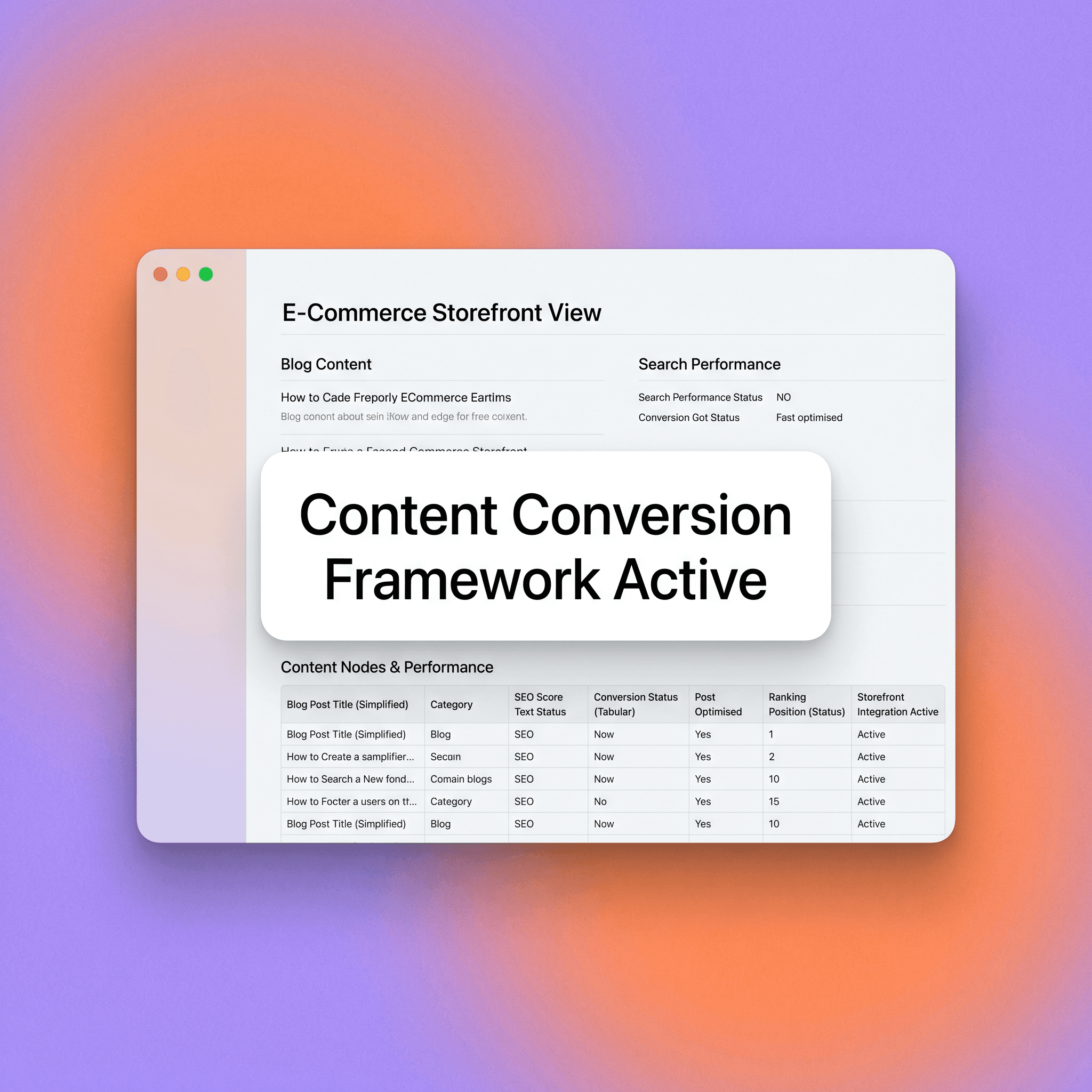
Most Shopify blogs are a graveyard of product announcements and trend roundups that no one searched for and no one reads twice. If your store's blog has a pulse but no traffic, the problem is almost never effort — it's architecture. This is often because store owners fail to realize that Google treats ecommerce blogs as information hubs rather than brand journals, requiring a fundamental shift in how metadata and search signals are handled within the platform's constraints. By treating your blog as a technical asset rather than a marketing afterthought, you create a sustainable pipeline that bridges the gap between passive curiosity and active checkout behavior.
A Shopify SEO content strategy is not about publishing more. It's about building an editorial system where every piece of content has a defined keyword target, a clear role in your funnel, and a logical path to conversion. Done correctly, your blog becomes a compounding traffic asset that lowers your long-term customer acquisition cost by capturing users before they even reach the comparison phase of their buying journey. Done incorrectly, it's a cost center that flatters your team and does nothing for revenue because it fails to satisfy the intent signals that search algorithms actively reward in the current competitive landscape.
This guide lays out the framework, the structure, and the decisions you need to make before you publish another word. Implementing these foundational strategies early prevents the common pitfall of having to perform a massive site-wide audit later, saving hundreds of development hours and protecting your domain authority as you scale your operations.
Why Most Shopify Blogs Fail at SEO
The failure pattern is consistent. A brand launches a Shopify store, adds a blog because they heard content was important, and then publishes irregularly without a defined keyword strategy. Twelve months later, the blog has forty posts and ranks for almost nothing. This cycle is driven by a lack of operational discipline where brands confuse activity with actual growth, leading to a bloated index of low-value pages that drain your crawl budget and confuse search engine crawlers regarding your site's core topical authority.
The root causes are usually one of four things:
No keyword-to-content mapping: Posts are written around brand preferences, not search demand. This happens when teams prioritize internal sentiment over external intent, failing to use data-driven insights to determine what the customer is actually typing into the search bar when they face a problem your product solves.
Weak on-page structure: Titles aren't optimized, H1s don't match search intent, and meta descriptions are auto-generated. Without explicit headers and meta-data, you lose the ability to influence your click-through rate (CTR) directly from the search results page, effectively leaving your organic performance in the hands of randomized site scraping.
Zero internal link architecture: Content sits in silos with no path to collection or product pages. When your posts exist on an island, the valuable link equity they gather from search cannot flow to your revenue-generating pages, which effectively wastes the authority that your content efforts have worked so hard to build.
Misaligned content type: Publishing opinion pieces when the SERP rewards how-to guides, or writing general content when the query demands specific answers. This misalignment ensures that even if you do rank, the user will immediately bounce because the content fails to meet the fundamental promise made to them by the search query.
None of these are hard to fix. But fixing them requires a strategy before the writing starts, necessitating a shift toward a research-first culture where every publish event is validated against concrete search metrics to ensure maximum return on time invested.
The PS Content-to-Commerce Audit Matrix
Before building forward, audit what you have. The PS Content-to-Commerce Audit Matrix is a four-quadrant evaluation framework for existing Shopify blog content. Map every post across two axes:
Axis 1 (X): Search Relevance — Does this post target a keyword with measurable search volume that your audience is actively querying? This involves checking monthly search volume (MSV) and keyword difficulty to ensure your efforts are focused on topics that have a sustainable, recurring audience of potential buyers.
Axis 2 (Y): Commercial Proximity — Does this post sit close to a purchase decision, or is it purely informational with no conversion pathway? This axis forces you to critically evaluate whether a reader is likely to transition from reading a guide into a shopping cart, which is essential for determining the long-term ROI of every single article you host on your domain.
This produces four quadrants:
Quadrant 1 — Rank & Convert: High search relevance, high commercial proximity. These are your priority pages. Optimize aggressively and make sure internal links connect them to product and collection pages. These pages act as your primary organic revenue drivers and should be monitored for rank fluctuations on a weekly basis to ensure they hold their position against competitors.
Quadrant 2 — Rank & Nurture: High search relevance, low commercial proximity. These posts pull in traffic at the awareness stage. They're worth keeping and improving, but they need better CTAs or contextual links to move readers toward purchase intent content. By providing value early, you establish brand trust, which is a critical intangible asset for high-ticket or complex products.
Quadrant 3 — Rewrite or Redirect: Low search relevance, high commercial proximity. These posts are close to the money but nobody's finding them. Either rewrite them around a real keyword or consolidate them into a stronger page. By repurposing the existing high-value content, you can leverage previous efforts while correcting the initial oversight regarding how people actually search for your solutions.
Quadrant 4 — Archive or Delete: Low search relevance, low commercial proximity. These posts do nothing. Canonicalize, redirect to a relevant page, or remove them. Crawl budget and internal equity are finite, and keeping dead weight on your server can dilute your topical authority and signal to Google that your site is not maintained or high-quality.
Run this matrix once before building your content calendar. It will save you from publishing new content over a weak foundation, ensuring your future SEO efforts are focused on growth rather than remediation of past mistakes.
Building Your Shopify SEO Keyword Architecture
A Shopify SEO content strategy runs on three keyword tiers. Each tier serves a different audience stage and a different search intent. By layering these tiers, you create a comprehensive content ecosystem that addresses the entire customer journey, from initial discovery to final purchase validation.
Tier 1: Category and Collection Keywords
These are high-volume, competitive terms that typically align with your collection pages — not your blog. Think "men's leather wallets" or "natural skincare for sensitive skin." Your blog rarely wins these head-on. Instead, use the blog to support them through internal linking and topical authority. By embedding these terms into your blog's context, you provide search engines with the necessary relevance signals to validate that your entire site is the authority on that specific, competitive topic.
Tier 2: Problem and Comparison Keywords
This is where your blog wins. Queries like "best leather wallet under $100," "how to choose a moisturizer for sensitive skin," or "glycolic acid vs. lactic acid" represent active consideration. The searcher is in evaluation mode. These posts should rank well, answer the question directly, and link internally to relevant product or collection pages. This is the "sweet spot" for content creators because it captures users at the moment of peak intent when they are most susceptible to a well-timed recommendation or comparison.
Tier 3: Long-Tail and Niche-Specific Keywords
Lower volume, lower competition, often higher intent. A post targeting "how to store a leather wallet to prevent cracking" may pull 200 visitors a month, but those visitors know what they want. Tier 3 content builds topical depth and signals domain expertise to search engines. It also frequently earns featured snippets. These long-tail keywords are critical for small-to-medium stores because they allow you to compete with industry giants by owning narrow niches that larger, more generalized competitors ignore or overlook in their broad-stroke strategies.
A functional content calendar maps each piece of content to a specific tier before it gets written — not after. This planning process eliminates the "spray and pray" approach and replaces it with a rigorous, data-informed strategy that maximizes the utility of every word written.
Structuring a Shopify Blog Post for SEO
H1 and Title Alignment
Your H1 and your SEO title should be close to identical or identical. Both should contain the primary keyword. This is not a creative exercise — it is a signal to Google about what the page covers. By keeping these synchronized, you reduce cognitive load for the reader and provide the search engine with an unambiguous signal that reinforces your content's relevance, which is essential for capturing top-three positions in competitive SERPs.
First 100 Words
Place your primary keyword in the first 100 words naturally. The opening paragraph should confirm to the reader (and the crawler) that the page delivers exactly what the title promised. Don't build to your point. Lead with it. In an era where user attention spans are measured in seconds, immediate confirmation of relevance prevents bounce rates and keeps the user engaged with the rest of the high-value information you have prepared for them.
H2 and H3 Hierarchy
H2s should address sub-topics that the primary keyword's SERP also covers. Look at the "People Also Ask" box and the structure of pages currently ranking in the top five. This tells you what Google's model of the topic looks like. Use that model as your structural scaffold, then add your own depth and differentiation. H3s are useful for breaking down specific points within an H2 section — not for adding headers where none are needed. Over-structuring creates noise. A logical, hierarchical structure is not just for SEO; it is for accessibility, allowing both human readers and machine crawlers to parse your content with absolute clarity.
Internal Links to Product and Collection Pages
Every blog post in your Shopify content strategy should have at least one contextually natural link to a collection or product page. "Natural" is the operative word. If you're writing about how to care for leather wallets and you carry leather wallets, the link earns its place. Force it and it reads like an ad. Effective internal linking creates a spiderweb of authority across your site, distributing the weight of your top-performing blog posts toward the pages that drive your business's revenue and bottom-line success.
Meta Description
Write it. Don't rely on Shopify to pull a default excerpt. Your meta description is a click-rate lever. 150–160 characters. Include the keyword. Lead with value, not with your brand name. A well-crafted meta description acts as an advertisement for your page in the search results, and optimizing this often results in a significant, immediate lift in traffic without requiring a change in your actual search ranking position.
Content Formats That Perform for Ecommerce SEO
Not all formats are equal in ecommerce search. The following formats consistently perform well for D2C Shopify brands:
Buying guides — "The Complete Guide to Choosing [Product Category]." High commercial proximity, high purchase intent, strong for Tier 2 keywords. These serve as the final authority in a user's search process, often resulting in direct additions to cart immediately after the user finishes reading.
Comparison posts — "X vs. Y: Which Is Right for You?" These capture mid-funnel searchers who are close to a decision. By providing an objective look at trade-offs, you build incredible amounts of trust, which is a major factor in reducing cart abandonment and increasing long-term customer lifetime value.
How-to and care guides — Post-purchase content that attracts new visitors via long-tail queries and builds brand trust. These are evergreen assets that continue to deliver traffic years after publication, creating a permanent, low-maintenance stream of qualified leads that find you through specific, actionable problem-solving.
Ingredient or material deep-dives — Effective in beauty, wellness, food, and materials-based categories. Builds topical authority and earns links from adjacent sites. By going deeper into the "why" of your products, you differentiate yourself from generic retailers and position your brand as a true subject matter expert.
Seasonal and trend-driven content — Lower shelf life but strong traffic spikes. Worth building if you have the bandwidth and a clear promotional tie-in. These are effective for temporary awareness campaigns, but they must be supported by a secondary strategy of linking them to permanent evergreen content to avoid long-term traffic gaps.
Opinion pieces, brand stories, and product launch announcements are legitimate for brand building, but they should not be your primary SEO output. Write them with purpose, not as filler between strategy posts, as they rarely serve the high-intent searcher who is looking for a solution or a specific answer.
Common Mistakes and Trade-Offs in Shopify Content Strategy
Publishing Without Keyword Research
Writing a post because the topic feels relevant is not a content strategy. Every piece of content should begin with a keyword validation step: search volume, competition level, and SERP intent check. If you skip this, you're writing for yourself. Writing in a vacuum is one of the most common reasons ecommerce brands fail at content; if no one is searching for the specific phrase you are writing about, no matter how beautiful or well-written the post is, it will result in zero traffic.
Targeting Keywords That Your Domain Can't Win Yet
A new Shopify store with low domain authority should not be trying to rank for "best running shoes." You will not rank. Instead, prioritize Tier 3 long-tail terms where the competition is thinner, build topical authority gradually, and work up the keyword difficulty curve as your domain earns authority. This incremental approach allows you to build a reputation for expertise in smaller sub-topics, which eventually provides the signal necessary for Google to trust your site with more competitive, higher-volume keyword targets.
Treating All Traffic as Equal
Ranking #1 for a query that sends you 5,000 monthly visitors with 0.1% purchase intent is less valuable than ranking #4 for a query that sends 400 visitors with 8% purchase intent. Build your editorial calendar around revenue proximity, not just traffic volume. Revenue-focused content strategy ensures that every minute your team spends writing contributes directly to the growth of your company's P&L, rather than just boosting vanity metrics in your analytics dashboard.
Neglecting Existing Content
New content gets attention. Existing content gets ignored. In most cases, updating and re-optimizing a post that already has some Google equity will generate faster results than publishing something new. Audit before you build. Many stores have "sleeping giant" articles that are ranking at position 12; a simple refresh of the data, an update to the internal links, and a tightening of the text can move that post into the top 3, providing a massive, immediate boost to organic revenue.
Ignoring Technical SEO Basics
Content strategy and technical SEO are not the same discipline, but they are interdependent. Slow page speed, uncompressed images, duplicate product description content, and poor mobile formatting will limit what your content can achieve regardless of its quality. The writing has to sit on a clean foundation. Technical debt at the theme level will always act as a headwind; by optimizing your site's technical health, you ensure that your high-quality content is capable of performing at its full potential without being held back by site-wide errors.
How to Build a 90-Day Shopify Content Calendar
A 90-day content calendar gives you enough runway to build momentum without over-committing. Structure it as follows:
Days 1–15 — Audit Phase: Run the PS Content-to-Commerce Audit Matrix on your existing content. Identify your Quadrant 1 and Quadrant 2 posts for immediate optimization. Identify Quadrant 3 posts for rewriting. Flag Quadrant 4 for removal or redirect. This phase is critical for cleaning up the "technical debt" of your blog, ensuring that your current efforts aren't hampered by a backlog of irrelevant, low-quality pages that are dragging down your overall domain health.
Days 15–30 — Architecture Phase: Map your three-tier keyword architecture. Identify ten to fifteen Tier 2 and Tier 3 keyword opportunities you don't currently have content for. These become your new content pipeline. By planning ahead, you can create a cohesive topical structure where every post links to another, building a dense web of information that search engines find highly authoritative and valuable for users.
Days 30–90 — Publish Phase: Publish two to three new posts per month targeting your identified keywords. Simultaneously update at least one existing Quadrant 2 post every two weeks. Track ranking movement with a tool like Ahrefs, Semrush, or Mangools. Consistency outperforms volume. Two well-structured, keyword-validated posts per month will generate more organic return than eight undifferentiated posts with no search strategy.
Consistency is the single most important factor in the success of this 90-day plan; by sticking to a predictable schedule, you establish a cadence that Google's crawlers can learn to anticipate, which can lead to faster indexation and better overall performance for your newly published content as you build out your site's authority.
Measuring What Matters
Traffic is a vanity metric without context. Measure these in tandem:
Organic sessions to blog content: Is total traffic growing month-over-month? This is your top-line metric for the reach of your strategy. If this is stagnant, your keyword targeting or your overall topical coverage is likely too narrow.
Keyword rankings for target terms: Are your Tier 2 posts moving into the top 10? Monitoring rank movement for specific keywords allows you to identify which topics are resonating with your audience and which might need further refinement or additional internal linking to help them break through the barrier of page one.
Blog-to-product page click-through rate: Are readers following internal links to your collection and product pages? This is the most important conversion metric for a content team. If traffic is high but this rate is low, your content is failing to transition readers into buyers, requiring a review of your call-to-action placement and the contextual relevance of your internal links.
Assisted conversions from blog: What percentage of converting customers touched a blog post at some point in their journey? (Visible in GA4 multi-touch attribution.) This confirms that your blog is playing a key role in the customer's decision-making process, providing the evidence needed to justify continued investment in content operations.
These four metrics together tell you whether your Shopify SEO content strategy is building a real asset or just producing content. Focusing on these outcomes shifts the conversation from "how much are we posting" to "how much value are we driving," which is the hallmark of a high-performing ecommerce growth team.
Most Shopify blogs are a graveyard of product announcements and trend roundups that no one searched for and no one reads twice. If your store's blog has a pulse but no traffic, the problem is almost never effort — it's architecture. This is often because store owners fail to realize that Google treats ecommerce blogs as information hubs rather than brand journals, requiring a fundamental shift in how metadata and search signals are handled within the platform's constraints. By treating your blog as a technical asset rather than a marketing afterthought, you create a sustainable pipeline that bridges the gap between passive curiosity and active checkout behavior.
A Shopify SEO content strategy is not about publishing more. It's about building an editorial system where every piece of content has a defined keyword target, a clear role in your funnel, and a logical path to conversion. Done correctly, your blog becomes a compounding traffic asset that lowers your long-term customer acquisition cost by capturing users before they even reach the comparison phase of their buying journey. Done incorrectly, it's a cost center that flatters your team and does nothing for revenue because it fails to satisfy the intent signals that search algorithms actively reward in the current competitive landscape.
This guide lays out the framework, the structure, and the decisions you need to make before you publish another word. Implementing these foundational strategies early prevents the common pitfall of having to perform a massive site-wide audit later, saving hundreds of development hours and protecting your domain authority as you scale your operations.
Why Most Shopify Blogs Fail at SEO
The failure pattern is consistent. A brand launches a Shopify store, adds a blog because they heard content was important, and then publishes irregularly without a defined keyword strategy. Twelve months later, the blog has forty posts and ranks for almost nothing. This cycle is driven by a lack of operational discipline where brands confuse activity with actual growth, leading to a bloated index of low-value pages that drain your crawl budget and confuse search engine crawlers regarding your site's core topical authority.
The root causes are usually one of four things:
No keyword-to-content mapping: Posts are written around brand preferences, not search demand. This happens when teams prioritize internal sentiment over external intent, failing to use data-driven insights to determine what the customer is actually typing into the search bar when they face a problem your product solves.
Weak on-page structure: Titles aren't optimized, H1s don't match search intent, and meta descriptions are auto-generated. Without explicit headers and meta-data, you lose the ability to influence your click-through rate (CTR) directly from the search results page, effectively leaving your organic performance in the hands of randomized site scraping.
Zero internal link architecture: Content sits in silos with no path to collection or product pages. When your posts exist on an island, the valuable link equity they gather from search cannot flow to your revenue-generating pages, which effectively wastes the authority that your content efforts have worked so hard to build.
Misaligned content type: Publishing opinion pieces when the SERP rewards how-to guides, or writing general content when the query demands specific answers. This misalignment ensures that even if you do rank, the user will immediately bounce because the content fails to meet the fundamental promise made to them by the search query.
None of these are hard to fix. But fixing them requires a strategy before the writing starts, necessitating a shift toward a research-first culture where every publish event is validated against concrete search metrics to ensure maximum return on time invested.
The PS Content-to-Commerce Audit Matrix
Before building forward, audit what you have. The PS Content-to-Commerce Audit Matrix is a four-quadrant evaluation framework for existing Shopify blog content. Map every post across two axes:
Axis 1 (X): Search Relevance — Does this post target a keyword with measurable search volume that your audience is actively querying? This involves checking monthly search volume (MSV) and keyword difficulty to ensure your efforts are focused on topics that have a sustainable, recurring audience of potential buyers.
Axis 2 (Y): Commercial Proximity — Does this post sit close to a purchase decision, or is it purely informational with no conversion pathway? This axis forces you to critically evaluate whether a reader is likely to transition from reading a guide into a shopping cart, which is essential for determining the long-term ROI of every single article you host on your domain.
This produces four quadrants:
Quadrant 1 — Rank & Convert: High search relevance, high commercial proximity. These are your priority pages. Optimize aggressively and make sure internal links connect them to product and collection pages. These pages act as your primary organic revenue drivers and should be monitored for rank fluctuations on a weekly basis to ensure they hold their position against competitors.
Quadrant 2 — Rank & Nurture: High search relevance, low commercial proximity. These posts pull in traffic at the awareness stage. They're worth keeping and improving, but they need better CTAs or contextual links to move readers toward purchase intent content. By providing value early, you establish brand trust, which is a critical intangible asset for high-ticket or complex products.
Quadrant 3 — Rewrite or Redirect: Low search relevance, high commercial proximity. These posts are close to the money but nobody's finding them. Either rewrite them around a real keyword or consolidate them into a stronger page. By repurposing the existing high-value content, you can leverage previous efforts while correcting the initial oversight regarding how people actually search for your solutions.
Quadrant 4 — Archive or Delete: Low search relevance, low commercial proximity. These posts do nothing. Canonicalize, redirect to a relevant page, or remove them. Crawl budget and internal equity are finite, and keeping dead weight on your server can dilute your topical authority and signal to Google that your site is not maintained or high-quality.
Run this matrix once before building your content calendar. It will save you from publishing new content over a weak foundation, ensuring your future SEO efforts are focused on growth rather than remediation of past mistakes.
Building Your Shopify SEO Keyword Architecture
A Shopify SEO content strategy runs on three keyword tiers. Each tier serves a different audience stage and a different search intent. By layering these tiers, you create a comprehensive content ecosystem that addresses the entire customer journey, from initial discovery to final purchase validation.
Tier 1: Category and Collection Keywords
These are high-volume, competitive terms that typically align with your collection pages — not your blog. Think "men's leather wallets" or "natural skincare for sensitive skin." Your blog rarely wins these head-on. Instead, use the blog to support them through internal linking and topical authority. By embedding these terms into your blog's context, you provide search engines with the necessary relevance signals to validate that your entire site is the authority on that specific, competitive topic.
Tier 2: Problem and Comparison Keywords
This is where your blog wins. Queries like "best leather wallet under $100," "how to choose a moisturizer for sensitive skin," or "glycolic acid vs. lactic acid" represent active consideration. The searcher is in evaluation mode. These posts should rank well, answer the question directly, and link internally to relevant product or collection pages. This is the "sweet spot" for content creators because it captures users at the moment of peak intent when they are most susceptible to a well-timed recommendation or comparison.
Tier 3: Long-Tail and Niche-Specific Keywords
Lower volume, lower competition, often higher intent. A post targeting "how to store a leather wallet to prevent cracking" may pull 200 visitors a month, but those visitors know what they want. Tier 3 content builds topical depth and signals domain expertise to search engines. It also frequently earns featured snippets. These long-tail keywords are critical for small-to-medium stores because they allow you to compete with industry giants by owning narrow niches that larger, more generalized competitors ignore or overlook in their broad-stroke strategies.
A functional content calendar maps each piece of content to a specific tier before it gets written — not after. This planning process eliminates the "spray and pray" approach and replaces it with a rigorous, data-informed strategy that maximizes the utility of every word written.
Structuring a Shopify Blog Post for SEO
H1 and Title Alignment
Your H1 and your SEO title should be close to identical or identical. Both should contain the primary keyword. This is not a creative exercise — it is a signal to Google about what the page covers. By keeping these synchronized, you reduce cognitive load for the reader and provide the search engine with an unambiguous signal that reinforces your content's relevance, which is essential for capturing top-three positions in competitive SERPs.
First 100 Words
Place your primary keyword in the first 100 words naturally. The opening paragraph should confirm to the reader (and the crawler) that the page delivers exactly what the title promised. Don't build to your point. Lead with it. In an era where user attention spans are measured in seconds, immediate confirmation of relevance prevents bounce rates and keeps the user engaged with the rest of the high-value information you have prepared for them.
H2 and H3 Hierarchy
H2s should address sub-topics that the primary keyword's SERP also covers. Look at the "People Also Ask" box and the structure of pages currently ranking in the top five. This tells you what Google's model of the topic looks like. Use that model as your structural scaffold, then add your own depth and differentiation. H3s are useful for breaking down specific points within an H2 section — not for adding headers where none are needed. Over-structuring creates noise. A logical, hierarchical structure is not just for SEO; it is for accessibility, allowing both human readers and machine crawlers to parse your content with absolute clarity.
Internal Links to Product and Collection Pages
Every blog post in your Shopify content strategy should have at least one contextually natural link to a collection or product page. "Natural" is the operative word. If you're writing about how to care for leather wallets and you carry leather wallets, the link earns its place. Force it and it reads like an ad. Effective internal linking creates a spiderweb of authority across your site, distributing the weight of your top-performing blog posts toward the pages that drive your business's revenue and bottom-line success.
Meta Description
Write it. Don't rely on Shopify to pull a default excerpt. Your meta description is a click-rate lever. 150–160 characters. Include the keyword. Lead with value, not with your brand name. A well-crafted meta description acts as an advertisement for your page in the search results, and optimizing this often results in a significant, immediate lift in traffic without requiring a change in your actual search ranking position.
Content Formats That Perform for Ecommerce SEO
Not all formats are equal in ecommerce search. The following formats consistently perform well for D2C Shopify brands:
Buying guides — "The Complete Guide to Choosing [Product Category]." High commercial proximity, high purchase intent, strong for Tier 2 keywords. These serve as the final authority in a user's search process, often resulting in direct additions to cart immediately after the user finishes reading.
Comparison posts — "X vs. Y: Which Is Right for You?" These capture mid-funnel searchers who are close to a decision. By providing an objective look at trade-offs, you build incredible amounts of trust, which is a major factor in reducing cart abandonment and increasing long-term customer lifetime value.
How-to and care guides — Post-purchase content that attracts new visitors via long-tail queries and builds brand trust. These are evergreen assets that continue to deliver traffic years after publication, creating a permanent, low-maintenance stream of qualified leads that find you through specific, actionable problem-solving.
Ingredient or material deep-dives — Effective in beauty, wellness, food, and materials-based categories. Builds topical authority and earns links from adjacent sites. By going deeper into the "why" of your products, you differentiate yourself from generic retailers and position your brand as a true subject matter expert.
Seasonal and trend-driven content — Lower shelf life but strong traffic spikes. Worth building if you have the bandwidth and a clear promotional tie-in. These are effective for temporary awareness campaigns, but they must be supported by a secondary strategy of linking them to permanent evergreen content to avoid long-term traffic gaps.
Opinion pieces, brand stories, and product launch announcements are legitimate for brand building, but they should not be your primary SEO output. Write them with purpose, not as filler between strategy posts, as they rarely serve the high-intent searcher who is looking for a solution or a specific answer.
Common Mistakes and Trade-Offs in Shopify Content Strategy
Publishing Without Keyword Research
Writing a post because the topic feels relevant is not a content strategy. Every piece of content should begin with a keyword validation step: search volume, competition level, and SERP intent check. If you skip this, you're writing for yourself. Writing in a vacuum is one of the most common reasons ecommerce brands fail at content; if no one is searching for the specific phrase you are writing about, no matter how beautiful or well-written the post is, it will result in zero traffic.
Targeting Keywords That Your Domain Can't Win Yet
A new Shopify store with low domain authority should not be trying to rank for "best running shoes." You will not rank. Instead, prioritize Tier 3 long-tail terms where the competition is thinner, build topical authority gradually, and work up the keyword difficulty curve as your domain earns authority. This incremental approach allows you to build a reputation for expertise in smaller sub-topics, which eventually provides the signal necessary for Google to trust your site with more competitive, higher-volume keyword targets.
Treating All Traffic as Equal
Ranking #1 for a query that sends you 5,000 monthly visitors with 0.1% purchase intent is less valuable than ranking #4 for a query that sends 400 visitors with 8% purchase intent. Build your editorial calendar around revenue proximity, not just traffic volume. Revenue-focused content strategy ensures that every minute your team spends writing contributes directly to the growth of your company's P&L, rather than just boosting vanity metrics in your analytics dashboard.
Neglecting Existing Content
New content gets attention. Existing content gets ignored. In most cases, updating and re-optimizing a post that already has some Google equity will generate faster results than publishing something new. Audit before you build. Many stores have "sleeping giant" articles that are ranking at position 12; a simple refresh of the data, an update to the internal links, and a tightening of the text can move that post into the top 3, providing a massive, immediate boost to organic revenue.
Ignoring Technical SEO Basics
Content strategy and technical SEO are not the same discipline, but they are interdependent. Slow page speed, uncompressed images, duplicate product description content, and poor mobile formatting will limit what your content can achieve regardless of its quality. The writing has to sit on a clean foundation. Technical debt at the theme level will always act as a headwind; by optimizing your site's technical health, you ensure that your high-quality content is capable of performing at its full potential without being held back by site-wide errors.
How to Build a 90-Day Shopify Content Calendar
A 90-day content calendar gives you enough runway to build momentum without over-committing. Structure it as follows:
Days 1–15 — Audit Phase: Run the PS Content-to-Commerce Audit Matrix on your existing content. Identify your Quadrant 1 and Quadrant 2 posts for immediate optimization. Identify Quadrant 3 posts for rewriting. Flag Quadrant 4 for removal or redirect. This phase is critical for cleaning up the "technical debt" of your blog, ensuring that your current efforts aren't hampered by a backlog of irrelevant, low-quality pages that are dragging down your overall domain health.
Days 15–30 — Architecture Phase: Map your three-tier keyword architecture. Identify ten to fifteen Tier 2 and Tier 3 keyword opportunities you don't currently have content for. These become your new content pipeline. By planning ahead, you can create a cohesive topical structure where every post links to another, building a dense web of information that search engines find highly authoritative and valuable for users.
Days 30–90 — Publish Phase: Publish two to three new posts per month targeting your identified keywords. Simultaneously update at least one existing Quadrant 2 post every two weeks. Track ranking movement with a tool like Ahrefs, Semrush, or Mangools. Consistency outperforms volume. Two well-structured, keyword-validated posts per month will generate more organic return than eight undifferentiated posts with no search strategy.
Consistency is the single most important factor in the success of this 90-day plan; by sticking to a predictable schedule, you establish a cadence that Google's crawlers can learn to anticipate, which can lead to faster indexation and better overall performance for your newly published content as you build out your site's authority.
Measuring What Matters
Traffic is a vanity metric without context. Measure these in tandem:
Organic sessions to blog content: Is total traffic growing month-over-month? This is your top-line metric for the reach of your strategy. If this is stagnant, your keyword targeting or your overall topical coverage is likely too narrow.
Keyword rankings for target terms: Are your Tier 2 posts moving into the top 10? Monitoring rank movement for specific keywords allows you to identify which topics are resonating with your audience and which might need further refinement or additional internal linking to help them break through the barrier of page one.
Blog-to-product page click-through rate: Are readers following internal links to your collection and product pages? This is the most important conversion metric for a content team. If traffic is high but this rate is low, your content is failing to transition readers into buyers, requiring a review of your call-to-action placement and the contextual relevance of your internal links.
Assisted conversions from blog: What percentage of converting customers touched a blog post at some point in their journey? (Visible in GA4 multi-touch attribution.) This confirms that your blog is playing a key role in the customer's decision-making process, providing the evidence needed to justify continued investment in content operations.
These four metrics together tell you whether your Shopify SEO content strategy is building a real asset or just producing content. Focusing on these outcomes shifts the conversation from "how much are we posting" to "how much value are we driving," which is the hallmark of a high-performing ecommerce growth team.
FAQs
How long does it take for a Shopify blog post to rank on Google?
For a new domain or a post targeting moderately competitive keywords, expect a three to six month window before meaningful ranking movement. Low-competition long-tail queries can move faster — sometimes within four to eight weeks. The timeline depends on your domain authority, the quality and structure of the post, the strength of your internal linking, and the competitive density of the keyword. Publishing and waiting is not a strategy; instead, actively track your progress and make incremental improvements as the search landscape shifts or as you gather more data on how your target audience interacts with your content, allowing for data-driven optimizations that accelerate the ranking process.
How often should I post on my Shopify blog for SEO?
There is no universal answer, and publishing frequency is less important than publishing consistency and quality. For most D2C Shopify brands, two well-researched, keyword-targeted posts per month outperforms eight rushed posts. Search engines reward topical depth and content quality over raw volume. Set a cadence you can sustain without compromising structure. By focusing on higher quality, you ensure that every post serves a genuine purpose, which avoids the problem of filling your site with fluff that only serves to decrease the average quality score of your domain in the eyes of automated search algorithms.
Should my Shopify blog target the same keywords as my collection pages?
Not directly. Your collection pages should target high-volume commercial keywords ("men's leather wallets," "natural face serum"). Your blog should target informational and consideration-phase keywords that support those collection pages through internal links and topical authority. Competing with your own collection pages for the same keyword is counterproductive and creates cannibalization risk. By separating these intents, you ensure that you are always meeting the user exactly where they are in their buying journey, which significantly increases the likelihood that they will proceed through your funnel rather than being presented with two pages that compete for the same ranking slot.
What is keyword cannibalization and how does it affect Shopify SEO?
Keyword cannibalization happens when multiple pages on your Shopify store target the same keyword, causing Google to split authority between them rather than consolidate it on one strong page. The result is that neither page ranks as well as a single consolidated page would. Audit your content to identify overlapping keyword targets, then merge, redirect, or differentiate the conflicting pages. This process of consolidation is one of the most effective ways to boost your organic search performance overnight, as it sends a much clearer, stronger signal to Google about which specific page is the definitive answer to a user's search query.
Do Shopify blogs get penalized for thin content?
Google does not issue manual penalties for thin content in most cases, but thin content significantly limits your ability to rank. Pages with shallow, duplicated, or generic content receive less organic visibility over time as Google's quality signals deprioritize them. For Shopify stores specifically, thin blog posts with fewer than 600–700 substantive words targeting competitive queries rarely outperform well-structured posts of 1,200 words or more. Because competitive keywords often require a high degree of depth to truly answer the user's intent, shallow content acts as a ceiling that prevents you from capturing the high-intent traffic that your business needs to grow.
Is a Shopify blog better for SEO than standalone landing pages?
They serve different purposes. Blog posts are best for informational and consideration-phase keywords. Landing pages are best for high-intent, commercial, or promotional keywords. Both can rank. A strong Shopify SEO content strategy uses both: landing pages for conversion-ready traffic, blog content for top-of-funnel discovery and topical authority building. Using only one limits your reach. By strategically deploying both formats across your domain, you ensure that your site is prepared for every single point of entry in the customer journey, from the researcher asking "how do I fix this?" to the buyer searching for "best product to buy."They serve different purposes. Blog posts are best for informational and consideration-phase keywords. Landing pages are best for high-intent, commercial, or promotional keywords. Both can rank. A strong Shopify SEO content strategy uses both: landing pages for conversion-ready traffic, blog content for top-of-funnel discovery and topical authority building. Using only one limits your reach. By strategically deploying both formats across your domain, you ensure that your site is prepared for every single point of entry in the customer journey, from the researcher asking "how do I fix this?" to the buyer searching for "best product to buy."
How do I find the right keywords for a Shopify blog without a big SEO budget?
Start with free and low-cost tools: Google's "People Also Ask" boxes, Google Autocomplete, and Google Search Console (if your store has any existing data). Paid tools like Mangools or Ubersuggest are affordable entry points. Focus on Tier 3 long-tail keywords with low keyword difficulty scores. These are winnable with a well-structured post and a modest domain authority, and they compound over time into meaningful topical authority. The key is to find the "hidden" questions that your customers are asking that larger, less agile competitors aren't bothering to answer, allowing you to dominate those niches and gradually build the authority required to scale toward larger, high-volume terms.
insights
Explore more on AI, Design and Growth

SEO
Google AI & Local SEO: Rank in Both (2026 Guide)
Learn how to optimize content for Google AI search and local SEO simultaneously to rank in AI Overviews, maps, and organic search results.
SEO
Semantic Content Clusters for SEO & AEO (Templates)
Learn how to build semantic content clusters for SEO and AEO. Includes practical templates, internal linking structures, and examples for ranking in AI search.

SEO
How Google AI Search Works: RankBrain to Gemini (2026)
Discover how Google’s AI search evolved from RankBrain to Gemini and what it means for SEO, AI search results, and ranking strategies in 2026.
SEO
Google AI & Local SEO: Rank in Both (2026 Guide)
Learn how to optimize content for Google AI search and local SEO simultaneously to rank in AI Overviews, maps, and organic search results.
SEO
Semantic Content Clusters for SEO & AEO (Templates)
Learn how to build semantic content clusters for SEO and AEO. Includes practical templates, internal linking structures, and examples for ranking in AI search.
get in touch
Ready to Grow From Day One?
Strategy, execution, and digital experiences designed to move together. Fill out the form below and our team will contact you shortly.
get in touch
Ready to Grow From Day One?
Strategy, execution, and digital experiences designed to move together. Fill out the form below and our team will contact you shortly.
get in touch
Ready to Grow From Day One?
Strategy, execution, and digital experiences designed to move together. Fill out the form below and our team will contact you shortly.
Services
We'd love to hear from you.
Tell us what you're building and where you need support.
© 2026 projectsupply AI, Data and Digital Engineering
Company. Pune, India. All rights reserved.
Part of Tangle
Services
We'd love to hear from you.
Tell us what you're building and where you need support.
© 2026 projectsupply AI, Data and Digital Engineering
Company. Pune, India. All rights reserved.
Part of Tangle
Services
We'd love to hear from you.
Tell us what you're building and where you need support.
© 2026 projectsupply AI, Data and Digital Engineering
Company. Pune, India. All rights reserved.
Part of Tangle