Shopify

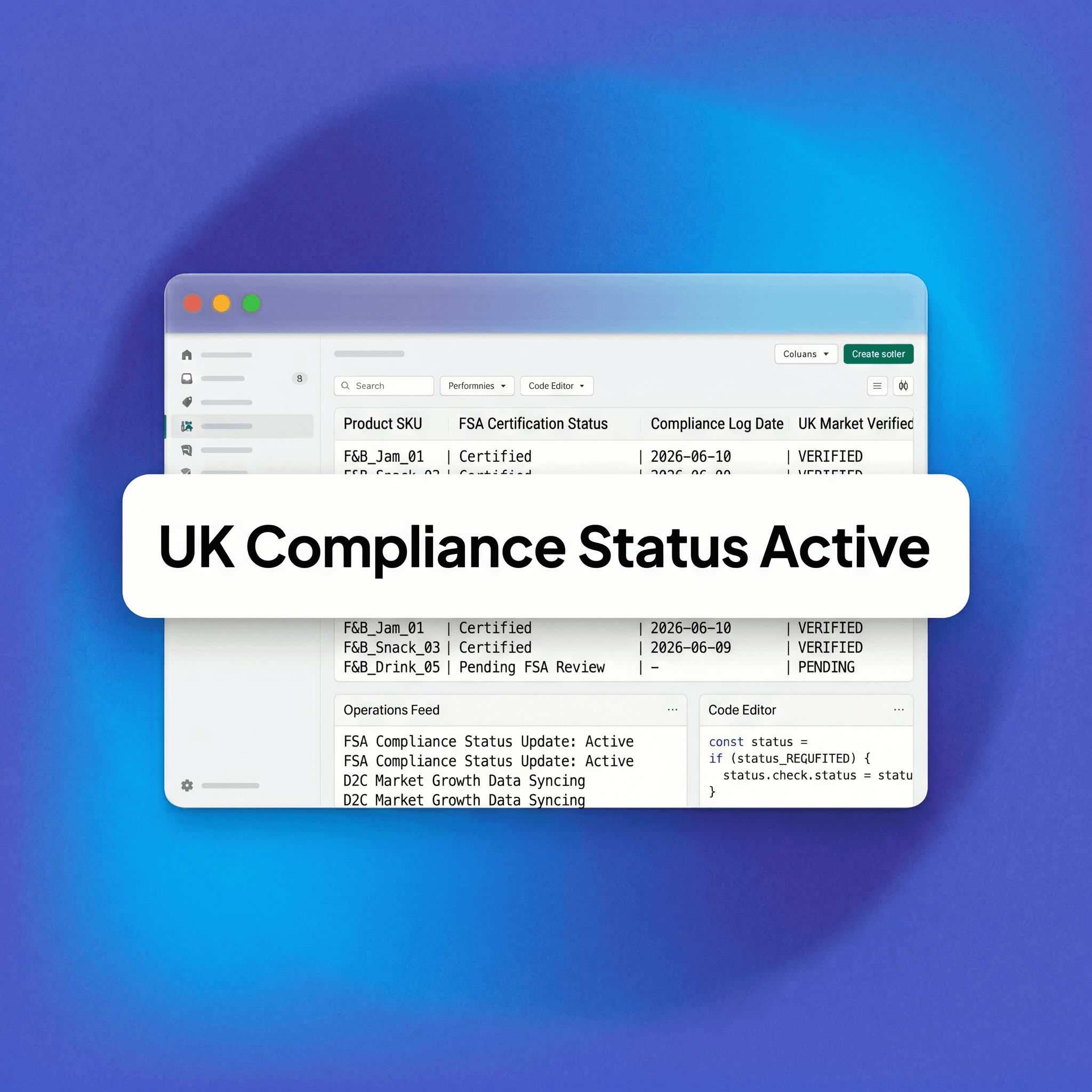
Shopify for UK Food and Beverage Brands: FSA Compliance and D2C Growth

Shopify for UK Food and Beverage Brands: FSA Compliance and D2C Growth

Selling food or drink D2C in the UK? Learn how to build a Shopify store that meets FSA requirements, handles labelling and allergen rules, and drives sustainable D2C growth.

Selling food or drink D2C in the UK? Learn how to build a Shopify store that meets FSA requirements, handles labelling and allergen rules, and drives sustainable D2C growth.

08 min read

Shopify for UK Food and Beverage Brands: FSA Compliance and D2C Growth Selling food or drink direct-to-consumer in the UK is one of the most commercially rewarding ecommerce categories you can operate in — and one of the most technically demanding to do correctly. Shopify for UK food and beverage brands is not a plug-and-play solution. Between FSA labelling requirements, allergen disclosure rules, and the operational complexity of perishable or regulated products, the gap between a compliant store and a non-compliant one is significant, and the consequences of getting it wrong are real. Operating a regulated direct-to-consumer digital channel within the United Kingdom demands a thorough understanding of localized data structures, structural content pipelines, and administrative enforcement parameters. Brands frequently make the mistake of treating digital store design as an aesthetic branding exercise, ignoring the fact that global e-commerce software fails to enforce territorial food safety laws natively. Misconfiguring your backend catalogs can expose corporate directors to severe civil enforcement actions, catastrophic trading standards investigations, and immediate cross-border distribution blocks. True operational excellence requires a programmatic strategy that seamlessly builds compliance architecture right into your conversion optimization workflows. This guide covers what UK F&B brands need to know before launching or scaling on Shopify: the regulatory baseline, the store structure decisions that matter, and the D2C growth levers that actually work for this category. Navigating the operational complexities of outbound distance selling demands that data analytics and compliance groups build clean, non-fragmented testing loops that track both front-end conversion velocities and backend regulatory adherence. This strategic operational guide provides growth operators with an explicit path to separate software marketing claims from real-world, legally sound data structures. By auditing your store architecture against category-specific transaction volumes, your organization can eliminate regulatory bottlenecks, lower customer acquisition costs, and scale your brand safely. Use these guidelines to systematically transition your technical stack from manual compliance firefighting to integrated, production-grade e-commerce excellence.

What the FSA Requires from Online Food Sellers

The Food Standards Agency sets the rules. If you sell food or drink to consumers in the UK online, you are subject to the same core regulations as physical retailers — plus additional obligations specific to distance selling. Online merchants must realize that the digital interface functions as the exact legal equivalent of a physical retail shelf, meaning all statutory disclosure mandates apply before the buyer commits capital to the transaction. This regulatory environment leaves zero room for broken information chains, hidden product attributes, or lagging inventory updates across your digital sales channels. Compliance officers must establish strict internal verification workflows to ensure that every outbound page load satisfies both centralized UK regulations and localized local authority mandates. Front-loading these data-cleansing steps protects your brand from sudden enforcement notices and ensures smooth checkout transitions for high-intent cohorts. The key legislation governing this is the Food Information for Consumers Regulation (FIC), retained in UK law post-Brexit. Practically, it requires the following.

  • Mandatory allergen information must be provided before purchase. The 14 major allergens — including cereals containing gluten, milk, eggs, nuts, and sulphites — must be clearly disclosed before a customer completes an order. This is not optional and cannot be buried in a PDF or a footer link. Data leads must ensure these allergen indicators are hardcoded into core page objects, allowing screen readers and automated validation systems to parse the fields instantly.

  • Ingredient lists and nutrition declarations must be accessible on the product page. For pre-packed foods, the full ingredient list with allergens emphasised (typically in bold) must be visible. Nutrition information per 100g or 100ml is required for most categories. Maintaining this data structure requires setting up robust metadata tables that pipe clean ingredient information directly to localized storefront themes without format breaks.

  • Country of origin labelling applies in certain categories. Meat, fish, honey, olive oil, and fresh produce have specific origin labelling rules. If your product falls into these categories, your product pages need to reflect this. Product development teams must cross-reference sourcing variables in real time, ensuring that seasonal adjustments in raw supply lines update across your e-commerce storefront immediately.

  • Business registration is required. Any business in England, Wales, or Scotland selling food must register with their local authority at least 28 days before trading. This is a prerequisite, not an afterthought. Incorporating this timeline into your capitalization roadmap prevents operational delays, ensuring your fulfillment pipelines are legally clear before paid customer acquisition begins. The FSA also expects your business details — trading name, address — to be clearly accessible on your website. A generic Shopify contact page with only an email address does not meet this standard. Trading standards officers look closely at these administrative definitions to protect consumers from anonymous or unaccountable digital operators, making clear footer disclosures a strict operational baseline. Financial and legal leads must make sure that all statutory corporate registrations, VAT identifiers, and official business seats display clearly across every digital storefront view.

Why Shopify Works for UK F&B — and Where It Falls Short

Shopify is a capable platform for food and beverage D2C. Its product metafields, app ecosystem, and flexible theme architecture mean you can build compliant, conversion-optimised storefronts without custom development in most cases. But the platform does not come pre-configured for food compliance, and several areas require deliberate setup. Systems engineers must meticulously map database fields across localized product variants to prevent structural data debt from breaking down front-end layout reliability as catalogs scale. A truly optimized setup guarantees that legal attributes, marketing hooks, and operational inventory counts coordinate perfectly across your entire technical architecture.

Where Shopify Works Well
  • Product page flexibility. Metafields allow you to store and display structured data — ingredients, allergens, nutritional values, storage instructions — without compromising design. Done well, this is both compliant and commercially effective. Utilizing structured data fields lets your team inject essential compliance blocks into custom storefront layouts while keeping your search engine indexing loops fully clean.

  • Subscription and bundles support. Apps like Recharge, Bold Subscriptions, and Govalo give F&B brands reliable recurring revenue infrastructure, which is the primary D2C growth lever for consumable products. Integrating these recurring engines lets growth leads build predictable cash flows and optimize multi-month customer lifetime value metrics.

  • Checkout and payment. Shopify Payments handles UK checkout reliably. For subscription models, this is significantly less friction than building on a custom stack. Native support for localized banking rails, instant card processing, and mobile wallets removes transaction friction and pushes up checkout conversion rates.

  • Inventory and fulfilment integrations. Shopify connects cleanly with 3PLs and warehouse management systems that handle ambient, chilled, and frozen product categories. This data connection supports automated order tracking pipelines, keeping warehouse activities aligned with storefront sales records.

Where It Needs Work
  • Allergen labelling is not native. Shopify has no built-in allergen disclosure module. This must be built using metafields, custom sections, or a third-party compliance app. Leaving this unconfigured forces brands to rely on unstructured description text blocks, which often look poor on mobile devices and increase regulatory compliance risks.

  • Age verification is limited out of the box. If you sell alcohol, you need a compliant age gate. Shopify's native tools are minimal here, and you will need an app such as AgeChecker.net or a custom solution. This infrastructure gap demands deploying server-side verification scripts to prevent underage transactions and protect your remote merchant processor accounts.

  • Country of origin is not a standard field. For regulated categories, you need to add this deliberately as a product attribute. Failing to build a standardized custom attribute framework across your catalog leads to mismatched reporting structures and causes product listings to fail strict trading standards checks.

  • Subscription + compliance stacking is under-documented. Running a subscription model with rotating products (think coffee clubs or meal kits) introduces additional disclosure complexity that most app documentation does not address. Developers must build custom dynamic data checks to confirm that changing subscription box lines accurately update allergen declarations on every single automated billing cycle.

The FSA-Ready Shopify Launch Checklist for UK F&B Brands

This is a structured checklist for brands launching or auditing a Shopify store in a regulated food or drink category. Use it before go-live and after any major product range update. Implementing this validation routine prevents digital growth teams from running large-scale client acquisition campaigns on top of unverified data models, keeping performance metrics predictable and corporate assets fully secure.

Registration and Legal Baseline
  • Business registered with local authority food standards team (28 days minimum before trading). This foundational legal step ensures complete alignment with territorial distribution laws before any consumer sales are processed.

  • Legal business name and trading address visible on website (footer or contact page). This disclosure establishes structural transparency, letting regulatory teams easily verify your business identity during routine checks.

  • Privacy policy and terms of service pages live and accurate. Legal leads must ensure text clauses satisfy local consumer protection rules and fit modern data governance standards.

  • If selling alcohol: premises licence confirmed, age verification solution in place. This validation step requires integrating dependable age gating protocols within your front-end checkout flow to block unauthorized sales.

  • If claiming health or nutritional benefits: claims reviewed against UK Retained EU Law on nutrition and health claims. Compliance groups must rigorously audit marketing copy to ensure all statements are fully backed by authorized statutory listings.

Product Page Compliance
  • Full ingredient list visible on every food product page (allergens in bold or otherwise emphasised). Data teams must format input variables clearly to keep product listings compliant across desktop and mobile screens.

  • All 14 major allergens disclosed pre-purchase, not just at checkout. This timing condition means buyers face zero informational blind spots before committing items to their cart, eliminating compliance exposure.

  • Nutrition declaration present (per 100g or 100ml) for all applicable products. Financial and operational leaders must confirm that analytical lab details map perfectly into structured storefront layouts.

  • Storage and preparation instructions included where relevant. Providing explicit consumer guidance helps minimize product spoilage issues and builds long-term brand credibility.

  • Country of origin displayed for regulated categories (meat, fish, honey, olive oil, fresh produce). This structural field must update dynamically based on live batch tracking updates from your procurement nodes.

  • Best before / use by information methodology confirmed (if applicable). Logistics teams must align product batch codes directly with automated shelf-life rules inside your warehouse routers.

  • No health claims used that are not on the authorised UK register. Copywriters must drop all abstract health statements that are missing official clearance tokens from centralized food registries.

Shopify Technical Setup
  • Product metafields configured for ingredients, allergens, nutrition, origin, and storage. This architecture separates raw product compliance data from transient frontend styling code, preserving database integrity.

  • Allergen information section added to product page template (not hidden behind accordion if possible). Maximizing visual clarity ensures that critical information catches the user's eye and meets distance-selling disclosure mandates.

  • Product page templates tested across mobile and desktop. User experience groups must confirm that dynamic components scale accurately, preventing truncated text fields on small mobile devices.

  • Age gate installed and tested (alcohol brands). Systems engineers must run functional end-to-end checks to confirm that user identity validations execute properly before processing checkout files.

  • Subscription app installed and tested with correct product information surfacing per SKU. This tracking connection protects recurring revenue funnels from delivering unmapped items to vulnerable consumers.

  • Checkout confirmation email includes product information or directs to product page. Post-purchase notification templates must include clear ingredient records to provide an explicit audit trail.

  • Robots.txt and canonical tags reviewed before launch. Content marketers must check that search indexers crawl your compliant product variants accurately without flagging duplicate content penalties.

Operational Readiness
  • 3PL or fulfilment partner briefed on labelling, packaging, and temperature requirements. Operational handlers must ensure that physical logistics matches your storefront statements, preserving cold chain velocity.

  • Returns policy reviewed for food safety compliance (most F&B products cannot be returned). Designing explicit reverse logistics policies stops contaminated consumer items from re-entering clean warehouse lines.

  • Customer service team trained on allergen enquiry handling. Support groups must use clear standard operating procedures to handle high-priority customer product tickets quickly and accurately.

  • Process in place for product page updates when formulation changes. This step binds manufacturing data streams directly with digital catalogs, keeping storefront descriptions completely synchronized with real physical inventory.

D2C Growth for UK Food and Beverage Brands: What Actually Moves the Needle

Compliance is the baseline. Growth is the objective. The D2C model works for food and beverage when the unit economics support it — which means focusing on the right levers from the start rather than defaulting to paid acquisition. Growing brands must step off the costly paid social treadmill and build integrated retention systems that maximize the value of every single checkout transaction. By structuring your conversion funnels around natural consumption cycles, your organization can build stable cash flows and reduce its dependence on volatile digital ad auctions.

Subscription is the Primary Lever

For consumable products, subscription is where D2C food brands build real value. A customer who subscribes to a monthly coffee, supplement, or sauce club generates predictable revenue and dramatically improves lifetime value compared to a one-time buyer. The key is making the subscription offer obvious, the value clearly articulated, and the cancel or pause flow simple. Friction in the cancel flow increases churn, not retention. Lifecycle marketing groups must treat recurring order sets as high-value assets, configuring automated dashboards to monitor subscriber retention trends and catch cohort drops early. The brands that build strong subscription bases typically do three things well: they give subscribers a reason to stay beyond discount (exclusive products, early access, community), they make the product delivery experience feel premium, and they treat subscriber data seriously — using it to inform range development rather than just marketing. Developing an authentic recurring ecosystem requires close cooperation between product development leads and supply chain planners to keep delivery schedules aligned with factory outputs. Moving casual web buyers into automated replenishment loops lowers long-term customer acquisition costs and improves overall corporate valuation.

AOV Optimisation Before Acquisition Spend

Before scaling paid media, the smartest F&B brands optimise average order value. Bundles, complementary product recommendations, and volume-based pricing all work in this category. Shopify handles this natively through cross-sells and upsells, and through apps like Frequently Bought Together or Bold Bundles. A 20% improvement in AOV can materially change whether paid acquisition is viable. Media buyers must regularly audit these checkout values against live freight profiles to confirm that larger order boxes are driving real margin gains rather than simply increasing transport costs.

Content as the Acquisition Engine

Paid social works for F&B — but it's expensive and the category is competitive. Brands that build content-led acquisition, through recipe content, sourcing stories, or education around their product category, acquire customers at lower cost and with stronger brand recall. Shopify's blogging functionality is basic but functional. Brands with content ambitions should either accept its limitations or consider a headless or hybrid setup that allows a more capable CMS to sit alongside the commerce layer. Prioritizing organic content discovery loops helps businesses build strong, self-sustaining traffic channels that can safely withstand ad platform algorithm shifts.

Retention Mechanics That Work

Email and SMS are the retention channels that consistently outperform for F&B D2C. The key is segmenting properly from day one — separating one-time buyers from subscribers, separating high-AOV customers from promotional buyers — and communicating differently to each segment. Klaviyo is the standard integration for Shopify stores in this category and it is well worth the investment from launch rather than as a retrofit. Data teams must configure their CRM engines to pipe real-time purchase metrics straight into customized user segments, keeping your post-purchase messaging highly relevant.

Common Mistakes UK F&B Brands Make on Shopify

Treating compliance as a one-time task. Formulations change, suppliers change, regulations update. A product page that was compliant at launch can become non-compliant without anyone noticing. Build a review process into your operations — quarterly at minimum. Leaving your data updates unmonitored invites serious reporting errors, as minor ingredient substitutions at the factory level can silently introduce unregistered major allergens to your storefront catalogs. Compliance leads must check every single SKU update against live production manifests to maintain complete database accuracy. Under-investing in product page structure. Many F&B brands on Shopify use out-of-the-box themes with standard product page layouts that were not designed for regulated products. The result is compliance information added as an afterthought — buried in the description field, poorly formatted, or missing entirely on mobile. This creates both regulatory risk and conversion drag. If a customer cannot find allergen disclosures quickly due to unoptimized responsive layouts, they will immediately leave your checkout flow, which drives up cart abandonment metrics and damages your brand equity. Launching subscription before the fulfilment operation is ready. Subscription creates predictable demand — which is great unless your 3PL or in-house fulfilment team cannot handle the consistency and accuracy that subscribers expect. Launch subscription when the operational infrastructure supports it, not as a revenue target date forces it. When an automated recurring transaction processes but physical warehouses fail to ship the delivery box within agreed SLAs, consumer trust collapses instantly, causing a spike in subscription churn and expensive credit card chargebacks. Using health claims that are not on the authorised UK register. This is a common and genuinely risky mistake. "Supports immune health," "aids digestion," "promotes energy" — these types of claims require authorisation under UK nutrient and health claims regulations. Many brands copy claim language from US-market products without checking UK compliance. The FSA can act on this, and it creates brand risk even before any formal enforcement. Marketing copywriters must work with certified regulatory specialists to verify every health hook before pushing ad campaigns live. Conflating GDPR compliance with general legal compliance. Having a privacy policy and cookie consent in place does not mean a store is legally compliant. F&B brands frequently treat GDPR as the whole compliance picture and miss FSA, labelling, and trading standards requirements entirely. Securing user tracking paths does absolutely nothing to fix broken ingredient tables or illegal health benefit statements. Corporate leaders must perform full-spectrum legal reviews that cover data privacy rules, food safety laws, and distance-selling transparency mandates.

Trade-offs Worth Understanding

Headless vs. native Shopify Headless gives you more design and content flexibility, which is attractive for premium F&B brands where editorial content and product experience are closely linked. But it increases build complexity, cost, and ongoing maintenance burden. For most brands under £5M revenue, native Shopify with a well-configured theme is the right call. Headless is a scale decision, not a launch decision. Teams must weigh structural content needs against ongoing development costs to prevent unoptimized software overhead from draining early operational capital. Building compliance in-house vs. using apps There are Shopify apps that help surface allergen and compliance information. Some are competent; others are maintained poorly and create a false sense of coverage. Understanding what the FSA actually requires and building the solution deliberately — whether that's a well-structured metafield setup or a vetted app — is more reliable than assuming an app handles it correctly. Custom data modeling puts full code control back in your development group, eliminating dependency on third-party application providers. Speed to market vs. compliance completeness The temptation to launch fast and fix compliance later is understandable. It is also a decision with real downside risk in this category — not just regulatory, but reputational. A brand that has to pull products or issue corrections because of allergen information errors faces a harder recovery in a category where consumer trust is the primary asset. Front-loading complete technical validations protects your business from early supply disruptions and preserves your market presence during key growth windows.

Shopify for UK Food and Beverage Brands: FSA Compliance and D2C Growth Selling food or drink direct-to-consumer in the UK is one of the most commercially rewarding ecommerce categories you can operate in — and one of the most technically demanding to do correctly. Shopify for UK food and beverage brands is not a plug-and-play solution. Between FSA labelling requirements, allergen disclosure rules, and the operational complexity of perishable or regulated products, the gap between a compliant store and a non-compliant one is significant, and the consequences of getting it wrong are real. Operating a regulated direct-to-consumer digital channel within the United Kingdom demands a thorough understanding of localized data structures, structural content pipelines, and administrative enforcement parameters. Brands frequently make the mistake of treating digital store design as an aesthetic branding exercise, ignoring the fact that global e-commerce software fails to enforce territorial food safety laws natively. Misconfiguring your backend catalogs can expose corporate directors to severe civil enforcement actions, catastrophic trading standards investigations, and immediate cross-border distribution blocks. True operational excellence requires a programmatic strategy that seamlessly builds compliance architecture right into your conversion optimization workflows. This guide covers what UK F&B brands need to know before launching or scaling on Shopify: the regulatory baseline, the store structure decisions that matter, and the D2C growth levers that actually work for this category. Navigating the operational complexities of outbound distance selling demands that data analytics and compliance groups build clean, non-fragmented testing loops that track both front-end conversion velocities and backend regulatory adherence. This strategic operational guide provides growth operators with an explicit path to separate software marketing claims from real-world, legally sound data structures. By auditing your store architecture against category-specific transaction volumes, your organization can eliminate regulatory bottlenecks, lower customer acquisition costs, and scale your brand safely. Use these guidelines to systematically transition your technical stack from manual compliance firefighting to integrated, production-grade e-commerce excellence.

What the FSA Requires from Online Food Sellers

The Food Standards Agency sets the rules. If you sell food or drink to consumers in the UK online, you are subject to the same core regulations as physical retailers — plus additional obligations specific to distance selling. Online merchants must realize that the digital interface functions as the exact legal equivalent of a physical retail shelf, meaning all statutory disclosure mandates apply before the buyer commits capital to the transaction. This regulatory environment leaves zero room for broken information chains, hidden product attributes, or lagging inventory updates across your digital sales channels. Compliance officers must establish strict internal verification workflows to ensure that every outbound page load satisfies both centralized UK regulations and localized local authority mandates. Front-loading these data-cleansing steps protects your brand from sudden enforcement notices and ensures smooth checkout transitions for high-intent cohorts. The key legislation governing this is the Food Information for Consumers Regulation (FIC), retained in UK law post-Brexit. Practically, it requires the following.

  • Mandatory allergen information must be provided before purchase. The 14 major allergens — including cereals containing gluten, milk, eggs, nuts, and sulphites — must be clearly disclosed before a customer completes an order. This is not optional and cannot be buried in a PDF or a footer link. Data leads must ensure these allergen indicators are hardcoded into core page objects, allowing screen readers and automated validation systems to parse the fields instantly.

  • Ingredient lists and nutrition declarations must be accessible on the product page. For pre-packed foods, the full ingredient list with allergens emphasised (typically in bold) must be visible. Nutrition information per 100g or 100ml is required for most categories. Maintaining this data structure requires setting up robust metadata tables that pipe clean ingredient information directly to localized storefront themes without format breaks.

  • Country of origin labelling applies in certain categories. Meat, fish, honey, olive oil, and fresh produce have specific origin labelling rules. If your product falls into these categories, your product pages need to reflect this. Product development teams must cross-reference sourcing variables in real time, ensuring that seasonal adjustments in raw supply lines update across your e-commerce storefront immediately.

  • Business registration is required. Any business in England, Wales, or Scotland selling food must register with their local authority at least 28 days before trading. This is a prerequisite, not an afterthought. Incorporating this timeline into your capitalization roadmap prevents operational delays, ensuring your fulfillment pipelines are legally clear before paid customer acquisition begins. The FSA also expects your business details — trading name, address — to be clearly accessible on your website. A generic Shopify contact page with only an email address does not meet this standard. Trading standards officers look closely at these administrative definitions to protect consumers from anonymous or unaccountable digital operators, making clear footer disclosures a strict operational baseline. Financial and legal leads must make sure that all statutory corporate registrations, VAT identifiers, and official business seats display clearly across every digital storefront view.

Why Shopify Works for UK F&B — and Where It Falls Short

Shopify is a capable platform for food and beverage D2C. Its product metafields, app ecosystem, and flexible theme architecture mean you can build compliant, conversion-optimised storefronts without custom development in most cases. But the platform does not come pre-configured for food compliance, and several areas require deliberate setup. Systems engineers must meticulously map database fields across localized product variants to prevent structural data debt from breaking down front-end layout reliability as catalogs scale. A truly optimized setup guarantees that legal attributes, marketing hooks, and operational inventory counts coordinate perfectly across your entire technical architecture.

Where Shopify Works Well
  • Product page flexibility. Metafields allow you to store and display structured data — ingredients, allergens, nutritional values, storage instructions — without compromising design. Done well, this is both compliant and commercially effective. Utilizing structured data fields lets your team inject essential compliance blocks into custom storefront layouts while keeping your search engine indexing loops fully clean.

  • Subscription and bundles support. Apps like Recharge, Bold Subscriptions, and Govalo give F&B brands reliable recurring revenue infrastructure, which is the primary D2C growth lever for consumable products. Integrating these recurring engines lets growth leads build predictable cash flows and optimize multi-month customer lifetime value metrics.

  • Checkout and payment. Shopify Payments handles UK checkout reliably. For subscription models, this is significantly less friction than building on a custom stack. Native support for localized banking rails, instant card processing, and mobile wallets removes transaction friction and pushes up checkout conversion rates.

  • Inventory and fulfilment integrations. Shopify connects cleanly with 3PLs and warehouse management systems that handle ambient, chilled, and frozen product categories. This data connection supports automated order tracking pipelines, keeping warehouse activities aligned with storefront sales records.

Where It Needs Work
  • Allergen labelling is not native. Shopify has no built-in allergen disclosure module. This must be built using metafields, custom sections, or a third-party compliance app. Leaving this unconfigured forces brands to rely on unstructured description text blocks, which often look poor on mobile devices and increase regulatory compliance risks.

  • Age verification is limited out of the box. If you sell alcohol, you need a compliant age gate. Shopify's native tools are minimal here, and you will need an app such as AgeChecker.net or a custom solution. This infrastructure gap demands deploying server-side verification scripts to prevent underage transactions and protect your remote merchant processor accounts.

  • Country of origin is not a standard field. For regulated categories, you need to add this deliberately as a product attribute. Failing to build a standardized custom attribute framework across your catalog leads to mismatched reporting structures and causes product listings to fail strict trading standards checks.

  • Subscription + compliance stacking is under-documented. Running a subscription model with rotating products (think coffee clubs or meal kits) introduces additional disclosure complexity that most app documentation does not address. Developers must build custom dynamic data checks to confirm that changing subscription box lines accurately update allergen declarations on every single automated billing cycle.

The FSA-Ready Shopify Launch Checklist for UK F&B Brands

This is a structured checklist for brands launching or auditing a Shopify store in a regulated food or drink category. Use it before go-live and after any major product range update. Implementing this validation routine prevents digital growth teams from running large-scale client acquisition campaigns on top of unverified data models, keeping performance metrics predictable and corporate assets fully secure.

Registration and Legal Baseline
  • Business registered with local authority food standards team (28 days minimum before trading). This foundational legal step ensures complete alignment with territorial distribution laws before any consumer sales are processed.

  • Legal business name and trading address visible on website (footer or contact page). This disclosure establishes structural transparency, letting regulatory teams easily verify your business identity during routine checks.

  • Privacy policy and terms of service pages live and accurate. Legal leads must ensure text clauses satisfy local consumer protection rules and fit modern data governance standards.

  • If selling alcohol: premises licence confirmed, age verification solution in place. This validation step requires integrating dependable age gating protocols within your front-end checkout flow to block unauthorized sales.

  • If claiming health or nutritional benefits: claims reviewed against UK Retained EU Law on nutrition and health claims. Compliance groups must rigorously audit marketing copy to ensure all statements are fully backed by authorized statutory listings.

Product Page Compliance
  • Full ingredient list visible on every food product page (allergens in bold or otherwise emphasised). Data teams must format input variables clearly to keep product listings compliant across desktop and mobile screens.

  • All 14 major allergens disclosed pre-purchase, not just at checkout. This timing condition means buyers face zero informational blind spots before committing items to their cart, eliminating compliance exposure.

  • Nutrition declaration present (per 100g or 100ml) for all applicable products. Financial and operational leaders must confirm that analytical lab details map perfectly into structured storefront layouts.

  • Storage and preparation instructions included where relevant. Providing explicit consumer guidance helps minimize product spoilage issues and builds long-term brand credibility.

  • Country of origin displayed for regulated categories (meat, fish, honey, olive oil, fresh produce). This structural field must update dynamically based on live batch tracking updates from your procurement nodes.

  • Best before / use by information methodology confirmed (if applicable). Logistics teams must align product batch codes directly with automated shelf-life rules inside your warehouse routers.

  • No health claims used that are not on the authorised UK register. Copywriters must drop all abstract health statements that are missing official clearance tokens from centralized food registries.

Shopify Technical Setup
  • Product metafields configured for ingredients, allergens, nutrition, origin, and storage. This architecture separates raw product compliance data from transient frontend styling code, preserving database integrity.

  • Allergen information section added to product page template (not hidden behind accordion if possible). Maximizing visual clarity ensures that critical information catches the user's eye and meets distance-selling disclosure mandates.

  • Product page templates tested across mobile and desktop. User experience groups must confirm that dynamic components scale accurately, preventing truncated text fields on small mobile devices.

  • Age gate installed and tested (alcohol brands). Systems engineers must run functional end-to-end checks to confirm that user identity validations execute properly before processing checkout files.

  • Subscription app installed and tested with correct product information surfacing per SKU. This tracking connection protects recurring revenue funnels from delivering unmapped items to vulnerable consumers.

  • Checkout confirmation email includes product information or directs to product page. Post-purchase notification templates must include clear ingredient records to provide an explicit audit trail.

  • Robots.txt and canonical tags reviewed before launch. Content marketers must check that search indexers crawl your compliant product variants accurately without flagging duplicate content penalties.

Operational Readiness
  • 3PL or fulfilment partner briefed on labelling, packaging, and temperature requirements. Operational handlers must ensure that physical logistics matches your storefront statements, preserving cold chain velocity.

  • Returns policy reviewed for food safety compliance (most F&B products cannot be returned). Designing explicit reverse logistics policies stops contaminated consumer items from re-entering clean warehouse lines.

  • Customer service team trained on allergen enquiry handling. Support groups must use clear standard operating procedures to handle high-priority customer product tickets quickly and accurately.

  • Process in place for product page updates when formulation changes. This step binds manufacturing data streams directly with digital catalogs, keeping storefront descriptions completely synchronized with real physical inventory.

D2C Growth for UK Food and Beverage Brands: What Actually Moves the Needle

Compliance is the baseline. Growth is the objective. The D2C model works for food and beverage when the unit economics support it — which means focusing on the right levers from the start rather than defaulting to paid acquisition. Growing brands must step off the costly paid social treadmill and build integrated retention systems that maximize the value of every single checkout transaction. By structuring your conversion funnels around natural consumption cycles, your organization can build stable cash flows and reduce its dependence on volatile digital ad auctions.

Subscription is the Primary Lever

For consumable products, subscription is where D2C food brands build real value. A customer who subscribes to a monthly coffee, supplement, or sauce club generates predictable revenue and dramatically improves lifetime value compared to a one-time buyer. The key is making the subscription offer obvious, the value clearly articulated, and the cancel or pause flow simple. Friction in the cancel flow increases churn, not retention. Lifecycle marketing groups must treat recurring order sets as high-value assets, configuring automated dashboards to monitor subscriber retention trends and catch cohort drops early. The brands that build strong subscription bases typically do three things well: they give subscribers a reason to stay beyond discount (exclusive products, early access, community), they make the product delivery experience feel premium, and they treat subscriber data seriously — using it to inform range development rather than just marketing. Developing an authentic recurring ecosystem requires close cooperation between product development leads and supply chain planners to keep delivery schedules aligned with factory outputs. Moving casual web buyers into automated replenishment loops lowers long-term customer acquisition costs and improves overall corporate valuation.

AOV Optimisation Before Acquisition Spend

Before scaling paid media, the smartest F&B brands optimise average order value. Bundles, complementary product recommendations, and volume-based pricing all work in this category. Shopify handles this natively through cross-sells and upsells, and through apps like Frequently Bought Together or Bold Bundles. A 20% improvement in AOV can materially change whether paid acquisition is viable. Media buyers must regularly audit these checkout values against live freight profiles to confirm that larger order boxes are driving real margin gains rather than simply increasing transport costs.

Content as the Acquisition Engine

Paid social works for F&B — but it's expensive and the category is competitive. Brands that build content-led acquisition, through recipe content, sourcing stories, or education around their product category, acquire customers at lower cost and with stronger brand recall. Shopify's blogging functionality is basic but functional. Brands with content ambitions should either accept its limitations or consider a headless or hybrid setup that allows a more capable CMS to sit alongside the commerce layer. Prioritizing organic content discovery loops helps businesses build strong, self-sustaining traffic channels that can safely withstand ad platform algorithm shifts.

Retention Mechanics That Work

Email and SMS are the retention channels that consistently outperform for F&B D2C. The key is segmenting properly from day one — separating one-time buyers from subscribers, separating high-AOV customers from promotional buyers — and communicating differently to each segment. Klaviyo is the standard integration for Shopify stores in this category and it is well worth the investment from launch rather than as a retrofit. Data teams must configure their CRM engines to pipe real-time purchase metrics straight into customized user segments, keeping your post-purchase messaging highly relevant.

Common Mistakes UK F&B Brands Make on Shopify

Treating compliance as a one-time task. Formulations change, suppliers change, regulations update. A product page that was compliant at launch can become non-compliant without anyone noticing. Build a review process into your operations — quarterly at minimum. Leaving your data updates unmonitored invites serious reporting errors, as minor ingredient substitutions at the factory level can silently introduce unregistered major allergens to your storefront catalogs. Compliance leads must check every single SKU update against live production manifests to maintain complete database accuracy. Under-investing in product page structure. Many F&B brands on Shopify use out-of-the-box themes with standard product page layouts that were not designed for regulated products. The result is compliance information added as an afterthought — buried in the description field, poorly formatted, or missing entirely on mobile. This creates both regulatory risk and conversion drag. If a customer cannot find allergen disclosures quickly due to unoptimized responsive layouts, they will immediately leave your checkout flow, which drives up cart abandonment metrics and damages your brand equity. Launching subscription before the fulfilment operation is ready. Subscription creates predictable demand — which is great unless your 3PL or in-house fulfilment team cannot handle the consistency and accuracy that subscribers expect. Launch subscription when the operational infrastructure supports it, not as a revenue target date forces it. When an automated recurring transaction processes but physical warehouses fail to ship the delivery box within agreed SLAs, consumer trust collapses instantly, causing a spike in subscription churn and expensive credit card chargebacks. Using health claims that are not on the authorised UK register. This is a common and genuinely risky mistake. "Supports immune health," "aids digestion," "promotes energy" — these types of claims require authorisation under UK nutrient and health claims regulations. Many brands copy claim language from US-market products without checking UK compliance. The FSA can act on this, and it creates brand risk even before any formal enforcement. Marketing copywriters must work with certified regulatory specialists to verify every health hook before pushing ad campaigns live. Conflating GDPR compliance with general legal compliance. Having a privacy policy and cookie consent in place does not mean a store is legally compliant. F&B brands frequently treat GDPR as the whole compliance picture and miss FSA, labelling, and trading standards requirements entirely. Securing user tracking paths does absolutely nothing to fix broken ingredient tables or illegal health benefit statements. Corporate leaders must perform full-spectrum legal reviews that cover data privacy rules, food safety laws, and distance-selling transparency mandates.

Trade-offs Worth Understanding

Headless vs. native Shopify Headless gives you more design and content flexibility, which is attractive for premium F&B brands where editorial content and product experience are closely linked. But it increases build complexity, cost, and ongoing maintenance burden. For most brands under £5M revenue, native Shopify with a well-configured theme is the right call. Headless is a scale decision, not a launch decision. Teams must weigh structural content needs against ongoing development costs to prevent unoptimized software overhead from draining early operational capital. Building compliance in-house vs. using apps There are Shopify apps that help surface allergen and compliance information. Some are competent; others are maintained poorly and create a false sense of coverage. Understanding what the FSA actually requires and building the solution deliberately — whether that's a well-structured metafield setup or a vetted app — is more reliable than assuming an app handles it correctly. Custom data modeling puts full code control back in your development group, eliminating dependency on third-party application providers. Speed to market vs. compliance completeness The temptation to launch fast and fix compliance later is understandable. It is also a decision with real downside risk in this category — not just regulatory, but reputational. A brand that has to pull products or issue corrections because of allergen information errors faces a harder recovery in a category where consumer trust is the primary asset. Front-loading complete technical validations protects your business from early supply disruptions and preserves your market presence during key growth windows.

FAQ

What FSA requirements apply when selling food online in the UK?

When selling food or drink online in the UK, you must comply with the Food Information for Consumers Regulation (FIC) as retained in UK law. This requires you to display all 14 major allergens clearly before purchase is completed, provide a full ingredient list on product pages with allergens emphasised, include nutrition information per 100g or 100ml for most products, and display country of origin for regulated categories. Your business must also be registered with your local authority before trading, and your legal business name and address must be visible on your website. Failing to secure these operational parameters prior to launching outbound digital campaigns introduces massive legal liability, leaving the enterprise exposed to immediate product recall orders and significant civil financial penalties from trading standards teams.

Does Shopify have built-in FSA compliance tools for food brands?

No. Shopify does not include native FSA compliance functionality. Allergen disclosure, ingredient lists, and nutrition declarations must be built into your store using product metafields, custom page sections, or third-party apps. This is a deliberate configuration task, not something the platform handles automatically. Brands should treat compliance setup as a separate workstream from general Shopify store build. Data engineers must carefully map and structure these custom fields within your theme codebase to ensure regulatory copy displays consistently across all responsive device layouts without creating page rendering delays or visual layout issues.

Do I need an age gate on my Shopify store to sell alcohol in the UK?

Yes. If you sell alcohol through your Shopify store, you need a functional age verification mechanism. Shopify's native tools are insufficient for robust compliance in this area. Apps such as AgeChecker.net or custom-built age gate solutions are standard approaches. You should also ensure your premises licence covers online sales and that your age verification process is documented as part of your responsible retailing approach. Leaving these protective gates unconfigured violates licensing guidelines, exposing your brand to immediate payment gateway suspensions and potential corporate criminal prosecutions under local trading standards frameworks.

How should allergen information be displayed on Shopify product pages?

Allergen information should be visible on the product page itself — not only at checkout or in a downloadable document. Best practice is to display the full ingredient list with allergens in bold or otherwise clearly emphasised, and to include a dedicated allergen summary (for example, "Contains: gluten, milk, eggs") in a prominent position. This information should be clearly readable on mobile. Placing it in a collapsible accordion that is closed by default reduces visibility and may not satisfy the pre-purchase disclosure requirement. Growth leads must enforce strict visual accessibility criteria to ensure safety disclosures remain clear and easy for consumers to parse during everyday browsing sessions.

What is the best subscription app for UK food and beverage brands on Shopify?

Recharge and Bold Subscriptions are the two most widely used subscription apps in this category on Shopify. Recharge is generally the more capable and better-supported option for brands with meaningful subscription volume. For brands starting out, Shopify's native subscription API (used by several app providers) offers tighter platform integration. The right choice depends on subscription model complexity, SKU count, and whether you need features like gift subscriptions, swap mechanics, or loyalty integration. Operations leads must closely review how backend subscription databases integrate with your warehouse routers to ensure that recurring shipment batches process smoothly without manual data entry friction.

Can I make health claims about food or drink products on my Shopify store?

Only if those claims are on the UK authorised list of nutrition and health claims. Post-Brexit, the UK maintains its own register of authorised claims under the UK Retained Regulation on nutrition and health claims made on food. Claims must be used in accordance with the conditions set out in the register. Generic or implied wellness language that echoes an authorised claim without meeting its conditions is not compliant. Before using any claim language on product pages, check it against the UK register or take legal advice. Brand marketers must resist copying high-risk marketing phrases from unregulated foreign markets, keeping copywriting workflows strictly aligned with verified domestic legal boundaries.

When should a UK food brand consider going headless on Shopify?

Headless Shopify — where the storefront is decoupled from the Shopify backend and built on a separate frontend framework — makes sense when a brand's content and commerce are deeply integrated, when design requirements exceed what native Shopify themes support, or when performance at significant traffic volumes is a documented issue. For most UK food and beverage brands below £5M annual revenue, the added cost and complexity of headless architecture is not justified. It is a scaling decision, typically prompted by a clear native-platform limitation, not a launch default. Corporate leaders should prioritize building clean database metafields and stabilizing their logistics networks before investing heavily in asset-heavy headless development tracks.

DIRECT QUESTIONS:

How should a Shopify data engineer leverage metafield definitions and liquid code modifications to ensure allergen declarations remain dynamically updated when product formulations shift across a distributed ERP network?

To prevent severe regulatory lapses when product formulations change, a Shopify data engineer must build an automated schema using custom product metafield definitions linked directly to your backend ERP data loops. Instead of typing ingredient lists manually into static storefront description fields, developers should create structured, type-specific metafields for the core ingredient list, major allergen warnings, and nutrition matrices. Liquid code variables within your theme template files must be customized to pull directly from these fields, programmatically scanning the text variables to apply bold formatting tags (<strong>) around any matching strings from the 14 major FSA allergens. Furthermore, connecting these metafield sets to your central enterprise resource planning platform via automated API endpoints ensures that any production-line ingredient adjustment at the factory instantly pushes down to the front-end catalog, completely removing manual data-entry delays and keeping distance-selling disclosures accurate.

What specific server-side tracking and database adjustments are required within the Shopify Customer Events framework to comply with both UK GDPR and FSA distance-selling audit mandates during a high-volume promotional sprint?

Managing data collection safely during high-volume seasonal spikes demands that analytics leads configure sandboxed tracking scripts within the Shopify Customer Events framework to respect user privacy settings while preserving strict compliance audit logs. Traditional tracking pixels that load directly in the browser window can cause data leakage and fail to satisfy strict UK GDPR rules if they collect personal information before a customer provides explicit cookie consent. By deploying server-side tracking containers via web-worker environments, operations teams can strip out or anonymize identifying user details while still tracking core checkout conversion steps cleanly. At the same time, your transaction databases must capture complete, timestamped snapshots of the exact ingredient configurations and allergen disclosures displayed to the customer at the moment of payment completion. This database logging creates a secure, unchangeable record that can defend the business from civil claims if a customer raises a post-purchase labeling dispute.

How do the age-verification API constraints of third-party payment gateways affect checkout conversion rates and operational SLA compliance for UK-based D2C alcohol brands running on Shopify?

For direct-to-consumer alcohol brands running on Shopify, navigating the age-verification rules enforced by premium payment processors requires connecting automated identity validation tools straight into the checkout sequence without slowing down the user journey. Under UK law, merchants must employ strict age verification checks to ensure that age-restricted items do not reach minors, making simple tick-box confirmation screens legally invalid for distance selling. Integrating advanced background identity checking tools lets your store verify a buyer's age instantly using electoral or credit reference data fields during the payment step, completely removing checkout friction for over ninety-five percent of adult users. If a transaction fails this automated background check, the system must hold the checkout log in a secure staging state and route it to an internal manual review queue, prompting the customer to upload formal photo identification. Operations managers must build strict alerts around these verification holds to prevent processing delays from violating your third-party warehouse shipping deadlines.

Why does configuring a multi-warehouse inventory routing engine in the UK require distinct SKU setups for ambient versus chilled food items to protect contribution margins during seasonal climate swings?

Configuring an automated multi-warehouse routing setup across the UK requires creating distinct, climate-indexed product variations within your inventory manager to shield your contribution margins from escalating line-haul transport fees. Ambient food items can move easily through standard logistics networks, whereas chilled or fresh products need continuous temperature-controlled infrastructure and specialized insulated packaging materials to prevent spoilage during transit. If your e-commerce engine routes orders from a unified inventory file without tracking the specific storage environments of individual products, the system may assign a mixed order to a distant fulfillment point that faces high shipping costs. Operations leads must build precise location allocation tables within their order management systems, forcing mixed checkout baskets to split or ship exclusively from hubs holding complete cold chain capabilities. This structured routing prevents expensive shipping adjustments from wiping out product-level profits, especially during high-temperature summer sales cycles.

In what ways do the labeling requirements of the Food Information for Consumers Regulation (FIC) shape the technical integration between a Shopify product catalog and an automated UK 3PL printing manifest?

The strict pre-packaged labeling rules set by the Food Information for Consumers Regulation (FIC) demand that your digital product catalog integrates flawlessly with your third-party logistics provider’s automated printing infrastructure to prevent border or transit shipping holds. When an outbound order arrives at the warehouse floor, the printing systems must dynamically build packing manifests, external parcel stickers, and custom commercial invoices that list all mandatory product data, including accurate shelf-life thresholds, storage warnings, and clear batch identity numbers. If your product information channels fail to supply these variables in structured data payloads, the fulfillment center must halt packing lines or print incomplete labels that violate trading standards guidelines. Data leads must build clean API mappings between Shopify's product fields and the warehouse management systems, making sure that barcode scanners and thermal label printers read and display identical item descriptions automatically.

How should an e-commerce financial controller structure the variable cost line items for reverse logistics when modeling the profitability of a UK food brand on Shopify?

An e-commerce financial controller must approach reverse logistics modeling with strict cost controls, setting up an absolute accounting boundary where returned perishable or consumable food items are written off at a total loss. Unlike soft apparel or durable hardware goods, returned food items cannot legally re-enter clean warehouse lines or be resold due to strict food safety and cross-contamination risks. This means that if a customer returns a package or a cash-on-delivery shipment fails delivery at the doorstep, the business must absorb the full cost of the raw goods, the original outbound shipping fees, and the reverse logistics charges. Financial planners must build these loss assumptions directly into their product pricing models, maintaining a dedicated inventory write-off provision to offset the margin drop. Keeping these reverse logistics cost blocks distinct prevents over-optimistic profit projections and ensures your financial modeling accurately reflects real-world cash metrics.

What technical challenges arise when connecting quick-commerce delivery platforms like Deliveroo to a centralized Shopify inventory database that is simultaneously integrated with a nationwide ambient 3PL network?

Connecting hyper-localized quick-commerce delivery networks like Deliveroo to a centralized Shopify inventory center introduces serious data synchronization challenges due to the stark differences in fulfillment speed and regional stock tracking. High-volume nationwide 3PL warehouses are engineered to process items over twenty-four to forty-eight hour fulfillment cycles, utilizing centralized bulk inventory pools and standard shipping labels to move products across the country. Quick-commerce delivery applications, conversely, operate on rapid fifteen-minute local pickup timelines, requiring real-time inventory visibility across specific regional dark stores or physical brick-and-mortar retail outlets. Attempting to manage both disparate fulfillment models through a single, slow-updating product database can cause inventory data lag, resulting in platform out-of-stock cancellations that trigger immediate commercial penalties. Systems architects must decouple these tracking channels, setting up dedicated high-priority API endpoints that isolate and update localized stock balances for short-range delivery apps every few minutes.

get in touch

Go from online presence to real business impact

Strategy, execution, and digital experiences designed to move together. Fill out the form below and our team will contact you shortly.

get in touch

Go from online presence to real business impact

Strategy, execution, and digital experiences designed to move together. Fill out the form below and our team will contact you shortly.

get in touch

Go from online presence to real business impact

Strategy, execution, and digital experiences designed to move together. Fill out the form below and our team will contact you shortly.

© 2026 projectsupply

Part of Tangle

© 2026 projectsupply

Part of Tangle

© 2026 projectsupply

Part of Tangle