
Ecommerce Development
Shopify for UK Pet Brands: PFMA Compliance, Subscriptions, and D2C Growth
Shopify for UK Pet Brands: PFMA Compliance, Subscriptions, and D2C Growth
08 min read
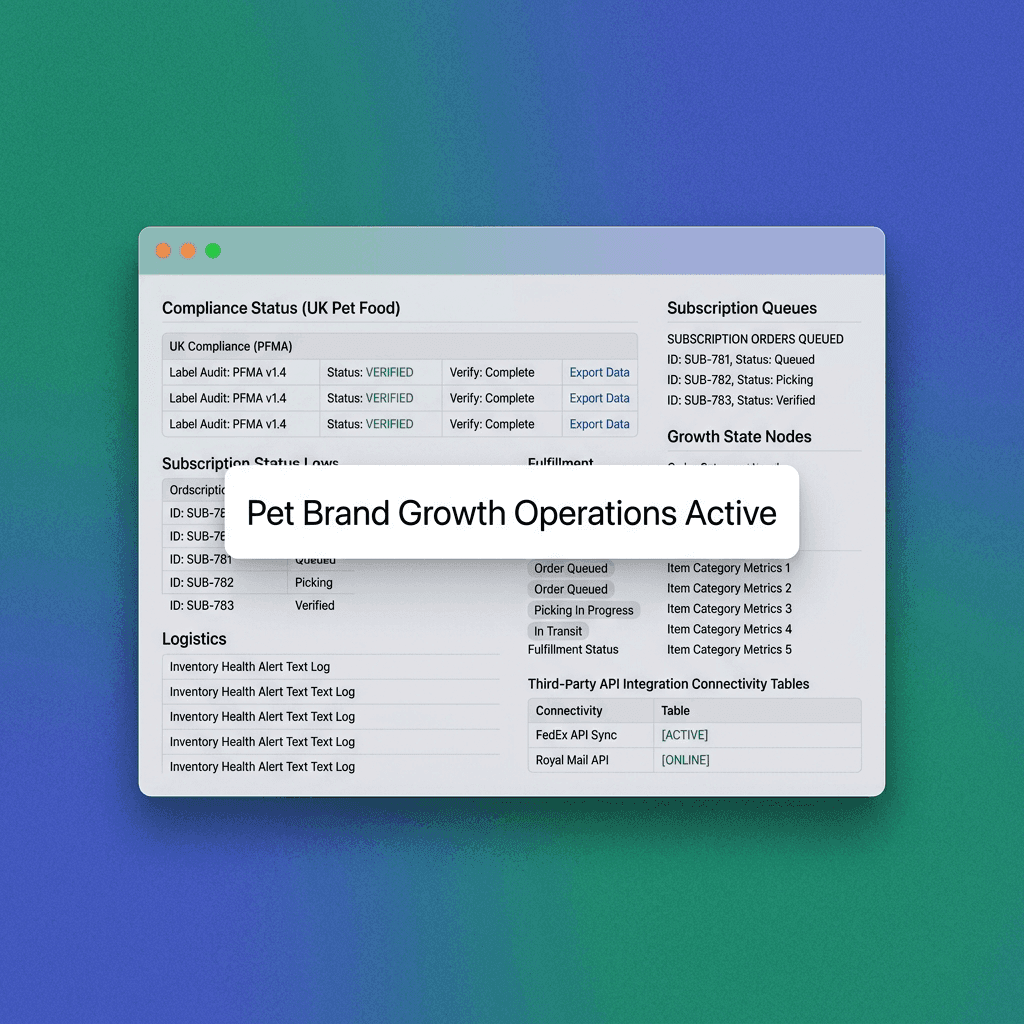
The UK pet industry is worth over £3.5 billion and growing. Direct-to-consumer is where the margin is, and Shopify is where most serious pet brands are building. But most guides treat Shopify as a generic tool. If you're selling pet food, supplements, or subscription boxes in the UK, you're operating in a more complex environment — one where labelling regulations, ingredient transparency, and recurring revenue mechanics matter as much as your product page design. This guide covers what pet brand operators actually need to know: PFMA compliance on Shopify, how to build a subscription model that retains customers, and the structural choices that separate growing D2C pet brands from stagnant ones. Building a pet-focused storefront requires a strategic intersection of high-end design, rigorous data hygiene for nutritional information, and a seamless checkout experience that prioritizes trust above all else. Because the pet category carries high emotional stakes for the consumer, your digital infrastructure must serve as both a reliable source of truth for ingredients and a high-converting engine for recurring revenue, effectively balancing the cold, hard logic of manufacturing compliance with the warm, benefit-driven messaging that drives brand loyalty.
Why Pet Brands Are Moving to Shopify D2C
Retail margins for pet products are tight. Supermarkets and large pet chains dictate terms, delay payments, and compress pricing. D2C changes that equation. You own the customer relationship, collect first-party data, and control how and when you communicate. Shopify has become the default infrastructure for this shift because it handles the full commercial stack — storefront, checkout, subscriptions, fulfilment logic, and data — without requiring enterprise budgets or bespoke development. For a UK pet brand doing £500k to £10m in revenue, it's the right tool at the right price point, assuming it's configured correctly. The challenge is that "correctly" looks different for pet brands than it does for apparel or wellness. You have regulatory obligations, subscription retention complexity, and a buyer who is unusually loyal but also unusually value-sensitive. By moving to Shopify, brands can bypass the gatekeepers of traditional retail, allowing for a leaner operational model where marketing spend can be optimized based on precise customer lifetime value data, ensuring that every pound spent on acquisition is directly tied to a predictable stream of subscription revenue that reinforces long-term brand equity rather than short-term shelf presence.
PFMA Standards and What They Mean for Your Shopify Store
The Pet Food Manufacturers' Association (PFMA) sets voluntary but widely adopted standards for pet food labelling and marketing in the UK. These sit alongside the statutory requirements in retained EU law — specifically the regulations governing pet food composition, labelling, and advertising. Getting this wrong on your Shopify store creates real risk: trading standards complaints, retailer rejections, and reputational damage in a community that talks. Compliance is not merely a legal hurdle; it acts as a critical signal of quality and integrity that separates premium, trustworthy brands from generic alternatives in an increasingly crowded marketplace. Establishing a foundation of radical transparency regarding product composition on your digital storefront effectively builds an early defensive moat, shielding your brand from the negative scrutiny often directed at opaque or poorly labeled products, while simultaneously reassuring savvy pet parents that your nutritional claims are backed by authorized, industry-standard data.
What Does PFMA Compliance Actually Require on a Product Page?
At minimum, your product listings should display:
Species Designation — The correct species designation (e.g., "complete pet food for adult dogs") serves as the fundamental anchor for all nutritional claims, ensuring that owners do not mistakenly purchase products that fail to meet the specific metabolic requirements of their pets.
Analytical Constituents — Analytical constituents in the required order (protein, fat, crude fibre, moisture) provide the essential breakdown of nutrient density, allowing informed owners to perform direct comparisons between brands based on verifiable, standardized laboratory-tested metrics.
Ingredient Transparency — A full ingredient list with PFMA-compliant naming conventions ensures there is no ambiguity in your formulation, preventing consumer confusion that arises from marketing-first terms that obscure the true biological content of the feed.
Traceability Data — Net quantity and best before / batch information (on physical packaging, but should be consistent with digital representation) are critical for both logistical accuracy and consumer trust, facilitating efficient product recalls and maintaining a professional standard of manufacturing accountability.
Responsible Identification — Registered or trading name and address of the responsible party is a non-negotiable legal requirement that authenticates your brand as a legitimate, UK-based entity subject to the appropriate oversight and quality control standards.
Nutritional Claims — Any specific nutritional claims backed by permitted language must be carefully scrutinized to ensure they align with the scientific evidence provided by the PFMA, preventing the dissemination of misleading health promises that could endanger the well-being of the animal and invite regulatory sanctions.
Shopify's native product page structure supports all of this — but only if you build it deliberately. Most out-of-the-box themes are not configured for regulatory content. Fields for analytical constituents often end up buried in collapsible tabs or stripped out entirely in favour of lifestyle copy. To optimize for both compliance and conversion, you should implement custom meta-fields that store this data systematically, ensuring that critical nutritional labels remain machine-readable for SEO and human-readable for consumers who prioritize deep product research over superficial branding aesthetics.
The PFMA-Ready Shopify Store Checklist
Use this checklist when auditing or building any pet food or supplement product page on Shopify.
Product Page Essentials — Analytical constituents displayed above the fold or in a dedicated, always-visible section are essential for capturing the attention of nutrition-focused buyers who value transparency as a proxy for product quality.
Naming Conventions — Ingredient list using PFMA-accepted naming (not marketing language in place of required terminology) maintains the professional standard required for cross-channel consistency and prevents potential friction during customer support inquiries regarding specific sensitivities.
Life-Stage Clarity — Species and life-stage designations clearly stated help prevent purchase errors by ensuring the product's nutritional profile perfectly aligns with the developmental or maintenance phase of the pet, reducing return rates and increasing satisfaction.
Classification Transparency — "Complete" or "complementary" food classification visible acts as a safety guardrail for consumers, distinguishing between daily-use meals and supplemental treats, which is a vital distinction for maintaining pet health and preventing over-supplementation.
Health Claims Integrity — No unsubstantiated health claims (e.g., "improves joint health" requires evidential backing) are strictly monitored to ensure the brand remains within the legal boundaries of nutritional advertising, preventing the spread of misinformation that could harm pets or erode brand reputation.
Anthropomorphic Guardrails — No anthropomorphic claims that could mislead on nutritional value prevent the trap of marketing pet food as "human-grade" or "gourmet" in a way that ignores the unique physiological realities of animal digestion, keeping the focus squarely on biological necessity.
Site-Level Compliance — Responsible party name and UK address present in footer or About page grounds the digital brand in reality, providing a clear point of contact that signals accountability to regulators and customers alike, reinforcing the legitimacy of your D2C operation.
Comparative Honesty — No misleading comparative claims against competitors protect the brand from litigation while maintaining a high road in marketing, where success is built on the inherent quality of your product rather than disparaging others.
Data Integrity — Subscription or bundle pages do not obscure per-serving nutritional data, ensuring that customers are fully aware of what they are committing to over the long term, which reduces surprise churn and helps build a transparent, value-driven relationship.
UGC Moderation — If using user-generated content (reviews mentioning health outcomes), moderation policy is active to filter out medically dangerous or unverified testimonials, ensuring that your social proof remains ethical and compliant with advertising standards.
Product Schema — Product schema markup includes ingredient and nutritional data where possible, which enhances your visibility in rich snippets and search results, allowing potential customers to see critical data points even before they click through to your site.
Variant Accuracy — Variant-level content (e.g., different flavours) has unique, accurate ingredient lists — not inherited from a parent product with different formulation, which is a common technical pitfall that causes compliance violations during bulk imports.
Error Prevention — No auto-generated pages with conflicting product data from bulk import errors serve as a critical check to ensure your store's information architecture remains pristine, avoiding the damage to credibility caused by displaying incorrect or mismatched nutritional data.
This checklist is designed to be saved, shared internally, and revisited every time a new SKU goes live. Add only if available and relevant: a link to your internal compliance sign-off workflow.
Building a Subscription Model on Shopify That Actually Retains
Subscription is the revenue model that makes D2C pet brands defensible. A customer on a monthly raw food box or a quarterly supplement subscription has a lifetime value two to four times higher than a one-off buyer. But most pet brand subscription setups are leaky. To successfully scale, you must treat subscription not as a set-and-forget checkout feature, but as a dynamic service layer that requires active management, frequent communication, and a user experience that allows customers to feel empowered rather than trapped. This requires integrating advanced churn-prevention logic, personalized replenishment reminders based on known consumption rates, and a frictionless customer portal that permits easy adjustments to delivery dates, quantities, and product varieties without requiring human-assisted support tickets.
Which Shopify Subscription Apps Are Worth Using?
The three apps most commonly used by UK pet brands on Shopify are Recharge, Skio, and Seal Subscriptions. Each has trade-offs.
Recharge — Recharge is the most widely deployed and integrates with the broadest range of third-party tools, handling complex subscription logic well — skip, pause, swap, and gifting — and maintaining a strong analytics layer that gives founders deep visibility into cohorts and churn rates.
Skio — Skio is newer and built with a cleaner UI, particularly for the subscriber portal, which reduces customer service ticket volume because subscribers can self-manage more easily, while the built-in referral mechanic provides a low-friction growth engine that leverages your happiest customers.
Seal Subscriptions — Seal Subscriptions is the low-cost option and works for early-stage brands that need basic subscribe-and-save functionality without committing to an enterprise-tier app, providing a stable foundation for testing subscription viability before scaling to more expensive, feature-rich platforms.
What Subscription Structure Works for Pet Brands Specifically?
The subscribe-and-save model (a discount for committing to a recurring delivery) converts well for consumables — food, treats, supplements. A flat 10–15% discount is the UK market norm. Going deeper than 15% signals desperation; going shallower than 10% rarely lifts conversion meaningfully. For subscription boxes — curated products delivered monthly or quarterly — the model is different. Here you're selling curation and surprise, not just convenience. The retention mechanic is editorial: the quality of your selection, the presentation, and the sense of community around the product. For subscription boxes, consider:
Thematic Delivery — A named, recurring theme per delivery creates anticipation and content, turning the receipt of the box into an event rather than a chore, which is essential for maintaining engagement in competitive subscription categories.
Advance Notification — Spoilers sent via email 5–7 days before despatch reduce cancellation at the point of charge by keeping the customer informed and excited, rather than surprised by a sudden notification from their bank.
Community Integration — A subscriber-only community or content layer, even a basic email sequence, fosters a sense of belonging among your most loyal customers, making the brand feel more like a lifestyle choice and less like a transactional utility.
Frictionless Management — Clear skip and pause options, while counterintuitive, act as a powerful retention tool; by reducing the fear of being "locked in," you actually increase the willingness of customers to start a subscription in the first place, ultimately leading to longer tenures.
Common Subscription Mistakes Pet Brands Make on Shopify
Layout Prioritization — Burying the subscription option below one-time purchase is a classic conversion killer that relegates your most valuable revenue stream to an afterthought, necessitating a strategic redesign of the product page to give the subscription toggle the prominence it deserves.
Notification Gaps — Not sending a pre-charge reminder is a significant oversight that leads to increased chargeback requests and customer frustration, especially as UK consumers increasingly expect transparency regarding the timing of recurring payments.
Pricing Inconsistency — Identical pricing across all subscription intervals creates a flat value proposition that fails to reward long-term commitment, necessitating a tiered pricing structure that incentivizes customers to choose longer replenishment cycles.
Churn Inaction — No win-back sequence for cancelled subscribers is a massive missed opportunity to recover revenue at a low cost, as a well-timed, three-email sequence can recapture a significant portion of customers who might have simply churned due to temporary financial constraints or forgetfulness.
D2C Growth: The Structural Decisions That Matter
Once your Shopify store is compliant and your subscription is set up properly, growth becomes a systems question. These are the decisions that compound over time. Success in the D2C pet space is rarely about finding a single "hack," but rather about building a resilient, scalable infrastructure where every touchpoint—from the landing page to the post-purchase email—is optimized for both customer utility and operational efficiency. By systematizing these processes early, you create the bandwidth required to experiment with new growth levers without compromising the stability of your core subscription revenue, ensuring that your operational capacity grows in tandem with your customer base.
How Should a Pet Brand Structure Its Shopify Storefront for D2C Scale?
The brands that scale D2C on Shopify tend to share a few structural traits:
Need-Based Collections — Collections built around need, not product category (e.g., "for senior dogs" rather than "dry food") allows you to meet the customer at the level of their intent, significantly increasing conversion rates by simplifying the path from search to solution.
Dedicated Landing Pages — A landing page layer separate from the main catalogue is essential for high-performance marketing; by tailoring the content on these pages to the specific pain points and awareness levels of traffic coming from social media or search, you drastically improve acquisition efficiency.
Trial-Led Acquisition — A first-order offer that de-risks trial is crucial for overcoming the inherent skepticism of pet owners regarding new subscription services, as a low-commitment entry point like a sample kit lowers the barrier to entry while allowing you to prove your value proposition.
Habit-Forming Sequences — A post-purchase sequence that builds habit during the critical 30-day window between the first and second orders is the most effective way to improve repeat purchase rates, as it shifts the brand from being a one-off purchase to a consistent, reliable part of the pet's health regimen.
What Shopify Apps and Stack Should UK Pet Brands Prioritise?
You don't need a large stack. You need the right one.
Essential — Shopify Payments, a reputable subscription app, Klaviyo for email/SMS automation, and a high-quality review app with photo support form the core of a sustainable, growth-oriented stack.
Growth-Stage Evaluation — Loyalty/referral tools (e.g., LoyaltyLion) and bundles apps become highly valuable as your subscriber base reaches a scale where community-led growth and inventory-optimized selling start to yield significant margin improvements.
Strategic Avoidance — Avoid headless Shopify architectures and multiple-storefront complexity until you reach an inflection point where the cost and engineering overhead are justified by genuine multi-market or omnichannel requirements, as simplicity is the best friend of a scaling brand.
Common Trade-Offs Pet Brands Face on Shopify
Compliance vs. Conversion — Balancing dense regulatory information with high-converting marketing copy is a constant challenge that requires sophisticated page design—such as using collapsible sections or tabbed layouts—to ensure compliance remains visible without cluttering the user experience.
Discount vs. Margin — Striking the right balance with subscribe-and-save discounts is a delicate act of financial modeling; you must clearly understand your contribution margins after accounting for shipping and potentially complex cold-chain fulfillment costs before committing to aggressive discount tiers.
Growth vs. Operations — Scaling traffic into a store that isn't operationally ready to handle the increased order volume is a recipe for disaster, making it imperative that your fulfillment, stock management, and customer support capabilities are stress-tested before major marketing pushes.
Direct vs. Wholesale — Expanding into wholesale and retail channels is a strategic pivot that changes the core logic of your business; it requires a disciplined approach to inventory planning and brand messaging to ensure that these secondary channels do not cannibalize your primary D2C profit centers.
The UK pet industry is worth over £3.5 billion and growing. Direct-to-consumer is where the margin is, and Shopify is where most serious pet brands are building. But most guides treat Shopify as a generic tool. If you're selling pet food, supplements, or subscription boxes in the UK, you're operating in a more complex environment — one where labelling regulations, ingredient transparency, and recurring revenue mechanics matter as much as your product page design. This guide covers what pet brand operators actually need to know: PFMA compliance on Shopify, how to build a subscription model that retains customers, and the structural choices that separate growing D2C pet brands from stagnant ones. Building a pet-focused storefront requires a strategic intersection of high-end design, rigorous data hygiene for nutritional information, and a seamless checkout experience that prioritizes trust above all else. Because the pet category carries high emotional stakes for the consumer, your digital infrastructure must serve as both a reliable source of truth for ingredients and a high-converting engine for recurring revenue, effectively balancing the cold, hard logic of manufacturing compliance with the warm, benefit-driven messaging that drives brand loyalty.
Why Pet Brands Are Moving to Shopify D2C
Retail margins for pet products are tight. Supermarkets and large pet chains dictate terms, delay payments, and compress pricing. D2C changes that equation. You own the customer relationship, collect first-party data, and control how and when you communicate. Shopify has become the default infrastructure for this shift because it handles the full commercial stack — storefront, checkout, subscriptions, fulfilment logic, and data — without requiring enterprise budgets or bespoke development. For a UK pet brand doing £500k to £10m in revenue, it's the right tool at the right price point, assuming it's configured correctly. The challenge is that "correctly" looks different for pet brands than it does for apparel or wellness. You have regulatory obligations, subscription retention complexity, and a buyer who is unusually loyal but also unusually value-sensitive. By moving to Shopify, brands can bypass the gatekeepers of traditional retail, allowing for a leaner operational model where marketing spend can be optimized based on precise customer lifetime value data, ensuring that every pound spent on acquisition is directly tied to a predictable stream of subscription revenue that reinforces long-term brand equity rather than short-term shelf presence.
PFMA Standards and What They Mean for Your Shopify Store
The Pet Food Manufacturers' Association (PFMA) sets voluntary but widely adopted standards for pet food labelling and marketing in the UK. These sit alongside the statutory requirements in retained EU law — specifically the regulations governing pet food composition, labelling, and advertising. Getting this wrong on your Shopify store creates real risk: trading standards complaints, retailer rejections, and reputational damage in a community that talks. Compliance is not merely a legal hurdle; it acts as a critical signal of quality and integrity that separates premium, trustworthy brands from generic alternatives in an increasingly crowded marketplace. Establishing a foundation of radical transparency regarding product composition on your digital storefront effectively builds an early defensive moat, shielding your brand from the negative scrutiny often directed at opaque or poorly labeled products, while simultaneously reassuring savvy pet parents that your nutritional claims are backed by authorized, industry-standard data.
What Does PFMA Compliance Actually Require on a Product Page?
At minimum, your product listings should display:
Species Designation — The correct species designation (e.g., "complete pet food for adult dogs") serves as the fundamental anchor for all nutritional claims, ensuring that owners do not mistakenly purchase products that fail to meet the specific metabolic requirements of their pets.
Analytical Constituents — Analytical constituents in the required order (protein, fat, crude fibre, moisture) provide the essential breakdown of nutrient density, allowing informed owners to perform direct comparisons between brands based on verifiable, standardized laboratory-tested metrics.
Ingredient Transparency — A full ingredient list with PFMA-compliant naming conventions ensures there is no ambiguity in your formulation, preventing consumer confusion that arises from marketing-first terms that obscure the true biological content of the feed.
Traceability Data — Net quantity and best before / batch information (on physical packaging, but should be consistent with digital representation) are critical for both logistical accuracy and consumer trust, facilitating efficient product recalls and maintaining a professional standard of manufacturing accountability.
Responsible Identification — Registered or trading name and address of the responsible party is a non-negotiable legal requirement that authenticates your brand as a legitimate, UK-based entity subject to the appropriate oversight and quality control standards.
Nutritional Claims — Any specific nutritional claims backed by permitted language must be carefully scrutinized to ensure they align with the scientific evidence provided by the PFMA, preventing the dissemination of misleading health promises that could endanger the well-being of the animal and invite regulatory sanctions.
Shopify's native product page structure supports all of this — but only if you build it deliberately. Most out-of-the-box themes are not configured for regulatory content. Fields for analytical constituents often end up buried in collapsible tabs or stripped out entirely in favour of lifestyle copy. To optimize for both compliance and conversion, you should implement custom meta-fields that store this data systematically, ensuring that critical nutritional labels remain machine-readable for SEO and human-readable for consumers who prioritize deep product research over superficial branding aesthetics.
The PFMA-Ready Shopify Store Checklist
Use this checklist when auditing or building any pet food or supplement product page on Shopify.
Product Page Essentials — Analytical constituents displayed above the fold or in a dedicated, always-visible section are essential for capturing the attention of nutrition-focused buyers who value transparency as a proxy for product quality.
Naming Conventions — Ingredient list using PFMA-accepted naming (not marketing language in place of required terminology) maintains the professional standard required for cross-channel consistency and prevents potential friction during customer support inquiries regarding specific sensitivities.
Life-Stage Clarity — Species and life-stage designations clearly stated help prevent purchase errors by ensuring the product's nutritional profile perfectly aligns with the developmental or maintenance phase of the pet, reducing return rates and increasing satisfaction.
Classification Transparency — "Complete" or "complementary" food classification visible acts as a safety guardrail for consumers, distinguishing between daily-use meals and supplemental treats, which is a vital distinction for maintaining pet health and preventing over-supplementation.
Health Claims Integrity — No unsubstantiated health claims (e.g., "improves joint health" requires evidential backing) are strictly monitored to ensure the brand remains within the legal boundaries of nutritional advertising, preventing the spread of misinformation that could harm pets or erode brand reputation.
Anthropomorphic Guardrails — No anthropomorphic claims that could mislead on nutritional value prevent the trap of marketing pet food as "human-grade" or "gourmet" in a way that ignores the unique physiological realities of animal digestion, keeping the focus squarely on biological necessity.
Site-Level Compliance — Responsible party name and UK address present in footer or About page grounds the digital brand in reality, providing a clear point of contact that signals accountability to regulators and customers alike, reinforcing the legitimacy of your D2C operation.
Comparative Honesty — No misleading comparative claims against competitors protect the brand from litigation while maintaining a high road in marketing, where success is built on the inherent quality of your product rather than disparaging others.
Data Integrity — Subscription or bundle pages do not obscure per-serving nutritional data, ensuring that customers are fully aware of what they are committing to over the long term, which reduces surprise churn and helps build a transparent, value-driven relationship.
UGC Moderation — If using user-generated content (reviews mentioning health outcomes), moderation policy is active to filter out medically dangerous or unverified testimonials, ensuring that your social proof remains ethical and compliant with advertising standards.
Product Schema — Product schema markup includes ingredient and nutritional data where possible, which enhances your visibility in rich snippets and search results, allowing potential customers to see critical data points even before they click through to your site.
Variant Accuracy — Variant-level content (e.g., different flavours) has unique, accurate ingredient lists — not inherited from a parent product with different formulation, which is a common technical pitfall that causes compliance violations during bulk imports.
Error Prevention — No auto-generated pages with conflicting product data from bulk import errors serve as a critical check to ensure your store's information architecture remains pristine, avoiding the damage to credibility caused by displaying incorrect or mismatched nutritional data.
This checklist is designed to be saved, shared internally, and revisited every time a new SKU goes live. Add only if available and relevant: a link to your internal compliance sign-off workflow.
Building a Subscription Model on Shopify That Actually Retains
Subscription is the revenue model that makes D2C pet brands defensible. A customer on a monthly raw food box or a quarterly supplement subscription has a lifetime value two to four times higher than a one-off buyer. But most pet brand subscription setups are leaky. To successfully scale, you must treat subscription not as a set-and-forget checkout feature, but as a dynamic service layer that requires active management, frequent communication, and a user experience that allows customers to feel empowered rather than trapped. This requires integrating advanced churn-prevention logic, personalized replenishment reminders based on known consumption rates, and a frictionless customer portal that permits easy adjustments to delivery dates, quantities, and product varieties without requiring human-assisted support tickets.
Which Shopify Subscription Apps Are Worth Using?
The three apps most commonly used by UK pet brands on Shopify are Recharge, Skio, and Seal Subscriptions. Each has trade-offs.
Recharge — Recharge is the most widely deployed and integrates with the broadest range of third-party tools, handling complex subscription logic well — skip, pause, swap, and gifting — and maintaining a strong analytics layer that gives founders deep visibility into cohorts and churn rates.
Skio — Skio is newer and built with a cleaner UI, particularly for the subscriber portal, which reduces customer service ticket volume because subscribers can self-manage more easily, while the built-in referral mechanic provides a low-friction growth engine that leverages your happiest customers.
Seal Subscriptions — Seal Subscriptions is the low-cost option and works for early-stage brands that need basic subscribe-and-save functionality without committing to an enterprise-tier app, providing a stable foundation for testing subscription viability before scaling to more expensive, feature-rich platforms.
What Subscription Structure Works for Pet Brands Specifically?
The subscribe-and-save model (a discount for committing to a recurring delivery) converts well for consumables — food, treats, supplements. A flat 10–15% discount is the UK market norm. Going deeper than 15% signals desperation; going shallower than 10% rarely lifts conversion meaningfully. For subscription boxes — curated products delivered monthly or quarterly — the model is different. Here you're selling curation and surprise, not just convenience. The retention mechanic is editorial: the quality of your selection, the presentation, and the sense of community around the product. For subscription boxes, consider:
Thematic Delivery — A named, recurring theme per delivery creates anticipation and content, turning the receipt of the box into an event rather than a chore, which is essential for maintaining engagement in competitive subscription categories.
Advance Notification — Spoilers sent via email 5–7 days before despatch reduce cancellation at the point of charge by keeping the customer informed and excited, rather than surprised by a sudden notification from their bank.
Community Integration — A subscriber-only community or content layer, even a basic email sequence, fosters a sense of belonging among your most loyal customers, making the brand feel more like a lifestyle choice and less like a transactional utility.
Frictionless Management — Clear skip and pause options, while counterintuitive, act as a powerful retention tool; by reducing the fear of being "locked in," you actually increase the willingness of customers to start a subscription in the first place, ultimately leading to longer tenures.
Common Subscription Mistakes Pet Brands Make on Shopify
Layout Prioritization — Burying the subscription option below one-time purchase is a classic conversion killer that relegates your most valuable revenue stream to an afterthought, necessitating a strategic redesign of the product page to give the subscription toggle the prominence it deserves.
Notification Gaps — Not sending a pre-charge reminder is a significant oversight that leads to increased chargeback requests and customer frustration, especially as UK consumers increasingly expect transparency regarding the timing of recurring payments.
Pricing Inconsistency — Identical pricing across all subscription intervals creates a flat value proposition that fails to reward long-term commitment, necessitating a tiered pricing structure that incentivizes customers to choose longer replenishment cycles.
Churn Inaction — No win-back sequence for cancelled subscribers is a massive missed opportunity to recover revenue at a low cost, as a well-timed, three-email sequence can recapture a significant portion of customers who might have simply churned due to temporary financial constraints or forgetfulness.
D2C Growth: The Structural Decisions That Matter
Once your Shopify store is compliant and your subscription is set up properly, growth becomes a systems question. These are the decisions that compound over time. Success in the D2C pet space is rarely about finding a single "hack," but rather about building a resilient, scalable infrastructure where every touchpoint—from the landing page to the post-purchase email—is optimized for both customer utility and operational efficiency. By systematizing these processes early, you create the bandwidth required to experiment with new growth levers without compromising the stability of your core subscription revenue, ensuring that your operational capacity grows in tandem with your customer base.
How Should a Pet Brand Structure Its Shopify Storefront for D2C Scale?
The brands that scale D2C on Shopify tend to share a few structural traits:
Need-Based Collections — Collections built around need, not product category (e.g., "for senior dogs" rather than "dry food") allows you to meet the customer at the level of their intent, significantly increasing conversion rates by simplifying the path from search to solution.
Dedicated Landing Pages — A landing page layer separate from the main catalogue is essential for high-performance marketing; by tailoring the content on these pages to the specific pain points and awareness levels of traffic coming from social media or search, you drastically improve acquisition efficiency.
Trial-Led Acquisition — A first-order offer that de-risks trial is crucial for overcoming the inherent skepticism of pet owners regarding new subscription services, as a low-commitment entry point like a sample kit lowers the barrier to entry while allowing you to prove your value proposition.
Habit-Forming Sequences — A post-purchase sequence that builds habit during the critical 30-day window between the first and second orders is the most effective way to improve repeat purchase rates, as it shifts the brand from being a one-off purchase to a consistent, reliable part of the pet's health regimen.
What Shopify Apps and Stack Should UK Pet Brands Prioritise?
You don't need a large stack. You need the right one.
Essential — Shopify Payments, a reputable subscription app, Klaviyo for email/SMS automation, and a high-quality review app with photo support form the core of a sustainable, growth-oriented stack.
Growth-Stage Evaluation — Loyalty/referral tools (e.g., LoyaltyLion) and bundles apps become highly valuable as your subscriber base reaches a scale where community-led growth and inventory-optimized selling start to yield significant margin improvements.
Strategic Avoidance — Avoid headless Shopify architectures and multiple-storefront complexity until you reach an inflection point where the cost and engineering overhead are justified by genuine multi-market or omnichannel requirements, as simplicity is the best friend of a scaling brand.
Common Trade-Offs Pet Brands Face on Shopify
Compliance vs. Conversion — Balancing dense regulatory information with high-converting marketing copy is a constant challenge that requires sophisticated page design—such as using collapsible sections or tabbed layouts—to ensure compliance remains visible without cluttering the user experience.
Discount vs. Margin — Striking the right balance with subscribe-and-save discounts is a delicate act of financial modeling; you must clearly understand your contribution margins after accounting for shipping and potentially complex cold-chain fulfillment costs before committing to aggressive discount tiers.
Growth vs. Operations — Scaling traffic into a store that isn't operationally ready to handle the increased order volume is a recipe for disaster, making it imperative that your fulfillment, stock management, and customer support capabilities are stress-tested before major marketing pushes.
Direct vs. Wholesale — Expanding into wholesale and retail channels is a strategic pivot that changes the core logic of your business; it requires a disciplined approach to inventory planning and brand messaging to ensure that these secondary channels do not cannibalize your primary D2C profit centers.
FAQs
Web Personalisation
Framer is a design tool that allows you to design websites on a freeform canvas, and then publish them as websites with a single click.
UI and UX Design
Framer is a design tool that allows you to design websites on a freeform canvas, and then publish them as websites with a single click.
Search Engine Optimisation
Framer is a design tool that allows you to design websites on a freeform canvas, and then publish them as websites with a single click.
CRM and ERP Solutions
Framer is a design tool that allows you to design websites on a freeform canvas, and then publish them as websites with a single click.
Ecommerce
Framer is a design tool that allows you to design websites on a freeform canvas, and then publish them as websites with a single click.
Email Marketing
Framer is a design tool that allows you to design websites on a freeform canvas, and then publish them as websites with a single click.
Marketing Automation
Framer is a design tool that allows you to design websites on a freeform canvas, and then publish them as websites with a single click.
Chatbots and Conversational AI
Framer is a design tool that allows you to design websites on a freeform canvas, and then publish them as websites with a single click.
Chatbots and Conversational AI
Framer is a design tool that allows you to design websites on a freeform canvas, and then publish them as websites with a single click.
Related Blogs
We know your space
Explore our latest UI/UX Case Studies that showcase how our process-driven creativity transforms complex ideas into real, measurable business results, step by step.

AI and Data Analytics
•
Aug 19, 2026
Context Engineering for Enterprise AI Agents: Memory, Retrieval, Tools and State Management

AI and Data Analytics
•
Aug 19, 2026
Enterprise RAG vs Agentic RAG vs AI Search: Which Architecture Should You Build?

AI and Data Analytics
•
Aug 19, 2026
Enterprise Semantic Layer for AI Agents: How to Produce Trusted Business Answers
Let's work together
Have a project in mind?
Let's make it real.
Tell us what you're building. We'll bring the design, technology, and thinking to make it happen.
Fill up the following form to start a conversation
with our team
Let's work together
Have a project in mind?
Let's make it real.
Tell us what you're building. We'll bring the design, technology, and thinking to make it happen.
Fill up the following form to start a conversation with our team
Let's work together
Have a project in mind?
Let's make it real.
Tell us what you're building. We'll bring the design, technology, and thinking to make it happen.
Fill up the following form to start a conversation
with our team
Services
Services
© 2026 projectsupply
Part of Tangle
Services
© 2026 projectsupply
Part of Tangle