

Shopify
Shopify vs Klaviyo Revenue Attribution: Why They Never Match and How to Reconcile Them
Shopify vs Klaviyo Revenue Attribution: Why They Never Match and How to Reconcile Them
Shopify and Klaviyo will never show the same revenue numbers — and that's expected. Here's why the gap exists, what it means for your reporting, and how to reconcile both platforms without losing confidence in your data.
Shopify and Klaviyo will never show the same revenue numbers — and that's expected. Here's why the gap exists, what it means for your reporting, and how to reconcile both platforms without losing confidence in your data.
08 min read
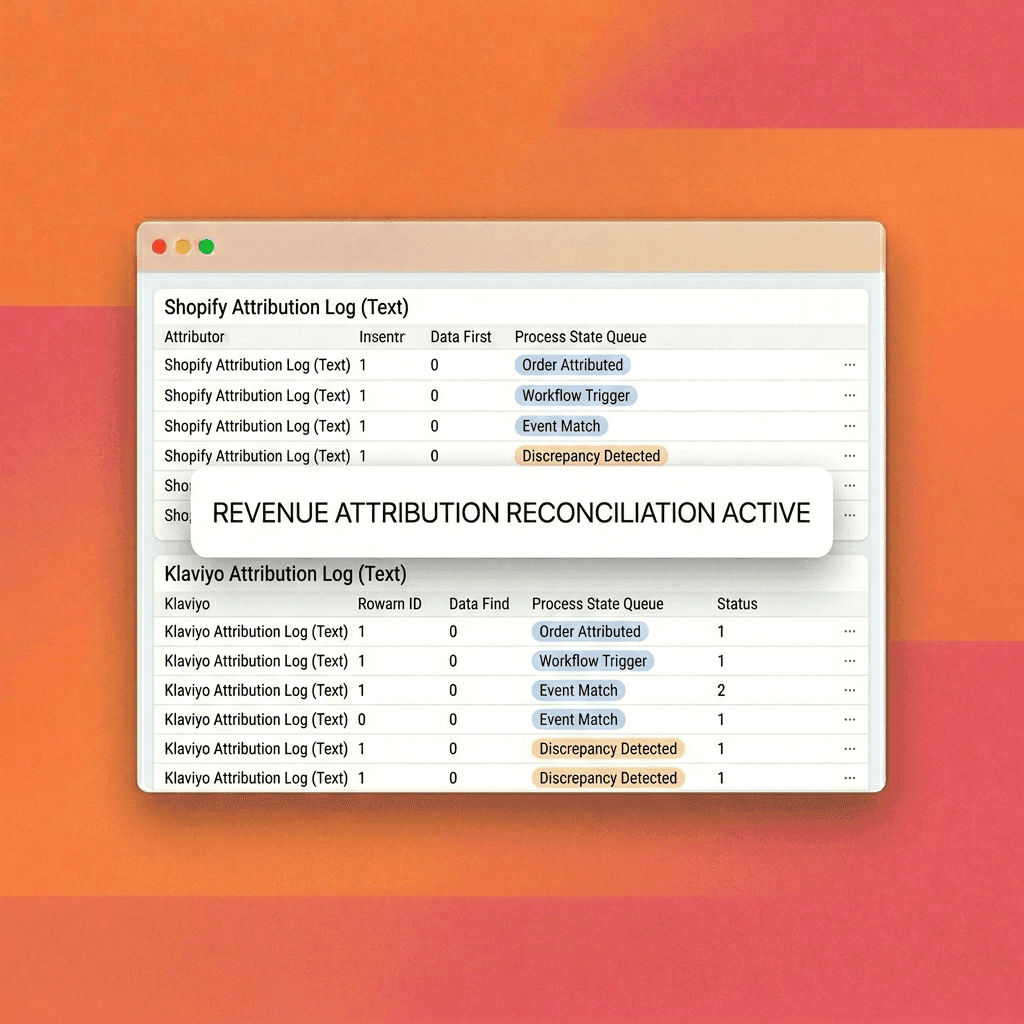
If you've ever pulled revenue numbers from Shopify and Klaviyo on the same day for the same period and gotten two completely different figures, you're not looking at a bug. You're looking at two fundamentally different attribution models doing exactly what they were built to do — and arriving at different answers. This is one of the most common points of confusion for D2C teams running email as a core revenue channel. It creates friction in reporting, arguments in leadership meetings, and misallocated budget. This post explains why the gap exists, what each number actually represents, and how to build a reconciliation framework your team can use consistently. Deep operational expertise requires understanding that data is never absolute; it is a manifestation of the specific logic constraints programmed into the platform’s underlying architecture. By viewing Shopify as your immutable financial ledger and Klaviyo as a behavior-tracking engine, you move from a mindset of error-finding to one of strategic analysis. This transition is critical for maturing brands that need to justify email marketing spend while maintaining a grounded, finance-first approach to total business growth and profitability targets.
Why Shopify and Klaviyo Measure Revenue Differently
The root issue is simple: Shopify counts orders. Klaviyo counts influence. Shopify records a sale when a customer completes a purchase. It logs the order, assigns it to a source (typically last-click or direct), and reports it against that channel. Shopify is your system of record for transactions. Klaviyo records a sale when a customer opens or clicks an email and then places an order within a defined attribution window — typically 5 days for clicks and 1 day for opens, though these are configurable. Klaviyo is your system of record for email-influenced revenue. Neither is wrong. They are answering different questions.
Shopify's Objective: Answers how much revenue was generated and identifies the final touchpoint, ensuring that your financial accounting aligns with actual cash flow and order fulfillment status, which is vital for reconciliation with your payment gateway.
Klaviyo's Objective: Answers how much revenue occurred after email engagement, providing a proxy for the effectiveness of your customer lifecycle messaging, flow performance, and segment-specific conversion power regardless of the final path taken.
When a customer clicks a Klaviyo email, browses for three days, then returns via Google and checks out — Shopify attributes that order to organic search. Klaviyo attributes it to the email flow. Both platforms are technically correct within their own logic. This inherent overlap is not a sign of broken integration but rather a byproduct of the modern, non-linear customer journey where touchpoints are dispersed across multiple devices, platforms, and timeframes.
The Four Core Reasons the Numbers Will Never Match
1. Attribution Window Differences
Klaviyo uses a multi-day attribution window (configurable, but 5-day click / 1-day open by default). Any purchase that happens within that window after an email engagement gets credited to Klaviyo — even if the customer used a completely different channel to return. Shopify's attribution is session-based. It credits the channel that brought the customer to the checkout session. The longer the Klaviyo window, the larger the gap between the two platforms. This creates a divergence where Klaviyo’s "look-back" period essentially creates a proprietary view of the customer journey, prioritizing engagement metrics over the immediate session-based limitations inherent in Shopify’s standard reporting modules.
2. Multi-Touch vs Last-Touch Logic
Shopify uses last-touch attribution by default. Klaviyo uses a first-touch or any-touch model within its own window, depending on how engagement is tracked. A customer who received three emails, clicked one, saw a Facebook ad, and then purchased via a branded search will appear in all three reporting systems simultaneously — and each will claim full credit. This is not a data quality problem. It is the nature of multi-channel marketing. Attribution is always a model, not a measurement. Sophisticated operators understand that by forcing these platforms to agree, you are actually stripping away the nuances of your customer's decision-making process, which often involves multiple brand touchpoints before the final conversion event.
3. Cross-Device and Cross-Browser Gaps
Klaviyo tracks engagement at the profile level. If a customer opens an email on mobile and checks out on desktop, Klaviyo still connects the dots using the email address tied to that profile. Shopify tracks sessions. If the checkout session happened on a different device or browser, Shopify sees it as a separate session with a different source. The two platforms are working from different identity graphs. This identity resolution capability makes Klaviyo superior for identifying the full impact of an email strategy, even when the final session is disconnected from the original email interaction, whereas Shopify’s session-centric approach is limited by browser-level cookies and device handoff protocols.
4. Cancelled Orders and Refunds
Shopify removes or adjusts revenue when orders are cancelled or refunded. Klaviyo's revenue figures may still reflect the original attributed value depending on when the event was logged and whether your integration syncs those updates in real time. This creates a persistent gap that compounds over time, especially for brands with higher return rates. Operational teams must account for the fact that Klaviyo’s attribution is essentially a point-in-time calculation based on conversion events, while Shopify is a living ledger that accounts for post-purchase modifications and financial settlement realities that Klaviyo's internal reporting engine often ignores.
The Attribution Reconciliation Matrix
Rather than chasing a single "true" revenue number, the goal is to understand what each number is useful for and use them accordingly. This framework — the Attribution Reconciliation Matrix — defines the correct use case for each data source.
Question You're Answering: How much did we actually make? / Use This Platform: Shopify / Why: Source of truth for transactions.
Question You're Answering: Is our email program driving incremental revenue? / Use This Platform: Klaviyo / Why: Measures email-influenced behavior.
Question You're Answering: What is our email program's efficiency (RPE, CVR)? / Use This Platform: Klaviyo / Why: Benchmarks against email engagement.
Question You're Answering: Which channels are genuinely driving top-of-funnel? / Use This Platform: GA4 or Triple Whale / Why: Multi-touch path data.
Question You're Answering: What is our blended CAC and ROAS? / Use This Platform: Your MER calculation / Why: Channel-agnostic business performance.
Using Klaviyo to report total business revenue is a category error. Using Shopify to evaluate email program performance is an equally poor fit. The platforms serve different reporting functions, and your team should not be expected to reconcile them into a single number — because that number does not exist and does not need to.
How to Build a Reliable Reporting Stack Around Both
Step 1: Establish Shopify as the Revenue System of Record
All revenue totals reported to leadership, investors, or finance should come from Shopify. This is non-negotiable. Shopify data is tied to actual transactions, is reconcilable with your payment processor, and does not double-count across channels. By treating Shopify as the "Gold Standard," you remove the ambiguity of marketing attribution models and provide a concrete, audit-ready financial baseline that is resistant to the fluctuations of marketing platform reporting adjustments.
Step 2: Use Klaviyo for Email Program Health Metrics
Klaviyo attributed revenue is most useful as a relative metric — comparing flows to campaigns, measuring list segment performance, and evaluating lifecycle stage efficiency. Track revenue per recipient (RPR), revenue per email sent, and flow contribution as a percentage of Klaviyo-attributed total. These metrics provide granular insights into the health of your list and the quality of your content, allowing for optimization at the campaign level that aggregate Shopify totals would otherwise obscure.
Step 3: Set a Standard Attribution Window and Lock It
Whatever Klaviyo's default attribution window is, choose one and stop changing it. Changing your attribution window mid-year destroys year-over-year comparability. Document the window in your reporting SOP and only revisit it during a planned annual review. Consistency is the cornerstone of analytical integrity, and by locking your window, you ensure that your trend analysis remains untainted by arbitrary methodology shifts that could lead to incorrect optimization decisions.
Step 4: Add a Third Layer for Path-to-Purchase Clarity
GA4, Triple Whale, Northbeam, or Rockerbox can give you path-level data showing how email intersects with paid social, organic search, and direct. This doesn't eliminate attribution complexity — it helps you understand it structurally rather than reacting to surface-level discrepancies. These advanced tools serve as the "connective tissue" between your siloed data points, providing a clearer view of how top-of-funnel discovery leads to bottom-of-funnel conversion via the email channel.
Step 5: Report the Gap Transparently
Build a standard line into your email reporting that acknowledges the gap between Klaviyo-attributed revenue and Shopify revenue. Something simple: "Klaviyo attributed $X. Shopify recorded $Y. The difference reflects multi-touch attribution overlap and is expected." This removes the confusion from leadership reviews before it becomes a problem. Being proactive in your reporting demonstrates a high degree of operational maturity and establishes you as a credible partner who manages data with precision rather than ignorance.
Common Mistakes D2C Teams Make With Revenue Attribution
Using Klaviyo revenue to calculate ROAS or blended CAC: These metrics require Shopify-sourced revenue to be accurate and comparable.
Panicking when Klaviyo revenue exceeds Shopify revenue: This happens routinely. Klaviyo's multi-touch window will often credit more revenue than Shopify's last-click model records for email. It does not mean you have a tracking error.
Shortening attribution windows to make the gap smaller: The gap is not the problem. Misunderstanding the gap is the problem. Shrinking the window artificially reduces reported email performance and makes trend analysis unreliable.
Benchmarking Klaviyo-attributed revenue against industry benchmarks that use Shopify data: Most published ecommerce benchmarks use order-level data. Comparing Klaviyo-attributed revenue to those figures inflates your apparent performance.
Treating attribution as a solved problem: Multi-channel attribution is a modeling exercise. The goal is not accuracy down to the dollar — it is confident, consistent decision-making.
If you've ever pulled revenue numbers from Shopify and Klaviyo on the same day for the same period and gotten two completely different figures, you're not looking at a bug. You're looking at two fundamentally different attribution models doing exactly what they were built to do — and arriving at different answers. This is one of the most common points of confusion for D2C teams running email as a core revenue channel. It creates friction in reporting, arguments in leadership meetings, and misallocated budget. This post explains why the gap exists, what each number actually represents, and how to build a reconciliation framework your team can use consistently. Deep operational expertise requires understanding that data is never absolute; it is a manifestation of the specific logic constraints programmed into the platform’s underlying architecture. By viewing Shopify as your immutable financial ledger and Klaviyo as a behavior-tracking engine, you move from a mindset of error-finding to one of strategic analysis. This transition is critical for maturing brands that need to justify email marketing spend while maintaining a grounded, finance-first approach to total business growth and profitability targets.
Why Shopify and Klaviyo Measure Revenue Differently
The root issue is simple: Shopify counts orders. Klaviyo counts influence. Shopify records a sale when a customer completes a purchase. It logs the order, assigns it to a source (typically last-click or direct), and reports it against that channel. Shopify is your system of record for transactions. Klaviyo records a sale when a customer opens or clicks an email and then places an order within a defined attribution window — typically 5 days for clicks and 1 day for opens, though these are configurable. Klaviyo is your system of record for email-influenced revenue. Neither is wrong. They are answering different questions.
Shopify's Objective: Answers how much revenue was generated and identifies the final touchpoint, ensuring that your financial accounting aligns with actual cash flow and order fulfillment status, which is vital for reconciliation with your payment gateway.
Klaviyo's Objective: Answers how much revenue occurred after email engagement, providing a proxy for the effectiveness of your customer lifecycle messaging, flow performance, and segment-specific conversion power regardless of the final path taken.
When a customer clicks a Klaviyo email, browses for three days, then returns via Google and checks out — Shopify attributes that order to organic search. Klaviyo attributes it to the email flow. Both platforms are technically correct within their own logic. This inherent overlap is not a sign of broken integration but rather a byproduct of the modern, non-linear customer journey where touchpoints are dispersed across multiple devices, platforms, and timeframes.
The Four Core Reasons the Numbers Will Never Match
1. Attribution Window Differences
Klaviyo uses a multi-day attribution window (configurable, but 5-day click / 1-day open by default). Any purchase that happens within that window after an email engagement gets credited to Klaviyo — even if the customer used a completely different channel to return. Shopify's attribution is session-based. It credits the channel that brought the customer to the checkout session. The longer the Klaviyo window, the larger the gap between the two platforms. This creates a divergence where Klaviyo’s "look-back" period essentially creates a proprietary view of the customer journey, prioritizing engagement metrics over the immediate session-based limitations inherent in Shopify’s standard reporting modules.
2. Multi-Touch vs Last-Touch Logic
Shopify uses last-touch attribution by default. Klaviyo uses a first-touch or any-touch model within its own window, depending on how engagement is tracked. A customer who received three emails, clicked one, saw a Facebook ad, and then purchased via a branded search will appear in all three reporting systems simultaneously — and each will claim full credit. This is not a data quality problem. It is the nature of multi-channel marketing. Attribution is always a model, not a measurement. Sophisticated operators understand that by forcing these platforms to agree, you are actually stripping away the nuances of your customer's decision-making process, which often involves multiple brand touchpoints before the final conversion event.
3. Cross-Device and Cross-Browser Gaps
Klaviyo tracks engagement at the profile level. If a customer opens an email on mobile and checks out on desktop, Klaviyo still connects the dots using the email address tied to that profile. Shopify tracks sessions. If the checkout session happened on a different device or browser, Shopify sees it as a separate session with a different source. The two platforms are working from different identity graphs. This identity resolution capability makes Klaviyo superior for identifying the full impact of an email strategy, even when the final session is disconnected from the original email interaction, whereas Shopify’s session-centric approach is limited by browser-level cookies and device handoff protocols.
4. Cancelled Orders and Refunds
Shopify removes or adjusts revenue when orders are cancelled or refunded. Klaviyo's revenue figures may still reflect the original attributed value depending on when the event was logged and whether your integration syncs those updates in real time. This creates a persistent gap that compounds over time, especially for brands with higher return rates. Operational teams must account for the fact that Klaviyo’s attribution is essentially a point-in-time calculation based on conversion events, while Shopify is a living ledger that accounts for post-purchase modifications and financial settlement realities that Klaviyo's internal reporting engine often ignores.
The Attribution Reconciliation Matrix
Rather than chasing a single "true" revenue number, the goal is to understand what each number is useful for and use them accordingly. This framework — the Attribution Reconciliation Matrix — defines the correct use case for each data source.
Question You're Answering: How much did we actually make? / Use This Platform: Shopify / Why: Source of truth for transactions.
Question You're Answering: Is our email program driving incremental revenue? / Use This Platform: Klaviyo / Why: Measures email-influenced behavior.
Question You're Answering: What is our email program's efficiency (RPE, CVR)? / Use This Platform: Klaviyo / Why: Benchmarks against email engagement.
Question You're Answering: Which channels are genuinely driving top-of-funnel? / Use This Platform: GA4 or Triple Whale / Why: Multi-touch path data.
Question You're Answering: What is our blended CAC and ROAS? / Use This Platform: Your MER calculation / Why: Channel-agnostic business performance.
Using Klaviyo to report total business revenue is a category error. Using Shopify to evaluate email program performance is an equally poor fit. The platforms serve different reporting functions, and your team should not be expected to reconcile them into a single number — because that number does not exist and does not need to.
How to Build a Reliable Reporting Stack Around Both
Step 1: Establish Shopify as the Revenue System of Record
All revenue totals reported to leadership, investors, or finance should come from Shopify. This is non-negotiable. Shopify data is tied to actual transactions, is reconcilable with your payment processor, and does not double-count across channels. By treating Shopify as the "Gold Standard," you remove the ambiguity of marketing attribution models and provide a concrete, audit-ready financial baseline that is resistant to the fluctuations of marketing platform reporting adjustments.
Step 2: Use Klaviyo for Email Program Health Metrics
Klaviyo attributed revenue is most useful as a relative metric — comparing flows to campaigns, measuring list segment performance, and evaluating lifecycle stage efficiency. Track revenue per recipient (RPR), revenue per email sent, and flow contribution as a percentage of Klaviyo-attributed total. These metrics provide granular insights into the health of your list and the quality of your content, allowing for optimization at the campaign level that aggregate Shopify totals would otherwise obscure.
Step 3: Set a Standard Attribution Window and Lock It
Whatever Klaviyo's default attribution window is, choose one and stop changing it. Changing your attribution window mid-year destroys year-over-year comparability. Document the window in your reporting SOP and only revisit it during a planned annual review. Consistency is the cornerstone of analytical integrity, and by locking your window, you ensure that your trend analysis remains untainted by arbitrary methodology shifts that could lead to incorrect optimization decisions.
Step 4: Add a Third Layer for Path-to-Purchase Clarity
GA4, Triple Whale, Northbeam, or Rockerbox can give you path-level data showing how email intersects with paid social, organic search, and direct. This doesn't eliminate attribution complexity — it helps you understand it structurally rather than reacting to surface-level discrepancies. These advanced tools serve as the "connective tissue" between your siloed data points, providing a clearer view of how top-of-funnel discovery leads to bottom-of-funnel conversion via the email channel.
Step 5: Report the Gap Transparently
Build a standard line into your email reporting that acknowledges the gap between Klaviyo-attributed revenue and Shopify revenue. Something simple: "Klaviyo attributed $X. Shopify recorded $Y. The difference reflects multi-touch attribution overlap and is expected." This removes the confusion from leadership reviews before it becomes a problem. Being proactive in your reporting demonstrates a high degree of operational maturity and establishes you as a credible partner who manages data with precision rather than ignorance.
Common Mistakes D2C Teams Make With Revenue Attribution
Using Klaviyo revenue to calculate ROAS or blended CAC: These metrics require Shopify-sourced revenue to be accurate and comparable.
Panicking when Klaviyo revenue exceeds Shopify revenue: This happens routinely. Klaviyo's multi-touch window will often credit more revenue than Shopify's last-click model records for email. It does not mean you have a tracking error.
Shortening attribution windows to make the gap smaller: The gap is not the problem. Misunderstanding the gap is the problem. Shrinking the window artificially reduces reported email performance and makes trend analysis unreliable.
Benchmarking Klaviyo-attributed revenue against industry benchmarks that use Shopify data: Most published ecommerce benchmarks use order-level data. Comparing Klaviyo-attributed revenue to those figures inflates your apparent performance.
Treating attribution as a solved problem: Multi-channel attribution is a modeling exercise. The goal is not accuracy down to the dollar — it is confident, consistent decision-making.
FAQs
Why does Klaviyo always show more revenue than Shopify?
Klaviyo attributes revenue to any purchase that happens within its attribution window after an email engagement, regardless of what channel the customer used to return and complete the purchase. Shopify credits only the final session source. Because Klaviyo casts a wider net, it will almost always report higher revenue than Shopify's email channel attribution — and this is normal behavior, not a discrepancy to fix. This disparity is fundamentally rooted in the difference between session-based last-touch attribution (Shopify) and event-based engagement attribution (Klaviyo), and it is a structural reality that all sophisticated D2C operators must accept as part of their daily data management routine.
What is the default Klaviyo attribution window and should I change it?
Klaviyo's default is 5 days for clicks and 1 day for opens. You can adjust this in your account settings. Whether you should change it depends on your customer purchase cycle — a brand with a longer consideration window might use a 7-day or 14-day click window. What matters most is consistency: pick a window that reflects your customer behavior and do not change it arbitrarily. Changing these settings mid-cycle will fundamentally invalidate your historical reporting baselines, making it impossible to perform accurate year-over-year growth assessments or seasonal trend analysis across your email segments.
Which number should I report to my leadership team or investors?
Report Shopify revenue for business performance. Use Klaviyo revenue only when specifically discussing the email program's contribution. Clearly label the source in every report to prevent confusion about what's being measured. By standardizing your reporting, you ensure that your financial stakeholders are presented with a clean, defensible set of transaction-level data, while your growth team can leverage Klaviyo’s internal metrics for the iterative testing and optimization that drive the business forward.
Can I make Shopify and Klaviyo revenue match exactly?
No, and attempting to do so will lead you away from useful analysis. The platforms use fundamentally different attribution models. Your goal is not to reconcile them into one number — it is to understand what each number is telling you and use it in the right context. Forcing a reconciliation ignores the fact that these platforms serve distinct organizational needs, with one focused on the hard realities of cash flow and the other on the nuanced behavioral psychology of the customer journey.
Does Klaviyo attribution account for cancelled or refunded orders?
Not always in real time. Shopify updates revenue figures when orders are cancelled or refunded. Klaviyo's attributed revenue may reflect the original purchase event depending on your integration settings and sync frequency. This is a meaningful driver of long-term gap growth and worth auditing periodically, especially for brands with high return rates. Failing to account for this lag can lead to an overestimation of your email program’s net profitability, highlighting why periodic financial audits are necessary to align marketing reports with actual net-revenue realities.
How does cross-device behavior affect the attribution gap?
Klaviyo tracks at the profile level (tied to email address), so it can connect an email open on mobile to a checkout on desktop if both events are tied to the same profile. Shopify tracks at the session level and cannot make that connection natively. This means Klaviyo will correctly attribute revenue that Shopify's session-based model can't see — which is one of the legitimate arguments for email as an undervalued channel in last-click reporting. This identity resolution is a significant technical advantage for Klaviyo, providing a more comprehensive view of the customer journey than the fragmented session data captured by standard Shopify analytics.
insights
Explore more on AI, Design and Growth

SEO
Google AI & Local SEO: Rank in Both (2026 Guide)
Learn how to optimize content for Google AI search and local SEO simultaneously to rank in AI Overviews, maps, and organic search results.

SEO
Semantic Content Clusters for SEO & AEO (Templates)
Learn how to build semantic content clusters for SEO and AEO. Includes practical templates, internal linking structures, and examples for ranking in AI search.

SEO
How Google AI Search Works: RankBrain to Gemini (2026)
Discover how Google’s AI search evolved from RankBrain to Gemini and what it means for SEO, AI search results, and ranking strategies in 2026.
SEO
Google AI & Local SEO: Rank in Both (2026 Guide)
Learn how to optimize content for Google AI search and local SEO simultaneously to rank in AI Overviews, maps, and organic search results.
SEO
Semantic Content Clusters for SEO & AEO (Templates)
Learn how to build semantic content clusters for SEO and AEO. Includes practical templates, internal linking structures, and examples for ranking in AI search.
get in touch
Ready to Grow From Day One?
Strategy, execution, and digital experiences designed to move together. Fill out the form below and our team will contact you shortly.
get in touch
Ready to Grow From Day One?
Strategy, execution, and digital experiences designed to move together. Fill out the form below and our team will contact you shortly.
get in touch
Ready to Grow From Day One?
Strategy, execution, and digital experiences designed to move together. Fill out the form below and our team will contact you shortly.
Services
We'd love to hear from you.
Tell us what you're building and where you need support.
© 2026 projectsupply AI, Data and Digital Engineering
Company. Pune, India. All rights reserved.
Part of Tangle
Services
We'd love to hear from you.
Tell us what you're building and where you need support.
© 2026 projectsupply AI, Data and Digital Engineering
Company. Pune, India. All rights reserved.
Part of Tangle
Services
We'd love to hear from you.
Tell us what you're building and where you need support.
© 2026 projectsupply AI, Data and Digital Engineering
Company. Pune, India. All rights reserved.
Part of Tangle