Shopify

Shopify vs TikTok Shop: How D2C Brands Should Think About Social Commerce in 2026

Shopify vs TikTok Shop: How D2C Brands Should Think About Social Commerce in 2026

Shopify or TikTok Shop? D2C brands don't have to choose one — but they do need a clear stack strategy. Here's how to think about it in 2026.

Shopify or TikTok Shop? D2C brands don't have to choose one — but they do need a clear stack strategy. Here's how to think about it in 2026.

08 min read

Shopify vs TikTok Shop: How D2C Brands Should Think About Social Commerce in 2026

The Shopify vs TikTok Shop debate is the wrong frame. Most D2C brands asking this question are really asking something else: where should my growth energy go, and how do I build a commerce stack that doesn't fragment my operations? This operational fragmentation is one of the most destructive forces in modern digital retail, silently creating data silos, broken fulfillment pipelines, and duplicated administrative overhead that drains working capital. When growth leads treat sales channels as entirely isolated technical domains, they construct un-synchronized systems that struggle to manage rapid shifts in audience behavior or inventory drawdowns. Overcoming this friction point requires an analytical transition away from basic frontend platform comparison toward a holistic, unified data engineering methodology. Treating your commerce infrastructure as a single centralized source of truth is the absolute baseline requirement to secure long-term capital efficiency.

That's a better question. And the answer requires understanding what each platform actually is — not just what it's marketed as. Many software applications promise turnkey, cross-platform synchronization but fail completely under the weight of live transactional mutations, custom bundle logic, or regional tax updates. Growth operators must evaluate channel selection through a strict lens of data locality, principle of least privilege access, and variable cost structures to protect baseline gross margins. Shifting away from standard out-of-the-box configurations and building custom, resilient backend data loops prevents premature technical obsolescence while stabilizing your multi-channel conversion funnels. Let us break down the exact operational parameters that separate these two transactional environments cleanly.

What Shopify and TikTok Shop Are Actually Built For

They are not competing products. They solve different problems for different moments in the customer journey. Understanding this baseline divergence prevents executive teams from misallocating media buying budgets or over-engineering duplicate software interfaces that clutter your stack.

Shopify is an owned commerce infrastructure. It gives you a storefront, checkout, fulfillment logic, customer data, and a platform to build on. Your Shopify store is an asset. You control the data, the experience, and the relationship. By establishing a completely brand-owned cloud architecture, your development teams can deploy advanced server-side tracking scripts, build granular customer cohort matrices, and pass first-party data strings directly to advertising managers to optimize lookalike targeting algorithms. This structural control allows your lifecycle marketing division to write highly personalized email retention flows, build custom webhook triggers, and maximize customer lifetime values natively.

TikTok Shop is a discovery-to-checkout pipeline built inside a content platform. It's designed to collapse the gap between "I just saw this" and "I just bought this." You do not own the customer relationship. TikTok does. The entire platform infrastructure operates on a hyper-optimized, impulsive social-commerce delivery engine that utilizes native video placement, live shopping windows, and decentralized creator networks to move massive product volume instantly. However, because the platform purposefully anonymizes buyer profiles behind encrypted data masks and blocks direct off-platform communication, your brand is cut off from traditional retention mechanics, forcing you into a loop of continuous, algorithm-dependent re-acquisition.

Why D2C Brands Are Getting This Wrong

Most brands approach social commerce as a channel decision when it's actually a data and customer ownership decision.

The common mistakes:

  • Acquisition Misattribution: Treating TikTok Shop as a replacement for owned-channel revenue rather than a new acquisition source.

  • Margin Blindness: Ignoring the margin impact of TikTok Shop's commission structure and fulfillment requirements.

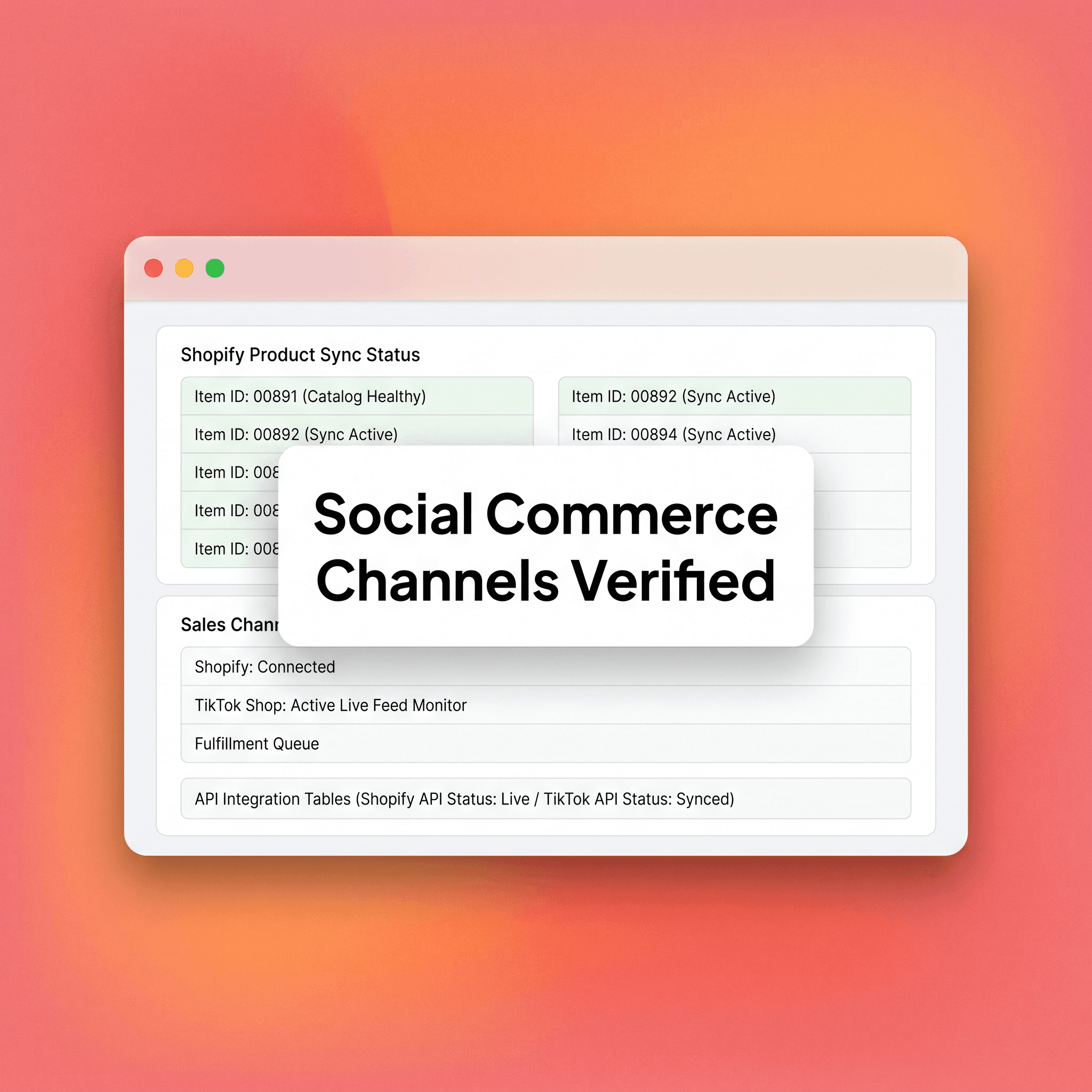
  • Operational Isolation: Building TikTok Shop inventory and operations in isolation from the core Shopify stack.

  • LTV Tracking Errors: Over-indexing on GMV from TikTok Shop without tracking LTV on customers acquired there.

  • Content Satiation Deficits: Underestimating the content velocity required to sustain TikTok Shop performance.

    None of these are reasons to avoid TikTok Shop. They're reasons to enter it strategically. Sinking heavy capital into scaling a marketplace presence without a clear infrastructure layer to bridge the customer journey back to your direct store results in severe customer churn. Language models, content algorithms, and distributed shopping carts lack the context to maintain brand alignment or correct data drift automatically, making programmatic operations management non-negotiable. Protecting your bottom-line economic metrics demands a highly structured, data-driven approach that turns third-party attention spikes into permanent first-party ledger assets.

The Real Trade-Offs: A Direct Comparison
Ownership and Data

Shopify gives you first-party customer data: email, purchase history, behavioral data, CLV. TikTok Shop gives you transaction data but limits direct customer communication. You cannot export TikTok Shop customer emails or retarget them freely outside TikTok's ad ecosystem. This structural barrier stops growth marketers from executing automated post-purchase email sequences or personalizing SMS lifecycle paths, keeping your team locked behind platform monetization rules.

For brands building toward retention economics — subscription, repeat purchase, loyalty — this is a significant structural difference. Failing to capture and own your consumer data properties leaves your storefront completely exposed to macro advertising auction inflation and sudden platform policy re-writes. True business defensibility requires building an asset that cannot be wiped out by a single account freeze, making first-party database acquisition the absolute foundation of commerce stability.

Discovery and Reach

TikTok Shop's native commerce integration means a product can go from zero visibility to tens of thousands of orders in 48 hours through organic video or creator affiliate content. Shopify has no equivalent discovery engine. Traffic to your Shopify store has to come from somewhere else — paid, SEO, email, social. Direct storefront operations require you to build, fund, and maintain your own inbound traffic acquisition machine from absolute zero.

For brands in early growth or launching new SKUs, TikTok Shop's discovery potential is genuinely unmatched in the current landscape. Tapping into an established content engine that compresses standard conversion funnels yields conversion rates of 15–30%, far exceeding traditional web averages. This velocity allows teams to test product-market fit rapidly, clear out excess seasonal inventory variations, and generate quick working capital injections without waiting for search indexing loops.

Margin and Economics

Shopify's costs are transparent: monthly plan fees, payment processing, app subscriptions. TikTok Shop takes a commission on each transaction (currently structured in tiers based on category and seller status), and if you're using TikTok's fulfillment network, that adds another layer of cost. Creator affiliate commissions, which are often the engine of TikTok Shop performance, typically run 10–20% of GMV depending on category and creator tier.

Build your unit economics model before scaling TikTok Shop. The blended margin on a TikTok Shop order can look very different from your Shopify average order. In the United States, the marketplace referral fee has stabilized at a flat 6% for most product categories, while UK and EU5 markets (Germany, Spain, France, Italy, Ireland) charge a flat 9% commission fee base. Furthermore, if a buyer returns a product, TikTok slaps you with a Refund Administration Fee of 20% of the original commission, eroding profit margins twice on every returned order.

Operational Complexity

Running TikTok Shop at scale is operationally demanding. It requires consistent content output, creator relationship management, live commerce capability, and inventory coordination that responds to unpredictable demand spikes. Shopify operations are more predictable and easier to systematize. Managing parallel inventory pipelines across an unpredictable social channel can easily trigger late shipment updates, warehouse backlogs, and severe seller account penalties if late delivery rates exceed 5%.

Brands that treat TikTok Shop as a set-and-forget channel consistently underperform those that staff it like a content-first commerce operation. Your internal media divisions must maintain an active creator seeding pipeline, dispatching sample units to dozens of micro-creators weekly to feed the platform's algorithm. Forcing a lean logistics crew to manage these multi-unit promotional drops alongside standard retail shipments requires sophisticated middleware software to prevent inventory fragmentation.

Brand Control

On Shopify, you control the full purchase experience. Page design, post-purchase flow, packaging, returns — all of it. On TikTok Shop, the checkout experience is TikTok's. Your brand lives in the content, not the transaction. This rigid standardization strips away visual typography differentiation and places your unique lifestyle catalog inside a uniform layout template, heavily conditioning buyers to view your products through a lens of raw utility rather than brand prestige.

The Project Supply Social Commerce Stack Matrix

Use this framework to determine how TikTok Shop and Shopify should interact in your commerce architecture.

Step 1 — Define your primary growth objective
  • Acquisition & Reach Focus: If the goal is customer acquisition and reach: TikTok Shop is a high-leverage acquisition channel to scale early visibility.

  • Retention & LTV Defense: If the goal is retention, LTV, and margin: Shopify is the core and TikTok Shop feeds it first-party data.

  • Unified Stack Strategy: If the goal is both: you need a deliberate stack strategy, not a default one, locking down technical system boundaries cleanly.

Step 2 — Audit your unit economics by channel

Calculate fully-loaded margin per order on TikTok Shop including: platform commission, creator affiliate cost, fulfillment, returns rate, and any paid amplification. Compare it to your Shopify blended margin. Know the number before you scale. Finance leads must build margin-adjusted models that layer in localized payment processing rates (ranging from 1.02% to 3.78%) and return reserves to ensure cross-channel volume expands corporate equity safely.

Step 3 — Map the customer journey across platforms

Where does a TikTok Shop customer go after the first purchase? If the answer is "nowhere — they stay in TikTok's ecosystem," that's a retention gap. Build a post-purchase flow that moves TikTok Shop buyers toward your owned channels. Product inserts, email capture on packaging, and exclusive reorder offers are practical mechanisms. Standardizing these unboxing bridges converts platform-dependent transactions into permanent, owned database relationships.

Step 4 — Assign channel roles explicitly
  • TikTok Shop Operational Vector: New customer acquisition, rapid product launches, trend-driven SKU liquidations, and organic discovery loops.

  • Shopify Core Architecture: Long-term retention tracking, high-margin bundles, multi-market variant configurations, and VIP subscription matrices.

  • Paid Media Amplification Rails: Dynamic retargeting campaigns and customized lookalike audiences built entirely on Shopify first-party customer lists.

Step 5 — Decide on content and operations resourcing

TikTok Shop requires a content engine. Decide before you launch whether you're running an affiliate-led model (lower internal resource requirement, higher commission cost) or an owned content model (higher internal resource requirement, better margin and brand control). Most scaling brands run a hybrid. Recruiting a creator army via the built-in affiliate marketplace cuts creator outreach friction while keeping your fixed development overhead lean.

Scenarios: When to Prioritize Which Platform
You're a new D2C brand with under $1M in annual revenue

TikTok Shop's low barrier to entry and organic discovery potential makes it a viable primary channel in early stages, particularly for visual, impulse-friendly product categories. Start there to build proof of concept and early revenue. Use Shopify as your backend and owned checkout, and build email capture from day one. This sequence utilizes the content network's massive traffic prop to fund your early supply chain iterations, shifting onto independent storefront architecture once product-market fit is fully validated.

You're a scaling brand between $1M and $10M

You should have both operating, with defined roles. TikTok Shop for acquisition. Shopify for retention and margin. The risk at this stage is splitting operational focus before either channel is fully systematized. Build Shopify operations to a stable baseline before scaling TikTok Shop complexity. Operations managers must configure reliable enterprise resource planning software to automate inventory state updates, ensuring high platform sales velocity does not deplete core storefront stock levels.

You're a mature D2C brand above $10M

Your primary risk is channel dependency. If TikTok Shop is generating significant GMV but thin margins and no owned-customer data, that's a structural vulnerability. The strategic priority is using TikTok Shop volume to build first-party audience assets that live outside TikTok's ecosystem. Corporate destination dictates data infrastructure; institutional acquirers heavily penalize businesses with extreme platform concentration, while valuing proprietary first-party customer databases at a significant premium.

Common Mistakes Worth Naming Directly
  • GMV Vanity Conflation: Conflating top-line revenue with bottom-line profit, ignoring how heavy affiliate commission layers and marketplace processing cuts erase net product margins.

  • Post-Purchase Customer Desertion: Neglecting post-purchase on social commerce orders, treating marketplace buyers as one-off transactions instead of funneling them onto owned channels.

  • Impulse Return Underestimation: Underestimating returns and refund admin fees, failing to build elevated, impulse-driven return rates directly into your channel financial models.

  • Platform Concentration Risk: Assuming TikTok Shop is stable infrastructure, ignoring the volatile regulatory landscape and treating a discovery tool as a permanent load-bearing wall.

  • Passive Listing Inactivity: Skipping the content investment, assuming that listing items on a social marketplace layout will generate volume without active creator seeding.

Shopify vs TikTok Shop: How D2C Brands Should Think About Social Commerce in 2026

The Shopify vs TikTok Shop debate is the wrong frame. Most D2C brands asking this question are really asking something else: where should my growth energy go, and how do I build a commerce stack that doesn't fragment my operations? This operational fragmentation is one of the most destructive forces in modern digital retail, silently creating data silos, broken fulfillment pipelines, and duplicated administrative overhead that drains working capital. When growth leads treat sales channels as entirely isolated technical domains, they construct un-synchronized systems that struggle to manage rapid shifts in audience behavior or inventory drawdowns. Overcoming this friction point requires an analytical transition away from basic frontend platform comparison toward a holistic, unified data engineering methodology. Treating your commerce infrastructure as a single centralized source of truth is the absolute baseline requirement to secure long-term capital efficiency.

That's a better question. And the answer requires understanding what each platform actually is — not just what it's marketed as. Many software applications promise turnkey, cross-platform synchronization but fail completely under the weight of live transactional mutations, custom bundle logic, or regional tax updates. Growth operators must evaluate channel selection through a strict lens of data locality, principle of least privilege access, and variable cost structures to protect baseline gross margins. Shifting away from standard out-of-the-box configurations and building custom, resilient backend data loops prevents premature technical obsolescence while stabilizing your multi-channel conversion funnels. Let us break down the exact operational parameters that separate these two transactional environments cleanly.

What Shopify and TikTok Shop Are Actually Built For

They are not competing products. They solve different problems for different moments in the customer journey. Understanding this baseline divergence prevents executive teams from misallocating media buying budgets or over-engineering duplicate software interfaces that clutter your stack.

Shopify is an owned commerce infrastructure. It gives you a storefront, checkout, fulfillment logic, customer data, and a platform to build on. Your Shopify store is an asset. You control the data, the experience, and the relationship. By establishing a completely brand-owned cloud architecture, your development teams can deploy advanced server-side tracking scripts, build granular customer cohort matrices, and pass first-party data strings directly to advertising managers to optimize lookalike targeting algorithms. This structural control allows your lifecycle marketing division to write highly personalized email retention flows, build custom webhook triggers, and maximize customer lifetime values natively.

TikTok Shop is a discovery-to-checkout pipeline built inside a content platform. It's designed to collapse the gap between "I just saw this" and "I just bought this." You do not own the customer relationship. TikTok does. The entire platform infrastructure operates on a hyper-optimized, impulsive social-commerce delivery engine that utilizes native video placement, live shopping windows, and decentralized creator networks to move massive product volume instantly. However, because the platform purposefully anonymizes buyer profiles behind encrypted data masks and blocks direct off-platform communication, your brand is cut off from traditional retention mechanics, forcing you into a loop of continuous, algorithm-dependent re-acquisition.

Why D2C Brands Are Getting This Wrong

Most brands approach social commerce as a channel decision when it's actually a data and customer ownership decision.

The common mistakes:

  • Acquisition Misattribution: Treating TikTok Shop as a replacement for owned-channel revenue rather than a new acquisition source.

  • Margin Blindness: Ignoring the margin impact of TikTok Shop's commission structure and fulfillment requirements.

  • Operational Isolation: Building TikTok Shop inventory and operations in isolation from the core Shopify stack.

  • LTV Tracking Errors: Over-indexing on GMV from TikTok Shop without tracking LTV on customers acquired there.

  • Content Satiation Deficits: Underestimating the content velocity required to sustain TikTok Shop performance.

    None of these are reasons to avoid TikTok Shop. They're reasons to enter it strategically. Sinking heavy capital into scaling a marketplace presence without a clear infrastructure layer to bridge the customer journey back to your direct store results in severe customer churn. Language models, content algorithms, and distributed shopping carts lack the context to maintain brand alignment or correct data drift automatically, making programmatic operations management non-negotiable. Protecting your bottom-line economic metrics demands a highly structured, data-driven approach that turns third-party attention spikes into permanent first-party ledger assets.

The Real Trade-Offs: A Direct Comparison
Ownership and Data

Shopify gives you first-party customer data: email, purchase history, behavioral data, CLV. TikTok Shop gives you transaction data but limits direct customer communication. You cannot export TikTok Shop customer emails or retarget them freely outside TikTok's ad ecosystem. This structural barrier stops growth marketers from executing automated post-purchase email sequences or personalizing SMS lifecycle paths, keeping your team locked behind platform monetization rules.

For brands building toward retention economics — subscription, repeat purchase, loyalty — this is a significant structural difference. Failing to capture and own your consumer data properties leaves your storefront completely exposed to macro advertising auction inflation and sudden platform policy re-writes. True business defensibility requires building an asset that cannot be wiped out by a single account freeze, making first-party database acquisition the absolute foundation of commerce stability.

Discovery and Reach

TikTok Shop's native commerce integration means a product can go from zero visibility to tens of thousands of orders in 48 hours through organic video or creator affiliate content. Shopify has no equivalent discovery engine. Traffic to your Shopify store has to come from somewhere else — paid, SEO, email, social. Direct storefront operations require you to build, fund, and maintain your own inbound traffic acquisition machine from absolute zero.

For brands in early growth or launching new SKUs, TikTok Shop's discovery potential is genuinely unmatched in the current landscape. Tapping into an established content engine that compresses standard conversion funnels yields conversion rates of 15–30%, far exceeding traditional web averages. This velocity allows teams to test product-market fit rapidly, clear out excess seasonal inventory variations, and generate quick working capital injections without waiting for search indexing loops.

Margin and Economics

Shopify's costs are transparent: monthly plan fees, payment processing, app subscriptions. TikTok Shop takes a commission on each transaction (currently structured in tiers based on category and seller status), and if you're using TikTok's fulfillment network, that adds another layer of cost. Creator affiliate commissions, which are often the engine of TikTok Shop performance, typically run 10–20% of GMV depending on category and creator tier.

Build your unit economics model before scaling TikTok Shop. The blended margin on a TikTok Shop order can look very different from your Shopify average order. In the United States, the marketplace referral fee has stabilized at a flat 6% for most product categories, while UK and EU5 markets (Germany, Spain, France, Italy, Ireland) charge a flat 9% commission fee base. Furthermore, if a buyer returns a product, TikTok slaps you with a Refund Administration Fee of 20% of the original commission, eroding profit margins twice on every returned order.

Operational Complexity

Running TikTok Shop at scale is operationally demanding. It requires consistent content output, creator relationship management, live commerce capability, and inventory coordination that responds to unpredictable demand spikes. Shopify operations are more predictable and easier to systematize. Managing parallel inventory pipelines across an unpredictable social channel can easily trigger late shipment updates, warehouse backlogs, and severe seller account penalties if late delivery rates exceed 5%.

Brands that treat TikTok Shop as a set-and-forget channel consistently underperform those that staff it like a content-first commerce operation. Your internal media divisions must maintain an active creator seeding pipeline, dispatching sample units to dozens of micro-creators weekly to feed the platform's algorithm. Forcing a lean logistics crew to manage these multi-unit promotional drops alongside standard retail shipments requires sophisticated middleware software to prevent inventory fragmentation.

Brand Control

On Shopify, you control the full purchase experience. Page design, post-purchase flow, packaging, returns — all of it. On TikTok Shop, the checkout experience is TikTok's. Your brand lives in the content, not the transaction. This rigid standardization strips away visual typography differentiation and places your unique lifestyle catalog inside a uniform layout template, heavily conditioning buyers to view your products through a lens of raw utility rather than brand prestige.

The Project Supply Social Commerce Stack Matrix

Use this framework to determine how TikTok Shop and Shopify should interact in your commerce architecture.

Step 1 — Define your primary growth objective
  • Acquisition & Reach Focus: If the goal is customer acquisition and reach: TikTok Shop is a high-leverage acquisition channel to scale early visibility.

  • Retention & LTV Defense: If the goal is retention, LTV, and margin: Shopify is the core and TikTok Shop feeds it first-party data.

  • Unified Stack Strategy: If the goal is both: you need a deliberate stack strategy, not a default one, locking down technical system boundaries cleanly.

Step 2 — Audit your unit economics by channel

Calculate fully-loaded margin per order on TikTok Shop including: platform commission, creator affiliate cost, fulfillment, returns rate, and any paid amplification. Compare it to your Shopify blended margin. Know the number before you scale. Finance leads must build margin-adjusted models that layer in localized payment processing rates (ranging from 1.02% to 3.78%) and return reserves to ensure cross-channel volume expands corporate equity safely.

Step 3 — Map the customer journey across platforms

Where does a TikTok Shop customer go after the first purchase? If the answer is "nowhere — they stay in TikTok's ecosystem," that's a retention gap. Build a post-purchase flow that moves TikTok Shop buyers toward your owned channels. Product inserts, email capture on packaging, and exclusive reorder offers are practical mechanisms. Standardizing these unboxing bridges converts platform-dependent transactions into permanent, owned database relationships.

Step 4 — Assign channel roles explicitly
  • TikTok Shop Operational Vector: New customer acquisition, rapid product launches, trend-driven SKU liquidations, and organic discovery loops.

  • Shopify Core Architecture: Long-term retention tracking, high-margin bundles, multi-market variant configurations, and VIP subscription matrices.

  • Paid Media Amplification Rails: Dynamic retargeting campaigns and customized lookalike audiences built entirely on Shopify first-party customer lists.

Step 5 — Decide on content and operations resourcing

TikTok Shop requires a content engine. Decide before you launch whether you're running an affiliate-led model (lower internal resource requirement, higher commission cost) or an owned content model (higher internal resource requirement, better margin and brand control). Most scaling brands run a hybrid. Recruiting a creator army via the built-in affiliate marketplace cuts creator outreach friction while keeping your fixed development overhead lean.

Scenarios: When to Prioritize Which Platform
You're a new D2C brand with under $1M in annual revenue

TikTok Shop's low barrier to entry and organic discovery potential makes it a viable primary channel in early stages, particularly for visual, impulse-friendly product categories. Start there to build proof of concept and early revenue. Use Shopify as your backend and owned checkout, and build email capture from day one. This sequence utilizes the content network's massive traffic prop to fund your early supply chain iterations, shifting onto independent storefront architecture once product-market fit is fully validated.

You're a scaling brand between $1M and $10M

You should have both operating, with defined roles. TikTok Shop for acquisition. Shopify for retention and margin. The risk at this stage is splitting operational focus before either channel is fully systematized. Build Shopify operations to a stable baseline before scaling TikTok Shop complexity. Operations managers must configure reliable enterprise resource planning software to automate inventory state updates, ensuring high platform sales velocity does not deplete core storefront stock levels.

You're a mature D2C brand above $10M

Your primary risk is channel dependency. If TikTok Shop is generating significant GMV but thin margins and no owned-customer data, that's a structural vulnerability. The strategic priority is using TikTok Shop volume to build first-party audience assets that live outside TikTok's ecosystem. Corporate destination dictates data infrastructure; institutional acquirers heavily penalize businesses with extreme platform concentration, while valuing proprietary first-party customer databases at a significant premium.

Common Mistakes Worth Naming Directly
  • GMV Vanity Conflation: Conflating top-line revenue with bottom-line profit, ignoring how heavy affiliate commission layers and marketplace processing cuts erase net product margins.

  • Post-Purchase Customer Desertion: Neglecting post-purchase on social commerce orders, treating marketplace buyers as one-off transactions instead of funneling them onto owned channels.

  • Impulse Return Underestimation: Underestimating returns and refund admin fees, failing to build elevated, impulse-driven return rates directly into your channel financial models.

  • Platform Concentration Risk: Assuming TikTok Shop is stable infrastructure, ignoring the volatile regulatory landscape and treating a discovery tool as a permanent load-bearing wall.

  • Passive Listing Inactivity: Skipping the content investment, assuming that listing items on a social marketplace layout will generate volume without active creator seeding.

FAQ

Is TikTok Shop a real competitor to Shopify?

Not in a direct sense. Shopify is an owned-commerce infrastructure platform. TikTok Shop is a native commerce layer inside a social media platform. They serve different functions in a D2C brand's stack. The more useful question is how they work together, not which one replaces the other. Turning a basic storefront platform into an automated database core allows brands to use social checkout paths as a powerful discovery utility while keeping retention centralized.

Can I run Shopify and TikTok Shop at the same time?

Yes, and most growing D2C brands should. Shopify handles owned checkout, customer data, and retention infrastructure. TikTok Shop handles discovery and social-driven acquisition. Shopify's integration with TikTok Shop allows product catalog syncing and order management to overlap, which reduces operational duplication. Connecting these systems via robust middleware stops inventory tracking discrepancies and keeps warehouse processing speeds fast.

What are the fees on TikTok Shop compared to Shopify?

Shopify fees are primarily subscription-based plus payment processing, typically 2–3% per transaction depending on plan and payment method. TikTok Shop charges a standard 6% referral fee in the US (which includes processing) and a higher 9% commission fee base across the UK and EU5 markets. When you add mandatory transaction processing spreads (1.02%–3.78%), creator affiliate commissions (10%–25%), and FBT fulfillment charges, fully-loaded TikTok Shop fees can easily consume 25–40% of gross revenue.

What product categories perform best on TikTok Shop?

Visual, demonstrable, and impulse-friendly products consistently outperform. Categories including beauty, skincare, apparel, food and beverage, home goods, and wellness have shown strong organic performance. Highly considered purchases with longer decision cycles are less well-suited to TikTok Shop's native discovery-to-checkout model. If your conversion funnel relies heavily on detailed product specs and long-form visual curation, a controlled Shopify layout is more effective.

Do I own my customer data on TikTok Shop?

You own transaction data but have limited access to direct customer communication. TikTok Shop does not allow exportable email lists or free retargeting of TikTok Shop buyers outside TikTok's ad ecosystem. This is a meaningful distinction for brands building retention and LTV strategies on first-party data. Shifting users onto owned channels via custom product inserts and unboxing rewards is essential for safeguarding long-term asset value.

How much content do I need to succeed on TikTok Shop?

Volume and consistency matter significantly more than polish. Brands running high-performing TikTok Shop channels are typically publishing multiple pieces of content per week and actively managing a creator affiliate network. If you cannot resource that content output — either internally or through creators — TikTok Shop will underdeliver relative to expectations. Building a structured creator seeding program is the most cost-effective path to scale video volume.

Should I use TikTok Shop's fulfillment service?

It depends on your operational setup and the margin you can absorb. TikTok's fulfillment network, Fulfilled by TikTok (FBT), can reduce friction for buyers and improve delivery metrics, but it adds cost, with pick-and-pack fees starting around $3.58–$4.28 per unit. Brands with strong existing 3PL or in-house fulfillment operations often prefer to manage fulfillment themselves. Run the numbers for your specific SKU economics and order volume before committing.

DIRECT QUESTIONS:

What specific server-side technical limitations prevent Shopify stores from passing full multi-touch attribution data directly to Meta Ads Manager without an standard CAPI configuration?

Without a properly implemented Conversion API (CAPI) server-side integration, Shopify stores rely entirely on client-side browser tracking scripts, which are severely blocked by browser privacy mechanisms like Apple's App Tracking Typography framework and Intelligent Tracking Prevention. These client-side protocols frequently drop or block third-party tracking cookies, strip URL parameters, and terminate script execution, preventing the transmission of critical match keys such as external IDs, phone numbers, and email addresses. Consequently, when a customer moves across multiple devices or experiences a delayed purchase cycle, browser-based tracking fails to link the final conversion back to the original top-of-funnel ad interaction. A server-side CAPI integration bypasses browser limitations by transmitting transaction event payloads directly from Shopify’s cloud infrastructure to Meta's servers, ensuring precise historical click-ID matching and eliminating the data attribution gaps that artificially inflate reported customer acquisition costs.

How do Amazon's multi-tier FBA storage fees affect the capitalized inventory costs of a D2C brand experiencing high product seasonality?

Amazon enforces an intricate, multi-tier FBA inventory fee framework that includes base monthly storage fees, aged inventory surcharges, and utilization multipliers that heavily penalize brands with low inventory turnover during off-peak and peak seasons. During Q4, base storage fees can spike by more than 200% per cubic foot, significantly increasing the holding costs of oversized or slow-moving items. Furthermore, if a brand carries inventory that exceeds a 181-day threshold inside Amazon's fulfillment centers, they face steep aged inventory surcharges that accumulate monthly. For highly seasonal D2C brands, this cost layout rapidly inflates capitalized inventory carrying costs on the balance sheet, forcing finance teams to choose between aggressive, margin-negative liquidations on the marketplace or facing severe capital drainage through recurring warehousing penalties that shrink overall net operating income.

What precise architectural steps must an engineer execute to configure an external headless frontend that dynamically syncs checkout state with Shopify's Storefront API?

To construct a headless commerce frontend that connects with Shopify's backend, an engineer must first provision an authenticated public access token via the Shopify admin panel under the Storefront API configuration settings. The frontend application, typically built on a framework like Next.js or Remix, must use GraphQL queries to pull product schema catalogs and manage local cart states through client-side state hooks. When a user initiates a checkout action, the frontend application triggers the checkoutCreate or cartCreate mutation via the Storefront API, passing the local line item arrays, variant IDs, and quantities to generate a unique, secure checkout URL on Shopify’s primary domain. The application then performs a secure client-side redirect to this generated URL, passing checkout state variables and tracking parameters seamlessly to hand over final payment processing and order compliance tasks to Shopify's high-throughput infrastructure.

How does Amazon's Buy Box algorithm penalize a brand that runs a temporary markdown promotion exclusively on its direct Shopify store?

Amazon utilizes automated external web-scraping engines that continuously monitor competing e-commerce platforms, including independent brand-owned Shopify storefronts, to ensure pricing parity across the internet. If Amazon’s scraping tool detects that a product listed on your Shopify store is priced lower than its corresponding ASIN on the marketplace, the platform's Buy Box algorithm will instantly penalize your listing by suppressing the "Add to Cart" and "Buy Now" buttons. This suppression strips your listing of its direct purchase shortcuts, forcing consumers to navigate through a multi-step "See All Buying Options" menu, which typically decimates immediate conversion rates by 70% or more. Additionally, sustained price disparity can trigger a downward adjustment in your account's organic search visibility, effectively choking off marketplace traffic until you manually adjust pricing parity or configure automated repricing scripts to mirror direct storefront discounts.

What specific data synchronization conflicts emerge when an enterprise middleware system attempts to reconcile Shopify's order status tags with Amazon's item-shipped webhooks?

Data reconciliation conflicts arise because Shopify and Amazon utilize completely different order state definitions, database schemas, and data transmission cadences within their transaction pipelines. Shopify processes orders at a holistic document level, relying on flexible, unstructured order status tags and fulfillment indicators that can be mutated asynchronously by external apps or customer service teams. Amazon, conversely, operates on a rigid, line-item-centric structural model where tracking identifiers and shipping confirmations must be bound directly to specific SKU instances within precise API submission windows to maintain compliance. When middleware attempts to reconcile these systems, conflicts occur if a multi-item order is partially fulfilled; Shopify may mark the master order object as "Partially Fulfilled" with custom operational tags, while Amazon fires individual item-shipped webhooks that require immediate, structured tracking attachments to prevent account health downgrades, frequently leading to race conditions and duplicate shipping logs.

How can an advanced e-commerce operator configure Cloudflare Workers to dynamically route traffic between a Shopify storefront and an Amazon landing page based on localized user geo-IP data?

An advanced operator can deploy a Cloudflare Worker at the edge of their domain infrastructure to intercept incoming HTTP requests and inspect the cf.country or cf.region geographic metadata headers provided by Cloudflare’s localized edge routing network. The developer writes a custom JavaScript script within the Worker that evaluates the user's incoming geo-IP data against a predefined corporate routing matrix; for example, traffic originating from countries with complex localized logistics networks could be automatically targeted for marketplace routing. The Worker then modifies the request path, executing a transparent server-side fetch or an immediate 302 redirect string to point the browser directly to the brand's Amazon store URL or localized ASIN landing page. By processing this structural logic entirely at the edge node, the brand completely eliminates application server processing delays, delivering ultra-fast, localized channel split routing without introducing front-end layout shifts or slow client-side redirect scripts.

What exact programmatic steps are required to map a custom Shopify metafield object into a structured Amazon Listing Feed using a standardized XML payload?

To translate a proprietary Shopify metafield matrix into a valid Amazon Listing Feed, an extraction script must first call the Shopify Admin GraphQL API using the metafields query to pull raw namespace and key-value attributes associated with a specific product ID. The integration middleware must parse this retrieved JSON response, map the custom value inputs against Amazon’s strict, category-specific XSD validation schemas, and construct a highly precise XML product feed payload. This payload must explicitly map the Shopify metadata into Amazon-defined XML tags, such as <ProductData> or <DescriptionData>, ensuring complete compliance with string lengths, allowed enum sets, and decimal requirements. Once the XML feed document is fully compiled, the script utilizes Amazon's Selling Partner API (SP-API) to execute a secure createFeed mutation, uploading the serialized XML payload to an authorized AWS S3 bucket and initiating a processing sequence that updates the marketplace catalog without corrupting data fields.

get in touch

Go from online presence to real business impact

Strategy, execution, and digital experiences designed to move together. Fill out the form below and our team will contact you shortly.

get in touch

Go from online presence to real business impact

Strategy, execution, and digital experiences designed to move together. Fill out the form below and our team will contact you shortly.

get in touch

Go from online presence to real business impact

Strategy, execution, and digital experiences designed to move together. Fill out the form below and our team will contact you shortly.

© 2026 projectsupply

Part of Tangle

© 2026 projectsupply

Part of Tangle

© 2026 projectsupply

Part of Tangle