Shopify
08 min read
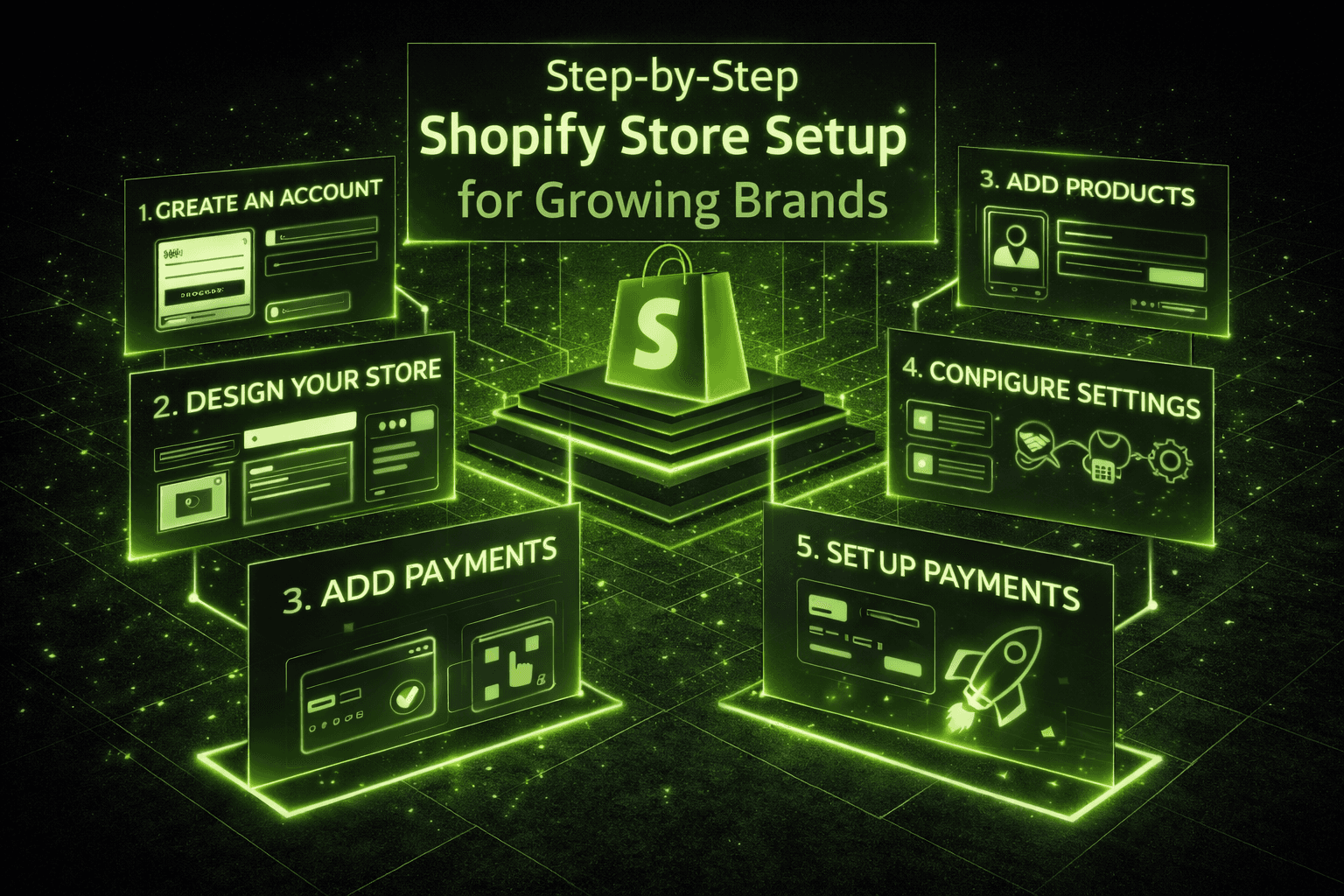
Step-by-Step Shopify Store Setup Guide for Growing Brands
Strategic Context: Why Shopify Store Setup Is a Revenue Decision
Most Shopify store launches fail not because of poor products, but because the technical and operational foundation is wrong from the start.
A Shopify store is not just a storefront. It is an operational system that connects:
storefront UX
product data architecture
checkout flows
payment infrastructure
shipping logic
analytics
marketing automation
retention systems
When these elements are poorly structured, brands face problems such as:
slow site performance
high customer acquisition cost
poor conversion rates
operational inefficiencies
expensive redesigns within 12–18 months
A well-structured Shopify setup prevents those issues and creates a scalable commerce infrastructure.
This guide focuses on the strategic setup process Shopify operators should follow before launching.
Step 1: Define Commerce Architecture Before Building
Before installing themes or apps, the most important decision is commerce architecture planning.
This determines how the store will operate across marketing, operations, and fulfillment.
Key architectural decisions include:
Decision Area | Strategic Questions |
|---|---|
Product catalog structure | How many SKUs and variants will exist? |
Market regions | Domestic or international sales? |
Fulfillment model | 3PL, warehouse, or dropshipping? |
Payment stack | Local payments, BNPL, subscriptions? |
Customer data | How will customer profiles be tracked? |
Marketing stack | Email, SMS, retargeting tools? |
Skipping this planning phase often results in app stack bloat and data fragmentation later.
Step 2: Create the Shopify Store Environment
Next, the brand creates its store account on Shopify.
At this stage, configure the foundational settings.
Core setup tasks include:
store name and business information
store currency
tax configuration
shipping regions
checkout settings
staff permissions
For international brands, also configure:
multi-currency selling
local payment methods
regional tax compliance
These settings form the operational backbone of the store.
Step 3: Structure the Product Catalog Correctly
Product data architecture directly impacts:
site navigation
search experience
merchandising
SEO performance
A strong catalog structure includes:
Products
Each product should include:
optimized product titles
structured descriptions
variant configuration
pricing logic
inventory tracking
Collections
Collections act as merchandising categories and navigation drivers.
Example structure:
Collection | Purpose |
|---|---|
Best Sellers | Conversion-focused landing |
New Arrivals | Merchandising freshness |
Category Collections | Product discovery |
Seasonal Collections | Campaign landing pages |
Proper collection strategy improves both UX and organic search visibility.
Step 4: Choose the Right Theme Architecture
Shopify stores typically operate on theme-based storefront architecture.
Themes control:
layout
product pages
homepage structure
navigation
merchandising modules
Modern Shopify themes support section-based editing, allowing marketers to modify layouts without developer intervention.
Important theme evaluation criteria include:
Factor | Why It Matters |
|---|---|
Page speed | Directly affects conversion |
Section flexibility | Enables rapid marketing updates |
Mobile optimization | Majority of traffic is mobile |
App compatibility | Prevents integration conflicts |
Checkout UX | Reduces cart abandonment |
For most brands, theme-based architecture is sufficient until traffic scale or personalization needs justify headless commerce.
Step 5: Implement Core Shopify Pages
Every Shopify store needs foundational pages before launch.
These include:
homepage
product pages
collection pages
about page
contact page
policy pages
FAQ pages
Product pages should prioritize:
product imagery
benefit-driven descriptions
social proof
delivery expectations
return policy clarity
These elements reduce purchase hesitation and refund risk.
Step 6: Configure Payments and Checkout Infrastructure
Checkout infrastructure directly influences conversion rates and revenue capture.
Key setup components include:
Component | Strategy |
|---|---|
Payment gateway | Support local and global payment methods |
Express checkout | Enable Apple Pay / Google Pay |
Fraud protection | Reduce chargebacks |
Checkout fields | Minimize friction |
Many stores use Shopify Payments because it simplifies integration and reduces transaction fees.
However, regional payment providers may still be necessary depending on the market.
Step 7: Design Shipping and Fulfillment Logic
Shipping strategy impacts both:
operational efficiency
customer conversion behavior
Typical shipping configurations include:
Strategy | Best For |
|---|---|
Free shipping threshold | Increasing AOV |
Flat-rate shipping | Simplifying pricing |
Real-time carrier rates | Accurate logistics pricing |
Zone-based pricing | International selling |
Clear delivery timelines significantly reduce support tickets and cart abandonment.
Step 8: Build a Lean App Stack
Shopify’s ecosystem offers thousands of apps, but excessive app usage creates problems:
slower page speed
higher operational costs
integration conflicts
A disciplined app stack focuses only on essential functionality.
Common categories include:
Category | Purpose |
|---|---|
Email marketing | Customer retention |
Reviews | Social proof |
Analytics | Performance tracking |
Upsells | AOV growth |
Customer support | Post-purchase experience |
A healthy Shopify store typically operates with 5–12 core apps, not dozens.
Step 9: Configure Analytics and Data Tracking
Data infrastructure must be implemented before marketing campaigns begin.
Key analytics integrations include:
Google Analytics
Meta Pixel
conversion tracking
server-side tracking
email platform analytics
Without reliable data infrastructure, brands cannot accurately measure:
marketing efficiency
acquisition cost
campaign profitability
Data accuracy becomes critical once ad spending increases.
Step 10: Optimize Store Performance Before Launch
Performance optimization directly impacts both SEO and conversion rates.
Key technical checks include:
Optimization Area | Impact |
|---|---|
image compression | Faster loading |
script management | Reduced render blocking |
app performance | Lower page weight |
mobile optimization | Improved mobile conversion |
Even a 1-second delay in page load can reduce conversions significantly.
Performance optimization should happen before marketing traffic begins.
Step 11: Launch With CRO Foundations
Many brands treat CRO as a later step. High-performing stores launch with conversion principles built in.
Important CRO elements include:
strong homepage value proposition
product page benefit hierarchy
clear shipping messaging
customer reviews
urgency triggers
optimized cart flow
These factors determine how effectively the store converts paid traffic.
Bottom Line: What Metrics Should Drive Your Shopify Decision?
A Shopify setup should always be evaluated using performance metrics.
Key metrics include:
Conversion Rate
Healthy Shopify stores typically aim for 2–4% conversion rates, depending on product category.
Average Order Value (AOV)
Shipping thresholds and upsell modules can significantly increase AOV.
Customer Acquisition Cost (CAC)
Poor site UX increases CAC because paid traffic converts less efficiently.
Return on Ad Spend (ROAS) / MER
Better conversion infrastructure improves ad performance.
Contribution Margin
App costs, payment fees, and logistics expenses influence profitability.
Customer Lifetime Value (LTV)
Retention systems like email marketing increase repeat purchases.
Refund Rate
Clear product communication reduces refunds and returns.
Operational Cost Per Order
Automation and integrations lower fulfillment costs.
App Stack Cost
Many stores spend $200–$1,000 monthly on apps unnecessarily.
Development Cost vs Payback Period
Store setup investments should typically pay for themselves within 6–12 months through improved conversions and operational efficiency.
Forward View (2026 and Beyond)
Shopify’s ecosystem is evolving rapidly as commerce infrastructure becomes more automated.
Several developments will influence how stores are built.
Shopify AI integrations
AI-powered tools are increasingly handling:
product description generation
merchandising recommendations
customer segmentation
marketing automation
These capabilities will reduce manual operations.
Commerce automation
Future Shopify stores will automate:
inventory synchronization
customer segmentation
post-purchase communication
personalized offers
Automation reduces operational cost per order.
App consolidation
Shopify is gradually replacing third-party app functions with native capabilities.
Brands relying heavily on third-party apps may face rising costs and complexity.
First-party data strategy
Privacy regulations are shifting marketing toward first-party data ownership.
Shopify’s customer data layer will become central to retention marketing.
Retail + DTC convergence
Shopify POS continues expanding, allowing brands to unify:
online commerce
retail stores
inventory systems
customer profiles
Brands that integrate both channels will have stronger customer data and operational control.
FAQs
Should a new brand use a free or premium Shopify theme?
Free themes are sufficient for early-stage brands. Premium themes become valuable when brands require advanced merchandising layouts or higher design flexibility.
How many apps should a Shopify store use?
Most well-optimized Shopify stores operate with 5–12 core apps. Excessive apps increase cost and reduce site performance.
Is Shopify suitable for large product catalogs?
Yes. Shopify can support large catalogs, but product data architecture and collection organization must be planned carefully to maintain navigation clarity.
When should a brand consider Shopify Plus?
Brands typically move to Shopify Plus when they reach $2M–$5M annual revenue and require advanced automation, checkout customization, and higher operational scalability.
Can a Shopify store scale without rebuilding the site later?
Yes. If the store architecture, theme structure, and integrations are implemented strategically from the start, Shopify can scale from early-stage brands to multi-million-dollar operations without major platform changes.
Direct Q&A
What are the steps to set up a Shopify store?
The core steps include defining commerce architecture, creating the Shopify account, structuring products and collections, selecting a theme, configuring payments and shipping, installing essential apps, implementing analytics, and optimizing for performance before launch.
How long does it take to set up a Shopify store?
A basic Shopify store can be launched within a few days, but a strategically structured store with optimized product pages, analytics, and integrations typically takes 2–6 weeks.
Do I need apps to launch a Shopify store?
Most Shopify stores use a small number of essential apps for reviews, email marketing, analytics, and upsells. However, excessive apps should be avoided because they slow the site and increase operational costs.
What is the most important part of Shopify store setup?
Product page structure, checkout optimization, and site performance have the largest impact on conversion rate and revenue.
Can Shopify handle international selling from launch?
Yes. Shopify supports multi-currency, regional shipping zones, and localized payment methods, allowing brands to sell internationally from the beginning.
insights