
Business Process Automation
AI Marketing Automation for D2C Brands in 2026
AI Marketing Automation for D2C Brands in 2026
08 min read
AI Marketing Automation Is Either Your Fix or Your Next Expensive Mistake.
Here's the situation most D2C founders are sitting in right now: Meta costs have climbed every quarter. Google Shopping is more competitive. Email open rates are acceptable but click-to-purchase is flat. And the marketing team, however talented — is spending 60% of its week on tasks that shouldn't require a human.
The standard answer in 2026 is "use AI." But most brands that have tried it are not seeing the returns they expected. Not because AI marketing automation doesn't work — it does, in specific applications but because they implemented it backwards. They bought tools before defining the problem. They automated workflows that were already broken. They measured activity instead of revenue.
This blog is a practical breakdown of what's actually working for D2C and ecommerce brands right now: where to put AI first, what it costs, how long it takes to pay back, and the mistakes that are quietly burning budget across the industry.
The Real Problem Isn't Your Tools. It's Your Acquisition Dependency.
Most D2C brands are structurally over-indexed on paid acquisition. And in 2026, it has risen significantly across Meta, Google, and TikTok for most categories, the margin math breaks unless LTV climbs with it or acquisition cost comes down through efficiency gains.
AI marketing automation addresses both levers, but not equally. It is significantly more effective at improving retention, reactivation, and lifetime value than it is at reducing top-of-funnel acquisition cost. If your primary brief is "make our Meta ads cheaper," AI is not the lever. If your brief is "make every customer we acquire worth more over time," AI is exactly the right investment.
This distinction matters before you spend anything. Brands that deployed AI automation expecting it to rescue their acquisition economics have been disappointed. Brands that deployed it to deepen post-purchase engagement, increase repeat purchase rate, and reduce churn have seen measurable returns within a single quarter.
The D2C brands seeing the fastest payback from AI automation in 2026 are those with a repeat purchase rate problem — not a traffic problem. If your first-order economics are broken, fix them before automating anything.
Where the LTV math actually changes
A customer who buys once and never returns is worth their first-order margin. A customer who buys three times is often worth four to six times that, once you account for referral behaviour and reduced re-acquisition cost. The gap between those two outcomes is almost entirely determined by what happens in the 7 to 30 days after the first purchase.
AI-driven post-purchase flows — personalised replenishment reminders, cross-sell sequences based on actual purchase behaviour rather than product category, winback campaigns triggered by inactivity signals are the highest-ROI automation deployment for most D2C brands. Not because the technology is impressive, but because the window they're addressing is where most brands have historically done the least.
ProjectSupply Benchmark — Across D2C brand engagements we've run at ProjectSupply, brands that deployed a properly structured behavioural post-purchase flow saw a median 26% improvement in 90-day repeat purchase rate compared to their pre-automation baseline over the same 90-day window. The top quartile hit 38%+. The common thread wasn't the tool they used. It was deploying against a clean data baseline and reviewing flow performance at the 30-day mark rather than setting it live and moving on.
Five AI Automation Plays That Are Actually Working for Ecommerce Right Now
1. Behavioural email and SMS — beyond the abandoned cart
Every D2C brand has an abandoned cart sequence. Almost none of them have a properly built post-browse sequence, a category affinity sequence, or a replenishment trigger based on actual average order cycle rather than a generic 30-day timer. These three flows alone, built with AI personalisation at the content and timing layer, consistently outperform abandoned cart recovery in total revenue recovered.
The practical implementation: use a platform like Klaviyo, Omnisend, or Attentive with AI send-time optimisation and dynamic content blocks driven by purchase and browse history. The AI component is not writing the emails from scratch, it's selecting the right content, the right product recommendation, and the right send window for each individual contact. That's the part that moves conversion rate.
2. AI-powered segmentation that goes beyond RFM
Recency, frequency, monetary value — the standard RFM model — is a 1990s framework being applied to 2026 customer behaviour. It doesn't account for category affinity, channel preference, price sensitivity signals, or the difference between a customer who bought once during a sale and one who bought twice at full price. AI segmentation models that ingest all of this produce audience splits that are materially more predictive.
For a D2C brand with a list of 50,000 or more, the difference between sending a promotional campaign to your entire list versus sending it to the 12,000 contacts the model identifies as most likely to convert and suppressing it from the 8,000 most likely to churn if hit with another discount is the difference between a campaign that grows LTV and one that trains your customers to wait for sales.
3. Dynamic ad creative testing at scale
Producing enough creative variation to run meaningful A/B tests on paid social has historically been a production bottleneck. AI-generated creative variants — different hooks, different copy angles, different visual compositions tested against the same audience remove that bottleneck. The economics are compelling: creative that would have taken a team two weeks to produce can be generated, tested, and iterated in days.
The important caveat: AI-generated creative still needs human brand oversight. The tools regularly miss brand voice, tone, and aesthetic standards without a review layer. Use AI to generate volume and speed, human creatives to curate and approve. The ratio that's working for most brands: AI produces 20 variants, the human team selects 5 to test, AI analyses performance and generates the next round informed by results.
4. Predictive churn intervention
Most D2C brands try to reactivate churned customers. The smarter play is identifying customers who are about to churn before they do and intervening while they still have purchase intent. AI models trained on your customer data can identify the behavioural signals that precede churn: decreasing email engagement, longer intervals between purchases, a pattern of browsing without buying. A targeted intervention at that moment costs a fraction of a full reacquisition campaign.
Brands with subscription components to their D2C model see the highest returns here. A 5-point reduction in monthly churn rate compounds significantly over 12 months — often more than any acquisition efficiency gain within the same budget. If you want to see how we structure churn intervention models for subscription D2C, our audit process covers exactly this.
5. AI-assisted customer service and post-purchase experience
Customer service volume scales with order volume, and for most D2C brands the unit economics of handling a WISMO ("where is my order") query with a human agent don't work at scale. AI-powered support handling order status, returns initiation, and basic product questions reduces resolution time, reduces cost, and — when implemented well actually improves CSAT scores because the response is immediate rather than queued.
The implementation standard that matters: the AI needs to know when to escalate. A model that attempts to handle a complex complaint it can't resolve correctly will damage trust faster than slow human support would have. Build clear escalation triggers from day one.
What It Costs and What a Realistic Payback Looks Like
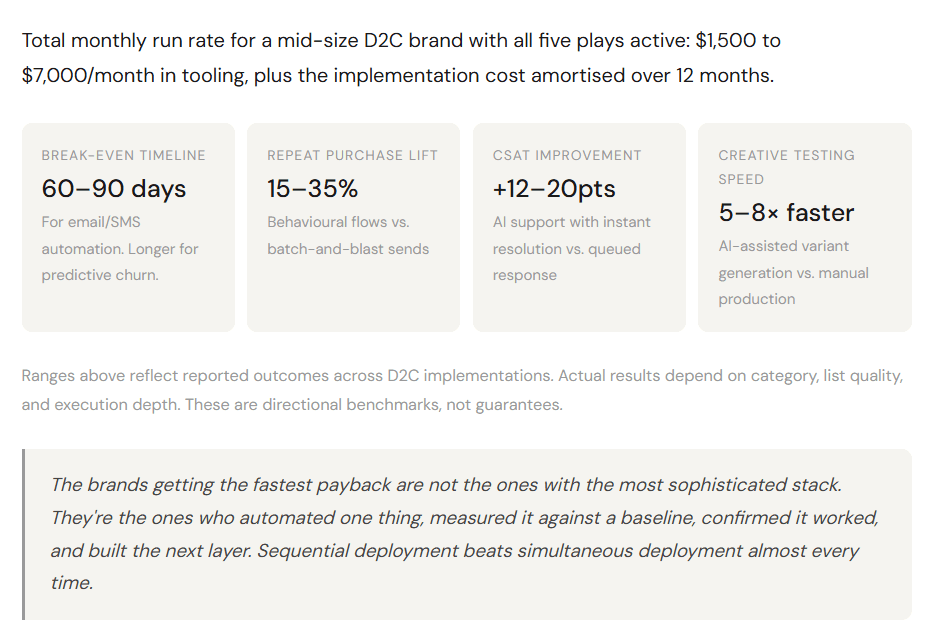
Email and SMS platform with AI features: $300–$2,000/month depending on list size (Klaviyo, Omnisend, Attentive). Most brands are already paying this — the question is whether the AI features are activated.
AI segmentation and analytics layer: $500–$3,000/month for specialist tools like Triple Whale or Northbeam with predictive features.
AI creative tooling: $200–$800/month for paid social variant generation (AdCreative.ai, Pencil, or similar).
Conversational AI / customer service: $300–$1,500/month for AI support tools like Gorgias AI.
Implementation and setup: One-time cost of $3,000–$15,000 for data integration, flow architecture, and team training — depending on stack complexity.
The Mistakes That Are Quietly Killing D2C Automation ROI
Treating AI as a set-and-forget system
Email flows built once and never reviewed. Segmentation models trained on data from 18 months ago. Chatbot scripts not updated since launch. AI marketing automation is not a one-time deployment — it's an ongoing system that needs quarterly review at minimum. The brands that see compounding returns are running continuous improvement cycles on their automation, not checking in once a year.
Discounting their way through AI-triggered flows
If every AI-triggered email in your retention stack contains a discount code, you are training your customers to expect a discount and reducing your margin on every recovered sale. AI personalization should be used to send the right product to the right person at the right time — not to automate the delivery of offers. Discount-heavy automation is often more expensive than doing nothing.
Skipping the data audit before deployment
If your customer purchase history has gaps, your product catalogue isn't tagged consistently, or your email engagement data is contaminated by bot clicks — and most lists have some of this — the model will produce recommendations that are technically confident but practically wrong. A data audit before deployment is not optional; it's the difference between a system that works and one that looks like it works while quietly degrading customer trust.
Measuring opens instead of revenue
The only number that matters in your automation reporting is revenue attributed to each flow, measured against a control group wherever possible. Teams that report "our welcome sequence has a 42% open rate" without knowing the conversion rate and AOV those opens produce are measuring effort, not impact.
The KPIs That Tell You If It's Working
Define these before you deploy anything. If you can't baseline them today, create the measurement infrastructure first.
Revenue per recipient (RPR) on each automated flow — not open rate, not click rate. The dollar value generated per contact the flow touches. This is your primary automation health metric.
Repeat purchase rate at 60 and 90 days post first order. If your AI post-purchase flows are working, this number should move within one quarter of deployment.
Churn rate for subscription or high-frequency purchase cohorts. If you've deployed predictive churn intervention, measure monthly churn before and after across matched cohorts.
Cost per resolution on customer service tickets handled by AI versus human agents. Should drop materially within 60 days of AI support deployment.
Blended CAC trend — the number that tells you whether improved retention is reducing your need to reacquire customers at high cost.
One metric most teams ignore: human review time per automated touchpoint. If your team is spending more than 2–3 hours per week correcting AI-generated content in live flows, the system is either underconfigured or the tool isn't right for your brand voice. That time cost is invisible in most P&Ls but very real in team bandwidth.
What's Coming in the Next 18 Months — and What to Do About It Now
The capability gap between D2C brands with a functioning AI marketing stack and those without is currently at roughly 12 to 18 months of operational maturity. That gap is closing as tools become more accessible — but the brands at the front are not standing still.
The next significant shift is full-funnel AI orchestration: systems where a single customer signal — a browse event, a support query, a social engagement — automatically updates the customer's profile, adjusts their segment, and triggers the appropriate cross-channel response without human intervention. Not a chatbot. Not a flow. A coordinated system that treats each customer interaction as data informing every subsequent touchpoint.
For D2C brands specifically, the most strategically important capability emerging right now is AI-powered first-party data enrichment. As third-party cookies become less reliable and paid social signal quality degrades, brands that build rich behavioural profiles from their own data — and activate that data through AI-driven personalisation — will have a structural cost advantage in acquisition and a retention advantage that compounds over time.
The risk of waiting is not that you'll miss the technology. It's that your competitors will have built 12 months of model training data, customer behaviour history, and operational know-how that you can't shortcut. The tools are table stakes. The data and the operational muscle are the moat.
The smartest D2C operators right now are not deploying everything at once. They're identifying one high-value automation — usually post-purchase retention — deploying it properly, measuring it rigorously, and using the results to build the business case for the next layer. That sequencing is not caution. It's compounding.
Ready to find your highest-ROI automation play?
If the forward picture above resonates but you're not sure where your brand sits on that maturity curve, that's exactly what ProjectSupply's AI Marketing Audit is designed to answer. We look at your current stack, your customer data, your retention metrics — and tell you specifically what to build first, what to skip, and what you're probably paying for that isn't doing anything.
AI Marketing Automation Is Either Your Fix or Your Next Expensive Mistake.
Here's the situation most D2C founders are sitting in right now: Meta costs have climbed every quarter. Google Shopping is more competitive. Email open rates are acceptable but click-to-purchase is flat. And the marketing team, however talented — is spending 60% of its week on tasks that shouldn't require a human.
The standard answer in 2026 is "use AI." But most brands that have tried it are not seeing the returns they expected. Not because AI marketing automation doesn't work — it does, in specific applications but because they implemented it backwards. They bought tools before defining the problem. They automated workflows that were already broken. They measured activity instead of revenue.
This blog is a practical breakdown of what's actually working for D2C and ecommerce brands right now: where to put AI first, what it costs, how long it takes to pay back, and the mistakes that are quietly burning budget across the industry.
The Real Problem Isn't Your Tools. It's Your Acquisition Dependency.
Most D2C brands are structurally over-indexed on paid acquisition. And in 2026, it has risen significantly across Meta, Google, and TikTok for most categories, the margin math breaks unless LTV climbs with it or acquisition cost comes down through efficiency gains.
AI marketing automation addresses both levers, but not equally. It is significantly more effective at improving retention, reactivation, and lifetime value than it is at reducing top-of-funnel acquisition cost. If your primary brief is "make our Meta ads cheaper," AI is not the lever. If your brief is "make every customer we acquire worth more over time," AI is exactly the right investment.
This distinction matters before you spend anything. Brands that deployed AI automation expecting it to rescue their acquisition economics have been disappointed. Brands that deployed it to deepen post-purchase engagement, increase repeat purchase rate, and reduce churn have seen measurable returns within a single quarter.
The D2C brands seeing the fastest payback from AI automation in 2026 are those with a repeat purchase rate problem — not a traffic problem. If your first-order economics are broken, fix them before automating anything.
Where the LTV math actually changes
A customer who buys once and never returns is worth their first-order margin. A customer who buys three times is often worth four to six times that, once you account for referral behaviour and reduced re-acquisition cost. The gap between those two outcomes is almost entirely determined by what happens in the 7 to 30 days after the first purchase.
AI-driven post-purchase flows — personalised replenishment reminders, cross-sell sequences based on actual purchase behaviour rather than product category, winback campaigns triggered by inactivity signals are the highest-ROI automation deployment for most D2C brands. Not because the technology is impressive, but because the window they're addressing is where most brands have historically done the least.
ProjectSupply Benchmark — Across D2C brand engagements we've run at ProjectSupply, brands that deployed a properly structured behavioural post-purchase flow saw a median 26% improvement in 90-day repeat purchase rate compared to their pre-automation baseline over the same 90-day window. The top quartile hit 38%+. The common thread wasn't the tool they used. It was deploying against a clean data baseline and reviewing flow performance at the 30-day mark rather than setting it live and moving on.
Five AI Automation Plays That Are Actually Working for Ecommerce Right Now
1. Behavioural email and SMS — beyond the abandoned cart
Every D2C brand has an abandoned cart sequence. Almost none of them have a properly built post-browse sequence, a category affinity sequence, or a replenishment trigger based on actual average order cycle rather than a generic 30-day timer. These three flows alone, built with AI personalisation at the content and timing layer, consistently outperform abandoned cart recovery in total revenue recovered.
The practical implementation: use a platform like Klaviyo, Omnisend, or Attentive with AI send-time optimisation and dynamic content blocks driven by purchase and browse history. The AI component is not writing the emails from scratch, it's selecting the right content, the right product recommendation, and the right send window for each individual contact. That's the part that moves conversion rate.
2. AI-powered segmentation that goes beyond RFM
Recency, frequency, monetary value — the standard RFM model — is a 1990s framework being applied to 2026 customer behaviour. It doesn't account for category affinity, channel preference, price sensitivity signals, or the difference between a customer who bought once during a sale and one who bought twice at full price. AI segmentation models that ingest all of this produce audience splits that are materially more predictive.
For a D2C brand with a list of 50,000 or more, the difference between sending a promotional campaign to your entire list versus sending it to the 12,000 contacts the model identifies as most likely to convert and suppressing it from the 8,000 most likely to churn if hit with another discount is the difference between a campaign that grows LTV and one that trains your customers to wait for sales.
3. Dynamic ad creative testing at scale
Producing enough creative variation to run meaningful A/B tests on paid social has historically been a production bottleneck. AI-generated creative variants — different hooks, different copy angles, different visual compositions tested against the same audience remove that bottleneck. The economics are compelling: creative that would have taken a team two weeks to produce can be generated, tested, and iterated in days.
The important caveat: AI-generated creative still needs human brand oversight. The tools regularly miss brand voice, tone, and aesthetic standards without a review layer. Use AI to generate volume and speed, human creatives to curate and approve. The ratio that's working for most brands: AI produces 20 variants, the human team selects 5 to test, AI analyses performance and generates the next round informed by results.
4. Predictive churn intervention
Most D2C brands try to reactivate churned customers. The smarter play is identifying customers who are about to churn before they do and intervening while they still have purchase intent. AI models trained on your customer data can identify the behavioural signals that precede churn: decreasing email engagement, longer intervals between purchases, a pattern of browsing without buying. A targeted intervention at that moment costs a fraction of a full reacquisition campaign.
Brands with subscription components to their D2C model see the highest returns here. A 5-point reduction in monthly churn rate compounds significantly over 12 months — often more than any acquisition efficiency gain within the same budget. If you want to see how we structure churn intervention models for subscription D2C, our audit process covers exactly this.
5. AI-assisted customer service and post-purchase experience
Customer service volume scales with order volume, and for most D2C brands the unit economics of handling a WISMO ("where is my order") query with a human agent don't work at scale. AI-powered support handling order status, returns initiation, and basic product questions reduces resolution time, reduces cost, and — when implemented well actually improves CSAT scores because the response is immediate rather than queued.
The implementation standard that matters: the AI needs to know when to escalate. A model that attempts to handle a complex complaint it can't resolve correctly will damage trust faster than slow human support would have. Build clear escalation triggers from day one.
What It Costs and What a Realistic Payback Looks Like
Email and SMS platform with AI features: $300–$2,000/month depending on list size (Klaviyo, Omnisend, Attentive). Most brands are already paying this — the question is whether the AI features are activated.
AI segmentation and analytics layer: $500–$3,000/month for specialist tools like Triple Whale or Northbeam with predictive features.
AI creative tooling: $200–$800/month for paid social variant generation (AdCreative.ai, Pencil, or similar).
Conversational AI / customer service: $300–$1,500/month for AI support tools like Gorgias AI.
Implementation and setup: One-time cost of $3,000–$15,000 for data integration, flow architecture, and team training — depending on stack complexity.
The Mistakes That Are Quietly Killing D2C Automation ROI
Treating AI as a set-and-forget system
Email flows built once and never reviewed. Segmentation models trained on data from 18 months ago. Chatbot scripts not updated since launch. AI marketing automation is not a one-time deployment — it's an ongoing system that needs quarterly review at minimum. The brands that see compounding returns are running continuous improvement cycles on their automation, not checking in once a year.
Discounting their way through AI-triggered flows
If every AI-triggered email in your retention stack contains a discount code, you are training your customers to expect a discount and reducing your margin on every recovered sale. AI personalization should be used to send the right product to the right person at the right time — not to automate the delivery of offers. Discount-heavy automation is often more expensive than doing nothing.
Skipping the data audit before deployment
If your customer purchase history has gaps, your product catalogue isn't tagged consistently, or your email engagement data is contaminated by bot clicks — and most lists have some of this — the model will produce recommendations that are technically confident but practically wrong. A data audit before deployment is not optional; it's the difference between a system that works and one that looks like it works while quietly degrading customer trust.
Measuring opens instead of revenue
The only number that matters in your automation reporting is revenue attributed to each flow, measured against a control group wherever possible. Teams that report "our welcome sequence has a 42% open rate" without knowing the conversion rate and AOV those opens produce are measuring effort, not impact.
The KPIs That Tell You If It's Working
Define these before you deploy anything. If you can't baseline them today, create the measurement infrastructure first.
Revenue per recipient (RPR) on each automated flow — not open rate, not click rate. The dollar value generated per contact the flow touches. This is your primary automation health metric.
Repeat purchase rate at 60 and 90 days post first order. If your AI post-purchase flows are working, this number should move within one quarter of deployment.
Churn rate for subscription or high-frequency purchase cohorts. If you've deployed predictive churn intervention, measure monthly churn before and after across matched cohorts.
Cost per resolution on customer service tickets handled by AI versus human agents. Should drop materially within 60 days of AI support deployment.
Blended CAC trend — the number that tells you whether improved retention is reducing your need to reacquire customers at high cost.
One metric most teams ignore: human review time per automated touchpoint. If your team is spending more than 2–3 hours per week correcting AI-generated content in live flows, the system is either underconfigured or the tool isn't right for your brand voice. That time cost is invisible in most P&Ls but very real in team bandwidth.
What's Coming in the Next 18 Months — and What to Do About It Now
The capability gap between D2C brands with a functioning AI marketing stack and those without is currently at roughly 12 to 18 months of operational maturity. That gap is closing as tools become more accessible — but the brands at the front are not standing still.
The next significant shift is full-funnel AI orchestration: systems where a single customer signal — a browse event, a support query, a social engagement — automatically updates the customer's profile, adjusts their segment, and triggers the appropriate cross-channel response without human intervention. Not a chatbot. Not a flow. A coordinated system that treats each customer interaction as data informing every subsequent touchpoint.
For D2C brands specifically, the most strategically important capability emerging right now is AI-powered first-party data enrichment. As third-party cookies become less reliable and paid social signal quality degrades, brands that build rich behavioural profiles from their own data — and activate that data through AI-driven personalisation — will have a structural cost advantage in acquisition and a retention advantage that compounds over time.
The risk of waiting is not that you'll miss the technology. It's that your competitors will have built 12 months of model training data, customer behaviour history, and operational know-how that you can't shortcut. The tools are table stakes. The data and the operational muscle are the moat.
The smartest D2C operators right now are not deploying everything at once. They're identifying one high-value automation — usually post-purchase retention — deploying it properly, measuring it rigorously, and using the results to build the business case for the next layer. That sequencing is not caution. It's compounding.
Ready to find your highest-ROI automation play?
If the forward picture above resonates but you're not sure where your brand sits on that maturity curve, that's exactly what ProjectSupply's AI Marketing Audit is designed to answer. We look at your current stack, your customer data, your retention metrics — and tell you specifically what to build first, what to skip, and what you're probably paying for that isn't doing anything.
FAQs
How long does AI marketing automation take to implement?
Framer is a design tool that allows you to design websites on a freeform canvas, and then publish them as websites with a single click.
Web Personalisation
Framer is a design tool that allows you to design websites on a freeform canvas, and then publish them as websites with a single click.
UI and UX Design
Framer is a design tool that allows you to design websites on a freeform canvas, and then publish them as websites with a single click.
Search Engine Optimisation
Framer is a design tool that allows you to design websites on a freeform canvas, and then publish them as websites with a single click.
CRM and ERP Solutions
Framer is a design tool that allows you to design websites on a freeform canvas, and then publish them as websites with a single click.
Ecommerce
Framer is a design tool that allows you to design websites on a freeform canvas, and then publish them as websites with a single click.
Email Marketing
Framer is a design tool that allows you to design websites on a freeform canvas, and then publish them as websites with a single click.
Marketing Automation
Framer is a design tool that allows you to design websites on a freeform canvas, and then publish them as websites with a single click.
Chatbots and Conversational AI
Framer is a design tool that allows you to design websites on a freeform canvas, and then publish them as websites with a single click.
Chatbots and Conversational AI
Framer is a design tool that allows you to design websites on a freeform canvas, and then publish them as websites with a single click.
Related Blogs
We know your space
Explore our latest UI/UX Case Studies that showcase how our process-driven creativity transforms complex ideas into real, measurable business results, step by step.

AI and Data Analytics
•
Aug 19, 2026
Context Engineering for Enterprise AI Agents: Memory, Retrieval, Tools and State Management

AI and Data Analytics
•
Aug 19, 2026
Enterprise RAG vs Agentic RAG vs AI Search: Which Architecture Should You Build?

AI and Data Analytics
•
Aug 19, 2026
Enterprise Semantic Layer for AI Agents: How to Produce Trusted Business Answers
Let's work together
Have a project in mind?
Let's make it real.
Tell us what you're building. We'll bring the design, technology, and thinking to make it happen.
Fill up the following form to start a conversation
with our team
Let's work together
Have a project in mind?
Let's make it real.
Tell us what you're building. We'll bring the design, technology, and thinking to make it happen.
Fill up the following form to start a conversation with our team
Let's work together
Have a project in mind?
Let's make it real.
Tell us what you're building. We'll bring the design, technology, and thinking to make it happen.
Fill up the following form to start a conversation
with our team
Services
Services
© 2026 projectsupply
Part of Tangle
Services
© 2026 projectsupply
Part of Tangle