

Shopify
AI for Shopify Advertising Optimization
Learn how AI improves Shopify ad performance through smarter targeting, budget allocation, and creative optimization across Meta, Google, and TikTok.
08 min read
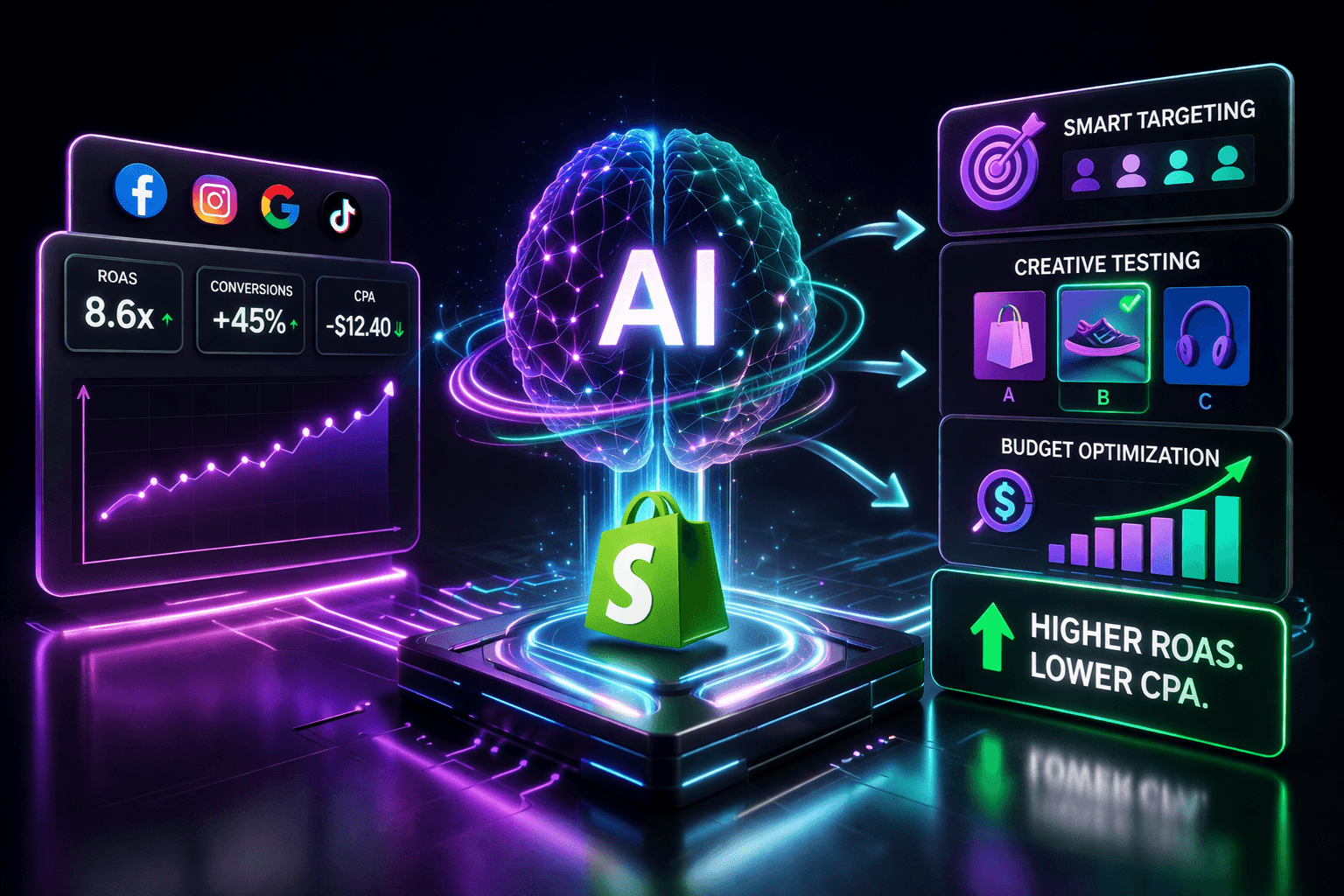
AI for Shopify Advertising Optimization
Why Advertising Efficiency Is the Real Constraint in Shopify Growth
For most scaling Shopify brands, growth is constrained less by demand and more by advertising efficiency.
As brands move from early traction to meaningful scale, several problems emerge:
rising customer acquisition costs
declining return on ad spend
audience fatigue
limited creative testing capacity
Many brands continue to manage campaigns manually through traditional optimization techniques:
manual audience testing
manual budget allocation
creative rotation
spreadsheet-based reporting
This approach quickly becomes inefficient when ad spend grows beyond $20k–$50k per month.
AI-driven advertising optimization introduces automation and predictive analysis into the media buying process. Instead of relying solely on human decision-making, algorithms continuously analyze performance signals to improve campaign outcomes.
For Shopify brands scaling aggressively, this can materially impact revenue growth and marketing profitability.
What AI Advertising Optimization Actually Does
AI advertising systems analyze large volumes of campaign data and automatically adjust campaign parameters to improve performance.
These systems evaluate signals such as:
Data Signal | Example |
|---|---|
Conversion behavior | purchases, add-to-cart events |
Customer attributes | location, device, returning vs new |
Ad engagement | clicks, video completion, dwell time |
Purchase value | average order value by audience |
Creative performance | image vs video vs carousel |
AI models use these signals to make real-time adjustments that would be difficult to manage manually.
Key automation areas include:
audience targeting
budget allocation
creative testing
bid optimization
Where AI Fits in the Shopify Advertising Stack
AI optimization typically operates within three layers of the advertising workflow.
Audience Targeting
Modern advertising platforms rely heavily on algorithmic targeting.
Instead of manually defining narrow audiences, AI analyzes conversion signals and automatically expands targeting to similar users.
Examples include:
lookalike audience expansion
behavioral pattern detection
predictive buyer modeling
For Shopify stores with sufficient conversion data, this dramatically improves targeting efficiency.
Budget Allocation
AI systems continuously evaluate which campaigns or ad sets generate the best results.
Budget can be automatically shifted toward higher-performing segments.
Example logic:
Campaign | ROAS | Budget Adjustment |
|---|---|---|
Campaign A | 4.2 | increase budget |
Campaign B | 2.1 | maintain |
Campaign C | 0.9 | reduce |
This dynamic allocation improves marketing efficiency without requiring constant manual monitoring.
Creative Optimization
Creative performance is often the biggest determinant of ad success.
AI systems analyze engagement patterns across creatives to determine which formats resonate most with specific audiences.
Examples include:
testing multiple creative variations
identifying winning visual formats
rotating underperforming creatives out of campaigns
This significantly accelerates creative experimentation.
Advertising Platforms Where AI Plays the Largest Role
AI optimization capabilities vary across advertising platforms used by Shopify brands.
Platform | AI Optimization Strength |
|---|---|
Meta Ads | strong algorithmic targeting |
Google Ads | advanced bidding and search automation |
TikTok Ads | creative-driven algorithm |
YouTube Ads | video engagement optimization |
Each platform uses different machine learning models to determine which users see which ads.
For Shopify brands, the challenge is aligning these systems with store data.
Connecting Shopify Data with AI Advertising Systems
AI optimization becomes significantly more powerful when it has access to Shopify purchase data.
This integration typically occurs through:
Shopify pixel integrations
conversion APIs
server-side tracking systems
These systems allow advertising platforms to receive high-quality conversion signals such as:
purchases
order value
repeat customers
Better data improves the accuracy of machine learning models used in ad targeting.
App-Based vs Custom Advertising Optimization Systems
Shopify brands typically use either platform-native AI tools or specialized third-party optimization software.
Platform-Native AI Optimization
Advertising platforms already include powerful automation capabilities.
Examples include:
automated bidding strategies
dynamic creative optimization
algorithmic audience expansion
Advantages:
no additional cost
deep integration with platform data
strong optimization models
For many brands, this is sufficient.
Third-Party AI Optimization Platforms
Some Shopify brands use external tools to coordinate advertising optimization across platforms.
These systems analyze performance data across:
Meta Ads
Google Ads
TikTok Ads
Shopify sales data
Advantages include centralized analytics and budget allocation.
Typical costs range from $100 to $1,000+ per month depending on ad spend.
Shopify vs Shopify Plus Advertising Considerations
Advertising optimization strategies can vary depending on Shopify plan level.
Capability | Shopify | Shopify Plus |
|---|---|---|
Data integrations | standard | advanced |
Conversion tracking | basic | more flexible |
custom checkout tracking | limited | stronger |
Shopify Plus brands often implement more sophisticated tracking infrastructure, which improves AI optimization accuracy.
Theme vs Headless Store Tracking Considerations
Advertising performance depends heavily on tracking accuracy.
Theme-Based Shopify Stores
Traditional Shopify themes typically rely on standard tracking tools:
platform pixels
Shopify analytics
basic event tracking
This setup works well for most stores.
Headless Shopify Stores
Headless storefronts often require custom tracking implementation.
Benefits include:
server-side tracking
enhanced event data
improved attribution accuracy
This can significantly improve AI ad optimization.
CRO Impact of AI Advertising Optimization
AI advertising systems influence conversion performance indirectly.
Improved targeting means higher-quality traffic reaches the store.
Examples include:
Impact Area | Result |
|---|---|
better audience targeting | higher conversion rates |
improved creative selection | stronger engagement |
optimized landing traffic | lower bounce rates |
Traffic quality improvements typically lead to higher store conversion rates.
Retention and Customer Value Implications
AI advertising can also optimize campaigns for long-term customer value rather than immediate purchases.
Advanced strategies may optimize toward:
high LTV customers
repeat buyers
subscription customers
This shifts marketing focus from short-term revenue to sustainable growth.
Operational Efficiency Gains
AI reduces the operational workload of advertising teams.
Without automation, media buyers must:
monitor campaign performance continuously
adjust bids manually
analyze audience segments
rotate creatives frequently
Automation allows teams to focus on higher-level strategy and creative development.
Common Implementation Mistakes
Many Shopify brands adopt AI advertising tools but fail to see improvements.
Typical issues include poor data infrastructure and unrealistic expectations.
Weak Conversion Data
AI models require large amounts of conversion data to learn effectively.
Stores with low conversion volume may see limited optimization benefits.
Over-Fragmented Campaign Structures
Too many small campaigns restrict the ability of algorithms to learn from aggregated data.
Simplified campaign structures usually perform better.
Poor Creative Inputs
AI can optimize distribution but cannot fix weak creative assets.
Brands must maintain a strong creative testing pipeline.
Inaccurate Tracking
If conversion events are not tracked correctly, AI systems optimize toward incorrect signals.
Accurate data infrastructure is essential.
Bottom Line: What Metrics Should Drive Your Shopify Decision?
AI advertising optimization should ultimately improve financial performance rather than simply automate campaigns.
Key decision metrics include:
Metric | Strategic Importance |
|---|---|
Conversion Rate | traffic quality indicator |
Average Order Value (AOV) | determines revenue per purchase |
Customer Acquisition Cost (CAC) | primary marketing efficiency metric |
ROAS / MER | overall advertising profitability |
Contribution Margin | determines real profitability |
Lifetime Value (LTV) | measures long-term customer value |
Refund Rate | signals product-market fit issues |
Operational Cost per Order | marketing overhead efficiency |
App Stack Cost | software costs for optimization tools |
Development Cost vs Payback Period | ROI of advanced data infrastructure |
Example ROI logic:
If AI optimization improves ROAS from 2.5 to 3.5, a brand spending $50,000 per month on ads could generate significantly higher revenue without increasing budget.
Forward View (2026 and Beyond)
AI-driven advertising is rapidly becoming the default model for ecommerce growth.
Several structural shifts are shaping this transition.
First, algorithmic media buying will replace manual campaign management for most brands. Human operators will increasingly focus on creative strategy and data infrastructure rather than daily bid adjustments.
Second, first-party data will become central to advertising performance as privacy restrictions reduce third-party tracking.
Shopify brands that maintain strong customer data pipelines will benefit most from AI optimization.
Third, creative intelligence systems will expand.
AI tools will increasingly analyze and generate advertising creatives based on performance patterns.
Fourth, advertising platforms will become more integrated with ecommerce platforms.
Deeper Shopify integrations will allow AI systems to optimize campaigns based on revenue quality rather than simple conversion counts.
Finally, margin compression in ecommerce will push brands toward greater advertising efficiency.
As acquisition costs rise, brands that combine AI-driven media buying with strong CRO and retention strategies will maintain sustainable growth.
For Shopify operators scaling toward eight-figure revenue, AI advertising optimization will evolve from a tactical advantage to a core marketing infrastructure layer.
FAQs
Can AI automatically manage Shopify ad budgets?
Yes. Many advertising platforms use AI to dynamically allocate budget toward the best-performing campaigns.
Does AI replace media buyers in ecommerce advertising?
No. AI handles optimization tasks, but strategic planning and creative development still require human expertise.
How important is data quality for AI advertising?
Extremely important. Poor tracking or missing conversion data reduces optimization accuracy.
Do AI advertising tools increase conversion rates?
Indirectly. AI improves targeting and traffic quality, which often results in higher conversion rates.
How quickly can AI advertising optimization improve results?
Most campaigns begin improving within a few weeks once the system gathers sufficient performance data.
Direct Q&A
What is AI advertising optimization for Shopify?
AI advertising optimization uses machine learning to automatically improve targeting, bidding, and creative performance for campaigns driving traffic to Shopify stores.
Does AI improve Shopify ad performance?
Yes. AI systems analyze conversion data and engagement signals to improve audience targeting and budget allocation.
Do Shopify brands need third-party AI ad tools?
Many brands rely on built-in AI optimization within advertising platforms, though external tools can provide cross-platform insights.
How does Shopify data improve AI ad targeting?
When advertising platforms receive purchase and revenue data from Shopify, their algorithms can optimize campaigns toward higher-value customers.
Is AI advertising optimization useful for small Shopify stores?
It becomes most effective once stores generate enough conversion data for machine learning models to identify patterns.
INSIGHTS
Expert perspectives on design, AI, and growth.
Explore our latest strategies for scaling high-performance creative in a digital world.

View more