
Performance Media
Google Ads Attribution Models Explained (GA4 + Google Ads) in 2026
Google Ads Attribution Models Explained (GA4 + Google Ads) in 2026
08 min read
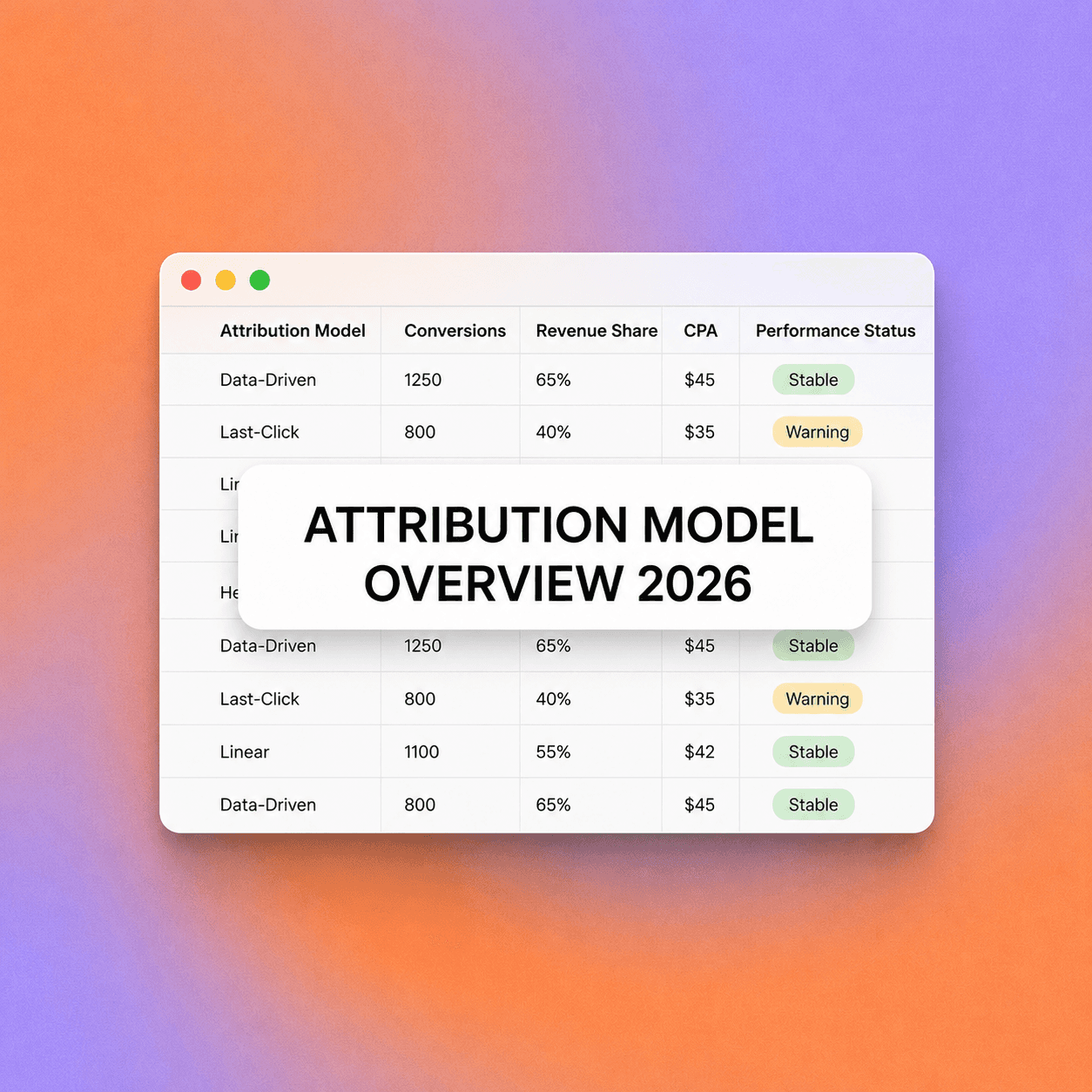
Most advertisers inadvertently optimize their marketing budgets based on superficial data, focusing only on the final touchpoint rather than the entire journey that leads to a conversion.
In the complex digital landscape of 2026, attribution serves as the critical mechanism that determines exactly which touchpoints from initial discovery ads to final closing actions receive credit for a sale, which in turn dictates where your budget is reallocated.
Inside both Google Ads and Google Analytics 4, attribution modeling defines how total conversion credit is distributed across a diverse array of channels including Search, Display, YouTube, Organic search, Direct traffic, and Paid social. If your attribution strategy is flawed or overly simplistic, your optimization decisions will inevitably be misaligned with true business value, leading to the premature cutting of profitable top-funnel channels and the inefficient over-funding of brand search.
Attribution is not just a reporting nuance; it is the hidden driver of ROI that determines whether your automated bidding engines fuel growth or squander capital on the wrong parts of the sales funnel.
What Is Attribution in Google Ads?
Attribution represents the set of rules used to determine how conversion credit is assigned across multiple marketing touchpoints before a user ultimately completes a purchase or lead submission.
For instance, consider a user journey where a prospect first clicks a broad Display ad to discover your brand, returns several days later to click a highly specific Search ad for a product category, and finally arrives via a direct link to convert on your website. Under a restrictive reporting logic, this journey might look like a direct sale, but the attribution rules are what allow you to identify the critical role played by those earlier interactions.
Without an intelligent attribution framework, you are effectively flying blind, unable to quantify the "assisted conversion" value provided by your prospecting campaigns, which leads to a distorted perception of marketing efficiency and prevents you from scaling your customer acquisition engine effectively across the entire buyer journey.
Attribution Models in Google Ads (2026 Overview)
Data-Driven Attribution (Default & Recommended)
Data-driven attribution (DDA) utilizes sophisticated machine learning to distribute credit across touchpoints based on actual account data, analyzing millions of click patterns, conversion paths, time-lapse factors, and individual user signals to understand what truly moves the needle.
DDA assigns credit proportionally across all meaningful touchpoints, such as allocating 20% to the initial Display ad, 60% to the mid-funnel Search ad, and 20% to the final Brand Search, providing a nuanced view of the full conversion story.
This is now the default model in nearly all Google Ads accounts for a reason: it creates a mathematically sound representation of how your different marketing assets work together. By moving away from arbitrary, rule-based credit assignment, you allow the algorithm to appreciate the contribution of every click, which results in more balanced reporting and higher-quality inputs for your automated bidding strategies.
Last Click Attribution
This legacy model gives 100% of the conversion credit to the final interaction immediately preceding the conversion, completely ignoring any upstream influence or awareness-building efforts that occurred earlier. If we revisit our previous example, Last Click would attribute the entire sale to the Brand Search ad, causing upper-funnel campaigns like Display and YouTube to appear completely unprofitable and disconnected from the final revenue.
This model is notoriously dangerous for growth, as it systematically undervalues awareness campaigns and leads marketers to cut off the very sources of new customer discovery that are required to fill the bottom-funnel pipeline, eventually causing the entire acquisition system to stall due to a lack of new prospects.
First Click Attribution
This model assigns full credit to the very first interaction a user has with your brand, which can be useful for specific marketing departments focused strictly on awareness measurement or early-stage funnel analysis.
While it offers a clean view of what successfully introduced a user to your product, it is deeply flawed for performance marketing because it completely ignores the closing influence of downstream search queries or remarketing efforts. Relying on this model for bid optimization is typically a losing strategy because it discourages the use of middle-funnel engagement tools that are necessary to actually guide a prospect from initial interest to a completed transaction.
Position-Based (Legacy Model)
Historically, this model gave 40% of the credit to the first click, 40% to the last click, and distributed the remaining 20% among the various middle-funnel touchpoints in an attempt to balance awareness and conversion.
While it was once popular as a middle ground, Google has largely deprecated most of these rule-based models in favor of dynamic, data-driven approaches that adapt to the reality of individual account performance rather than applying a fixed percentage to every conversion journey. The shift toward data-driven models reflects the reality that every business’s sales funnel is unique, and a one-size-fits-all rule simply cannot accurately capture the complexity of modern, multi-channel user journeys.
Google Ads vs GA4 Attribution — What’s the Difference?
Confusion often arises because marketers mistake the attribution logic inside Google Ads for the attribution logic inside GA4, despite their distinct operational purposes.
Google Ads attribution focuses strictly on Google Ads interactions, providing the data that directly influences your bidding optimization and the decision-making of your Smart Bidding strategies. In contrast, GA4 attribution is cross-channel, incorporating Organic search, Referrals, and Paid social to provide a comprehensive, data-driven cross-channel model that informs your broader marketing analysis and budget planning.
It is critical to never confuse reporting logic with bidding logic; you should use Google Ads attribution to tell the bidding engine what works best for ads, while you use GA4 attribution to inform your overarching strategic decisions about which channels deserve more investment across your entire marketing ecosystem.
How GA4 Data-Driven Attribution Works
Inside Google Analytics 4, the data-driven model is the default, and it allows for a highly customized attribution window that can be tweaked to match your specific customer journey length. GA4 evaluates complex cross-device behavior, maps out convoluted cross-channel paths, and analyzes engagement signals that are far broader and more granular than the Google Ads-only attribution view.
Because it captures the full story of how a user interacts with your digital presence, GA4 attribution provides the necessary "macro" context that your Google Ads campaigns lack, helping you understand how users are moving between social media, organic blog content, and your paid advertising assets before they finally decide to convert.
Why Attribution Model Choice Impacts Smart Bidding
Strategies like Target CPA, Target ROAS, and Maximize Conversions rely heavily on the accuracy of the conversion signals that you feed into them. If your attribution is set to last-click, upper-funnel campaigns may appear inefficient, causing the Smart Bidding algorithm to restrict their spend or pause them entirely, which effectively strangles your brand's reach and ability to acquire new customers.
Conversely, when you use Data-Driven Attribution, the credit is balanced across the funnel, providing the algorithm with a more accurate picture of how your campaigns drive revenue and allowing for more stable, long-term optimization. In 2026, using Data-Driven Attribution is the single best way to ensure that your automated bidding remains stable and consistently focused on your long-term growth objectives rather than just the easiest, most immediate sales.
Attribution Windows Explained
An attribution window defines the length of time after a click occurs that a conversion can still be credited back to that touchpoint. Common settings include 30, 60, and 90 days, with 30 days serving as the default for most accounts.
A shorter window is generally better for low-consideration, impulse-purchase products where the decision happens in minutes or hours, while a longer window is mandatory for B2B or high-ticket luxury products where the consideration cycle can span weeks or months.
Your choice of window directly affects your reported CPA and ROAS; if your window is too short for your sales cycle, you will report artificially high CPA metrics that might cause you to kill off campaigns that are actually performing quite well over a longer horizon.
When Should You Change Attribution Models?
You should consider switching or auditing your attribution model if you run full-funnel campaigns that include extensive Display or YouTube investment, if your sales cycle is exceptionally long, or if Brand search is dominating your reported conversions to an unrealistic degree.
If 70% or more of your conversions are being attributed to Brand search under a last-click model, you are almost certainly undervaluing your prospecting efforts and are likely failing to see how your other campaigns are actually fueling those Brand searches. Making the shift to a data-driven model in these scenarios provides the necessary correction, allowing you to see the true impact of your top-funnel awareness campaigns and justifying the budgets required to keep your prospect pipeline full.
How to Compare Attribution Models
Inside Google Ads, use the "Model Comparison Tool" to view your conversions side-by-side between the Last Click and Data-Driven models. Look for significant CPA differences, meaningful shifts in conversion value between campaigns, and the potential impact that a change would have on your campaign reallocation strategy.
It is imperative that you do not change your models without performing a deep-dive evaluation of historical performance shifts, as a sudden change in attribution can cause a massive, jarring shift in the bidding behavior of your Smart Bidding campaigns. Observe the data for a full cycle before making a final determination, ensuring that your change is based on a clear, data-backed hypothesis about which model provides a truer reflection of your business revenue.
Common Attribution Mistakes
Using GA4 numbers to judge Google Ads bidding performance: This leads to confusion because attribution logic differs between platforms.
Optimizing Display campaigns using last-click data: This will always make awareness campaigns look unprofitable and is a recipe for shrinking your reach.
Ignoring assisted conversions: These are the backbone of your funnel; failing to track them means you are ignoring the "fuel" that drives your bottom-line sales.
Changing attribution model mid-scaling phase: This creates massive volatility that can destabilize your bidding engine at the exact moment you need the most consistency.
Not aligning attribution window with sales cycle: If your window is shorter than your buyer journey, you are literally losing data on your most important customers.
Attribution Strategy by Business Type
E-commerce: Use data-driven attribution paired with a 30-day window, adjusting the window only if your average order value (AOV) requires a longer or shorter consideration period.
B2B Lead Gen: Use data-driven attribution and a longer attribution window of 60 to 90 days, as the journey from initial ad click to final contract signing is often slow and requires multiple touchpoints.
Local Services: Use a short attribution window and focus heavily on high-intent search, as users in this sector typically want an immediate solution to a pressing local problem.
High-Ticket Sales: Cross-channel GA4 analysis is absolutely critical here, as these prospects will rarely convert on their first visit, making it vital to track their multi-platform journey across weeks or months.
The Future of Attribution in 2026
With the ongoing restriction of third-party cookies and the expansion of privacy regulations, the traditional methods of tracking are becoming obsolete.
Modeled conversions are increasing in frequency, and AI-driven attribution is now the industry standard for bridging the gaps created by missing user data. Google is relying ever more heavily on first-party data, modeled conversion paths, and inferred behavioral patterns to maintain visibility for advertisers.
Consequently, your technical tracking setup is now more important than ever; you must ensure your first-party data collection is rock solid, as accurate, high-fidelity tracking is the only way to feed the AI models that now effectively govern the success or failure of your advertising campaigns.
Most advertisers inadvertently optimize their marketing budgets based on superficial data, focusing only on the final touchpoint rather than the entire journey that leads to a conversion.
In the complex digital landscape of 2026, attribution serves as the critical mechanism that determines exactly which touchpoints from initial discovery ads to final closing actions receive credit for a sale, which in turn dictates where your budget is reallocated.
Inside both Google Ads and Google Analytics 4, attribution modeling defines how total conversion credit is distributed across a diverse array of channels including Search, Display, YouTube, Organic search, Direct traffic, and Paid social. If your attribution strategy is flawed or overly simplistic, your optimization decisions will inevitably be misaligned with true business value, leading to the premature cutting of profitable top-funnel channels and the inefficient over-funding of brand search.
Attribution is not just a reporting nuance; it is the hidden driver of ROI that determines whether your automated bidding engines fuel growth or squander capital on the wrong parts of the sales funnel.
What Is Attribution in Google Ads?
Attribution represents the set of rules used to determine how conversion credit is assigned across multiple marketing touchpoints before a user ultimately completes a purchase or lead submission.
For instance, consider a user journey where a prospect first clicks a broad Display ad to discover your brand, returns several days later to click a highly specific Search ad for a product category, and finally arrives via a direct link to convert on your website. Under a restrictive reporting logic, this journey might look like a direct sale, but the attribution rules are what allow you to identify the critical role played by those earlier interactions.
Without an intelligent attribution framework, you are effectively flying blind, unable to quantify the "assisted conversion" value provided by your prospecting campaigns, which leads to a distorted perception of marketing efficiency and prevents you from scaling your customer acquisition engine effectively across the entire buyer journey.
Attribution Models in Google Ads (2026 Overview)
Data-Driven Attribution (Default & Recommended)
Data-driven attribution (DDA) utilizes sophisticated machine learning to distribute credit across touchpoints based on actual account data, analyzing millions of click patterns, conversion paths, time-lapse factors, and individual user signals to understand what truly moves the needle.
DDA assigns credit proportionally across all meaningful touchpoints, such as allocating 20% to the initial Display ad, 60% to the mid-funnel Search ad, and 20% to the final Brand Search, providing a nuanced view of the full conversion story.
This is now the default model in nearly all Google Ads accounts for a reason: it creates a mathematically sound representation of how your different marketing assets work together. By moving away from arbitrary, rule-based credit assignment, you allow the algorithm to appreciate the contribution of every click, which results in more balanced reporting and higher-quality inputs for your automated bidding strategies.
Last Click Attribution
This legacy model gives 100% of the conversion credit to the final interaction immediately preceding the conversion, completely ignoring any upstream influence or awareness-building efforts that occurred earlier. If we revisit our previous example, Last Click would attribute the entire sale to the Brand Search ad, causing upper-funnel campaigns like Display and YouTube to appear completely unprofitable and disconnected from the final revenue.
This model is notoriously dangerous for growth, as it systematically undervalues awareness campaigns and leads marketers to cut off the very sources of new customer discovery that are required to fill the bottom-funnel pipeline, eventually causing the entire acquisition system to stall due to a lack of new prospects.
First Click Attribution
This model assigns full credit to the very first interaction a user has with your brand, which can be useful for specific marketing departments focused strictly on awareness measurement or early-stage funnel analysis.
While it offers a clean view of what successfully introduced a user to your product, it is deeply flawed for performance marketing because it completely ignores the closing influence of downstream search queries or remarketing efforts. Relying on this model for bid optimization is typically a losing strategy because it discourages the use of middle-funnel engagement tools that are necessary to actually guide a prospect from initial interest to a completed transaction.
Position-Based (Legacy Model)
Historically, this model gave 40% of the credit to the first click, 40% to the last click, and distributed the remaining 20% among the various middle-funnel touchpoints in an attempt to balance awareness and conversion.
While it was once popular as a middle ground, Google has largely deprecated most of these rule-based models in favor of dynamic, data-driven approaches that adapt to the reality of individual account performance rather than applying a fixed percentage to every conversion journey. The shift toward data-driven models reflects the reality that every business’s sales funnel is unique, and a one-size-fits-all rule simply cannot accurately capture the complexity of modern, multi-channel user journeys.
Google Ads vs GA4 Attribution — What’s the Difference?
Confusion often arises because marketers mistake the attribution logic inside Google Ads for the attribution logic inside GA4, despite their distinct operational purposes.
Google Ads attribution focuses strictly on Google Ads interactions, providing the data that directly influences your bidding optimization and the decision-making of your Smart Bidding strategies. In contrast, GA4 attribution is cross-channel, incorporating Organic search, Referrals, and Paid social to provide a comprehensive, data-driven cross-channel model that informs your broader marketing analysis and budget planning.
It is critical to never confuse reporting logic with bidding logic; you should use Google Ads attribution to tell the bidding engine what works best for ads, while you use GA4 attribution to inform your overarching strategic decisions about which channels deserve more investment across your entire marketing ecosystem.
How GA4 Data-Driven Attribution Works
Inside Google Analytics 4, the data-driven model is the default, and it allows for a highly customized attribution window that can be tweaked to match your specific customer journey length. GA4 evaluates complex cross-device behavior, maps out convoluted cross-channel paths, and analyzes engagement signals that are far broader and more granular than the Google Ads-only attribution view.
Because it captures the full story of how a user interacts with your digital presence, GA4 attribution provides the necessary "macro" context that your Google Ads campaigns lack, helping you understand how users are moving between social media, organic blog content, and your paid advertising assets before they finally decide to convert.
Why Attribution Model Choice Impacts Smart Bidding
Strategies like Target CPA, Target ROAS, and Maximize Conversions rely heavily on the accuracy of the conversion signals that you feed into them. If your attribution is set to last-click, upper-funnel campaigns may appear inefficient, causing the Smart Bidding algorithm to restrict their spend or pause them entirely, which effectively strangles your brand's reach and ability to acquire new customers.
Conversely, when you use Data-Driven Attribution, the credit is balanced across the funnel, providing the algorithm with a more accurate picture of how your campaigns drive revenue and allowing for more stable, long-term optimization. In 2026, using Data-Driven Attribution is the single best way to ensure that your automated bidding remains stable and consistently focused on your long-term growth objectives rather than just the easiest, most immediate sales.
Attribution Windows Explained
An attribution window defines the length of time after a click occurs that a conversion can still be credited back to that touchpoint. Common settings include 30, 60, and 90 days, with 30 days serving as the default for most accounts.
A shorter window is generally better for low-consideration, impulse-purchase products where the decision happens in minutes or hours, while a longer window is mandatory for B2B or high-ticket luxury products where the consideration cycle can span weeks or months.
Your choice of window directly affects your reported CPA and ROAS; if your window is too short for your sales cycle, you will report artificially high CPA metrics that might cause you to kill off campaigns that are actually performing quite well over a longer horizon.
When Should You Change Attribution Models?
You should consider switching or auditing your attribution model if you run full-funnel campaigns that include extensive Display or YouTube investment, if your sales cycle is exceptionally long, or if Brand search is dominating your reported conversions to an unrealistic degree.
If 70% or more of your conversions are being attributed to Brand search under a last-click model, you are almost certainly undervaluing your prospecting efforts and are likely failing to see how your other campaigns are actually fueling those Brand searches. Making the shift to a data-driven model in these scenarios provides the necessary correction, allowing you to see the true impact of your top-funnel awareness campaigns and justifying the budgets required to keep your prospect pipeline full.
How to Compare Attribution Models
Inside Google Ads, use the "Model Comparison Tool" to view your conversions side-by-side between the Last Click and Data-Driven models. Look for significant CPA differences, meaningful shifts in conversion value between campaigns, and the potential impact that a change would have on your campaign reallocation strategy.
It is imperative that you do not change your models without performing a deep-dive evaluation of historical performance shifts, as a sudden change in attribution can cause a massive, jarring shift in the bidding behavior of your Smart Bidding campaigns. Observe the data for a full cycle before making a final determination, ensuring that your change is based on a clear, data-backed hypothesis about which model provides a truer reflection of your business revenue.
Common Attribution Mistakes
Using GA4 numbers to judge Google Ads bidding performance: This leads to confusion because attribution logic differs between platforms.
Optimizing Display campaigns using last-click data: This will always make awareness campaigns look unprofitable and is a recipe for shrinking your reach.
Ignoring assisted conversions: These are the backbone of your funnel; failing to track them means you are ignoring the "fuel" that drives your bottom-line sales.
Changing attribution model mid-scaling phase: This creates massive volatility that can destabilize your bidding engine at the exact moment you need the most consistency.
Not aligning attribution window with sales cycle: If your window is shorter than your buyer journey, you are literally losing data on your most important customers.
Attribution Strategy by Business Type
E-commerce: Use data-driven attribution paired with a 30-day window, adjusting the window only if your average order value (AOV) requires a longer or shorter consideration period.
B2B Lead Gen: Use data-driven attribution and a longer attribution window of 60 to 90 days, as the journey from initial ad click to final contract signing is often slow and requires multiple touchpoints.
Local Services: Use a short attribution window and focus heavily on high-intent search, as users in this sector typically want an immediate solution to a pressing local problem.
High-Ticket Sales: Cross-channel GA4 analysis is absolutely critical here, as these prospects will rarely convert on their first visit, making it vital to track their multi-platform journey across weeks or months.
The Future of Attribution in 2026
With the ongoing restriction of third-party cookies and the expansion of privacy regulations, the traditional methods of tracking are becoming obsolete.
Modeled conversions are increasing in frequency, and AI-driven attribution is now the industry standard for bridging the gaps created by missing user data. Google is relying ever more heavily on first-party data, modeled conversion paths, and inferred behavioral patterns to maintain visibility for advertisers.
Consequently, your technical tracking setup is now more important than ever; you must ensure your first-party data collection is rock solid, as accurate, high-fidelity tracking is the only way to feed the AI models that now effectively govern the success or failure of your advertising campaigns.
FAQs
Can I switch attribution models anytime?
Framer is a design tool that allows you to design websites on a freeform canvas, and then publish them as websites with a single click.
Web Personalisation
Framer is a design tool that allows you to design websites on a freeform canvas, and then publish them as websites with a single click.
UI and UX Design
Framer is a design tool that allows you to design websites on a freeform canvas, and then publish them as websites with a single click.
Search Engine Optimisation
Framer is a design tool that allows you to design websites on a freeform canvas, and then publish them as websites with a single click.
CRM and ERP Solutions
Framer is a design tool that allows you to design websites on a freeform canvas, and then publish them as websites with a single click.
Ecommerce
Framer is a design tool that allows you to design websites on a freeform canvas, and then publish them as websites with a single click.
Email Marketing
Framer is a design tool that allows you to design websites on a freeform canvas, and then publish them as websites with a single click.
Marketing Automation
Framer is a design tool that allows you to design websites on a freeform canvas, and then publish them as websites with a single click.
Chatbots and Conversational AI
Framer is a design tool that allows you to design websites on a freeform canvas, and then publish them as websites with a single click.
Chatbots and Conversational AI
Framer is a design tool that allows you to design websites on a freeform canvas, and then publish them as websites with a single click.
Related Blogs
We know your space
Explore our latest UI/UX Case Studies that showcase how our process-driven creativity transforms complex ideas into real, measurable business results, step by step.

AI and Data Analytics
•
Aug 19, 2026
Context Engineering for Enterprise AI Agents: Memory, Retrieval, Tools and State Management

AI and Data Analytics
•
Aug 19, 2026
Enterprise RAG vs Agentic RAG vs AI Search: Which Architecture Should You Build?

AI and Data Analytics
•
Aug 19, 2026
Enterprise Semantic Layer for AI Agents: How to Produce Trusted Business Answers
Let's work together
Have a project in mind?
Let's make it real.
Tell us what you're building. We'll bring the design, technology, and thinking to make it happen.
Fill up the following form to start a conversation
with our team
Let's work together
Have a project in mind?
Let's make it real.
Tell us what you're building. We'll bring the design, technology, and thinking to make it happen.
Fill up the following form to start a conversation with our team
Let's work together
Have a project in mind?
Let's make it real.
Tell us what you're building. We'll bring the design, technology, and thinking to make it happen.
Fill up the following form to start a conversation
with our team
Services
Services
© 2026 projectsupply
Part of Tangle
Services
© 2026 projectsupply
Part of Tangle