

Shopify
Shopify AI Personalization for Higher Conversions
Learn how Shopify brands use AI personalization to increase conversion rates, improve product discovery, and boost customer lifetime value.
08 min read
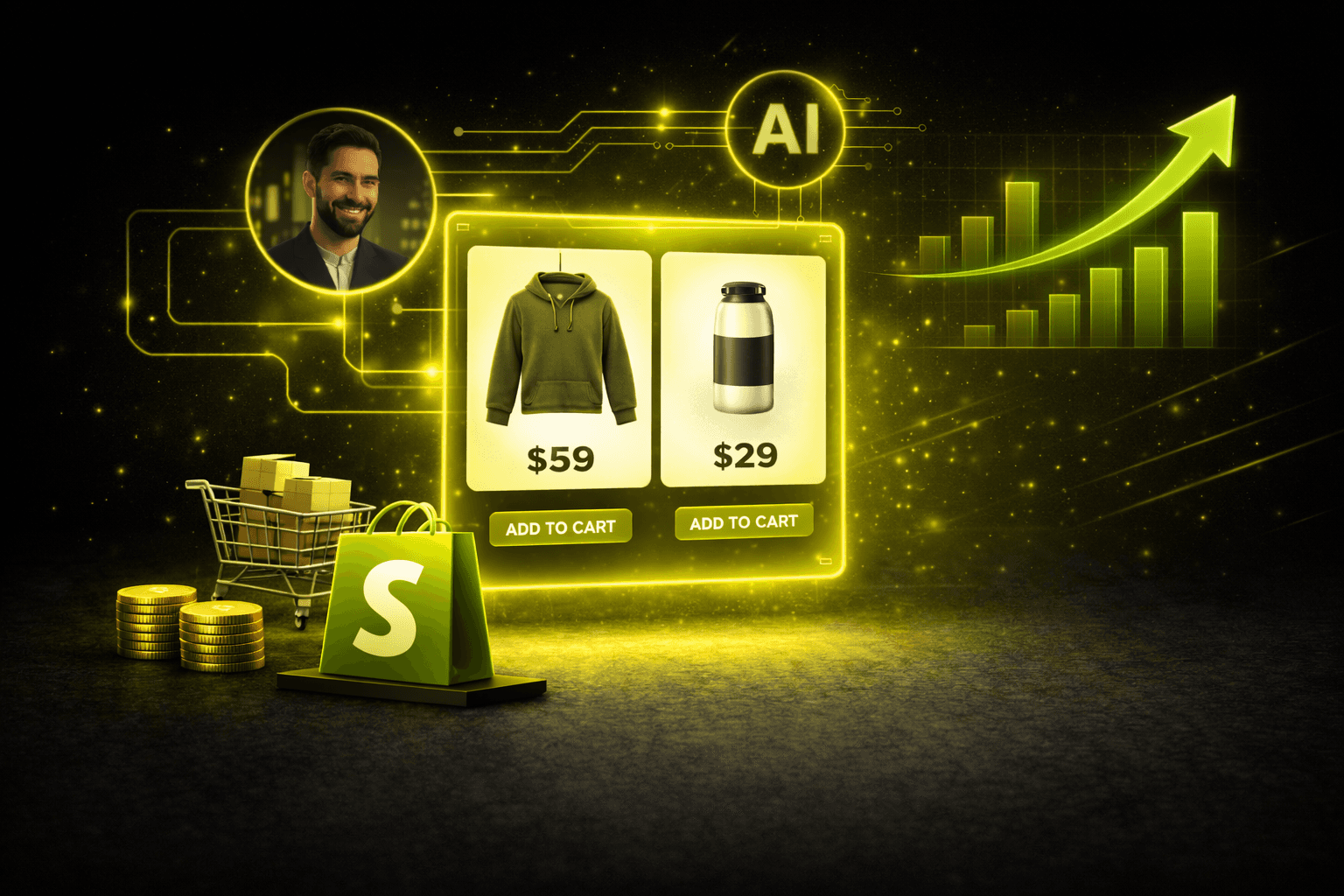
Shopify AI Personalization for Higher Conversions
Why Personalization Is Becoming a Core Conversion Lever in Shopify
Most Shopify stores still operate on a static storefront model.
Every visitor sees:
the same homepage
the same product recommendations
the same promotions
the same email messaging
But ecommerce customers do not behave the same way.
A first-time visitor browsing casually behaves very differently from a returning customer who has purchased multiple times.
Showing both visitors the same experience limits conversion performance.
AI personalization solves this problem by dynamically adapting the shopping experience based on customer data.
Instead of a generic storefront, the store becomes behavior-aware.
Examples include:
personalized product recommendations
dynamic homepage content
AI-driven search results
personalized offers
tailored email messaging
For Shopify brands scaling revenue, personalization is increasingly one of the most reliable ways to improve conversion rates without increasing traffic costs.
The Data Layer That Enables AI Personalization
AI personalization depends on structured customer data.
The more data available, the more accurate the personalization becomes.
Key data inputs include:
Data Type | Example Signals |
|---|---|
Behavioral data | pages viewed, products browsed |
Purchase history | previous orders |
Customer attributes | location, device type |
Engagement data | email clicks, time on site |
Session data | traffic source, campaign |
Shopify provides many of these signals natively through:
order data
customer profiles
product interactions
AI tools combine this data to generate personalized experiences in real time.
AI Product Recommendations
Product recommendation engines are the most widely implemented form of AI personalization.
Instead of showing generic “related products,” AI systems analyze customer behavior and suggest items with the highest probability of purchase.
Recommendation models often use techniques such as:
collaborative filtering
purchase pattern analysis
behavioral similarity modeling
Common recommendation types include:
Recommendation Type | Placement |
|---|---|
“Frequently bought together” | product pages |
“Customers also viewed” | product pages |
“Recommended for you” | homepage |
“You may also like” | cart pages |
These recommendations increase product discovery and encourage larger baskets.
Conversion Impact of AI Recommendations
Recommendation engines typically influence several key metrics:
Metric | Impact |
|---|---|
Conversion rate | improved product relevance |
Average order value (AOV) | cross-sell opportunities |
Session duration | increased product exploration |
Product discovery | faster navigation |
Many Shopify brands see meaningful revenue increases simply by improving how customers discover products.
Personalized Search and Product Discovery
Search is one of the most important conversion paths in ecommerce.
Visitors who use search often have higher purchase intent.
AI search systems improve this experience by understanding:
customer behavior
past purchases
browsing patterns
Instead of static keyword results, personalized search systems rank products based on predicted relevance.
Capabilities often include:
typo correction
semantic search
personalized ranking
intelligent filtering
These systems reduce friction for customers who know what they want.
Personalized Homepage Experiences
AI personalization allows Shopify stores to dynamically change homepage content based on visitor profiles.
Examples include:
Visitor Type | Homepage Experience |
|---|---|
first-time visitor | brand introduction and popular products |
returning visitor | previously viewed products |
high-value customer | premium product recommendations |
campaign traffic | campaign-specific landing content |
This type of personalization ensures visitors immediately see content relevant to their interests.
Email and Lifecycle Personalization
Email remains one of the highest ROI marketing channels in ecommerce.
AI enhances email performance by personalizing:
product recommendations
send times
subject lines
messaging tone
For example:
A customer who recently browsed running shoes may receive an email highlighting:
similar running products
complementary accessories
limited-time promotions
AI-driven email personalization increases both engagement and repeat purchases.
Real-Time Behavioral Personalization
Advanced personalization systems operate in real time.
Instead of relying only on historical data, these systems adapt the experience during a browsing session.
Examples include:
adjusting recommendations based on browsing activity
showing targeted popups for exit intent
highlighting products frequently purchased together
Real-time personalization significantly improves conversion probability during active sessions.
Shopify Apps vs Custom Personalization Systems
Shopify brands typically implement personalization using either apps or custom development.
Approach | Advantages | Limitations |
|---|---|---|
Personalization apps | fast implementation | limited customization |
Custom AI systems | fully tailored | higher development cost |
Most Shopify stores use personalization apps because they integrate quickly with existing storefronts.
Enterprise brands sometimes build custom personalization engines connected to their data infrastructure.
Theme vs Headless Personalization Considerations
Personalization strategies depend partly on storefront architecture.
Theme-based stores
Most Shopify themes support personalization apps directly through embedded scripts and widgets.
Headless storefronts
Headless implementations often require custom personalization logic integrated into the frontend framework.
This provides greater flexibility but requires additional development resources.
Cost of Implementing AI Personalization
Personalization tools vary significantly in cost depending on capabilities.
Tool Type | Typical Cost |
|---|---|
Basic recommendation apps | $20–$50/month |
Advanced personalization platforms | $100–$500/month |
Enterprise AI personalization | $1,000+ per month |
For most Shopify brands, personalization tools generate ROI quickly because they increase revenue from existing traffic.
Common Personalization Mistakes Shopify Brands Make
Personalization can significantly improve conversion rates, but poor implementation can reduce effectiveness.
Overpersonalization
Showing overly specific recommendations too early may confuse new visitors.
Early experiences should still highlight popular products and brand identity.
Insufficient Data
Personalization systems require enough behavioral data to make accurate predictions.
Very new stores may not yet have sufficient data volume.
Ignoring UX Simplicity
Adding too many recommendation widgets can clutter the shopping experience.
Personalization should improve navigation, not overwhelm users.
CRO Impact of AI Personalization
Personalization influences several conversion optimization factors.
CRO Lever | Personalization Impact |
|---|---|
Product relevance | better recommendations |
User experience | smoother navigation |
Basket size | effective cross-sells |
Repeat purchases | stronger retention |
Because personalization improves how customers discover products, it often increases revenue without increasing marketing spend.
Bottom Line: What Metrics Should Drive Your Shopify Decision?
Personalization investments should be evaluated based on measurable business outcomes.
Key performance metrics include:
Metric | Strategic Importance |
|---|---|
Conversion Rate | Indicates effectiveness of personalization |
Average Order Value (AOV) | Measures cross-sell success |
Customer Acquisition Cost (CAC) | Determines marketing efficiency |
ROAS / MER | Paid marketing profitability |
Contribution Margin | Real profitability per order |
Lifetime Value (LTV) | Long-term customer value |
Refund Rate | Product expectation alignment |
Operational Cost per Order | Operational efficiency |
App Stack Cost | SaaS overhead |
Development Cost vs Payback Period | ROI of personalization investment |
Example scenario:
If AI personalization increases conversion rate from 2.5% to 3.1%, a store with 100,000 monthly visitors generates significantly more revenue without additional marketing spend.
Even small conversion improvements compound quickly at scale.
Forward View (2026 and Beyond)
AI personalization is evolving rapidly within the Shopify ecosystem.
Several structural shifts will shape the next generation of ecommerce experiences.
First, AI-native storefronts are emerging. Instead of static pages, future Shopify stores will dynamically assemble content based on visitor behavior.
Second, first-party customer data will become increasingly valuable. As third-party cookies disappear, Shopify customer data will power personalization engines.
Third, AI assistants will guide customer journeys, recommending products conversationally rather than relying solely on traditional browsing.
Fourth, app consolidation will accelerate. Many personalization capabilities will move from standalone apps into unified marketing and commerce platforms.
Finally, margin pressure in ecommerce will push brands to extract more value from existing traffic.
In this environment, Shopify brands that deploy effective AI personalization systems will convert more visitors, increase average order value, and build stronger customer relationships.
Personalization will shift from a growth experiment to a core infrastructure layer of modern ecommerce operations.
FAQs
When should Shopify brands implement AI personalization?
Personalization becomes most effective once stores have sufficient customer traffic and purchase data to train recommendation systems.
Can personalization slow down a Shopify store?
Poorly implemented scripts may affect page speed, but well-optimized personalization tools are designed to maintain performance.
Does personalization work for small product catalogs?
Yes, but the impact is typically greater for stores with larger product catalogs where product discovery is more complex.
Can personalization increase average order value?
Yes. Personalized product recommendations often encourage cross-selling and larger shopping baskets.
Do Shopify Plus stores use different personalization tools?
Shopify Plus brands often deploy more advanced personalization platforms or custom-built recommendation systems integrated with their broader data infrastructure.
Direct Q&A
What is AI personalization in Shopify?
AI personalization in Shopify uses machine learning and customer data to tailor product recommendations, search results, and marketing messages to individual visitors.
How does personalization improve Shopify conversions?
By showing customers products and content relevant to their interests, personalization reduces browsing friction and increases the likelihood of purchase.
What tools provide AI personalization for Shopify stores?
Many Shopify apps offer personalization features such as AI-powered product recommendations, personalized search results, and dynamic marketing automation.
Does Shopify have built-in personalization features?
Shopify includes some basic personalization capabilities, but most advanced features are implemented through third-party apps or custom solutions.
Is AI personalization expensive for Shopify stores?
Basic personalization apps can start around $20 per month, while advanced enterprise solutions may cost several hundred or thousands of dollars monthly.
INSIGHTS
Expert perspectives on design, AI, and growth.
Explore our latest strategies for scaling high-performance creative in a digital world.
View more