

Shopify
Shopify CRM Integration for Growth Automation
Learn how integrating Shopify with CRM and automation tools improves customer retention, marketing efficiency, and operational workflows.
08 min read
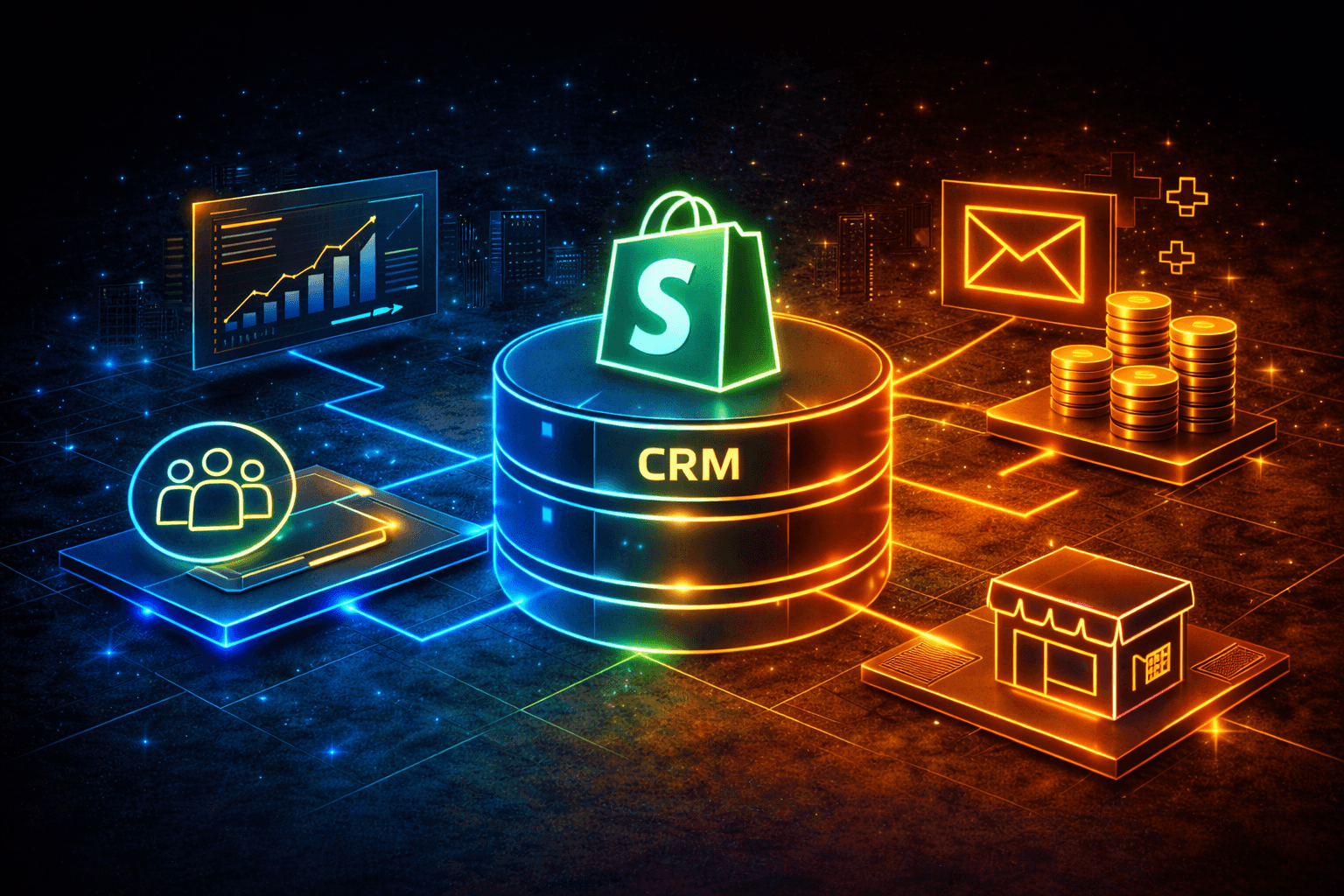
Shopify CRM Integration for Growth Automation
Why Shopify Alone Cannot Manage Customer Relationships at Scale
Shopify is an excellent commerce engine.
It manages:
products
orders
payments
fulfillment
basic customer records
However, Shopify was never designed to operate as a full customer relationship management system.
As brands scale, customer data becomes fragmented across multiple systems:
email marketing platforms
customer support tools
advertising platforms
loyalty programs
SMS marketing systems
This fragmentation creates operational blind spots.
Marketing teams cannot see the complete customer lifecycle. Support teams lack behavioral context. Growth teams struggle to segment customers accurately.
Integrating Shopify with a CRM and automation stack consolidates this data into a unified system, enabling brands to manage customer relationships strategically rather than transactionally.
What Shopify CRM Integration Actually Means
CRM integration connects Shopify customer data with external systems that manage marketing, support, and lifecycle automation.
This allows brands to synchronize information such as:
Shopify Data | CRM Usage |
|---|---|
Order history | segmentation |
customer lifetime value | retention targeting |
product preferences | personalized marketing |
purchase frequency | lifecycle automation |
customer support interactions | experience management |
When properly implemented, CRM systems transform Shopify from a transactional platform into a customer intelligence engine.
Key Workflows Enabled by Shopify CRM Integration
CRM integration enables automation across several critical business functions.
Customer Lifecycle Marketing
Customer lifecycle automation is one of the most valuable CRM capabilities.
Instead of sending identical campaigns to all customers, CRM systems segment audiences based on behavior.
Examples include:
Segment | Campaign Strategy |
|---|---|
first-time buyers | onboarding campaigns |
repeat customers | loyalty incentives |
high-value customers | VIP offers |
inactive customers | reactivation campaigns |
These targeted campaigns increase engagement and repeat purchase rates.
Sales and Lead Management
Some Shopify brands also generate leads outside the store through:
B2B inquiries
wholesale partnerships
product waitlists
content marketing
CRM systems manage these leads through structured pipelines.
Sales teams can track interactions, assign follow-ups, and manage long-term relationships.
This is particularly valuable for hybrid DTC + wholesale brands.
Customer Support Context
Support teams often lack visibility into a customer’s purchase history.
CRM integrations provide agents with access to:
previous orders
lifetime value
prior support interactions
product preferences
This context allows support teams to deliver faster and more personalized service.
Retention and Loyalty Programs
CRM systems can identify customers most likely to repurchase.
Automation tools can trigger targeted offers such as:
loyalty rewards
replenishment reminders
personalized discounts
These campaigns significantly increase customer lifetime value.
Data Architecture: How Shopify Connects with CRM Systems
Shopify CRM integration typically operates through structured data pipelines.
Core integration layers include:
Layer | Function |
|---|---|
Shopify API | provides order and customer data |
integration middleware | synchronizes data between systems |
CRM database | stores unified customer profiles |
automation engine | triggers campaigns and workflows |
This architecture ensures data flows consistently across the organization.
App-Based CRM Integration vs Custom Data Infrastructure
Shopify brands usually choose between app-based integrations or custom-built systems.
App-Based CRM Integration
Most Shopify stores rely on integration apps that connect CRM platforms with Shopify.
Advantages include:
fast setup
minimal development work
built-in automation templates
Typical implementation time: 1–2 days
Monthly costs generally range from $50 to $300, depending on the CRM platform and automation complexity.
This approach works well for most growing brands.
Custom CRM Data Infrastructure
Large brands often implement custom integrations using APIs and data warehouses.
Benefits include:
unified data architecture
cross-platform analytics
deeper segmentation capabilities
However, development costs are significantly higher.
Typical investment includes:
Component | Estimated Cost |
|---|---|
data warehouse setup | $10k–$40k |
integration development | $10k–$30k |
maintenance and updates | ongoing |
Custom systems are typically justified only at larger revenue levels.
Shopify vs Shopify Plus CRM Integration
Shopify Plus offers greater flexibility for CRM integrations.
Capability | Shopify | Shopify Plus |
|---|---|---|
CRM apps | Yes | Yes |
API limits | moderate | higher limits |
checkout data access | limited | expanded |
advanced automation | limited | stronger |
Shopify Plus brands often implement deeper customer data pipelines and complex automation workflows.
Theme-Based vs Headless CRM Considerations
Storefront architecture influences how customer data is captured.
Theme-Based Shopify Stores
Traditional Shopify themes collect customer data through:
checkout forms
account creation
newsletter signups
This data flows directly into Shopify and then into CRM systems.
Headless Shopify Stores
Headless architectures often integrate additional customer data signals such as:
browsing behavior
product interaction events
on-site engagement patterns
These signals enhance CRM segmentation capabilities.
CRO Impact of CRM Integration
CRM integration influences conversion performance indirectly by enabling smarter marketing.
Examples include:
CRO Mechanism | Result |
|---|---|
personalized email campaigns | higher conversion rates |
targeted remarketing audiences | better ad performance |
customer segmentation | more relevant offers |
Instead of broad promotions, brands can target customers with highly relevant campaigns.
Retention and Lifetime Value Improvements
Retention improvements often generate the highest ROI from CRM integrations.
CRM automation enables strategies such as:
replenishment reminders
subscription offers
cross-sell campaigns based on purchase history
These tactics increase purchase frequency and lifetime value.
Operational Efficiency Gains
CRM integration also improves internal operations.
Without CRM systems, teams often rely on manual data analysis to understand customer behavior.
Automation tools can generate:
lifecycle reports
customer segmentation dashboards
campaign performance insights
This reduces manual reporting workload.
Common Implementation Mistakes
Many Shopify brands install CRM tools but fail to extract meaningful value.
Poor Data Structure
If product categories, tags, and customer attributes are inconsistent, CRM segmentation becomes unreliable.
Clean data architecture is essential.
Too Many Automation Workflows
Over-automation can overwhelm customers with excessive messages.
Automation should be carefully structured around key lifecycle stages.
Lack of Cross-Team Alignment
CRM systems affect multiple departments:
marketing
support
sales
operations
If teams operate in isolation, CRM insights remain underutilized.
Ignoring Customer Lifetime Value
Some brands focus only on acquisition metrics while neglecting retention signals.
CRM systems should prioritize long-term customer value rather than single transactions.
Bottom Line: What Metrics Should Drive Your Shopify Decision?
CRM integration should ultimately improve customer economics and operational efficiency.
Key metrics to monitor include:
Metric | Strategic Importance |
|---|---|
Conversion Rate | effectiveness of targeted campaigns |
Average Order Value (AOV) | cross-sell and upsell performance |
Customer Acquisition Cost (CAC) | improved remarketing efficiency |
ROAS / MER | better targeting using CRM data |
Contribution Margin | improved profitability from repeat customers |
Lifetime Value (LTV) | primary metric for CRM success |
Refund Rate | product satisfaction indicator |
Operational Cost per Order | automation efficiency |
App Stack Cost | CRM software expenses |
Development Cost vs Payback Period | ROI of integration infrastructure |
Example ROI logic:
If CRM-driven lifecycle marketing increases repeat purchases by 15–25%, most systems pay for themselves quickly through improved customer lifetime value.
Forward View (2026 and Beyond)
Customer data infrastructure is becoming one of the most important strategic assets for Shopify brands.
Several structural trends are shaping this evolution.
First, first-party customer data will become the foundation of ecommerce marketing as privacy regulations limit third-party tracking.
CRM systems will act as the central hub for this data.
Second, AI-driven lifecycle automation will expand rapidly.
Instead of predefined campaigns, future CRM systems will automatically generate personalized messaging based on behavioral patterns.
Third, commerce and customer service platforms will increasingly merge.
Support teams will gain deeper access to customer profiles and predictive insights.
Fourth, app consolidation will reshape the Shopify ecosystem.
Brands will gradually replace multiple marketing tools with unified CRM-driven platforms.
Finally, margin pressure in ecommerce will force brands to maximize customer lifetime value.
Acquiring customers will continue becoming more expensive.
Brands that combine strong acquisition strategies with CRM-driven retention systems will maintain sustainable growth.
For Shopify operators scaling beyond early growth stages, CRM integration is no longer optional. It becomes a core infrastructure layer for customer intelligence and automation.
FAQs
Can Shopify CRM integrations track customer lifetime value?
Yes. CRM platforms often calculate lifetime value based on purchase history and engagement data.
Do CRM systems help with Shopify email marketing?
Yes. CRM systems often integrate with email automation platforms to trigger personalized campaigns.
Is CRM integration useful for small Shopify stores?
It becomes most valuable once stores begin managing larger customer databases and repeat purchase strategies.
Can CRM tools help with customer segmentation?
Yes. CRM systems allow brands to segment customers based on behavior, purchase history, and engagement patterns.
How long does Shopify CRM integration take?
App-based integrations can often be implemented within a few hours to a few days depending on system complexity.
Direct Q&A
What is Shopify CRM integration?
Shopify CRM integration connects store data with external customer relationship management systems to centralize customer information and automate marketing workflows.
Why do Shopify brands need CRM tools?
CRM systems help manage customer relationships, automate lifecycle marketing, and improve retention through better segmentation.
Can Shopify store data sync with CRM platforms automatically?
Yes. Integration apps and APIs can automatically sync order history, customer profiles, and behavioral data.
Does CRM integration improve Shopify marketing performance?
Yes. CRM-driven segmentation enables more targeted campaigns, which often increase conversion rates and repeat purchases.
Is CRM integration expensive for Shopify stores?
Most CRM integrations cost between $50 and $300 per month, though custom enterprise implementations can cost significantly more.
INSIGHTS
Expert perspectives on design, AI, and growth.
Explore our latest strategies for scaling high-performance creative in a digital world.
View more