

Shopify
Using Heatmaps to Improve Shopify UX
Learn how Shopify brands use heatmaps to improve UX, increase conversions, and identify friction points in product pages, carts, and checkout flows.
08 min read
Using Heatmaps to Improve Shopify UX
Why Shopify UX Problems Are Hard to Diagnose
Most Shopify brands notice UX issues only when conversion rates decline.
But by the time the decline becomes visible in analytics dashboards, the underlying problem may have existed for weeks or months.
Traditional analytics tools such as GA4 provide quantitative data:
page views
bounce rates
funnel drop-offs
However, they rarely explain why users behave the way they do.
Heatmaps fill this gap.
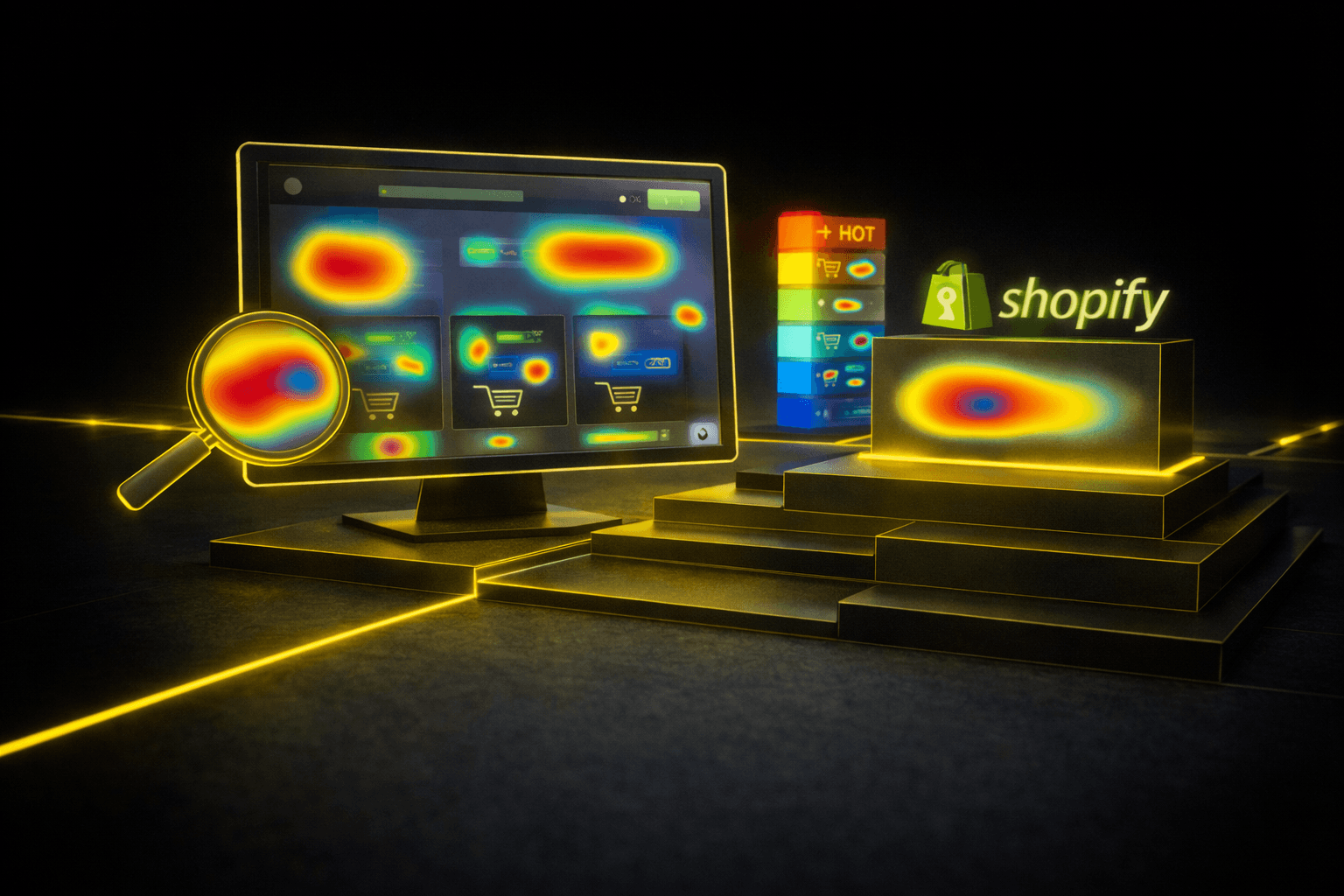
They visualize how visitors interact with a Shopify store by showing:
where users click
how far they scroll
what elements attract attention
which sections are ignored
For Shopify operators focused on conversion optimization, heatmaps provide behavioral insight that raw analytics cannot reveal.
What Heatmaps Actually Show in Shopify Stores
Heatmaps convert user interaction data into visual patterns.
The most common heatmap types used in Shopify UX analysis include:
Heatmap Type | Insight Provided |
|---|---|
Click heatmaps | Which elements users click most frequently |
Scroll heatmaps | How far users scroll down the page |
Move heatmaps | Cursor movement patterns indicating attention |
Rage click detection | Areas where users repeatedly click without response |
These visualizations help teams identify UX friction points that impact conversion rates.
Where Heatmaps Create the Most Value in Shopify Stores
Not every page requires heatmap analysis.
The most valuable insights typically come from three key areas.
Product Page Behavior
Product pages are where customers evaluate whether a purchase is worth making.
Heatmaps frequently reveal issues such as:
customers ignoring product descriptions
users focusing only on product images
low interaction with add-to-cart buttons
confusion around product variants
Example insight:
A scroll heatmap may reveal that 60% of users never reach customer reviews, meaning social proof is placed too far down the page.
Repositioning reviews higher can increase add-to-cart rates.
Cart Page Interactions
Cart pages often contain unnecessary friction.
Heatmaps can reveal whether customers are interacting with:
shipping information links
promo code fields
trust badges
checkout buttons
In some cases, users repeatedly click elements that are not interactive.
These “rage clicks” signal UX confusion that can reduce checkout initiation rates.
Checkout Flow
Checkout abandonment is one of the most expensive problems in ecommerce.
Heatmaps can show whether users struggle with:
shipping option selection
payment method fields
discount code entry
While Shopify restricts some checkout customization (except on Shopify Plus), identifying friction still helps teams prioritize improvements.
Heatmaps vs Traditional Analytics
Heatmaps and analytics tools serve complementary purposes.
Tool Type | Strength |
|---|---|
GA4 / analytics platforms | Quantitative funnel metrics |
Heatmaps | Qualitative behavioral insight |
For example:
Analytics may show:
product page conversion rate = 4%
But it cannot explain why users fail to convert.
Heatmaps may reveal:
add-to-cart button below the fold
customers focusing on product comparison sections
users confused by variant selection
Combining both tools creates a more complete UX optimization framework.
Heatmap Tools Used by Shopify Brands
Several tools are commonly used to generate heatmaps for Shopify stores.
These platforms integrate with Shopify themes to capture user behavior.
Common capabilities include:
click heatmaps
scroll heatmaps
session recordings
user journey visualization
Most tools operate through JavaScript tracking scripts inserted into the Shopify theme.
Implementation typically takes less than an hour.
Cost Considerations for Heatmap Tools
Heatmap platforms vary in pricing depending on traffic volume and feature sets.
Tool Type | Estimated Cost |
|---|---|
Entry-level heatmap tools | $20–$50/month |
Mid-tier behavior analytics platforms | $50–$200/month |
Advanced UX analytics platforms | $200–$500/month |
For most Shopify brands, the cost is relatively small compared to potential gains in conversion rate.
Even a 0.2–0.5% improvement in conversion rate can generate substantial additional revenue.
Using Heatmap Data for Shopify CRO
Heatmaps become valuable when their insights translate into UX improvements.
Operators should treat heatmap findings as hypotheses for CRO experiments.
Improving Product Page Layout
If heatmaps show users focusing heavily on product images but ignoring text descriptions, potential improvements include:
stronger visual storytelling
short benefit-focused bullet points
image annotations highlighting key features
These adjustments align the page structure with user attention patterns.
Optimizing Add-to-Cart Placement
Scroll heatmaps sometimes reveal that the add-to-cart button appears too low on the page.
Possible improvements include:
sticky add-to-cart bars
earlier placement of purchase options
simplified variant selectors
These changes increase purchase momentum.
Simplifying Navigation
Heatmaps occasionally reveal heavy clicking on non-clickable design elements.
This indicates:
misleading UI design
unclear navigation pathways
Improving navigation reduces user frustration and improves engagement.
Theme-Based Shopify Stores vs Headless UX Tracking
UX tracking complexity varies depending on store architecture.
Theme-Based Shopify Stores
Traditional Shopify themes make heatmap integration straightforward.
Most tools require:
inserting a script tag into the theme
activating tracking in the platform dashboard
All user interactions are automatically recorded.
Headless Shopify Architecture
Headless Shopify stores require more careful implementation.
Front-end frameworks such as:
Hydrogen
Next.js
Vue
may require additional configuration to ensure heatmap tools capture:
dynamic page interactions
product variant changes
custom checkout flows
Without proper setup, behavior tracking may miss critical interactions.
Operational Benefits of Heatmap Analysis
Beyond CRO, heatmaps provide several operational advantages.
Faster UX Diagnosis
Instead of guessing why conversion rates decline, teams can visually inspect user behavior.
This shortens the problem identification cycle.
Better Product Page Design
Heatmaps reveal which sections customers actually engage with.
Design teams can prioritize elements that drive purchase decisions.
Reduced UX Testing Costs
Instead of large-scale redesigns, brands can run targeted improvements based on behavioral evidence.
This reduces development costs while improving results.
Common Heatmap Analysis Mistakes
Heatmaps are powerful tools, but they are often misused.
Common mistakes include:
Analyzing Too Little Traffic
Heatmaps require sufficient visitor volume to produce meaningful patterns.
Small sample sizes may lead to misleading conclusions.
Ignoring Device Differences
Mobile behavior often differs significantly from desktop.
Heatmap analysis should always segment by device type.
Acting Without CRO Testing
Heatmap insights should guide experiments, not immediate design changes.
Operators should validate improvements through A/B testing.
Bottom Line: What Metrics Should Drive Your Shopify Decision?
UX improvements should ultimately influence financial performance.
Key metrics include:
Metric | Strategic Importance |
|---|---|
Conversion Rate | Measures store effectiveness |
Average Order Value (AOV) | Revenue per transaction |
Customer Acquisition Cost (CAC) | Cost of acquiring customers |
ROAS / MER | Marketing efficiency indicators |
Contribution Margin | Profitability after variable costs |
Lifetime Value (LTV) | Long-term customer value |
Refund Rate | Product and fulfillment performance |
Operational Cost per Order | Logistics efficiency |
App Stack Cost | Technology overhead |
Development Cost vs Payback Period | ROI of UX investments |
UX optimization initiatives should always be evaluated based on their impact on these metrics.
Forward View (2026 and Beyond)
Shopify UX analytics is evolving rapidly as ecommerce technology advances.
First, AI-powered UX analysis is beginning to interpret heatmap data automatically. These systems identify conversion barriers and recommend design changes without manual analysis.
Second, first-party behavioral data is becoming increasingly important. Privacy restrictions limit third-party tracking, making direct behavioral analytics within Shopify stores more valuable.
Third, analytics stack consolidation is accelerating. Many stores currently rely on multiple analytics tools, but platforms are beginning to combine heatmaps, session recordings, and funnel analytics into unified systems.
Fourth, headless commerce adoption will reshape UX tracking requirements. As more brands move to custom front-end frameworks, behavior tracking must become more sophisticated to capture dynamic user interactions.
Finally, ecommerce margin pressure is forcing brands to optimize conversion efficiency rather than relying solely on paid traffic growth.
In this environment, behavioral analytics tools such as heatmaps will become a standard component of the Shopify growth stack.
Brands that understand how customers actually interact with their storefront will be able to design higher-converting shopping experiences at scale.
FAQs
Do heatmaps slow down Shopify stores?
Most modern heatmap tools use lightweight scripts that have minimal performance impact when implemented correctly.
How much traffic is needed for reliable heatmap insights?
Typically at least several thousand page visits are required to identify meaningful user behavior patterns
Should Shopify brands analyze mobile and desktop heatmaps separately?
Yes. Mobile behavior often differs significantly from desktop interactions, making device-specific analysis essential.
Can heatmaps replace analytics tools like GA4?
No. Heatmaps complement analytics tools by explaining user behavior, while analytics platforms provide quantitative performance metrics.
When should Shopify brands invest in heatmap tools?
Most brands begin using heatmaps once they have consistent traffic and want to focus on conversion rate optimization rather than only increasing traffic.
Direct Q&A
What are heatmaps in Shopify UX optimization?
Heatmaps visualize how visitors interact with a Shopify store by showing where users click, scroll, and move their cursor, helping identify UX friction points.
Why are heatmaps useful for Shopify stores?
They reveal behavioral patterns that traditional analytics tools cannot explain, helping teams understand why visitors abandon product pages or checkout flows.
Where should Shopify stores use heatmaps?
The most valuable areas include product pages, cart pages, and checkout flows, where small UX improvements can significantly impact conversions.
Do heatmaps improve Shopify conversion rates?
Heatmaps themselves do not increase conversions directly, but the insights they provide enable UX improvements that can significantly boost conversion rates.
Are heatmap tools difficult to install on Shopify?
Most heatmap tools require only a small tracking script inserted into the Shopify theme, making implementation quick and relatively simple.
INSIGHTS
Expert perspectives on design, AI, and growth.
Explore our latest strategies for scaling high-performance creative in a digital world.


View more