

Shopify
Shopify Sections That Increase Conversion Rates
Discover the Shopify store sections that materially improve conversion rate, AOV, and merchandising performance—and how to implement them strategically.
08 min read
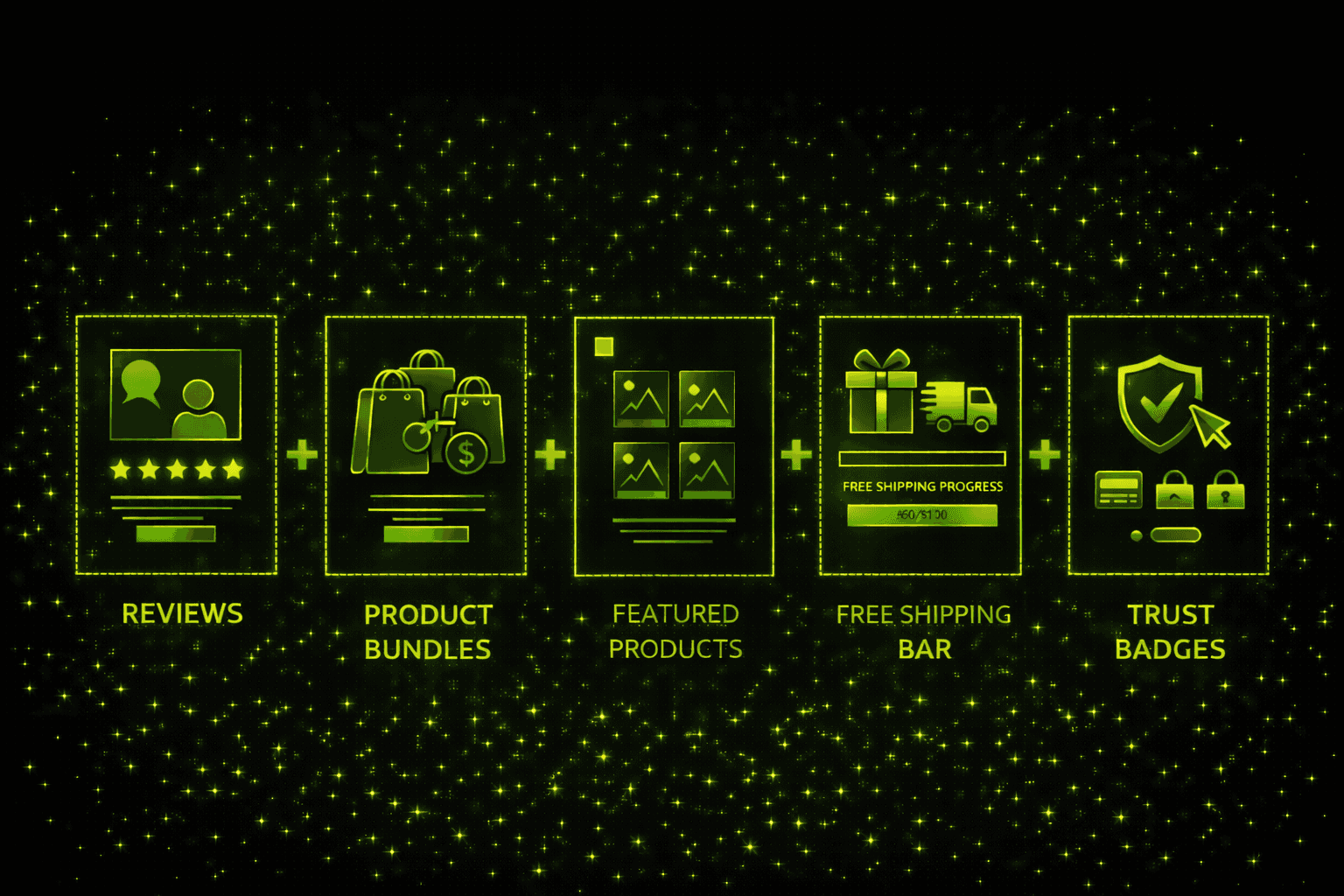
Shopify Sections That Increase Conversion Rates
Why Shopify Section Architecture Directly Impacts Revenue
Most Shopify stores underperform not because of traffic problems—but because the store architecture fails to convert intent into orders.
Sections in Shopify themes are not just design components. They are conversion infrastructure.
The right sections:
Reduce decision friction
Increase product discovery
Reinforce trust signals
Increase cart size
Guide users through a structured buying journey
The wrong section structure creates:
homepage clutter
weak product discovery
poor merchandising hierarchy
lower add-to-cart rates
slower purchase decisions
High-performing Shopify stores treat sections as conversion pathways, not decorative design.
This guide explains the Shopify sections that measurably influence revenue, how to structure them, and when to use apps vs custom development.
The High-Performance Shopify Homepage Structure
Most successful DTC stores follow a similar homepage architecture:
Section | Strategic Role |
|---|---|
Hero Section | Capture attention and communicate brand positioning |
Collection Navigation | Help shoppers quickly find relevant products |
Featured Products | Push high-margin or best-selling SKUs |
Social Proof | Reduce purchase anxiety |
Product Education | Clarify product value |
Bundles / Upsells | Increase average order value |
Trust & Guarantee | Reduce checkout hesitation |
The key principle: Every section must move the customer closer to purchase.
If a section does not serve conversion or merchandising goals, it should not exist.
Hero Section: The Store’s Primary Conversion Gate
The hero section is often misunderstood as branding space. In reality, it is a conversion gateway.
A strong hero section should communicate three things within seconds:
What the brand sells
Who it is for
Why it is worth buying
Critical components:
Clear headline
Supporting value proposition
Primary CTA (Shop Collection)
Secondary CTA (Learn More or Bestseller)
Weak hero sections cause immediate drop-offs.
Common mistakes:
Mistake | Revenue Impact |
|---|---|
Lifestyle imagery without product context | Visitors confused |
No CTA above the fold | Lower product discovery |
Multiple conflicting messages | Decision friction |
Implementation options:
Theme-native section
Best for most stores.
Custom section development
Required when:
dynamic offers change frequently
geo-targeted messaging is needed
personalized merchandising is used
Development cost range:
$300 – $1,500 depending on complexity.
Collection Navigation Section: Reduce Product Discovery Friction
Stores with large catalogs must prioritize collection navigation early on the page.
Why it matters:
Visitors rarely browse randomly. They search for product categories first.
Effective collection navigation sections include:
category tiles
visual navigation blocks
product type filtering
seasonal collections
Example structure:
Category Tile | Purpose |
|---|---|
New Arrivals | Capture returning visitors |
Best Sellers | Promote high-converting SKUs |
Bundles | Increase AOV |
Core Categories | Simplify navigation |
Implementation options:
Theme Section
Most Shopify themes include this.
Custom Development
Required if you want:
dynamic collections
personalized product recommendations
AI merchandising
Custom build cost:
$400 – $2,000.
Featured Product Section: Controlled Merchandising
Featured product sections allow brands to control product visibility.
Without these sections, product exposure relies heavily on navigation and search.
Best use cases:
bestseller products
high-margin SKUs
limited-time launches
hero products
Recommended layout:
Product Grid | Ideal Count |
|---|---|
Desktop | 4 products |
Mobile | 2–4 products |
Key elements:
product rating
price clarity
quick add-to-cart
variant preview
Apps vs Custom:
Approach | When to Use |
|---|---|
Theme built-in | Most stores |
Merchandising apps | Dynamic product ranking |
Custom development | Advanced personalization |
Popular merchandising apps often cost $20–$100/month.
Social Proof Section: Trust Compression
Trust is one of the biggest barriers in ecommerce conversion.
A dedicated social proof section reduces hesitation.
Examples:
customer testimonials
product reviews
UGC content
media mentions
Impact on conversion:
Stores with visible reviews often see higher product page engagement.
Implementation approaches:
Review Apps
Common tools:
Shopify Product Reviews
Judge.me
Loox
Monthly cost range:
$0 – $60.
Custom Integration
Used when integrating:
Trustpilot
Yotpo enterprise
large-scale review databases
Development cost:
$500 – $2,500.
Product Education Section: Reducing Pre-Purchase Questions
Many product pages fail because they assume customers understand the product.
High-performing Shopify stores include educational sections on the homepage or product pages.
Examples:
ingredient breakdown
feature comparison
product benefits
how-to usage guides
This section is critical for:
beauty brands
supplement brands
technical products
high-ticket DTC items
Common format:
Section Type | Use Case |
|---|---|
Comparison table | Show advantages vs competitors |
Step-by-step usage | Reduce hesitation |
Ingredient transparency | Increase trust |
Implementation cost:
$300 – $1,200.
Bundle / Upsell Section: AOV Expansion
Average Order Value growth often comes from intentional bundling sections.
Bundles work best when placed after the primary product section.
Examples:
“Frequently Bought Together”
“Complete the Routine”
“Build Your Kit”
Implementation approaches:
Approach | Pros | Cons |
|---|---|---|
App-based bundling | Quick setup | Monthly cost |
Custom bundle logic | More flexible | Higher dev cost |
Popular bundle apps cost $15–$80/month.
Custom development costs range from $1,500–$5,000 depending on complexity.
Trust & Guarantee Section: Final Conversion Reinforcement
Near the bottom of the page, successful Shopify stores reinforce purchase confidence.
Typical elements:
shipping guarantee
returns policy
payment security
satisfaction guarantee
These reduce checkout abandonment.
Effective format:
Trust Signal | Customer Impact |
|---|---|
30-day returns | Reduces purchase risk |
Secure checkout | Payment confidence |
Fast shipping | Faster purchase decisions |
Implementation cost:
Minimal if theme includes trust badges.
Custom design cost: $200–$500.
App vs Custom Sections: Strategic Decision Framework
Many Shopify founders over-install apps.
This creates app bloat, which leads to:
slower site speed
higher monthly costs
technical conflicts
Decision framework:
Requirement | Best Approach |
|---|---|
Simple section layout | Theme native |
Dynamic merchandising | App |
Complex personalization | Custom development |
Typical cost comparison:
Option | Cost |
|---|---|
Theme section | Free |
App-based section | $20–$80/month |
Custom development | $300–$2,000 |
Over a 24-month period, custom development often becomes cheaper than apps.
Shopify vs Shopify Plus Considerations
For most brands, standard Shopify is sufficient.
However, Shopify Plus allows deeper control over:
checkout extensibility
B2B merchandising
advanced automation
Section strategy differences:
Feature | Shopify | Shopify Plus |
|---|---|---|
Theme sections | Yes | Yes |
Checkout sections | Limited | Advanced customization |
Personalization | Apps | Custom + apps |
If your store generates $5M+ annually, section personalization may justify Shopify Plus.
Bottom Line: What Metrics Should Drive Your Shopify Decision?
Shopify section strategy must be evaluated using performance metrics, not aesthetics.
Key metrics to monitor:
Metric | Why It Matters |
|---|---|
Conversion Rate | Indicates section effectiveness |
Average Order Value (AOV) | Measures bundle/upsell impact |
Customer Acquisition Cost (CAC) | Higher conversions reduce CAC |
ROAS / MER | Shows marketing efficiency |
Contribution Margin | Ensures promotions remain profitable |
Customer Lifetime Value (LTV) | Indicates long-term customer quality |
Refund Rate | Detects expectation gaps |
Operational Cost per Order | Reflects fulfillment efficiency |
Cost considerations:
Cost Area | Typical Range |
|---|---|
App stack cost | $50–$400/month |
Development cost | $500–$5,000 |
Theme upgrades | $200–$500 |
Break-even modeling example:
If a store:
receives 40,000 monthly visitors
improves conversion rate from 2.0% → 2.4%
Revenue increase could be substantial depending on AOV.
Even small improvements justify section optimization investment.
Forward View (2026 and Beyond)
The Shopify ecosystem is evolving quickly.
Several trends will reshape how Shopify sections work.
1. Shopify AI merchandising
AI tools will dynamically reorder homepage sections based on user behavior.
2. Personalization at scale
Future stores will show:
personalized bundles
custom product recommendations
dynamic homepage layouts
3. App consolidation
Many Shopify brands are reducing app stacks to protect:
site speed
operational simplicity
margin control
4. First-party data importance
As ad tracking becomes harder, store architecture must capture:
email
SMS
behavioral data
Sections that drive newsletter signup and loyalty programs will become more important.
5. Retail + DTC convergence
Shopify stores will increasingly support:
omnichannel inventory
retail POS integrations
hybrid commerce experiences
Brands that structure their Shopify store as a conversion engine rather than a brochure will outperform competitors.
FAQs
Do Shopify themes limit how many sections you can add?
Most modern Shopify themes support flexible section layouts, but excessive sections can slow load time and reduce conversion clarity.
Are custom Shopify sections worth the development cost?
For stores generating significant traffic, custom sections often deliver strong ROI by improving merchandising control and reducing reliance on recurring app fees.
Should every Shopify store use bundle sections?
Bundle sections are most effective for consumable products, beauty, supplements, and products that naturally complement each other.
How often should Shopify homepage sections be updated?
High-performing stores refresh sections based on seasonal campaigns, product launches, and merchandising priorities.
Can Shopify sections be personalized for different users?
Yes, but this usually requires apps or custom development using personalization tools and customer segmentation.
Direct Q&A
What Shopify sections improve conversion rates the most?
Hero sections, featured product grids, social proof sections, bundle recommendations, and trust guarantee sections typically produce the largest conversion improvements.
How many sections should a Shopify homepage include?
Most high-performing Shopify homepages use 6–10 strategic sections that guide visitors from brand introduction to product discovery and purchase confidence.
Should Shopify stores use apps for sections?
Apps are useful for dynamic merchandising and bundling, but simple sections should remain theme-native to avoid unnecessary app costs and speed issues.
Where should upsell sections appear on Shopify stores?
Upsell and bundle sections perform best immediately after the main product display or featured product sections where purchase intent is already high.
Do Shopify sections impact SEO?
Yes. Well-structured sections improve internal linking, product discoverability, and engagement metrics, which can indirectly benefit search rankings.
INSIGHTS
Expert perspectives on design, AI, and growth.
Explore our latest strategies for scaling high-performance creative in a digital world.


View more