

Shopify
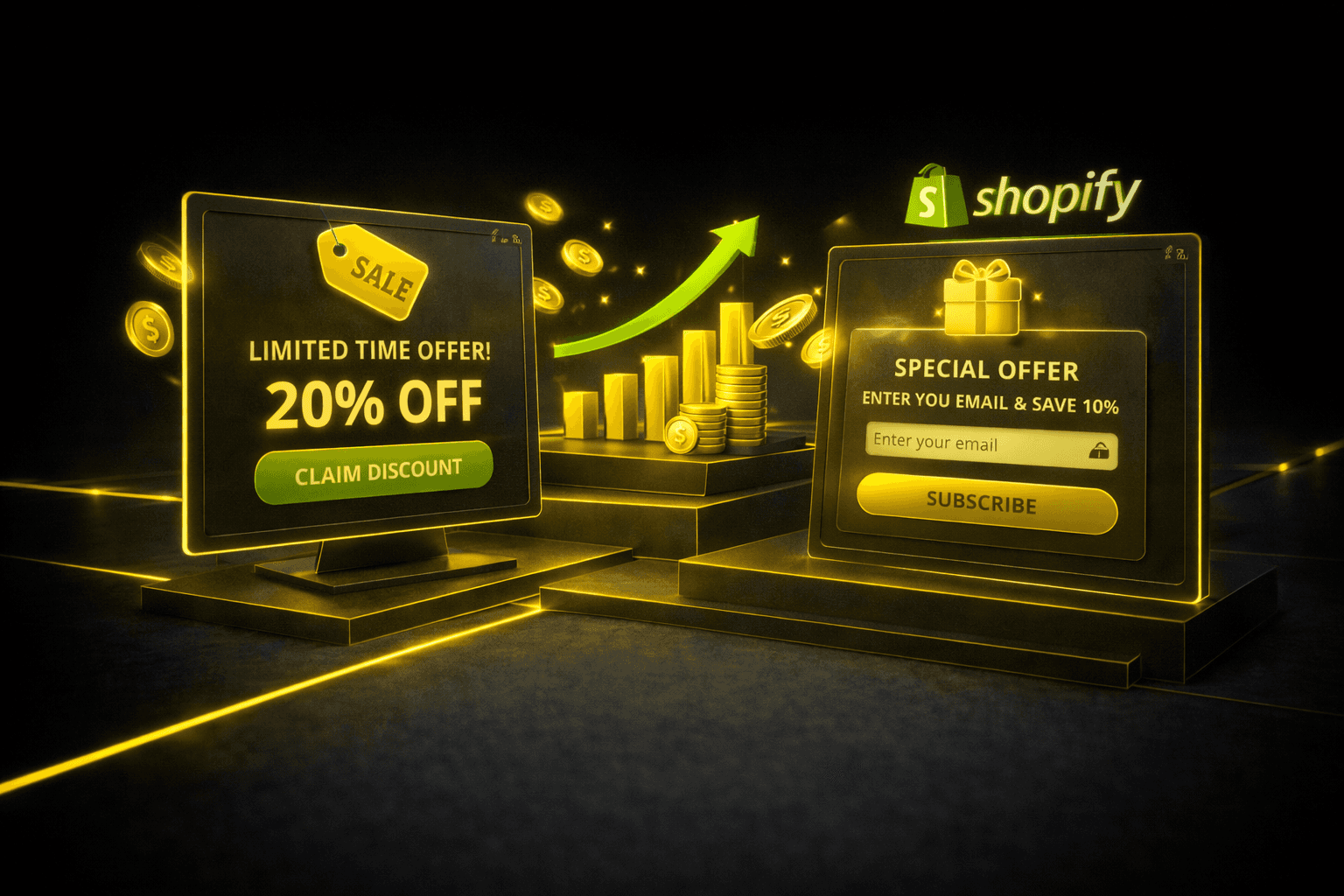
Smart Shopify Pop-ups That Increase Revenue
Strategic guide to Shopify pop-ups that increase conversions, capture emails, and grow revenue without harming UX or slowing your storefront.
08 min read
Smart Shopify Pop-ups That Increase Revenue
Why Pop-ups Still Work on Shopify When Implemented Strategically
Pop-ups often get a negative reputation because many stores deploy them aggressively.
However, when implemented strategically on Shopify, pop-ups can materially improve:
email list growth
conversion rate
average order value
customer retention
campaign ROI
High-performing Shopify brands treat pop-ups as conversion infrastructure, not intrusive marketing widgets.
The key difference is contextual relevance and timing.
Pop-ups should appear when they solve a customer hesitation rather than interrupt browsing.
The Role of Pop-ups in the Shopify Conversion Funnel
Smart pop-ups serve different purposes depending on the stage of the customer journey.
Funnel Stage | Pop-up Objective | Example |
|---|---|---|
Visitor discovery | capture email | newsletter incentive |
Product consideration | reduce hesitation | discount offer |
Cart stage | prevent abandonment | shipping incentive |
Post-purchase | increase LTV | loyalty signup |
This structured use of pop-ups aligns with conversion rate optimization (CRO) rather than generic list-building.
Types of Shopify Pop-ups That Drive Revenue
Different pop-up types influence different revenue drivers.
Exit Intent Pop-ups
Exit intent pop-ups trigger when users attempt to leave the page.
Use cases include:
offering first-time purchase discounts
collecting email addresses
reminding users about abandoned carts
These pop-ups capture value from visitors who would otherwise leave without interacting.
Email Capture Pop-ups
Email capture remains one of the most profitable acquisition channels.
Email pop-ups allow brands to build first-party marketing lists.
Typical incentives include:
10–15% first purchase discounts
early access to product launches
free shipping offers
Email lists also reduce dependency on paid advertising channels.
Cart Abandonment Pop-ups
Cart abandonment rates across ecommerce often exceed 60%.
Strategic pop-ups can recover some of these potential orders.
Common approaches include:
Trigger | Offer |
|---|---|
Cart exit intent | limited-time discount |
Cart idle time | free shipping reminder |
Checkout hesitation | trust reassurance |
These prompts often recover revenue that would otherwise disappear.
Product Recommendation Pop-ups
Recommendation pop-ups can increase average order value (AOV).
Examples include:
bundle suggestions
complementary product upsells
cross-sell recommendations
These prompts help customers discover relevant products they may have overlooked.
Post-Purchase Pop-ups
Post-purchase pop-ups appear after order confirmation.
They are used to:
promote loyalty programs
encourage social sharing
introduce subscription offers
These interactions improve customer lifetime value (LTV) without interfering with the purchase process.
Pop-up Timing Strategy: The Critical Success Factor
Pop-ups fail when they appear too early.
Effective timing depends on behavioral signals.
Trigger Type | Timing Logic |
|---|---|
Scroll trigger | after 40–60% scroll depth |
Time delay | after 10–20 seconds |
Exit intent | when cursor moves toward browser exit |
Cart trigger | when user adds product to cart |
Behavior-based triggers produce better engagement than static timers.
App-Based Pop-ups vs Custom Shopify Development
Most Shopify stores deploy pop-ups using apps.
However, custom implementations can sometimes perform better.
Approach | Advantages | Limitations |
|---|---|---|
Pop-up Apps | fast deployment | recurring cost |
Custom Development | performance control | development resources |
Headless Pop-ups | advanced personalization | engineering complexity |
App-based solutions are sufficient for most stores, but large brands sometimes implement custom logic for greater flexibility.
Performance Impact: Pop-ups and Shopify Page Speed
Poorly implemented pop-ups can slow down storefront performance.
Heavy scripts from marketing tools increase:
JavaScript execution time
page rendering delays
mobile performance issues
This is particularly important because slow pages reduce conversion rates.
High-performing brands regularly audit their app stack performance.
Reducing unnecessary pop-up tools improves both speed and margin.
Personalization: The Future of Shopify Pop-ups
Generic pop-ups convert poorly.
Modern pop-ups should use customer data to personalize messaging.
Examples include:
Customer Segment | Pop-up Strategy |
|---|---|
First-time visitors | discount offer |
Returning visitors | loyalty reminder |
High-value customers | VIP promotions |
Cart abandoners | urgency messaging |
Personalization dramatically improves pop-up engagement rates.
Mobile Optimization for Shopify Pop-ups
Most Shopify traffic comes from mobile devices.
Mobile pop-ups must be carefully designed to avoid friction.
Best practices include:
smaller modal windows
easy dismissal buttons
minimal form fields
Overly aggressive mobile pop-ups often increase bounce rates.
Compliance and UX Considerations
Regulatory compliance also affects pop-up strategy.
Stores must respect:
cookie consent requirements
data privacy regulations
email marketing permissions
Additionally, Google penalizes intrusive interstitials on mobile devices.
Pop-ups should never block critical content.
Shopify Plus and Advanced Pop-up Strategies
Stores running on Shopify Plus often implement more advanced pop-up strategies.
These may include:
behavioral targeting based on customer segments
dynamic discount codes
integrated CRM triggers
Enterprise brands frequently integrate pop-up tools with:
marketing automation platforms
CDP systems
lifecycle marketing campaigns
This turns pop-ups into part of a broader customer acquisition ecosystem.
Implementation Roadmap for Smart Shopify Pop-ups
A structured deployment approach ensures pop-ups support revenue growth rather than disrupt UX.
Step 1: Funnel Mapping
Identify where visitors drop off:
product pages
cart pages
checkout entry
Step 2: Define Pop-up Objective
Each pop-up should solve a specific problem:
Problem | Pop-up Solution |
|---|---|
Visitor leaving | exit intent offer |
No email capture | lead generation pop-up |
Low AOV | product upsell |
Step 3: Test Messaging
Test variations of:
discount levels
CTA wording
visual design
Step 4: Monitor Performance
Measure conversion improvements and list growth.
Continuous optimization improves results over time.
Bottom Line: What Metrics Should Drive Your Shopify Decision?
Pop-up performance should always be evaluated using business metrics.
Metric | Why It Matters |
|---|---|
Conversion Rate | shows impact on purchases |
Average Order Value | measures upsell success |
Customer Acquisition Cost | pop-ups reduce paid ad dependency |
ROAS / MER | improved conversions increase marketing efficiency |
Contribution Margin | discounts must remain profitable |
Customer Lifetime Value | email capture drives retention |
Refund Rate | ensures offers don’t attract low-quality buyers |
Operational Cost Per Order | fewer support queries improve efficiency |
App Stack Cost | pop-up tools add recurring expenses |
Development Cost vs Payback | custom solutions must generate ROI |
Example scenario:
A Shopify store with:
80,000 monthly visitors
2% conversion rate
$90 AOV
Monthly revenue ≈ $144,000
If exit-intent pop-ups recover even 5% of abandoning visitors, incremental revenue can increase meaningfully without additional traffic.
Strategic pop-ups therefore function as revenue recovery mechanisms.
Forward View (2026 and Beyond)
The role of pop-ups in ecommerce is evolving rapidly.
AI-powered personalization
Future pop-up systems will dynamically adapt based on:
visitor behavior
browsing history
purchase probability
AI will automatically optimize messaging and timing.
First-party data dominance
As third-party cookies disappear, pop-ups will become critical for collecting first-party customer data.
Email and SMS capture will remain essential for owned marketing channels.
App ecosystem consolidation
Shopify brands are increasingly reducing the number of apps in their tech stack.
Future pop-up solutions will likely integrate with broader marketing automation platforms.
Real-time commerce experiences
Pop-ups will evolve from static overlays to dynamic messaging layers embedded into the storefront experience.
Examples include:
real-time inventory alerts
live demand indicators
personalized product suggestions
Margin pressure and smarter incentives
As acquisition costs increase, discounts must be used carefully.
Future pop-ups will focus more on:
value-based messaging
product education
loyalty incentives
Brands that treat pop-ups as strategic conversion tools rather than marketing gimmicks will extract the most value from this channel.
FAQs
Are pop-ups bad for Shopify SEO?
Pop-ups do not harm SEO if they do not block primary content or create intrusive mobile experiences.
How many pop-ups should a Shopify store use?
Most stores perform best with two to three strategic pop-ups targeting different funnel stages.
Do Shopify pop-ups work on mobile devices?
Yes, but they must be optimized for small screens and include easy dismissal options.
Should pop-ups always offer discounts?
No. Discounts are effective but can reduce margins. Many brands use value-driven incentives like early access or exclusive content.
Can pop-ups integrate with Shopify email marketing tools?
Yes. Most pop-up tools integrate with email platforms and CRM systems to automate customer follow-up campaigns.
Direct Q&A
Do pop-ups increase Shopify conversions?
Yes. When properly timed and targeted, pop-ups can increase email capture, reduce cart abandonment, and improve overall conversion rates.
What type of Shopify pop-up works best?
Exit intent pop-ups and email capture pop-ups tend to generate the highest impact because they engage visitors who are about to leave the site.
Do pop-ups slow down Shopify stores?
They can if implemented with heavy scripts or multiple apps. Performance-friendly pop-up tools and regular app audits help maintain speed.
When should Shopify pop-ups appear?
Pop-ups should trigger based on user behavior, such as scroll depth, exit intent, or cart actions, rather than appearing immediately on page load.
Can Shopify pop-ups increase email subscribers?
Yes. Many ecommerce brands grow their email lists significantly using well-designed pop-ups with relevant incentives.
INSIGHTS
Expert perspectives on design, AI, and growth.
Explore our latest strategies for scaling high-performance creative in a digital world.


View more