Shopify
08 min read
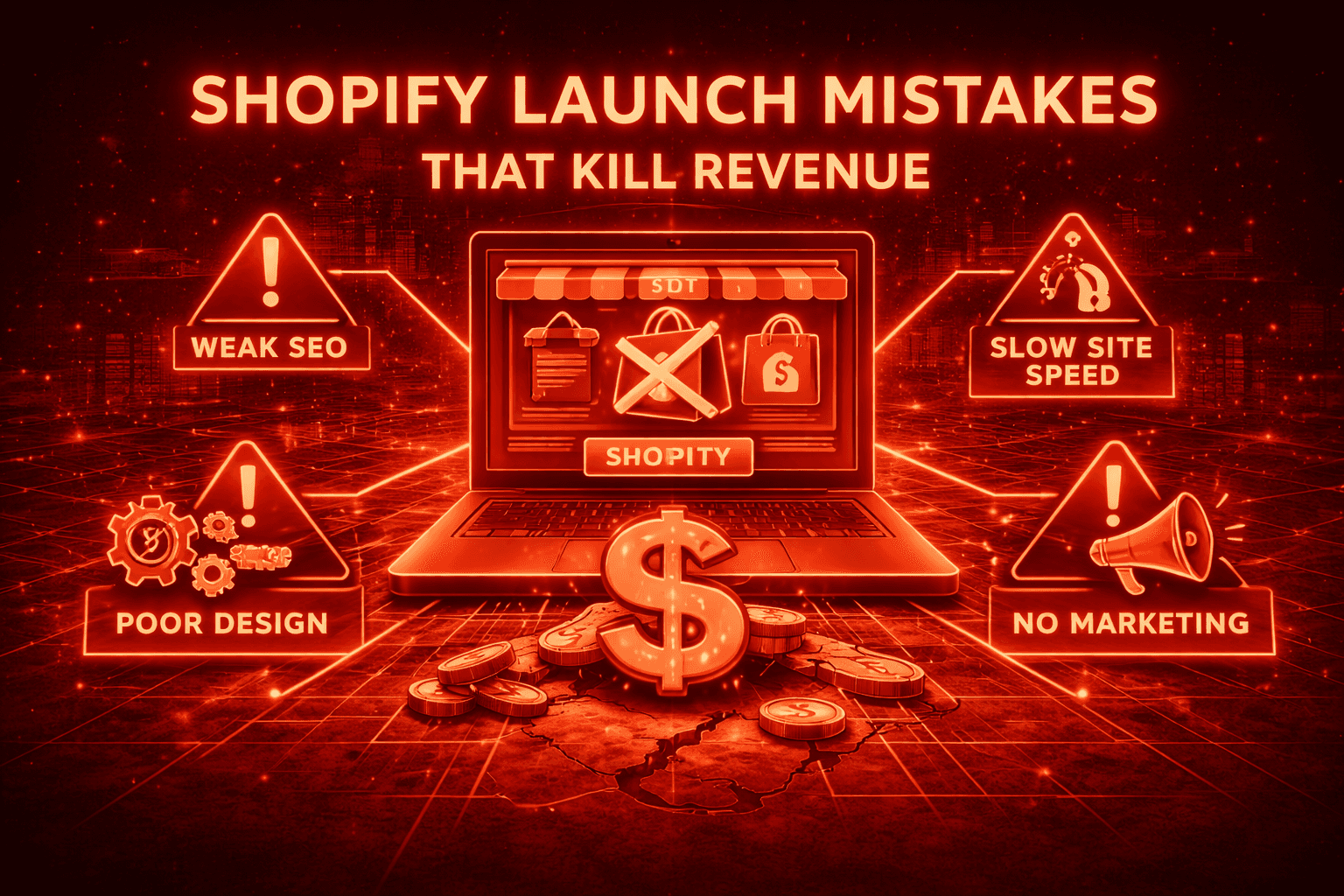
Shopify Launch Mistakes That Kill Revenue
Why Most Shopify Store Launches Underperform
Launching a Shopify store is often treated like a milestone event: build the store, upload products, run ads, and start selling.
But for many brands, the first 90 days post-launch reveal a harsh reality:
Traffic arrives but conversions remain low
Marketing costs escalate quickly
Operational friction slows fulfillment
Customer acquisition costs exceed margins
The problem usually isn’t demand. It’s launch architecture.
Many Shopify stores go live with structural mistakes that limit conversion, reduce discoverability, and increase operational costs.
For founders scaling toward $1M–$20M revenue, the launch phase should focus on building commerce infrastructure, not just a storefront.
Mistake 1: Launching Without a Conversion-Oriented Store Architecture
A visually attractive store is not the same as a conversion-focused store.
Many launches prioritize branding and design but ignore buyer decision flow.
A high-performing Shopify architecture typically follows:
Layer | Role |
|---|---|
Homepage | Brand positioning + navigation entry |
Collection pages | Product discovery |
Product pages | Purchase decision |
Checkout | Transaction completion |
Stores that blur these layers confuse users.
Common launch mistakes include:
Overloaded homepages
Poor collection hierarchy
Hard-to-navigate product categories
Hidden calls-to-action
Before launch, operators should test whether a new user can reach a product and add it to cart within three clicks or fewer.
Mistake 2: Weak Product Page Structure
The product page is where revenue actually happens.
However, many stores launch with incomplete or poorly structured product pages.
Typical issues include:
Minimal product descriptions
Lack of benefits-focused messaging
Few product images
Missing trust signals
A high-converting Shopify product page typically includes:
Component | Purpose |
|---|---|
Clear headline | Immediate product clarity |
Multiple product images | Reduce purchase uncertainty |
Benefit-driven description | Reinforce value |
Reviews and ratings | Social proof |
Visible call-to-action | Encourage purchase |
Launching with weak product pages often results in high bounce rates and low conversion.
Mistake 3: Overloading the Store With Apps
Shopify’s app ecosystem is powerful, but many merchants install too many apps before launch.
Typical early-stage stores run 25–40 apps, often solving overlapping problems.
Every app introduces:
Additional scripts
Page load delays
Potential UI conflicts
This leads to slower page performance and higher monthly operating costs.
Example comparison:
Scenario | Apps Installed | Monthly Cost |
|---|---|---|
Lean stack | 10–12 apps | $120–$200 |
App-heavy store | 30+ apps | $400–$800 |
Performance also suffers.
Stores should prioritize only revenue-impacting apps at launch:
Reviews
Email capture
Upsells
Analytics
Additional functionality can be added later as the business scales.
Mistake 4: Ignoring Site Speed Before Launch
Page speed is one of the most overlooked launch factors.
Slow stores lead to:
Higher bounce rates
Lower mobile conversions
Poor SEO performance
Common causes of slow Shopify stores include:
Large product images
Heavy themes
Excessive third-party scripts
Too many apps
Speed optimization actions before launch include:
Compressing images
Testing mobile performance
Removing unnecessary scripts
Limiting apps
Fast stores consistently convert better than slow ones.
Mistake 5: Poor Collection and Navigation Structure
Collections drive both SEO traffic and browsing behavior.
Yet many stores launch with poorly structured collections.
Common issues include:
Too many collections with little differentiation
Unclear naming conventions
No category descriptions
Lack of filtering options
A well-structured collection strategy helps customers find products quickly.
Example structure:
Home
→ Men's Clothing
→ T-Shirts
→ Product Page
Collections should represent real shopping categories rather than internal product organization.
Mistake 6: Weak Product SEO Setup
Many Shopify launches ignore search visibility.
Product pages often lack:
Optimized titles
Meta descriptions
Structured URLs
Image alt text
Example optimized product URL:
/products/organic-cotton-black-tshirt
Without proper SEO setup, stores depend entirely on paid traffic.
Organic search should become a long-term acquisition channel.
Early SEO optimization compounds over time.
Mistake 7: Incomplete Checkout Optimization
Even with strong product pages, checkout friction can destroy conversion rates.
Common launch mistakes include:
Limited payment methods
Hidden shipping costs
Mandatory account creation
Complicated checkout forms
Best practices include:
Guest checkout enabled
Multiple payment options
Clear shipping policies
Transparent delivery timelines
Checkout should remove friction, not introduce new decisions.
Mistake 8: No Data Tracking or Analytics Setup
Some stores launch without proper analytics infrastructure.
Without data visibility, operators cannot diagnose performance problems.
Essential tracking tools include:
Tool | Purpose |
|---|---|
Analytics platforms | Traffic and conversion tracking |
Advertising pixels | Campaign performance |
Heatmaps | User behavior insights |
Without proper tracking, marketing spend becomes difficult to optimize.
Launching without analytics is equivalent to operating blind.
Mistake 9: No Merchandising Strategy
Many Shopify stores treat product placement as static.
But high-performing stores actively manage merchandising.
Examples include:
Best seller collections
Seasonal product highlights
Bundled product offers
Dynamic merchandising increases both conversion and average order value.
Mistake 10: Launching Without a Retention Strategy
Acquiring customers is expensive.
Yet many stores launch without retention systems in place.
Retention infrastructure typically includes:
Email capture forms
Abandoned cart automation
Post-purchase follow-ups
Without these systems, stores lose valuable repeat revenue opportunities.
Retention is often the largest profit lever in eCommerce.
Bottom Line: What Metrics Should Drive Your Shopify Decision?
Launch success should be evaluated using commerce performance metrics rather than vanity metrics.
Key metrics include:
Conversion Rate
Most Shopify stores convert between 1.5% and 3%. Early optimization should focus on improving this baseline.
Average Order Value (AOV)
Bundles, upsells, and merchandising increase revenue per customer.
Customer Acquisition Cost (CAC)
Lower conversion rates drive higher CAC.
Optimized stores reduce marketing cost pressure.
ROAS / MER
Efficient storefronts improve advertising efficiency.
Contribution Margin
Revenue per order must exceed product, fulfillment, and marketing costs.
Customer Lifetime Value (LTV)
Retention strategies increase long-term profitability.
Refund Rate
Clear product expectations reduce return rates.
Operational Cost per Order
Efficient systems reduce customer service and fulfillment complexity.
App Stack Cost
Monthly app costs can easily exceed $500 if not managed carefully.
Development Cost vs Payback Period
Optimizing a store pre-launch typically costs $5k–$15k but can dramatically improve revenue during the first year.
Forward View (2026 and Beyond)
Shopify store launches will evolve significantly over the next few years.
Several ecosystem shifts are already shaping the future.
AI-driven storefront optimization
Shopify is integrating AI tools that assist with merchandising, product descriptions, and personalization.
These tools will reduce manual setup but require structured store architecture.
Automated CRO
Future storefronts will dynamically adapt layouts based on user behavior and intent.
App ecosystem consolidation
Merchants are increasingly replacing multiple small apps with integrated platforms to reduce performance overhead.
First-party data strategies
Privacy changes are pushing brands to build stronger direct customer relationships.
Stores will need better customer data infrastructure.
Retail and DTC integration
Many brands operate across retail marketplaces and direct channels.
Shopify stores will act as the central commerce hub.
Margin pressure
Advertising costs continue rising globally.
Brands that rely entirely on paid traffic will struggle.
Those with strong conversion infrastructure and organic acquisition will maintain stronger margins.
The brands that treat their Shopify launch as strategic infrastructure rather than a simple website launch will build more resilient commerce businesses.
FAQs
How long should Shopify stores prepare before launching?
A well-structured Shopify store launch typically requires 4–8 weeks of preparation, including product setup, design, SEO, and testing.
Is Shopify Plus necessary at launch?
Most stores do not need Shopify Plus initially. Standard Shopify plans support early-stage growth effectively.
What conversion rate should a new Shopify store aim for?
Most stores target a 2%–3% conversion rate initially, though this varies by product category and traffic quality.
Can Shopify stores launch without marketing integrations?
Technically yes, but launching without analytics and tracking tools makes it difficult to measure performance and optimize campaigns.
Should Shopify stores focus on traffic or conversion first?
Conversion optimization should come first. Driving traffic to a poorly optimized store wastes marketing spend.
Direct Q&A
What is the biggest mistake when launching a Shopify store?
The most common mistake is launching without a conversion-focused store architecture, resulting in poor navigation, weak product pages, and low conversion rates.
How many apps should a Shopify store use at launch?
Most successful stores launch with 10–15 essential apps. Installing too many apps slows performance and increases operational costs.
Why is product page optimization critical before launch?
Product pages drive purchase decisions. Weak product content and poor layout reduce conversion rates and increase marketing costs.
Should SEO be set up before launching a Shopify store?
Yes. Early SEO setup ensures product and collection pages begin ranking sooner and reduces reliance on paid traffic.
How important is page speed for Shopify stores?
Page speed directly affects both conversion rate and search rankings, making it one of the most critical launch optimization factors.
insights