

Shopify
Technical SEO Setup for Shopify Stores
A strategic technical SEO setup guide for Shopify stores covering architecture, speed, indexing, schema, and ROI-focused optimization decisions.
08 min read
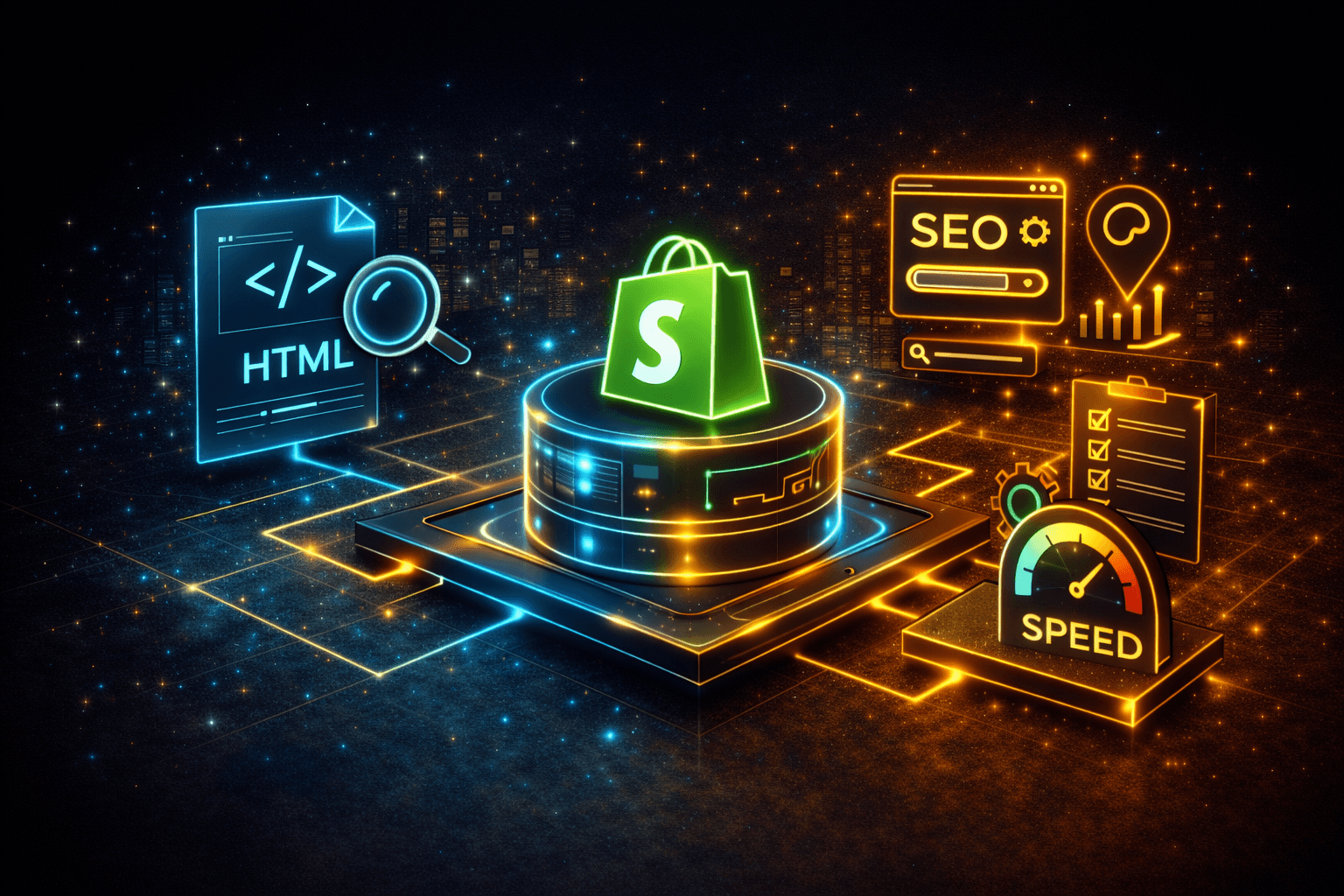
Technical SEO Setup for Shopify Stores
Why Technical SEO Determines Shopify Revenue Performance
Many Shopify stores invest heavily in ads, influencers, and creative assets while ignoring the technical layer that determines whether their store can scale organic acquisition.
Technical SEO is not simply about ranking pages. For Shopify operators, it directly influences:
Product discovery across Google Shopping and organic search
Page speed and checkout friction
Crawl efficiency for large catalogs
Indexing of product and collection pages
Structured data visibility for product listings
Conversion rates driven by performance and UX
Poor technical architecture results in:
Duplicate product URLs
Slow mobile performance
Weak collection ranking
Crawl waste on filters and parameters
Poor structured data eligibility
The outcome is predictable: higher CAC, lower organic revenue share, and heavier dependence on paid traffic.
For Shopify brands aiming to scale from $1M to $20M revenue, technical SEO becomes a margin lever.
Shopify Site Architecture: Structuring for Crawl Efficiency and Ranking
Shopify stores operate on a specific URL architecture that impacts SEO performance.
Default Shopify structure includes:
Page Type | Default URL Structure |
|---|---|
Product | /products/product-name |
Collection | /collections/collection-name |
Blog | /blogs/blog-name |
Pages | /pages/page-name |
While this structure is fixed, operators must optimize hierarchy and internal linking.
Recommended Shopify Collection Architecture
A scalable architecture should follow a category → subcategory → product logic.
Example:
Home
→ /collections/mens-clothing
→ /collections/mens-tshirts
→ /products/black-cotton-tee
This structure improves:
Crawl depth
Internal link equity
Collection keyword targeting
Collection pages should target high-intent category keywords, while product pages target long-tail transactional queries.
Duplicate Content: The Hidden Shopify SEO Risk
Shopify automatically generates multiple product URLs when accessed through collections.
Example duplicate structures:
/products/product-name
/collections/category/products/product-name
Search engines may crawl both versions.
The correct approach is ensuring canonical tags point to the primary product URL.
Shopify automatically includes canonical tags, but operators should still audit:
Collection product links
Internal linking patterns
Pagination behavior
Tools like crawling software can identify duplicate indexing risks.
Large catalogs with 1,000+ SKUs should run quarterly crawl audits.
Shopify Page Speed Optimization: A Direct CRO Lever
Site speed is both an SEO ranking factor and a conversion driver.
For Shopify stores, speed issues commonly originate from:
Excessive apps
Heavy themes
Unoptimized product images
JavaScript bloat
Core Performance Levers
1. Theme Selection
Lightweight themes reduce script load.
Common mistakes include heavily customized themes with redundant scripts.
2. Image Optimization
Large product images increase load times.
Best practice:
Convert images to WebP
Limit hero images
Use responsive image sizes
3. App Stack Discipline
Many Shopify stores accumulate 20–40 apps.
Each app introduces additional scripts.
Operators should conduct app stack audits quarterly and remove redundant functionality.
Example cost impact:
Scenario | App Cost | Performance Impact |
|---|---|---|
25 Apps | $400/month | Heavy JS, slower pages |
12 Apps | $150/month | Faster pages |
Reducing app count improves both page speed and operating margin.
Shopify Structured Data: Unlocking Rich Search Results
Structured data helps search engines interpret store content.
Shopify themes often include basic product schema, but advanced stores should expand this.
Critical schema types include:
Schema Type | SEO Impact |
|---|---|
Product Schema | Enables price, availability, rating display |
Review Schema | Improves CTR through star ratings |
Breadcrumb Schema | Improves site structure understanding |
FAQ Schema | Supports AI answer extraction |
Example product schema elements include:
Product name
Price
Availability
SKU
Review rating
Brand
Rich snippets significantly increase search result click-through rates.
Shopify Technical SEO for Collections: The Real Traffic Engine
For most Shopify stores, collections drive the majority of organic traffic.
However, many stores fail to optimize them properly.
Collection pages should include:
SEO-optimized titles
Category descriptions
Internal links to subcategories
Structured heading hierarchy
Example structure:
H1: Collection Title
H2: Subcategory sections
Internal links to product clusters
Thin collection pages without content struggle to rank.
Adding category copy (150–300 words) improves keyword relevance without harming UX.
Shopify Robots.txt and Crawl Budget Control
Shopify provides limited but useful control over the robots.txt file.
Common crawl issues include:
Tag pages
Filter URLs
Search result pages
These can create thousands of low-value URLs.
Crawl budget optimization ensures search engines prioritize:
Product pages
Collection pages
High-value landing pages
Reducing crawl waste improves indexing speed for new products.
Shopify XML Sitemaps: Ensuring Indexing Efficiency
Shopify automatically generates XML sitemaps.
Typical structure includes:
Products
Collections
Blog posts
Pages
Operators should verify sitemap submission in search consoles and monitor:
Indexing errors
Crawling issues
Excluded pages
Stores with frequent product launches benefit from rapid sitemap discovery.
Theme vs Headless Shopify SEO Considerations
Some growing brands consider headless commerce to gain performance advantages.
Headless setups separate frontend and backend architecture.
Potential advantages:
Faster frontend performance
Custom UX capabilities
Advanced personalization
However, SEO complexity increases.
Challenges include:
SSR rendering requirements
Structured data management
Crawlability configuration
For most brands under $10M revenue, optimized theme-based Shopify setups are more cost-effective.
Typical headless costs:
Setup Type | Estimated Cost |
|---|---|
Theme customization | $3k–$15k |
Headless architecture | $40k–$150k |
Unless performance or UX limitations exist, theme optimization usually delivers better ROI.
Shopify Plus Technical SEO Differences
Shopify Plus stores gain advantages that influence technical SEO indirectly.
These include:
Higher API limits
Advanced automation
Script customization
Checkout extensibility
However, core SEO architecture remains largely the same.
Plus does not change URL structures or indexing rules.
The primary benefits are operational and conversion related rather than technical SEO alone.
Technical SEO Mistakes Shopify Stores Repeatedly Make
Experienced Shopify consultants see the same issues repeatedly.
Common mistakes include:
App overload
Stores installing dozens of apps that slow performance.
Weak collection strategy
No category content or keyword targeting.
Duplicate product URLs
Improper canonical handling.
Ignoring mobile performance
Mobile accounts for most eCommerce traffic.
Thin product pages
Minimal descriptions and missing structured data.
These issues compound over time and reduce organic acquisition potential.
Bottom Line: What Metrics Should Drive Your Shopify Decision?
Technical SEO investments should always be evaluated against measurable commerce outcomes.
Key metrics include:
Conversion Rate
Faster pages and clearer structure increase conversions.
Even a 0.5% improvement can generate significant revenue impact.
Average Order Value (AOV)
Better product discovery through SEO improves cross-category purchases.
Customer Acquisition Cost (CAC)
Organic search lowers dependency on paid media.
Improved rankings reduce blended CAC.
ROAS / MER
As organic revenue increases, paid media efficiency improves.
Higher organic share raises overall marketing efficiency ratio.
Contribution Margin
Reduced paid acquisition improves contribution margin per order.
Customer Lifetime Value (LTV)
Organic discovery often produces higher intent customers.
Refund Rate
Better product content and structured data reduce expectation gaps.
Operational Cost per Order
Efficient SEO reduces paid traffic reliance and improves order economics.
App Stack Cost
Reducing redundant apps lowers monthly expenses and improves performance.
Development Cost vs Payback Period
Technical SEO improvements typically require:
$3k–$10k initial optimization
3–6 month payback through organic revenue growth
Operators should treat SEO as infrastructure investment rather than marketing expense.
Forward View (2026 and Beyond)
The Shopify ecosystem is evolving quickly, and technical SEO strategies must adapt.
Several shifts are already underway.
AI-driven search extraction
Search engines increasingly extract structured answers from well-structured pages.
Stores with strong schema and structured collections will benefit.
Shopify AI integrations
AI tools will increasingly automate product descriptions, search optimization, and merchandising decisions.
However, AI-generated content without structured architecture will not perform well.
Commerce automation
Shopify apps and APIs are increasingly automating merchandising and content generation.
Automation will reduce manual SEO work but increase the importance of technical foundations.
App consolidation
Merchants are moving away from large app stacks toward fewer multi-functional platforms.
This improves performance and reduces operational cost.
First-party data dominance
With privacy changes limiting third-party tracking, organic acquisition becomes even more valuable.
SEO will act as a first-party traffic engine.
Retail + DTC convergence
Brands selling across retail and DTC channels will rely on SEO to support omnichannel discovery.
Margin compression realities
Paid advertising costs continue rising.
Organic acquisition through SEO will become one of the few scalable ways to protect margins.
Brands that invest early in technical SEO infrastructure will outperform those relying solely on paid media.
FAQs
How often should Shopify stores run technical SEO audits?
Growing Shopify stores should run technical SEO audits every 3–6 months, especially if they frequently add products, install apps, or update themes.
Should Shopify brands use headless commerce for better SEO?
Headless setups can improve performance but introduce SEO complexity. For most brands under $10M revenue, optimizing a traditional Shopify theme offers better ROI.
How important are collection pages for Shopify SEO?
Collection pages are often the primary organic traffic drivers because they target category-level keywords with higher search volume.
What is the biggest technical SEO issue for Shopify stores?
App overload is one of the most common issues. Excessive apps slow page speed, add scripts, and degrade both SEO and conversion performance.
Can Shopify stores rank without blogging?
Yes. Many Shopify stores rank successfully using optimized product pages and collections alone. Blogging supports content marketing but is not mandatory for SEO success.
Direct Q&A
What is technical SEO for Shopify stores?
Technical SEO for Shopify refers to optimizing site architecture, page speed, structured data, indexing, and crawlability so search engines can efficiently discover and rank product and collection pages.
Do Shopify stores need technical SEO if Shopify handles SEO automatically?
Shopify provides basic SEO features, but technical optimization is still required. Store owners must manage site structure, page speed, schema markup, internal linking, and app performance.
What is the most important SEO page type on Shopify?
Collection pages typically generate the most organic traffic because they target high-volume category keywords and act as product discovery hubs.
How many apps should a Shopify store run for good performance?
High-performing stores typically run 10–15 essential apps. Stores running 25+ apps often experience slower performance and higher operational costs.
Does Shopify Plus improve SEO performance?
Shopify Plus does not change SEO architecture but enables advanced automation, checkout customization, and operational scaling that can indirectly improve conversion rates.
INSIGHTS
Expert perspectives on design, AI, and growth.
Explore our latest strategies for scaling high-performance creative in a digital world.
View more